Creating Summarization Systems with SUMMA
Horacio Saggion
Department of Information and Communication Technologies Universitat Pompeu Fabra
C/Tanger 122 Barcelona - 08018
Spain
Abstract
Automatic text summarization, the reduction of a text to its essential content is fundamental for an on-line information society. Although many summarization algorithms exist, there are few tools or infrastructures providing capabilities for developing summarization appli-cations. This paper presents a new version of SUMMA, a text summarization toolkit for the development of adaptive summarization applications. SUMMA includes algorithms for computation of various sentence relevance features and functionality for single and multidocument summarization in various languages. It also offers methods for content-based evaluation of summaries.
Keywords:Text Summarization Tools, Applications, Infrastructure
1.
Introduction
Due to the overabundance of textual information on-line, automatic text summarization, the reduction of a text to its essential content (Saggion and Poibeau, 2013) is fun-damental for information systems dealing with textual con-tent. In recent years text summarization research has inten-sified with well known evaluation programmes promoting the interest in the area (Owczarzak and Dang, 2010; Over et al., 2007; Giannakopoulos et al., 2011; Giannakopoulos and Petasis, 2013). In this context, comparison of different summarization approaches, which is usually done by rely-ing on well established or widely used or accessible sys-tems such as MEAD (Radev et al., 2004), is of paramount importance in text summarization. However, MEAD only provides few summarization functionalities or features such as a position-based feature, a centroid-based feature, and a first-sentence similarity feature which could be limited for comparison purposes. Availability of customizable Natural Language Processing (NLP) systems, and not only ready-made applications, is also important for teaching NLP at university. In this paper we present a new and improved version of the SUMMA toolkit (Saggion, 2008), a library and GATE plug-in (Maynard et al., 2002) which can be used to implement different summarization solutions, mak-ing it ideal for the creation of baseline and advanced sum-marization systems. SUMMA can also be used as a teach-ing aid in NLP, in fact it is beteach-ing used as a teachteach-ing tool at Universitat Pompeu Fabra to demonstrate theoretical and practical concepts in a NLP course and to facilitate the de-velopment of NLP laboratory assignments.
2.
Related Work
Research on text summarization has progressed steadily in recent years, however, and contrary to what occurs with NLP tools such as parsers, named entity recognizers, POS taggers, etc. which can be obtained from well known
pack-ages such as GATE1, OpenNLP2, Stanford CoreNLP3, etc. there are no many softwares providing summarization ca-pabilities. There are many text summarization systems re-ported in the literature (Mihalcea and Tarau, 2004; Erkan and Radev, 2004; Plaza et al., 2008; Litvak and Last, 2008), however there are few systems which allow one to cre-atetext summarization solutions adapted to new domains, text types, or genres. The MEAD system (Radev et al., 2004) is a well known example of a tool which has been widely used for comparison purposes, however it has fewer components and customization possibilities than SUMMA. Compendium (Lloret, 2012) is a text summarization archi-tecture which includes components for relevance computa-tion and redundancy removal, however apart from an on-line demo, it is not freely available. Several systems used in international evaluation programs – Cortex (Boudin and Moreno, 2007) or Classy (Conroy et al., 2005), etc. – are generally used locally within an specific organization.
3.
Refining SUMMA
SUMMA is a set of text summarization resources for the development of text summarization applications. It has been implemented using the GATE API and relies on GATE documents, GATE annotations, and other data-structures for information storage and retrieval. Since 2010, several improvements have been made to SUMMA including the development of new components and better parametriza-tion of existing ones. SUMMA has been used since 2010 in different projects and evaluation programmes including the TOPAS Project4(patent summarization in English, French and German), the INEX evaluations5, the DEFT
evalua-1
http://gate.ac.uk 2
https://opennlp.apache.org
3http://nlp.stanford.edu/software/
corenlp.shtml 4
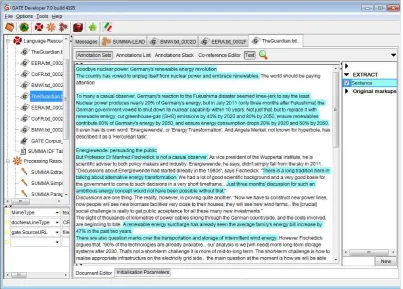
Figure 1: Highlighted Sentences in Document.
tions6, and TAC7. It is currently being used in the Multi-Sensor8project and adapted for the Dr. Inventor project9. It has also been used for comparative evaluation in different research contexts (e.g., (Plaza, 2011), (Lloret, 2012) and (Aker et al., 2013)).
3.1.
Processing Resources
SUMMA contains over twenty processing resources (i.e., implemented algorithms in GATE jargon) which are fully described in the SUMMA website10. Most processing re-sources require tokens (e.g. words) and sentences which can be easily obtained applying the GATE default tokeniser and sentence splitter. Apart from these basic units, some components will also require the computation of named en-tities, which can also be produced by applying the off-the-shelf ANNIE system to the input documents. Processing resources add feature-values to existing annotations or cre-ate new annotation types such as vector representations or n-grams. Summaries in SUMMA are annotations added to the document (see Figure 1). This makes SUMMA flexible enough to allow extraction of units of different granulari-ties such as sentences, paragraphs, or sub-sentential units.
6http://deft2011.limsi.fr/ 7
http://users.iit.demokritos.gr/˜ggianna/ TAC2011/MultiLing2011.html
8
http://www.multisensorproject.eu/ 9
http://drinventor.eu/
10http://www.taln.upf.edu/pages/summa.upf/
Some of the most relevant components for creating summa-rization applications are the following:
• SUMMA NEs Statistics. It computes statistics – term frequency andtf*idfstatistics – for words in the input document. These statistics are stored as features of the words. The component needs as a parameter an in-verted document frequency table also available in the toolkit (see Section 3.2.).
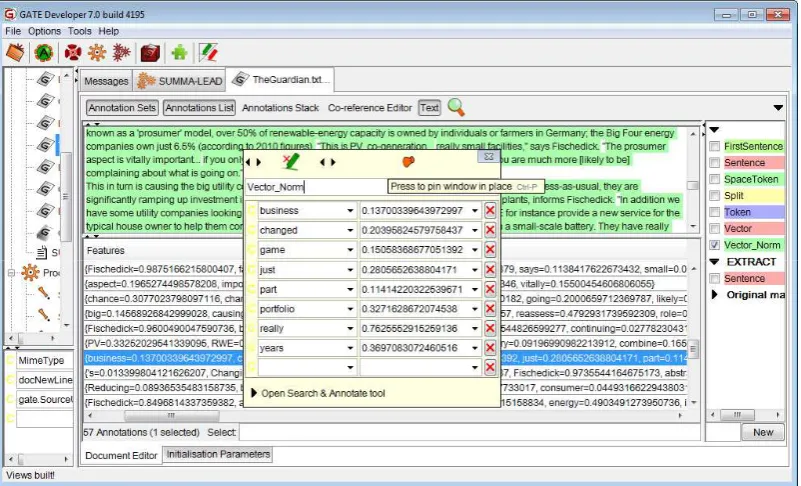
• SUMMA Vector Computation. This module creates vector representations – implemented as feature maps – which contain terms (e.g. words) with associ-ated numerical values representing the weight of the terms. The module is designed to create representa-tions for different document parts such as sentences, paragraphs, titles, full sections or the full document. Term weights can be customized to be frequencies, or
tf*idfvalues, etc. Figure 3 shows a sentence vector computed in a document. In order to compact the rep-resentations, stop word tables can be specified to filter out stop words or specific types of tokens.
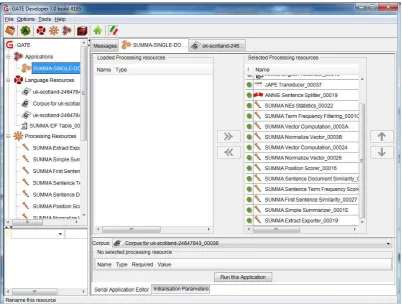
Figure 2: Summarization Application in the GATE GUI.
value we apply thecosineformula to the vector rep-resentations of the sentence and the target textual unit. This component requires vector representations for the sentences and the target unit to compare the sentences to.
• SUMMA Position Scorer. This component is an im-plementation of the classical position feature (Lin and Hovy, 1997) in which sentences receive a relevance based on their positions in the document. Moreover, theSUMMA Paragraph Scorermodule can be used to assess sentence relevance according to the location of the sentence in its paragraph. The weights the sen-tences receive can be customized.
• SUMMA Cue Phrase Scorer. This resource is a cue-based relevance feature computation procedure (Paice, 1990). In order to use it, a cue-phrase list which con-tains ”important” words and their weights is needed (see 3.2.). The weight of the sentence will be propor-tional to the sum of weights of the important words it contains.
• SUMMA Query Method Scorer. This component im-plements a query-based summarization feature which scores sentences based on the similarity of a sentence to an input query (Tombros et al., 1998; Saggion et al., 2003). The query – a parameter of the component – is in fact a document which should have a single vector annotation representing the whole query; this query
vector is compared to each sentence vector in the in-put document using the cosine function to produce a relevance feature.
• SUMMA Term Frequency Scorer. This component implements a relevance scoring function based on weights associated to the terms in the sentences, these could betf*idfor any other statistic. A normalized rel-evance is produced after all sentences have been pro-cessed in order to obtain relevance values in the inter-val(0..1).
• SUMMA Semantic Scorerimplements a relevance fea-ture for the sentence that is proportional to the num-ber of named entities and types the sentence contains. The types of the named entities to be considered can be customized.
Figure 3: Vectors in a Document Processed by SUMMA.
• SUMMA Centroid. In order to support multi-document summarization functionalities SUMMA im-plements acentroid computation procedure for a set of documents (i.e., a corpus in GATE) (Saggion and Gaizauskas, 2004). The centroid, which is the aver-age of all document vectors in the corpus is stored for further processing.
• SUMMA Sentence Centroid Similarity. This module computes the similarity of each sentence in a docu-ment to the centroid of a set of docudocu-ments. Here again, the comparison is based on the cosine function.
• SUMMA Simple Summarizer is a module which per-forms the final sentence scoring computation. It can be customized to indicate which features and associated weights will be used to score sentences. This compo-nent is also in charge of selecting the top ranked sen-tences according to the compression parameter, create the annotations for the summary, and eventually create an independent document for the generated summary. A flag can be used to score sentences only which is relevant for multi-document summarization.
• SUMMA Simple Multi-document Summarizerhas sim-ilar functionalities to the above, but it operates over a set of related documents which sentences have already being scored. It selects top ranked sentences from the set of documents filtering out redundancy. The sen-tences selected from each document are annotated and
a new document created with them. To avoid incoher-ence all sentincoher-ences from the same document will appear together in the multi-document summary. The order in which the sentences appear in the summary will be that of the sentences in the input documents.
Some additional resources include a summary exporter to save summarization results to disk, a random summarizer, a vanilla multi-document summarizer, a term filtering mod-ule, and a random summarizer. Figure 2 shows SUMMA components pipelined in a summarization application in the GATE development environment.
3.2.
Language Resources
SUMMA implements language resources needed by sev-eral of its components. For example in order to perform sta-tistical analysis, SUMMA relies on inverse document fre-quency (idf) tables (Salton and McGill, 1983) which can be created from external resources or directly with a SUMMA component. The table of inverted document frequencies is a text file which first line contains the number of docu-ments (num docs) used to compute the idf statistics, and then each line contains a word (w) from the corpus to-gether with the number of documents where the word oc-curs (count(w)). Below is an example of idf table for Span-ish:
298
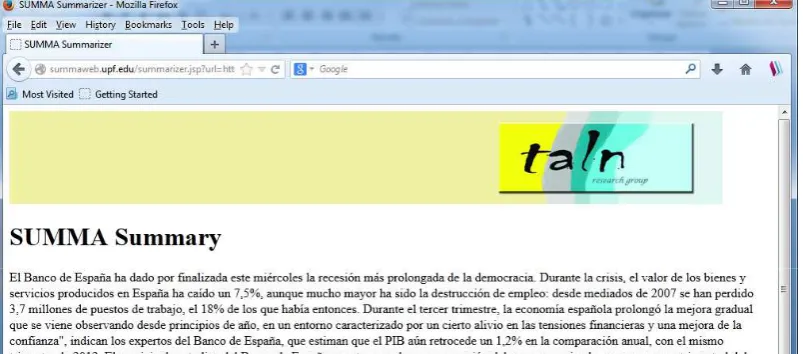
Figure 4: Summarization Application on the Web (http://summaweb.upf.edu/).
abandonada 1 Margaret 2 sardina 1 delictivo 1 ....
For idf computation of a wordwwe use the following stan-dard formula:
idf(w) = log2(num docscount(w))
The default value for words not appearing in the table is one. The table itself can be generated by any program, however SUMMA contains a module which can be used to produce such a table from a pre-processed corpus. This module allows the user to adapt the word characteristics – for example restricting the counts to: (i) the original words of the document; (ii) their lemmas; or (iii) any normalized version of the word (e.g. lowercased).
Tables for stop words and stop categories are also im-plemented to support term filtering functionalities which are needed to create more compact vector representations. They are files containing one word per line as shown below.
ser estar les el la los ...
A table of stop categories may be used to filter out some specific words from vector representations such as num-bers, symbols, or any other non-word.
In order to implement our cue phrase component, a ”cue” word lists has to be implemented relying on a Gazetteer lists implementation available in GATE. One example list in the precise format required by SUMMA is shown below:
presents:count=10 discusses:count=5 shows:count=5 ....
The list contains the cue word or expression and acount
feature together with a value used to weight words in the cue-based method.
4.
Applications
4.1.
Web Applications
Summarization applications to support single document summarization of news articles in Spanish, English, and Catalan have been developed and deployed in a server. The interface can be seen athttp://summaweb.upf. edu/and the result of summarizing a document in Spanish can be appreciated in Figure 4. This application can create standalone summaries or sentence highlights.
4.2.
Customizable Command Line Apps
In addition to the basic building blocks to create NLP pipelines, two readymade applications implemented as script programs are made available for single and multi-document summarization. These applications can be easily customized by setting up a fixed number of parameters in the script files. Example input texts are also provided to test the applications.
4.3.
Java Demonstrators
The distribution of SUMMA includes two stand-alone pro-grams to startprogrammingwith SUMMA. One program is designed to help developers in the integration of process-ing resources from SUMMA in a corpus pipeline. A sec-ond program illustrates how a full GATE application which contains resources from SUMMA can be loaded and exe-cuted over a document in order to extract a summary from it. One point one has to keep in mind when developing an application with SUMMA is that documents may need to be pre-processed before they can be summarized. For example Web pages will usually need to be cleaned-up of non-textual material in order to obtain reasonable output. This means that additional logic is usually needed to extract and isolate the text from the document before a SUMMA application can summarize it.
5.
Evaluation in SUMMA
The GATE system provides resources for the computation of inter-annotator agreement, precision, recall, and f-score which could be used to compare sentences selected by a summarization system to sentences selected by humans, however, automatic evaluation in summarization is usually reported in the literature in terms of values of content-based measures (Lin, 2004; Saggion et al., 2010). The ROUGE package is thede factoevaluation tool used when reporting evaluation in summarization research. SUMMA does not integrate the ROUGE package but it implements some of its functionalities. The module to compute ROUGE statistics in SUMMA is calledSUMMA Rouge Evaluationand can be used to compare the sentences selected by a SUMMA sum-marizer (e.g. annotations) with a corpus of ideal abstracts provided as input. It can also be used to compare one in-put text (a system summary) to a set of ideal summaries. The component can be customized to select the size (e.g., 1, 2, 3, 4) and type (e.g., only words, only lemmas) of the n-gram to be used in the computation of ROUGE values.
6.
Teaching Summarization
We have used SUMMA as a teaching tool to cover in prac-tical sessions automatic text summarization. In the theoret-ical part of the course a number of classic sentence
rele-vance features are introduced in addition to adrele-vanced sum-marization techniques, additionally several sumsum-marization applications on the Web are demonstrated including one de-veloped with SUMMA. In the practical sessions we match theory with practice. The tool is first used in a tutorial where the students interact with the tool creating a summa-rization application using the GATE GUI. In this tutorial session they follow the teacher who indicates how the dif-ferent component should be customized and pipelined in an application. After adding a new component to the applica-tion they test it and observe the new features added and/or annotations created. At the end of the tutorial they are able to create a simple but complete application. In a second session they are asked to create from scratch two “portable” summarization application, one for English and another one for Spanish. They are given precise instructions of how they should be customized (e.g., features to combine, compres-sion). The applications which are appropriately saved are used in a standalone Java program to summarize English or Spanish input.
7.
Software Distribution and Installation
The SUMMA software is distributed through a dedicated website at http://www.taln.upf.edu/pages/ summa.upf/. The site includes all documentation on processing resources required to use the software as well as Java examples of how to create standalone applications. The installation procedure is very simple, it only requires the user to copy the distribution directory to disk. Within GATE the software can be loaded as a plug-in.8.
Closing Remarks
In this paper we have presented a new version of SUMMA, a library of summarization components freely available for research purposes. This new version has been improved by making the components customizable in as much as pos-sible, additionally a website dedicated to its distribution, documentation, and support has been created. Before this new release, SUMMA was only available by requesting a copy of the library.
We have used it for developing basic and advanced sum-marization systems in different languages and for differ-ent summarization tasks such as generic or query focused summarization, single or multi-document summarization, patent summarization, etc. Baseline summarization sys-tems are easy to create by using one of the many relevance summarization feature computation modules (e.g., position, term frequency, title similarity). SUMMA is easy to in-stall and use provided the user has some experience with the GATE system. The SUMMA website offers full docu-mentation and practical examples to start developing appli-cations.
Acknowledgments
Innovaci´on, Spain, and from UPF/PlaQUID Grant number 47 (2011-2012).
9.
References
Aker, A., Plaza, L., Lloret, E., and Gaizauskas, R. (2013). Multi-document summarization techniques for generat-ing image descriptions: A comparative analysis. In Poibeau, T., Saggion, H., Piskorski, J., and Yangarber, R., editors, Multi-source, Multilingual Information Ex-traction and Summarization, Theory and Applications of Natural Language Processing, pages 299–320. Springer Berlin Heidelberg.
Boudin, F. and Moreno, J. M. T. (2007). Neo-cortex: A performant user-oriented multi-document summariza-tion system. In Gelbukh, A. F., editor,CICLing, volume 4394 ofLecture Notes in Computer Science, pages 551– 562. Springer.
Conroy, J. M., Stewart, J. G., and Schlesinger, J. D. (2005). Classy query-based multi-document summarization. In
In Proceedings of the Document Understanding Confer-ence 2005 (DUC 2005) at HLT/EMNLP.
Edmundson, H. (1969). New Methods in Automatic Ex-tracting. Journal of the Association for Computing Ma-chinery, 16(2):264–285, April.
Erkan, G. and Radev, D. R. (2004). Lexrank: Graph-based lexical centrality as salience in text summarization. J. Artif. Int. Res., 22(1):457–479, December.
Giannakopoulos, G. and Petasis, G. (2013). Proceed-ings of the MultiLing 2013 Workshop on Multilingual Multi-document Summarization. Association for Com-putational Linguistics, Sofia, Bulgaria, August.
Giannakopoulos, G., El-Haj, M., Favre, B., Litvak, M., Steinberger, J., and Varma, V. (2011). Tac2011 multi-ling pilot overview. In TAC 2011 Workshop, Gaithers-burg, MD, USA. NIST.
Lin, C. and Hovy, E. (1997). Identifying Topics by Posi-tion. InFifth Conference on Applied Natural Language Processing, pages 283–290. Association for Computa-tional Linguistics, 31 March-3 April.
Lin, C.-Y. (2004). ROUGE: A Package for Automatic Evaluation of Summaries. pages 74–81, Barcelona, Spain, July. Association for Computational Linguistics. Litvak, M. and Last, M. (2008). Graph-based keyword
extraction for single-document summarization. In Pro-ceedings of the Workshop on Multi-source Multilingual Information Extraction and Summarization, MMIES ’08, pages 17–24, Stroudsburg, PA, USA. Association for Computational Linguistics.
Lloret, E. (2012). Text Summarisation based on Human Language Technologies and its Applications. Ph.D. the-sis, Universidad de Alicante, Spain.
Maynard, D., Tablan, V., Cunningham, H., Ursu, C., Sag-gion, H., Bontcheva, K., and Wilks, Y. (2002). Archi-tectural Elements of Language Engineering Robustness.
Journal of Natural Language Engineering – Special Is-sue on Robust Methods in Analysis of Natural Language Data, 8(2/3):257–274.
Mihalcea, R. and Tarau, P. (2004). TextRank: Bringing or-der into texts. InProceedings of EMNLP-04and the 2004
Conference on Empirical Methods in Natural Language Processing, July.
Over, P., Dang, H., and Harman, D. (2007). DUC in con-text.Inf. Process. Manage., 43:1506–1520, November. Owczarzak, K. and Dang, H. (2010). Overview of the tac
2010 summarization track. InProceedings of TAC 2010. NIST.
Paice, C. D. (1990). Constructing Literature Abstracts by Computer: Technics and Prospects. Information Pro-cessing & Management, 26(1):171–186.
Plaza, L., D´ıaz, A., and Gerv´as, P. (2008). Concept-graph based biomedical automatic summarization using on-tologies. InProceedings of the 3rd Textgraphs Workshop on Graph-Based Algorithms for Natural Language Pro-cessing, pages 53–56, Stroudsburg, PA, USA. Associa-tion for ComputaAssocia-tional Linguistics.
Plaza, L. (2011). Towards a methodology for automatic term recognitionThe Use of Semantic Graphs in Au-tomatic Summarization: Comparative Case Studies in Biomedicine, Journalism and Tourism. Ph.D. thesis, Universidad Complutense de Madrid, Spain.
Radev, D. R., Allison, T., Blair-Goldensohn, S., Blitzer, J., C¸ elebi, A., Dimitrov, S., Dr´abek, E., Hakim, A., Lam, W., Liu, D., Otterbacher, J., Qi, H., Saggion, H., Teufel, S., Topper, M., Winkel, A., and Zhang, Z. (2004). MEAD - A Platform for Multidocument Multilingual Text Summarization. InLREC.
Saggion, H. and Gaizauskas, R. (2004). Multi-document summarization by cluster/profile relevance and redun-dancy removal. InProceedings of the Document Under-standing Conference 2004. NIST.
Saggion, H. and Poibeau, T. (2013). Automatic text summarization: Past, present, and future. In Poibeau, T., Saggion, H., Piskorski, J., and Yangarber, R., edi-tors, Multi-source, Multilingual Information Extraction and Summarization, Theory and Applications of Natural Language Processing. Springer.
Saggion, H., Bontcheva, K., and Cunningham, H. (2003). Robust Generic and Query-based Summarisation. In
Proceedings of the European Chapter of Computational Linguistics (EACL), Research Notes and Demos. Saggion, H., Moreno, J. M. T., da Cunha, I., SanJuan, E.,
and Velzquez-Morales, P. (2010). Multilingual summa-rization evaluation without human models. In Huang, C.-R. and Jurafsky, D., editors, COLING, pages 1059– 1067. Chinese Information Processing Society of China. Saggion, H. (2008). SUMMA: A Robust and Adapt-able Summarization Tool. Traitement Automatique des Langues, 49(2):103–125.
Salton, G. and McGill, M. J. (1983). Introduction to Mod-ern Information Retrieval. McGraw-Hill.