R E S E A R C H
Open Access
Spatial correlation-based side information
refinement for distributed video coding
Mohamed Haj Taieb
1*, Jean-Yves Chouinard
1and Demin Wang
2Abstract
Distributed video coding (DVC) architecture designs, based on distributed source coding principles, have benefitted from significant progresses lately, notably in terms of achievable rate-distortion performances. However, a significant performance gap still remains when compared to prediction-based video coding schemes such as H.264/AVC. This is mainly due to the non-ideal exploitation of the video sequence temporal correlation properties during the generation of side information (SI). In fact, the decoder sidemotion estimationprovides only an approximation of thetrue motion. In this paper, a progressive DVC architecture is proposed, which exploits the spatial correlation of the video frames to improve the motion-compensated temporal interpolation (MCTI). Specifically, Wyner-Ziv (WZ) frames are divided into several spatially correlated groups that are then sent progressively to the receiver. SI refinement (SIR) is performed as long as these groups are being decoded, thus providing more accurate SI for the next groups. It is shown that the proposed progressive SIR method leads to significant improvements over the Discover DVC codec as well as other SIR schemes recently introduced in the literature.
Keywords: Distributed video coding; Side information refinement (SIR); Motion estimation; Spatial correlation
1 Introduction
Digital video coding standards have steadily evolved in order to achieve high compression performances using sophisticated, but increasingly complex, techniques for accurate motion estimation and compensation. These compression tasks are typically executed at the encoder, resulting in a high computational load. At the decoder, video sequences can be easily reconstructed by exploiting the motion vectors already computed at the encoder. This computational effort distribution between the encoder and decoder is well suited to common video transfer appli-cations such as broadcasting and video streaming, where powerful encoders are typically used to compress the video sequences only once before sending them to several low-cost computationally limited video decoding devices. However, the emergence of locally distributed wireless surveillance cameras, cellular interactive video devices, and other applications involving several low-cost video encoders have driven recent research efforts towards the
*Correspondence: [email protected] 1Laval University, Quebec, Quebec, G1V 0A8, Canada Full list of author information is available at the end of the article
development of video standards with the opposite com-plexity reallocation between the encoders and decoders. Indeed, high-complexity operations, such as motion esti-mation, need to be done at the decoder side instead of at the encoder. Slepian and Wolf information theoreti-cal results on lossless coding for correlated distributed sources [1] and their extension to lossy source coding with side information at the decoder by Wyner and Ziv [2] con-stitute the theoretical basis for this new distributed video coding paradigm.
Although these theoretical foundations were laid down back in the 1970s, the first actual distributed video coding (DVC) implementations have been proposed in 2002 by Ramchandran et al. [3,4] and Girod et al. [5,6]. Based on these [7], the European Distributed Coding for Video Ser-vices (DISCOVER) consortium [8] have investigated and proposed new DVC coding schemes as well as design tools for improving the rate-distortion performances while addressing practical issues such as scalability and robust-ness against transmission errors.
A critical component of the DVC architecture is the generation of the side information from neighboring key and Wyner-Ziv frames. Discover has adopted a motion-compensated temporal interpolation (MCTI) technique
known as bidirectional motion estimation with spatial smoothing(BiMESS). Despite the improvements achieved with BiMESS interpolation, temporal correlation is still not as fully exploited in distributed video coding as it is in predictive video coding. Motion estimation is performed without knowledge of the original Wyner-Ziv (WZ) frame: it assumes linear motion. Even though this assumption holds fairly well in many cases, for high-speed video sequences, motion may no longer be linear and, in such cases, the interpolation is more likely to fail.
Based on our prior work [9], a novel progressive DVC architecture is proposed to mitigate the limitations of such blind motion estimationand to further explore the intrinsic spatial redundancy of each frame. The proposed side information refinement (SIR) technique works as fol-lows. Each WZ frame is divided into blocks, and the blocks themselves are grouped into two, three, or four spatially correlated sets. The first set of blocks is sent to the receiver and is then used for side information refinement of the second set. The SIR is based on the spatial correlation between the first decoded set and the upcoming second set. Thus, the second set of blocks will require lower bitrates since the side information will be affected with less distortion after the first pass of refine-ment. The SIR process is repeated for the next sets of blocks using all the previously decoded sets, thus ben-efitting more and more from the video frame’s spatial correlation.
The SI refinement is based on motion estimation using various templates composed of the previously recon-structed sets. These templates display a certain level of correlation with the block subject to refinement. To assess the relevance of the proposed technique, this paper first investigates the template ability to ensure the side information refinement. A new metric, termed spatio-temporal correlation factor ρ, is defined to quantify at which extent does the block spatially correlated templates are able to refine the temporal motion estimation using the neighboring frames.
The overall progressive DVC scheme is evaluated by comparing the rate-distortion (RD) performances to the state-of-the-art Discover DVC codec for five Quarter Common Intermediate Format (QCIF) sequences exhibit-ing different camera and motion attributes. The proposed architecture is also compared to recent DVC systems using successively refined side information (Martins et al. [10] and Deligiannis et al. [11]) in terms of the Bjøntegaard metrics [12] (Bjøntegaard delta rate and peak signal-to-noise ratio (PSNR) metrics) according to the non-refined DVC system DISCOVER. It is shown that the proposed progressive SIR method does improve the performances over the system introduced by Martins et al. [10] and Deligiannis et al. [11] for most of the test scenarios inves-tigated in this paper.
This paper is organized as follows. Section 2 describes the Discover codec basic architecture and components. Section 3 presents an overview of the on-going research efforts on alternative techniques for SI generation and side information refinement methods. In section 4, different progressive architectures, allowing for spatial correlation based SIR techniques, are proposed. Section 5 demon-strates the PSNR improvement obtained at each refine-ment stage and the overall RD performance improverefine-ment. A complexity analysis is also presented in this section.
2 Overview of the Discover DVC codec
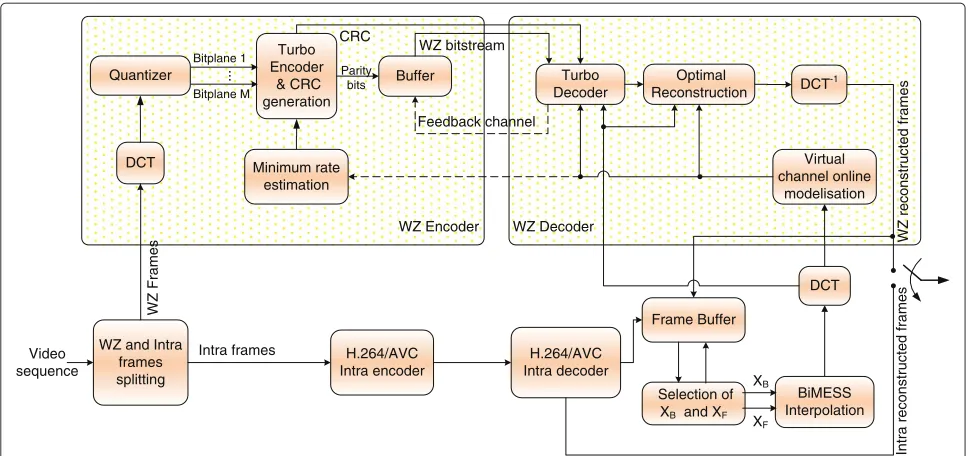
The architecture of the Discover [8] WZ system is depicted in Figure 1. As shown in this figure, the key frames are H.264/AVC intra-encoded (intra-frames) and transmitted to the H.264/AVC intra-decoder which reconstructs the intra-frames and also generates the side information that will be used to decode the Wyner-Ziv frames (inter-frames).
At the Wyner-Ziv encoder, the interframes are com-pressed using an integer 4×4 block-based discrete cosine transform (DCT). The DCT coefficients are then fed to a uniform quantizer, and the bitplanes are extracted. The bitplanes are in turn fed to a turbo encoder with two rate 1/2 recursive systematic convolutional (RSC) encoders. Each RSC associates the parity bits to the bitplanes. To achieve compression, the systematic bits are discarded since the decoder has already an interpolated version of the WZ frames. The parity bits are stored in a buffer and sent gradually, packet by packet, upon decoder feedback requests according to a periodic puncturing pattern. The feedback channel helps in adapting the forward transmis-sion rate to the time-varying virtual channel statistics. The WZ decoding process implies several turbo decoding iter-ations. To alleviate the decoder computational hurdle, an initial number of parity bits packets is estimated by way of a hybrid encoder/decoder rate control mechanism [13]. These parity bits packets are sent once to the decoder, and subsequent packets will eventually be sent afterwards.
Quantizer
WZ Encoder WZ Decoder
Frame Buffer
Figure 1Transform domain Wyner-Ziv video codec (Discover architecture).
correlation noise modeling technique developed by Brites and Pereira [17]: parameterαis estimated for each coeffi-cient of each DCT band. Alternativeon-the-flyestimation methods are proposed in [18] and [19] to track the unpre-dictable and dynamic temporal changes within a video sequence. The correlation noise parameter is refined iter-atively during the decoding instead of pre-estimating this parameter before decoding [17].
The side information, replacing the systematic infor-mation in the turbo decoding process, is thus corrupted by the Laplacian noise whose parameter is, before-hand, online estimated (without using original data). The received parity bits along with the side information are fed to the turbo decoder. After a number of iterations, the log-likelihood ratios are computed and then the bit-plane is deducted. To estimate the decoded bitbit-plane error rate, without knowledge of the original data, these log-likelihood ratios are used to compute aconfidence score [13]. If this score exceeds 10−3, then aparity bitsrequest is sent back to the turbo encoder. Otherwise, the decod-ing process is likely to be satisfactory. However, some errors can still persist even if the confidence score is below the 10−3threshold. For this reason, a cyclic redun-dancy check (CRC) code is used to detect the remaining bitplane decoding errors. If the decoded bitplane CRC corresponds to the original data CRC, then the decod-ing process is considered successful; otherwise, more parity bits are requested. Using jointly the confidence score and the CRC code results in error detection per-formances as good as for ideal error detection where the decoded bitplane is directly compared to the original bitplane [13].
After being decoded, the different bitplanes are recom-bined to form the quantization symbols. These symbols and the side information are used to reconstruct the DCT coefficients. An optimal reconstruction function is pro-posed in [20] to minimize the mean squared error accord-ing to the Laplacian correlation model. For coefficient bands that have not been transmitted, the side informa-tion is directly considered in the reconstrucinforma-tion. Finally, an inverse 4×4 DCT is applied to the reconstructed DCT band to restore the WZ frame back in the pixel domain.
3 Alternative SI generation techniques
Side information generation techniques (interpolation or extrapolation) in DVC architectures are affected by the absence of any information about the current WZ frames. For these, it is typically assumed that each block motion ischanging linearlybetween the successive frames. Recent research works addressing the inefficiency issues inherent toblind SI generationare presented hereafter.
considering the discrete wavelet transform (DWT) com-paction property. It consists of the low-low (LL) wavelet subband of the current WZ frame. At the decoder, the LL subband is upsampled by inverse DWT to refine the motion estimation using the previous reconstructed frame. In [23], the extrapolation is aided by using robust hash codewords consisting of a coarsely quantized version of each block in the WZ frame. The distance between the hash codeword for a given block and the corresponding hash codeword of the previous frame is computed at the encoder. According to this distance, the encoder decides if the hash codeword should be sent to help the decoder motion estimation.
To avoid performing transformations, e.g., DCT or DWT, at the source encoder, pixel domain DVC archi-tectures were proposed in [24] and [25] where the spa-tial redundancy is exploited at the decoder side. In [24], each WZ frame is split into two sets according to a checkerboard pattern. The first SI subset is generated by extrapolation. The second subset has access to two SI components: atemporal extrapolationcomponent and a spatial interpolationof the first decoded set component. Depending on the local difference between the tempo-ral SI and the first decoded set, the decoder decides whether or not the spatial SI should be used. In [25], however, instead of selecting a single SI component, the turbo decoder is extended to handle likelihood value calculations based on both the temporal and spatial SI components.
In [26], the SIR is based on an iterative bitplane decod-ing algorithm since each decoded bitplane brdecod-ings addi-tional information that can be used to generate better SI for the subsequent least significant bitplanes. In [27], using MCTI SI, the WZ decoder is launched leading to a partially decoded WZ (PDWZ) frame. Then, motion refinement is performed using the neighboring frames and the PDWZ frame, leading to a better SI that is fed again to the WZ decoder. The decoding complexity is doubled for a modest improvement of 0.15 dB. A simi-lar iterative approach is proposed in [28] involving motion refinement framework using the PDWZ frame to improve the SI quality. This approach leads to an improvement up to 1 dB in the reconstructed frames without reduc-ing the overall bitrate. The decodreduc-ing complexity is also doubled.
In [29] an iterative SIR technique is considered for a feedback-free DVC architecture. For this encoder-driven rate control scheme, the channel decoder may fail using the number of parity bits estimated at the encoder. Since the feedback channel is suppressed, the decoder reat-tempts decoding with the same number of parity bits but using an improved SI. The SI is improved itera-tively through successive refinement levels (RLs). For the first RL (RL0), the DC coefficients are reconstructed and
used to refine the SI. Then, in RL1, two other DCT bands are decoded along with the DC coefficients if the decoding fails at RL0. Thus, the DC band SI can be improved using the information brought by subsequent bands. This process is iterated for RL2 where a fully decoded and reconstructed WZ frame is produced. If some failed bitplanes still persist, supplemental RLs are added. A similar SIR technique with four and six RLs is considered in [11] for a feedback channel-based archi-tecture. This latter technique will be considered in the present paper for comparison with the proposed progres-sive technique using the Bjøntegaard delta rate and PSNR metrics [12].
In [30], the PDWZ frame consists of the DC (zero fre-quency) component which is used for SIR of the other DCT components. While the motion search during the SIR process is conducted in the DC domain (i.e., between the PDWZ frame and the neighboring frames’ DC com-ponent), motion compensation itself is performed in the pixel domain, after regaining the full image resolution. After decoding a number of DCT bands, the PDWZ frame is updated to take into account the new frequency com-ponents. Similarly in [10], it is proposed to refine the side information at the DCT band level by processing motion search in the pixel domain. More specifically, after decoding each DCT band, an inverse DCT is applied leading to the PDWZ frame. Motion estimation is thus conducted between the PDWZ pixel domain frame and the neighboring frames without applying the DCT. The results given in [10] will later be used for comparison to assess the performances of the proposed progressive architecture.
4 Proposed progressive DVC scheme
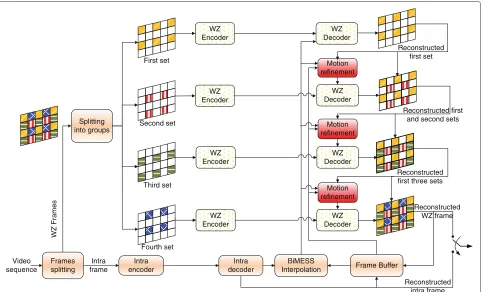
The principle of the proposed progressive coding scheme is to partition a Wyner-Ziv frame into 4×4 pixel blocks and then group these blocks into several sets, as shown in Figure 2. These sets of blocks are then progressively encoded using conventional DVC coding (WZ encoding) and transmitted one after another to the receiver. At the receiver, they are progressively decoded, one at the time. The previously decoded sets of blocks are used to improve the quality of the side information that is then used for decoding the current set. To ensure side informa-tion improvement, the successive sets of blocks must be spatially correlated.
WZ
Figure 2Proposed Wyner-Ziv video codec (progressive DVC architecture).
Thegeneric algorithm formof the progressive scheme is shown in Figure 2 and given by the following steps:
1. WZ encoding of the first set.
2. WZ decoding and reconstruction of the first set using the conventional SI generated by MCTI (without any refinement).
3. WZ encoding of the next set.
4. Based on all previously decoded sets, a refinement template is constructed to improve the SI quality of the current set.
5. WZ decoding and reconstruction of the current set using the refined SI.
6. Go to step 3 until all the WZ frame sets are reconstructed.
4.1 Progressive DVC using two sets of blocks
Here, each Wyner-Ziv frame is divided into two sets of blocks according to a chessboard structure as shown in Figure 3: the first set consists of all theblackblocks and the second one consists of all thewhiteblocks. The set of black blocks is first encoded and transmitted with con-ventional DVC coding. This set of blocks is decoded using the DCT-transformed interpolated frame as side infor-mation. These decoded blocks are used to improve the side information for the white blocks. Then, the encoder
transmits the set of white blocks using the same coding method, and the receiver decodes the white blocks using the improved side information. As the side information for the white blocks has been improved, fewer bits are needed for the decoding processes, hence reducing the overall bitrate. Moreover, the reconstruction using the refined SI will yield to better quality.
First set
Second set
Figure 3Partition of the Wyner-Ziv frame into two sets of blocks according to a chessboard structure.
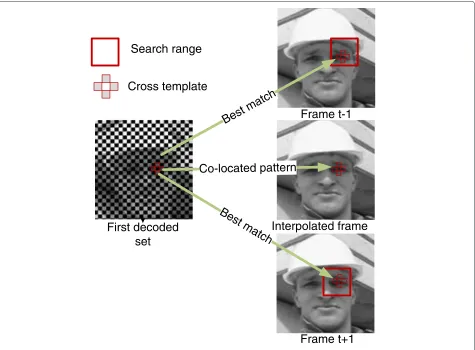
block is taken without best match searching (Figure 4). At the end of the process, there are three estimates for the white block:BP,BN, andBIfrom the previous, next, and interpolated reference frames, respectively.
The empty block (white block) inside the cross template is filled (motion compensated) by a weighted summation
of the three blocks, inside the empty crosses, estimated from the previous stage: BP, BN, andBI. The weighting coefficients correspond to the inverse of the MAD match-ing criterion between the empty cross pattern obtained from the first decoded set and the best empty cross pattern found in the previous and next frames (MADP,
First decoded
set
Frame t+1
Search range
Cross template
Frame t-1
h
c
t
a
m
t
s
e
B
Best
match
Co-located pattern
Interpolated frame
First set
Second set
Third set
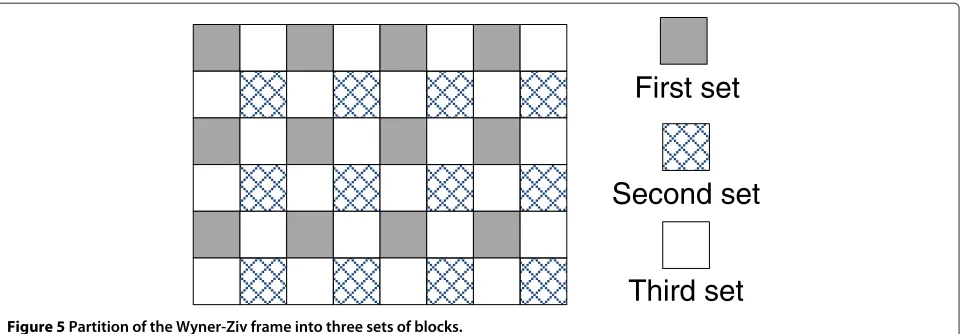
Figure 5Partition of the Wyner-Ziv frame into three sets of blocks.
MADN) and the co-located pattern in the interpolated frame (MADI). The compensated block,BCOMP, is given by
BCOMP= 1
MADPBP+MADN1 BN+MADI1 BI 1
MADP +MADN1 + MADI1
. (1)
The weighted average compensated block is statisti-cally more appropriate than considering only the best match or the average of the three blocks. In this con-text, simulation tests have been conducted showing that the best match compensation approach is more sensi-tive to noise in fast or complex motion locations. Fur-thermore, the weighted average block tends towards the best match block if the two other blocks appear to be unsuitable (i.e., with high MAD). The unsuitable blocks will be weighted according to the inverse of the MAD.
4.2 Progressive DVC using three sets of blocks
In the previous progressive DVC scheme, only the second set benefits from the side information refinement. On the other hand, the first set, equivalent to half of the frame, is decoded using the interpolated frame. Thus, the pro-gressive side information updating is restrained to only half the frame. In light of this, one may consider splitting the frame into more groups. However, the effectiveness of the progressive scheme depends strongly on the spa-tial correlation between the already decoded sets and the next set to be decoded. Thus, there is a trade-off that must be taken into account when choosing the number of sets and the location of each set. Therefore, a split-ting arrangement of the Wyner-Ziv frames into three sets is considered as shown in Figure 5. These three sets of blocks display mutual spatial correlation which is neces-sary for the progressive architecture. Otherwise, decoding one set of blocks would not bring any further information
about the next ones and thus would not contribute to the SI refinement.
For the progressive video coding with three sets of blocks, the side information is updated with two refine-ment passes. The first side information refinerefine-ment pass
Frame t+1
Second pass side information refinement
template Frame t-1
Interpolated frame First decoded
set
First and second decoded sets
Best match Co
-located
pattern Best match
h ct a m ts e B
First pass side information refinement
template
Best match
Co-located
pattern
First set
Second set
Third set
Fourth set
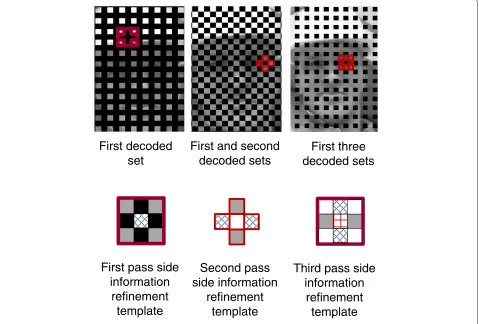
Figure 7Partition of the Wyner-Ziv frame into four sets of blocks.uses a template consisting of the four diagonal neigh-boring blocks of the block to be updated. The second side information update considers the same cross tem-plate as for the previous progressive scheme with two sets of blocks (Section 4.1). Figure 6 depicts how the two
side information refinement passes are done. It shows the reconstructed frame after decoding the first set bringing out the template of four diagonal blocks. A best match search of this template is conducted within a 28 × 28 pixel area of the previous and next frames. When the
Second pass
side information
refinement
template
First decoded
set
First and second
decoded sets
First pass side
information
refinement
template
Third pass side
information
refinement
template
First three
decoded sets
Table 1 Spatio-temporal correlation factorρof the refinement templates
4D EC AN
Foreman 0.7775 0.8100 0.8052
Coastguard 0.8404 0.8582 0.8553
Hall monitor 0.8891 0.9035 0.9022
Soccer 0.6344 0.7134 0.6913
Carphone 0.9659 0.9716 0.9705
Average 0.8215 0.8513 0.8449
four diagonal blocks lead to the best matches, it means that the central block (in the previous or next frame) is more likely to be close to the original block. For the ini-tially interpolated frame, no motion search is done and the MAD is computed using the co-located template. The computed MAD establishes thecontribution levelof the central block during motion compensation. After decod-ing the first and second sets of blocks, the reconstructed frame is similar to the reconstructed frame obtained after decoding the first set of the progressive scheme with two sets of blocks: the same template, consisting of an empty cross, is thus considered for the second SI refine-ment pass. However, the empty cross template experi-ences more spatial correlation with the central block than the diagonal template. Thus, the improvement of SI infor-mation is expected to be more pronounced as it will later be confirmed by simulations (see Section 5.1).
The motion estimation and compensation technique is similar to that described for the progressive schemes with two sets of blocks: it considers the weighted average of the three blocks obtained by motion search from the two neighboring frames and bycopyingthe co-located block in the interpolated frame.
4.3 Progressive DVC using four sets of blocks
To further explore the performances of the progressive scheme, one more side information refinement pass is considered by splitting the Wyner-Ziv frames into four sets of blocks as shown in Figure 7. The first two passes for side information refinement are the same as in the three groups scheme.
The refinement template for the third pass considers all the neighboring blocks of the block to be updated. This template results in even more spatial correlation than the diagonal and empty cross templates. Thus, the qual-ity of the SI relative to the fourth set of blocks is expected to be better than the other three sets. An experimental-based analysis of the SI quality for each set is given later in Section 5.1. The three side information update passes and their corresponding search templates are illustrated in Figure 8.
4.4 Spatio-temporal correlation factor of the different refinement templates
The refinement templates used along the various refine-ment passes are labeled as follows:
• Empty cross template (EC) : This template contains 4 blocks×16 pixels=64pixels. It is used in the unique refinement pass of the progressive scheme with two sets, in the second refinement pass of the progressive scheme with three sets, and in the third refinement pass of the progressive scheme with four sets. • Four diagonal blocks template (4D) : This template
contains 4 blocks×16 pixels=64pixels. It is used in the first refinement pass of the progressive scheme with three sets and in the first refinement pass of the progressive scheme with four sets.
• All neighboring blocks template (AN) : This template contains 8 blocks×16 pixels=128pixels. It is used in the third refinement pass of the progressive scheme with four sets.
The relevance of the aforementioned templates is inves-tigated through the computation of a spatio-temporal correlation factor.
The computation of this factor is based on offline measurements with the five QCIF video sequences:
Foreman, Coastguard, Hall monitor, Soccer, and Carphone (see Section 5). Each frame is divided into 4×4 pixel blocks. Then, considering a refinement template surrounding each block, B, the best match is searched in the previous and next neighboring frames. The central blocks in the previous frame,BP, and in the
Table 2 Intra-frame quantization parameters for the tested QCIF video sequences
Intra-frame quantization
Sequence Number of frames Q1 Q2 Q3 Q4 Q5 Q6 Q7 Q8
Foreman 145 40 39 38 34 34 32 29 25
Coastguard 145 37 36 36 33 33 31 29 24
Hall monitor 164 38 37 37 34 33 31 30 26
Soccer 145 44 43 41 36 36 34 31 25
Table 3 PSNR (dB) of two groups of blocks of the progressive architecture with only one refinement pass
Group 1 Group 2 PSNREC12
GOP = 2
Foreman 29.558 33.282 3.724
Coastguard 31.761 32.858 1.097
Hall monitor 36.084 36.794 0.710
Soccer 21.678 27.51 5.832
Carphone 29.243 32.560 3.3170
Average 29.664 32.601 2.9370
GOP = 4
Foreman 27.78 32.399 4.619
Coastguard 30.144 31.714 1.570
Hall monitor 34.902 35.935 1.033
Soccer 20.509 26.312 5.803
Carphone 28.703 32.198 3.495
Average 28.407 31.711 3.304
GOP = 8
Foreman 26.407 31.332 4.925
Coastguard 29.082 30.93 1.848
Hall monitor 34.053 35.411 1.358
Soccer 19.908 26.285 6.377
Carphone 28.061 31.841 3.780
Average 27.502 31.160 3.658
PSNREC
12, PSNR difference between group 2 refined using the EC template and
group 1.
next frame,BN, are used to compute the correlation factor as follows: deviation ofX.E[X] denotes the average or expected value ofX.
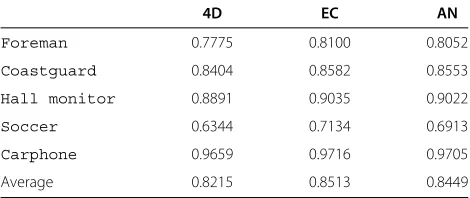
Table 1 provides the computed correlation factors obtained through simulations over all the frames of the five video sequences. As expected, the EC and AN plates lead to higher correlation values than the 4D tem-plate. However, the EC template is slightly better than the AN template even if the latter contains more blocks. In fact, considering only the horizontal and vertical blocks as in the EC template is better than adding the diagonal blocks. It should be emphasized that the computations of the spatio-temporal correlation factors is conducted to assess the effectiveness of each template and that it is based on the original distortion-free frames. However,
progressive DVC applies motion refinement on recon-structed frames with some amount of distortion. More-over, it considers the interpolated frame during motion compensation along with the neighboring frames.
5 Simulations and discussion
The proposed SIR method for progressive distributed video coding was implemented and its performances eval-uated using the Discover DVC codec as a benchmark reference. The rate-distortion performances of the pro-posed progressive scheme with spatial correlation-based SIR is also compared with the performances obtained with the SIR method presented in [10]. To ensure fair perfor-mance comparisons, the same test conditions as those reported in [10] were applied: these are actually the same test conditions as those listed in the Discover evaluation website [31]:
• Video sequences: The simulations were done on the luminance component, at 15 frames per second, of the same five QCIF video sequences mentioned in Section 4.4 (Foreman,Coastguard,Hall
Table 4 PSNR (dB) of three groups of blocks of the progressive architecture with two refinement passes
Group 1 Group 2 PSNR4D12 Group 3 PSNREC13
GOP = 2
Foreman 29.558 31.917 2.359 33.357 3.799
Coastguard 31.761 29.306 −2.455 32.882 1.121
Hall monitor 36.084 35.82 −0.264 36.792 0.708
Soccer 21.678 25.167 3.489 27.533 5.855
Carphone 29.353 31.223 1.870 32.637 3.284
Average 29.686 30.686 1.00 32.640 2.954
GOP = 4
Foreman 27.78 30.918 3.138 32.353 4.573
Coastguard 30.144 28.361 −1.783 31.777 1.633
Hall monitor 34.902 34.751 −0.151 35.93 1.028
Soccer 20.509 24.024 3.515 26.338 5.829
Carphone 28.842 30.833 1.991 32.262 3.420
Average 28.435 29.777 1.342 31.732 3.297
GOP = 8
Foreman 26.407 30.033 3.626 31.523 5.116
Coastguard 29.082 27.782 −1.30 30.956 1.874
Hall monitor 34.053 34.106 0.053 35.398 1.345
Soccer 19.908 23.484 3.576 25.741 5.833
Carphone 28.202 30.455 2.253 31.920 3.718
Average 27.530 29.172 1.642 31.107 3.577
PSNR4D
12, PSNR difference between group 2 refined using the 4D template and
group 1;PSNREC
13, PSNR difference between group 3 refined using the EC
monitor,Soccer, andCarphone). These five video test sequences, listed in Table 2, cover a wide range of motion and texture contents.
• Temporal correlation: Three sizes of group of pictures are considered in the tests:GOP = 2, 4, and 8, such that the efficiency of the proposed SIR scheme can be examined under different temporal correlation conditions.
• WZ frame quantization matrix indexes (Qi) : To investigate different codec bitrates, eight quantization 4×4matrices for the WZ DCT bands are chosen: Qi=1,. . ., 8; that is, 1 for low bitrates and 8 for high bitrates. These matrices indicate the number of quantization levels allocated to each DCT band and can be found in [8].
• Intra-frame quantization: For each quantization matrixQi, a different quantization parameterQpfor the H.264/AVC intra-frame is considered. EachQp value is selected such that the intra-frame would have a quality similar to that of the WZ frame to avoid sudden quality variations: theseQpvalues are similar to those used in [8] and [11]: these values are given in Table 2 for each QCIF sequence.
• Search area parameters: For the proposed SIR scheme, a4×4pixel WZ frame block decomposition is considered. The template best match search area is 28×28pixels. As each of the three templates (diagonal, empty cross, and all blocks templates) covers an area of12×12pixels, a28×28search area allows for a displacement of 8 pixels in each direction (right, left, up, and down).
5.1 Side information quality for the different distributed video coding schemes
Before analyzing the overall rate-distortion performances of the proposed progressive DVC architecture, the side information generation itself is examined as the interpo-lated frame quality has a direct impact on the achievable rate reduction and on the video sequence reconstruc-tion quality. The effectiveness of the progressive scheme, reflected on the side information quality improvement, is reported for the three different GOP sizes implying dif-ferent temporal correlation conditions. In this section, we evaluate the proposed technique’s SI quality, in terms of PSNR, at the highest rate quantization point (best achiev-able quality) on the rate-distortion function. In other
Table 5 PSNR (dB) of four groups of blocks of the progressive architecture with three refinement passes
Group 1 Group 2 PSNR4D12 Group 3 PSNREC13 Group 4 PSNRAN14
GOP = 2
Foreman 29.558 31.917 2.359 33.402 3.844 33.61 4.052
Coastguard 31.761 29.306 −2.455 33.167 1.406 32.703 0.942
Hall monitor 36.084 35.82 −0.264 36.976 0.892 36.724 0.640
Soccer 21.678 25.167 3.489 27.517 5.839 27.782 6.104
Carphone 29.353 31.223 1.870 32.476 3.123 33.079 3.726
Average 29.686 30.686 1.00 32.707 3.021 32.779 3.093
GOP = 4
Foreman 27.78 30.918 3.138 32.399 4.619 32.695 4.915
Coastguard 30.144 28.361 −1.783 32.12 1.976 31.586 1.442
Hall monitor 34.902 34.751 −0.151 36.055 1.153 35.93 1.028
Soccer 20.509 24.024 3.515 26.34 5.831 26.547 6.038
Carphone 28.837 30.838 2.001 32.103 3.266 32.733 3.896
Average 28.434 29.778 1.3440 31.803 3.3690 31.898 3.464
GOP = 8
Foreman 26.407 30.033 3.626 31.551 5.144 31.921 5.514
Coastguard 29.082 27.782 −1.30 31.278 2.196 30.78 1.698
Hall monitor 34.053 34.106 0.053 35.204 1.151 35.15 1.097
Soccer 19.908 23.4844 3.5764 25.726 5.818 25.964 6.056
Carphone 28.203 30.449 2.246 31.8 3.597 32.375 4.172
Average 27.531 29.170 1.639 31.112 3.581 31.238 3.707
PSNR4D
12, PSNR difference between group 2 refined using the 4D template and group 1;PSNREC13, PSNR difference between group 3 refined using the EC template
and group 1;PSNRAN
words, the key frames are encoded for the highest quality, i.e., with the lowest quantization parameterQp.
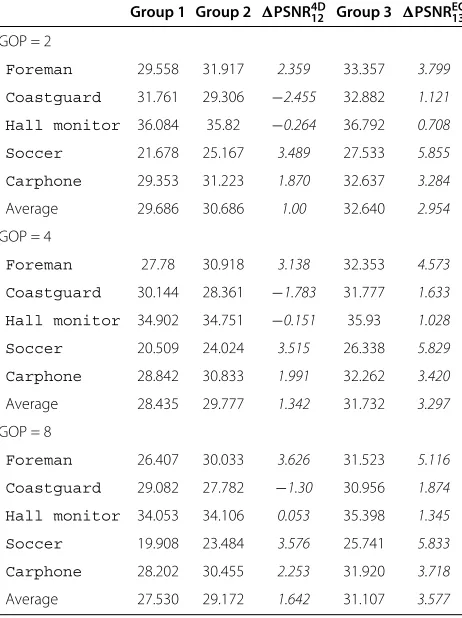
Tables 3, 4, and 5 provide the PSNR values of the side information of each set of blocks (or group of blocks) for the progressive scheme with one, two, and three refine-ment passes. The PSNR of each group is the average PSNR of that group over all the WZ frames in the video sequence. More precisely, the PSNR of group 1 is com-puted between the blocks belonging to that group in the BiMESS-generated SI and the corresponding blocks in the original frame. Similarly, the PSNR of group 2 is computed between the blocks belonging to that group in the refined SI and the original frame and so on.
A comparison of each of the groups before and after the refinement could have also been done. However, this is practically the same as comparing the SI quality between each group. In fact, the various groups of blocks repre-sent almost the same content since they are uniformly dispersed over the WZ frame. These tables also give the
PSNR average over all the WZ frames of the five video sequences to provide an overall statistical comparison of the side information quality for the aggregated video sequences. The SI refinement improvement is assessed through the PSNR difference,PSNRtemplate1g , between the first group, g = 1 (generated using the conventional BiMESS method without any refinement) and the second, third, and fourth groups, g = 2, 3, or 4, after refine-ment using one of the aforerefine-mentioned templates (EC, 4D, or AN). The PSNR differences in Tables 3, 4, and 5 are emphasized.
5.1.1 Progressive architecture with two groups of blocks
To assess the side information quality improvement dur-ing the different refinement passes, Table 3 reports the PSNR values of the interpolated frames for the two sets for GOP values of 2, 4, and 8. It shows the improvement of the side information quality of the second set (refined using the EC template) over the first set (without refinement),
obtained by averaging the PSNR over the whole sequence of frames.
Furthermore, Table 3 shows that the PSNR improve-ment of the progressive scheme is more important when the temporal correlation decreases, or as the GOP size increases. The improvement obtained by motion refine-ment, by exploiting also the spatial correlation, is more pronounced for low temporal correlation. When the GOP size increases, the MCTI estimates the motion between two temporally distant key frames. The actual motion is not easy to track in practice and the progressive scheme is thus particularly efficient for that purpose.
5.1.2 Progressive architecture with three groups of blocks
Interpolation performances of the progressive scheme with two refinement passes are reported in Table 4. The first refinement pass is based on the 4D refinement tem-plate. This template is slightly less spatially correlated with the central block than the EC template used in the second
refinement pass. Therefore, the PSNR results for the sec-ond refinement pass (third group) are higher, on average, than those obtained with the first pass (second group). For slow-motion sequences, however, the 4D refinement template is not precise enough to increase the accuracy of motion estimation. In other words, the motion estima-tion is already working well and the moestima-tion refinement with an inaccurate template is more likely to capture noise than true motion. For fast-motion sequences, the tem-poral interpolation is highly inaccurate, and because of this, even a coarse refinement template is able to enhance the SI quality. Indeed, the first refinement pass using the 4D template gives a significant improvement for the
ForemanandSoccervideo sequences.
5.1.3 Progressive architecture with four groups of blocks
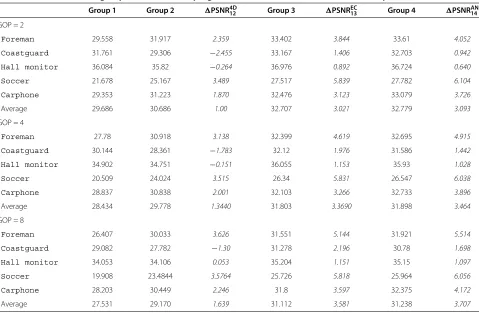
The PSNR values of the four groups of blocks are shown in Table 5 for the progressive SIR scheme using three refine-ment passes. The first two refinerefine-ment passes give the
100 200 300 400 500 28
100 200 300 400 500 28
Coastguard @ 15 fps (GOP=4)
50 100 150 200 250 300 350 400
100 200 300 400 500 600 28
Progressive TC (4 groups) Progressive TC (3 groups) Progressive TC (2 groups) Deligiannis et. al. (LDPC) [11] Martins et. al. (TC) [10] DISCOVER TC (reimplemented) DISCOVER TC [30] H.264/AVC intra I-I-I H.264/AVC no motion I-B-B-B-I
100 200 300 400 500 28
same results as those achieved with the previous progres-sive scheme with three groups. As the third refinement pass uses a template composed of all the neighboring blocks, it is expected to lead to better motion refinements, especially for fast-motion video sequences. However, for slow-motion videos, the third refinement does not give interpolation improvement.
To summarize, it is observed from Tables 3, 4, and 5 that the improvement obtained with SIR is more significant as the GOP increases and for fast-motion video sequences. By means of progressive distributed video coding, the lack of temporal correlation is compensated by the spatial correlation during the SI generation.
5.2 Rate-distortion performances of progressive architectures
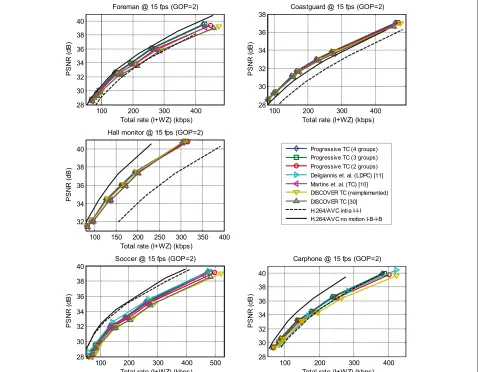
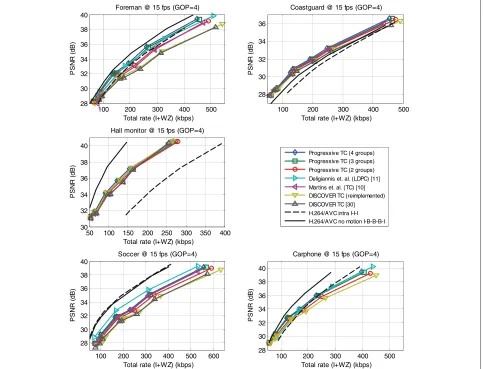
For the rate-distortion analysis, the Discover DVC codec with turbo coding was reimplemented according to the simulation conditions specified in [31] and recalled at the
beginning of this section. It is verified that the perfor-mance results for the reimplemented benchmark Discover codec are similar to those reported for the turbo code-based Discover architecture in [31] (see Figures 9, 10, and 11). The Discover performances are computed using the software downloaded from the Discover website [31].
The proposed progressive mechanism is incorporated over the reimplemented Discover codec. A summary of the interpolated frame quality obtained with the differ-ent DVC schemes is given in Table 6. The first scheme, identified as BiMESS, refers to the BiMESS interpolation used by Discover. The subsequent schemes are the pro-posed progressive DVC schemes with the three propro-posed block arrangements. The average PSNR over all interpo-lated frames with its different groups are evaluated. On the average, the interpolation quality increases as more refinement passes are performed, except for the case of slower motion video sequences (i.e., Hall monitor). The impact of the interpolation quality on the overall
PSNR as a function of the bitrate is demonstrated in the RD curves of Figures 9, 10, and 11. The different DVC and conventional video schemes presented in these figures do not perform any motion estimation at the encoder side:
• H264/AVC no motion I-(GOP-1)B-I : It exploits the spatial redundancy without any motion estimation. • H264/AVC intra I-I-I : Each frame is encoded
independently from the neighboring frames without exploiting the spatial redundancy.
• Discover (Turbo Code) [31] : The values are taken from the Discover website [31] and for which the Slepian-Wolf codec is based on turbo coding. • Discover (reimplemented) : Reimplementation of the
Discover benchmark codec based on turbo coding and considering the same simulation conditions as in [31].
• Martins et al. [10] : The SIR scheme proposed by Martins et al. [10]. The WZ part of this codec is based on turbo code (TC).
• Deligiannis et al. [11] : The SIR scheme proposed by Deligiannis et al. [11]. The WZ part of this codec is based on low-density parity-check code (LDPC).
Note that the LDPC-based SW decoder gives better compression than the TC-based SW decoder. For this reason, the Bjøntegaard metrics of this scheme is computed by considering the LDPC-based
DISCOVER codec.
• Proposed (two, three, or four groups) : The proposed progressive scheme with two, three, and four groups of blocks.
The improvement obtained by the progressive scheme is intimately related to the interpolation quality. For larger groups of pictures, the progressive refinement improve-ment is more significant: the lack of temporal correlation is mitigated by exploiting the spatial correlation during the side information generation. The SIR based on pro-gressive schemes has proven more effective for the rapid sequences, showing an improvement of up to 3 dB, for instance, for theForemansequence with GOP=8 and the progressive scheme with 4 groups. For the slow-motion sequences, such as the Hall monitor video sequence, however, the progressive scheme does not bring noticeable performance improvements even when the GOP size increases.
Table 6 Average PSNR (dB) of the interpolated frame over all the WZ frames
BiMESS Progressive DVC Progressive DVC Progressive DVC (2 groups) (3 groups) (4 groups)
GOP = 2
Foreman 29.549 31.393 32.047 32.122
Coastguard 31.675 32.315 31.708 31.734
Hall Monitor 36.138 36.455 36.372 36.401
Soccer 21.698 24.592 25.478 25.536
Carphone 29.271 30.90 31.46 31.53
Average 29.666 31.131 31.413 31.464
GOP = 4
Foreman 27.721 30.063 30.851 30.95
Coastguard 30.136 30.927 30.515 30.555
Hall Monitor 35.007 35.42 35.194 35.41
Soccer 20.501 23.405 24.302 24.353
Carphone 28.716 30.451 31.049 31.128
Average 28.416 30.053 30.382 30.479
GOP = 8
Foreman 26.37 28.674 29.499 29.981
Coastguard 29.038 30.004 28.901 29.731
Hall Monitor 34.227 34.729 34.739 34.484
Soccer 19.896 23.057 23.154 23.778
Carphone 28.068 29.951 30.624 30.707
Average 27.519 29.283 29.383 29.736
From Table 6, one can verify that the quality of the interpolated frames is slightly improved by the progres-sive scheme for theHall monitorsequence. However, this slight interpolation improvement does not lead to an improvement in the rate-distortion curves in Figures 9, 10, and 11. This can be explained from a channel cod-ing point of view: when the frame is subdivided into more subsets, the length of the turbo code and its interleaver is smaller. Therefore, the error-correcting capability of the turbo code decreases.
The PSNR of theCoastguardsequence interpolated frames obtained by the progressive scheme with three and four sets is lower than that of the interpolated frame with the progressive scheme with two sets. This is due to the refinement pass using the coarse 4D template. How-ever, the RD performances of the progressive schemes with three and four sets are better than that with two sets. Recall that the Coastguard sequence contains a ‘moving boat’ and a large texture area of ‘water’ in the background which is usually hard to refine since the tem-plate is vulnerable to the noise. Nevertheless, around the moving boat, there is some structure that can help the
refinement process to eliminate the motion estimation errors.
The progressive scheme leads to an improvement over the SIR technique of Martins et al. [10] by up to 1.2 dB (Foremanwith GOP 8) since the motion refinement is processed using completely reconstructed templates con-taining the various DCT components and not only a subset of the DCT bands. The concept of the progressive scheme was inspired from the principle of the intra-frame differential pulse code modulation(DPCM) coding. How-ever, since the WZ codec requires long codes, it is not possible to apply linear prediction, pixel by pixel, using the neighboring spatially correlated pixels. Thus, the frame decomposition in the progressive scheme should provide spatially correlated groups. Unlike DPCM, where the spa-tial correlation is used to predict the upcoming pixel, for the proposed progressive DVC scheme, the spatial corre-lation is used to rectify the motion field, thus leading to a better exploitation of the temporal correlation properties across the video sequence.
In Table 7 the overall RD performances of the dif-ferent SIR schemes are evaluated using the Bjøntegaard
Table 7 Bjøntegaard Deltas of the different refined DVC codecs compared to the DISCOVER DVC system
GOP 2 GOP 4 GOP 8
Sequence SIR technique R (%) PSNR (dB) R (%) PSNR (dB) R (%) PSNR (dB)
Foreman Progressive with 4 sets −13.1935 0.8249 −24.0237 1.4995 −31.3859 2.0677
Progressive with 3 sets −11.3440 0.6997 −21.0332 1.2848 −28.0933 1.8069
Progressive with 2 sets −6.9061 0.4149 −12.7094 0.7371 −15.6575 0.9305
Deligiannis et al. −4.7693 0.3162 −20.8418 1.3473 −34.1192 2.3699
Martins et al. −5.6930 0.3644 −7.1264 0.4419 −14.3356 0.8285
Soccer Progressive with 4 sets −14.1737 0.8376 −19.2194 1.2067 −22.0967 1.4351
Progressive with 3 sets −11.9026 0.6945 −16.4910 1.0198 −19.3024 1.2328
Progressive with 2 sets −7.4463 0.4279 −10.5923 0.6393 −13.9559 0.8687
Deligiannis et al. −17.1781 0.9931 −30.2909 1.9246 −38.9008 2.6557
Martins et al. −9.0854 0.5333 −15.2502 0.9139 −15.8318 0.9906
Coastguard Progressive with 4 sets −4.3803 0.2189 −10.8566 0.4840 −17.5782 0.8257
Progressive with 3 sets −2.5786 0.1271 −7.5031 0.3267 −13.4620 0.6154
Progressive with 2 sets −2.1362 0.1060 −4.5434 0.1947 −7.8475 0.3476
Martins et al. 0.3071 −0.0067 −7.3185 0.2890 −13.2512 0.6355
Hall Progressive with 4 sets −1.9400 0.1437 −2.1744 0.1359 0.6280 −0.0233
monitor Progressive with 3 sets −0.3869 0.0311 1.1726 −0.0605 2.7001 −0.1306
Progressive with 2 sets 0.6052 −0.0383 3.8789 −0.2132 6.6494 −0.3268
Martins et al. 3.4073 −0.2491 5.5937 −0.3381 9.5248 −0.4840
Carphone Progressive with 4 sets −11.9046 0.7508 −16.6542 0.9418 −22.6768 1.2945
Progressive with 3 sets −10.0661 0.6258 −13.7520 0.7611 −18.9992 1.0578
Progressive with 2 sets −5.8555 0.3546 −6.6457 0.3519 −9.4964 0.4989
Deligiannis et al. −2.2857 0.1941 −6.3553 0.4628 −16.3032 1.0443
Delta PSNR and bitrate metrics [12]. These metrics are computed according to the SI non-refined system DIS-COVER. All the refined DVC architectures considered here use turbo coding in the WZ part, and they are consequently compared to the DISCOVER system using turbo coding, except for the refined technique of Deli-giannis [11] which uses LDPC and is then compared to DISCOVER system using LDPC. Using the Bjøntegaard measure [12], it is observed that the proposed progressive codec also achieves compression gains of up to 31.3859% rate reduction when compared to DISCOVER. Moreover, the progressive scheme with four groups exceeds the per-formances of the SIR technique of Martins [10] for all the different setups. By comparison with the Deligiannis [11] SI refinement technique, the progressive scheme with four groups gives better results for the majority of scenarios, that is except for theSoccerQCIF sequence.
5.3 Complexity analysis
In this section, the encoding and decoding complexity of the proposed progressive scheme with four sets is inves-tigated. The complexity is assessed by measuring the exe-cution time required by the encoder and by the decoder using a personal computer with an Intel® Core™ i7 CPU processor at 2.67 GHz with 12 GB of RAM.
Table 8 gives the encoding execution time in seconds for three video schemes with all the frames (see Table 2) of
theForemanandSoccersequences and with GOP=2 and 8:
1. Conventional H264/AVC intra-standard (TIntraenc ). Four quantization parameter (QP) values are considered. The same encoder generates the key frames used by the DISCOVER and progressive DVC systems.
2. The state-of-the-art DISCOVER encoder (TDISCenc ). Four quantization index (Qi) values are considered. The execution time is the sum of the key frame encoding time and the WZ frame encoding time: TDISCenc =TKey+TDISCWZ .
3. The proposed progressive DVC encoder with four sets.TProg4enc =TKey+TProg4WZ .
The T enc prog4 Tenc
DISC ratio indicates that the progressive encoder complexity exceeds the DISCOVER encoder complexity by about 12% for GOP=2 and about 57% for GOP=8. The additional complexity is mainly due to the frame split-ting into four parts and the execution of four times the encoding process of the two RSC encoders forming the turbo encoder. Despite this encoding complexity increase, the proposed progressive scheme still follows the DVC paradigm purpose as it reduces significantly the encod-ing complexity when compared to that of the H264/AVC
Table 8 Comparison of the encoding execution times in seconds
H264/AVC intra DISCOVER Progressive with 4 sets Ratios
QP TencIntra Q
i TKey TDISCWZ TencDISC TWZProg4 TProg4enc
Tenc Prog4
Tenc DISC
Tenc Prog4
Tenc Intra
Foreman 40 27.941 1 14.659 1.14 15.79 2.36 17.02 1.08 0.61
GOP 2 34 29.630 5 15.551 1.59 17.14 3.47 19.02 1.11 0.64
29 31.263 7 16.451 1.81 18.26 4.10 20.55 1.12 0.62
25 33.291 8 17.491 2.01 19.50 4.39 21.88 1.12 0.65
Foreman 40 27.941 1 3.371 2.10 5.47 5.07 8.44 1.54 0.30
GOP 8 34 29.630 5 3.581 2.82 6.40 6.14 9.72 1.52 0.33
29 31.263 7 3.817 3.01 6.83 6.47 10.29 1.51 0.33
25 33.291 8 4.105 3.52 7.62 8.03 12.13 1.59 0.36
Soccer 44 27.971 1 14.281 1.46 15.74 3.31 17.59 1.12 0.63
GOP 2 36 29.563 5 15.211 1.75 16.96 3.82 19.03 1.12 0.64
31 31.251 7 16.121 1.90 18.02 4.31 20.43 1.13 0.65
25 33.270 8 17.513 2.03 19.54 4.81 22.32 1.14 0.67
Soccer 44 27.971 1 3.271 2.16 5.43 4.96 8.23 1.51 0.29
GOP 8 36 29.563 5 3.471 3.08 6.55 6.84 10.31 1.57 0.35
31 31.251 7 3.731 3.29 7.02 7.29 11.02 1.57 0.35
25 33.270 8 4.091 3.61 7.70 8.30 12.391 1.61 0.37
Tenc
Prog4, encoding execution time of the proposed progressive scheme with four sets;TencDISC, encoding execution time of DISCOVER;TencIntra, encoding execution time of
H264/AVC intra.Tenc
Table 9 Comparison of the decoding execution times in seconds
DISCOVER Progressive with 4 sets Ratios
Qi TSIG
Foreman 1 53.54 339.0 392.6 217.79 403.1 620.9 4.07 1.19 1.58
GOP 2 5 53.06 849.0 902.1 217.94 848.2 1,066.2 4.11 0.99 1.18
7 53.02 1,702.0 1,755.1 217.92 1,595.5 1,813.4 4.11 0.94 1.03
8 53.15 2,858.6 2,911.7 217.03 2,681.0 2,898.0 4.11 0.94 0.99
Foreman 1 88.73 829.4 918.1 358.68 977.1 1,335.8 4.04 1.18 1.45
GOP 8 5 88.65 2,075.1 2,163.8 358.75 2,042.5 2,401.3 4.05 0.98 1.11
7 88.67 4,115.5 4,204.2 360.60 3,617.1 3,977.7 4.06 0.89 0.94
8 88.73 6,696.9 6,785.6 358.93 5,633.0 5,991.9 4.04 0.84 0.88
Soccer 1 53.79 490.38 544.17 218.18 532.59 750.77 4.05 1.09 1.38
GOP 2 5 53.08 1,108.59 1,161.67 217.54 1,165.73 1,383.27 4.10 1.05 1.19
7 53.64 2,126.88 2,180.52 217.23 1,952.67 2,169.90 4.05 0.92 0.99
8 53.24 3,357.65 3,410.89 217.39 2,945.31 3,162.70 4.08 0.88 0.93
Soccer 1 89.84 945.46 1,035.30 364.35 989.26 1,353.61 4.05 1.05 1.31
GOP 8 5 89.86 2,172.66 2,262.52 362.52 2,014.83 2,377.35 4.03 0.93 1.05
7 89.17 4,330.37 4,419.54 364.02 3,756.27 4,120.29 4.08 0.87 0.93
8 89.76 6,972.57 7,062.33 365.24 5,102.67 5,467.91 4.07 0.73 0.77
Tdec
Prog4=TSIGProg4+TSWProg4, decoding execution time of the proposed progressive scheme with four sets;TdecDISC=T SIG DISC+T
SW
DISC, decoding execution time of DISCOVER.
TdecDISC,T
intra-coding: the ratios T enc Prog4 Tenc
Intra in Table 8 indicate a com-plexity reduction of almost 40% and 70% for GOP=2 and 8, respectively.
As for the decoding complexity itself, Table 9 pro-vides the decoding execution times for both progres-sive and DISCOVER schemes. The overall decoding time involves the side information generation execu-tion time, TSIG, and the Slepian-Wolf decoder execu-tion time, TSW (turbo decoding): Tdec = TSIG +TSW. This table shows that the additional computational com-plexity of the proposed decoder, due to multiple side information refinement passes, is compensated by a faster turbo decoding. For instance, for the progressive scheme with four groups of blocks, the 1,584-long bit-plane is split into four parts leading to four 396-long bitplanes: the turbo decoding process of the 1,584-long bitplane is more time-consuming than the turbo decod-ing of the four 396-long bitplanes, leaddecod-ing to comparable decoding execution times, TDISCdec and TProg4dec , for DIS-COVER and the progressive scheme with four correlated sets.
6 Conclusions
A new distributed video coding scheme is presented in this paper. This DVC scheme, based on progressive cod-ing, consists of splitting the Wyner-Ziv frames into spa-tially correlated sets. These sets are then sent and decoded
progressively to aid the motion-compensated temporal interpolation process for the decoding of the subsequent sets through motion refinement passes. This method complies perfectly with the distributed paradigm and does not involve additional decoding complexity. Moreover, the refinement passes are based on carefully chosen templates which are able to improve progressively the estimation of the motion vectors. To demonstrate the feasibility of the proposed method, the progressive scheme is incorporated over the Discover DVC codec. Significant improvements have been obtained, particularly for fast video sequences and larger group of pictures. The interpolation quality is greatly enhanced and an improvement of up to 3 dB is reported for the overall rate-distortion (PSNR versus bitrate) performances, and this does not have any sig-nificant impact on the computational complexity of the encoders and decoders.
Competing interests
The authors declare that they have no competing interests.
Acknowledgements
The authors would like to thank the anonymous reviewers for their valuable comments and suggestions to improve the quality of the paper. They are also grateful to the authors of [11] and in particular to Dr N. Deligiannis for sharing their experimental results.
Author details
1Laval University, Quebec, Quebec, G1V 0A8, Canada.2Communications Research Centre Canada, Ottawa, Ontario, K2H 8S2, Canada.
Received: 9 April 2013 Accepted: 23 October 2013 Published: 5 November 2013
References
1. J Slepian, J Wolf, Noiseless coding of correlated information sources. IEEE Trans. Inf. Theory.19(4), 471–480 (1973)
2. AD Wyner, J Ziv, The rate-distortion function for source coding with side information at the decoder. Trans. Inf. Theory.IT-22(1), 1–10 (1976) 3. R Puri, K Ramchandran, Prism: a new robust video coding architecture
based on distributed compression principles, inProceedings of the Allerton Conference on Communication Control and Computing,
(Urbana-Champaign, 2–4 Oct 2002)
4. R Puri, A Majumdar, K Ramchandran, Prism: a video coding paradigm with motion estimation at the decoder. IEEE Trans. Image Process.16, 2436–2448 (2007)
5. A Aaron, R Zhang, B Girod, Wyner-Ziv coding of motion video, inAsilomar Conference on Signals, Systems and Computers, (Pacific Grove, 3–6 Nov 2002)
6. B Girod, A Aaron, S Rane, DR Monedero, Distributed video coding. Proc. IEEE, Special Issue on Advances in Video Coding and Delivery.93, 71–83 (2005)
7. F Pereira, C Brites, J Ascenso, M Tagliasacchi, Wyner-Ziv video coding: a review of the early architectures and further developments, in Proceedings of the IEEE International Conference on Multimedia and Expo (ICME ‘08),(Hannover, 23 June–26 April 2008), pp. 625–628
8. X Artigas, J Ascenso, M Dalai, S Klomp, D Kubasov, M Ouaret, The DISCOVER codec: architecture, techniques and evaluation, inProceedings of the Picture Coding Symposium, (Lisbon, 7–9 Nov 2007)
9. MH Taieb, J-Y Chouinard, D Wang, Loukhaoukha K, Progressive coding and side information updating for distributed video coding. J. Inf. Hiding Multimedia Signal Process.3, 1–11 (2011)
10. R Martins, C Brites, J Ascenso, F Pereira, Refining side information for improved transform domain Wyner-Ziv video coding. IEEE Trans. Circuits Syst. Video Technol.19, 1327–1341 (2009)
11. N Deligiannis, F Verbist, J Slowack, RVD Walle, P Schelkens, A Munteanu, Progressively refined Wyner-Ziv video coding for visual sensors. ACM Trans. Sensor Netw., Special Issue New Advancements Distributed Smart Camera Netw. (2014, in press)
12. G Bjøntegaard, Calculation of average PSNR differences between RD-curves, inProceedings of the ITU-T Video Coding Experts Group (VCEG) Thirteenth Meeting, (Austin, 2–4 Apr 2001)
13. D Kubasov, K Lajnef, C Guillemot, A hybrid encoder/decoder rate control for Wyner-Ziv video coding with a feedback channel, inProceedings of the International Workshop on Multimedia Signal Processing, (Crete, 1–3 Oct 2007)
14. J Ascenso, C Brites, F Pereira, Improving frame interpolation with spatial motion smoothing for pixel domain distributed video coding, in Proceedings of the 5th EURASIP Conference on Speech and Image Processing, Multimedia Communications and Services, (Smolenice, 29 June–2 July 2005)
15. J Ascenso, C Brites, F Pereira, Content adaptive Wyner-Ziv video coding driven by motion activity, inProceedings of the IEEE International Conference on Image Processing, (Atlanta, 8–11 Oct 2006), pp. 605–608 16. S Klomp, Y Vatis, J Ostermann, Side information interpolation with sub-pel
motion compensation for Wyner-Ziv decoder, inProceedings of the International Conference on Signal Processing and Multimedia Applications (SIGMAP), (Setu´bal, 7–10 Aug 2006)
17. C Brites, F Pereira, Correlation noise modeling for efficient pixel and transform domain Wyner-Ziv video coding. IEEE Trans. Circuits Syst. Video Technol.18, 1177–1190 (2008)
18. S Wang, L Cui, L Stankovic, V Stankovic, S Cheng, Adaptive correlation estimation with particle filtering for distributed video coding. IEEE Trans. Circuits Syst. Video Technol.22, 649–658 (2012)
19. L Cui, S Wang, X Jiang, S Cheng, Adaptive distributed video coding with correlation estimation using expectation propagation. Proc. SPIE 8499, Applications of Digital Image Processing XXXV, 84990M (2012). doi:10.1117/12.929357
20. D Kubasov, J Nayak, C Guillemot, Proceedings of the IEEE International Workshop on Multimedia Signal Processing, (Crete, 1–3 Oct 2007) 21. D Agrafiotis, P Ferr, DR Bull, Hybrid key/Wyner-Ziv frames with flexible
macroblock ordering for improved low delay distributed video coding, in Proceedings of the Visual Communications and Image Processing, (San Jose, 30 Jan 2007), pp. 3097–3100
22. B Wu, X Ji, D Zhao, W Gao, Spatial-aided low-delay Wyner-Ziv video coding. EURASIP J. Image Video Process.2009, 109057 (2009) 23. A Aaron, S Rane, B Girod, Wyner-Ziv video coding with hash-based
motion compensation at the receiver, inProceedings of IEEE International Conference on Image Processing (ICIP 04),vol. 5 (IEEE, Piscataway, 2004), pp. 3097–3100
24. M Tagliasacchi, A Trapanese, S Tubaro, J Ascenso, C Brites, F Pereira, Exploiting spatial redundancy in pixel domain Wyner-Ziv video coding, in Proceedings of IEEE International Conference on Image Processing (ICIP 06)vol. 5 (IEEE, Piscataway, 2006), pp. 253–256
25. M Guo, Y Lu, F Wu, S Li, W Gao, Distributed video coding with spatial correlation exploited only at the decoder, inProceedings of the International Symposium on Circuits and Systems (ISCAS 2007)(IEEE, Piscataway, 2007), pp. 41–44
26. J Ascenso, C Brites, F Pereira, Motion compensated refinement for low complexity pixel based distributed video coding, inProceedings of IEEE Conference on Advanced Video and Signal Based Surveillance (AVSS 05)(IEEE, Piscataway, 2005), pp. 593–598
27. X Artigas, L Torres, Iterative generation of motion-compensated side information for distributed video coding, inProceedings of the IEEE International Conference on Image Processing (ICIP), (Genoa, 11–14 Sept 2005)
28. S Ye, M Ouaret, F Dufaux, T Ebrahimi, Improved side information generation with iterative decoding and frame interpolation for distributed video coding, inProceedings of IEEE International Conference on Image Processing (ICIP 08), (San Diego, 12–15 Oct 2008)
29. F Verbist, N Deligiannis, SM Satti, A Munteanua, P Schelkens, Iterative Wyner-Ziv decoding and successive side-information refinement in feedback channel-free hash-based distributed video coding. Proc. SPIE 8499, Applications of, Digital Image Processing, XXXV, 84990O (2012). doi:10.1117/12.929680
30. MB Badem, WAC Fernando, JL Martinez, P Cuenca, An iterative side information refinement technique for transform domain distributed video coding, inProceedings of the 2009 IEEE International Conference on Multimedia and Expo, ICME’09(IEEE, Piscataway, 2009), pp. 177–180 31. European Union: The discover codec evaluation 2005.
www.discoverdvc.org. Accessed 30 Oct 2013
doi:10.1186/1687-6180-2013-168
Cite this article as:Haj Taiebet al.:Spatial correlation-based side informa-tion refinement for distributed video coding.EURASIP Journal on Advances in Signal Processing20132013:168.
Submit your manuscript to a
journal and benefi t from:
7Convenient online submission 7Rigorous peer review
7Immediate publication on acceptance 7Open access: articles freely available online 7High visibility within the fi eld
7Retaining the copyright to your article