R E V I E W
Open Access
Analysis framework of network security
situational awareness and comparison of
implementation methods
Yan Li
1*, Guang-qiu Huang
2, Chun-zi Wang
1and Ying-chao Li
1Abstract
Information technology has penetrated into all aspects of politics, economy, and culture of the whole society. The information revolution has changed the way of communication all over the world, promoted the giant development of human society, and also drawn unprecedented attention to network security issues. Studies, focusing on network security, have experienced four main stages: idealized design for ensuring security, auxiliary examination and passive defense, active analysis and strategy formulation, and overall perception and trend prediction. Under the background of the new strategic command for the digital control that all countries are scrambled for, the discussion of network security situational awareness presents new characteristics both in the academic study and industrialization. In this regard, a thorough investigation has been made in the present paper into the literature of network security situational awareness. Firstly, the research status both at home and abroad is introduced, and then, the logical analysis framework is put forward concerning the network security situational awareness from the perspective of the data value chain. The whole process is composed of five successive stages: factor acquisition, model representation, measurement establishment, solution analysis, and situation prediction. Subsequently, the role of each stage and the mainstream methods are elaborated, and the application results on the experimental objects and the
horizontal comparison between the methods are explained. In an attempt to provide a panoramic recognition of network security situational awareness, and auxiliary ideas for the industrialization of network security, this paper aims to provide some references for the scientific research and engineering personnel in this field.
Keywords: Network security, Network situational awareness, Big data network security, Intrusion detection, Data fusion analysis
1 Introduction
The information technology revolution has made great changes in the way of human communication in the world today. Especially in recent years, in-depth studies of the industrialization concepts of cloud computing, large data, Internet of Things, and mobile terminals have made the control of digital information become a new strategic com-manding point, and the problem of network security has also received more attention in a wider range. The exposure of“prism plan”in June 2013 brought information security from economic interest to the level of national security. In February 2014, the establishment of the “central network security and information group”marked the awakening of
the national consciousness of the Internet in China and highlighted the importance of the national information se-curity strategy. However, the ability of network overall defense at the national level to attack risk is still relatively weak [1]. How to prevent organized malicious network at-tack has become a hot topic in the field of security.
Studies on network security have started since the birth of information networks. The exponential growth of network size and application, especially the random dynamic access relationship built on the static Internet physical connection network based on OSI model, makes the study of network security more complicated. Before the 1960s, the focus on the network security research is how to build an absolute security system and reduce de-sign vulnerabilities to ensure the confidentiality, integrity, and availability of the system, which can be regarded as
© The Author(s). 2019Open AccessThis article is distributed under the terms of the Creative Commons Attribution 4.0 International License (http://creativecommons.org/licenses/by/4.0/), which permits unrestricted use, distribution, and reproduction in any medium, provided you give appropriate credit to the original author(s) and the source, provide a link to the Creative Commons license, and indicate if changes were made.
* Correspondence:[email protected]
1Xi’an Polytechnic University, Xi’an 710048, Shaanxi, China
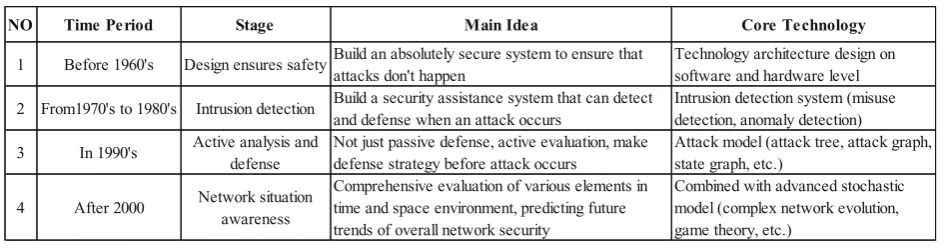
the first stage of network security research. However, people soon realized the impossibility in practical oper-ation [2]. The existence of malicious intrusion provokes the thought to build a security assistant system with an aim to detect the intrusion in time and take corresponding measures. The most typical application is the intrusion detection system (IDS) [3]. The intrusion detection is orig-inated from Anderson’s Technical Research Report [4], and the subsequent researches can be divided into two categories: anomaly detection and misuse detection. At present, the IDS of most research institutions and com-mercial organizations is based on these two categories. Intrusion detection technology provides predictive warn-ing information to ensure network security when network attacks occur, but it is too weak to do anything about the wall-around stealth attack and multi-step compound attack. Such a passive defense technology is unsatisfactory in the real-time detection. On this basis, the focus of the third stage research after the 1990s shifted from passive defense to active analysis [5,6], which is originated from the development of hacker technology. The intent is to carry out an integrated safety assessment before the occur-rence of network attacks, formulate a defense strategy, or still provide predetermined service function given the dam-aged network. In 1990, Bass first proposed the concept of Cyber Situation Awareness CSA [7, 8], which intends to perceive elements in the time and space environment, so that people can better grasp the overall network security situation and predict future trends, which to a certain ex-tent promotes the integration of network security research and other disciplines. The development, especially the combination with some advanced stochastic models, has made theoretical progress (such as stochastic algebra [9], game theory [10], Bayesian network [11]). However, most of them are based on CSA conceptual model to optimize the evaluation algorithm with few breakthroughs in the practical application and systematic expositions (Table 1 gives a brief summary of the four main stages of the devel-opment of network security studies).
This paper gives a systematic introduction to the field of network security situational awareness, with an aim
to provide insightful guidance for understanding the related concepts, promoting their application in practice and carrying out large-scale network expansion. In addition, a general analysis framework of network secur-ity situational awareness is proposed from the perspec-tive of value chain. The framework divides the process of network security situational awareness into five stages: factor acquisition, model representation, measurement es-tablishment, solution analysis, and situation prediction, which summarizes the current research progress in each stage and discusses the practical application results of typ-ical methods. Moreover, this paper also elaborates the visualization of perception analysis results and situational awareness in the large data environment and prospects the key issues and research trend of this topic.
2 Research status at home and abroad
Situational awareness is first seen in the study of military academia. The human factor analysis of Theureau [12] in aviation has greatly promoted the application of this field in human-machine interaction, medical emergency scheduling, and real-time battlefield command. In 1988, Endsley [13] defined situation awareness as the three-level model of situation factor acquisition, situation understanding, and situation prediction, and the applica-tion framework of situaapplica-tional awareness in dynamic decision making was proposed in 1995 [14]. On this basis, the case study of the practical application of situational awareness is started, for example, Boyd con-trol cycle model [15], Tadda JDL data fusion model [16] based on Endsley’s three-level model, cognitive fusion control model [17], and so on.
Inspired by the air traffic control (ATC) situational awareness, Bass [7] of the US Air Force Communica-tions and Information Center first proposed the concept of network situational awareness, in an attempt to apply the ATC data fusion to network situational awareness. Since then, the attention of most studies is paid to the data fusion analysis with the ignorance of the essential definition of cybersecurity situational awareness. At present, there is no clear and unified expression of
network security situational awareness. However, con-firmation is made that network security situational awareness and situational awareness belong to the rela-tionship between instance and type instead of that of subset, which means the relevant theory of situational awareness and the method can be applied in the field of network security situational awareness after the specific processing. The literature [19] has a systematic explan-ation for the definition of network security situexplan-ational awareness and the understanding of the basic concept. Based on the explanation above, this paper offers the basic operation mechanism of network security situ-ational awareness and illustrates the role of each link in the cognitive process of network security status in the mechanism.
2.1 Network security situation awareness and intrusion detection
The general model of the intrusion detection system (IDS) is first proposed by Denning [20]. Its core idea is to set up a regular set of rules that can be updated and modified under the condition of a unified clock. There-after, information is collected by an agent from the net-work process records and compared with the defined rules, and then, determination is made whether the activity set exists, which is trying to break the integrity, confidentiality, and availability of resources. The struc-ture of IDS can be mainly divided into three types: host-based detection [21], network-host-based detection [22, 23], and agent-based detection [24]. The host-based detec-tion mainly matches the process record informadetec-tion on a single host. This obviously does not meet the security requirements under the network environment; thus, the network-based detection is built after adding some ele-ments on the host-based detection, such as network traf-fic and protocol information; however, with the gradual use of distributed systems, IDS on distributed hosts also needs information interaction, which contributes to the formation of agent-based detection. Technically, IDS is mainly divided into two types [25], abnormal intrusion detection and misuse intrusion detection. Abnormal be-havior is the opposite of normal or harmless bebe-havior, so the rule set in abnormal behavior detection is the mode of the normal operation of the system. When detecting the deviation from the normal model, the alarm signal is generated. The advantage of this method is that any ex-ploratory behavior will be recorded in addition to the prescribed “normal” action. But there will be a higher “false alarm rate” because the normal mode of the sys-tem is dynamic and cannot be completely normalized at the beginning of the establishment of the detection model; misuse behavior is abnormal or harmful behavior, so the rule set of misuse behavior detection is a model of system harmful behavior. When it detects the behavior
that matches the harmful pattern, it produces an alarm. In the case of clear matching, this method has high accuracy, especially for the typical known attack model. But there is a big“rate of missing report”because it is almost impossible to passively carry out the whole sample summarization of harmful behavior under the background of diverse aggres-sive behaviors.
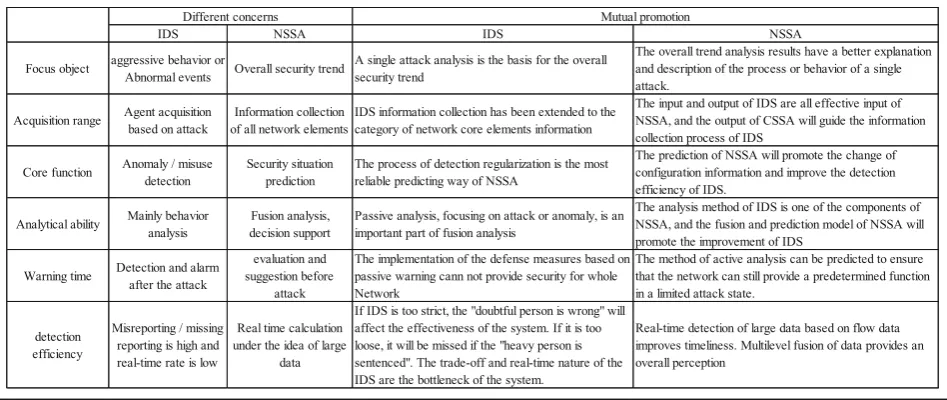
Through the brief summary of IDS, there are two main bottlenecks: passive response and false alarm rate/miss-ing report rate, and the researchers have done a great deal of improvement on these two points. The main improvement of the passive response mode is on the automatic or semi-automatic response mode [26]. The main reason forfalse alarm rateormissing report rateis that there is a gray area between normal and abnormal, for which the IDS system and administrators cannot be analyzed in a unified perspective. Therefore, the im-provement of this aspect is mainly the multi-level fusion analysis of more information [27–29], which is consist-ent with the summary of the four main stages of net-work security research in Table 1. In fact, the initial research on network situational awareness is also based on IDS. Bass [7,30] proposed a multi-sensor integration intrusion detection framework after the concept of situ-ation awareness, and literature [31, 32] also put forward a similar framework. On this basis, lots of influential security situational awareness applications appeared, such as NVisionIP [33], VisFlowConnect-IP [34], and UCLog+ [35].
whole network. With the elaborate study, the input information of IDS also has a great expansion, but the input of IDS must be a subset of the input of the net-work security situational awareness, and the output of the IDS can also be used as the input element of the net-work security situational awareness. In turn, the result of the network security situational awareness will make IDS’s information collection more precise and effective. Thirdly, at the functional level, the core function of IDS is to intercept suspected attack behavior through abnor-mal/misuse detection comparison and guide network administrators to take measures to defend the next at-tack. The core purpose of network security situational awareness is to carry out the security situation predic-tion, which is intended to guide the administrator to take configuration measures before the attack, which will certainly improve the detection efficiency of IDS. The pre/post-rule detection method based on standard IDS is also the most effective and reliable prediction method of network security situational awareness; fourthly, the analysis of IDS mainly focuses on attack be-havior, but it is not capable of multi-step attack or attack around the wall. Most fusion analysis of network secur-ity situational awareness also deals with the analysis of aggressive behavior or abnormal behavior, because such behavior produces more benefit than normal access be-havior. However, the overall analysis results including other behaviors will give IDS guidance both in particle size and in the accuracy of description; fifthly, in the early warning period, IDS carries out the acquisition analysis and warning based on audit information after attack, and the passive response mode is difficult to guarantee the network security in real time. Network se-curity situational awareness does the active sese-curity situ-ation perception before the attack, and it does not aim
to eliminate the attack but to ensure that the network system is still safe or can still provide a predetermined function under the conditions of a certain attack. At last, in the detection efficiency, the core breakthroughs of IDS are high rate on false alarm/missing report and weak real time. If the configuration is too strict, the as-sertion of “suspect is wrong”will affect the effectiveness of the system. Loose configuration means “only heavy person should be judged”will miss the report. The com-promise state between the two extremes requires the system to have the human gray perception ability, rather than the computer cognitive logic which means one or the other. The fusion process of network security situ-ational awareness (NSSA) is easier to cross boundaries with artificial intelligence and other multidisciplinary research results for further improving the flexibility of detection, and the fusion analysis of flow data in large data environment will greatly promote the real-time per-formance of detection.
2.2 Status of foreign research
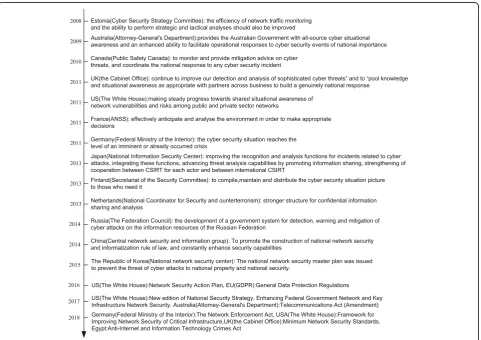
understandings of cybersecurity and strategy implemen-tation, countries are aware of the need to take action to protect the key information and related infrastructure, as well as to achieve the prediction of intelligent
net-work security situation with new methods and
technologies.
The great emphasis from governments can bring more financial support in terms of the fund. Besides, the spon-taneous and continuous attention of many researchers to this field has made the researches on cybersecurity the top hot issue. In order to fully understand the re-search status of network security situational awareness, this paper firstly searched and reviewed articles on this topic in the past 10 years in the core database in September 2017, and sorted out a total of 10 large cita-tions of review literature [16, 37–45]. Based on the actor-network theory, Kopylec et al. [37] explored the critical relationship between physical and network infra-structure, and demonstrated the results of situational awareness through visual cascading. From the viewpoint of network’s key equipment administrators, he managed to maximize the understanding of the process of the risk propagation, thus providing systematic guidance in
related planning and emergency response. Based on the combination of computer automation technology with human irregularity (abnormal or new mode) processing capabilities, literature [38] describes the research ideas and tools provided by the VizSec R&D community, which enables network managers to better identify the potential cyber threats. With aspect to the multidiscip-linary integration, Jajodia et al. [39] conducted the re-search in relation to the questions and methods of network situational awareness in 2010 with an excellent conclusion and analyzed the key problem of the network situational awareness, as well as summarizes the main reasons for the lack of network situational awareness. Tadda and Salerno [16], Giacobe [40], and Schreiber-Ehle and Koch [42] inquired into the application process of JDL model in the field of situational awareness, espe-cially in literature [40] for the favorable induction and summary of the data source information at level 0/1 in JDL model. In addition, Klein et al. [41] and Vincent [45] et al. applied the OODA loop model [15] to the network situational awareness and some stages in the model are prerequisites for others. Through such a class decision paradigm, the various activities in network
defense are integrated. Much emphasis in literature [43] is attached to the information security of industrial networks. The difference between industrial networks and general computer networks makes the commonly used “detection/repair” methods in general computer networks not fully applicable. In light of this, the current state of distributed computing systems has been evalu-ated in the present paper, and the key elements in defen-sive countermeasures can help to reduce the risks to an acceptable threshold. In 2014, Franke and Brynielsson [44] conducted an effective summary of 102 articles in the four major scientific databases, being regarded as one of the best researches in the past 3 years, where 11 sub-categories were compared and the current status of the research was discussed according to the research field or content. The literature [46] provides an overview of the problems, challenges, threats, and solutions in social network security. In a strict sense, computer net-work security is an integral part of social netnet-work secur-ity. Therefore, some of the methods mentioned provide a meaningful reference, and the logic of their induction and comparison has greatly inspired this current paper.
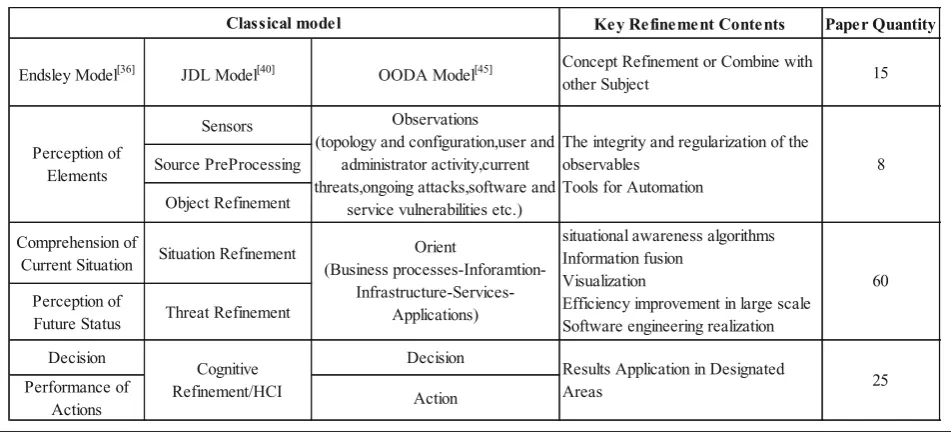
By summarizing the literature review, it can be found that the main thread of foreign research is to instantiate the situational awareness model and method in the field of network security situational awareness, and continu-ously test and optimize the process in practice. In order to effectively analyze the research details of network security situational awareness, this paper concludes 75 papers in the core database in recent years and the re-search points of these articles are mainly concentrated on 9 aspects (the key points in these 9 aspects are shown in Table 3). The research content is mapped with the
traditional Endsley model [36], the JDL model [40], and the logical phase of the OODA model [45]:
The concept of the model (integration with other disciplines) [16,18,39,45,50–57,63,67,68]
The completeness and regularization of data acquisition variables [40,42,45,47,73,87]
The optimization of related algorithms [58–67]
The information fusion analysis [40,42,53,69–74]
The automation of process tools [33–35,73,75,84,85,87]
The visualization of work at each stage [5,11,55,
61,76–79,86]
Practice testing and efficiency gains in large-scale real-world networks [80–82]
The software engineering implementation of sensing methods [42,83–85,88]
The practical application of analysis and prediction results in specific fields [42,47,73,79,87,89,90]
(1). In the research for the concept of model, some papers are aimed at explaining interpretations of traditional situational awareness models in network security situational awareness (such as literature [16,39,45]). Some papers focus on the
combination of situational awareness with security issues in specific fields. For example, Ralston et al. [47] summarize the safety perception problem of distributed control system and data acquisition control system. Barford et al. [48] defines and explains the scope, background, and research objectives of network-aware defense. Alexandros
et al. [49] summarizes the security threats and detection technologies in the field of wireless networks. Literature [50] has incorporated sensitive devices into the priority perception area and showed that how the DPI is installed at the boundary of the network perceives the health of the system; some literatures try to integrate the concepts of other disciplines into network security situational awareness, such as the combination with game theory in literature [51–53,63], the combination with Petri network [54], and the combination with the Bayesian network [55]; also, some other articles try to provide a more general operational model (such as the literature [56,57,67]).
(2). Data acquisition is the basis of network security situational awareness. The attention now is paid to how to ensure that the collected information is a complete set for the fusion analysis in next step (completeness) and to standardize the collected information to promote the mutual call between different systems (regularization). Giacobe [40] has effectively combed the scope of source data and entities. In literature [45], the categories of sensors are divided into three categories: activity,
configuration, and topology. In addition, in the specific field, the scope or type of collected information may be different [42,47,73,87]. (3). The research on perception algorithm or
architecture accounts for the largest part in all literature, with a proportion of more than 70%. Most of the articles give the logic of the algorithm and the demonstration effect in the experimental application. Literature [58] divides the common methods in situation awareness into five categories: Bayesian approach, knowledge-based approach, artificial neural systems approach, fuzzy logic approach, and genetic algorithm approach. In the algorithm for network security situational awareness, there are algorithms for data sources (such as the algorithm for the attacker [59], the algorithm for intrusion detection data [60], and the algorithm for the vulnerability logic association analysis [61]). Some algorithms are targeted at the behavior analysis of attackers or defenders (for example, hidden Markov chains are used to predict internal attack threats in document [62], combined with game theory [63], machine learning method [64], and honeypot technology [65], etc.); also, there are many algorithms for improving efficiency and enabling them to be extended in large scale networks (such as real-time decision analysis method [66], and fast calculation method for static statistical data [67]). (4). The fusion analysis ability on the related
information is the advantage of network security
situational awareness. The core method is to derive the hidden knowledge from the data from different sources. The related literatures are divided into three parts: one is the instantiation of data fusion model in traditional situational awareness in the network security situational awareness (such as [40,42]); one is to propose a specific fusion technology or idea based on the characteristics of network security data. For example, Paffenroth et al. [70] and Mathews et al. [71] have designed data models or coordinate working systems to integrate data from different network sensors. Literature [69,72] discuss the uncertainty in the network security situation. Sanfilippo [73] design a multi-sensor fusion framework to improve the perception ability; other literatures attempt to promote the efficiency of information fusion (e.g., [53,74]).
(5). Automation based on the full use of the computing power of the computer is one of the effective ways to improve efficiency. In the IDS phase (the second stage of Table1), the working mechanism of IDS is automated, but it also becomes the bottleneck of the system in turn, since the rule of the computer is not consistent with the perspective of human fuzzy evaluation. At present, the research on automation is mainly focused on information collection (such as literature [33–35,75]). In addition, systematic implementation of the overall application effect has realized automatic processing to a certain extent (such as [84,85]); the automation ability is also a prerequisite for the practical application of large-scale networks (e.g., [73,87]).
(6). Visualization is undoubtedly an important part of network security situational awareness [86]. Tamassia et al. [76] give a clear statistical result on this aspect. Most of the current literature focuses on the friendly interaction between human and machine. Beaver et al. [77] effectively filter the analysis process and data in IDS and present them to administrators in a visual way. In literature [78], with the help of the unique professional knowledge of the participants, a real-time evaluation visual framework is designed to allow network managers to participate in the analysis loop manually; some articles focus on machine learning methods for visual rendering (such as artificial neural network [79] and cluster analysis [77]). In addition, most active analysis models such as attack graphs are combined with visualization technology [5,11,55,61].
the model. There are two aspects of research in this segment. One is the construction of basic data sets that can be used for horizontal comparison among multiple models (for example, the data set
produced by the security contest held in literature [80] in 2010. Fink [81] collates the data set by each team in the competition). The other is the practice of wide area environment (at present, the attention to this aspect is little; literature [82] has made a preliminary attempt on this).
(8). Consideration for the overall logic rather than a certain segment is the consensus view of the scholars [83], in view of the fact that the overall logic means that it should be designed from the perspective of software engineering. Only on this basis, the process and result of perceptual analysis can become effective tools. D’Amico and Whitley [84] design the overall analysis process based on the different roles and present it visually; literature [85] gives a task flow chart according to processes, goals, and concerns. There is a long way to go now, and the design and realization of network security situational awareness can be done from the perspective of instrumentalism software, which integrates the characteristics of all kinds of users in the network, and give a friendly target
understanding method when human-machine interaction with necessary attention [42]. (9). There are some articles concerning the analysis
method of network security situational awareness and the practical application of prediction results in specific fields. The present statistical results mainly concentrate on three parts: one is the application of industrial control networks [47], especially in the field of power grid control [79,87]; one is for the emergency management of the key equipment, such as the shared situational awareness metamodeling proposed in Literature [89] and the operational architecture proposed by Adams [90]; and another is in the military field [42], such as the practice application of nautical training [73].
2.3 Status of domestic research
When it comes to the dominance of policies China, great importance is attached to the network security from top to bottom. As a consequence, China has established the emer-gency response mechanism related to network security at all levels, which is similar to European and American coun-tries, such as CCERT(China education and scientific re-search network computer emergency team), set up in May 1999, and CNCERT/CC (National Computer Network Emergency Technology Processing Coordination Center, referred to as the “National Internet Emergency Center”), established in September 2002, as well as the central
network security and information leading group, formed on February 27, 2014. On April 19, 2016, General Secretary Xi Jinping emphasized the importance, task, and goal of net-work security in his speech at the Symposium on Netnet-work Security and Informatization [91], and clearly put forward that perceiving network security situation is the most basic and basic work. Due to the limited space, this paper does not make too much interpretation of China’s network se-curity policies and industrial development.
awareness and expounds the relationship between situ-ational awareness and IDS. Gong et al. [98] put forward a logical research framework on the basis of full under-standing of situational awareness and attached emphasis on the method of network assessment. Based on the fu-sion algorithm of cross-layer swarm optimization, Liu et al. [17] puts forward a cognitive sensing and control model. Under the background of the transition of network development from perceptual network to perceptual net-work, the related algorithms of quantitative perception are given. Gong et al. [19] discuss the relationship between network security situational awareness and situational awareness at the conceptual level and further proposes the definition and explanation of network security situ-ational awareness. Based on Endsley’s three-stage model [14], the stages of network security situational awareness are divided, and the specific analysis methods of each stage are compared.
In light of the comparison between the domestic and foreign literature, it is found that the time Chinese scholars pay attention to network security situational awareness is close to that of foreign scholars, but most of them are in the state of“following,”with few original and innovative articles. Most of the high-cited articles in ESI are aimed at the breakthrough of the model algo-rithm optimization and application level [96, 99], espe-cially in the aspect of situation quantitative computing perception [115, 117, 124, 129], which can be regarded as the main line of domestic research in this field. At the same time, after a careful screening of domestic research literature, it can be found that a considerable number of articles on the topic of “information fusion, situational awareness”only stay at the micro-cognitive level (which is generally different from foreign literature based on the improvement of Endsley’s model [36], JDL model [40],
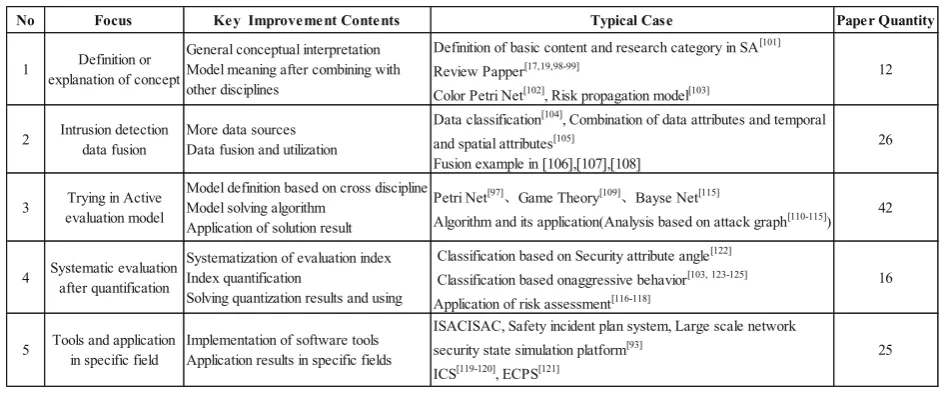
and OODA model [45]), that is, more data sources are integrated from the bottom up instead of the top down. However, these first partial then overall studies have also made remarkable progress and have played an obvious role in promoting the whole field. By summarizing about 100 articles among core journals in the CNKI, the re-search focus of these articles is mainly concentrated on five aspects (the summary of the key research contents in these five aspects and the typical article representa-tives are listed in Table4):
The definition or explanation of concept [17,19,97,
98,100–102]
The intrusion detection data fusion [103–107]
The active evaluation model attempt [96,101,108– 114,124–126,128,129,132,143,153–155,159– 162,177]
The systematic evaluation after quantification [102,
109,115–117,121–124,173]
The implementation of design and application in special fields [92,118–120]
(1) The research on the definition or interpretation of the concept mainly focuses on two aspects: one is the basic conceptual explanation, and the other is the prac-tical significance of network security situational aware-ness in special field after merging with other subjects. The basic conceptual explanation is mostly found in the summary literature, such as the definition of the basic content and research category in literature [100], the description of the concept of intrusion detection in lit-erature [19], and the definition of the network security situation perception by the literature [17, 19, 97, 98]. Prior to achieving multisensory integration with other disciplines, it is necessary to do the abstract definition,
which can explain whether the integration is effective, and the effect after the combination, such as the defin-ition of color Petri net (CPN) in literature [101] and the definition of risk propagation model in [102].
(2) The fusion and utilization analysis on IDS includes two aspects: the collection of more complete data sources and the integration and utilization of multiple types of data. In the collection of multi-data sources, there is a good display in the evaluation framework of literature [103]. Li and Lan [104] combine data attri-butes with time attribute and space attribute, which is beneficial to the evidence fusion of subsequent data; there are lots of articles for multi-type data fusion; litera-ture [105] combines multiple IDS and manual survey techniques, and studies its optimal allocation and strat-egy based on game theory. Ren et al. [106] puts forward an intrusion detection model based on data mining and ontology, which can cluster and classify the underlying alerts, discover and filter attacks, and then based on the established ontology attack knowledge model, correlate these attacks to identify, track, and predict the effect of multi-step attacks, such as the fuzzy clustering anomaly intrusion detection method in literature [107].
(3) The attempt of the active evaluation model mainly re-volves around the attack model, and each article usually contains three components: model definition, model solv-ing algorithm, and solution result. The definition of the model is generally combined with other disciplines,
such as Petri network [96, 153–155], game theory
[108, 124, 159–162], and Bayesian network [114, 132], and some articles also focus on the improvement of model description ability [125, 126]; the solution algo-rithm depends on the definition of the model, and it is generally shown together with the solution result. There are lots of literature [109–114] trying to improve on this point, such as the reachable path analysis based on attack graph [101, 128, 129, 143, 177], defense strategy analysis [111,124,161], and survivability analysis [126].
(4) There are three main parts in the systematic evalu-ation after quantifying: systematizevalu-ation of evaluevalu-ation index, index quantification, and quantified results and its application. The research on the systematization of evaluation index and the quantification of corresponding indicators mainly proceed from two angles: security at-tribute and attack behavior. From the perspective of se-curity attributes, it is more focused on the definition and interpretation of network security. For example, Wang et al. [121] propose an attack technology classification method to meet the Amoroso classification standard; from the perspective of attack behavior, most of the researches take the attack as the center to quantify the important factors in the attack process. According to the statistics and analysis of the existing literature, the quantifi-cation of the 3 elements (attack severity, attack occurrence/
success probability, and attack income) has basically formed a certain standard [102,122–124]. On the basis of index system and index quantification, risk assessment algo-rithm can be developed to get the perception or evaluation result [109, 115–117].
(5) The active participation of all parties will definitely promote the production of relevant research results and deepen the application in the industry. The emergency response of China’s network security follows the PDCERF methodology (the preparation, detection, eradi-cation, suppression, recovery, and tracking of 6 stages). A large number of practical products and systems have been put into use, such as information sharing and ana-lysis center, large network security events coordination early warning positioning and rapid isolation control, se-curity event planning system, large-scale network secur-ity state simulation platform, linkage system, and backup and recovery system [92]; on the combination of indus-try applications, similar to foreign countries, it mainly focuses on two aspects: ICS [118,119] and ECPS [120].
2.4 Summary of the present research
This section summarizes the research history, develop-ment stage, and present situation at home and abroad of network security situational awareness. In general, in the background of winning the commanding heights of network security strategy for all countries, the research on this aspect is of great significance and has made considerable progress, but the result of the study is still on the path of exploration, and the main problems are concentrated in three aspects.
Firstly, there is no comprehensive analytical perspec-tive in terms of concept and ideology. Foreign researches mainly focus on the instantiation of situational awareness in this field, and domestic researches concentrate more on the integration of more information and efficiency im-provement. However, according to the summary of Table1 in this paper, network security situational awareness is a more advanced stage of network security research. It is not a model or a method. It should be a more valuable framework from all the existing network security concepts or means.
feedback effect should be effectively embodied in the model after perception decision.
Thirdly, there is no meaningful horizontal comparison in terms of effectiveness and application level. Every art-icle or model will be verified by experiments, but few ar-ticles are compared as a whole. The existing and previous literature are more compared in the complexity of the algorithm, and the result of perception is a com-prehensive synthesis of intelligence. It is different to judge directly for so many constraint factors, and the current application value comparison should focus on the horizontal comparison within a certain stage based on a standard data set.
The following chapters are arranged as follows: The second section abstracts the experiment object from the actual network topology and configuration of a medium scale software company to ensure the accuracy verifica-tion and relative comparison in the following chapters under the same standard. In the third section, from the perspective of system engineering, the network security situational awareness analysis is divided logically and gives out a new reasonable frame. From the fourth to the eighth, each segment of the whole framework is expounded, focusing on the role of this segment, the mainstream method, the application results on the ex-perimental network, and the horizontal comparison be-tween the methods within a certain segment. The ninth section briefly introduces the research dimension and direction of network security in a big data environment. The tenth section is the summary of the full text.
3 Experimental basis
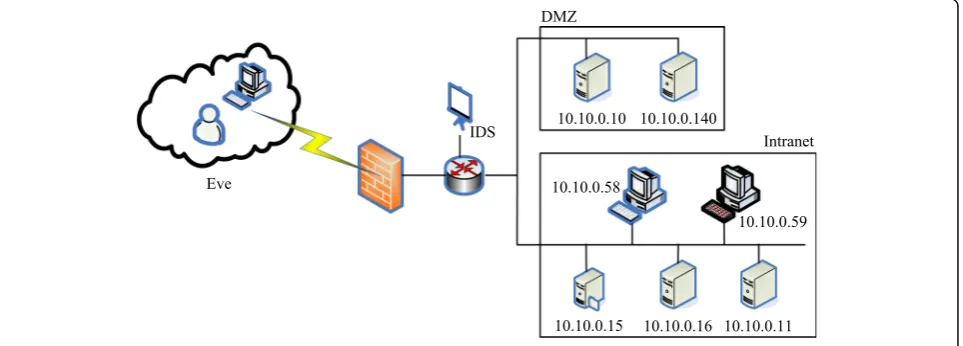
In order to effectively compare and summarize the dif-ferent methods in difdif-ferent stages of the proposed framework, this section first briefly introduces the ex-perimental environment used in this paper as the basis for subsequent chapters. A medium-sized software
development company is chosen as an experimental ob-ject. Figure2is the network topology graph of the enter-prise. The network God is used as the monitoring device between the internal and external networks through the dedicated telecommunication lines and the external net-work links. 10.10.0.10 is a web server which provides the function of publicity website and product demonstration. 10.10.0.140 is a log server that can be accessed from the external network (because company personnel are often on business trips, both internal and external network ac-cess are required to go through the external network). 10.10.0.15 is the company’s database server, running SQL Server, Oracle, the two relational databases, and a non-relational database MongoDB. 10.10.0.16 is the test server, and the products the company has delivered and is developing have the latest version of the deployment on the test server. 10.10.0.11 is the internal development server. All the company’s source code and important project solutions, process information, etc. are all on this server. The company has a development team of about 100 people, which is mainly divided into two categories
due to the different development technologies.
10.10.0.58 represents the technical team developed by.net, and 10.10.0.59 denotes the technical team devel-oped by Java.
4 Logical analysis framework
Network security situational awareness usually involves multiple different phases, and the systematic approach is preferred to process the data related to cybersecurity. There are two main methods for logical division: the first method is the engineering hierarchical method (such as Figure 2 in literature [45], Figure 3 in literature [97], Figure 1 in literature [103], and Figure 4 in litera-ture [126]) and the second is the conceptual hierarchy (such as Figure 3 in literature [45] and Figure 1 in litera-ture [14]), but neither of these methods can provide an
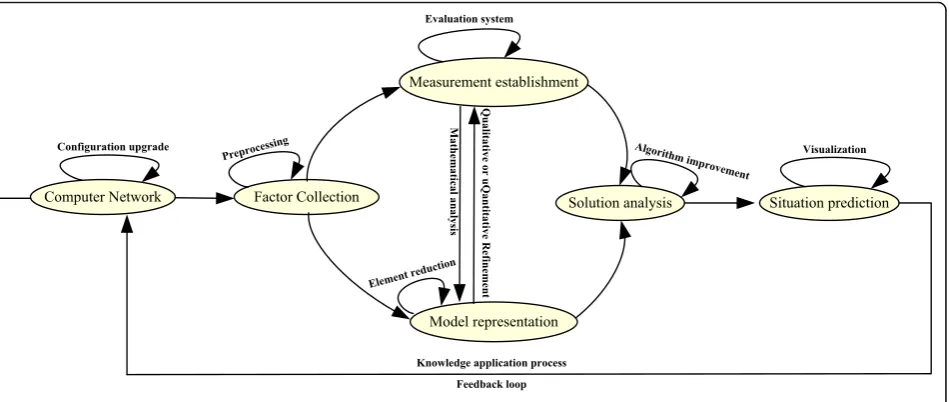
easy-to-understand architecture from the perspective of the data processing stage. From the perspective of data value chain, the present paper adopts the systematic engineering method which is widely accepted by indus-try to decompose the typical cybersecurity situational awareness process into five continuous processing stages, including element acquisition, model representa-tion, metric establishment, solution analysis, and situ-ation prediction, as is shown in Fig.3below.
(1) The element acquisition phase is concerned with how to effectively obtain the security-related data as much as possible, which is mainly divided into two tasks: data acquisition and data preprocessing. Data acquisition refers to the effective storage process including collecting configuration information in the network, behavior information in the log, and vulnerability information which can be achieved by using a scanner, a sensor, or a specially written tool. Data preprocessing is a process of regularizing original data before data modeling or analysis and utilization.
(2) The model representation stage is focused on the correlative expression of the effective elements, which is mainly divided into two tasks: element reduction and formal representation. According to the purpose of the analysis, it is necessary to reduce the acquired objects effectively during the element acquisition process in order to achieve the efficient analysis. The formal expression refers to the process of precision abstraction including the attributes of the reduced elements, the relationship between the elements, and the order relationship.
(3) The metric establishment stage is the process of refining the value of each element object before the
solution analysis, mainly including the quantitative classification and evaluation index system to determine two tasks. The quantitative process is a process of numerically assigning the attribute values of each element (in this present paper, the
qualitative classification is treated as a special quantitative classification without special
explanation), and the confirmation of the evaluation index system is the process to regularize the logical relationship between the attribute values of the elements.
(4) Solution analysis is the algorithmic process based on the first three stages mentioned above, which mainly includes three tasks: the determination of the solution algorithm, the verification of the correctness of the algorithm, and the improvement of the algorithm. The solution algorithm is the process of effectively combining the target with the model and the metric to ascertain the analysis step. The correctness verification of the algorithm is to validly correspond to the input and output of the algorithm. On this basis, the efficiency of the algorithm should be considered to improve in order to expand in the true scale network environment. (5) Situation prediction is a process of comprehensive
evaluation and decision-making based on the analysis results, which mainly includes two tasks: result visualization and decision-making after knowledge application. The result visualization is the process of presenting and constructing the solution results in an easy-to-understand way. After the analysis and decision-making, the feedback loop will be applied to the current network for cybersecurity reinforcement (such as vulnerability repair and configuration upgrade) to complete a perceptual loop.
5 Phase I: Element acquisition
The function of the element acquisition phase is to ef-fectively capture the key data used in each phase of the cybersecurity situational awareness. In general, element acquisition refers to the collection of all the elements related to cybersecurity. In the narrow sense, element acquisition refers to the collection of the elements involved in a certain perception process. The purpose of this present paper is to sort out the basic framework of cybersecurity situational awareness, and the core imple-mentation methods of each stage are compared horizon-tally, so the element acquisition in this current paper refers to the generalized element acquisition.
Undoubtedly, element acquisition is the premise of cy-bersecurity situational awareness. Other subsequent stages are unable to work without basic data collection. Most of the documents collected so far have clearly defined the functions and important impacts of this stage in the logical description of the framework. How-ever, as for the implementation, most of them only men-tion the data acquisimen-tion through automated scanning tools or sensors, and according to the following-up model to directly stipulate or preprocess, there are also some literature introducing the way to obtain data or tools [33–35] and so on. Strictly speaking, element ac-quisition is divided into three parts: data generation, data acquisition, and data preprocessing. In light of the division of logic analysis framework in Section 3, data preprocessing is generally carried out after the model definition or measurement establishment phase. Data ac-quisition is generally completed by combining manual and automatic methods. The focus is generally on the development of automated tools. This section focuses on the classification of data from the perspective of data generation.
In the existing cybersecurity situational awareness lit-erature, the basic data collection part is mostly accord-ing to the needs of model analysis to reverse the data used (narrow element acquisition), which is not condu-cive to data standard unification and model-to-model comparison verification. According to the logic of engin-eering, this present paper briefly summarizes and classi-fies the data in cybersecurity analysis from the perspective of data generation.
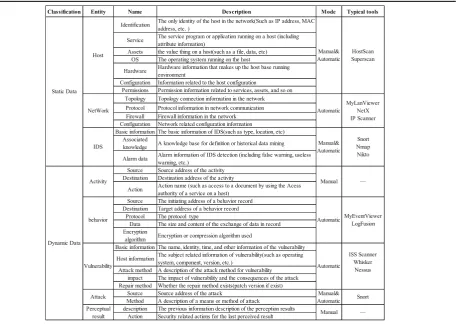
Here, the data is divided into two categories: static data and dynamic data. Static data refers to data that does not change substantially in a cybersecurity situ-ational awareness analysis cycle shown in Fig. 3. Dy-namic data refers to changes in the cybersecurity situational awareness analysis cycle shown in Fig. 3 as the analysis process going on. As shown in Table5, the static data mainly includes host information (such as host IP address or MAC address unique identifier, run-ning service or program, file, data and other confidential
assets, operating system, hardware composition, system configuration, and permission configuration), network information (such as network device information,
net-work topology information, protocol information,
firewall information, and network configuration informa-tion), and IDS information (such as basic information of intrusion detection system, expert knowledge base, and alarm information), and the dynamic information mainly includes activity information (such as source address, destination address, and activity description), behavior information (such as source address, destination address, protocol in use, transmission data size, and compression algorithm), vulnerability information (such as vulnerabil-ity name, logo, basic information such as release time, vulnerability host information, attack methods, attack ef-fects, and repair methods), attack information (such as attack source address and attack method), and perceived result information (e.g., perceptual result information of the last perceived loop and the action information after perception).
6 Phase II: Model representation
Formal modeling is the key link in the cybersecurity situational awareness operation mechanism. The de-scription ability in the modeling stage of reduced state and formalization will directly affect the subsequent per-ceptual analysis results. Through the summary of the existing literature, the cybersecurity situational aware-ness model is mainly divided into three categories: mathematical model, stochastic model, and biological heuristic model. The core concepts and typical represen-tatives of each classification are shown in Table6below.
6.1 Mathematical model
The mathematical model is used to analyze the cyberse-curity situational awareness. The main idea is to use mathematical language or mathematical symbols to summarize or approximate the security-related features or quantity dependencies of computer network systems. The mathematical model here refers to the mathematical model in the narrow sense, that is, the mathematical expression of the relationship between variables in the cybersecurity system. Therefore, the perceptual analysis method based on a mathematical model is more biased towards the form of quantitative analysis. It mainly in-cludes analytic hierarchy model, Bayesian model, fuzzy set/rough set model, reliability/survability model, etc.
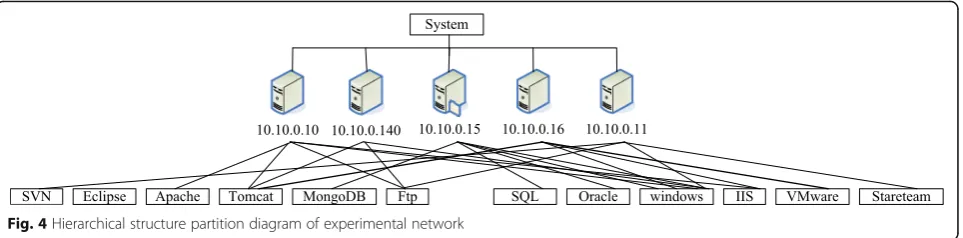
and local area network are security situation quantification results, based on the subjective quantization method in lit-erature [99]; Tomcat service, FTP service, and the overall security situation of each host and local area network are security situation quantification results. The hierarchical model is consistent with the decision-maker’s thinking process in both the analysis and the calculation process, which ensures the results are intuitively understandable (for example, the security situation index is relatively high in Fig.5at around 17:30; because most people fill in the logs around this moment, the frequent external network map-ping will lead to higher security risks). The construction of an effective hierarchical structure is the key to the applica-tion of this model, and some literature has studied the in-stantiation of the hierarchy [127], but the current element
quantization process basically adopts the subjective experi-ence value method, which cannot be compared and quanti-fied between every two factors in the classical analytic hierarchy process, thus leading to the lack of objectivity, and the current hierarchical structure is only suitable for the local area network which contributes to the difficulty in carrying out large-scale promotion, as well as no effective prediction of the future situation.
In order to effectively reflect the uncertainty and sub-jective elements in the cybersecurity situational awareness analysis, the probabilistic method is usually used for quan-titative description [128, 129], in which Bayesian logic is the most commonly used model. The relationship rules and mathematical reliability of Bayes are very similar to those of human thinking reasoning. Bayesian calculation Table 5Classification results of entity and data in element collection
can synthesize the latest evidence information and prior information to ensure that the calculation results maintain two important characteristics: continuity and accumula-tion. There are literatures adopting Bayesian mathematical methods for cybersecurity situational assessment [131], but most of them are used as quantitative computing tools in combination with other models, especially the combination of Bayesian and attack graphs [114, 130, 132], combining graph theory and probability theory to complete a Bayesian network, using graph theory to show the structure and interdependence at the qualitative level, and using probabil-ity theory to carry out quantitative expression and reason-ing at the quantitative level. Some progress has been made in this perspective, but the Bayesian network is a decom-position form of the joint probability distribution at the the-oretical level. The variables in the actual solution are not independent from each other, and the joint probability is too complex to suit the large-scale networks.
The fuzzy set contraposes the traditional set. In the traditional set, the relationship between the object and the set is clear (either one or the other), but in reality, some objects do not have a clear affiliation of the set, There exists an interval of degree of membership
(membership function). Some literatures apply fuzzy similarity and fuzzy comprehensive evaluation in cyber-security situational awareness analysis [133, 134]; the rough set extends the classical set theory, which uses the upper and lower approximations to approximate any set, and it can analyze incomplete information such as in-accuracy, inconsistency, and incompleteness without prior knowledge, discover hidden knowledge, and reveal potential laws. Zhao and Xue [135] and Kong et al. [136] utilized the idea of rough concentration mode classifica-tion in the cybersecurity situaclassifica-tional assessment, using each security evaluation index as the condition attribute set C, and determining the decision attribute D of the load situation assessment result according to C and then according to the D synthesis comprehensive security situation network. However, the current research in this area is limited to describe the uncertainty in the process of fuzzy sets or rough sets, and it is impossible to com-bine the target or core problem of cybersecurity situ-ational awareness with the fuzzy set or rough set method. The practicability and the continuity of research are limited. In combination with other models or methods, it is generally carried out at a certain point in
Fig. 4Hierarchical structure partition diagram of experimental network
a b
c d
the analysis process and adopted more as a quantitative tool for uncertainty.
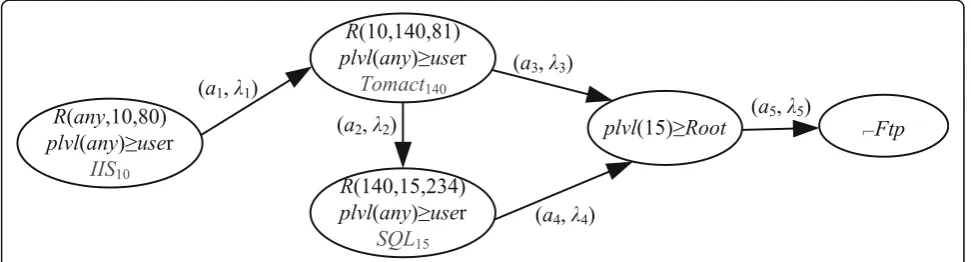
Feng et al. [137] combined the reliability theory with the vulnerability analysis process to quantify the security of the distributed system. It is intended to ascertain the system maintenance probability of the security state under the specified conditions and the specified cost c through the reliability function Rs(c). Figure 6 below is the vulnerability state modeling result of the attack on the Ftp service on 10.10.0.11 (internal development server) according to the literature [137], and the average attack cost for this service isE(C) = 1/λ1+1/λ2+1/λ3+1/
λ4+1/λ5. In literature [138], the mathematical
condi-tions are used to obtain the criteria of complete prob-ability control or partial probprob-ability control of complex attack networks. It is theoretically proved that if there are effective defense nodes in the network, the complex network can still provide normal service when it is attacked and destroyed and suggests ways to defend against node selection and control networks. The ad-vantage of adopting the reliability or survivability model for cybersecurity situational awareness analysis is that there is a mathematical derivation process to ensure the rigor of the analysis, but the preconditions of these formulas also greatly limit its large-scale network con-ditions of actual perceptual analysis, the diversity of in-fluencing elements in the real network often makes the calculation result unsatisfied, and the model generally cannot provide the repair method after confirming the network insecurity state, so that the system has the ability of active defense.
6.2 Stochastic model
The stochastic analysis model is a non-deterministic model. Its main feature is that the exogenous variables in the model will change with specific conditions, which has a high degree of fit with the occurrence of cybersecurity-related behaviors. During the attack, the choice of the attacker’s assault means the choice of the defender’s resist strategy and the normal user’s operation
are random. Using a stochastic model for cybersecurity situational awareness, it is possible to describe the lo-gical relationship between the random behaviors and be-haviors of various elements of the system more clearly, and thus, it is easier to fully describe the network status, and it can also include the influence of unknown behav-ior, based on Stochastic model cybersecurity situational awareness is the focus of current academic circles, in-cluding attack tree/graph model, Petri net, game theory, and Markov’s model.
The attack tree model was proposed by Scheier [139] in 1999. It can be seen as an extension of the fault tree, which is intuitive and easy to understand, but the de-scription capabilities are limited. The attack graph model was first proposed by Swiler and Phillips [5] in 1998. It is currently the most widely used method. Sheyner et al. [140] adopt the model detection method to generate the attack graph, and Ammann et al. [61] generate an attack graph through the idea of graph theory which starts from the initial state and searches forward. The litera-ture [141] focuses on the attack, and a tool for generat-ing an attack graph is given. There are also literature focuses on large-scale construction and visualization of attack graphs [142, 143]. Early attack graphs tend to construct state attack graphs [5, 61, 140–143], but it is easy to cause the explosion of state space. As the re-search progresses, it tends to construct the causality dia-gram [144], and its edges represent the connection relationship between nodes or the logical relationship of atomic attacks, which is more scalable and easier to use for large-scale networks. Figure 7 is the result of the attack graph of attacker Eve attacking the FTP service located on the development server (10.10.0.11) in the ex-perimental network in Section 2. Figure7a is a graphical description, and Fig. 7b is a formal description of the attack step. The advantages of attack graph model is dir-ectness and descriptive and is easy to combine with other methods which are the currently basic model of cybersecurity situational awareness analysis; the current research focuses on the refinement of the original [125]
or improved model [145] to enhance the description ability and fusion with other disciplines [11, 146] and thus to enhance the analytical ability.
Models similar to the attack graph also include privil-ege graphs and state transition graphs. Dacier [147] abstracted the nodes in the graph into the permission state and proposed the privilege graph model. Ortalo et al. [148] established the Markov model based on the concept of privilege graph and presented the security evolution process. Dr. Wang Lidong [149] refined this process, but the privilege graph model is difficult to describe the dependencies between states or random events, so subsequent research on the extension of this model has little influential results; Porras and Kemmerer [150] proposed the intrusion detection method based on state transition graph for the first time. Each node in the graph represents a temporary state of the system, and the edge represents the state transition and transfer process. The probabilistic model in literature [151], the semi-Markov process model in literature [152], and so on are all the extensions based on it. The advantage of the state diagram is that it is more descriptive, but there are problems of state space explosion under large-scale networks, and the solutions to this problem [128, 143] are still not satisfied.
Petri Net (PN) was first proposed by Karl A. Petrie in 1962 to perform effective mathematical simulations of discrete parallel systems. It consists of three elements: place, transition, and the directed arc (Arc);N= (P,T;F) can have any number of tokens in the place to represent the resource (Token), and the initial application scenario is through the flow of Token in the place to detect the protocol Error (deadlock state). In the combination of Petri net and cybersecurity situational awareness, the place P usually represents the descriptive local state of the system. The transition T represents an attack event
or normal activity that can change the state of the sys-tem. The directed arc F effectively associate the local state and the event. On the one hand, it refers to the local state that can cause the change to occur, and on the other hand, it points to the change of the local state caused by the change. The following Fig. 8 shows the experimental network in the second section which is the Petri net model modeling result of the FTP service attack for 10.10.0.11. Compared with the classic Petri net, the place is not a Token, but the probability of a transition occurring in a local state. The number at-tached to the transition represents an attack or success probability, on this basis, qualitative reachable identity analysis or quantitative analysis by correlation matrix, state equation, etc., for example, using the“or” principle of maximum risk estimation (maximum probability between different paths) and the probability of the inter-mediate place P7 is max (0.4 × 0.4, 0.7 × 0.5, 0.8 × 0.1) = 0.35. It can be seen that Petri net not only has the char-acteristics of intuitive and vivid of graphical modeling, but also is more suitable for asynchronous and parallel attack process. The research progress in this direction includes coloring Petri nets with increased model description ability [153], a stochastic Petri net with in-creasing random occurrence time for transitions [154], a fuzzy Petri net described for uncertainty in the modeling process [155], etc.
With the deepening of cybersecurity situational aware-ness research, researchers have realized two problems: First, the cybersecurity confrontation process is not sim-ply a technical matter, and different people who apsim-ply in different scenarios will produce the opposite result with the same technology implementation means; Second, the analysis of cybersecurity must not be the behavior of one party. In an environment with active defense, the secur-ity situation will variate on the choice of two or more
a b
parties, which has a very high degree of agreement with the strategic dependence of game theory. Once pro-posed, it has become a hot topic of research [156]. Trad-itional research on intrusion detection or aggression behavior is based on a game analysis [157]. Considering the application in the real environment, it is certainly a repetitive multistage incomplete information dynamic game [158], and there is a refined Bayesian Nash equilib-rium. Each cybersecurity situational awareness model based on game theory contains at least five parts:N= {1, 2,…,n} is a collection of people in the game (generally combines multiple similar objects and divides them into attackers, defender, and normal user |N| = 3).S = {S1,S2,
…,Sk} is the set of game states in the offensive and defen-sive process.θ = {θA, θD}is the set of action strategies of both offense and defense. P is the transition probability between game statesS. Rn =Si×θ ×Sj∈(−∞,+∞)), which represents the income function of the person n in the state Si transitioning to the state Sj; GM = {N,S,θ,P,R}, according to this basic definition, after a finite-step (k -step) game process, the system transforms between dif-ferent states to form a tree structure, the goal of the player is to make their function maximized, and the model’s Nash equilibrium strategy f*
can be obtained by means of Shapley algorithm or problem transformation solution [162]. The combination of game theory makes the focus of cybersecurity situational awareness rise from technology to management strategy and can portray the psychological activities of each participant, which greatly improves the description ability of the model and the scientific nature of the analysis results. The improve-ment direction focuses on static game turning to dy-namic game [159], model-related element quantification [10], or combining with other methods [160] and pre-sents practical application effects [108,124,161], etc.
The basic idea of the Markov model is that the transi-tion of the next state is only related to the current state but not the historical state. The Markov model consists of three elements:Sis the set of non-empty states com-posed of all possible states of the system,Pis the system state transition probability matrix, and Q is the initial probability distribution of the system, M = {S,P,Q}. The intention of applying the Markov model to the cyberse-curity situational awareness is to predict the attack and defense evolution effectively when the initial conditions are met, but there will be a large number of camouflage attacks or covert attacks during the attack. Forcing the application with inefficiency will lead to the extreme result of statistics (overexaggerating the impact of a certain acci-dent or neglecting the impact of a key step), so Markov is generally combined with other models [53, 109, 162]. To obtain causal knowledge through Markov’s method, and to simplify the operation process by one-step transition probability matrix, the model can be performed efficiently under large-scale networks.
The risk communication model is proposed by Zhang et al. [102], whose core idea is that the risk of a network subject will spread to the object with non-vulnerability or even the whole network because of the high relevance of the network system, so it needs effective means to effectively evaluate the risk state of the whole network information system. The risk communication model (vulnerability diffusion model) is generally composed of two parts: network abstraction and propagation algo-rithm. The network abstraction describes the logical access relationship structure of the system, and the propagation algorithm describes the rules of risk diffu-sion. Figure9below is the result of abstract modeling of the risk diffusion logic access to the development server (10.10.0.11), the database server (10.10.0.15), and the test
server (10.10.0.16) in the second section of the experi-mental network, after the attacker’s attack on the web server (10.10.0.10), in which the weight of the directed edge represents the attack revenue. If we use the cumu-lative effect algorithm that ensures the optimal result of the final risk diffusion to determine the diffusion value between the nodesλuv, that isλuv¼ Xwðu;vÞ
m∈NðvÞ
wðm;vÞwhere
w(u,v) represents the weight between nodes uand v; we can get the results shown in Table7below. From the re-sult, we can see that the risk state of the network is not only related to the object with vulnerabilities, but also related to the logical access structure and the distribu-tion state of the vulnerabilities, and the risk propagadistribu-tion model can be used to identify the most security threats or risk propagation paths.
6.3 Biological heuristic model
The intelligent computing method, which is inspired by the natural phenomena or processes of nature, is called the biological heuristic calculation method. The basic principle is to explore the solution of a problem
combined with the known information and to effectively record and accumulate related information during the exploration process and guide the next move and correct the previous steps, and then get better overall results. The attacker’s attack process and the defender’s defense process are also the same. They are all based on the current knowledge state to seek the maximum benefit at the least cost. This promising approach can be regarded as the specific application of artificial intelligence in the field of cybersecurity situational awareness. At present, the research is in its infancy, the high-dimensional and non-linear data in the offensive and defensive process are abstracted, and the results of the solution through heuristic calculation are tested and improved in terms of feasibility and optimality. Models that have made some progress include neural network models and artificial immune models.
The general method based on neural network is to use the collected real-time security status indicators (such as vulnerability information, attack methods, and defense methods) as the input vector X, and regard the indica-tors of situation awareness results (such as confidential-ity and integrconfidential-ity) as the output vectorY. In this regard, a non-linear mapping fromXtoYis constructed by effect-ive training [163, 164]. Literature [165] introduced the neural network learning method in IDS research, which greatly improved the accuracy of the alarm effectively. The literature [166] integrated the self-encoding network and deep belief network structure technology into the risk identification model and proposed a lightweight in-trusion detection model which can reduce training time and test time to a certain extent and reduce the false alarm rate.
Computer immunology, which imitates the biological immune system [167], has been widely used in cyberse-curity situational awareness analysis. The literature [168] proposed an immune model that applies the dynamic clonal selection algorithm to the network intrusion de-tection system. Based on the correspondence between the changes of antibody concentration in the human im-mune system and the invasion intensity of pathogens, Li Tao proposed an immune-based cybersecurity risk de-tection model [169], and an immune-based network monitoring model was established by the dynamic model of immune memory and the recursive equation of re-sponse [170]. In literature [171], the artificial immune al-gorithm is used as a multi-objective solution method for risk assessment, which shows the change of cybersecu-rity status under different attack strategies to some ex-tent. However, as a new approach to cybersecurity situational awareness analysis, the immune model must fully mimic the mechanism of immunology to function. The complexity and agnostic of immunology will make the modeling and solving process more complicated.
Whether it can effectively reflect the evolution of the se-curity situation remains to be tested.
6.4 Combination and comparison between models
Table8 shows the classification results of each model in 9 dimensions. It can be seen that there is no model that can meet the high standard requirements of more than 5 dimensions at the same time, which also indicates that the research on network security situational awareness is still in the exploration stage. For the formal modeling phase of model representation, there are two main improvement aspects: one is to improve or enhance the research for a certain model, such as in-depth analysis based on attack graph [101, 143, 146] and the applica-tion of fuzzy set ideas in the field of percepapplica-tion [107]. Most of them belong to the second category, that is, through the combination of models, the purpose of analysis can be achieved by means of the advantages of multiple models, such as Bayesian attack map [114,128,129], fuzzy Petri net [155], and Markov game [162].
7 Phase III: Establishment of metrics
The core purpose of metric establishment is to refine or quantify the value of each element object involved in cy-bersecurity situational awareness before solving the solu-tion. According to the cybersecurity situational awareness operation mechanism in Fig. 3, the metric establishment phase may occur after the formal representation of the model, or directly on the basis of element acquisition, so this phase is mainly divided into two cases: one is model element quantification and the other is the evaluation sys-tem and index.
7.1 Model element quantification
In the process of formal modeling in Section 5, the rele-vant elements have been defined in detail. To conduct the solution analysis needed for cybersecurity situational awareness, it is also necessary to quantify each element in the model (from the perspective of model description ability, the process of quantifying the value of elements is also the process of describing the refinement of cap-abilities). Therefore, this stage has a strong correlation Table 7Theλuvcalculation results of each node’s in Fig.10