R E S E A R C H
Open Access
A Q-learning-based network content
caching method
Haijun Chen
1,2*and Guanzheng Tan
1Abstract
Cloud computing provides users with a distributed computing environment offering on-demand services. As its technologies become gradually mature and its application becomes more universal, cloud computing greatly reduces users’costs while increasing working efficiency of enterprises and individuals (Futur Gener Comput Syst 25:599–616, 2009). Software as a service (SaaS), as a kind of information servicing model based on cloud platforms, is rising with the developments of Internet technologies and the maturing of application software. The responsibility of a SaaS server is to timely and accurately satisfy users’needs for information. An intelligent and efficient content caching solution or method plays a vital role in that. This paper proposes a reinforcement learning (RL)-based content caching method named time-based Q Cacher (TQC) which effectively solves the problem of low hit ratio of server caching and ultimately achieves an intelligent, flexible, and highly adaptable content caching model.
1 Introduction
Cloud computing is regarded as a revolution in enterprise application deployment and software configuration. Trad-itional software sales model requires users to purchase, deploy, use, and maintain software permanently. However, this puts high requirements on users’technical experience and initial costs. At the same time, software also needs to be regularly updated and maintained, which increases users’investment in manpower and material resources.
Internet, through Web services, provides enterprises and individuals with an innovative business model and flexible calculation modes. With the emergence of software as a service (SaaS), applications are moving away from PC-based or ownership-based programs to Web delivered-hosted services [1]. The software services are provisioned on a pay-as-you-go basis to overcome the limitation of the traditional software sales model. Due to its flexibility, scalability, and cost-effectiveness, SaaS model has been increasingly adopted for distributing enterprise soft-ware systems, such as banking and e-commerce business software [2,3]. The number of SaaS services is available in the markets such as Twitter, Gmail, Saleforce.com, and Google Maps to configure SaaS-based Web service systems.
To use cloud computer server facility, it is much faster, more reliable solution than private client-server model (c/ s). This is the biggest factor to use cloud computer server and run SaaS today [4]. SaaS is also involving PaaS and IaaS. But there are several issues to achieving these require-ments, scalable, configurable, multi-tenant-efficient SaaS model. To meet these requirements, SaaS infrastructure is required to have scale-out architecture with data interoper-able function without any data contamination. It also needs short latency of time service because Web service is online and follows the remote client-server model. If service re-sponse time does not meet these timeliness requirements, users will not use SaaS application services again.
In addition, Web-based applications also need more intensive I/O access, putting higher requirements on I/O performance. To meet this requirement, we are facing issues of how to create effectiveness for the total computer system with amount of data and how to reduce computer facilities in data center. To do this, available memory space is the big performance factor. If memory space on server is insufficient, guest OS and application programs will be flushing between memory and storage. Once VMM server encounters this situation, the VMM environment would become very slow [4]. Wilhelm et al. [5] prove that ration-ally using caching technologies is necessary and important for reducing worst-case execution times (WCETs) and improving system performance.
* Correspondence:[email protected]
1Department of School of Information Science & Engineering, Central South
University, Changsha, China
2
Hunan University of Commerce, Changsha, China
© The Author(s). 2018Open AccessThis article is distributed under the terms of the Creative Commons Attribution 4.0 International License (http://creativecommons.org/licenses/by/4.0/), which permits unrestricted use, distribution, and reproduction in any medium, provided you give appropriate credit to the original author(s) and the source, provide a link to the Creative Commons license, and indicate if changes were made.
Chen and TanEURASIP Journal on Wireless Communications and Networking (2018) 2018:268
SaaS caching model for serving customers in cloud is shown in Fig. 1. SaaS caching framework can be divided into four parts: user, SaaS server, caching server, and storage system. As shown in Fig. 1, users periodically send data acquisition requests to SaaS services via the Internet. The requests are diverse, dynamic, in large quantity, and
random. Based on a cloud platform, SaaS server provides information acquisition service for users in a unified, on-demand, and efficient way. The server first listens to and analyses users’requests and then checks whether the cache server has cached the data that users need to acquire. If it has not, the SaaS server then sends the query request Fig. 1SaaS caching model
to the database. The cache server replaces file system or database to respond to the data query request sent to the SaaS server so as to increase the response speed of SaaS platform. An important indicator of the cache server is cache hit ratio. In such a caching system, one of the most important design decisions is the content replacement pol-icy that determines which content is to be replaced when the cache is full. The storage system stores all data of the SaaS platform. In SaaS environments, databases are typic-ally relational or non-relational such as Oracle, MySQL, PostgreSQL, mongoDB, and Hbase.
Meanwhile, Wang et al. [6] analyzed where to cache, what to cache, and how to cache. They point out that cach-ing policies, decidcach-ing what to cache and when to release cache, are crucial for overall caching performance. The in-creases in the number and types of SaaS service requests not only put higher requirements on cache hit ratio, adapt-ability, and scaladapt-ability, but also bring severe challenges to first in first out (FIFO), least recently/frequently used (LRFU), and other traditional caching algorithms.
Given the important role of cache in increasing the re-sponse speed of SaaS platform and the shortcomings of current caching algorithms, the focus of this paper is on exploring policies to maximize the cache hit ratio and minimize the required latency. To achieve this, this paper, based on Q-learning, implements an intelligent caching policy, which we call time-based Q cacher (TQC). The specific contributions of this paper are as follows:
a) Realizes an intelligent and model-free cache updating and replacement policy.
b) Provides a cache hit ratio 8–12% higher than that of current algorithms with the same cache size. c) The algorithm not only has short-term memory
capability but can also learn the pattern of users’ long-term and low-frequency requests.
d) The algorithm can not only passively learn the caching policy based on users’requests but also autonomously load data into cache and generate a caching policy by observing the cache hit ratio.
The rest of this paper consists of the following parts: the second part, which introduces the caching algorithm and the caching model; the third part, which introduces the TQC algorithm; the fourth part, which evaluates the performance of the algorithm; and the fifth part, which provides a summary and the future research direction.
2 Related work
Common methods used to increase the cache hit ratio in reality are mainly improved based on FIFO and LRFU [7] algorithm proposed by Lee et al. Wang et al. [8] propose a practically feasible centrality-based heuristic method that does not depend on global content distribution informa-tion as required by the optimal soluinforma-tion. The algorithm searches for the latest caching policy based on shortest path tree (SPT) and in a heuristic manner.
Psaras et al. [9] propose the ProbCache algorithm which approximates the caching capability of a path and caches contents probabilistically to leave caching space for other flows sharing (part of) the same path and to fairly multiplex contents in caches along the path from the server to the cli-ent. ProbCache considers each path of caching entities as a pool of caching resources and tries to find optimal ways of distributing content in these caches. Jeswani et al. [10] propose the DiffCache algorithm which computes a cache composition with the objective of minimizing transfers from repository, thereby reducing request service time. The algorithm is based on the phenomenon that image tem-plates often have high degree of commonality. They exploit the presence of this commonality among template files to generate different files or patches between two templates. A patch file can be applied on another template to generate a new template. Instead of caching large templates, they can cache patches and templates and effectively cater to a larger set of template requests by paying a small cost of patching time, while saving the time to fetch the complete template file from the repository. Neumann et al. [11] propose the hybrid cloud storage framework (HCSF) which includes cache synchronization with table storage and provides cloud application developers with single point of data ac-cess. Their article demonstrates how the data consistency and persistence of tabular storage can be combined with a volatile but fast distributed cache, while adhering to the CAP theorem.
Identifying and predicting user’s behavior and inter-ested content are often more valuable than simply pro-viding services to users. Traditional caching decisions are driven by user requests. Statistical decision-making based on the popularity, size, type, and location of Table 1File type and size (MB)
Type Size (MB) M
Cache capacity C 32 to 64 GB
File request rate B 250 to 500 times/min
content has high requirements on hardware resources and poor flexibility. Its algorithm does not offer long-term memory and intelligence. Recently, Mnih et al. [12] combine deep learning and reinforcement learning algo-rithms, using game video images (high-dimensional sen-sory information) and game scores as inputs to simulate a human player playing the Atari 2600 game. In the absence of explicitly defined game rules and human experience, the intelligent agent, through studying human behavior,
ultimately attains the level of human professional players and surpasses all similar algorithms. Besides, Silver et al. [13] propose a new search algorithm that combines Monte Carlo simulation with value and policy networks. Using this search algorithm, their program AlphaGo achieved a 99.8% winning rate against other Go programs and defeated the human European Go champion by 5 games to 0. The above two achievements have aroused great con-cern of AI researchers.
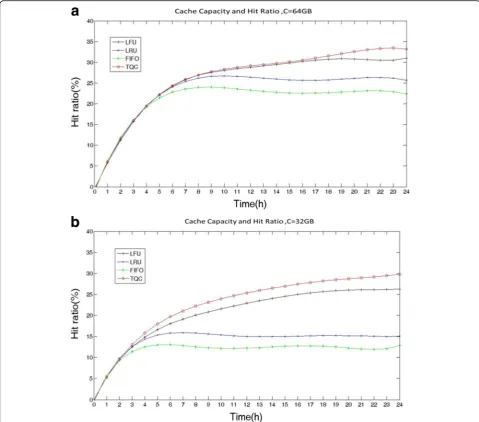
Fig. 3Effect of cache capacity on hit ratio. The figure shows the comparison for the cache hit ratios of different policies when request rate is 500 times/ min and the cache capacityCis 64 GB and 32 GB respectively. It can be seen that LRU, LFU, FIFO, and TQC policies all have the same hit ratios when the cache is not full. When t_full = 4.5 h,C= 64 GB, t_full = 2.5 h,C= 32 GB, and the cache is full, different replacement policies start replacing the contents.
Heess et al. [14] study the partially observable state problem in reinforcement learning. They extend two re-lated, model-free algorithms for continuous control-deter-ministic policy gradient and stochastic value gradient to solve partially observed domains using recurrent neural networks trained with back-propagation through time, to solve challenging memory problems such as the Morris water maze. Blundell et al. [15] restrict the size of Q table by removing the entries of the least and recently accessed updates as soon as a large state sequence is received. Meanwhile, they combine the non-parametric nearest-neighbors model and solve the two problems that reinforcement learning consumes large amounts of mem-ory and lacks a way to generalize across similar states. Schaul et al. [16] make improvements based on the fact that experience transitions were uniformly sampled from a replay memory [17] and propose the prioritized experi-ence replay (PER) method. They applied the two methods to DQN [13] algorithm and made comparison. The results showed that the performance of PER was far better than common experience replay algorithm.
Our work is close to that of Chiocchetti et al. [18]. In dy-namic network conditions, they made several improve-ments to the Q-routing algorithm in order to apply it to various network contexts. Their article achieved a distrib-uted reinforcement learning based on the reward informa-tion exchanged between routers in the network so as to improve the cache hit ratio. Caarls et al. [19], combining the Q-routing algorithm and MEC algorithm, propose the Q-caching algorithm aiming at the minimum user down-load time. They exploit the fact that Q-routing computes the cost-to-go and use it to make not only routing but also caching decisions in a weighted least frequently used (WLFU) manner, evicting the item with the minimum ex-pected cost (MEC) to retrieve. Then, Q-routing and MEC
are combined in order to efficiently route requests and store content with the goal of minimizing the download time experienced by users.
Based on user’s location, Q-routing and Q-caching passively calculate the frequency of content access and gen-erates the Q table. In reality, acquisition of SaaS data by users or applications is often in large amounts, diverse, low-frequency, and in long periodicity, for example, acquir-ing SaaS content in every 15 min or a longer period. Mak-ing cachMak-ing or replacement decisions driven by user access behaviors and calculating the recent frequency of content access put serious challenges on computing performance and storage space and even are impossible. To solve the problem of caching solution by directly calculating and ana-lyzing user behaviors, we propose viewing from caching server, using Q-learning to improve cache hit ratio, and let-ting caching server execute a specific action in a specific time in order to indirectly learn user behaviors and inter-ested content.
3 Methods/experimental
Q-learning algorithm was proposed by Watkings and Dayan. It uses a direct approximation approach to solve Bellman’s optimal equation in order to obtain the opti-mal value function [20]. Rummery and Niranjan made some modifications to Q-learning and proposed the state action reward state action (Sarsa) algorithm [21]. Both Q-learning and Sarsa interact with environment ε by constructing an agent. In a specific environment sta-tus, the agent generates a specific action and the envir-onment returns different rewards to the agent. The purpose of training an agent is to maximize its reward.
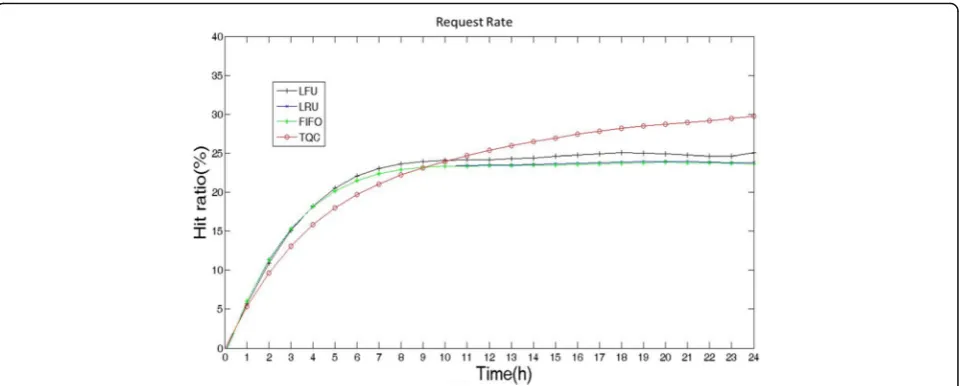
In this section, we describe the design of the TQC caching policy. We make decisions on content caching and releasing by manipulating the cache space of the Fig. 4Request rate evaluation. The figure shows the hit ratios of different policies when cache capacity C is 32 GB and request rate is 250 times/min
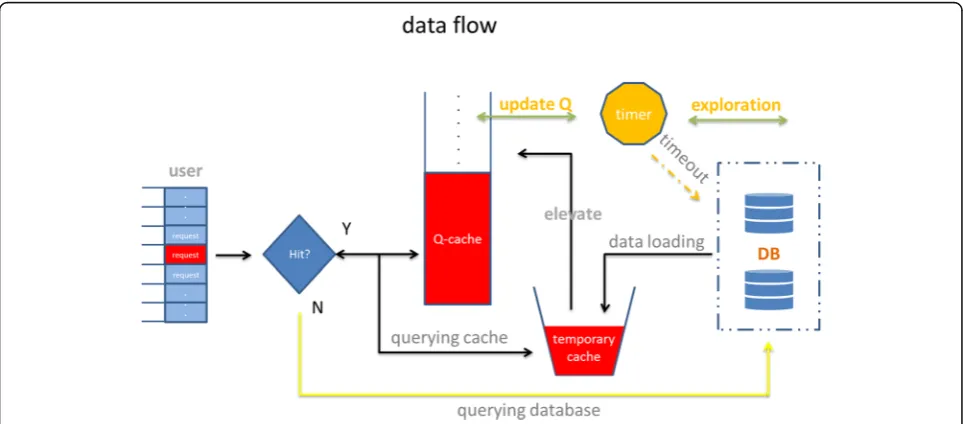
server. The goal of TQC is twofold: (i) minimize manual involvement in the caching policy and implement an in-telligent model-free caching policy and (ii) increase the cache hit ratio and reduce the time required for users to obtain data from the SaaS platform. In particular, due to the size of the cache, we only add the contents of the group <time,request,action,hitrate> with the highest Q value (the highest cache hit ratio) in the table Q to the cache. The TQC periodically updates the Q value of
each record in the table Q and replaces the contents of the cache according to the change of the Q value (Fig.2). In order to guarantee the exploration ability of the algo-rithm, we divide the cache into two parts. One is 20% and the other one is 80%. Twenty percent of the space stores the requests, missing the contents of the cache. The advantages of this design can speed up the conver-gence rate of the algorithm and ensure the algorithm’s exploration ability.
TQC uses time series as the basis of learning. By conven-tion, we calculate the hit ratio of the cache att+ 1 based on the discount factorγ. The calculation formula of the hit ratio
is Ht ¼ P t0¼t T
γt0−th
t0, t=stride(s,τ)t∈onedaywhich denotes
the discrete time node with the stride of s and the unit of τ in a certain time range T (1 day). h= hitra-tet(q,a) indicates the cache hit ratio when the user request q is received and the action a is executed at time t. We define an optimal value function Qtðq;aÞ (i.e., the maximal cache hit ratio) where data= map(q) indicates that the user request q is mapped to
an actual data block by the map function and a rep-resents the action sequence. The specific formula is Qtðd;aÞ ¼ maxπE½Htjdt ¼d;at ¼a;π where π is a
caching policy which maps the time series and the request sequence to the action sequence a=π(t,q). The optimal Q value function indicates that at time t each caching policy selects a valid caching action from the action sequence a for the request sequenceq and maximizes the hit ratio of the entire cache. The opti-mal value function obeys an important and widely used principle (Bellman 1957) of optimality. An optimal policy has the property that the residual decision must be the Fig. 6File average access time.aThe average response time for four cache policies to retrieve all files. It can be seen that TQC is better than LFU and LRU, and FIFO is the worst policy.bThe average access time of five file types. The average response time of FIFO for all objects is the highest. And the time cost of LFU and TQC is the smallest. However, TQC has five types whose response time is not more than 50 ms, LFU has two while LRU has none. TQC can eventually achieve a stable state for each file after a long time of learning
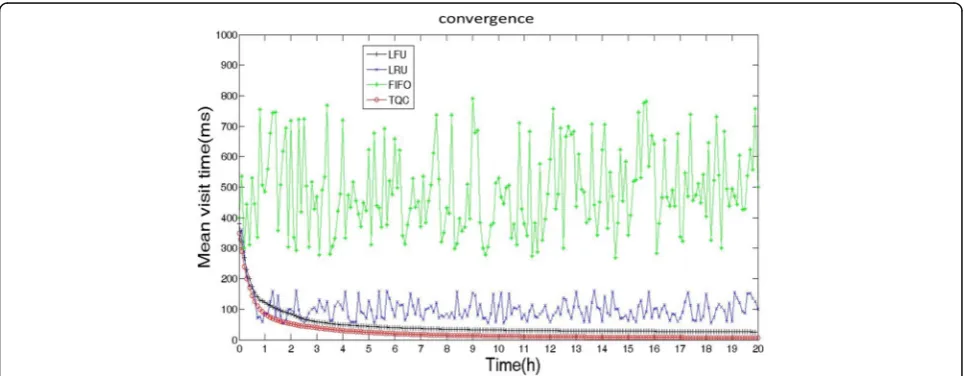
Fig. 7Variation trend of average file response time over time. The figure shows the changes of average response time for several policies. The average access time for LRU and FIFO is constantly changing due to the variability of the cache contents of LRU and FIFO, resulting in the loss of cache data. Conversely, TQC and LFU do not exhibit this behavior, thus increasing stability. It can be seen that the convergence of TQC is slower than LFU but the average time cost of TQC after convergence is 6 ms and that of LFU is 26 ms. This indicates that the performance of TQC is superior to that of LFU for dynamic changes of file access
optimal policy for the state resulting from the first deci-sion regardless of the initial state and the initial decideci-sion. That is, if the optional caching action that the optimal functionQtðd
0
;a0Þexecutes for each request is known, the optimal caching policy is to select a caching ac-tion sequence that maximizes the subsequent cache hit ratio based on these request states sequences: ht +γQt'∗(q',a'). The optimal Q value function is shown
In many reinforcement learning algorithms, the esti-mation of the action-value function is done by iteratively updating the Bellman equation as shown in Eq.2. Rich-ard Sutton [11] proved that iterative updating can con-verge to the optimal value function when Qt→ Q∗ast→∞.
Based on the Bellman equation, the calculation method of TQC optimal cache hit ratio is shown in Eq. 3where count(t,q) represents the access counts of user requestq at timet:
Our updating method of the cache hit ratio divides the Bellman equation into instantaneous hit ratio and the sum of historical hit ratios based on the time series and finally multiplies them by the timetand the access counts of the contents corresponding to user request q. The updating method of Formula 4 uses Robins-Monro stochastic ap-proximation method to iteratively update the Bellman equation so as to estimate the action-value function:
Qtþ1ðq;aÞ ¼ 1−ηtðq;aÞ in the initial period of learning to make the algorithm tend to exploration. Then, we increased the exploitation probability of TQC by linearly reducingη. Finally, we fix the value of η to 0.2 to make the algorithm maintain 20% of the exploration capacity.
Because SaaS requests have a certain time periodicity, compared with LFU, Q-routing and Q-caching, TQC fo-cuses on cache hit ratio. The outer loop of Algorithm 1 ini-tializes the cache and table Q then processes each user request. For requests that have hit the cache, TQC updates
the hit ratio, access counts, and the Q value of the contents. The inner loop of the algorithm (a) maps the user request to the actual data of the database or the file system through the map function; (b) adds the data directly to the cache when the cache is not full; (c) replaces the contents of the cache using ε−policywhen the cache is full; (d) executes actionat, observes the number of hits, and calculates the Q value; and (e) selects the valid action from the action list after the timeout of the updating timer, actively loads the contents into the cache, and updates the whole Q table.
algorithm, TQC can show a very good performance. Its hit ratio continues to increase until convergence. Sec-ond, the partitioned cache accelerates the convergence of the algorithm while ensuring the exploration of un-known contents and learning ability. Third, the learning style based on the time series only needs very little com-puting time and storage space. It will be able to learn long-period and low-frequency user request behaviors. Fourth, the learning style of active exploration allows user requests to directly hit the cache, which greatly re-duces the time that a user’s first request needs for read-ing data from the database or file system.
4 Results
The following simulation experiment evaluated four dif-ferent caching policies namely LFU, LRU, FIFO, and TQC from cache space size, request rate, data amount, and average access time and got the digital analysis results. We selected 100,000 files of different sizes and types as the ob-jects to be cached as shown in Table 1. The cache space size ranges from 32 to 64 GB. The time detection range of hit ratio is from 0 to 24 h. And the stride size is 1 h. File request rate ranges from 250 to 500 times/min. The spe-cific parameters are shown in Table2.
Comparing Fig.4with Fig.3b, it can be seen that with the increase of request times, TQC hit ratio increases the fastest followed by LFU, LRU, and FIFO. It shows that TQC can achieve good learning effect with a large number of request samples. Comparing Fig.4with 3a, it can be found that simultaneous increases of cache cap-acity and request rate can make the hit ratio of TQC reach the steady state faster. For example, at t= 5 h, LFU, TQC, and LRU achieve the steady state at 500 times/min and need nearly twice the time to achieve the steady state at 250 times/min.
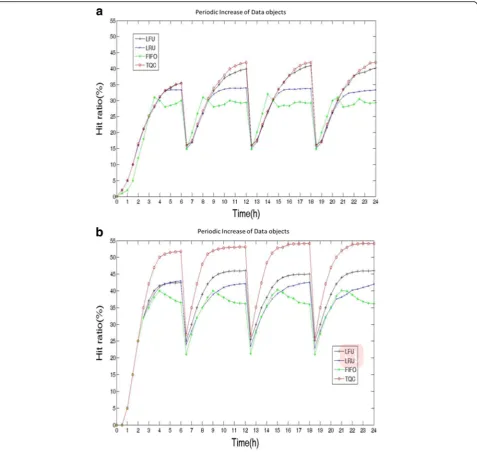
In a real network, the number of contents is increasing continuously. Suppose att= 0, the number of files M = 100,000.1000 new files are generated every 6 h and these new files reach the highest degree of accesses within 6 h (Figs.5,6,7, and8).
5 Discussion
The methods based on statistics and manual caching policy not only put high requirements on computational resources and storage space but also have poor scalabil-ity and flexibilscalabil-ity, which usually only adapt to specific environments. This paper proposes the cache manage-ment policy TQC based on reinforcemanage-ment learning (Q-learning). Compared with traditional cache manage-ment methods, TQC not only eliminates the need to manually customize the cache rules but also has strong adaptability. In addition, TQC caching policy is more in-telligent. The algorithm can well sense and predict low-frequency and long-period user requests, taking the
first step in active caching and direct hit of requests. In the future, TQC will be based on distributed architecture and combined with neural network technology for pre-diction of continuous state spaces (user requests) so that the TQC hit ratio and SaaS response speed can reach a higher level.
Abbreviations
FIFO:First in first out; IaaS: Infrastructure-as-a-service; LFU: Least frequently used; LRU: Least recently used; MEC: Minimum expected cost; PaaS: Platform-as-a-service; PER: Prioritized experience replay; RL: Reinforcement learning; SaaS: Software as a service; Sarsa: State action reward state action; SPT: Shortest path tree; TQC: Time-based Q Cacher; WCETs: Worst-case execution times; WLFU: Weighted least frequently used
Acknowledgements
Not applicable.
Funding
This research is supported by Natural Science Foundation of Hunan Province of China (No. 2016JJ4045) and Educational Commission of Hunan Province of China (No. 17A114). We thank the National Supercomputing Center in Changsha for providing with the technical support of this research.
Availability of data and materials
The datasets used and/or analyzed during the current study are available from the corresponding author on reasonable request.
Authors’contributions
HC made substantial contributions to conception and design, or acquisition of data, or analysis and interpretation of data and been involved in drafting the manuscript or revising it critically for important intellectual content, and he has also given final approval of the version to be published. Each author should have participated sufficiently in the work to take public responsibility for appropriate portions of the content; GT agreed to be accountable for all aspects of the work in ensuring that questions related to the accuracy or integrity of any part of the work are appropriately investigated and resolved. Both authors read and approved the final manuscript.
Authors’information
Haijun Chen received B.S. degrees at the School of Computer Science and Technology, National University of Defense Technology, Changsha, China, in 1997, and M.S. degree in software engineering from Hunan University,
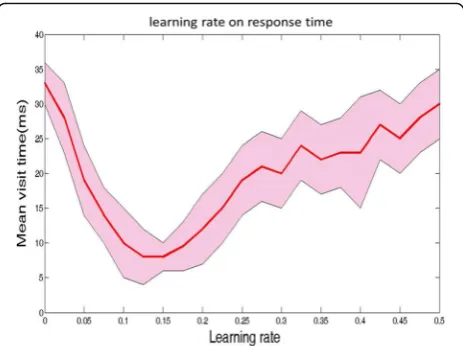
Fig. 8Learning rate detection. We investigated the impact of learning rate on response time. It can be seen that the average response time of TQC reaches the minimum value of 8 ms when the learning rate is about 0.15
Changsha, China, in 2006. He is currently pursuing Ph.D. degree at Central South University, Changsha, China. His research interests include wireless sensor networks, machine learning, and neural network.
GuanZheng Tan received B.S degree in aeronautical power plant control engineering from Nanjing University Of Aeronautics and Astronautics, Nanjing, China, in 1983, and M.S. degrees in automatic control theory and application from National University of Defense Technology, Changsha, China, in 1988, and Ph.D. degrees in mechanical manufacture and automation from Nanjing University Of Aeronautics and Astronautics, Nanjing, China, in 1992; he worked as a professor at the School of Information Science and Engineering of Central South University, Changsha, China. His research interests include artificial intelligence and application, bionic robot and intelligent bionic system, advanced control theory and advanced calculation, and biomedical image processing.
Competing interests
The authors declare that they have no competing interests.
Publisher’s Note
Springer Nature remains neutral with regard to jurisdictional claims in published maps and institutional affiliations.
Received: 28 July 2018 Accepted: 10 October 2018
References
1. L. Wu, S.K. Garg, R. Buyya, SLA-based resource allocation for software as a service provider (SaaS) in cloud computing environments[C]// Ieee/acm international symposium on cluster, cloud and grid IEEE Computer Society 2011:195–204
2. R. Buyya, C.S. Yeo, S. Venugopal, J. Broberg, I. Brandic, Cloud computing and emerging IT platforms: vision, hype, and reality for delivering computing as the 5th utility. Futur. Gener. Comput. Syst.25(6), 599–616 (2009) Elsevier Science, Amsterdam, The Netherlands
3. M. A. Vouk,“Cloud Computing-Issues, Research and Implementation”. In Proceedings of 30th International Conference on Information Technology Interfaces ( ITI 2008), Dubrovnik, Croatia
4. H. Takahashi, K. Mori, H.F. Ahmad, Efficient I/O intensive multi tenant SaaS system using L4 level cache[C]// IEEE international symposium on service oriented system engineering. IEEE Computer Society, 2010:222–228 5. R. Wilhelm, J. Engblom, A. Ermedahl, et al., The worst-case execution-time
problem—overview of methods and survey of tools. Cheminform7(3), 36 (2008) 6. X. Wang, M. Chen, T. Taleb, et al., Cache in the air: exploiting content
caching and delivery techniques for 5G systems. IEEE Commun. Mag.52(2), 131–139 (2014)
7. D. Lee, J. Choi, J.H. Kim, et al., LRFU: a spectrum of policies that subsumes the least recently used and least frequently used policies. Acm Sigmetrics Perform. Eval. Rev.50(12), 1352–1361 (2001)
8. Y. Wang, Z. Li, G. Tyson, et al., Design and evaluation of the optimal cache allocation for content-centric networking. IEEE Trans. Comput.65(1), 95–107 (2016)
9. I. Psaras, K.C. Wei, G. Pavlou, In-network cache management and resource allocation for information-centric networks. IEEE Trans. Parallel Distrib. Syst.
25(11), 2920–2931 (2014)
10. D. Jeswani, M. Gupta, P. De, et al., Minimizing latency in serving requests through differential template caching in a cloud[C]// IEEE, International conference on cloud computing. IEEE, 2012:269–276
11. R. Neumann, S. Taggeselle, R. Dumke, et al.,Combining query performance with data integrity in the cloud: a hybrid cloud storage framework to enhance data access on the Windows Azure platform(2012), pp. 518–525
12. V. Mnih, K. Kavukcuoglu, D. Silver, et al., Human-level control through deep reinforcement learning. Nature518(7540), 529–533 (2015)
13. D. Silver, A. Huang, C.J. Maddison, et al., Mastering the game of Go with deep neural networks and tree search. Nature529(7587), 484–489 (2016) 14. N. Heess, J.J. Hunt, T.P. Lillicrap, et al., Memory-based control with recurrent
neural networks. Comp. Sci. (2015)
15. C. Blundell, B. Uria, A. Pritzel, et al., Model-Free Episodic Control. 2016 16. T. Schaul, J. Quan, I. Antonoglou, et al., Prioritized experience replay. Comp.
Sci. (2015)
17. L.J. Lin, Self-improving reactive agents based on reinforcement learning, planning and teaching. Mach. Learn.8(3), 293–321 (1992)
18. R. Chiocchetti, D. Perino, G. Carofiglio, et al., INFORM: a dynamic interest forwarding mechanism for information centric networking[C]// ACM SIGCOMM Workshop on Information-Centric NETWORKING. 2013:9–14 19. W. Caarls, E. Hargreaves, D.S. Menasché, Q-caching: an integrated
reinforcement-learning approach for caching and routing in information-centric networks. Comp. Sci. (2015)
20. C.J.C.H. Watkins, P. Dayan, Q-learning. Mach. Learn.8(3–4), 279–292 (1992) 21. M. Riedmiller, Neural fitted q iteration–first experiences with a data