IEEE 802.11 Wireless LANs: Performance Analysis
and Protocol Refinement
P. Chatzimisios
Multimedia Communications Research Group, School of Design, Engineering and Computing, Bournemouth University, Fern Barrow, Poole, Dorset BH12 5BB, UK
Email:[email protected]
A. C. Boucouvalas
Multimedia Communications Research Group, School of Design, Engineering and Computing, Bournemouth University, Fern Barrow, Poole, Dorset BH12 5BB, UK
Email:[email protected]
V. Vitsas
Information Technology Department, Technological Educational Institute of Thessaloniki, 54101 Thessaloniki, Greece Email:[email protected]
Received 25 February 2004; Revised 1 November 2004; Recommended for Publication by C. C. Ko
The IEEE 802.11 protocol is emerging as a widely used standard and has become the most mature technology for wireless local area networks (WLANs). In this paper, we focus on the tuning of the IEEE 802.11 protocol parameters taking into consideration, in addition to throughput efficiency, performance metrics such as the average packet delay, the probability of a packet being discarded when it reaches the maximum retransmission limit, the average time to drop a packet, and the packet interarrival time. We present an analysis, which has been validated by simulation that is based on a Markov chain model commonly used in the literature. We further study the improvement on these performance metrics by employing suitable protocol parameters according to the specific communication needs of the IEEE 802.11 protocol for both basic access and RTS/CTS access schemes. We show that the use of a higher initial contention window size does not considerably degrade performance in small networks and performs significantly better in any other scenario. Moreover, we conclude that the combination of a lower maximum contention window size and a higher retry limit considerably improves performance. Results indicate that the appropriate adjustment of the protocol parameters enhances performance and improves the services that the IEEE 802.11 protocol provides to various communication applications.
Keywords and phrases:IEEE 802.11, wireless LANs, DCF, packet delay, protocol tuning.
1. INTRODUCTION
During the past few years, the field of wireless local area net-works (WLANs) has witnessed a massive development and has become one of the fastest growing areas in telecommu-nications and networking [1]. Continuing advances in wire-less technology and mobile communications have equipped portable devices with wireless capabilities that allow net-worked communication even while a user is mobile. WLANs have found widespread use and have become an essential tool in many people’s professional and personal life. To satisfy the
This is an open-access article distributed under the Creative Commons Attribution License, which permits unrestricted use, distribution, and reproduction in any medium, provided the original work is properly cited.
growing needs of wireless data networking, the IEEE working group proposed the 802.11 protocol family [2].
and the request-to-send/clear-to-send (RTS/CTS) reserva-tion scheme.
Many research efforts have been conducted on model-ing the performance of DCF since the standardization of IEEE 802.11 MAC. Bianchi in [5] and Wu et al. in [6] use Markov chain models to analyze the throughput of 802.11 protocol. In particular, Bianchi assumes that packet retrans-missions are unlimited and that a packet is being transmit-ted continuously until its successful reception. Wu in [6] extends Bianchi’s analysis to include the finite packet retry limits as defined in the IEEE 802.11 standard [2]. In [7], we provide a new performance analysis of the 802.11 proto-col, which is based on the extensively-used-in-the-literature Markov chain model of [6] and allows the calculation of the packet delay, the packet drop probability, and the packet drop time. Ziouva in [8] develops a Markov chain model that introduces an additional transition state to the models of [5,6,7] and actually allows stations to transmit consecu-tive packets without activating the backoffprocedure.1This feature, which is not specified in any IEEE 802.11 standard, causes an unfair use of the medium since stations are not treated in the same way after a successful transmission. The proposed model in [8] lacks of any validation using simula-tion results and the calculasimula-tion of average packet delay uti-lizes a very complicated approach since it calculates the aver-age number of the collisions of a packet before its successful reception and the average time a station’s backofftimer re-mains stopped.
Several other papers in the literature [9, 10, 11] have attempted to improve IEEE 802.11 performance by either modifying the backoffmechanism or by fine-tuning certain protocol parameters. Carvalho and Garcia-Luna-Aceves in [9] considered the impact of the minimum contention win-dow (CW) size and the corresponding capacity improvement that is achieved when CW increases but not combined with packet retry limits and other protocol parameters. Cali et al. in [10] proposes a method of estimating the number of active stations via the number of empty slots and exploits the estimated value to tune the CW parameter based on a
p-persistent version of the IEEE 802.11 protocol. Aad and Castelluccia in [11] suggests three different ways to enhance 802.11 performance; by scaling the CW based on the priority factor of each station or by giving each priority level with a different value of DIFS or different maximum packet length. In this paper, we concentrate on the performance en-hancement of IEEE 802.11 DCF by simply modifying specific protocol parameter values. In order to adjust the protocol pa-rameters, the mathematical description of the system turns out to be extremely helpful in observing the effect on the considered performance metrics of any parameter changes made. Our work reports and explores several performance metrics such as the average packet delay, the packet drop probability, the average time to drop a packet, the packet
in-1According to the authors of [8], this takes place when a station detects that its previous transmitted packet was successfully received and the chan-nel is idle.
terarrival time, and the throughput efficiency. OPNET simu-lation results validate the accuracy of our performance analy-sis. Moreover, a performance comparison of (a) the proposed delay analysis in [8], (b) our validated delay analysis, and (c) simulation results, demonstrates that the analysis based on Wu’s model, which takes into account packet retry lim-its, predicts very accurately DCF packet delay performance. We then propose a simple-to-implement appropriate tuning of the backoffalgorithm for the basic access scheme (the con-clusions are also applicable to the RTS/CTS scheme) depend-ing on the specific communication requirements. The pro-posed fine-tuning does not depend on the employed access scheme or the packet size and aims to improve the services that the protocol provides to higher layers of the communi-cation protocol stack.
2. DISTRIBUTED COORDINATION FUNCTION
In DCF basic access mode, a station with a packet to transmit monitors the medium activity. If the medium is idle, the sta-tion transmits the data packet. If the medium is sensed busy, the station waits until the medium becomes idle for more than a distributed interframe space (DIFS) time interval. The station then defers transmission for a randomly selected in-terval in order to minimize collisions and transmits the data packet. A station that receives a data packet replies by a posi-tive acknowledgement packet (ACK) after a short interframe space (SIFS) interval. If the source station does not receive an ACK, the data packet is assumed to have been lost and a retransmission is scheduled. Each station maintains a station short retry count (SSRC) that has an initial value of zero for every new packet. The short retry count indicates the max-imum number of retransmission attempts of a data packet when the basic access scheme is utilized.
In IEEE 802.11, a station waits a random backoff inter-val before initiating a packet transmission. The backofftimer value for each station is uniformly chosen in the interval [0,Wi −1] whereWi is the current CW size and i is the backoffstage. The backofftimer is decremented when the medium is idle, is frozen when the medium is sensed busy, and resumes only after the medium has been idle for longer than DIFS. A station initiates a packet transmission when the backofftimer reaches zero. The value ofWidepends on the number of failed transmissions of a packet; at the first trans-mission attempt,W0=CWmin=W. After each retransmis-sion due to a packet colliretransmis-sion,Wiis doubled up to a maxi-mum value,Wm=CWmax=W2m, wheremis the number of backoffstages. OnceWireaches CWmax, it will remain at this value until it is reset to CWminin the following cases: (a) after the successful transmission of a data packet or (b) when SSRC reaches the short retry limit. When the short retry limit is reached, retry attempts will cease and the packet will be dis-carded. The SSRC is reset to 0 whenever an ACK is received in response to a data packet.
3. MATHEMATICAL MODELING
In this paper, we assume that the network consists of n
b(t) changes backofftimer changes
s(t) changes CW changes
0, 0 0, 1 0, 2 0,W0−2 0,W0−1
1−p
1 1 1 1 1
· · ·
. . .
. . .
. . .
. . .
p/W1
. . .
. . .
i, 0 i, 1 i, 2 · · · i,Wi−2 i,Wi−1 1−p
1−p
1 1 1 1 1
i+ 1, 0
1
i+ 1, 1 i+ 1, 2 i+ 1,Wi+1−2 i+ 1,Wi+1−1
1 1 1 1 1 1
m, 0
1 1 1 1
m, 1 m, 2 m,W
m−2 m,Wm−1 · · · · · ·
p/Wi+1
. . .
. . .
. . .
. . .
. . .
. . .
. . .
p/Wm · · · · · ·
Figure1: Markov chain model.
available for transmission. The main assumption of our model is that the collision probability of a data packet trans-mission is constant and independent of the number of colli-sions the packet has suffered in the past.
Letb(t) ands(t) be the stochastic processes represent-ing the backoff timer and the backoff stage, respectively, for a given station at slot time t. The discrete-time Markov chain illustrated in Figure 1 is employed to model the bi-dimensional process{b(t),s(t)}. Letbi,k =limt→∞P{s(t)=
i, b(t) = k}be the stationary distribution of the Markov chain denoting the probability of a station to be in state (i,k),
wherei∈[0,m],k∈[0,Wi−1], andmis the station retry limit. By considering thatbi,0 = pbi−1,0,i∈(0,m], we have the following relation forbi,0:
bi,0=pib0,0, 0< i≤m. (1)
Following the same reasoning with [6,7] and by means of the above Markov chain model, the probability τ that a station transmits a packet in a randomly chosen slot time is presented by (we consider the case ofm > m, which is usu-ally the case)
τ= 2(1−2p)
1−pm+1
W1−(2p)m+1(1−p) + (1−2p)W2m
pm+11−pm−m+ 1−
pm+1. (2)
The probability p that a transmitted packet encounters a collision is the probability that at least one of the n−1 remaining stations transmits in the same slot time. If all sta-tions transmit with probability τ, the conditional collision probabilitypis given by
p=1−(1−τ)n−1. (3)
Equations (2) and (3) form a nonlinear system with two unknowns τ and p. This nonlinear system can be solved
utilizing numerical methods and has a unique solution.2
4. PERFORMANCE ANALYSIS
Our performance analysis, as already shown in the previ-ous section, includes the effect of packet retry limits and
considers the following metrics, which are good indicators for the performance of IEEE 802.11 WLANs. We consider throughput efficiency, average packet delay, probability of a packet being discarded when it reaches the maximum re-transmission limit, the average time to drop a packet, and packet interarrival time.
4.1. Saturation throughput
LetPtrbe the probability that at least one station transmits a packet in a randomly selected slot time andPsthe proba-bility that an occurring packet transmission is successful. For a wireless LAN ofncontending stations, the probabilitiesPtr andPsare given by
Considering that a random slot is empty with probability (1−Ptr) contains a successful transmission with probability
PtrPsand a collision with probabilityPtr(1−Ps), the satura-tion throughputSis given by
S= PtrPsl
where E[slot] is the average length of a slot time, l is the length of the transmitted packet, σ is the duration of an empty slot,TsandTcare the average durations the medium is sensed busy due to a successful transmission and a collision, respectively. We have
Ts=DIFS +Theader+TDATA+δ+ SIFS +TACK+δ. (6)
In order to explicitly specify the value of the time in-tervalTc, we have to categorize stations in two groups: the listening (noncolliding) and the colliding stations. In the case of the “listening” stations, a packet collision will re-sult in an error reported by the PHY (by utilizing the PHY-RXEND.indication) and the time interval Tc for those sta-tions is equal to an extended interframe space (EIFS) after the packet transmission. For the “colliding” stations the time intervalTcis equal to an ACK Timeout following the packet transmission. As it is specified in the IEEE 802.11 standard [2], the ACK Timeout is equal to EIFS (almost equal since the latter is shorter by a slot time). Thus, the values ofTsand
Tc, which both depend on the medium access mechanism, in the case of basic access are
Ts=Tc=DIFS +Theader+TDATA+δ+ SIFS +TACK+δ, (7)
whereTheaderis the time required to transmit the MAC and the physical packet header,TDATA=l/Cis the time required to transmit the packet data payload oflbits, whenC is the data rate,TACK =lACK/Ccontrolis the time required to trans-mit the ACK packet oflACKbits,Ccontrolis the control (base) rate at which the ACK packet is sent andδis the propagation delay.
4.2. Packet drop probability
The packet drop probability is defined as the probability that a packet is dropped when the retry limit is reached. A packet is found in the last backoffstagemif it encountersm colli-sions in the previous stages and it will be discarded if it expe-riences another collision. Therefore, packet drop probability can be expressed as a function of the last backoffstage (by means of (1)) and the collision probabilitypas3
pdrop=bm,0
b0,0p=p
mp=pm+1
. (8)
4.3. Average packet delay
The delayDfor a successfully transmitted packet is defined to be the time interval from the time the packet is at the head of its MAC queue ready for transmission, until an acknowl-edgement for this packet is received. If a packet is dropped because it has reached the specified retry limit, the time de-lay for this packet will not be included in the calculation of the average packet delay since this packet is not successfully received.
The average packet delayE[D] is given by
E[D]=E[X]E[slot], (9)
whereE[X] is the average number of slot times required for a successful packet transmission and can be found by mul-tiplying the number of slot timesdithe packet is delayed in each backoffstage by the probabilityqifor the packet to uti-lize this backoffstage:
E[X]=
m
i=0
diqi. (10)
The average number of slot timesdia station utilizes in theistage (including the transmission slot) is given by
di=Wi+ 1
2 , i∈[0,m]. (11)
The probability qi that a packet reaches the i backoff stage, provided that this packet is not discarded, is given by
qi=
pi−pm+1
1−pm+1 , i∈[0,m] (12)
since packets that are not dropped (with probability 1−pm+1) arrive at the i stage with probability (pi−pm+1) (we have to deduct the probability pm+1 of dropped packets from the probabilitypiof the total number of packets arriving at thei stage).
4.4. Average time to drop a packet
A packet is dropped when it reaches the last backoffstage and experiences another collision. The average time to drop a packet is equal to
EDdrop
=EXdrop
E[slot], (14)
whereE[Xdrop] is the average number of slot times required for a packet to experiencem+ 1 collisions in the (0, 1,. . .,m) stages. Given that the average number of slot times a station defers in theistage is (Wi+ 1)/2, thenE[Xdrop] is given by
4.5. Packet interarrival time
The packet interarrival time is defined as the time interval between two successful packet receptions at the receiver and can be simply obtained from throughput:
EDinter
= l
S/n. (16)
Using the same reasoning with (9), the packet interarrival timeE[Dinter] is also given by
which after some algebra reaches (16).
Intuitively, the average packet delay, interarrival time, and drop time are related by
E[D]=EDinter dropped packets needed for a successful transmission. The expression in (18) is of key importance since it gives insights of the delay characteristics of the IEEE 802.11 backoff mech-anism and relates the average packet delay with the packet interarrival time, the packet drop probability, and the aver-age time to drop a packet.
5. MODEL VALIDATION
The mathematical analysis presented in this paper is vali-dated by comparing analytical with simulation results ob-tained using our IEEE 802.11 simulator. This IEEE 802.11 simulator is developed using the OPNET modeler communi-cation networks modeling and simulation software package. OPNET modeler is an event-driven simulator and provides a powerful graphical tool to display simulation statistics.
In fact, our OPNET 802.11 simulator emulates the real op-eration of a wireless station as closely as possible, by imple-menting the collision avoidance procedures and all param-eters such as packet transmission times, propagation delays, turnaround times, and so forth. The simulator closely fol-lows all timer values and packet element transmission times defined by IEEE 802.11 specifications. Furthermore, we have suitably modified the model of the IEEE 802.11 wireless sta-tion provided in the standard library of OPNET in order to employ saturation conditions, that is, all stations always have a packet ready for transmission.
The Markov chain analysis presented in the previous sec-tions is independent of physical layer parameters and can be applied to all IEEE 802.11 PHY standards. The parameters used in both the analytical model and our simulations fol-low the parameters in [6,7] and are summarized inTable 1. The system parameter values are those specified for the di-rect spread sequence spectrum (DSSS) physical layer utilized in IEEE 802.11b [3].
Figures2and3confirm the accuracy of the considered assumptions in the mathematical analysis.4The figures pro-vide performance results (throughput efficiency, packet de-lay, packet drop time, and packet drop probability) versus the number of contending stations. Figure 2depicts an al-most exact match observed between analytical results (lines) and simulation outcome (symbols) illustrating that the an-alytical model that considers retry limits predicts very ac-curately DCF throughput performance, a conclusion not clearly drawn in [6] which added packet retry limits in the analytical model in [5]. Figure 2 also displays packet de-lay calculated using our dede-lay analysis as well as Ziouva’s model [8] against OPNET simulation results. The perfor-mance comparison shows that our packet delay analysis gives results in high agreement with OPNET simulations. We can observe that the model in [8], which is less conformant to the IEEE 802.11 standard than our model, causes a high overestimation of packet delay due to the adoption of the additional transition state and the absence of packet retry limits.Figure 3also validates our analysis for the other two considered performance metrics: packet drop time and drop probability.
6. TUNING OF PROTOCOL PARAMETERS AND PERFORMANCE RESULTS
There are a variety of performance requirements according to the various communication needs or application desires. For example, time bounded applications that exchange query-like messages, require low packet loss and low delivery delay. Conversely, applications that provide delay insensitive ser-vices (i.e., email, ftp) are not concerned much with packet timely deliverance and maximising throughput performance is of prime importance in this case. Additionally, there are many applications that lie somewhere in the middle and may
Table1: DSSS system parameters in IEEE 802.11b.
Parameter Value Parameter Value
Slot time,σ 20µs Packet payload,l 1023 or 1500 bytes
MAC header,lMAC 272 bits DIFS 50µs
PHY header,lPHY 192 bits SIFS 10µs
Data header time,Theader (lPHY+lMAC)/Ccontrol Minimum CW,W0 32 ACK packet,lACK 112 bits +lPHY Number of CW sizes,m 5 Channel bit rate,C 11 Mbit/s Short retry limit,m 6 Control rate,Ccontrol 1 Mbit/s Propagation delay,δ 1µs
0.85 0.8 0.75 0.7 0.65 0.6 0.55
5 10 15 20 25 30 35 40 45 50 55 60 65 70 Number of stations
Thr
o
ug
hput
e
ffi
ciency
Delay, no retry limits, (Bianchi) Delay,m=6, (Wu)
Delay, (OPNET simulation) Delay, (Ziouva in [8])
Throughput, no retry limits, (Bianchi) Throughput,m=6, (Wu)
Throughput, (OPNET simulation) 2 1.8 1.6 1.4 1.2 1 0.8 0.6 0.4 0.2 0
Pa
ck
et
d
el
ay
(s
)
Packet delay
Figure2: Throughput efficiency and packet delay: analysis versus simulation (l=1023 bytes).
9 8 7 6 5 4 3 2 1 0
5 10 15 20 25 30 35 40 45 50 55 60 65 70 Number of stations
Pa
ck
et
d
ro
p
ti
m
e
(s
)
Drop time, basic access (simulation) Drop probability (simulation)
Drop time, basic access (analysis) Drop probability (analysis)
0.04 0.035 0.03 0.025 0.02 0.015 0.01 0.005 0
P
ac
ket
dr
op
pr
obabilit
y
Drop time
Figure3: Packet drop time and packet drop probability: analysis versus simulation (l=1023 bytes).
demand low delivery delay but will not be sensitive to some loss of packets or may demand low loss but not small delay. For example, multimedia applications are not able to tolerate
Table2: Packet delay and throughput efficiency for a small network size (l=1500 bytes).
Number of stations
IEEE 802.11 standard
W=64,m=6,m=5
W=32,m=6,m=5
Packet delay (s) Throughput efficiency Packet delay (s) Throughput efficiency
n=2 0.003779 0.577334 0.004049 0.538847
n=3 0.005664 0.577849 0.005843 0.560091
n=4 0.007624 0.572318 0.007683 0.567978
n=5 0.009647 0.565203 0.009564 0.570292
n=6 0.011722 0.557878 0.011485 0.569902
In order to fulfil specific communication needs, we pro-pose the adjustment of certain protocol parameters to diff er-ent values than those proposed by the IEEE standard. Three parameters are being examined: the initial contention size (W), the packet retry limit (m), and the number of back-offstages (m). Our performance analysis examines the fol-lowing metrics as good indicators for the performance of the IEEE 802.11 protocol, namely, the throughput efficiency, the average packet delay, the packet drop probability as well as the average time to drop a packet.
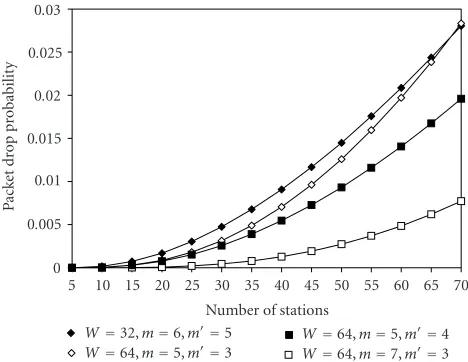
By employing the analytical model presented previously, various sets of protocol parameter values have been exam-ined and compared with parameter values that the IEEE 802.11 standard proposes in order to identify potential im-provements on protocol performance. After an extensive performance study, we have identified three sets of pa-rameter values. Each set of papa-rameter values achieves bet-ter performance on some particular metrics and it can be employed according to the specific communication needs. For example, one set of parameter values can signifi-cantly improve the throughput efficiency whereas another combination of parameters can considerably reduce the packet drop probability or the packet drop time.
The following three sets of parameter values that are be-ing employed for the basic access scheme, for the case of “long” packets ofl=1500 bytes5and compared with the val-ues that the IEEE 802.11 protocol proposes (W=32,m=6,
m=5) are
(a) W=64,m=5,m=4, (b) W=64,m=5,m=3, (c) W=64,m=7,m=3.
In all considered cases, we increase the value ofW to re-duce the number of collisions. In the first case, the CWmax value that the standard proposes (CWmax=1024) is utilized by decreasingmto 4; a lower retry limit (m=5) is consid-ered sufficient since increasingWto 64 reduces the collision probability. In the second set, we study the effect of reducing CWmax to 512 by decreasingmto 3; this set is expected to
5Results for the RTS/CTS scheme and other packet sizes such as “short” VoIP packets ofl =200 bytes have reached exactly the same conclusions, denoting that the proposed improvement does not depend on the employed access scheme or the packet payload size.
0.03 0.025 0.02 0.015 0.01 0.005 0
5 10 15 20 25 30 35 40 45 50 55 60 65 70 Number of stations
P
ac
ket
dr
op
pr
obabilit
y
W=32,m=6,m=5
W=64,m=5,m=3
W=64,m=5,m=4
W=64,m=7,m=3 Figure4: Packet drop probability against number of stations (l=
1500 bytes).
improve the average packet delay. Finally, in the last set, the retry limit is increased to the value of 7. As a result, a con-tending station utilizes two more times the (relatively) small last backoffstage (CWmax=512) aiming to reduce the packet drop probability while keeping a fairly low packet delay.
At a first glance, it might seem that the choice of a higher value for the initial CW size (W = 64) comparing to the value of the standard (W = 32) will cause a performance decrease in a small network scenario. A closer study to the case of a small network size (2≤n≤6) was performed and
Table 2presents the packet delay and throughput efficiency for the two different values of the initial contention window
W. The table illustrates that the adjustment ofWto a higher value does not cause a considerable effect on both the packet delay and throughput efficiency for very small networks; on the contrary performance is improved in networks with five or more contending stations.
0.18 Figure5: Packet delay against number of stations (l=1500 bytes).
collisions are taking place. WhenW=64,m=5,m=3 are employed, the packet drop probability increases rapidly and gradually attains the same value with the standard proposed values in a large network scenario (n=70). This is justified by noting that employingW =64 andm=3, the maximum value of the CW size will be lower (CWmax=512) compared to the one that the IEEE standard proposes (CWmax=1024) resulting in an increased number of collisions when the num-ber of contending stations is high. The lowest packet drop probability is achieved whenW =64,m =7, andm =3 since the packet drop probability is reduced up to 75% com-pared to the IEEE standard proposed values despite of the decrease of CWmax.
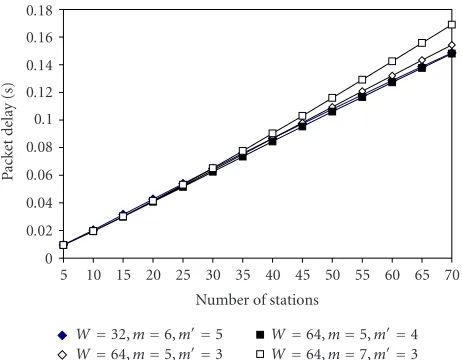
Figure 5depicts that the packet delay increases when the network size grows in all cases due to the higher number of collisions. The figure also shows that the packet delay is not significantly affected by the employment of different param-eter values. The only exception is whenW = 64,m = 7,
m = 3, the packet delay increases faster than in the other cases when n > 35 and a packet experiences an increase on delay of up to 10% in a large network (n = 70). How-ever, by means of Figure 4the situation is easily explained since a larger number of packets are transmitted successfully and not discarded. The small increase of the packet delay is the small price we pay for significantly decreasing the packet drop probability.
Figure 6plots the average time to drop a packet when it reaches the maximum retransmission limit against the num-ber of contending stations. For all sets of parameter values, the packet drop time increases when the network size in-creases. The figure shows that the employment of any of the considered sets of parameter values, as compared to the IEEE standard parameters, results in a significant improvement on the packet drop time. The highest packet drop time is at-tained using the parameter values suggested in the standard, whereas the case ofW = 64,m = 5,m = 3 achieves the lowest packet drop time with a reduction of about 40% for a large network size (n=70). Figure6: Packet drop time against number of stations (l =1500 bytes). Figure7: Throughput efficiency against number of stations (l =
1500 bytes).
Figure 7 examines the throughput efficiency that each considered set of parameter values achieves with varying the number of contending stations. When any of the proposed value sets is employed, the achievable throughput efficiency is higher compared to the standard parameter values mainly because the larger W value decreases the number of colli-sions. Especially whenW =64,m=5,m=4, the increase on throughput can be up to 10% compared to the case when the standard parameter values are employed.
0.2 Figure8: Packet interarrival time against number of stations (l =
1500 bytes).
Performance results reported in the previous figures show that when (W = 64,m = 5,m = 4), lower packet drop probability, packet drop time, packet interarrival time, and better throughput performance are achieved compared to the values proposed by the standard. When the CWmaxis decreased to a lower value (CWmax=512) for the same retry limit (m = 5), we attain the lowest packet drop time com-pared to any other case but the drop probability increases considerably. On the contrary, the adjustment of the retry limit to a higher value (W =64,m=7,m=3) results in the lowest packet drop probability and a small increase of packet drop time and delay due to the larger number of packets not being discarded and transmitted successfully. Each combi-nation of parameters achieves an improved performance on some specific metrics compared to the standard proposed values and the choice of which set of protocol parameters should be employed depends on the specific communication requirements.
7. CONCLUSIONS
In this paper, we have focused on the performance enhance-ment of the IEEE 802.11 MAC protocol using several perfor-mance metrics such as the average packet delay, the packet drop probability, the average time to drop a packet, the packet interarrival time, and the throughput efficiency. Per-formance results obtained from our analysis fully agree with OPNET simulations confirming the improvements in accu-racy when retry limits are considered. We also compared throughput and delay results for different models presented in the literature. With the infinite retry limit model [5], per-formance results deviate from simulations as the number of contending stations increases. Moreover, for the model [8] based on a different operational mode of IEEE 802.11 MAC results revealed that it overestimates packet delay per-formance.
We have also examined the effect of the initial con-tention window size on performance by employing a higher value (W = 64) compared to the standard proposed value (W = 32). Results indicate that this adjustment does not considerably degrade performance in very small WLANs but improves performance in networks with five or more con-tending stations. Based on performance results for the ba-sic access scheme (the same conclusions are derived for the RTS/CTS scheme), we have proposed an appropriate tun-ing of the backoff algorithm to improve the services that the IEEE 802.11 protocol provides. We have shown that the high value of CWmax that the IEEE standard has proposed could be safely lowered and when combined with a higher retry limit, then the performance can be improved. Finally, we have proposed three sets of parameter values for initial contention window size, retry limit, and number of backoff stages and we have concluded that each proposed set achieves better performance on particular metrics and it could be em-ployed to match specific communication needs.
APPENDIX
Let bi,k = limt→∞P{s(t) = i, b(t) = k} be the station-ary distribution of this Markov chain, where i ∈ [0,m],
k∈[0,Wi−1]. Based on the two-dimensional Markov chain illustrated inFigure 1and by considering thatb1,0=p·b0,0 andb2,0=p·b1,0=p2·b0,0, we have the following relation forbi,0:
bi,0=pbi−1,0=pib0,0, 0< i≤m. (A.1)
Owing to chain regularities and by means of equation (A.1), all bi,k values are expressed as a function of b0,0and
pas
bi,k=Wi−k
Wi ·bi
,0, 0≤i≤m, 0≤k≤Wi−1. (A.2)
Applying the normalization condition for this stationary dis-tribution
b0,0=
2(1−2p)(1−p)
W1−(2p)m+1
(1−p) + (1−2p)W2m
pm+1
1−pm−m
+ 1−pm+1. (A.5)
By utilizing the Markov chain model, the probabilityτ
that a station transmits a packet in a randomly chosen slot time is equal to
τ=m
i=o
bi,0= m
i=o
pi·b
0,0=b0,0·
1−pm+1
(1−p) (A.6)
andb0,0can be acquired from (A.5). From (A.6), we observe that the transmission probability τ depends on the condi-tional probabilityp, which is defined as the probability that a transmitted packet collides and is given by
p=1−(1−τ)n−1. (A.7)
As we stated before, (A.6) and (A.7) represent a nonlinear system with two unknownsτ andp. This nonlinear system,
which has a unique solution, can be solved utilizing numer-ical methods evaluatingtandpfor a certainW,m, andm
combination. Since the system of the two equations is diff er-ent from the one in [5], a detailed proof of the uniqueness of this solution is derived next.
Equation (A.7) can be rewritten as
τ∗(p) :τ=1−(1−p)1/(n−1). (A.8)
The functionτ∗(p) is a continuous and monotone in-creasing function in the range p ∈(0, 1). It increases from
τ∗(0)=0 toτ∗(1)=1. Functionτ(p) given by (A.6) is also continuous in the same range;6continuity in correspondence of the critical value p=1/2 is simply proven by using (A.5) as follows:
b0,0=m 2 i=0
1/2)iWi+m i=0(1/2)i
,
= m 2
i=0(1/2)i
2iW+m
i=m+1(1/2)i
2m·
W+1−(1/2)m+1/(1−1/2)
= m 2
i=0W+
2m·
W mi=m+1(1/2)i+
1−(1/2)m+1/(1/2)
= 2
W(m+ 1) +2m·
W1−(1/2)m−m
/(1−1/2)(1/2)m+1+1−(1/2)m+1/(1/2)
= 2
W(m+ 1) +W2m−m−12m−m
/(1/2)(1/2) +2m+1−1/2m+1/(1/2)
= 2
W(m+ 1) +W2m−m−
1/2m−m
+2m+1−1/2m.
(A.9)
Therefore, whenp=1/2, (A.6) becomes
τ
1 2
=
m
i=o
bi,0= m
i=o
1 2
i
b0,0= 2 m+1−1
2m b0,0
= 2m+1−1
2m−1W(m+ 1) +W2m−m−
1/2m−m
+2m+1−1/2m.
Moreover, whenp=1 and by means of (A.5), we have
Functionτ(p) is continuous and monotone decreasing in the range p∈(0, 1) since it decreases fromτ(0)=2/(W+ 1) to
τ(1) given by (A.12). Uniqueness of the solution is proven by considering thatτ(0)> τ∗(0) andτ(1)< τ∗(1).
ACKNOWLEDGMENT
The authors would like to thank Professor Giuseppe Bianchi at the University of Roma Tor Vergata for useful discussions and for his valuable comments that helped to improve the quality and readability of this paper.
REFERENCES
[1] R. van Nee, G. Awater, M. Morikura, H. Takanashi, M. Web-ster, and K. W. Halford, “New high-rate wireless LAN stan-dards,”IEEE Commun. Mag., vol. 37, no. 12, pp. 82–88, 1999. [2] ISO/IEC, “IEEE standard for wireless LAN medium ac-cess control (MAC) and physical layer (PHY) specifications,” ISO/IEC 8802-11:1999(E), 1999.
[3] IEEE, “IEEE standard for wireless LAN medium access con-trol (MAC) and physical Layer (PHY) specification: higher-speed physical layer extension in the 2.4 GHz band,” IEEE 802.11b, 1999.
[4] IEEE, “Ieee standard for wireless LAN medium access control (MAC) and physical layer (PHY) specification: higher-speed physical layer in the 5 GHz band,” IEEE 802.11a, 1999. [5] G. Bianchi, “Performance analysis of the IEEE 802.11
dis-tributed coordination function,” IEEE J. Select. Areas Com-mun., vol. 18, no. 3, pp. 535–547, 2000.
6Note that ifp=1 orp=1/2, the expression forτin (A.6) cannot be used.
[6] H. Wu, Y. Peng, K. Long, S. Cheng, and J. Ma, “Performance of reliable transport protocol over IEEE 802.11 wireless LAN: analysis and enhancement,” inProc. 21st Annual Joint Confer-ence of the IEEE Computer and Communications Society (IN-FOCOM ’02), vol. 2, pp. 599–607, Piscataway, NJ, USA, June 2002.
[7] P. Chatzimisios, A. C. Boucouvalas, and V. Vitsas, “IEEE 802.11 packet delay—a finite retry limit analysis,” inProc. IEEE Global Telecommunications Conference (GLOBECOM ’03), vol. 2, pp. 950–954, San Francisco, Calif, USA, Decem-ber 2003.
[8] E. Ziouva and T. Antonakopoulos, “CSMA/CA performance under high traffic conditions: throughput and delay analysis,” Computer Communications, vol. 25, no. 3, pp. 313–321, 2002. [9] M. M. Carvalho and J. J. Garcia-Luna-Aceves, “Delay analysis of IEEE 802.11 in single-hop networks,” inProc. 11th IEEE International Conference on Network Protocols (ICNP ’03), pp. 146–155, Atlanta, Ga, USA, November 2003.
[10] F. Cali, M. Conti, and E. Gregori, “IEEE 802.11 protocol: design and performance evaluation of an adaptive backoff mechanism,” IEEE J. Select. Areas Commun., vol. 18, no. 9, pp. 1774–1786, 2000.
[11] I. Aad and C Castelluccia, “Differentiation mechanisms for IEEE 802.11,” inProc. 20th Annual Joint Conference of the IEEE Computer and Communications Societies (INFOCOM ’01), vol. 1, pp. 209–218, Anchorage, Alaska, USA, April 2001.
P. Chatzimisiosreceived his B.S. degree in informatics from the Technological Edu-cational Institute of Thessaloniki, Greece, in 2000. He is currently pursuing a Ph.D. in wireless communication protocols with the School of Design, Engineering and Computing (DEC), Bournemouth Univer-sity, United Kingdom. His research focuses on performance modelling and analysis as well as discrete-event simulation of wireless
communication protocols and communication networks. He has published over 20 papers in the areas of wireless communications (especially IEEE 802.11 and IrDA) and network management. He is in the Technical Program Committee of the International Con-ference on Cybernetics and Information Technologies, Systems and Applications (CITSA 2005). Mr. Chatzimisios is a Student Member of IEEE and IEE, and a Professional Member of ACM.
A. C. Boucouvalas has worked at GEC Hirst Research Centre, and became a Group Leader and a Divisional Chief Scientist un-til 1987, when he joined Hewlett Packard (HP) Laboratories as a Project Manager. At HP Labs, he worked in the areas of optical communication systems, optical networks, and instrumentation, until 1994, when he joined Bournemouth University. In 1996, he became a Professor in multimedia
of Arts, Manufacturers and Commerce (FRSA) and a Fellow of IEE (FIEE). In 2002, he became a Fellow of the Institute of Electrical and Electronic Engineers (FIEEE), for contributions to optical fibre components and optical wireless communications. He is a Mem-ber of the New York Academy of Sciences, and the Association for Computing Machinery (ACM). He is an Editor of numerous jour-nals and in the organising committees of many conferences.
V. Vitsasreceived his B.S. degree in electri-cal engineering from the University of Thes-saloniki, Greece, in 1983, his M.S. degree in computer science from the University of California, Santa Barbara, in 1986, and his Ph.D. degree in wireless communica-tions from Bournemouth University, UK, in 2002. In 1988, he joined Hellenic Telecom-munications Organisation where he worked in the field of X.25 packet switching