Volume 2007, Article ID 95917,10pages doi:10.1155/2007/95917
Research Article
Fading-Aware Packet Scheduling Algorithm in
OFDM-MIMO Systems
Zhifeng Diao1and Victor O. K. Li2
1Department of Electrical Engineering, Arizona State University, Tempe, AZ 85287, USA
2Department of Electrical and Electronic Engineering, The University of Hong Kong, Pokfulam, Hong Kong
Received 26 June 2006; Revised 9 December 2006; Accepted 1 February 2007
Recommended by Athina Petropulu
To maximize system throughput and guarantee the quality of service (QoS) of multimedia traffic in orthogonal frequency division multiplexing (OFDM) systems with smart antennas, a new packet scheduler is introduced to consider QoS requirements, packet location in the frame, and modulation level. In the frequency domain, several consecutive subchannels are grouped as a frequency subband. Each subband in a frame can be used to transmit a packet, and can be reused by several users in a multiple-input and multiple-output (MIMO) systems. In this paper, we consider the adaptive packet scheduling algorithms design for OFDM/SDMA system. Based on the BER requirements, all traffics are divided into classes. Based on such classification, a dynamic packet scheduler is proposed, which greatly improves system capacity, and can guarantee QoS requirements. Adaptive modulation is also applied in the scheduler. Then, the complexity analysis of these algorithms is given. When compared with existing schedulers, our scheduler achieves higher system capacity with much reduced complexity. The use of adaptive modulation further enhances the system capacity. Simulation results demonstrate that as the traffic load increases, the new scheduler has much better performance in system throughput, average delay, and packet loss rate.
Copyright © 2007 Z. Diao and V. O. K. Li. This is an open access article distributed under the Creative Commons Attribution License, which permits unrestricted use, distribution, and reproduction in any medium, provided the original work is properly cited.
1. INTRODUCTION
Next-generation wireless communication networks are ex-pected to provide a wide range of services, such as mul-timedia, internet access, and video conferencing. Orthogo-nal frequency division multiplexing (OFDM) is considered as a multiple access scheme for wireless broadband net-works, and has been adopted in wireless LAN standards IEEE 802.11a/ETSI HIPERLAN2 and digital audio/video broad-casting (DAB/DVB) [1,2].
Spectrum is an important wireless resource, and the scarcity of the spectrum demands high bandwidth efficiency. Space division multiple access (SDMA) allows the reuse of bandwidth by multiplexing users in the same frequency band
[3]. SDMA has been applied to TDMA and CDMA
sys-tems. Shad et al. [4] propose several dynamic slot allocation schemes for TDMA systems with smart antennas at the base station, and simulation results show that the system capacity is greatly improved. In [5], a smart channel assignment al-gorithm is introduced in mobile cellular SDMA/TDMA sys-tems. In [6], smart antenna is applied to CDMA systems.
The employment of smart antennas in the physical layer raises significant issues in the medium access control (MAC) layer. Many papers [7] have treated the resource management
problem in OFDM systems. In [8], the whole bandwidth
of an OFDM system is divided into several subbands, and each subband is composed of several successive subchannels. Three schemes are proposed to schedule the bandwidth re-source. However, SDMA is not considered. An overview on the dynamic packet assignment for high-efficiency resource
management in OFDM systems can be found in [9].
Com-pared with OFDM systems, OFDM/SDMA systems have larger capacity but are also more complex. In [10],
sev-eral efficient approaches are proposed to adopt SDMA in
OFDM systems. In [11], an algorithm is proposed to allo-cate spatially separable users in the same subchannel by ad-justing beam patterns of individual users at the transmitter. However, this paper considers each subchannel separately, and the scheduler is on the bit level, not on the packet level. Thus the complexity is very high.
In multimedia OFDM/SDMA networks, different
traffics are allocated to the same channel, the system must satisfy the most stringent BER requirements of all the pack-ets transmitted at the same channel. When users with low BER requirements are transmitted together with users with high BER requirements on the same channel, the BER per-formance exceeds their needs. Therefore, the number of users that can be accommodated in the channel is reduced.
In this paper, we consider an OFDM/SDMA system, in which the bandwidth is divided into subbands composed of several consecutive subchannels. The same subband can be used by several users at the same time. Further, a num-ber of OFDM symbols are grouped as an OFDM frame. The transmission power is adaptively allocated among ac-tive users to optimize wireless channel capacity. We first ap-ply the Random-Fit, First-Fit, and Best-Fit packet allocation
schemes proposed in [4] to OFDM/SDMA systems. Then,
based on the Best-Fit scheme, we propose a BER-classified Best-Fit packet scheduler. The scheduler classifies all traffics into classes according to the BER requirements, and allocate packets of the same class to the same frequency subband. Adaptive modulation is applied. We also compare the com-plexity of our algorithm with those in [4], and find that our complexity is lower than that of Best-Fit. In the simulation, the system capacity of these algorithms are compared. It is found that the BER-classified Best-Fit scheduler always has the best performance, in terms of system throughput, av-erage delay, and packet loss rate. Adaptive modulation also improves the system performance when combined with the scheduler.
The remainder of this paper is organized as follows. In Section 2, we introduce the system architecture. Basic packet scheduler algorithms are given in Section 3. Then, the BER-classified Best-Fit scheduler is illustrated in details inSection 4. The simulation results are shown inSection 5.
Section 6is the conclusion.
2. SYSTEM MODEL
In this section, we describe the structure of the mobile termi-nal and base station. When a termitermi-nal has packets to trans-mit, it places an admission-request packet through a reserva-tion request slot, from which the base stareserva-tion obtains the spa-tial signature and traffic information of the terminal. Then, the base station assigns frequency-space subbands to the ter-minal depending on the QoS request and the traffic informa-tion. In this paper, we only consider the scheduling of packets after the terminals are admitted.
2.1. System structure
We consider an OFDM/SDMA system which consists ofNu
mobile terminals, each equipped with a single antenna. The base station has anM-element adaptive linear antenna
ar-ray, capable of separating K ≤ M users. In OFDM
sys-tems, the total wireless bandwidth is divided intoNc orthog-onal subchannels. In this paper, we group a fixed number of subchannels into a subband, which is called a frequency subband.
Output
Demodulation P/S FFT S/P
Figure1: Mobile terminal structure.
Figures1and2give the structures of the mobile termi-nal and base station in an OFDM/SDMA system. We con-sider the downlink of the system and assume that the base station has perfect user channel information. The sched-uler will distribute user packets into the subband. After beamforming, adaptive modulation is applied. These pack-ets are then feeded in blocks of symbols into anN-tap inverse fast Fourier transform (IFFT) operator to generate the time domain sequence. Power is also adaptively allocated among the users. The sequence is then converted into a serial stream, and is finally transmitted. At the mobile terminal, the signal is converted to a parallel data stream, processed by FFT, then converted to serial data stream, and finally demodulated.
2.2. Channel model and beamforming
We assume the multipath fading channel is wide-sense sta-tionary with uncorrelated scattering. With tolerable leakage, the time domain channel impulse response is modeled as a tapped delay line at a tap spacing of a sampling interval. The channel impulse response between the bth antenna of the base station and mobile terminalkcan be expressed as
hb,k(t,τ)=
interval of the OFDM system. SuperscriptsT andH denote
the transpose and complex conjugate transpose of a vector or matrix. Here, we assume the base station has all channel information about mobile terminals. In real systems, such in-formation can be achieved by channel estimation [12].
In the frequency domain, the channel response is repre-sented as
wherenis the index for an OFDM symbol,jis the
subchan-nel index, Ts is the duration of an OFDM symbol, W =
e−j2π/Nc, andN
c is the number of OFDM subchannels. Let
P/S
Figure2: Base station downlink structure.
At the base station, the SDMA module generates a set of weight vectors for each subchannel of each user. The weight vector can be denoted as
Vn,k=
which is one of the eigenvectors of the channel matrix (H(n))H(H(n)), and all these eigenvectors are orthogonal to steering the set of beamforming vectors, the signal of diff er-ent users on the same subchannels can be separated at the mobile terminals.
2.3. Power allocation between cochannel users
To achieve good system throughput with smart antennas, we need to optimally allocate the power to all users. Let
P1,P2,. . .,PKbe the power allocated to each user. The power for each user should satisfy
K
j=1
Pj=P, (5)
wherePis a constant corresponding to the power constraint. As in [14], the power allocated for userishould be
Pi=
μis the Lagrange coefficient. Then, all power factors should satisfy
The signal received by thekth mobile terminal can be ex-pressed as
whereHk(n) is the channel vector of subchannelnbetween userk and the base station, xn,k andxn,j are the signal for each user. The first term in (8) is the desired signal, the sec-ond term is the interference from other users, andηn,kis the additive white Gaussian noise with varianceσ2. The
signal-to-interference-and-noise ratio (SINRn,k) at subchannelnof userkis
In this paper, we consider the wireless channel as slow fad-ing, and suppose the channel gains on these subchannels in a subband have small variations. Then, the channel quality can be represented by the average SINR. Let SINRb,kbe the average SINR of thebth frequency subband which is assigned to userk. The average SINR value can be given as
SINRb,k= qe
q=qsSINRn,k
Setting
Figure3: Description of scheduler.
where theqsandqedenote the subchannel indices of the start and the end of the frequency subband. The average SINR value determines the BER performance.
Next, we discuss the relationship between SINR and the
BER performance. We consider a family of M-QAM signal
constellations, where M denotes the number of points in each signal constellation. From [15], we know that the BER of a
user withM-QAM modulation is approximated as
BER≈0.2e−1.5(SINR/(M−1)). (11)
Then, the minimum SINR value to support BER≤pforM
-QAM modulation is
SINRthreshold= −
ln(5p)
1.5 (M−1). (12)
3. BASIC OFDM/SDMA PACKET ALLOCATION ALGORITHMS
3.1. OFDM/SDMA packet scheduling
We consider a scheduler as shown inFigure 3. All packets will be assigned a priority before being put into a first-in-first-out (FIFO) queue. Then, the packets are allocated into frames. We require a packet to be allocated in the subband of a frame once the SINR requirements of all packets in the subband are satisfied. After packet allocation, the frame is transmitted. Then, another round of operation starts.
The job of the scheduler is to allocate the packets in the space-frequency subbands, which greatly affects the system capacity. In TDMA systems with smart antennas employed at the base station [16], several schemes are proposed to dy-namically allocate time slots to different users. Such schemes can be extended to OFDM systems. These algorithms are de-scribed in an increasing order of complexity as Random-Fit, First-Fit, and Best-Fit.
To facilitate the algorithm description, the following def-initions and variables are used. All terminals are numbered from the set{1, 2,. . .,K}, and each terminal can be referred to by its ID. ξ(i) is defined to be the set of terminals cur-rently allocated in frequency sloti. Letχbe the set of mobile terminals with unallocated packets, and let SINRthresholdbe
the SINR threshold value to guarantee the BER performance.
The packets have to be transmitted above a SINR threshold SINRthresholdto guarantee the QoS requirement. Due to the
property of SDMA, only one packet of the same user can be allocated in the same frequency subband.
3.2. Basic scheduling algorithms
The Random-Fit algorithm is very simple and works as fol-lows. The system randomly picks a terminal fromχ. Suppose the packet has been put into the current frequency subband
d. Then, the scheduler will check each packet in setξ(d) to see if the SINR value is above the desired threshold. If not, the scheduler moves to the next subband. The algorithm ends when no frequency subband is available. The shortcoming of Random-Fit is that if two consecutive packets cannot be accommodated in the same subband, the algorithm will ad-vance to the next subband even though another unallocated packet can be put into the current subband.
The second is the First-Fit algorithm. This algorithm is similar to Random-Fit. For each frequency subband, the sys-tem will check all packets of the terminals in setχto see if they can be assigned in the frequency subband. Once a suit-able subband is found, the packet is allocated to the subband. The third one is the Best-Fit scheme. Since the base station has perfect channel knowledge of all terminals, the scheduler is able to predict the received power at the re-ceiver terminal if the packet is transmitted in the frequency subband. Due to changes in wireless channel condition, the received power in each subband is different. The received signal power of subchannelqallocated to userkcan be ex-pressed as subband. The SINR margin value for each subband is cal-culated as
SINRmargin,b=SINRb−SINRthreshold. (14)
We pick a subbandb with the largest SINR margin value.
We then check whether the SINR requirements of the pack-ets inξ(b) can be satisfied if the packet is allocated in the subband. If not, we try the next subband. This algorithm will stop when all subbands are tried.
3.3. Performance comparison
0
Average aggregate traffic rate (packets/s)
0 2 4 6 8 10 12
Figure4: Capacity comparison among basic algorithms.
The three packet scheduler algorithms have not consid-ered the QoS characteristics of multimedia traffic. Since dif-ferent traffics have different BER requirements, the sched-uler must satisfy the most stringent BER requirement among all the packets in the subband, thus degrading the system throughput.
4. BER-CLASSIFIED BEST-FIT AND ADAPTIVE MODULATION ALGORITHM
In wireless networks, traffic will be a mixture of voice, data, and video. Each service has its special QoS requirements, such as maximum tolerable BER and timeout requirements.
When multimedia traffic is transmitted in OFDM/SDMA
systems, the system capacity is largely limited by the traf-fic with the highest BER requirement [17,18]. For exam-ple, voice packets can typically tolerate BER of up to 10−3,
while data packets require BER below 10−6. As a result, it
is wasteful to schedule voice and data packets in the same frequency subband, since the system must be able to satisfy the most stringent BER requirements among the packets that are being transmitted in the same frequency subband in the frame.
The main objectives of our scheduler are to maximize the throughput and to minimize the packet error rate. In this algorithm, traffic is classified by BER requirements. Then, packets of the same class are allocated in the same frequency subband. In this way, bandwidth can be used efficiently. Con-sider that each traffic classCq, for q = 1, 2,. . .,T, has a BER specification given by B(Cq). BER is only determined by SINR given FEC and modulation.
These objectives can be achieved by the scheduler with two steps: (1) packet priority determination and (2) packet allocation in the frame. Particularly, the packet priori-tizer minimizes the packet loss, while the packet allocator
maximizes the frame throughput. The scheduler selects the packets with the highest priority for transmission, then allo-cates packets in the frequency subband. Packets with diff er-ent priorities can be transmitted in the same OFDM/SDMA frequency subband as long as they have equal or similar BER requirements. We will illustrate these two steps in the follow-ing.
4.1. Packet priority determination
Many papers have proposed methods to determine packet priority, such as [9,17,19,20]. The packet priority is used primarily when there are more packets for transmission than can be accommodated. The computation of packet priority is done dynamically at the start of each frame.
In this paper, we consider the case that each mobile ter-minal only supports one type of traffic. It is straightforward to extend the results to the heterogeneous traffic case.
We assume the buffer of terminalkhasLkpackets, whose deadlines aret1,t2,. . .,tLk. Let the current time betc. Then for theith packet in the buffer, the minimum transmit rate isri = 1/(tc−ti). If the transmission rate is larger thanri, the packet can be transmitted before the timeout; otherwise, the packet will be discarded. Then, the total transmission rate at the current frame should beLki=1(1/(tc−ti)), which indi-cates how many frequency subbands should be allocated in the frame for terminalk. Based on this idea, we define the priority of each packet in the queue as
Priorityk(i)=
This priority definition is based on the total transmission rate of the packet and the remaining packets backlogged after it. If there are many packets in the buffer, the priority of the head of line packet is higher. This priority reflects the re-quired transmission rate of the terminal. It is only related to packets in the same queue and is calculated independently, which reduces the complexity. On the other hand, the pri-ority calculation is based on all packets in the buffer. Thus the longer the queues are, the higher the priority is. Though the priority calculation is based on heuristics, it works well as shown in the simulations.
4.2. BER-classified Best-Fit packet allocation
After packet prioritization, all the packets enter a buffer. The task of the allocator is to arrange the packets into OFDM/SDMA frequency subbands, so that the maximum packet throughput is achieved.
Based on the Best-Fit algorithm, we present a new packet scheduler. First, the scheduler tries to find the subbands hav-ing the same class packets, then empty subbands, then the subbands with more stringent SINR thresholds, and finally the subbands with more relaxed thresholds. The Best-Fit al-gorithm will be applied to these subbands.
(1) An ID to identify the mobile terminal. In an OFDM/ SDMA frame, only one packet of a mobile can be transmitted in the same frequency subband.
(2) Traffic classCq. It is used for BER scheduling.
The packet allocator will attempt to arrange the packets in the following steps.
Step 1. Search the subbands that contain the same traffic class Cq. If a set of such subbands are found, check if the number of packets is less thanM; if not, ignore this subband. Then, the scheduler attempts to insert the packet into the fre-quency subband which has the largest SINR margin value. Then, it checks whether the SINR requirements of all the packets in the subband can be satisfied. If yes, the packet is allocated in the subband. If not, the subband with the second largest SINR margin is selected. If the packet cannot be allo-cated when all subbands with traffic classCqare tried, go to
Step 2.
Step 2. Search an empty subband. If found, arrange the packet in the empty subband. If no empty subband is found, the packet scheduler proceeds toStep 3.
Step 3. Search the frequency subband that has packets with
more stringent BER requirements and has less than M
packets. In other words, the scheduler will search for a fre-quency subband with traffic class Cq−1, which has more
stringent BER requirements thanCq. If such subbands are found, the scheduler will try to place the packet into the fre-quency subband by the Best-Fit algorithm. If the subbands cannot accommodate the packet, the scheduler tries to find subbands of traffic classesCq−2,. . .,C1until the packet is
al-located. In this step, the packet is allocated in the subband with more stringent BER requirement. If the packet still can-not be allocated, go toStep 4.
Step 4. Search the frequency subband that has packets with
more relaxed BER requirements and has less thanM
pack-ets. The scheduler looks for a frequency subband with traffic classCq+1. If such subbands are found, based on the Best-Fit
algorithm, the scheduler will test whether the packet can be added into the subbands. Then, the packets in this subband are converted into classCqsince more stringent BER require-ment in the subband must be satisfied. Similarly, the sched-uler looks for subbands with traffic classesCq+1,Cq+2,. . .,CT. This operation will stop until the last subband with traffic classCTis reached.
It is obvious that the packet scheduling algorithm finishes when the algorithm reachesStep 4. In the packet allocation procedure, the scheduler will check the ID of each packet to ensure that no more than one packet of the same mobile ter-minal is transmitted in the same frequency subband.
4.3. Adaptive modulation
Adaptive modulation can be applied to make better use of wireless resource and improve the system throughput.
Algorithm First-Fit Best-Fit BER-classified
Complexity x+ 1 2
Mx 2 +x!
x/2
i=1
1 +Mi 2 +i!
We consider a family ofM-QAM signal constellations of BPSK, QPSK, and 16-QAM. All packets have the same fixed length. BER performance is related to both SINR and mod-ulation. A high SINR value in a frequency subband enables the utilization of highM-QAM modulation level, which in-creases the system throughput.
After the above four steps of the scheduler operation, we consider adaptive modulation for users who still have pack-ets in the buffer waiting for transmission. First, we should find out the frequency subband that contains the packets of these users. Second, we increase the modulation level of these packets. Since the packet length is fixed, if we increase the modulation level by one step, the number of bits that a subband can accommodate doubles, and two packets of the same user can be merged as one. Then, the scheduler will check in that frequency subband to determine if the SINR of all packets can be satisfied. If it can be satisfied, then the packet modulation level is increased. Otherwise, find the next frequency subband that contains the packet of that user. This operation will continue until all the frequency subbands are considered or there is no packets in the queues.
4.4. Complexity comparison
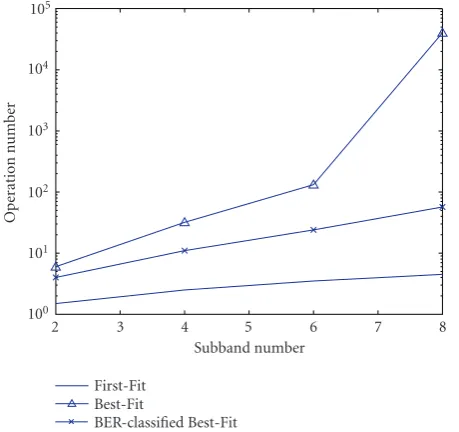
The complexity of an algorithm is important for practical systems. In this section, the complexity of each algorithm is given. As a measure of complexity, we consider the aver-age number of operations to allocate a packet in the frame.
Letx be the number of subbands in the frame, and let M
be the maximum number of packets a subband can accom-modate. The First-Fit algorithm tests all subbands in the frame, and the average number of operations to allocate a packet is (x+1)/2. The Best-Fit scheduler calculates the max-imum SINR margin for each subband, then the subbands are ranked in decreasing order of the margin value. We as-sume the average number of packets in the subband isM/2, the number of operations for SINR margin isMx/2, andx! for subband ranking. The average complexity expression is shown inTable 1andFigure 5. Here,Mis set to be 4. Com-pared with the Best-Fit algorithm, the BER-classified Best-Fit complexity is much reduced.
5. SIMULATION RESULTS WITH MULTIMEDIA TRAFFIC
100
101
102
103
104
105
Subband number
2 3 4 5 6 7 8
Ope
ratio
n
n
umbe
r
First-Fit
BER-classified Best-Fit Best-Fit
Figure5: Complexity comparison.
5.1. Simulation setup
The base station has four antennas serving 100 mobile users. In OFDM, the bandwidth is divided into 64 subchannels. Only 48 subchannels are used to transport data packets, which are divided into eight frequency subbands. In other words, six subchannels in a frame are grouped as a frequency subband. We group 1000 OFDM symbols as a frame, which lasts for 4 milliseconds. Here, the total simulation time is 1 hour. Here, the wireless channel is a Rayleigh fading channel. All packets have the same fixed length. The channel re-sponse during one frame time is regarded as a constant. The base station has perfect channel information for each user.
5.2. System capacity comparison with Poisson traffic
Figure 6shows the system capacity of each algorithm with re-spect to the average packet arrival rate. There are two classes of packets whose SINR thresholds are 5 dB and 10 dB. As the packet arrival rate increases, it is found that the BER-classified Best-Fit scheduler has higher capacity than the original Best-Fit algorithm since the former considers the
BER requirements of different users. Combining adaptive
modulation with the proposed scheduler also improves the system capacity.
5.3. Simulation for multimedia traffic
We perform simulations with several different traffic models including the following:
(i) voice traffic,
(ii) CBR digital audio traffic, (iii) CBR video traffic, (iv) VBR video traffic,
(v) computer data traffic.
0 5 10 15 20 25 30
Average aggregate traffic rate (packets/s)
0 2 4 6 8 10 12
A
gg
regat
e
thr
oug
h
put
(pac
kets/fr
ame)
Best-Fit Best-Fit-classified Random
Best-Fit-classified and adaptive modulation Figure6: System capacity comparison.
Table2: Voice traffic model parameter.
State Average duration time (s)
Principal talkspurt 1.00
Principal gap 1.35
Minispurt 0.275
Minigap 0.05
They generate different traffic classes with notable diff er-ences in the traffic characteristics and BER requirements.
5.3.1. Multimedia traffic models
The details of the different traffic models are described as fol-lows.
Voice traffic: this model is based on the three-state Markov model presented in [21]. The speech source creates a patten of talkspurts and gaps. The duration of all spurts and gaps are exponentially distributed, and independent of each other. During the spurt states, the mobile generates a data rate of 16 kb/s. All the parameters of this model are listed in
Table 2.
CBR digital audio traffic: this model represents the pro-duction of continuous bit stream of digital FM stereo audio. The constant bit rate of the stream is 128 k/s, and the average holding time of an audio call is 360 seconds with an expo-nential distribution [22]. The packet transmission rate is 10 packets/s.
CBR video traffic: in this model, a continuous bit stream is generated at 220 kbps. The interval between two packet transmissions is 0.05 second.
Traffic type BER Modulation SINR (dB) Time out
Computer data 10−7 BPSK 8 200
Table4: The breakdown of the traffic.
Traffic class Percentage
Voice 50%
CBR audio 10%
CBR video 10%
VBR video 10%
Computer data 20%
average duration in each state is set to be 40 milliseconds. The bit rate values for different states are exponentially dis-tributed. The average bit rate is also 220 kbps, the same as in CBR video traffic, but the BER threshold and delay require-ments are different.
Computer data traffic: the transmission interval is expo-nentially distributed and the mean bit rate is 30 kbps.
The BER and timeout requirements of these traffics are listed inTable 3. In the simulation, adaptive modulation is applied. To simplify the simulation complexity, only BPSK and QPSK modulations are considered. By (11) and (12), the SINR threshold values with different modulations can be cal-culated by the BER requirements of different traffic classes.
5.3.2. Numerical results
In this section, we give the simulation results. We evaluate the performance of the BER-classified Best-Fit scheduler, and compare with the Best-Fit scheduler. The new mobile ter-minal arrival rates for different traffic classes are maintained constant throughout the simulations. The percentage of dif-ferent traffic classes in the total traffic used in the simulation is listed inTable 4.
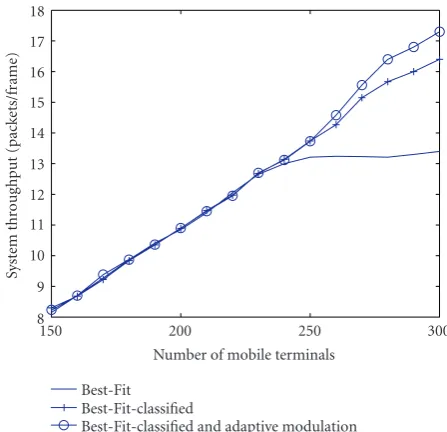
Figure 7gives the system throughput of the schedulers of Fit, BER-classified Fit, and BER-classified Best-Fit with adaptive modulation. At light cell load, the system throughputs of all schedulers are the same. As cell load in-creases, the performance gap becomes more pronounced. It is obvious that BER-classified algorithm is better than Best-Fit. Adaptive modulation also contributes to the system throughput.
In Figure 8, the average packet loss rates of different schedulers are compared. The simulation results show that
8
Number of mobile terminals 150
Best-Fit-classified and adaptive modulation Figure7: Multimedia system throughput comparison.
Mobile terminal number 10−3
10−2 10−1
200 210 220 230 240 250 260 270 280 290 300
Pe
Best-Fit-classified and adaptive modulation Figure8: Packet loss rate comparison.
the average packet loss rate of Best-Fit is always larger than the other two schedulers. Adaptive modulation with Best-Fit also reduces the packet loss rate.
Mobile terminal number
200 210 220 230 240 250 260 270 280 290 300
Av
Best-Fit-classified and adaptive modulation Figure9: Packet delay comparison.
Best-Fit scheduler, with adaptive modulation, also reduces the average packet delay.
6. CONCLUSIONS
In this paper, we propose a dynamic packet allocation scheme
with BER scheduling for OFDM/SDMA systems. All traffics
are classified by the BER requirement. The algorithm tries to allocate the packets with the same BER class in a fre-quency subband. In this way, the system throughput is im-proved, and the complexity is also reduced when compared with the Best-Fit algorithm. Adaptive modulation is applied to improve the system performance. We simulate multime-dia traffic with different QoS requirements. Comparing the throughput, delay, and packet loss rate, the BER-classified Best-Fit scheduler is always better than the Best-Fit sched-uler, and adaptive modulation further enhances system per-formance. The number of subchannels in each subband will impact the system performance, and should be decided by the statistical channel quality. In frequency selective chan-nel, the variations of the number of neighboring subchan-nels are correlated. Thus, scheduling with adaptive subband length will more effectively improve the system performance. We plan to study this in the future.
ACKNOWLEDGMENT
This research is supported in part by the Research Grants Council of the Hong Kong Special Administrative Region, China (Project no. HKU 7152/05E).
REFERENCES
[1] IEEE 802.11 WG—Part 11, “Wireless LAN Medium Access Control (MAC) and Physical Layer (PHY) specifications:
High-speed Physical Layer in the 5 GHz Band,” Supplement to 802.11 standard, September 1999.
[2] ETSI, “Broadband radio access networks (BRAN); HIPERLAN Type 2 technical specification—Part I, Physical layer,” October 1999.
[3] J. Litva and T. K. Lo,Digital Beamforming in Wireless Commu-nicaitons, Artech, Norwood, Mass, USA, 1996.
[4] F. Shad, T. D. Todd, V. Kezys, and J. Litva, “Dynamic slot allo-cation (DSA) in indoor SDMA/TDMA using a smart antenna basestation,”IEEE/ACM Transactions on Networking, vol. 9, no. 1, pp. 69–81, 2001.
[5] F. Piolini and A. Rolando, “Smart channel-assignment algo-rithm for SDMA systems,”IEEE Transactions on Microwave Theory and Techniques, vol. 47, no. 6, part 1, pp. 693–699, 1999.
[6] J. C. Liberti and T. S. Rappaport,Smart Antennas for Wireless Communications: IS-95 and Third Generation CDMA Applica-tions, Prentice Hall, Upper Saddle River, NJ, USA, 1999. [7] Z. Diao, D. Shen, and V. O. K. Li, “CPLD-PGPS scheduler in
wireless OFDM systems,”IEEE Transactions on Wireless Com-munications, vol. 5, no. 10, pp. 2923–2931, 2006.
[8] J. Chuang, L. J. Cimini Jr., G. Y. Li, et al., “High-speed wire-less data access based on combining EDGE with wideband OFDM,”IEEE Communications Magazine, vol. 37, no. 11, pp. 92–98, 1999.
[9] J. C.-I. Chuang and N. Sollenberger, “Beyond 3G: wideband wireless data access based on OFDM and dynamic packet as-signment,”IEEE Communications Magazine, vol. 38, no. 7, pp. 78–87, 2000.
[10] P. Vandenameele, L. Van Der Perre, M. G. E. Engels, B. Gy-selinckx, and H. J. De Man, “Combined OFDM/SDMA ap-proach,”IEEE Journal on Selected Areas in Communications, vol. 18, no. 11, pp. 2312–2321, 2000.
[11] I. Koutsopoulos and L. Tassiulas, “Adaptive resource allocation in SDMA-based wireless broadband networks with OFDM signaling,” inProceedings of the 21st Annual Joint Conference of the IEEE Computer and Communications Societies (INFO-COM ’02), vol. 3, pp. 1376–1385, New York, NY, USA, June 2002.
[12] D. Shen, Z. Diao, K.-K. Wong, and V. O. K. Li, “Analysis of pilot-assisted channel estimators for OFDM systems with transmit diversity,”IEEE Transactions on Broadcasting, vol. 52, no. 2, pp. 193–202, 2006.
[13] A. Goldsmith,Wireless Communications, Cambridge Univer-sity Press, Cambridge, UK, 2003.
[14] I. E. Telatar, “Capacity of multi-antenna Gaussian channels,”
European Transactions on Telecommunications, vol. 10, no. 6, pp. 585–595, 1999.
[15] A. Goldsmith and S.-G. Chua, “Variable-rate variable-power MQAM for fading channels,”IEEE Transactions on Communi-cations, vol. 45, no. 10, pp. 1218–1230, 1997.
[16] H. Yin and H. Liu, “Performance of space-division multiple-access (SDMA) with scheduling,”IEEE Transactions on Wire-less Communications, vol. 1, no. 4, pp. 611–618, 2002. [17] S. Choi and K. G. Shin, “Cellular wireless local area network
with QoS guarantees for heterogeneous traffic,” inProceedings of the 16th Annual Joint Conference of the IEEE Computer and Communications Societies (INFOCOM ’97), vol. 3, pp. 1030– 1037, Kobe, Japan, April 1997.
[18] I. F. Akyildiz, D. A. Levine, and I. Joe, “A slotted CDMA pro-tocol with BER scheduling for wireless multimedia networks,”
[19] W. Anchun, X. Liang, Z. Shidong, X. Xibin, and Y. Yan, “Dy-namic resource management in the fourth generation wireless systems,” inProceedings of International Conference on Com-munication Technology (ICCT ’03), vol. 2, pp. 1095–1098, Bei-jing, China, April 2003.
[20] K. B. Johnsson and D. C. Cox, “QoS scheduling of mixed priority non real-time traffic,” inProceedings of IEEE Vehicu-lar Technology Conference (VTC ’01), vol. 4, pp. 2645–2649, Rhodes, Greece, May 2001.
[21] D. J. Goodman and S. X. Wei, “Efficiency of packet reserva-tion multiple access,”IEEE Transactions on Vehicular Technol-ogy, vol. 40, no. 1, part 2, pp. 170–176, 1991.