
R E S E A R C H
Open Access
LDMC design for low complexity MIMO
detection and efficient decoding
Han Hai
1, Xue-Qin Jiang
1*, Poongundran Selvaprabhu
2, Sunil Chinnadurai
3, Jia Hou
4and Moon Ho Lee
5Abstract
Low-density multiple-input multiple-output code (LDMC) can reduce the complexity of tree-search detection in MIMO systems. In this paper, we present a new modified progressive edge-growth (PEG) algorithm to construct large girth LDMCs, which are referred to as PEG-LDMCs. We analyze the complexity of the LDMC constrained sphere decoding (SD) and show that the LDMC constrained SD detection can be used for high reliability of the data transmission in MIMO systems. Furthermore, we propose two new efficient iterative decoding algorithms for LDMCs, which are high speed serial decoding and fast convergence shuffled decoding. Finally, we compare the bit error rate (BER) performance of PEG-LDMCs to that of the existing LDMCs. The simulation results show that the PEG-LDMCs can achieve better BER performance than that of the existing LDMCs.
Keywords: Low-density parity-check (LDPC) codes, Multiple-input multiple-output (MIMO), Sphere decoding (SD), Low-density MIMO codes (LDMCs)
1 Introduction
Multiple-input multiple-output (MIMO) techniques have been widely studied during the past decades as they can provide significant multiplexing and diversity gains in transmission. Therefore, MIMO techniques have been identified as one of the most practical methods to combat fading and to increase the capacity of wireless channels in the recent years [1–4].
In order to provide high reliability of the data transmis-sion in MIMO systems, special attention has to be paid in the receiver design. Maximum-likelihood (ML) detection is the optimal detection for MIMO systems [5,6]. How-ever, the complexity of the exhaustive searching in ML detection is too high for practical use. Therefore, subopti-mal but low complexity detections were proposed, which include linear detection, such as zero-forcing (ZF) [7,8], minimum mean-square error (MMSE) [9], and non-linear detection, such as sphere decoding (SD) [10]. The per-formance of MMSE detection is better than that of ZF detection, due to the fact that the correlation between the noises in ZF detection is neglected in the projection oper-ation. However, both the ZF detection and the MMSE
*Correspondence:[email protected]
1School of Information Science and Technology, Donghua University, 2999
Renmin N Rd, Songjiang, 201620 Shanghai, China
Full list of author information is available at the end of the article
detection suffer from serious performance degradation with respect to the optimal ML detection. On the other hand, the SD detection draws attention of researchers as it can achieve a near-ML detection performance [11]. The main idea of the SD detection is that it only searches the ML candidate symbols which lie inside a specific sphere. For a given sphere size, the detection complexity of SD detection in MIMO systems becomes very high when the number of candidates is large.
Practically, error-correction codes are usually applied in MIMO systems. In particular, low-density parity-check (LDPC) codes have drawn attention of many researchers due to their Shannon limit approaching performance [12–14]. As a subclass of LDPC codes, low-density MIMO codes (LDMCs) were presented in [15,16], which reduce the complexity of the ML detection by introducing con-straints in each transmission vector. The transmission vector is defined as the set of symbols which are transmit-ted simultaneously via multiple antennas. In [17], LDMCs with low-encoding complexity are further presented.
Motivated by the near-ML detection performance of the SD detection and the complexity reduction property of the LDMCs, in this paper, we study the design of LDMCs and the concatenation strategy of LDMCs and SD detection in MIMO systems.
Furthermore, we propose more efficient iterative decod-ing algorithms for LDMCs. It is well known that the iterative decoding converges to the optimal solution pro-vided that the parity-check matrix of the code is of large girth [18]. Therefore, LDMCs of large girth are particu-larly desirable. Hence, we propose a modified progressive edge-growth (PEG) algorithm to construct LDMCs of large girth. The contributions of this paper are as follows:
• We propose a new modified PEG algorithm to construct large girth LDMCs for good performance. • We analyze the complexity of SD detection in the
LDMC-coded MIMO systems, which indicates that the LDMC-constrained SD detection can be used for MIMO systems with large number of transmit antennas.
• We propose two efficient iterative decoding algorithms for LDMCs for high speed and fast convergence decoding.
This paper is organized as follows. In Section 2, we review MIMO systems and LDMCs. In Section 3, we introduce a modified PEG algorithm to construct large girth LDMCs. In Section 4, we compare the complex-ity of LDMC-constrained SD detection with that of the MMSE and ZF detections. In Section5, we introduce two new shuffled decoding algorithms for LDMCs. Examples of the LDMC-constrained SD detection in MIMO sys-tems and the corresponding simulation results are given in Section6. Finally, Section7concludes the paper.
Notation: bold lower case letters represent vectors, while bold upper case letters denote matrices.(·)T,(·)H, and · denote transpose, Hermitian, and norm opera-tions, respectively.Cm×nstands for the complex space of sizem×n.
2 Preliminaries
This section introduces some background concepts that will be used throughout the paper.
2.1 MIMO systems
Let Mt be the number of transmit antennas and Mr be the number of receive antennas. The source binary information bits b =[b1,· · ·,bnR] are first encoded using an LDPC encoder to generate a codeword w =
w1,w2,· · ·,w n Mt Q
, whereRis the code rate andnis the length of the codeword. Then, each group ofMtQcoded bitswi=[b1,· · ·,bMtQ] is mapped to a group ofMt
trans-mission vectorx=[x1,· · ·,xMt]T, wherexjis taken out of
the constellations of size 2Q.xis then passed to the trans-mit filter and sent through theMttransmit antennas.xis denoted as the transmission vector in the following.
Without loss of generality, we express the system model as
y=Hx+z. (1)
Here, y ∈ CMr×1 is the complex received signal
vec-tor. H ∈ CMr×Mt is the Rayleigh fading channel matrix
with independent entries that are complex Gaussian dis-tributed with zero mean and unit variance.His assumed to be known to the receiver, but not to the transmitter, and the channel coefficient randomly varys in time.z∈CMr×1
is complex white Gaussian noise with variance σ2 per dimension.
Referring to [22–24], the received signal is iteratively detected and decoded by mutually exchanging soft infor-mation between the detector and LDPC decoders. The detection computes the log-likelihood ratios (LLRs), Li, for each coded bit by using
Li = log problem and using the SD detection allows efficient com-putation of the LLRs [22,23].
Let (3) denote the distribution of the searching candi-dates in the searching space,
ηSD=(1, . . ., 1 ηP
,Q ,. . .,Q
ηQ
), (3)
each of whose elements is the number of constellation symbols to be searched at each antenna. Here,ηP+ηQ =
Mt.ηQdenotes the number of candidates, which are con-sidered to be fully searched, andηPdenotes the number of candidates are not required to be searched. It is clear that ifηQ=Mt, the SD detection becomes the ML detection.
The search over bit possibilities within xscales expo-nentially with the number of antennasMtand the constel-lation sizeQ. In addition, the complexity of SD detection is very high when the number of bits mapped to the trans-mission vector and the constellation are large. Then, the complexity of the SD detection is the major problem for applying SD detection to MIMO systems with large num-ber of transmit antennas. In the next subsection, we will describe that the LDMC is a subclass of LDPC codes and can reduce the complexity of the SD detection for MIMO systems.
2.2 Low-density MIMO codes
LDMCs are linear block codes which can be described by
P=
The first layerPgis a sparse parity-check matrix, while the second layerPeis defined by multiple, unconnected sub-codesPe. Each sub-codePecorresponding towihas a code lengthNe≤MtQ. LetNg =n/Nedenote the number of sub-codes in an LDMC codeword. The size ofPeisq× MtQand the size ofPgis(m−Ngq)×n.
As mentioned before, each transmission vectorxcarries MtQbits. It has to be guaranteed that all bits of a sub-code
Peare transmitted within one transmission vectorx. Thus, each transmission vectorxcarries an embedded codePe, i.e.,PewTi =0.
It has been shown that, the SD detection achieves near-ML performance if ηQ ≥
√
Mt − 1 [19]. Therefore, it requires at least 2Q(√Mt−1) times searching to achieve
near-ML performance. With q constraints in LDMC-constrained SD detection, the number of searching in LDMC-constrained SD will downscale to 2Q(√Mt−1)−q
[15,16].
3 LDMC design based on PEG algorithm
It was stated in [18] that large girths facilitate iterative decoding and impose a respectable minimum distance bound that enhances decoding performance. Among the existing approaches for constructing LDPC codes, one of the most successful approaches is PEG algorithm [17]. Recently, several PEG algorithms have been proposed [25–27], which can be applied to constructPe. For a given symbol nodesj, define its neighborhood within depthl,
Nslj, as the set consisting of all check nodes reached by a subgraph (or a tree) spreading from symbol nodesjwithin depthl. Its complementary set,N¯l
sj, is defined asVc\N Tanner graph by operating progressively on symbol nodes to establish edges required by Ds. To establish an edge incident tosj, the PEG algorithm first spreads a tree from
sjup to maximum depthland then chooses a check node
ci at random from the check nodes of the lowest degree inN¯l
sj. In this section, we introduce a modified PEG
algo-rithm to construct large girth LDMCs, which is referred to as PEG-LDMC algorithm and the corresponding codes as PEG-LDMCs in this paper.
LetDg andDe denote the degree sequence associated withPgandPe, respectively. The parity-check matrixPof
Algorithm 1High-level description of PEG-LDMC
algo-rithm
Input: code length n, sub-code length Ne, parity
lengthn, sub-code parity lengthq, the symbol-degree sequenceDgandDe
fork=1 toNgdo
Construct Pe with the Pe-PEG algorithm and symbol-degree sequenceDe.
forj=k·Neto(k+1)·Nedo
Construct thejth column ofPg with thePg -PEG algorithm and symbol-degree sequenceDg.
end for end for
Output: parity-check matrixP
Algorithm 2 Pe-PEG algorithm
Input: sub-code lengthNe, sub-code parity lengthq,
symbol-degree sequenceDe
Output: parity-check matrixPe
LDMC can be constructed by the PEG-LDMC algorithm with the following steps.
Preprocessing process :
From the optimized degree distribution for the code rate 1 − (m − Ngq)/n and code rate 1 − sequenceDe, whereIdenotes an identity matrix of sizeq×qandP¯eis of sizeq×(Ne−q).
Step 2. Construct the columns ofPg, which are in the
same columns asPeinP. If the construction ofPis not finished, go back toStep 1. Otherwise, stop the construction.
Algorithm 3 Pg-PEG algorithm
Input:dsj
fork=0 todsj−1do
Expand a subgraph fromsjup to depthlunder the current graph setting such that the cardinality ofNl
sj fromN¯sljhaving the lowest check-node degree.
end for
Output: thejth column ofPg
matrixP are constructed simultaneously. Therefore, the girth of P is optimized. A high-level description of the PEG-LDMC algorithm is given inAlgorithm 1and the algorithms for steps 1 and 2 are given inAlgorithm 2and
Algorithm 3, respectively.
4 Analysis of detection complexity
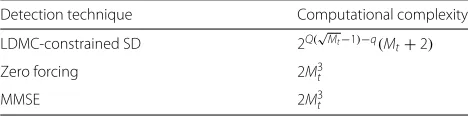
In this section, we compare the detection complexity of the LDMC-constrained SD detection in the LDMC coded MIMO system with that of ZF and MMSE detec-tions. To estimate the computational complexity, we use the number of multiplications required in the detection. Rough computational complexity estimations are given in Table 1. The number of additions is relatively small, therefore, it is omitted in the analysis.
Generally, SD is a searching algorithm for detection. It performs an exhaustive search based on setting a radius constraint. This has been proved by Hassibi [11] that the expected total number of points visited by the sphere decoding is proportional to the total number of candidates inside spheres of dimensionk=1. . .m: Gamma function. Clearly, ω depends on the radius d. Therefore, the channel state information (CSI) estimation does not impact the complexity in SD.
Table 1Number of multiplications in LDMC-constrained SD, ZF, and MMSE detections
Specifically, if SD is performed in an LDMC coded MIMO system, the norm y− Hx 2 in the LDMC-constrained SD detection in (2) needs 2(Mt+2) multipli-cations. Thus, the total number of multiplications in the LDMC-constrained SD detection is
CLDMC=2Q( √
Mt−1)−q+1(M
t+2). (7)
On the other hand, the ZF detection is represented by
¯
x=(HHH)−1HHy, (8)
and the MMSE detection is represented by
¯
x=(HHH+σ2I)−1HHy. (9)
From the (8) and (9), it is clear that the MMSE and ZF detections consist of a complex inversion ofMt×Mt matrix, and some matrix multiplications and additions. Mt×Mtmatrix inverse and matrix multiplication opera-tions are both known to needM3t multiplications. Conse-quently, the total number of multiplications in MMSE and ZF detections are both
CMMSE=CZF =2M3t. (10)
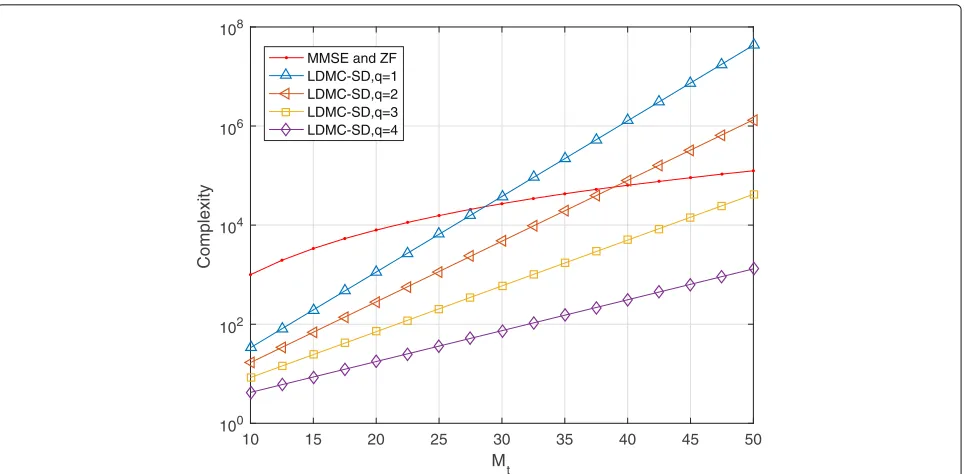
Note that the computational complexity of linear detec-tor mainly depend onMt while the computational com-plexity of LDMC-constrained SD detection depends on Mt, Q, and q. If q is large enough, it is possible that the computational complexity of LDMC-constrained SD detection is lower than that of ZF and MMSE detections. LetM3t ≥2Q(√Mt−1)−q2(M
If q satisfies condition (11), the computational com-plexity of LDMC-constrained SD detection with near-ML performance can be lower than that of ZF and MMSE detections. From Fig. 1, we can see that the complexity of the LDMC-constrained SD detection is lower than that of the MMSE and ZF detections if we choose q prop-erly. Note that a larger q reduces the size of Pg of the LDMC matrix, which is constructed by the PEG algo-rithm. Among the existing approaches for constructing LDPC codes, the most successful one is the PEG rithm. The LDPC code constructed by the PEG algo-rithm is one of the best codes of good error-correcting performance. Therefore, a larger q not only leads to worse error-correcting performance, but also lower SD detection complexity. Hence, there is a trade-off between performance and detection complexity by choosing the valueq.
5 Efficient decoding algorithm
10 15 20 25 30 35 40 45 50
M t
100 102 104 106 108
Complexity
MMSE and ZF LDMC-SD,q=1 LDMC-SD,q=2 LDMC-SD,q=3 LDMC-SD,q=4
Fig. 1Complexity comparison of MMSE, ZF, and LDMC-constrained SD detections for varyingMtandq
decoding. We denote the set of symbol nodes that par-ticipate in check node ci by N(i) = {j : Pij = 1}, and the set of check nodes in which sj participates as
M(j)= {i:Pij=1}.
The standard belief propagation (BP) decoding algo-rithm consists of initialization, check-node updating, symbol-node updating, stopping criterion test, and out-put steps [20]. In the proposed decoding algorithms, the initialization, stopping criterion test, and output steps remain the same as that in the standard BP algorithm, and therefore omitted here.
5.1 High-speed serial decoding
In LDMCs, the code length n can be divided into sub-codesPeof lengthNe. In the high-speed shuffled decod-ing algorithm, the updatdecod-ing of sub-codes is processed sequential, but the updating of symbol nodes and check nodes corresponding to each sub-code Pe remain in parallel. Let rijl and glij be the LLRs sent from check node ci to symbol node sj, and sent from the sym-bol node sj to check node ci, respectively, in the lth iteration.
In the standard BP algorithm, all value rijl should be updated before updating all value gijl. We observe that, since the sub-codesPein transmission vectors should not be connected to each other as shown by (4), all value rijl for updatinggij(l+1)ofkth sub-code have already been updated before updating rijl of the (k + 1)th sub-code,
1 ≤ k ≤ (Ng − 1). Therefore, the updating of gij(l+1) for kth sub-code can be computed in parallel with the
updating ofrijl for(k+1)th sub-code. In the high-speed serial decoding (HSSD), the check-node updating and the symbol-node updating of the HSSD are carried out alternately as follows.
Check-node updating corresponding to Pg:for 1 ≤
i≤(m−Ngq)and eachj∈N(i), process
τl ij=
j∈N(i)\j tanh
⎛ ⎝g
(l−1) ij
2
⎞
⎠ (12)
rlij=log1+τ l ij
1−τijl. (13)
For 1≤k≤Ng, process jointly the following two steps.
• Check-node updating:fork·q≤i≤(k+1)·qand
eachj∈N(i), process (12) and (13).
• Symbol-node updating:fork·Ne≤j≤(k+1)·Ne
and eachi∈M(j), process
gijl =Lj+
i∈M(j)\i
rlij (14)
gjl=Lj+
i∈M(j)
rlij, (15)
whereLjis the LLR ofj th bit and initially set
Lj=(4/N0)yj.
5.2 Fast convergence shuffled decoding
In the HSSD algorithm, the check-node updating cor-responding to Pg should be done for only once in each iteration. To increase the convergence speed, we modified the HSSD and propose the fast convergence shuffled decoding (FCSD) algorithm in this subsec-tion. In this decoding algorithm, the check-node updat-ing correspondupdat-ing to Pg will be done at each time the check-node updating corresponding to sub-code is done. The check-node updating and the symbol-node updating of the FCSD are carried out as fol-lows. For 1 ≤ g ≤ Ng, process jointly the following two steps:
• Check-node updating:for1≤i≤(m−Ngq),
k·q≤i≤(k+1)·qand eachj∈N(i), process (12) and (13).
• Symbol-node updating:fork·Ne≤j≤(k+1)·Ne
and eachi∈M(j), process (14) and (15).
Note that compared to the high-speed serial decoding, this algorithm has faster convergence speed [21].
6 Simulation results
In this section, we compare the bit error rate (BER) performance of the PEG-LDMCs, LDMCs proposed in [17] and original LDMCs [16]. The PEG-LDMCs are constructed with the proposed PEG-LDMCs algorithm. The code rate is R = 0.5. The channel matrix H is assumed to remain constant during the transmission of each codeword. We perform three outer-iterations between MIMO detector and LDPC decoder. In each outer-iteration, MIMO detection is performed followed by 40 inner-iterations inside LDPC decoder. The decod-ing process is halted if the decoder converges to a valid code or a maximum number of outer and inner itera-tions are reached. Note that in [16, 17], only the phys-ical layer is considered. Therefore, for the sake of fair-ness, we have only considered the LDMCs of the same length as that of [16,17], which are transmitted over the physical layer.
Figure2shows the BER performance of proposed PEG-LDMCs, LDMCs proposed in [17] and original LDMCs [16]. The transmission is over a 4×4 MIMO channel with 16-QAM and 64-QAM modulations. The first layerPgis of size 480×1920 and 480×2880 for each modulation, respectively. Therefore, the parity-check matrixP of the corresponding LDMCs is of size 960×1920 and 1440× 2880 for 16-QAM and 64-QAM. Thus, the code length isn = 1920 for 16-QAM andn = 2880 for 64-QAM, respectively. For the proposed PEG-LDMCs, the HSSD and FCSD algorithms are both applied for decoding. It can be seen that our proposed PEG-LDMCs with HSSD and FCSD algorithms have about 0.3 and 0.5 dB performance
gain compared to original LDMCs with 16-QAM modula-tion, and they have about 0.1 and 0.3 dB performance gain compared to LDMCs in [17] with 16-QAM modulation. The proposed PEG-LDMCs with HSSD and FCSD algo-rithms also have about 0.4dB and 0.6dB performance gain compared to original LDMCs with 64-QAM modulation, and they have about 0.15 and 0.35 dB performance gain compared to LDMCs in [17] with 64-QAM modulation. This is due to the reason that the girth of the PEG-LDMC is optimized globally by the PEG-LDMC algorithm and the FCSD has faster convergence speed. Therefore, the performance of PEG-LDMCs with FCSD algorithm is bet-ter than that of PEG-LDMCs with HSSD algorithm and original LDMCs in [16].
Figure3shows the BER performance of proposed PEG-LDMCs, LDMCs proposed in [17] and original LDMCs. The simulations are under 4 × 4 MIMO and 16× 16 MIMO with 16-QAM modulations. For the proposed PEG-LDMCs, the proposed HSSD and FCSD algorithms are also applied for decoding. It can be seen from Fig.3 that our proposed PEG-LDMCs with HSSD and FCSD algorithms have about 0.5 and 0.6 dB performance gain compared to original LDMCs over a 16×16 MIMO chan-nel, and they have about 0.1 and 0.3 dB performance gain compared to LDMCs in [17] over a 16×16 MIMO channel. This is due to the reason that the performance of LDMCs depends on the girth, and our proposed new modified PEG algorithm can construct PEG-LDMCs with a girth of 8, which is larger than that of LDMCs proposed in [17].
7 Conclusions
In this paper, we have introduced the PEG-LDMC algo-rithm to construct LDMCs of large girth. In order to reduce the complexity of detection, SD detection has been adopted into LDMC coded MIMO sys-tems. The complexity of LDMC-constrained SD detec-tion has been analyzed and compared to that of MMSE and ZF detections. Two new decoding algo-rithms have also been proposed for high-speed decoding and fast convergence decoding. The simulation results have shown that the proposed PEG-LDMCs with new decoding algorithms achieved better BER performance than that of LDMCs proposed in [17] and original LDMCs in [16].
8 Methods/Experimental
6 7 8 9 10 11 12 13
Eb/No (dB)
10-6 10-5 10-4 10-3 10-2 10-1 100
BER
Original LDMCs(16-QAM) [16] Original LDMCs(64-QAM) [16] PEG-LDMCs with HSSD(16-QAM) PEG-LDMCs with HSSD(64-QAM) PEG-LDMCs with FCSD(16-QAM) PEG-LDMCs with FCSD(64-QAM) LDMCs proposed in [17](16-QAM) LDMCs proposed in [17](64-QAM)
Fig. 2BER performance comparison of PEG-LDMCs, LDMCs proposed in [17] and original LDMCs in [16] with 16-QAM and 64-QAM
paper, we analyze the complexity of SD detection in the LDMC coded MIMO systems, and compare it to ZF detection and MMSE detection. Furthermore, we propose high-speed serial decoding and fast conver-gence shuffled decoding in order to improve the BER performance.
In this paper, the comparison of BER perfor-mance among the PEG-LDMCs, original LDMCs
[16], and LDMCs proposed in [17] is presented. The PEG-LDMCs are constructed with the proposed PEG-LDMCs algorithm. The function to generate the LDMCs and proposed PEG-LDMCs algorithm for MIMO systems can be made by MATLAB code. Experimental results in this paper had performed by using MATLAB R2016a on Intel Core i7-4790 @ 3.60GHz platform.
4 5 6 7 8 9 10 11
Eb/No (dB)
10-6 10-5 10-4 10-3 10-2 10-1 100
BER
Original LDMCs (16x16, 16-QAM) [16] PEG-LDMCs with HSSD (16x16, 16-QAM) PEG-LDMCs with FCSD(16x16, 16-QAM) LDMCs proposed in [17](16x16, 16-QAM) Original LDMCs (4x4, 16-QAM) [16] PEG-LDMCs with HSSD (4x4, 16-QAM) PEG-LDMCs with FCSD(4x4, 16-QAM) LDMCs proposed in [17](4x4, 16-QAM)
Abbreviations
BER: Bit error rate; BP: Belief propagation; CSI: Channel state information ; FCSD: Fast convergence shuffled decoding; HSSS: High-speed serial decoding; LDMC: Low-density MIMO code ; LDPC: Low-density parity-check; LLR: Log-likelihood ration; MIMO: Multiple-input multiple-output; MMSE: Minimum mean-square error ; PEG: Progressive edge-growth ; SD: Sphere decoding ; ZF: Zero-forcing;
Acknowledgements
We gratefully acknowledge the MDMC Lab, Chonbuk National University, Korea and Donghua University, China, which provided the simulation platform.
Funding
This work was supported by National Natural Science Foundation of China (61671143,61631004,61571315), and the Initial Research Funds for Young Teachers of Donghua University.
Availability of data and materials All data are fully available without restriction.
Authors’ contributions
HH and XQJ contributed to the main idea, PEG based algorithms and wrote the manuscript. PS and SC designed and carried out the analysis and simulations. MHL and HJ reviewed and edited the manuscript. All authors read and approved the final manuscript.
Competing interests
The authors declare that they have no competing interests.
Publisher’s Note
Springer Nature remains neutral with regard to jurisdictional claims in published maps and institutional affiliations.
Author details
1School of Information Science and Technology, Donghua University, 2999
Renmin N Rd, Songjiang, 201620 Shanghai, China.2Department of Information
and Communication Engineering, Inha University, 100 Inharo, Nam-gu, Incheon 22212, Korea.3Department of Electronics Engineering, Hanyang
University, 222 Wangsimni-ro, Seongdong-gu, Seoul 133-791, Korea.4Division
of Electronics and Information Engineering, Chonbuk National University, 567 Baekje-daero, Deokjin-gu, Jeonju 54896, Korea.5School of Electronic and
Information Engineering, Soochow University, 1 Shizi St, 205006 Suzhou, China.
Received: 27 July 2017 Accepted: 12 July 2018
References
1. GY Li, J Niu, D Lee, J Fan, Y Fu, Multi-cell coordinated scheduling and MIMO in LTE. IEEE Commun.Surveys Tuts.16(2), 761–775 (2014). 2nd Quart 2. C Lim, T Yoo, B Clerckx, B Lee, B Shim, Recent trend of multiuser MIMO in
LTE advanced. IEEE Commun.Mag.51(3), 127–135 (2013)
3. P-H Kuo, A glance at FD-MIMO technologies for LTE. IEEE Wirel. Commun. 23(1), 2–5 (2016)
4. P Selvaprabhu, S Chinnadurai, J Li, MH Lee, Topological interference management for K- user downlink massive MIMO relay network channel. Sensors.17(12), 1896 (2017)
5. X Zhu, RD Murch, Performance analysis of maximum likelihood detection in a MIMO antenna system. IEEE Trans.Commun.50(2), 187–191 (2002) 6. X-Q Jiang, Y Zheng, W Chen, M Wen, J Li, Two-layer LDPC codes for low
complexity ML detection in GSM systems. IEEE Wirel. Commun. Lett. 07(3), 408–411 (2018)
7. W van Etten, An optimum linear receiver for multiple channel digital transmission systems. IEEE Trans. Commun.23(8), 828–834 (1975) 8. GJ Foschini, Layered space-time architecture for wireless communication
in a fading environment when using multi-element antennas. Bell Labs Tech.J.1(2), 41–59 (1996)
9. DA Shnidman, A generalized Nyquist criterion and an optimum linear receiver for a pulse modulation system. Bell Syst.Tech. J.46(9), 2163–2177 (1967)
10. E Viterbo, J Boutros, A universal lattice code decoder for fading channels. IEEE Trans. Inform. Theory.45, 1639–1642 (1997)
11. B Hassibi, H Vikalo, On the sphere decoding algorithm.I. Expected complexity. IEEE Trans. Signal Process.53(8), 2806–2818 (2005) 12. T Ketseoglou, E Ayanoglu, Linear precoding for MIMO with LDPC coding
and reduced complexity. IEEE Trans. Wirel. Commun.14(4), 2192–2204 (2015)
13. K Wang, H Shen, W Wu, Z Ding, Joint detection and decoding in LDPC-based space-time coded MIMO-OFDM systems via linear programming. IEEE Trans.Signal Process.63(13), 3411–3424 (2015) 14. AGD Uchoa, CT Healy, RC de Lamare, Iterative detection and decoding
algorithms for MIMO systems in block-fading channels using LDPC codes. IEEE Trans. Veh. Technol.65(4), 2735–2741 (2016)
15. F Kienle, inProc. 5th International Symposium on Turbo Codes and Related Topics. Low-density MIMO codes (Proc. 5th International Symposium on Turbo Codes and Related Topics, Lausanne, 2008), pp. 107–112 16. F Kienle, inProc. IEEE International Conference On Communications (ICC).
On low-density MIMO codes (Proc. IEEE International Conference On Communications (ICC), Dresden, 2009), pp. 1–6
17. X Jiang, Y Yang, M Lee, M Zhu, Progressive edge-growth algorithm for low-density MIMO codes. J. Commun. Netw.16(6), 639–644 (2014) 18. XY Hu, E Eleftheriou, DM Arnold, Regular and irregular progressive
edge-growth Tanner graphs. IEEE Trans.Inform. Theory.51(1), 386–398 (2005)
19. LG Barbero, JS Thompson, Fixing the complexity of the sphere decoder for MIMO detection. IEEE Trans. Wirel. Commun.7(6), 2131–2142 (2008) 20. J Zhang, M Fossorier, Shuffled iterative decoding. IEEE Trans.Commun.
53(2), 209–213 (2005)
21. H-C Lee, Y-L Ueng, LDPC decoding scheduling for faster convergence and lower error floor. IEEE Trans. Commun.62(9), 3104–3113 (2014) 22. C Studer, H Bolcskei, inProc. IEEE International Symp. Inform. Theory.
Soft-input soft-output sphere decoding (Proc. IEEE International Symp. Inform. Theory, Toronto, 2008), pp. 2007–2011
23. C Studer, A Burg, H Bolcskei, Soft-output sphere decoding: algorithms and VLSI implementation. IEEE J.Sel. Areas Commun.26(2), 290–300 (2008) 24. H Vikalo, B Hassibi, T Kailath, Iterative decoding for MIMO channels via
modified sphere decoding. IEEE Trans. Wirel. Commun.3(6), 2299–2311 (2004)
25. G Han, YL Guan, L Kong, Construction of irregular QC-LDPC Codes via Masking with ACE Optimization. IEEE Commun.Lett.18(2), 348–351 (2014) 26. X Jiang, XG Xia, MH Lee, Efficient progressive edge-growth algorithm
based on Chinese remainder theorem. IEEE Trans.Commun.62(2), 442–451 (2014)
![Fig. 2 BER performance comparison of PEG-LDMCs, LDMCs proposed in [17] and original LDMCs in [16] with 16-QAM and 64-QAM](https://thumb-us.123doks.com/thumbv2/123dok_us/918567.1111223/7.595.61.541.481.712/fig-performance-comparison-ldmcs-ldmcs-proposed-original-ldmcs.webp)
