R E S E A R C H
Open Access
Multi-objective virtual network embedding
algorithm based on Q-learning and
curiosity-driven
Mengyang He, Lei Zhuang
*, Shuaikui Tian, Guoqing Wang and Kunli Zhang
Abstract
Network virtualization is a vital technology that helps overcome shortcomings such as network ossification of the current Internet architecture. However, virtual network embedding (VNE) involving the allocation of resources for heterogeneous virtual network requests (VNRs) on the substrate network (SN) is considered as NP-hard problem. VNE process may involve conflicting objectives, including energy saving and VNR acceptance rate as the most critical. In this paper, we propose a virtual network multi-objective embedding algorithm based on Q-learning and curiosity-driven (Q-CD-VNE) for improving the performance of the system by optimizing conflicting objectives, namely energy saving and acceptance rate. The proposed algorithm employs Q-learning and curiosity-driven mechanism by considering other non-deterministic factors to avoid falling into a local optimum. The major contributions of this work involve (1) modeling of the multi-objective deterministic factors as binary (0, 1) integer programming problem, (2) formulating the virtual node mapping problem using the Markov decision process (MDP), (3) solving the VNE problem using Q-learning algorithm, (4) mining non-deterministic factors using curiosity-driven mechanism for avoiding prematurely falling into the Exploration-Exploitation dilemma and local optimal. Experimental results in comparison with representative researches in the field prove that the proposed algorithm can reduce energy consumption, improve the request acceptance rate, and improve the long-term average income.
Keywords:Network virtualization, Q-learning, Curiosity-driven, Energy-aware
1 Introduction
Network virtualization is considered as an important technology of next-generation Internet for addressing the growing problem of network ossification [1]. In the recent past, the energy-aware virtual network embedding (EEVNE) remained as a focus of the current research community in the field for tackling this problem. EEVNE refers to shifting the virtual network embedding (VNE) problem from the utility to the power consumption of the substrate networks (SNs). The main aim is to reduce energy consumption of SNs in the mapping process for slicing the cost of VNE operation and maintenance. Request acceptance rate is one of the most important in-dicators in the VNE processes. It describes success rate of VNRs. Therefore, quality of the request acceptance rate directly reflects the quality of the VNE algorithm.
Most of the existing energy-efficient strategies usually search the subset of resources in the whole SNs for the VNs. Whereas, resource consolidation achieves the minimization of energy consumption by switching off or hibernating as many physical infrastructures as possible like physical servers and fiber optic links. However, this process may lead to the hotspots among SNs. Thus, it can result in a sharp decrease in request acceptance rate. Here, these objectives are conflicting in nature. There-fore, comprehensive consideration of these conflicting objectives has become a critical problem that requires immediate attention for resolving it.
In addition, there exist multiple factors known as non-deterministic factors that affect VNE performance, such as load balancing, mapping duration, and fragmen-tation rate [2–6]. These factors should be taken into consideration in specific scenarios for obtaining an ac-curate solution to the problem.
* Correspondence:[email protected]
School of Information and Engineering, Zhengzhou University, Zhengzhou, China
In this work, we propose a VNE method based on im-proved Q-learning algorithm, which considers the factor of energy saving and VNR acceptance rate as the main optimization objectives (termed deterministic factors). We also explored non-deterministic factors for ensuring guar-anteed performance of deterministic factors. The pro-posed method is a two-phase embedding algorithm that maps nodes followed by mapping of the links. It employs the Q-learning algorithm of reinforcement learning and a curiosity-driven mechanism to map the virtual nodes and shortest-path algorithm for mapping virtual links.
In summary, the proposed method firstly performs multi-objective modeling of deterministic factors as
binary (0–1) integer programming problem. Then, it
formalizes the virtual node mapping problem using the Markov decision process (MDP), and the node mapping algorithm is taken as an intelligent agent to aware the substrate environment. Finally, it employs Q-learning algorithm to solve the model, in combination with a curiosity-driven mechanism for mining non-deterministic factors. In this work, the optimization of the deterministic factors is used as an exploitation value, and the optimization of non-deterministic factors are used as an exploration value. The proposed method generates a trade-off solution to avoid prematurely falling into the Exploration-Exploitation dilemma and local optimal with a limited number of requests.
Major contributions of this study are as described below:
1. Modeling of the multi-objective deterministic factors as binary (0, 1) integer programming problem. 2. Formulating the virtual node mapping problem
using the MDP.
3. Solving the VNE problem using Q-learning algorithm. 4. Mining non-deterministic factors using curiosity-driven
mechanism for avoiding prematurely falling into the Exploration-Exploitation dilemma and local optimal.
The remainder of this paper is organized as follows.
Section 2 summarizes the state of the art highlighting
the significant researches in the field of VNE. Section3
describes the methods for modeling the VNE problem as
binary (0–1) integer programming and use of MDP.
Section 4 details the proposed method for solving VNE
problem using Q-learning and the curiosity-driven
mechanism. Section5presents a performance evaluation
of the proposed method and presented experimental results followed by their discussion. Finally, Section 6
concludes the proposed work at the end of this paper.
2 Related research
Numerous studies have been conducted for solving VNE problem by considering its different perspectives. Yu et
al. [7] proposed an effective competition algorithm for tackling VNE problem of non-division of path. They authors claimed the optimization of request acceptance rate of the virtual network mapping. Triki and Kara [8] proposed a solution to energy-saving mapping problem of virtual networks and provided an analysis of energy consumption, request priority, and requested distance
constraints. Guan and Choi [9] studied data centers
from both computing resources and network resources. Chen et al. [10] proposed the construction of dictionary library through historical data in the early stage of virtual network mapping and deployed the virtual net-work in a small-scale nodes and link set, thereby achieved saving in energy.
It can be noticed from the above cited work that researchers focused on the optimization of a single goal. Most of the researches lack in simultaneous
consider-ation of both deterministic factors along with
non-deterministic factors.
In recent years, machine learning techniques, particu-larly reinforcement learning technique, have been widely used to deal with decision-making issues. Karimpanal
and Wilhelm [11] employed off-policy learning to
ad-dress multiple objectives using adaptive clustering Q-learning algorithm. The authors proposed that agents can effectively use their own exploration behavior by identifying the possible goals in the environment to find effective strategies in the case of unknown goals. Vamvoudakis et al. [12] proposed the use of Q-learning technique for continuous-time-based graphical games on large networks with completely unknown linear system dynamics. They used the model-free formula of Q-learning function to model a large network to meet the user-defined distributed optimization criteria and used it for the agent having no information about the
leader. TheQfunction parameterizes each neighborhood
tracking error of the agent and results in a better strategy.
Curiosity has always been considered as one of the basic attributes of intelligence, and giving curiosity to machines is also an important research objective in the field of computer science. Hester et al. [13] attempted to make the machine curious by using reinforcement learn-ing technique. They proposed an intrinsically motivatlearn-ing model-based reinforcement learning algorithm that allows agents to explore themselves. Pathak and Agrawal
[14] proposed a self-supervised prediction algorithm
based upon curiosity-driven exploration. In many real-world scenarios, curiosity can be used as an intrinsic reward signal when the external rewards are scarce or absent that allows the agents to explore the external
en-vironment and learning. Kompella and Stollenga [15]
the external world model for acquiring new skills in ab-sence of external guidance.
Findings of the literature cited above indicate that reinforcement learning method based on the curiosity-driven has great advantages and feasibility in discovering new skills and actions. Therefore, it is necessary to further analyze the problem of mining non-determin-istic factors in multi-objective embedding of virtual networks using reinforcement learning method.
3 Problem formulation
3.1 Optimization model of deterministic factors
In this work, we proposed an optimization model for deterministic factors, namely energy saving and VNR
acceptance rate, using binary (0–1) integer
program-ming method. The proposed model considers the minimization of energy consumption and maximization of request acceptance rate. The objective function can be mathematically represented as shown in Eq. (1).
maxðωacceptance−ð1−ωÞ∙fðenergyÞÞ ð1Þ
whereωis a weighting factor that is used to adjust the weight of VNR acceptance rate and energy consumption. It is applied to meet different requirements in different scenarios.
acceptancedescribes VNR’s acceptance rate, as defined in Eq. (8).
acceptance¼AT
CT ð
8Þ where AT indicates the number of virtual network
re-quests successfully mapped during theT period, andCT
indicates the total number of virtual network requests reached in theTperiod.
energy represents the energy consumption of the substrate network which consists of physical nodes and links, as defined in Eqs. (9) and (10), respectively.
Pij¼
Pidleþ Pbusy−Pidle
∙φ;
ifivirtual nodes sucessfully mapped on thejphysical nodes
0;otherwise
Plinkidle;if um vitual link sucessfully mapped
on the mn physical link 0;otherwise
8 < :
ð10Þ where Pidleis the basic power consumption of physical
node, Pbusy is the full-load power consumption of
physical node, φ represents the CPU load rate of substrate node, and Plinkidle indicates the link energy
consumption, which is generally constant. Therefore, energy consumption of substrate network can be com-puted as per Eq. (11).
The proposed work considers two-phase mapping Al-gorithm involving mapping of nodes first. Therefore, only the node energy consumption is considered for using QCD VNE algorithm and updated as shown in Equation below:
energy¼X
j∈NSP i
j
wheref(energy) in Eq. (1) represents data normalization processing which is logarithmic function conversion. The purpose is to eliminate the data difference caused by the dimensions of energy saving and VNR rate. It fa-cilitates subsequent data processing and speeds up pro-gram convergence, as defined in Eq. (12).
fðenergyÞ ¼ log10ðenergyÞ log10 maxenergy
ð12Þ
where maxenergyis the maximum value of substrate
net-work energy consumption.
Equations (2) and (3) represent the capacity
con-straints, where ReqCPU(i) indicates the CPU resource
requests for i virtual node, CPU(j) represents the total
CPU resource for j physical node, ReqBWL(luw) is the
BW resource requests forluwvirtual link, and BWL(lmn)
denotes the total BW resource for lmn physical link.
Equation (4) restricts a virtual node to map to only one
physical node. Equation (5) indicates that the same
virtual node cannot be mapped to the same physical
node, NNo is the number of virtual nodes. Equations
(6) and (7) represent variable constraints. If i virtual node is successfully mapped on jphysical node, fij¼1 ; otherwise, fij¼0. Similarly, ifluwvirtual link is success-fully mapped on luw physical link, fuwmn¼1 ; otherwise,
3.2 Virtual network embedding as Markov decision process
We use the MDP to model the virtual network with an assumption that the arrival and departure of VNRs obey Poisson distribution. If a flow of events is a Poisson
event flow, it needs to satisfy the stationary,
non-post-effect, and generality [16]. For the virtual
network mapping problem, the occurrence of events is independent of each other, and its probability depends only on the time interval, only one virtual request enters or leaves in a unit time. Therefore, the virtual network mapping problem can be modeled as a Markov decision process as a quadruplet: {S、A、P、R}, where S rep-resents state set with the state Sρ denoted as the final
state. The value of reward in the final state is denoted as Rρ. Ais the action set,Pis the state transition
probabil-ity, andR(s,a) is the reward of the actionaat stateS. A MDP is called an episode from the initial state to the final state. A successful mapping process of each vir-tual network termed as one episode. In each episode, the agent starts execution from a randomly selected state until it reaches a final state. At the end of the episode, the agent is randomized to a new initial state and begins the next episode.
Assume that in a given state St, the agent selects one physical node ns∈Nψs for mapping the virtual node nv∈ Nψv and then enters the next stateSt+ 1, where Nψs is a set of all physical nodes that can carry virtual nodesnv, andNψv is all non-mapped virtual nodes. The state of M at timetis defined as:
St ¼ Nψtv ¼N
t−1 is a physical node carrying the previous
vir-tual nodens The action of agent selection node ns
t∈fN
where εindicates an arbitrary action that can reach the terminal state. When the agent selects the physical node
ns
t for the current virtual node nvt, it transits to the next
state St+ 1. Therefore, the probability of state transition
that the agent selects actionAttransits to the next state
St+ 1in stateStis defined as:
Pr Stþ1jnvt nst;St
¼1
where total reward consists of an external rewardRet and an internal signal Ri
t. The external reward Ret is
calcu-lated from the deterministic factor optimization model as shown in Eq. (13). The internal signal Ri
t is calculated
by the curiosity-driven mechanism as described in Section4.2.
If the total reward calculated in the stateStis smaller than it in the state Rρ, then the virtual request reaches the final state, and its value will be replaced byRρ, other-wise it will remain unchanged.
4 Virtual network embedding based on reinforcement learning and curiosity-driven In this section, we defines Q-learning and curiosity-driven for their application to VNE problem, and presents a description of the virtual network multi-objective embed-ding algorithm based on Q-learning and curiosity-driven (Q-CD-VNE).
4.1 VNE based on Q-learning algorithm
We employed Q-learning algorithm of reinforcement learning to solve the MDP process. It allows agents to automatically determine the ideal behavior within a spe-cific environment for maximizing its performance. Simple reward feedback is required for the agent to learn its be-havior. The agent’s living environment in each episode is described as a state set S, which can perform any possible action described as action set A as depicted in Fig.1Each time an actionatis performed in the statest, the agent re-ceives a reward rt, thus generating a series of statessi, a set of actionsaiand rewardritill the end of the episode. It finds the action sequenceπiteratively for maximizing all reward values as an optimal strategy as shown in Eq. (14).
π
For finding optimal strategies, the approximate behav-ioral value function Q is usually used. After successful mapping of a virtual node, the system deliverse aQvalue to the agent. TheQvalue matrix is obtained by approxi-mating the behavior value functionQ(st,at) gradually. This matrix can be used in the next episode to find the node with the highest reward value quickly for embedding,
where the Q value update strategy function is
expressed as:
Q sð;aÞ ¼R sð;aÞ þγmaxQðδðs;aÞ;a0Þ The estimate ofQis expressed as:
a′after the actionais performed in the states, andγis the conversion factor which is used to weigh the relationship between the current reward value and the subsequent reward value.
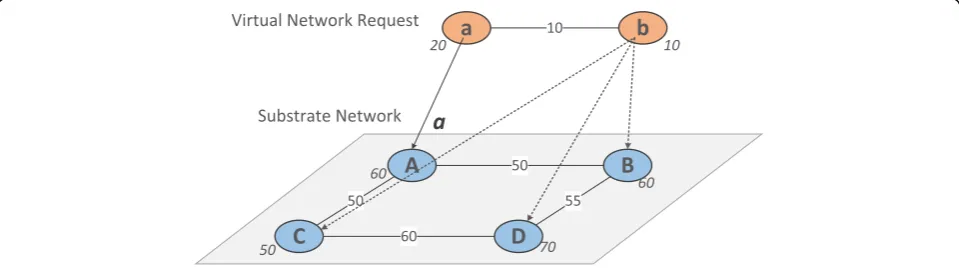
At a time t, the Qvalue update process of the virtual network node mapping is shown in Fig.2:
The solid lines with arrows in Fig. 2 represent the
sequence of actions that have been mapped success-fully, with the dashed arrows pointing to the select-able mapping nodes. This figure represents a network diagram for selecting the next action, that is, embedding the virtual node b when the virtual node a is successfully mapped to the physical node A. The detailed process is de-scribed below.
S1¼ Nat;Nbt
;NAt;NBt;NtC;NDt
After the action na
tnAt is performed in state S1, the agent arrivals at stateS2.
S2¼ Nbt ; NtB;NCt;NDt
At state S2, the mappable action set A2fnb
tnBt;nbtnCt ;nbt nD
tgsatisfies the resource of VNRs. TheQmatrix is initial-ized to an all-zero matrix. TheQvaluesQ^ðS2;ntbnBtÞ,Q^ðS2
;nb
tnCtÞ; and Q^ðS2;nbtnDtÞ are calculated according to the
Q value update strategy formula (13) when the system se-lects the action which is as follows.
^
Q Sð 2;A2Þ←R Sð 2;A2Þ þγ max a0
^
Q sð0;a0Þ
¼ max ReS2
þγ max
a0
^
Q sð0;a0Þ
¼ maxnbt nBt;nbt nCt;ntb nDtþ max 0ð ;0;0Þ
¼1−minðfðenergyÞÞ
For simplicity, we ignored the values of ω, γ, and
internal signals, where maxenergy is calculated as
follows.
maxenergy¼ max PidleþðCPUð Þi −PidleÞ
ReqCPUð Þi
CPUð Þi
where CPU(i)∈[a,b], and ReqCPU(i)∈[c,d.]
We draw this functional image in MATLAB and find the maximum value of this function. This
func-tion has an extreme in the interval for ReqCPU(i) =c
and CPU(i) =b. We can obtain the action with the
largest reward value using above cited expressions. Following this action, the reward value is recorded in
the Q matrix as the physical node evaluation standard
of the mapping, and the next state S3 is started. This
Fig. 1Reinforcement learning model
is repeated until the Q-value matrix reaches the con-vergence state, and the system can select the next
ac-tion A as per the current Q-value matrix by
considering energy saving and VNR acceptance rates.
4.2 The reward calculation method based on curiosity-driven
In this section, we present a curiosity-driven mechanism for generating internal signals and passing them to external reward generators for mining other non-deter-ministic factors. This method can achieve a trade-off be-tween exploration and exploitation and avoids falling into local optimum.
The traditional reinforcement learning method lacks the prediction of unknown environment for making
decisions with the highest reward called
exploitation-only. This causes a mismatch between the exploitation value and the exploration value and eventually leads to fall into a local optimum. For ex-ample, in the virtual network mapping process, the agent tends to repeatedly select nodes that perform well in the previous training process after much iter-ation. It may lead to deterioration of the substrate network connectivity and magnify the fragmentation rate of substrate network. Thus, it can be concluded that only considering the performance of determinis-tic factors can easily ignore the performance of non-deterministic factors. Therefore, it is suggested to consider prediction to the environment for selecting action a, so that the agent can adjust the mapping strategy before the formation of fragment in substrate network.
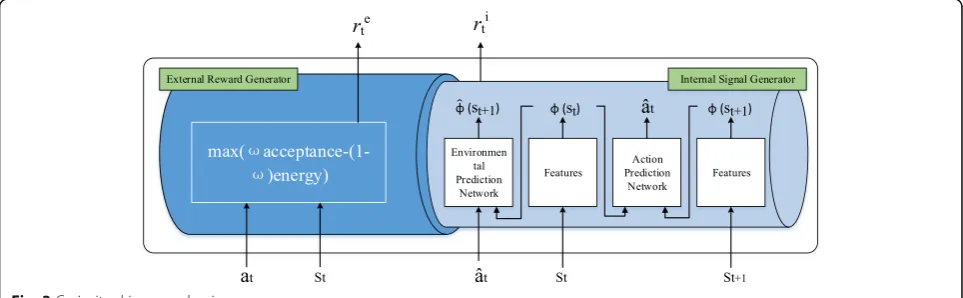
As shown in Fig. 3, the agent joins a curiosity-driven mechanism, by adding internal signals for external re-wards and predicting the results of its own actions in a self-monitoring manner. In the iterative process, the internal curiosity mechanism will motivate agents to
explore their own predictions of action by exploring the environment.
The curiosity-driven mechanism consists of external reward generator and internal signal generator as de-scribed in following paragraphs.
4.2.1 External reward generator
It is used to calculate rewards from deterministic fac-tors, such as energy saving and VNR acceptance rate.
It is called external reward re
t and calculated using
Eq. (13).
4.2.2 Internal signal generator
Agent trains its proficiency by responding to the changes in the environment by predicting movements and training familiarity with the surrounding environ-ment through predictions of the next environenviron-ment, so that corresponding changes can be made before the environment changes. Then, they explore other factors that affect the performance of VNE to gener-ate signals which guide the generation of total
re-wards, denoted as ri
t. The calculation process is as
described below.
4.2.3 Step 1
It predict the action ^at that causes the changes in
states by training a neural network amounts to
learn-ing function g(∙). The current state is denoted as
∅(st), take as inputs ∅(st) and ∅(st+ 1) and predict ac-tion ^at makes the agent from state st reach state st+ 1 which defined as
^
at ¼g sðt;stþ1;θIÞ
where ^at is the predicted value of the action at, θI is
trained by min
θ LIð^at;atÞ, and LI is the softmax loss
function measures the difference between predicted be-havior and actual bebe-havior.
4.2.4 Step 2
It predicts the next state ∅ð^ stþ1Þ generated by the ac-tion ^at under the current environment ∅(st)by train-ing another neural network amounts to learntrain-ing function f(∙).The state at t+ 1 is predicted by taking inputs as ^at and ∅(st).
^
∅ðstþ1Þ ¼ fð∅ð Þst ;^at;θFÞ
where ∅^ðstþ1Þ is the predictor of ∅(st) and θF is
mini-mized by the loss functionLF.
min
θF LFð∅ðstÞ;∅ð^ stþ1ÞÞ ¼ 1
2k∅ð^ stþ1Þ−∅ðstþ1Þk
2 2.
4.2.5 Step 3
It calculates the internal signal ri
t by predicting the next state:
rit¼
0;if ∅^ðstþ1Þcauses SN 0
s connectivity changes
e−
^
∅ðstþ1Þ−∅ðstþ1Þ
ð Þ2
∅ðstþ1Þ−∅^ðstþ1Þ
ð Þ2
; otherwise
8 < :
This assignment method is reference [18]. After
computing the values for internal signal and the ex-ternal reward generated by the deterministic factors, it is superimposed as a new reward to guide the agent to make a decision. Therefore, rt is defined as
rt¼ritþr e t
In summary, the proposed method involves the agent to obtain the current VNE environment such as the situation of the substrate network resources, the link connection status, and the request volume of the virtual network through the MDP model. At the be-ginning of each episode, the first mapped virtual node is randomly transported to a physical node in the set of executable actions, then the curiosity-driven mech-anism obtains the total reward value (composed of internal signals and external rewards), recorded in the
Q matrix, and then moves to the next state st+ 1.
Through this adaptive learning scheme, the potential impact factors can be mined by taking into account energy saving and VNR acceptance rates, for obtain-ing a global optimal mappobtain-ing method.
4.3 Algorithm description
It can be concluded from the description cited
process that Q-learning algorithm mixed with
curiosity-driven mechanism can ensure the energy saving and VNR acceptance rate performance and avoid falling into local optimum. So, the proposed al-gorithm is described as below.
5 Performance evaluation
This section describes the performance evaluation of the proposed method. It provides the details of the simulation environment, performance metrics, and experimental results followed by their discussion.
5.1 Simulation environment
The proposed method is implemented and executed on a PC having configuration as CPU: 3.4 GHz and 4G of memory. We used GT-ITM model and NS2 software to generate the substrate network and virtual
substrate network nodes pre-designed in this experi-ment is 100, and the probability of the nodes con-necting to each other is assumed as 0.5. The distribution of the substrate network and virtual net-work resources is as follows.
The value distribution of the CPU resource value of the physical nodes is [50, 100] and is subject to uniform distribution. The value range of the band-width resources of physical links is [50,100] and is uniformly distributed. The value distribution range of the virtual node CPU resource request amount is [0, 14] and obeys the uniform distribution. The value range of the virtual link bandwidth resource require-ment is [0, 34] and follows the uniform distribution. An average of 100 time units can reach 20 virtual network requests among all requests, and these requests obey the Poisson distribution. The number of requests to reach the virtual network in the experi-ment statistics is 2000, and the number of runtime units is about 14,000. The constant values for node
and link energy consumption are set as follows: Pl=
150, Pb= 150, Pn= 15, ω= 0.5, the number of
itera-tions is 100.
5.2 VNE performance metrics
The comprehensive quality of VNE problem can be judged in terms of following metrics.
1. Average number of open nodes (ANON):
ANON¼
PNT i¼1NOi
NT
where NT represents the number of all valid time
periods from 0 to T, NOi represents the number of
the physical nodes that are active in the effective period i.
2. Average number of open links (ANOL):
ANOL¼
PNT i¼1LOi
NT
where LOi indicates the number of the physical links
that are active during the valid periodi.
3. Average utilization of CPU (AUCPU):
AUCPU¼
PNT i¼1NRUi
NT
where NRUi indicates the CPU utilization of the node
resources in the effective time uniti.
4. Average utilization of BW (AUBW):
AUBW¼
PNT i¼1LRUi
NT
where LRUi indicates the bandwidth utilization of the
link resources in the effective time uniti.
5. Average amount of energy consumption (AAEC):
AAEC¼
PNT i¼1Ei NT
where Ei is the consumption of the physical resources
within the effective periodi.
6. Average ratio of revenue and cost (ARRC):
ARRC¼
PAT
i¼1RevenueRi
PAT i¼1CostRi
whereATrepresents the number of VNRs accepted
suc-cessfully from time 0 to time T. RevenueRi and CostRi
represent the revenue and cost of a successful virtual network requestRi, respectively.
7. Average acceptance ratio (AAR):
AAR¼AT
CT
where CT represents the total number of VNRs in the
time period from 0 toT.
8. Substrate network fragmentation (SNF):
SNFð Þ ¼t 1−
wheremrepresents the number of fragments in the sub-strate network, Residual((NS,LS),t) is the substrate re-sidual resources, and q is a positive integer number greater than 1 to reduce the influence of the small negli-gible fragments as long as one large fragment exits [20].
9. Node load balance (NLB):
NLB¼
5.3 Comparative analysis of experimental results
The proposed method is executed in a simulation en-vironment as described above, and reported results are compared with the representative researches in the field in terms of identified performance metrics. In order to compare the performance of the proposed
method, we choose the EAVNE algorithm [21] that
GSOVNE algorithm [22], because both algorithms use intelligent algorithms to embed virtual requests and
the classic greedy algorithm SP [23]. These three
al-gorithms have similarities with our algorithm, so they are used for comparison experiments. Ensure that our algorithmic experimental results are more credible.
Figures 3, 4, 5, 6, and 7 show the comparative results of the proposed method and representative methods in terms of average number of open nodes, average number of open links, average node resource utilization, average link resource utilization, and average amount of energy consumption.
a
b
d
e
c
It can be observed from Fig. 4a that ANON of the Q-CD-VNE algorithm is lower than the EAVNE, GSOVNE, and SP algorithms by 18, 13, and 32, respect-ively. It can be seen that it is significantly lower than that of the SP algorithm. This is because the SP algorithm does not consider energy saving during the mapping
process. As depicted in Fig. 4b, ANOL of the
Q-CD-VNE algorithm is 6 and 29 lower than the EAVNE algorithm and the SP algorithm, respectively, and about 5 more links than the GSOVNE algorithm. The performance of this algorithm is almost the same as that of EAVNE algorithm and the GSOVNE algorithm in terms of link opening amount. This is due to that these algorithms are all two-phase mapping algorithms, and the link-based processing uses the greedy-based shortest path algorithm, so no significant difference has been observed. It can be concluded from Fig.4cthat the AUCPU of the Q-CD-VNE algorithm is increased by 12.4, 8.3, and 23.3%, respectively, in comparison to the EAVNE algorithm, the GSOVNE algorithm, and the SP
algorithm. Figure 4d shows that the AUBW of the
Q-CD-VNE algorithm is 3.8, 0.1, and 13.8% higher than the EAVNE, GSOVNE, and SP algorithms, respectively. The improvement of the AUCPU is more significant than AUBW. It happens because the algorithm involves a two-phase mapping, and no more optimized algorithm
is used for mapping the links. Figure4e shows the
per-formance of algorithms in terms of AAEC because the Q-CD-VNE algorithm has a good energy-saving effect and the energy consumption of the proposed algorithm is the lowest among the four algorithms in comparison. Compared with the EAVNE algorithm, the GSOVNE al-gorithm, and the SP alal-gorithm, they have reduced 4335.54, 2276.78, and 5338.83 W, respectively.
Figure 5 shows that the VNR acceptance rate of the
Q-CD-VNE algorithm as 27.27, 15.12, and 21.13% higher than that of EAVNE, GSOVNE, and SP algorithms, re-spectively. This is because the algorithm regards energy saving and VNR acceptance rate as external rewards and considers both performances in the mapping process. Therefore, both the energy saving and the VNR accept-ance rate have been improved.
Figure 6 shows that the average ratio of revenue and
cost of Q-CD-VNE algorithm is slightly higher than that of the comparison energy-saving algorithm EAVNE and the intelligent algorithm GSOVNE, and almost the same value as that of SP algorithm. It shows that the perform-ance of the algorithm has not decreased while consider-ing other factors.
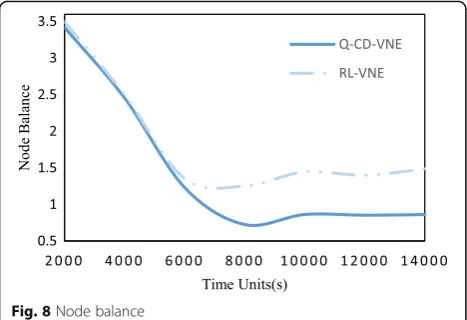
Figures 7and 8show the substrate fragmentation rate
and node load rate performance after adding a curiosity-driven mechanism. Here, Q-VNE is an
algo-rithm with no curiosity mechanism. Figure7shows that
the substrate fragmentation rate is reduced by 3–5 per-centage points in comparison to the algorithm without
the curiosity mechanism. Figure 8 shows that the load
Fig. 5Acceptance ratio
Fig. 6Average ratio of revenue and cost
imbalance is alleviated after the program runs for about 5000 time units. This is due to the fact that after the agent has been involved in the curiosity mechanism for a period of time, when the node is fully loaded, we feed back this information to the agent, prompting agent not to select actions which degrade the SN’s connectivity, thus avoiding the increase of node full load rate. This will inevitably reduce the fragmentation rate and ease the imbalance of the load.
6 Conclusions
In this paper, a virtual network embedding scheme is proposed on the basis of Q-learning algorithm, MDP, and curiosity-driven technology. The scheme addressed the multi-objective trade-off problem in VNE. The experimental results show that the algorithm can find a good trade-off between conflicting objectives. The com-parative results prove that the proposed method can im-prove the performance of the system in terms of conflicting objectives by reducing energy consumption, improving request acceptance rate, and improving the long-term average income.
In the future, we will consider making the fragmenta-tion rate and the load rate as deterministic factors. Meanwhile, we will consider improving the curiosity mechanism in order to explore more non-deterministic factors that can be used as optimization goals and in-corporate them into deterministic factors.
Abbreviations
AAEC:Average amount of energy consumption; AAR: Average acceptance ratio; ANOL: Average number of open links; ANON: Average number of open nodes; ARRC: Average ratio of revenue and cost; AUBW: Average utilization of BW; AUCPU: Average utilization of CPU; EEVNE: Energy-aware virtual network embedding; MDP: Markov decision process; NLB: Node load balance; SN: Substrate network; SNF: Substrate network fragmentation; VNE: Virtual network embedding; VNRs: Virtual network requests
Acknowledgements
This work is supported in part by the National Natural Science Foundation of China (no. 61379079), The Science and Technology Key Project of Henan Province (no. 172102210478), and The International Cooperation Program of
Henan Province (no. 152102410021). The Key Scientific Research Project of Higher Education of Henan (no.17A520057).
Authors’contributions
MH is in charge of the major theoretical analysis, algorithm design, numerical simulations, draft of the article, and critical revisions. ST is in charge of part of the algorithm design and experimental design. LZ, GW, and KZ provided critical revision and final approval of the version to be published. All authors read and approved the final manuscript.
Competing interests
The authors declare that they have no competing interests.
Publisher’s Note
Springer Nature remains neutral with regard to jurisdictional claims in published maps and institutional affiliations.
Received: 24 April 2018 Accepted: 30 May 2018
References
1. A Fischer, JF Botero, BM Till, et al., Virtual network embedding: a survey. IEEE Commun. Surv. Tutorials15(4), 1888–1906 (2013)
2. XW Zheng, B Hu, DJ Lu, et al., A multi-objective virtual network embedding algorithm in cloud computing. J. Internet Technol.17(4), 633–642 (2016) 3. Z Zhang, S Su, Y Lin, et al., Adaptive multi-objective artificial immune
system based virtual network embedding. J. Netw. Comput. Appl.53(3), 140–155 (2015)
4. P Zhang, H Yao, C Fang, et al., Multi-objective enhanced particle swarm optimization in virtual network embedding. EURASIP J. Wirel. Commun. Netw.2016(1), 167–175 (2016)
5. AA Shahin, Memetic multi-objective particle swarm optimization-based energy-aware virtual network embedding. Int. J. Adv. Comput. Sci. Appl. 6(4), 35–46 (2015)
6. I Houidi, W Louati, D Zeghlache, Exact multi-objective virtual network embedding in cloud environments. Comput. J.58(3), 403–415 (2015) 7. JJ Yu, CM Wu, et al., Design and analysis of virtual network mapping
competitive algorithms. Comput. Sci.42(2), 33–38 (2015)
8. N Triki, N Kara, ME Barachi, et al., A green energy-aware hybrid virtual network embedding approach. Comput. Netw. Int. J. Comput. Telecommun. Netw.91(C), 712–737 (2015)
9. XJ Guan, BY Choi, S Song, Energy efficient virtual network embedding for green data centers using data center topology and future migration. Comput. Commun.69(C), 50–59 (2015)
10. XH Chen, CZ Li, LY Chen, et al., Energy efficient virtual network embedding based on actively hibernating substrate nodes and links. J. Softw.25(7), 1416–1431 (2014)
11. TG Karimpanal, E Wilhelm, Identification and off-policy learning of multiple objectives using adaptive clustering. Neurocomputing263(8), 39–47 (2017) 12. KG Vamvoudakis, Q-learning for continuous-time graphical games on large networks with completely unknown linear system dynamics. Int. J. Robust Nonlinear Control27(16), 2900–2920 (2017)
13. T Hester, P Stone, Intrinsically motivated model learning for developing curious robots. Artif. Intell.247, 170–186 (2017)
14. D Pathak, P Agrawal, AA Efros, T Darrell, inICML. Curiosity-driven exploration by self-supervised prediction (2017)
15. VR Kompella, M Stollenga, M Luciw, et al., Continual curiosity-driven skill acquisition from high-dimensional video inputs for humanoid robots. Artif. Intell.247, 313–335 (2017)
16. L Xia, Mean-variance optimization of discrete time discounted Markov decision processes. Automatica88, 76–82 (2018)
17. C Watkins, P Dayan, Q-learning. Mach. Learn.8(3–4), 279–292 (1992) 18. C Bu, XW Wang, M Huang, Adaptive routing service composition: modeling
and optimization. J. Softw.28(9), 2481–2501 (2017)
19. E Zegura, K Calvert, S Bhattacharjee, inINFOCOM‘96. Conference on Computer Communications. How to model an Internet work (IEEE, San Francisco, 1996), pp. 594–602
20. J Gehr, J Schneider, in9th IEEE/ACM International Symposium on Cluster Computing and the Grid, 2009. CCGRID 09. Measuring fragmentation of two-dimensional resources applied to advance reservation grid scheduling (2009), pp. 276–283
21. JF Botero, X Hesselbach, M Duelli, et al., Energy efficient virtual network embedding. IEEE Commun. Lett.16(5), 756–759 (2012)
22. ZH Chen, XW Zheng, DJ Lu,A Study of a Virtual Network Embedding Algorithm. IEEE International Conference on Computer and Information Technology; Ubiquitous Computing and Communications; Dependable, Autonomic and Secure Computing; Pervasive Intelligence and Computing(IEEE, Las Vegas, 2015), pp. 814–818