Volume 2007, Article ID 76193,11pages doi:10.1155/2007/76193
Research Article
A Utility-Based Downlink Radio Resource Allocation for
Multiservice Cellular DS-CDMA Networks
Mahdi Shabany,1Keivan Navaie,2, 3and Elvino S. Sousa1
1Edward S. Rogers Sr. Department of Electrical and Computer Engineering, University of Toronto, Toronto, Ontario, Canada M5S 3G4 2Department of Electrical and Computer Engineering, Faculty of Engineering, Tarbiat Modares University,
P.O. Box 14155-4838, Tehran, Iran
3The Broadband Communications and Wireless Systems (BCWS) Center, Department of Systems and Computer Engineering,
Carleton University, Ottawa, Ontario, Canada K1S 5B6
Received 30 May 2006; Revised 1 December 2006; Accepted 8 January 2007
Recommended by Wei Li
A novel framework is proposed to model downlink resource allocation problem in multiservice direct-sequence code division multiple-access (DS-CDMA) cellular networks. This framework is based on a defined utility function, which leads to utilizing the network resources in a more efficient way. This utility function quantifies the degree of utilization of resources. As a matter of fact, using the defined utility function, users’ channel fluctuations and their delay constraints along with the load conditions of all BSs are all taken into consideration. Unlike previous works, we solve the problem with the general objective of maximizing the total network utility instead of maximizing the achieved utility of each base station (BS). It is shown that this problem is equivalent to finding the optimum BS assignment throughout the network, which is mapped to a multidimensional multiple-choice knapsack problem (MMKP). Since MMKP is NP-hard, a polynomial-time suboptimal algorithm is then proposed to develop an efficient base-station assignment. Simulation results indicate a significant performance improvement in terms of achieved utility and packet drop ratio.
Copyright © 2007 Mahdi Shabany et al. This is an open access article distributed under the Creative Commons Attribution License, which permits unrestricted use, distribution, and reproduction in any medium, provided the original work is properly cited.
1. INTRODUCTION
Third generation wireless cellular networks provide a variety of services ranging from multimedia to Internet access. In order to enable these services cellular networks are required to support multiple classes of traffic with diverse quality-of-service (QoS) requirements. Due to the limited availabil-ity of radio resources, designing a resource control mecha-nism to utilize the network resources efficiently is a crucial task for the next generation cellular communication systems. However, designing an optimal resource allocation scheme in CDMA cellular networks is a challenging problem especially when different parameters are involved in the system such as the rate, QoS, and delay requirements of various services.
The optimization can be performed either in the network level or in the cell level. Conventional methods for resource allocation in wireless networks are based on the characteriza-tion of traffic flows. In these methods the objective is either to minimize base-station power consumption or to maximize the system capacity [1–4]. There are two major limitations
in these approaches: they require the traffic characteristics of each flow, which may be difficult to obtain unless standard assumptions such as Poisson traffic are made. Furthermore, admission and access control must be considered in con-junction with the resource allocation mechanism. Moreover, these classical approaches fail to address the throughput-delay tradeoffefficiently [5].
treats multiclass services in a unified way. The utility func-tion then can be used as a tool to design an optimal resource allocation scheme. The objective of the allocation scheme is to optimize the total network utility, which is defined as the summation of all the users’ utility functions.
There is no clear way to define the utility function for multirate delay-constrained services. It is a complicated task because a comprehensive and yet meaningful utility function requires to take all the various aspects of the network and service types into account. Some of these aspects include the channel status, required data rates, and delay constraints of the services.
In this paper, we define a novel utility function for each user that is a function of its channel status, its required ser-vice as well as the load condition of the corresponding serv-ing base station. This new definition of the utility function incorporates the information of both the network side (chan-nel) and the user side (rate and delay) in a unified way for ra-dio resource allocation. We focus our attention on the down-link resources (i.e., power and bandwidth), which is consid-ered to be the bottleneck in multiservice systems [6]. To de-sign such a scheme, we take into account the system varia-tions in the physical layer as well as the traffic load of the base stations.
In other words, we propose a utility-based base station assignment and resource scheduling scheme for the down-link in multiservice cellular DS-CDMA networks. Unlike previous works, we solve the problem with the general objec-tive of maximizing the total network utility (multiple base) instead of maximizing the utility of each base station (BS) in-dividually. The scheme can be considered as a scheduler de-termining the set of users that should be served within each time slot. For the special case of having only packet traffic the work in this paper is a general case of the work in [7,8].
2. LITERATURE REVIEW
Radio resource allocation for the downlink in a DS-CDMA cellular network is considered in [9,10] based on the joint power allocation and base-station assignment. A pricing framework based on the utility concept has been introduced in [11]. Using this concept, the uplink resource allocation for power and spreading gain control for one type of non-real-time service is studied in [12]. Utility-based modeling is also utilized for uplink power control in a single service multicell data network in [13]. In the proposed method in [13], QoS for data users is modeled through a utility function that indi-cates the value of information per assigned power level (bits per Joule). Using the utility function the problem is solved by modeling it as a noncooperative game where each user tries to maximize its own utility.
For multiservice cellular networks with a mixture of sym-metric and asymsym-metric services, it has been shown that in most cases the downlink performance is more critical than that of the uplink [6]. For the downlink, the power allo-cation problem for multiservice DS-CDMA wireless net-works is studied in [14], where the downlink power con-trol problem for multicell wireless networks is formulated
as a noncooperative game, although they do not consider downlink power limitation. In practice, transmission power limitation in DS-CDMA cellular systems is a major con-cern. Therefore, it is necessary to develop algorithms for the power-constrained case as it is presented in this paper.
The pricing framework is also used in [15] to develop a distributed joint power allocation and base-station assign-ment with the objective of maximization of the total net-work utility. However, in the strategy adopted in [15], each base station tries to maximize its total utility without con-sidering the status of others. Therefore, the proposed scheme does not necessarily result in maximum total network utility. Furthermore, other QoS parameters such as delay constraint is not discussed. An opportunistic transmission scheduling with resource-sharing constraints has been proposed in [16], which exploits time-varying channel conditions in a single cell. However, the user’s delay constraint is not taken into ac-count in [16]. Moreover, their proposed utility function only depends on the channel status in the time slot that the user is being served.
Downlink resource allocation problem for multicell mul-tiservice DS-CDMA system is also studied in our previous works [17,18]. Both papers, besides per-user throughput, take into account delay requirements of data services as well. The optimum power allocation scheme in a multiservice en-vironment, which supports both data and real-time services, is then modeled using the multiple-choice multidimensional knapsack problem(MMKP); however, the detailed analysis of the problem as well as corresponding heuristic algorithm for MMKP has not been presented in [17,18].
In our later work [7], we show that optimal packet scheduling in a packet-oriented cellular CDMA/TDMA net-work can also be modeled as an MMKP. Exploiting delay tolerance of data traffic, we then introduced the notion of multiaccess-point diversity, which is a potential form of di-versity in cellular networks, where a signal can be transmit-ted to the corresponding mobile user via multiple base sta-tions. In [8] we derived analytical performance gain bound on multiaccess-point diversity.
3. SYSTEM MODEL
We consider a time hierarchy for wireless cellular systems where there are three main types of temporal variations in the system.
(1)Small-scale variationthat is mainly due to the fast fad-ing effect of wireless channel. Fast fading is a consequence of multipath propagation due to reflections of the signal by physical obstacles. We considerTf second as the time-scale
of small-scale variations, that is, fading is assumed to be con-stant during eachTf seconds.
(2)Medium-scale variationsthat is because of the shad-owing effect. Shadowing is the result of the existence of some obstacles between the transmitter and the receiver, usually modeled by a log-normal distribution. HereTwindicates the
time-scale of the medium-scale variations.
Table1: Notations.
Symbol Definition
M Number of base stations in the network coverage area
B Set of base stations in the network coverage area, which are controlled by the RNC
N Number of total users in the network coverage area NR
i Number of real-time users assigned to base-stationi ND
i Number of non-real-time users assigned to base-stationi
τj Maximum tolerable delay for userj
dj(n) The remaining tolerable delay of userjat timen α Orthogonality factor
gi,s j The channel gain from base-stationito the userjof services
Pi,s j The transmitted power from BSi, to userjof services RT Set of real-time users
NRT Set of non-real-time users
ASj Active set of userj
Ai Set of users assigned to base-stationi
Ωm A feasible base-station assignment Rj Average required data rate for userj PTi Total available transmit power for BSi PRi Total remaining transmit power for BSito be
allocated to nonreal-time users
connectivity. In this paper,Tpindicates the time scale of such
variations.
In each time scale, appropriate mechanisms should be utilized to manage the above variations. In this paper, a mul-tiservice DS-CDMA cellular network is considered. Base-stations and users arenonuniformlydistributed in the net-work coverage area. This system supports both real-time and nonreal-time (data) services. Real-time services include voice and multimedia. In this paper, we utilize the method pre-sented in our previous work, [18], inTptime-scale to
adap-tively adjust coverage areas of base stations based on their traffic loads. Based on this adjustment, in a smaller time scale, eachTwseconds, the more detailed decisions about
as-signed base stations and data rate of each individual user are made. The typical values forTf,Tw, andTpare 1 millisecond,
10 milliseconds, and 100 milliseconds, respectively. For the easy reference, we present the notations used in the rest of the paper inTable 1.
A nested-loop power control is used. A central radio net-work controller (RNC) performs outer-loop power control everyTw seconds.Tw is assumed to be less than the
maxi-mum tolerable delay of user j,τj. RNC also performs
base-station pilot power adjustments with a time scale ofTp
sec-onds; the coverage area of base stations are adjusted to tackle the large-scale mobility of users. For nonreal-time users, QoS is defined as a maximum delay constraint and a required av-erage bit rate. Data traffic is packetized into equal size packets and served by the DS-CDMA air interface.
Note that our proposed scheme for joint base-station assignment and time scheduling (JBSATS), which will be
described in Sections 4and 5, is performed everyTw
sec-onds. The scheme can be considered as a scheduler de-termining the set of users that should be served within each time slot. Adaptive pilot power adjustment schemes for base stations, [18], can be performed everyTp seconds.
In other words, every Tp seconds, the pilot powers of BSs
and consequently their coverage areas are adjusted. Based on these determined coverage areas, the active set of all users are determined. Using these active sets, within eachTw
seconds, the base-station assignment scheme is performed to determine the actual assignment of users to the net-work.
4. BASE-STATION ASSIGNMENT
The system is time slotted and at any time slot each base sta-tion first allocates power to the real-time users.
4.1. Real-time users
We consider a system with hexagonal cells including a cen-tral cell and the cells in its first and second tier. The received bit-energy-to-interference-plus-noise-spectral-density ratio of user j served by serviceswhile being in the coverage of base-stationi,Γi,s j, can be written as
Γi,s j= W
Rj
gi,s jpi,s j M
k=1,k=iPTkgk,s j+ (1−α)
PTi−pi,s j
gi,s j+η
(1)
for alliinB,sinRT, andjinNi, whereWis the chip rate,rs
is the data rate of user j, andηis the spectral density of the additive white Gaussian noise. The term in the numerator represents the desired received power at the location of the userj, wherePi,s jis the transmitted power of the base-station
i, andgi,s jis the gain between the base-stationiand userjof
the classs, which accounts for the effect of path loss, as well as the large scale fading (shadowing). A fast power control is assumed to be running with a separate mechanism, and the outer loop power control is performed within eachTp
seconds.
The first term in denominator represents the total re-ceived interference from the other base stations, inter cell interference, while the second term shows the intra cell in-terference, resulted from the portion of the power of base-stationithat is allocated to the other users within the cover-age area of the base-stationi,PTi−Pi,s j. The parameterαis
the orthogonality factor that is due to the effect of the multi-path fading.
Based on (1), the achieved rate of each user,rj, depends
directly on the amount of allocated power to that user by its base station,Pi,s j, as well as its received interference.
problem:
min
M
i=1
NR
i
j=1
Pi,s j
, s∈RT, (2)
s.t. 0≤
NR
i
j=1
Pi,s j≤PTi, (3)
Γi,s j≥γs, ∀i∈B,∀s∈RT, ∀j∈NiR, (4)
where (4) denotes the constraint for the maximum allow-able BS transmit power that can be assigned based on an up-per layer mechanism (i.e., managed by RNC). Constraint (4) indicates the air interface QoS satisfaction of the real-time users. The allocated power based on the downlink power control is the solution of (3), (e.g., see [19–21]).
4.2. Nonreal-time traffic
After power allocation to the real-time users, the available power for allocation to the nonreal-time data users isupper boundedby the remaining power of each base-station, which comes from the hardware limitation. We denote this available power of BSiat time slotnbyPRi(n) as
PRi(n)=PTi(n)−
s∈RT
Ns,i
j=1
Pi,s j(n). (5)
The solution of (3) results in maximum available power. Note that all of the remaining power is not necessarily the remaining resource of the system because of the more in-terference generated in the system by admitting more and more nonreal-time users. Therefore, to prevent real-time users’ call degradation after power allocation to nonreal-time users, someone may allocate powers to the real-nonreal-time users based on the worst-case interference. Worst-case inter-ference is when all base-stations transmit with their maxi-mum transmit power. In this case, the receivedEb/I0of the real-time users are higher than the threshold value and af-ter some degradations due to the assignment of the nonreal-time users; they will still get their minimum requiredEb/I0.
Therefore, at the end all real-time users will experience an acceptable level of QoS. The bit energy to the interference spectral density ratio for userjof the base-stationiserved by the servicesis
Γi j=
W pi,s jgi,s j
Rj
Ii j+ηj
≥Γs, (6)
whereΓsis the minimum requiredEb/I0of the services,W is the chip rate,ηjis the additive white Gaussian noise at the
user j’s receiver, andIi j is the total received interference at
the location of user jserved by the base-stationicalculated by RNC as follows:
Ii j(n)= M
k=1,k=i
PTkgk j+ (1−α)PTigi j. (7)
Based on (6), data rate of each user depends on its allo-cated power, pi,s j, channel gain,gi,s j, and received
interfer-ence, Ii j. Hereafter, we simply refer to gi,s j(n)/Ii j(n) as the
channel status and drop subscriptsfor the brevity of discus-sion.
Providing service to a user with poor channel status would require more air interface resources such as transmis-sion power,pi j, or longer transmission time due to a lower
data rate. As a result, providing the service to a user with bet-ter channel status leads to an efficient system resource utiliza-tion. On the other hand, among users with the same channel status, providing service to users with less remaining tolera-ble delay leads to QoS satisfaction of these users while does not degrade the service level of the others. Therefore, utility-based resource allocation is the technique of choice, where the user’s service and channel quality is jointly integrated and considered by a utility function, which is used as a tool to op-timize the resource allocation scheme.
4.3. Utility-based resource allocation
Considering the delay tolerance of a nonreal-time data user, the network can wait for a good channel status and then send to that user. This idea has been used in recently proposed methods based on utility-based resource control [13,15]. In these methods, the total network throughput is maximized subject to a set of QoS and resource constraints. For each user, a utility function is defined as an indicator of user’s achieved throughput.
In the case where each user has a finite delay constraint, the user’s throughput can only indicate the user’s satisfaction if it is served in its predetermined tolerable delay period. Tak-ing a network side insight, for a data user with a given max-imum delay tolerance, serving that user can be done during its maximum delay tolerance period. This is an opportunity for the network to postpone serving that user and serve other users with better channel status, which corresponds to the less air interface resource to be allocated, and/or a worse de-lay condition. In this paper, we define a novel utility function that shows the network’s benefit due to the above mentioned opportunity.
For userjbeing served by the BSiin time-slotn, we pro-pose the utility function as
ui j(n)= ⎧ ⎨ ⎩Φ
dj(n)
ΨΓi j(n)
, i∈ASj,
0, otherwise, (8)
wheredj(n) is the remaining tolerable delay of user j,Φ(·)
is an increasing function of 1/dj(n), andΨ(·) is the
proba-bility of success in packet transmission that is assumed to be an increasing function ofΓi j(n), defined in (6). The function
Φ(dj(n)) manages the delay-throughout tradeoffby
increas-ing the priority of the users with a given minimum delay tol-erance, whileΨ(Γi j(n)) characterizes multiaccess-point and
multiuser diversity gains. For instance, from two users with the same channel status, the one with less dj(n) has the
defined in (8) is a decreasing function ofdj(n), which has its
maximum value atdj(n)=0.
Total network utility,Q:−→u, is defined as a function of the individual utilities of the users that are assigned to the BSs, where−→u (u1b1,u2b2,. . .,uNbN) is the utility vector, indexbi
shows the assigned BS to the user j, andQ(·) is a casual pol-icy defined based on the network performance perspective.
The mathematical definition ofQ(·) is related to the ser-vice provider’s resource management strategy and generally is as follow:
Q−→u
N
j=1
M
i=1
ui j(n)xi j(n), (9)
wherexi j(n) is the assignment indicator in time-slotn, that
is,xi j(n) = 1 if BSi is assigned to user j andxi j(n) = 0,
otherwise. If a specific user is not assigned to the network at time-slotn, this means that a BS that is out of its active set is selected for serving. Therefore, by the definition in (8), its corresponding utility would be zero. The total network utility represents the total benefit that network earns by serving the users while their delay requirements are also being satisfied.
In this paper, the total network utility is defined as the sum of all individual user’s utility. In other words, the higher network utility shows the more resource control efficiency in terms of providing service to the users with the maximum achievable utility.
5. BASE-STATION ASSIGNMENT ALGORITHM
In this paper, our objective is to maximize the total network utility. Such optimization leads to maximizing the total allo-cated data rate in the network while considering the channel status, and the delay constraints of all users. In other words, maximizing the total network utility shows that the network waits intelligently for a better accessible channel status for each user while considering its maximum tolerable delay. Based on (8), the utility function of a user depends on its assigned base station. Therefore, for a given set of available powers for nonreal-time users, the problem of maximizing the total utility of the network leads to the problem of finding the optimum base-station assignment, which is implemented by RNC.
In DS-CDMA networks, for each user, the base-station assignment is performed based on the selection of a base-station whose corresponding receivedEc/I0, the bit energy of
pilot channel to the total received interference spectral den-sity, is the maximum. In other words, each user has an ac-tive set of base stations from which it chooses its best server. This active set is defined as a set of base stations whose cor-responding received Ec/I0 are greater than a performance threshold, that is,
ASj=
i|i∈B, Ec/I0
i j≥γmin
, (10)
whereγminis the minimum requiredEc/I0.
In this case, in selecting the best server for each user, the traffic profile of the network and the target base station is not taken into account while in our scheme it is possible for
(1) For eachj∈NRT, RNC obtainsui jfor all BSi∈ASj, (2) RNC obtains valid subsets for all base stations,
(3) RNC searches different feasible base-station assignments,
Ωm, and the optimal assignment is determined based on (14).
Algorithm1: Proposed base-station assignment scheme.
a specific user, whose best server is overloaded, to be served by another base station in its active set with better load con-dition. Therefore, the total utility of the network can be im-proved.
Here, we propose a base-station assignment mechanism, which selects the best server of each user to maximize the total network utility. The input of the algorithm consists of the values of the utility functions of all users, which can be defined in an arbitrary but meaningful way. Therefore, our proposed modeling can be applied in a more general case by anydefinition of utility. LetPR=[PR1,. . .,PRM] be the vector
of base-stations’ remaining powers. Therefore, the optimal base-station assignment in the time-slotnis a solution of the following optimization problem:
maxxi j
M
i=1
N
j=1
ui j(n)xi j(n)
, (11)
s.t.
j∈Ai
pi j(n)xi j(n)≤PRi(n), ∀i∈B, (12)
M
i=1
xi j(n)=1, xi j(n)∈ {0, 1} ∀j=1,. . .,N, (13)
wherexi j(n) is one if the userjis assigned to the base-station
iat the time-slotn, and zero, otherwise. For the brevity of discussion in the following we drop the time indexn.
LetMSi = {j | i ∈ ASj} be the set of nonreal-time
users that base station iis in their active sets. The total re-quired power to serve a valid subset ofMSishould be smaller
than or equal toPRi. Each user is assumed to be served by
only one base-station. Therefore, afeasible base-station as-signment,Ωm, is the combination of nonintersectvalid
sub-sets ofMSi,i=1,. . .,M. A valid subset means a subset whose
sum of required powers of its individual users is less than or equal to the total remaining power of its corresponding base-station. Our objective is to findΩm∗as its corresponding
to-tal utility,U(Ωm∗), such that
m∗=argmax
m U
Ωm∗. (14)
The base-station assignment scheme is summarized in
Algorithm 1.
Definition 1 (MMKP). An MMKP is the problem where there is anM-dimensional knapsack withMtotal allowable volumes ofW1,W2,. . .,WMand there areNgroups of items.
Group jhasnjitems. Each item has a value andMvolumes
corresponding to the knapsack’sMdimensions. The objec-tive of the MMKP is to pick up exactly one item from each group for the maximum total value of the selected items, sub-ject to the volume constraints of the knapsack’s dimensions. In mathematical representation, let vk j be the value of the
kth item of thejth group, let−→wk j =(wk j1,. . .,wk jM) be the
required volume of thekth item of thejth group correspond-ing toMdimensions, and let−→W =(W1,. . .,WM) be the
vol-ume constraints of different knapsack’s dimensions. Then the problem can be written as
max
5.1. Algorithm for optimal base-station assignment
Problem (12) is mapped to a multidimensional multiple-choice knapsack problem (MMKP) as follows. We consider
Mbase stations as a knapsack withMdimensions and each user as a group. Each group has nj (here M) items equal
to the number of base stations. Item k of the user j has a value uk j defined in (8), that is, the utility of user j when
which ensures that item kof any group (user), that corre-sponds to base-stationk, can only be assigned to base-station
k, which is meaningful.
Therefore, if item k of group j is selected in the op-timal solution, it means that the user j has been assigned to the base-station k, its corresponding achieved utility is
uk j, and the amount of power it takes from the base-station
k is pk j. We have to choose exactly one item from each
group, meaning that each user can be assigned to at most one base station. It is worth mentioning that by the defi-nition of MMKP we have to choose exactly one item from each group. However, the selection of all users is not feasi-ble in many cases. Therefore, if user j does not exist in the optimal solution it means that one of its items whose corre-sponding value and volumes are zero has been selected. This indirectly implies that user j has not been assigned to the network.
Using above mapping, problem (12) can be rewritten as
max
Since the problem was formulated as an MMKP, any technique available to solve MMKP can be used. Gener-ally, there are two approaches to solve an MMKP; exact and heuristic. The exact solution is based on the branch-and-bound algorithm [22]. The computational complexity of these algorithms isO(2M2N
). Therefore, branch-and-bound linear programming approach (BBLP) is often too slow to be useful for radio resource allocation. The alternative is to use a heuristic approach. There are some heuristic algorithms in the literature like the ones in [23,24]. We use the modified version of [24] to solve our MMKP. Here, we briefly outline some of the known theory on Lagrange multipliers and the algorithm for solving our MMKP to simplify the understand-ing of our approach.
Theorem 1(see [25]). Letλ1,. . .,λM, beMnonnegative
La-then the binary variablesx∗k jare also the solution to
max
Theorem 1 is the fundamental result that makes La-grange multipliers applicable to discrete optimization prob-lems such as the MMKP. According to this theorem, the solution to the unconstrained optimization problem (20) is also the solution to the constraint optimization problem (22), which is our MMKP with the constraint valuesPRi
re-placed byNj=1 nj
k=1x∗k jpi jk. Therefore, if the multipliersλi
are known, the optimization problem is easily solved, be-cause by a simple manipulation equation (20) can be written as
which in turn implies that the solutions are
I. INITIALIZATION PHASE
Whilemore items can be exchanged Forj=1 :N
Algorithm2: Heuristic algorithm for base-station assignment.
Since we have another constraint in (19), among the so-lutions in (24), we have to look for the one which satisfies (19) and is optimal at the same time.
Therefore, the only step to do so is to compute the La-grange multipliersλi. It is worth noting that if these
multipli-ers are computed such that the termsPRi− N
j=1
nj
k=1x∗k jpi jk
are nonnegative, the solution is feasible. The solution is opti-mal, if the following condition holds:
M
(i.e., the case whereby error is zero). The MMKP algorithm is given inAlgorithm 2.
5.2. Heuristic algorithm
The algorithm starts with the most valuable item of each user
jas the selected item (Kj), and the Lagrange multipliers
ini-tialized to zero such that the constraints in (19) and (24) are satisfied, Initialization Phase. In general, however, the vol-ume constraints will now be violated. The initial choice of selected items is adapted to obey the volume constraints by repeatedly improving on the most violated constraint,I. This step is done in DROP phase.
Consider the users whose selected items correspond to base-stationI(i.e.,{j | Kj =I}). For each itemkof these
users, the increaseΔk jof multiplierλI, that results from
ex-changing the selected item of group j, is computed. Eventu-ally, the itemK∗of userJ∗causing the least increase of mul-tiplierλIis chosen for exchange. This choice minimizes the
widening of the gap between the optimal solution character-ized by (25) and the solution returned by MMKP algorithm. The process is repeated until for each user an item has been selected such that the volume constraints are satisfied. Since each user has always an item whose value andM-dimension volume are zero corresponding to the base station that is not in its active set, the solution is always feasible.
After completion ofDropPhase, there may be some space left in the knapsack. This space may be utilized to improve the solution by replacing some selected items with more valuable ones. Therefore, in theAddPhase of the algorithm, each itemkof every userjis checked against the selected item of that user (Kj). It is tested whether itemk is more
valu-able than the selected item, and ifkcan replace the selected item without violating the volume constraints. Among all ex-changeable items, the itemKof userJcausing the largest increase of the knapsack value is exchanged with the selected item of that user (KJ). This process is repeated until no more
exchanges are possible. The resulting solution comprised of the selected items is feasible, and even optimal, if (25) is sat-isfied.
Proposition 1. The maximum difference between the total achieved throughput using above suboptimal algorithm and globally optimal solution is
M
wherex∗k jare the outputs of the heuristic algorithm. Proof. See the appendix.
5.3. Computational complexity
Step I is just the initialization whose effect on the time com-plexity of the algorithm is negligibleO(M+ 3NM+M2N). Drop phase is the determining factor in the complexity of the algorithm. Basically this step can be repeated at most
NMtimes until no infeasible knapsack (Ti>1) remains. At
is at mostO(MN(NM2+NM+ 2M)). Therefore, ignoring the negligible terms, we end up to the total complexity of
O(N2M3), which is polynomial time. For detailed complex-ity analysis, see [17].
6. SIMULATION RESULTS
We consider a two-tier hexagonal cell configuration with a wrap-around technique [26]. A universal mobile telecom-munication system (UMTS), with a fast power controller running at 1500 updates per second, is simulated. Cross-correlation between the codes in a cell at the mobile receiver is assumed to be equal to 0.3. We simulate a mixture of voice and data users; voice services with 12.2 kbps, activity factor of 0.67 and minimum requiredEb/I0=5 dB, while data ser-vices have minimum requiredEb/I0of 3 dB. Packet arrival is modeled by a Poisson process.
In this paper, we define
Φdj(n)
=
⎧ ⎪ ⎨ ⎪ ⎩
exp
1
Tw+dj(n)
, 0≤dj(n)≤τj,
0, otherwise.
(27)
In fact, any function that is a decreasing function ofdj(n) will
result in the same performance result. It is seen that ifdj(n)
of a user approaches zero, its correspondingΦ(·) becomes very high, and overrides channel considerations in (8). Note that when all services have no delay constraint, the problem is simply reduced to the conventional SIR-based base-station assignment.
Channel fading is based on the Gudmundson model with fading standard deviation equal to 6.5 dB. A distance-dependent channel loss with path exponent of−4 is consid-ered. We focus on the central cell and use the delay constraint and channel status of users to determine the utility function for each user relative to the base stations in its active set.
We now compare the gain of our proposed base-station assignment to the conventional SIR-based assignment. Ini-tially,Nuni users were distributed uniformly throughout all the cells. After that,Nnonuniusers were added to the boundary of the central cell. All users have the same delay constraint. The ratio of total achieved utility of our scheme to that of SIR-based scheme versus the number of added nonuniform users in an 8-set cell corresponding to the central cell and seven cells in its first tier is shown inFigure 1.
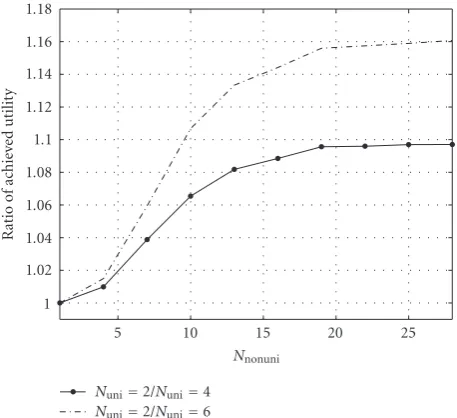
It is seen that our proposed scheme performs better for small values ofNuni, which means more total utility is gained when neighboring cells are lightly loaded or have users with more relaxed delay constraints. Therefore, the rate of in-crease in total utility is maximum for Nuni = 2. This idea is seen more clearly inFigure 2, where the rate of increase in achieved utility for different cases is shown.
It is seen by increasing the number of added nonuniform users in the boundary of the central cell, the performance is better when the number of uniform users is smaller. This is because adjacent cells can serve more users of the central cell when they have a smaller number of users. Moreover, by in-creasing the number of nonuniform users,Nnonuni, the total achieved gain approaches a steady-state value, which is the maximum capacity that can be obtained using our scheme.
1.3 1.25 1.2 1.15 1.1 1.05 1
T
o
tal
ac
h
ie
ve
d
u
tilit
y
in
first
8
cells
5 10 15 20 25
Nnonuni
Nuni=2
Nuni=4
Nuni=6
Figure1: The ratio of total achieved utility of our scheme to that of SIR-based scheme in first eight cell versus different number of added nonuniform users in the central cell.
In another scenario, we distributed 5 users in all cells like before, but limited the number of base stations in the active set of each user. Moreover, we considered the results for the two different patterns of nonuniform users’ distributions. In the first case (pattern A), we distributed more users through-out the central cell randomly, while in the second one (pat-tern B) the users were grouped in subcells located at the cell boundary in the corner of three adjacent cells. The result is shown inFigure 3. It is seen that by increasing the number of allowable BSs in the active set of each user the performance is improved slightly. Moreover, if all nonuniform users are lo-cated in the cell boundary for large values ofNnonuni, the total achieved utility is improved while for small values ofNnonuni the results are almost the same.
We also consider the total network utility as in (12) and compare the system performance for three distinct re-source control schemes: SIR-based (SIR-BSA), the individ-ual BS utility maximization (IU-BSA) [15], and the proposed JBATS. Nonuniform user distribution in the network cover-age area is expressed by the nonuniformity factorμD, which
is the ratio of the users that are distributed nonuniformly to the total number of users. The result is shown inFigure 4.
1.18 1.16 1.14 1.12 1.1 1.08 1.06 1.04 1.02 1
Ratio
o
f
ac
h
iev
ed
u
tilit
y
5 10 15 20 25
Nnonuni
Nuni=2/Nuni=4
Nuni=2/Nuni=6
Figure2: The ratio of total achieved utility of the case, whereNuni=
2, to the other two cases (Nuni=4 andNuni=6).
1.3 1.25 1.2 1.15 1.1 1.05 1
T
o
tal
ac
h
ie
ve
d
u
tilit
y
in
first
8
cells
5 10 15 20 25
Nnonuni
Active set=2, pattern A Active set=2, pattern B Active set=3, pattern A
Figure3: The ratio of total achieved utility of our scheme to that of SIR-based scheme in first eight cell versus different pattern of nonuniform users and number of active sets.
the averages of achieved throughput and execution time.
Table 2shows the percentage of the achieved throughput us-ing our heuristic method compared to the value achieved in the optimal case. Moreover, the third column of the table shows the required execution time in the heuristic method compared to that of branch-and-bound method. It shows that the performance is really good for large sets (greater than 95% most of the time), while the execution time is just a few percent of the time required for optimal solution (less than 5%).
1.7 1.6 1.5 1.4 1.3 1.2 1.1
R
elati
ve
utilit
y
10 15 20 25 30 35
N/B
JBATS,μD=0.5 IU-BSA,μD=0.5
PPA-BA,μD=0.2 IU-BSA,μD=0.2 μ=0.5; heavy
nonuniformity μ=0.2; light
nonuniformity
Figure4: The average achieved total network utility for IU-BSA and JBATS normalized by the average achieved total network util-ity of SIR-BSA versus average number of users per BS (N/B). Two nonuniformity cases:μD=0.2 andμD=0.5.
Table 2: Performance comparison of branch-and-bound and a heuristic algorithm in terms of total achieved throughput and ex-ecution time.
N Value % Time %
40 92.5 15.3
70 95.6 4.2
100 97.3 3.9
130 98.1 2.7
160 97.7 2.7
190 98.1 2.9
220 98.5 3.1
250 98.7 3.1
280 97.5 3.9
310 97.4 3.0
340 98.3 2.4
370 99.3 1.9
400 99.2 2.6
7. CONCLUSION
the total network utility instead of achieved utility of each base station. We then map this problem to multidimensional multiple-choice knapsack Problems (MMKP). Since MMKP is NP-hard, a polynomial-time suboptimal algorithm was then modified to develop an efficient base-station assign-ment. Simulation results indicate significant performance improvement using the proposed scheme.
APPENDIX
Proof ofProposition 1.AssumeX∗ = {x∗k j}is the output of
the algorithm, and Y∗ = {yk j∗} is the result of the
glob-ally optimum solution. Lets denoteTi∗= N
j=1
nj
k=1x∗k jpi jk.
Therefore, the total achieved throughput using the heuristic algorithm can be written as (A.1)-(A.2). For the optimal so-lution,Y∗, we can rewrite the same expression as in (A.2) throughput using the sub-optimal algorithm and the global optimal solution is
which completes the proof.
ACKNOWLEDGMENTS
This paper was partly presented at the IEEE/Sarnoff Sympo-sium on Advances in Wired and Wireless Communication, April 2004, and the IEEE Ninth International Symposium on Computers and Communications (ISCC ’04), June 2004. This work was supported in part by Bell University Labora-tory, University of Toronto.
REFERENCES
[1] M. L. Honig and J. B. Kim, “Resource allocation for packet data transmission in DS-CDMA,” inProceedings of the 33rd Annual Allerton Conference on Communication, Control, and Computing, pp. 925–934, Monticello, Ill, USA, October 1995. [2] M. L. Honig and J. B. Kim, “Allocation of DS-CDMA
pa-rameters to achieve multiple rates and qualities of service,” in Proceedings of IEEE Global Telecommunications Confer-ence (GLOBECOM ’96), vol. 3, pp. 1974–1978, London, UK, November 1996.
[3] J. B. Kim and M. L. Honig, “Resource allocation for multiple classes of DS-CDMA traffic,”IEEE Transactions on Vehicular Technology, vol. 49, no. 2, pp. 506–519, 2000.
[4] J. B. Kim, M. L. Honig, and S. Jordan, “Dynamic resource allo-cation for integrated voice and data traffic in DS-CDMA,” in Proceedings of the 54th IEEE Vehicular Technology Conference (VTC ’01), vol. 1, pp. 42–46, Atlantic City, NJ, USA, October 2001.
[5] A. E. Gamal, J. Mammen, B. Prabhakar, and D. Shah, “Throughput-delay trade-offin energy constrained wireless networks,” inProceedings of IEEE International Symposium on Information Theory (ISIT ’04), p. 439, Chicago, Ill, USA, June-July 2004.
[6] H. Holma and A. Toskala,WCDMA for UMTS: Radio Access for Third Generation Mobile Communications, John Wiley & Sons, New York, NY, USA, 2000.
[8] K. Navaie, D. Y. Montuno, H. Yanikomeroglu, and Y. Q. Zhao, “Optimal downlink resource allocation for cellular CDMA networks,” in Adaptation Techniques in Wireless Multimedia Networks, Y. Xiao and W. Li, Eds., Nova Science, New York, NY, USA, 2006.
[9] R. D. Yates and C.-Y. Huang, “Integrated power control and base station assignment,”IEEE Transactions on Vehicular Tech-nology, vol. 44, no. 3, pp. 638–644, 1995.
[10] S. V. Hanly, “An algorithm for combined cell-site selection and power control to maximize cellular spread spectrum capac-ity,”IEEE Journal on Selected Areas in Communications, vol. 13, no. 7, pp. 1332–1340, 1995.
[11] F. P. Kelly, “Charging and rate control for elastic traffic,” Eu-ropean Transactions on Telecommunications, vol. 8, no. 1, pp. 33–37, 1997.
[12] S.-J. Oh and K. M. Wasserman, “Optimality of greedy power control and variable spreading gain in multi-class CDMA mo-bile networks,” inProceedings of the 5th Annual ACM/IEEE In-ternational Conference on Mobile Computing and Networking (Mobicom ’99), pp. 102–112, Seattle, Wash, USA, August 1999. [13] C. U. Saraydar, N. B. Mandayam, and D. J. Goodman, “Pricing and power control in a multicell wireless data network,”IEEE Journal on Selected Areas in Communications, vol. 19, no. 10, pp. 1883–1892, 2001.
[14] M. Xiao, N. B. Shroff, and E. K. P. Chong, “Utility-based power control in cellular wireless systems,” inProceedings of the 20th Annual Joint Conference of the IEEE Computer and Communi-cations Societies (INFOCOM ’01), vol. 1, pp. 412–421, Anchor-age, Alaska, USA, April 2001.
[15] J.-W. Lee, R. R. Mazumdar, and N. B. Shroff, “Joint resource allocation and base-station assignment for the downlink in CDMA networks,” IEEE/ACM Transactions on Networking, vol. 14, no. 1, pp. 1–14, 2006.
[16] X. Liu, E. K. P. Chong, and N. B. Shroff, “Opportunistic trans-mission scheduling with resource-sharing constraints in wire-less networks,”IEEE Journal on Selected Areas in Communica-tions, vol. 19, no. 10, pp. 2053–2064, 2001.
[17] M. Shabany, K. Navaie, and E. S. Sousa, “Downlink resource allocation for data traffic in heterogenous cellular CDMA net-works,” inProceedings of the 9th International Symposium on Computers and Communications (ISCC ’04), vol. 1, pp. 436– 441, Alexandria, Egypt, June-July 2004.
[18] M. Shabany and K. Navaie, “Joint pilot power adjustment and base station assignment for data traffic in cellular CDMA net-works,” inProceedings of IEEE/SarnoffSymposium on Advances in Wired and Wireless Communication, pp. 179–183, Prince-ton, NJ, USA, April 2004.
[19] R. Vannithamby and E. S. Sousa, “An optimum rate/power al-location scheme for downlink in hybrid CDMA/TDMA cellu-lar system,” inProceedings of the 52th IEEE Vehicular Technol-ogy Conference (VTC ’00), vol. 4, pp. 1734–1738, Boston, Mass, USA, September 2000.
[20] T.-H. Lee, J.-C. Lin, and T. S. Yu, “Downlink power control al-gorithms for cellular radio systems,”IEEE Transactions on Ve-hicular Technology, vol. 44, no. 1, pp. 89–94, 1995.
[21] S. A. Grandhi and J. Zander, “Constrained power control in cellular radio systems,” in Proceedings of the 44th IEEE Ve-hicular Technology Conference (VTC ’94), vol. 2, pp. 824–828, Stockholm, Sweden, June 1994.
[22] W. Shih, “A branch and bound method for the multiconstraint zero-one knapsack problem,”The Journal of the Operational Research Society, vol. 30, no. 4, pp. 369–378, 1979.
[23] M. Akbar, E. G. Manning, G. C. Shoja, and S. Khan, “Heuris-tic solutions for the multiple-choice multi-dimension knap-sack problem,” inProceedings of the International Conference on Computational Science (ICCS ’01), pp. 659–668, San Fran-cisco, Calif, USA, May 2001.
[24] M. Moser, D. P. Jokanovic, and N. Shiratori, “An algorithm for the multidimensional multiple-choice knapsack problem,” IE-ICE Transactions on Fundamentals of Electronics, Communica-tions and Computer Sciences, vol. 80, no. 3, pp. 582–589, 1997. [25] H. Everett III, “Generalized lagrange multiplier method for solving problems of optimum allocation of resources,” Opera-tions Research, vol. 11, no. 3, pp. 399–417, 1963.