University of South Carolina
Scholar Commons
Theses and Dissertations
2016
Modern Estimation Problems in Group Testing
Md Shamim Sarker
University of South Carolina
Follow this and additional works at:https://scholarcommons.sc.edu/etd
Part of theStatistics and Probability Commons
This Open Access Dissertation is brought to you by Scholar Commons. It has been accepted for inclusion in Theses and Dissertations by an authorized administrator of Scholar Commons. For more information, please [email protected].
Recommended Citation
Sarker, M. S.(2016).Modern Estimation Problems in Group Testing.(Doctoral dissertation). Retrieved from
Modern estimation problems in group testing
by
Md Shamim Sarker
Bachelor of Science Jahangirnagar University 2005
Master of Science Lamar University 2011
Submitted in Partial Fulfillment of the Requirements
for the Degree of Doctor of Philosophy in
Statistics
College of Arts and Sciences
University of South Carolina
2016
Accepted by:
Joshua M. Tebbs, Major Professor
Timothy Hanson, Committee Member
Lianming Wang, Committee Member
Alexander C. McLain, Committee Member
c
Dedication
I dedicate this dissertation to my loving family. Their dedication, love, and patience
have guided and encouraged me to advance every single step of this long journey. I
would also like to dedicate this work to the University of South Carolina, where I
have spent the most valuable time and have received the most rewarding experience
Acknowledgments
First of all, I would like to express my heartfelt gratitude to my advisor Dr. Joshua
Tebbs for his expert guidance, unwavering support, and encouragement throughout
my study at the University of South Carolina. He has continually conveyed a spirit
of adventure towards research and scholarship. Without his incredible patience and
timely direction, my dissertation would have been a frustrating and overwhelming
pursuit. His teachings and the valuable experiences he has shared with me will
always accompany me along the academic career I am going to begin. Dr. Tebbs is
a mentor, colleague, and friend who I will eternally cherish.
I would like to express my heartfelt appreciation to other committee members.
I acknowledge the advice Dr. Hanson has offered throughout the process of this
dissertation. His insightful comments have shaped my thoughts to play with new
research ideas and to solve many complicated problems. I would like to thank Dr.
Lianming Wang for his valuable contribution to this work. I also wish to acknowledge
the value of Dr. Wang’s courses, as they have had a direct positive impact on my
research. I would like to warmly thank Dr. Alexander McLain for his insightful
comments, which directed me to think about my work more thoroughly.
I would like to thank Dr. Xianzheng Huang who has taught me a number of
courses and with whom I have worked in collaboration. I have had the opportunity
to share my ideas with her and receive valuable directions. The measurement error
project presented in Chapter 4 is motivated by a course that Dr. Huang taught.
I would like to thank other faculty members who were more than generous with
continued support and advice on teaching and many administrative activities. I am
very thankful to the staff in the Department of Statistics for their support in various
administrative affairs. I would also like to acknowledge the help from faculty members
and staff from other departments.
I have been privileged to have Dr. Christopher McMahan as a collaborator. His
unwavering support, critical assessment of my work, and very insightful suggestions
have had a tremendous impact on development of my dissertation. I would also like
to thank Dr. Christopher Bilder for his diligent effort and thoughtful advice. I am
extremely thankful to my M.S. advisor Dr. Kumer Pial Das who has always been a
mentor and a true friend. Finally, I express my heartfelt appreciation to my friends,
Abstract
In the simplest form of group testing, pools are formed by compositing a fixed
num-ber of individual specimens (e.g., blood, urine, swab, etc.) and then the pools are
tested for a binary characteristic, such as presence or absence of a disease. Group
testing is commonly used to screen for a variety of sexually transmitted diseases in
epidemiological applications where the main goal is to increase testing efficiency. In
this dissertation, we study three estimation problems that are motivated by real-life
applications. We propose new methods to model group testing data for both single
and multiple infections. In the first problem, we propose a Bayesian approach to
es-timate the prevalence of multiple infections. This relaxes the unreliable assumption
that diagnostic accuracies are constant. Also, when historical data are taken into
account, our method provides more efficient estimation than do existing approaches.
In the second problem, we propose a regression method to capture dilution effects
due to pooling. In addition to offering reliable inference, our parametric approach
enables one to perform a hypothesis test for dilution. In the third problem, we
pro-pose Bayesian measurement error models. Our approach provides flexibility to the
structural modeling approach which requires the availability of a known probability
distribution for true (unobserved) covariates. This work generalizes existing
regres-sion methods to account for covariate measurement error. We also discuss several
Table of Contents
Dedication . . . iii
Acknowledgments . . . iv
Abstract . . . vi
List of Tables . . . x
List of Figures . . . xiv
Chapter 1 Introduction . . . 1
1.1 Literature review . . . 1
Chapter 2 Estimating the prevalence of multiple diseases from two-stage hierarchical pooling . . . 7
2.1 Introduction . . . 8
2.2 Two-stage pooling algorithm . . . 11
2.3 Bayesian estimation . . . 12
2.4 Simulation evidence . . . 18
2.5 Infertility Prevention Project data . . . 24
2.6 Discussion . . . 30
3.1 Introduction . . . 34
3.2 Estimation . . . 36
3.3 Detecting the dilution effect . . . 43
3.4 Simulation evidence . . . 44
3.5 Data application . . . 50
3.6 Discussion . . . 55
Chapter 4 Group testing regression with measurement error in covariates . . . 57
4.1 Introduction . . . 57
4.2 Model formulation . . . 60
Chapter 5 Future research ideas in group testing . . . 64
5.1 Group testing for multiple infections . . . 64
5.2 Group testing for single infection . . . 65
5.3 Group testing coupled with measurement error in covariates . . . 66
Bibliography . . . 68
Appendix A Chapter 2 supplementary materials . . . 76
A.1 Generalization of estimation methods to include J ≥2 infections. . . 76
A.2 Complete simulation results from Section 2.4. . . 79
A.3 Comparison of Bayesian and ML estimates under misspecified assay accuracies. . . 88
Appendix B Chapter 3 supplementary materials . . . 98
B.1 E-step and Gibbs sampler for the EM algorithm in Section 3.2. . . 98
B.2 Covariance matrix estimation using Louis’s method. . . 101
B.3 Observed likelihood function for Dorfman decoding. . . 102
B.4 Additional information about dilution submodels. . . 103
B.5 Simulation results from Section 3.4. . . 105
B.6 The HBV data results from Section 3.5. . . 121
List of Tables
Table 2.1 Nebraska 2008 historical information for CT/NG. The historical estimate p0 = (p00(0), p10(0), p01(0), p11(0))0 was calculated using
the 2008 individual diagnoses (accounting for possible misclas-sification; see Appendix A). Stratum sample sizes N0 are given.
Priors for Se:j and Sp:j were determined using pilot data from
the Aptima Combo 2 Assay product literature (see Appendix A). The master pool size c∗k minimizes the expected number of
tests per individual as described in Tebbs et al. (2013). . . 26
Table 2.2 Nebraska CT/NG prevalence estimation results for 2009. Bayesian estimates (Bayes) are posterior medians averaged overB = 500 data sets; BSE is the average of the standard deviations calcu-lated from posterior samples of the B = 500 data sets. Values of a0 = 0, a0 = 0.5, anda0 = 1 are used to incorporate different
amounts of historical information for p as described in Section 2.5. Prior distributions for Se:j and Sp:j, where j = 1 for CT
and j = 2 for NG, are given in Table 2.1. Maximum likelihood estimates, calculated from Tebbs et al. (2013), are averaged over the same 500 data sets; the entries under SE are the averaged
standard errors. Stratum sample sizes N are given. . . 27
Table 2.3 Bayesian assay accuracy estimates from 2009. Bayesian esti-mates (Bayes) are posterior medians averaged over B = 500 data sets; BSE is the average of the standard deviations calcu-lated from posterior samples of the B = 500 data sets. Values of a0 = 0, a0 = 0.5, anda0 = 1 are used to incorporate different
amounts of historical information for p as described in Section 2.5. Prior distributions forSe:j andSp:j, wherej = 1 for CT and
j = 2 for NG, are given in Table 2.1. Stratum sample sizes N
are given. . . 28
Table 3.1 Test sensitivity using the submodelh in (3.8) with different
Table 3.2 Simulation results for master pool testing (MPT) and Dorfman decoding (DD) withθ = (β0, β1, β2, λ)0 = (−3,2,1, λ)0. “Mean”
is the averaged maximum likelihood estimate and SE is the aver-aged standard error estimate calculated from 500 simulated data sets. Cov is the estimated coverage rate of nominal 95% Wald confidence intervals. The margin of error for the estimated cov-erage rate, assuming a 99% confidence level, is 0.03. Constant pool sizes c are used. Random pooling has been used for this
simulation. . . 48
Table 3.3 Estimated size and power of the α = 0.05 likelihood ratio test calculated from 500 simulated data sets withθ = (β0, β1, β2, λ)0 =
(−3,2,1, λ)0. The margin of error for the estimated size when λ= 0, assuming a 99% confidence level, is 0.03. Constant pool
sizes cand unequal (UE) pool sizes are used. . . 49
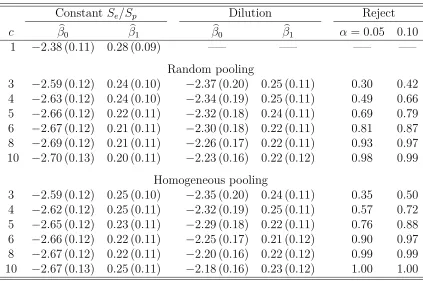
Table 3.4 Irish HBV data analysis with Dorfman decoding. The first-order logistic model in (3.9) is assumed. MLE (estimated standard error) for β= (β0, β1)0 averaged over B = 500 implementations.
“Reject” is the proportion that the likelihood ratio test in Section 3.3 detects dilution using the level of significance α. Individual
testing (c= 1) estimates are also reported for comparison. . . 54
Table A.1 Simulation results under prior misspecification. The true value of p is p = (0.80,0.10,0.09,0.01). The true values of Se:j and
Sp:j are 0.95 and 0.99, respectively. All quantities below are
as defined in Sections 2.4-2.5. The use of “∗” with Se∗:j and Sp∗:j
stresses that these are the wrong values. . . 90
Table A.2 Simulation results under prior misspecification. The true value of p is p = (0.95,0.03,0.01,0.01). The true values of Se:j and
Sp:j are 0.95 and 0.99, respectively. All quantities below are
as defined in Sections 2.4-2.5. The use of “∗” with Se∗:j and Sp∗:j
Table A.3 Nebraska CT/NG prevalence estimation results for 2009. Bayesian estimates (Bayes) are posterior medians averaged overB = 500 data sets; BSE is the average of the standard deviations calcu-lated from posterior samples of the B = 500 data sets. Values of a0 = 0, a0 = 0.5, anda0 = 1 are used to incorporate different
amounts of historical information for p as described in Section 2.5. Flat priors forSe:j andSp:j are used, wherej = 1 for CT and
j = 2 for NG; i.e., Se:j ∼ beta(1,1) and Sp:j ∼ beta(1,1).
Max-imum likelihood estimates, calculated from Tebbs et al. (2013), are averaged over the same 500 data sets; the entries under SE
are the averaged standard errors. Stratum sample sizes N are given. 96
Table A.4 Bayesian assay accuracy estimates from 2009. Bayesian esti-mates (Bayes) are posterior medians averaged over B = 500 data sets; BSE is the average of the standard deviations calcu-lated from posterior samples of the B = 500 data sets. Values of a0 = 0, a0 = 0.5, anda0 = 1 are used to incorporate different
amounts of historical information for p as described in Section 2.5. Flat priors for Se:j and Sp:j are used, where j = 1 for CT
and j = 2 for NG; i.e., Se:j ∼beta(1,1) andSp:j ∼beta(1,1). . . . 97
Table B.1 Simulation results for master pool testing (MPT) and Dorfman decoding (DD) withθ = (β0, β1, β2, λ)0 = (−3,2,1, λ)0. “Mean”
is the averaged maximum likelihood estimate and SE is the aver-aged standard error estimate calculated from 500 simulated data sets. Cov is the estimated coverage rate of nominal 95% Wald confidence intervals. The margin of error for the estimated cov-erage rate, assuming a 99% confidence level, is 0.03. Constant pool sizes c are used. Homogeneous pooling has been used for
this simulation. . . 107
Table B.2 Robustness study with misspecified submodels for master pool
testing (MPT) and Dorfman decoding (DD), whereθ = (β0, β1, β2, λ)0 =
(−3,2,1, λ)0. The proposed methods with the assumed submodel in (3.8) are fitted to the group testing data generated using the submodels HS, Probit, and Cloglog. Estimated size and power of the α = 0.05 likelihood ratio test calculated from 500 simu-lated data sets. The margin of error for the estimated size when λ= 0, assuming a 99% confidence level, is 0.03. Constant pool
Table B.3 Irish HBV data analysis with Dorfman decoding. The polyno-mial logistic model in Equation (3.10) is assumed. MLE (esti-mated standard error) for β = (β0, β1, β2)0 averaged over B =
500 implementations. “Reject” is the proportion that the like-lihood ratio test in Section 3.3 detects dilution using the level of significance α. Individual testing (c = 1) estimates are also
List of Figures
Figure 2.1 Simulation results with p = (0.80,0.10,0.09,0.01), N = 1000 individuals, Se:j = 0.95, and Sp:j = 0.99, for j = 1,2. The 5th
(bottom), 25th, 50th (median), 75th, and 95th (top) percentiles of the B = 500 posterior median estimates of p are provided. Flat priors forSe:j and Sp:j are used; i.e., Se:j ∼beta(1,1) and
Sp:j ∼beta(1,1). The precision parameter a0 increases from 0
(no historical information aboutpprovided) to 1 by increments
of 0.1. . . 21
Figure 2.2 Simulation results with p = (0.80,0.10,0.09,0.01), N = 1000 individuals, Se:j = 0.95, and Sp:j = 0.99, for j = 1,2. The 5th
(bottom), 25th, 50th (median), 75th, and 95th (top) percentiles of the B = 500 posterior median estimates of Se:j and Sp:j are
provided. Flat priors for Se:j and Sp:j are used; i.e., Se:j ∼
beta(1,1) and Sp:j ∼ beta(1,1). The precision parameter a0
increases from 0 (no historical information about p provided)
to 1 by increments of 0.1. . . 22
Figure 3.1 Irish HBV data analysis with Dorfman decoding and random pooling. The first-order logistic model in (3.9) is assumed. Esti-mated regression functions, averaged over B = 500 implemen-tations, are presented. The estimated regression function for
individual testing is also shown for comparison. . . 52
Figure 3.2 Irish HBV data analysis with Dorfman decoding and random pooling. The polynomial logistic model in (3.10) is assumed. Estimated regression functions, averaged over B = 500 imple-mentations, are presented. The estimated regression function
Figure A.1 Simulation results with p = (0.80,0.10,0.09,0.01), N = 1000 individuals, Se:j = 0.95, and Sp:j = 0.99, for j = 1,2. The 5th
(bottom), 25th, 50th (median), 75th, and 95th (top) percentiles of the B = 500 posterior median estimates of p are provided. Flat priors forSe:j and Sp:j are used; i.e., Se:j ∼beta(1,1) and
Sp:j ∼beta(1,1). The precision parameter a0 increases from 0
(no historical information aboutpprovided) to 1 by increments
of 0.1. . . 80
Figure A.2 Simulation results with p = (0.80,0.10,0.09,0.01), N = 1000 individuals, Se:j = 0.95, and Sp:j = 0.99, for j = 1,2. The 5th
(bottom), 25th, 50th (median), 75th, and 95th (top) percentiles of the B = 500 posterior median estimates of Se:j and Sp:j are
provided. Flat priors for Se:j and Sp:j are used; i.e., Se:j ∼
beta(1,1) and Sp:j ∼ beta(1,1). The precision parameter a0
increases from 0 (no historical information about p provided)
to 1 by increments of 0.1. . . 81
Figure A.3 Simulation results with p = (0.80,0.10,0.09,0.01), N = 1000 individuals, Se:j = 0.95, and Sp:j = 0.99, for j = 1,2. The
5th (bottom), 25th, 50th (median), 75th, and 95th (top) per-centiles of the B = 500 posterior median estimates of p are provided. Informative priors for Se:j and Sp:j are used; i.e.,
Se:j ∼ beta(109.0,6.7) and Sp:j ∼ beta(55.2,1.6). The
preci-sion parameter a0 increases from 0 (no historical information
about p provided) to 1 by increments of 0.1. . . 82
Figure A.4 Simulation results with p = (0.80,0.10,0.09,0.01), N = 1000 individuals, Se:j = 0.95, and Sp:j = 0.99, for j = 1,2. The 5th
(bottom), 25th, 50th (median), 75th, and 95th (top) percentiles of the B = 500 posterior median estimates of Se:j and Sp:j are
provided. Informative priors for Se:j and Sp:j are used; i.e.,
Se:j ∼beta(109.0,6.7) andSp:j ∼beta(55.2,1.6). The precision
parametera0 increases from 0 (no historical information about
p provided) to 1 by increments of 0.1. . . 83
Figure A.5 Simulation results with p = (0.95,0.03,0.01,0.01), N = 1000 individuals, Se:j = 0.95, and Sp:j = 0.99, for j = 1,2. The 5th
(bottom), 25th, 50th (median), 75th, and 95th (top) percentiles of the B = 500 posterior median estimates of p are provided. Flat priors forSe:j and Sp:j are used; i.e., Se:j ∼beta(1,1) and
Sp:j ∼beta(1,1). The precision parameter a0 increases from 0
(no historical information aboutpprovided) to 1 by increments
Figure A.6 Simulation results with p = (0.95,0.03,0.01,0.01), N = 1000 individuals, Se:j = 0.95, and Sp:j = 0.99, for j = 1,2. The 5th
(bottom), 25th, 50th (median), 75th, and 95th (top) percentiles of the B = 500 posterior median estimates of Se:j and Sp:j are
provided. Flat priors for Se:j and Sp:j are used; i.e., Se:j ∼
beta(1,1) and Sp:j ∼ beta(1,1). The precision parameter a0
increases from 0 (no historical information about p provided)
to 1 by increments of 0.1. . . 85
Figure A.7 Simulation results with p = (0.95,0.03,0.01,0.01), N = 1000 individuals, Se:j = 0.95, and Sp:j = 0.99, for j = 1,2. The
5th (bottom), 25th, 50th (median), 75th, and 95th (top) per-centiles of the B = 500 posterior median estimates of p are provided. Informative priors for Se:j and Sp:j are used; i.e.,
Se:j ∼ beta(109.0,6.7) and Sp:j ∼ beta(55.2,1.6). The
preci-sion parameter a0 increases from 0 (no historical information
about p provided) to 1 by increments of 0.1. . . 86
Figure A.8 Simulation results with p = (0.95,0.03,0.01,0.01), N = 1000 individuals, Se:j = 0.95, and Sp:j = 0.99, for j = 1,2. The 5th
(bottom), 25th, 50th (median), 75th, and 95th (top) percentiles of the B = 500 posterior median estimates of Se:j and Sp:j are
provided. Informative priors for Se:j and Sp:j are used; i.e.,
Se:j ∼beta(109.0,6.7) andSp:j ∼beta(55.2,1.6). The precision
parametera0 increases from 0 (no historical information about
p provided) to 1 by increments of 0.1. . . 87
Figure B.1 Robustness study with misspecified submodel using random pooling and moderate misclassification. Boxplots of the maximum likelihood estimates for β = (β0, β1, β2)0 from 500
simulated data sets are presented. The proposed method with the submodel in Equation (3.8) is fit to group testing data gen-erated using the submodel ‘HS’. On the horizontal axes, ‘I’ refers to individual testing, ‘C’ refers to the constantSe/Sp method,
and ‘D’ refers to our proposed dilution method. Constant pool sizes c are reported in parentheses. The true parameter values
Figure B.2 Robustness study with misspecified submodel using homoge-neous pooling and moderate misclassification. Boxplots of the maximum likelihood estimates forβ = (β0, β1, β2)0 from
500 simulated data sets are presented. The proposed model with the submodel in (3.8) is fit to the group testing data gen-erated using the submodel ‘HS’. On the horizontal axes, ‘I’ refers to individual testing, ‘C’ refers to the constantSe/Sp method,
and ‘D’ refers to our proposed dilution method. Constant pool sizes c are reported in parentheses. The true parameter values
are represented by dashed horizontal lines. . . 110
Figure B.3 Robustness study with misspecified submodel using random pooling and moderate misclassification. Boxplots of the maximum likelihood estimates for β = (β0, β1, β2)0 from 500
simulated data sets are presented. The proposed model with the submodel in (3.8) is fit to the group testing data generated using the submodel ‘Probit’. On the horizontal axes, ‘I’ refers to individual testing, ‘C’ refers to the constantSe/Sp method,
and ‘D’ refers to our proposed dilution method. Constant pool sizes c are reported in parentheses. The true parameter values
are represented by dashed horizontal lines. . . 111
Figure B.4 Robustness study with misspecified submodel using homoge-neous pooling and moderate misclassification. Boxplots of the maximum likelihood estimates forβ = (β0, β1, β2)0 from
500 simulated data sets are presented. The proposed model with the submodel in (3.8) is fit to the group testing data gen-erated using the submodel ‘Probit’. On the horizontal axes, ‘I’ refers to individual testing, ‘C’ refers to the constant Se/Sp
method, and ‘D’ refers to our proposed dilution method. Con-stant pool sizescare reported in parentheses. The true
param-eter values are represented by dashed horizontal lines. . . 112
Figure B.5 Robustness study with misspecified submodel using random pooling and moderate misclassification. Boxplots of the maximum likelihood estimates for β = (β0, β1, β2)0 from 500
simulated data sets are presented. The proposed model with the submodel in (3.8) is fit to the group testing data generated using the submodel ‘Cloglog’. On the horizontal axes, ‘I’ refers to individual testing, ‘C’ refers to the constantSe/Sp method,
and ‘D’ refers to our proposed dilution method. Constant pool sizes c are reported in parentheses. The true parameter values
Figure B.6 Robustness study with misspecified submodel using homoge-neous pooling and moderate misclassification. Boxplots of the maximum likelihood estimates forβ = (β0, β1, β2)0 from
500 simulated data sets are presented. The proposed model with the submodel in (3.8) is fit to the group testing data gen-erated using the submodel ‘Cloglog’. On the horizontal axes, ‘I’ refers to individual testing, ‘C’ refers to the constant Se/Sp
method, and ‘D’ refers to our proposed dilution method. Con-stant pool sizescare reported in parentheses. The true
param-eter values are represented by dashed horizontal lines. . . 114
Figure B.7 Robustness study with misspecified submodel using random pooling and severe misclassification. Boxplots of the max-imum likelihood estimates for β = (β0, β1, β2)0 from 500
sim-ulated data sets are presented. The proposed model with the submodel in (3.8) is fit to the group testing data generated using the submodel ‘HS’. On the horizontal axes, ‘I’ refers to individual testing, ‘C’ refers to the constantSe/Sp method, and
‘D’ refers to our proposed dilution method. Constant pool sizes c are reported in parentheses. The true parameter values are
represented by dashed horizontal lines. . . 115
Figure B.8 Robustness study with misspecified submodel using homoge-neous pooling and severe misclassification. Boxplots of the maximum likelihood estimates for β = (β0, β1, β2)0 from
500 simulated data sets are presented. The proposed model with the submodel in (3.8) is fit to the group testing data gen-erated using the submodel ‘HS’. On the horizontal axes, ‘I’ refers to individual testing, ‘C’ refers to the constantSe/Sp method,
and ‘D’ refers to our proposed dilution method. Constant pool sizes c are reported in parentheses. The true parameter values
are represented by dashed horizontal lines. . . 116
Figure B.9 Robustness study with misspecified submodel using random pooling and severe misclassification. Boxplots of the max-imum likelihood estimates for β = (β0, β1, β2)0 from 500
sim-ulated data sets are presented. The proposed model with the submodel in (3.8) is fit to the group testing data generated us-ing the submodel ‘Probit’. On the horizontal axes, ‘I’ refers to individual testing, ‘C’ refers to the constantSe/Sp method, and
‘D’ refers to our proposed dilution method. Constant pool sizes c are reported in parentheses. The true parameter values are
Figure B.10 Robustness study with misspecified submodel using homoge-neous poolingandsevere misclassification. Boxplots of the maximum likelihood estimates for β = (β0, β1, β2)0 from 500
simulated data sets are presented. The proposed model with the submodel in (3.8) is fit to the group testing data generated using the submodel ‘Probit’. On the horizontal axes, ‘I’ refers to individual testing, ‘C’ refers to the constantSe/Sp method,
and ‘D’ refers to our proposed dilution method. Constant pool sizes c are reported in parentheses. The true parameter values
are represented by dashed horizontal lines. . . 118
Figure B.11 Robustness study with misspecified submodel using random pooling and severe misclassification. Boxplots of the max-imum likelihood estimates for β = (β0, β1, β2)0 from 500
sim-ulated data sets are presented. The proposed model with the submodel in (3.8) is fit to the group testing data generated us-ing the submodel ‘Cloglog’. On the horizontal axes, ‘I’ refers to individual testing, ‘C’ refers to the constantSe/Sp method,
and ‘D’ refers to our proposed dilution method. Constant pool sizes c are reported in parentheses. The true parameter values
are represented by dashed horizontal lines. . . 119
Figure B.12 Robustness study with misspecified submodel using homoge-neous poolingandsevere misclassification. Boxplots of the maximum likelihood estimates for β = (β0, β1, β2)0 from 500
simulated data sets are presented. The proposed model with the submodel in (3.8) is fit to the group testing data generated using the submodel ‘Cloglog’. On the horizontal axes, ‘I’ refers to individual testing, ‘C’ refers to the constantSe/Sp method,
and ‘D’ refers to our proposed dilution method. Constant pool sizes c are reported in parentheses. The true parameter values
are represented by dashed horizontal lines. . . 120
Figure B.13 Irish HBV data analysis with Dorfman decoding and homo-geneous pooling. The first-order logistic model in Equation (3.9) is assumed. Estimated regression functions, averaged over B = 500 implementations, are presented. The estimated
regres-sion function for individual testing is also shown for comparison. . 123
Figure B.14 Irish HBV data analysis with Dorfman decoding and homo-geneous pooling. The polynomial logistic model in Equation (3.10) is assumed. Estimated regression functions, averaged over B = 500 implementations, are presented. The estimated regression function for individual testing is also shown for
Chapter 1
Introduction
1.1 Literature review
We start with a brief literature review of group testing classification (case
identifica-tion) and estimation problems. Before starting our main discussion, we define two
accuracy measures of a diagnostic assay that are associated with group testing. The
sensitivity is the probability that a positive sample is diagnosed as positive, and the
specificity is the probability that a negative sample is diagnosed as negative. In a
multiple-infection problem, we define these accuracy measures for each infection
sep-arately (see Chapter 2). To capture pooled dilution effects, we model the sensitivity
in Chapter 3 as an increasing function of the number of true positives within a pool.
Background
With the goal of minimizing testing costs, Dorfman (1943) introduced the idea of
group testing to screen US soldiers for syphilis during the Second World War.
Dorf-man’s method, which is commonly referred to as “Dorfman testing,” is a two-stage
hierarchical algorithm where initial (non-overlapping) master pools are tested in stage
1 and then individual retesting is performed in stage 2. If a pool is diagnosed as
neg-ative, all individuals in the pool are declared negative; on the other hand, if a pool is
diagnosed as positive, all individuals in the pool are retested one-by-one. As
demon-strated by Dorfman, this simple two-stage algorithm can offer substantial savings in
testing has been widely accepted as a cost-effective alternative to individual testing
in many applications, including public health, genetics, animal disease testing, drug
discovery, and pollution detection.
Classification
The use of Dorfman’s two-stage procedure has been well regarded by both
practi-tioners and researchers. The popularity of this method can likely be explained by
the fact that it is simple to implement. Many variations of Dorfman’s algorithm are
currently available. For example, Pilcher et al. (2005) uses a three-stage algorithm
which involves a second stage of testing subpools if the master pool tests positively.
Halving algorithm (Litvak et al., 1994) involves multiple stages in which each pool
that tests positively is split further into two halves before testing is performed in
subsequent stages. The final stage of halving involves individual testing.
Unlike hierarchical algorithms, non-hierarchical algorithms use overlapping pools.
An example of a non-hierarchical algorithm is square array testing (Phatarfod and
Sudbury, 1994; Kim et al., 2007). Before performing initial tests, n2 specimens are
placed in an n×n matrix. Then n pools are formed by taking samples from n rows and, similarly, another n pools are created from samples of n columns. These 2n pools are then tested. Specimens at the intersection of a positive row and a positive
column are tested individually. A more generalized square array testing algorithm
allows for the possibility of testing errors. Kim et al. (2007) summarizes the operating
characteristics (i.e., classification efficiency and accuracy) of hierarchical and square
array testing algorithms in the presence of testing error.
Sterrett (1957) proposed an extension of Dorfman’s procedure whereby individuals
from positive pools are retested in multiple stages. According to this procedure,
individuals in a positive pool are tested one-by-one with random selection until the
a new pool. If the new pool tests negatively, all individuals are declared negative;
however, if the new pool tests positively, individuals in the new pool are again tested
randomly until the first positive one is identified. This procedure is repeated until all
subjects are classified as positive or negative. Sterrett’s decoding procedure can be
more efficient than Dorfman’s when the probability of infection is small.
Sterrett’s procedure has been improved upon by Bilder et al. (2010) who used
individuals’ covariate information to perform informative retesting. In this approach,
each individual’s likelihood of disease positivity is first estimated using covariate
in-formation. When individuals from positive pools are to be retested, an individual who
is most likely to be positive is tested first. Motivated by this informative approach,
McMahan et al. (2012a) generalized array testing to account for the heterogeneity
among individuals. McMahan et al. (2012b) suggested an informative version of
Dorfman decoding in which pools are formed based on individuals’ risk
probabili-ties. Informative approaches can be significantly more efficient when compared to
the corresponding non-informative approaches; i.e., those that do not account for
heterogeneity among individuals.
As testing for multiple infections is becoming more common, group testing
re-search is also shifting. This is because recently developed assays can accurately detect
multiple infections simultaneously from a single specimen. Tebbs et al. (2013) first
studied a two-stage Dorfman-type testing protocol adopted by the Infertility
Preven-tion Project (IPP) for chlamydia and gonorrhea testing. These authors demonstrated
that efficiency can be increased dramatically when pool testing involves multiple
in-fections. The findings presented in Tebbs et al. (2013) serve as motivation to extend
existing classification algorithms from single to multiple infections. Further
advance-ments can be possible when exploiting heterogeneity among individuals as proposed
Estimation
While group testing research for classification has flourished over the past decades,
estimation has also received substantial attention. Testing data obtained from any
group testing protocol, such as Dorfman decoding, halving, and array testing, can be
modeled to estimate either an overall disease prevalence or individual-level disease
probabilities using covariates. For a rare disease, inference based on group testing
can be as efficient as that for individual testing at only a fraction of the testing cost.
Even though retesting individuals from positive pools is necessary for classification
purposes, retesting is not crucial for estimation. This can be explained heuristically as
follows. If a disease is rare, pools that test positively may not contain more than one
positive case; hence, retesting individuals from positive pools provides little additional
information. Therefore, the majority of group testing papers that proposed estimation
methods used testing responses from only initial master pools. The advantages of
this approach include simplicity in statistical modeling and additional reductions in
testing costs.
Most researchers in group testing, until the late 1990’s, focused only on estimating
the proportion (overall prevalence) of a rare binary trait. The first such estimation
paper is Thompson (1962), who took a maximum likelihood (ML) approach to
esti-mate the proportion of insect vectors capable of transmitting aster-yellow virus in a
population of aphids. Thompson’s work proceeded under the assumption that testing
results are perfect and that insects’ infection statuses are independent. In addition
to using master pool responses as in Thompson (1962), Sobel and Elashoff (1975)
al-lowed the statistical model to incorporate retest information. Hwang (1976) proposed
a maximum likelihood estimator (MLE) in the presence of dilution effects. Burrows
(1987) took an alternative ML approach which can improve estimation in terms of
bias and efficiency. Robustness of estimation has been studied by several authors
authors have studied group testing optimality; among others, see Tu et al. (1995)
and Liu et al. (2012).
Group testing estimation from within a Bayesian paradigm has also been studied.
Chaubey and Li (1995) presented a Bayesian method for estimation and showed that
Bayesian estimators can be preferred to ML estimators. Mendoza-Blanco et al. (1996)
presented a general Bayesian framework that models data resulting from a variety of
sampling strategies. Bilder and Tebbs (2005) proposed an empirical Bayes method
for estimation using master pools only. Johnson and Pearson (1999) developed a
Bayesian methodology for a two-stage testing where individuals from pools that test
negatively are re-pooled. This technique was originally proposed by Gastwirth and
Johnson (1994) who took a frequentist approach. A similar method was proposed
by Hanson et al. (2006), who acknowledge heterogeneity among populations due to
regional differences and allow the model to incorporate varying prevalences.
With the exception of Hanson et al. (2006), all of the estimation methods discussed
above aim at estimating a single proportion without accounting for heterogeneity
among individuals. Recent work has focused on developing regression methodology
using covariates, such as age, gender, and disease symptoms, to obtain
individual-level estimates. Farrington (1992) first proposed a regression method for a specific
generalized linear model with the stringent assumption that each individual within
a pool shares identical covariates. Vansteelandt et al. (2000) extended this work to
allow for any type of covariate structure. Xie (2001) presented a general
expectation-maximization methodology which can incorporate retest results. Bilder and Tebbs
(2009) studied estimation bias and efficiency for regression estimates using the model
introduced by Vansteelandt et al. (2000). Huang and Tebbs (2009) and Huang (2009)
developed diagnostic methods to identify latent model misspecification for structural
measurement error models using group testing responses. McMahan et al. (2013)
(2015) generalized the regression method of McMahan et al. (2013) to be applicable
for any group testing algorithm.
A number of papers have presented nonparametric regression estimation
meth-ods for group testing data. The seminal work in Delaigle and Meister (2011) used
test results from randomly formed pools. Delaigle and Hall (2012) later presented
a nonparametric approach for pools formed homogeneously. Wang et al. (2014b)
presented a general semiparametric approach to model data from any group testing
algorithm. Delaigle and Zhou (2015) presented a nonparametric extension of the
dilution methods in McMahan et al. (2013).
Switching gears to multiple infections, Hughes-Oliver and Rosenberger (2000) first
proposed a method to estimate the prevalence of multiple diseases with the
assump-tion that a perfect assay test is available to detect all diseases simultaneously. Tebbs
et al. (2013) extended this work to allow for imperfect testing and to incorporate
in-dividual retest results. Zhang et al. (2013) proposed a regression method for multiple
diseases. The research direction of group testing with multiple diseases is becoming
popular because of its additional cost savings and also because of the availability of
multiple-infection assays.
Subsequent chapters of this dissertation are organized as follows. In Chapter 2,
we present a Bayesian model to estimate the prevalence of multiple infections. In
Chapter 3, we present a regression method for single traits that accounts for dilution.
In Chapter 4, we propose a Bayesian framework that corrects for measurement errors
in covariates. Finally, we describe future research ideas in Chapter 5. Supplementary
Chapter 2
Estimating the prevalence of multiple diseases
from two-stage hierarchical pooling
1The material in this chapter and Appendix A are taken from the manuscript,
“Esti-mating the prevalence of multiple diseases from two-stage hierarchical pooling,” by
M. Warasi, J. Tebbs, C. McMahan, and C. Bilder. This manuscript was accepted at
Statistics in Medicineon 03/17/2016. Permission to reprint is shown in Appendix C.
Summary: Testing protocols in large-scale sexually transmitted disease screening
applications often involve pooling biospecimens (e.g., blood, urine, swabs, etc.) to
lower costs and to increase the number of individuals who can be tested. With the
recent development of assays that detect multiple diseases, it is now common to test
biospecimen pools for multiple infections simultaneously. Recent work has developed
an expectation-maximization algorithm to estimate the prevalence of two infections
using a two-stage, Dorfman-type testing algorithm motivated by current screening
practices for chlamydia and gonorrhea in the United States. In this article, we have
the same goal but instead take a more flexible Bayesian approach. Doing so allows
us to incorporate information about assay uncertainty during the testing process,
which involves testing both pools and individuals, and also to update information as
individuals are tested. Overall, our approach provides reliable inference for disease
probabilities and accurately estimates assay sensitivity and specificity even when little
1Warasi, M., Tebbs, J., McMahan, C., and Bilder, C. (2016). Estimating the prevalence
or no information is provided in the prior distributions. We illustrate the performance
of our estimation methods using simulation and by applying them to chlamydia and
gonorrhea data collected in Nebraska.
2.1 Introduction
Testing biospecimens in pools, which is known as group testing (or pooled testing),
is a cost-effective alternative to individual testing in a variety of disease screening
applications. Originally proposed by Dorfman (1943) to screen World War II soldiers
for syphilis, group testing is now widely used to screen human populations for sexually
transmitted diseases, including HIV (Pilcher et al., 2005), HBV and HCV (Hourfar
et al., 2008; Stramer et al., 2013), and chlamydia and gonorrhea (Lindan et al., 2005),
and for other infectious diseases including West Nile virus (Busch et al., 2005), malaria
(Wang et al., 2014a), and influenza (Van et al., 2012). Group testing also arises in
other applications, including drug discovery (Remlinger et al., 2006), genetics (Chi
et al., 2009), animal disease testing (Dhand et al., 2010), and food safety (Fahey
et al., 2006).
Because pooling has become so widespread, statistical research in group testing
has also flourished. This research has generally followed two different paths. In
the classification (case identification) problem, the goal is to classify each
individ-ual as positive or negative. This involves retesting individindivid-uals in pools that test
positively; see Kim et al. (2007) for a review. In the estimation problem, responses
from pools provide enough information to estimate a population prevalence, at times,
more efficiently than when individual testing is used (Liu et al., 2012; Zhang et al.,
2013). Recent work has focused on the development of regression methods to
esti-mate subject-specific probabilities, either parametrically (Vansteelandt et al., 2000;
Chen et al., 2009), semi-parametrically (Wang et al., 2014b), or non-parametrically
This article is motivated by screening practices for chlamydia and gonorrhea
(CT/NG) in the United States as part of a national program formerly known as
the Infertility Prevention Project (IPP). Chlamydia and gonorrhea are two of the
most common sexually transmitted diseases; together, there are approximately 1.5
million new infections reported each year in the United States (Gaydos et al., 2010).
The IPP was a federally funded program managed by the Centers for Disease Control
and Prevention (CDC) and implemented in each of the 50 states during 1988-2013.
After the Affordable Care Act (ACA) was passed in 2010 and implemented in 2014,
screening for CT/NG has continued in each state but now testing centers rely on
other sources of funding (e.g., federal health care plans, private insurance, etc.). To
reduce costs while still screening the same number of individuals for CT/NG, Iowa’s
IPP program switched from individual testing to group testing in 1999. Doing so has
led to millions of dollars in savings (Jirsa, 2008), and other states (Lewis et al., 2012)
have since adopted group testing as well. In light of new funding uncertainties created
by the ACA (JSI Research & Training Institute, 2015), Iowa’s application of group
testing might serve as a model for how to perform CT/NG screening nationwide.
Estimating the prevalence of a single disease has received a large amount of
at-tention in the group testing literature. However, testing procedures for CT/NG and
other infections are now moving towards the use of assays which detect multiple
infec-tions at once (Gaydos et al., 2010). In these instances, pools of individuals are tested
for multiple infections using a single assay, and then pools are resolved (decoded)
for each infection. Estimation in this situation is challenging, because the true
infec-tion statuses on the same individual are latent (due to inherent assay error) and are
also correlated. Recently, Tebbs et al. (2013) developed an expectation-maximization
(EM) algorithm to jointly estimate the prevalence of CT/NG, motivated by screening
practices in Iowa which use group testing (see Section 2.2). Their work, in the
(2000) to allow for assay error and also for the inclusion of retesting information on
positive pools.
In this article, we have the same estimation goals as in Tebbs et al. (2013), but
we take a Bayesian approach instead. Doing so confers important advantages. First,
it allows us to relax the potentially untrustworthy assumption that diagnostic test
accuracy rates (i.e., sensitivity and specificity) are fixed and known. In practice, these
rates are usually estimated on the basis of small pilot studies that manufacturers
publish in their product literature. Ignoring the variability in these estimates could
compromise inference, especially if the estimates deviate substantially from the true
accuracy rates and/or if assay performance varies according to other factors (CDC,
2015). Second, a Bayesian approach is natural given the sequential manner in which
screening data amass over time. For example, the State Hygienic Laboratory (SHL)
in Iowa City has screened thousands of Iowa residents each year for CT/NG, dating
back to 1992. This affords investigators ample information to construct sensible prior
distributions as well as to periodically update information on disease prevalence and
assay performance. Our work extends previous Bayesian group testing estimation
approaches for single diseases (Johnson and Pearson, 1999; Hanson et al., 2006).
Subsequent sections of this article are organized as follows. In Section 2.2, we
describe the screening algorithm for CT/NG used in Iowa. This two-stage algorithm
was described in detail in Tebbs et al. (2013), so we herein summarize only the salient
aspects. In Section 2.3, we present our estimation methods and discuss prior model
selection. In Section 2.4, we use simulation to assess estimation performance under a
variety of prior models, including models which incorporate little or no information
about disease prevalence and assay accuracy. In Section 2.5, we analyze IPP data in
the same manner as in Tebbs et al. (2013) to illustrate the advantages of estimation
from a Bayesian point of view. In Section 2.6, we conclude with a brief summary
probabilities for more than two infections if needed.
2.2 Two-stage pooling algorithm
The estimation methods we develop in this article are motivated by the two-stage
pooling algorithm described below. This algorithm is used to complete CT/NG
test-ing at the SHL in Iowa City and is potentially applicable in other situations.
POOLING ALGORITHM
Stage 1: Individuals are randomly assigned to master pools. Each pool is tested for
both infections using a single assay. A single assay detects both infections
simulta-neously.
Stage 2: Individuals in pools that
• test negatively for both infections are diagnosed as negative for both infections.
• test positively for either infection are retested (individually) for both infections using the same assay in Stage 1. Diagnoses for both infections are made from
the outcomes of the individual tests.
Tebbs et al. (2013) describe various logistical issues of this pooling procedure (as it
relates to implementation at the SHL) that we do not repeat here. The point worth
emphasizing is that, for simplicity, the SHL uses one assay, the Aptima Combo 2
Assay (Hologic/Gen-Probe, Inc., San Diego) nucleic acid amplification test, for its
CT/NG testing. This assay detects both infections simultaneously when it is applied
to pools (in Stage 1) and to individuals (in Stage 2). In the infectious disease testing
literature, such an assay is said todiscriminate because it elicits a diagnosis for each
infection separately. In this article, we assume that a discriminating assay is available
and that it can be applied to both pooled and individual specimens. The literature is
For example, most assays based on nucleic acid amplification technology used for
CT/NG detection discriminate between the two infections in both urine and swab
specimens (Gaydos et al., 2010; CDC, 2015). Furthermore, the CDC recommends
that nucleic acid amplification testing be used for laboratory-based CT/NG detection
(CDC, 2015).
2.3 Bayesian estimation
Model formulation and inference
Suppose N individuals are to be tested for two infections (e.g., CT/NG, etc.) using the algorithm described in Section 2.2. Let fYik = (Yei1k,Yei2k)0 denote the vector
of true individual binary statuses, for i = 1,2, ..., ck and k = 1,2, ..., K, where N =
PK
k=1ck. We callckthe pool size for thekth master pool. The number of master pools
formed at Stage 1 is K. We assume the Yfik’s, conditional on p= (p00, p10, p01, p11)0,
are independent and identically distributed random vectors with probability mass
function
pr(Yei1k = e
y1,Yei2k= e
y2|p) =p (1−
e
y1)(1−ey2)
00 pe
y1(1−ey2)
10 p
(1− e
y1)ey2
01 pe
y1ey2
11 ,
where ye1,ye2 ∈ {0,1} and p00 +p10+p01 +p11 = 1. Note that because of inherent
assay error, the fYik’s are best regarded as latent.
Let Zek = (Ze1k,Ze2k)0 denote the vector of true binary statuses for the kth master
pool, whereZejk =I(Pci=1k Yeijk>0), forj = 1,2, and I(·) is the indicator function. In
other words, Zejk = 1 if at least one individual in the kth master pool is truly positive
for the jth infection, Zejk = 0 otherwise. Let Zk = (Z1k, Z2k)0 denote the vector of
testing responses observed for the kth master pool in Stage 1, where Zjk = 1 if the
kth master pool tests positively for the jth infection, Zjk = 0 otherwise. If the kth
master pool tests positively for at least one infection in Stage 1, letYik = (Yi1k, Yi2k)0
i = 1,2, ..., ck, in Stage 2. We allow for pools (in Stage 1) and individuals (in Stage
2) to be misclassified and denote the assay sensitivity and specificity by
Se:j = pr(Zjk = 1|Zejk = 1) = pr(Yijk = 1|Yeijk = 1)
Sp:j = pr(Zjk = 0|Zejk = 0) = pr(Yijk = 0|Yeijk = 0),
respectively, forj = 1,2. We assumeSe:j andSp:j do not depend on the pool sizeckin
Stage 1 so that these probabilities also apply for individual tests performed in Stage
2. This assumption is common in group testing research for single infections (Kim
et al., 2007). For this to be reasonable in practice, assay detection thresholds and/or
dilution ratios may need to be changed to accommodate both pooled and individual
specimens; see McMahan et al. (2013) and the references therein.
The observed data from the pooling algorithm in Section 2.2 consist of (a) the
test-ing responses Zk = (Z1k, Z2k)0 from the K master pools in Stage 1 and (b) the
addi-tionalck individual testing responsesYik = (Yi1k, Yi2k)0 from those pools which tested
positively for either infection in Stage 1. For notational purposes, we aggregate all
master pool testing responses into a vector denoted byZand all individual testing
re-sponses into a vector denoted byY. Letθ= (p0,δ0)0, whereδ = (Se:1, Se:2, Sp:1, Sp:2)0.
Although it is possible to write out the observed data likelihoodπ(Z,Y|θ), its form is not easily amenable to performing a Bayesian analysis. Therefore, we use a data
aug-mentation step that introduces the individuals’ true infection statuses Yeijk as latent
random variables. Let fY denote the vector that aggregates all of the latent Yeijk’s.
onθ, can be expressed as
π(Z,Y,fY|θ) =
K
Y
k=1
ck Y
i=1
p(1−Yei1k)(1−Yei2k)
00 pe
Yi1k(1−Yei2k)
10 p
(1−Yei1k)Yei2k
01 pe
Yi1kYei2k 11
×
2
Y
j=1
K
Y
k=1
SZjk
e:j S
1−Zjk
e:j
I(Pcki=1Yeijk>0)
S1−Zjk
p:j S Zjk
p:j
I(Pcki=1Yeijk=0)
×
(ck
Y
i=1
SYijkYeijk
e:j S
(1−Yijk)Yeijk
e:j S
(1−Yijk)(1−Yeijk)
p:j S
Yijk(1−Yeijk)
p:j
)I(Z+k>0)
, (2.1)
where Z+k = Z1k +Z2k, Se:j = 1− Se:j, and Sp:j = 1− Sp:j. The first line in
Equation (2.1) represents the contribution of the individual latent statuses, while the
part within the brackets describes the contributions from Stage 1 (master pool test
results; second line) and Stage 2 (individual test results; third line). Note that if δ
were known, Equation (2.1) would be the same as the complete data likelihood in
Tebbs et al. (2013). For further discussion on additional assumptions underpinning
the construction of π(Z,Y,fY|θ) in Equation (2.1), see Section 2.6.
To complete our Bayesian model specification, we elicit independent beta prior
distributions for the assay test accuracies; i.e., Se:j ∼ beta(aSe:j, bSe:j) and Sp:j ∼
beta(aSp:j, bSp:j), for j = 1,2, where all hyperparameters are known. For the vector
of infection status probabilities, we specify a Dirichlet prior; i.e.,
p∼π(p) =B(α)pα00−1
00 p
α10−1
10 p
α01−1
01 p
α11−1
11 ,
whereB(α) is a normalizing constant andα= (α00, α10, α01, α11)0is a vector of known
hyperparameters. We assume the test accuracies Se:j and Sp:j are both independent
With these prior choices and assumptions, the “full conditional” distributions can
be easily derived from the augmented likelihood functionπ(Z,Y,fY|θ). For the assay
accuracies, these distributions are given by
Se:j|Z,Y,fY ∼ beta(a∗S e:j, b
∗
Se:j)
Sp:j|Z,Y,fY ∼ beta(a∗
Sp:j, b ∗
Sp:j),
for j = 1,2, where
a∗S
e:j = aSe:j +
K
X
k=1
(
ZjkZejk +I(Z+k >0)
ck X
i=1
YijkYeijk )
b∗S
e:j = bSe:j+
K
X
k=1
(
(1−Zjk)Zejk+I(Z+k >0)
ck X
i=1
(1−Yijk)Yeijk )
a∗S
p:j = aSp:j+
K
X
k=1
(
(1−Zjk)(1−Zejk) +I(Z+k>0)
ck X
i=1
(1−Yijk)(1−Yeijk) )
b∗Sp:j = bSp:j +
K
X
k=1
(
Zjk(1−Zejk) +I(Z+k >0)
ck X
i=1
Yijk(1−Yeijk) )
and Zejk = I(Pci=1k Yeijk > 0). For the prevalence parameter p, the full conditional
distribution is again Dirichlet; i.e., p|fY∼Dirichlet(Ψ), where
Ψ=
α00+
K X k=1 ck X i=1 e
V(00)ik, α10+
K X k=1 ck X i=1 e
V(10)ik,
α01+
K X k=1 ck X i=1 e
V(01)ik, α11+
K X k=1 ck X i=1 e
V(11)ik
0
and the latent random variablesVe(uv)ik =Yeiu
1k(1−Yei1k)1−uYeiv
2k(1−Yei2k)1−v, for u, v ∈
{0,1}.
If the latent data Yf were observed, the posterior distributions for the prevalence
parameters in p and the test accuracies in δ would be fully determined. However,
because the true individual statuses in fY are not observed, we develop a Gibbs
sampler to enable posterior inference. Let fYk(i) = (fY0
1k, ...,Yf
0
i−1,k,Yf
0
i+1,k, ...,fY
0
ckk) 0
{fYk(i),p,δ,Y,Z} is multinomial with cell probabilities ζ00ik/ζik, ζ10ik/ζik, ζ01ik/ζik, and
ζik
11/ζik, where
ζ00ik =p00 2
Y
j=1
SZjk
e:j S
1−Zjk
e:j
γijk
S1−Zjk
p:j S Zjk
p:j
1−γijk
S1−Yijk
p:j S Yijk
p:j
I(Z+k>0)
ζ10ik =p10SeZ:11kS 1−Z1k
e:1
SZ2k
e:2 S 1−Z2k
e:2
γi2k
S1−Z2k
p:2 S
Z2k
p:2
1−γi2k
×SYi1k
e:1 S 1−Yi1k
e:1 S 1−Yi2k
p:2 S
Yi2k
p:2
I(Z+k>0)
ζ01ik =p01SeZ:22kS 1−Z2k
e:2
SZ1k
e:1 S 1−Z1k
e:1
γi1k
S1−Z1k
p:1 S
Z1k
p:1
1−γi1k
×SYi2k
e:2 S 1−Yi2k
e:2 S 1−Yi1k
p:1 S
Yi1k
p:1
I(Z+k>0)
ζ11ik =p11 2
Y
j=1
SZjk
e:j S
1−Zjk
e:j
SYijk
e:j S
1−Yijk
e:j
I(Z+k>0)
,
ζik =P1
u=0
P1
v=0ζuvik, and γijk =I(Pi06=iYei0jk >0). Note that by sampling fVik from
this conditional distribution, fYik = (Ve(10)ik+Ve(11)ik,Ve(01)ik+Ve(11)ik)0; in other words,
the true individual statuses in fYik are uniquely determined.
Using the full conditional distributions of p, δ, and fVik described above, we now
outline our Gibbs sampler to implement a Bayesian analysis with the observed data
from the pooling algorithm described in Section 2.2:
GIBBS SAMPLER
1. Initialize Yf(0)ik = (Yei(0)
1k,Yei(0)
2k)0, for i= 1,2, ..., ck and k= 1,2, ..., K. Set d= 1.
2. Sample p(d) fromp|
f
Y(d−1) ∼Dirichlet(Ψ), where
f
Y(d−1) is the collection of all
f
Y(ikd−1)’s.
3. Sample Se(d:j) from Se:j|Z,Y,fY(d−1) ∼ beta(a∗S e:j, b
∗
Se:j) and sample S (d)
p:j from
Sp:j|Z,Y,Yf(d−1) ∼beta(a∗S p:j, b
∗
Sp:j) forj = 1,2. Setδ
(d)= (S(d)
e:1, S (d)
e:2, S (d)
p:1, S (d)
p:2)0.
4. Fori= 1, ..., ck andk = 1,2, ..., K, samplefV(d)
ik = (Ve
(d) (00)ik,Ve
(d) (10)ik,Ve
(d) (01)ik,Ve
(d) (11)ik)
0
from
f
Vik|fY(d)
k(i),p
(d),δ(d),Y,Z∼multinomialn1,(ζik
00/ζ
ik, ζik
10/ζ
ik, ζik
01/ζ
ik, ζik
11/ζ
ik)0o