A Data Sharing Scheme Module for Mobile
Cloud Computing Based on Light Weight
Agastya Bisht1, Dhirendra Singh2, Naveen Ghorpade3, K S Jagadeesh Gowda4
U.G. Student, Department of CSE, Sri Krishna Institute of Technology, Chikkabanavara, Bangalore India
U.G. Student, Department of CSE, Sri Krishna Institute of Technology, Chikkabanavara, Bangalore, India
Assistant Professor, Department of CSE, Sri Krishna Institute of Technology, Chikkabanavara, Bangalore, India
Professor & HOD, Department of CSE, Sri Krishna Institute of Technology, Chikkabanavara, Bangalore, India
ABSTRACT: Given the advances in mobile phones, users start to consider a mobile phone a personal information processing tool. So users want to execute its various operations on the top of mobile devices. Researchers have long recognized that mobile hardware is necessarily resource poor relative to static client and server hardware. Mobile cloud computing (MCC) which combines mobile computing and cloud computing is a good solution to this problem and has become one of the industry buzz words and a major discussion topic since 2009. This paper presents a review on the background and principle of MCC, characteristics, recent research works and future research trends.
I. INTRODUCTION
Advances in mobile hardware and software have allowed users to perform tasks that were once only possible on personal computers and specialized devices like digital cameras and GPS personal navigation systems. But still mobile phones are not capable of running all type of applications on its own without any constraint [1], [5].
Cloud computing is a model for enabling convenient, on demand network access to a shared pool of configurable computing resources (e.g., networks, servers, storage, applications, and services) that can be rapidly provisioned and released with minimal management effort or service provider interaction [3]. Cloud computing is a style of computing in which dynamically scalable resources are provided as a virtualized service [20]. Cloud computing delivers infrastructure, platform and software as services, which are made available as subscription-based services in a pay-as-you-go model to customers [2].
As shown in figure below, mobile devices are connected to the mobile networks via base stations (e.g., base transceiver station (BTS), access point, or satellite) that establish and control the connections and interfaces between networks and devices. Requests from users are transmitted to the central processors that are connected to servers. After that, the subscribers’ requests are delivered to a cloud through internet. In the cloud request processing is done and then results are provided back to mobile devices.
Mainly there are three service models.
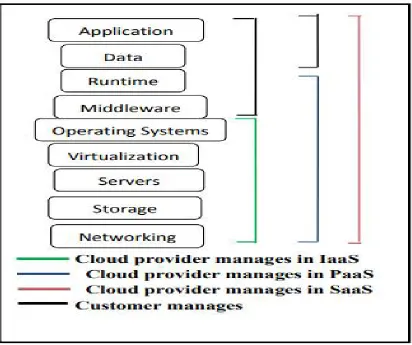
1.Cloud Software as a Service (SaaS) is the capability provided to the consumer to use the provider’s applications running on a cloud infrastructure. The applications are accessible from various client devices through a thin client interface such as a Web browser (e.g., Web-based email). The consumer does not manage or control the underlying cloud infrastructure including network, servers, operating systems, storage, or even individual application capabilities, with the possible exception of limited user-specific application configuration settings.
2.Cloud Platform as a Service (PaaS) is the capability provided to the consumer to deploy onto the cloud infrastructure consumer-created or -acquired applications created using programming languages and tools supported by the provider. The consumer does not manage or control the underlying cloud infrastructure including network, servers, operating systems, or storage, but has control over the deployed applications and possibly application hosting environment configurations.
which can include operating systems and applications. The consumer does not manage or control the underlying cloud infrastructure but has control over operating systems, storage, deployed applications, and possibly limited control of select networking components (e.g., host firewalls).
Fig 2. Responsibilities in accessing cloud using various service models
II. RELATED WORK
Attribute-based encryption (ABE) is proposed by Sahai and Waters. Attribute-based encryption (ABE) is a moderately late approach that re-evaluates the idea of public key cryptography. Attribute-based encryption is also referred to as ABE is a sort of public-key encryption wherein the secret key of a person and the cipher-text is established upon attributes. In an ABE, a person’s keys and cipher-texts are labeled with units of descriptive attributes and a symmetric key can decrypt a selected cipher-text only if there's a match between the attributes of the cipher-text and the person’s key. It reduces the quantity of key used and hence makes encryption and decryption technique faster.
III. PROPOSED SYSTEM
1. Identify the issues in cloud system for data storage on cloud. Since data is not secure on cloud user can upload the data in encrypted format.
2. Propose a crypto-system which can run on all limited resources devices. It can take data from the user and provide off-line-online service.
3. Apply Attribute Based Encryption Algorithm and Byte Rotation Algorithm for encryption of data to securely transfer the data between the users
ADVANTAGES
Here data can be transferred from one user to another securely over the cloud.
The system cost will be decreased.
It will work on all limited resource devices.
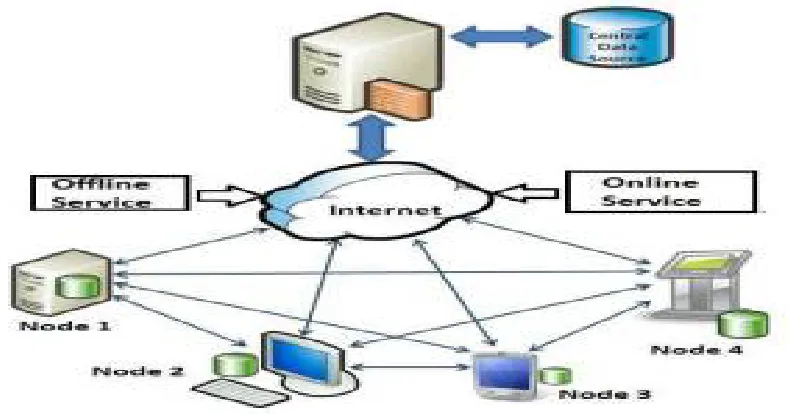
Fig 3. The Architecture of System Model
The architecture of the proposed system is shown in the figure which shows the users and the operations involved. The detailed description of the architecture is explained as follows:
Nodes: The User is responsible for uploading and sharing its personal data on the cloud.
On-line and Off-line Services: In On-line Service data will encrypted and directly transfer to the respective user. In Off-line Service if there is no Internet Connection the data will get encrypted first and then it will get stored in Main Server. Until the system does not comes on-line the data will not be shared over the cloud
Cloud Service Provider: Cloud service provider is responsible for providing all the required services to its users according to their demands.
Encryption and Decryption: Here we are using the combination of ABE and BRE algorithm to encrypt and decrypt the files.
File Upload and Download: The file which are uploaded on cloud are encrypted form. Users can
IV. IMPLEMENTATION
Step-1: Start
Step-2: Accept the data from the user.
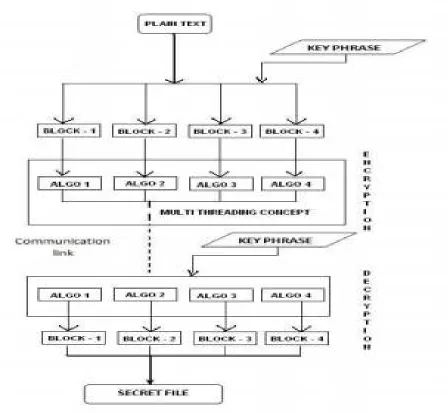
Step-4: With the help of these Attributes, Random Key is generated, and type of data is obtained for encryption by BRE algorithm.
Step-5: The data is converted into equal number of blocks and N x N matrix will be generated on the basis of these blocks.
Step-6: Based on no. of blocks, pool of threads will be created.
Step-7: Run the threads in multi core system to create encrypted data in short amount of time. Step-8: A secret key is generated in order to open the encrypted file which is stored in the cloud.
Step-9: The secret key is shared to the user via email or mobile number of the authorised user. This key will be used to decrypt the encrypted file.
REFERENCES
[1] M. Satyanarayan, “Fundamental Challenges in Mobile Cloud Computing,” Proceedings ACM Symposium Principles of distributed Computing, ACM Press, 1996.
[2] N. Tolia, M. Kaminsky, D. G. Andersen and S. Patil.An Architecture for Internet Data Transfer. In NSDI, 2006. [3] A. Weiss. Computing in the Clouds.NetWorker, 11(4):16- 25,Dec 2007.
[4] A. Zahariev, “Google App engine,” Helsinki University of Technology, 2009. [5] Wikipedia, “Mobile phone – Wikipedia , the free encyclopedia,
[6] Gonzalo Huerta-Canepa, Dongman Lee, “A Virtual Cloud Computing Provider for Mobile Devices”, ACM Workshop on Mobile Cloud Computing & Services: Social Networks and Beyond. MCS’10, 2010.
[7] J. Kangasharju, J. Ott, and O. Karkulahti, "Floating Content: Information Availability in Urban Environments," Proceedings of the 8th Annual IEEE International Conference on Pervasive Computing and Communications (PerCom) (WiP), Mannheim, Germany: 2010.
[8] A. Berl, H. Meer, H. Hlavacs, and T. Treutner, "Virtualization in energy-efficient future home environments," IEEE Communications Magazine, vol. 47, 2009, pp. 62-67. December 2009.
[9] Niroshinie Fernando, Seng W. Loke, WennyRahayu, “Dynamic Mobile Cloud Computing: Ad Hoc and Opportunistic Job Sharing”, Fourth IEEE International Conference on Utility and Cloud Computing, Victoria, NSW: December 2011.