ISSN(Online): 2320-9801
ISSN (Print) : 2320-9798
I
nternational
J
ournal of
I
nnovative
R
esearch in
C
omputer
and
C
ommunication
E
ngineering
(An ISO 3297: 2007 Certified Organization)
Vol. 3, Issue 9, September 2015
Energy Efficient Modified Cluster Routing
Algorithm for Maximizing Stability Period of
WSN
Shweta Sharma, Tarun Kumar
M. Tech Student, Dept. of C.S.E, GIMT Kanipla, Kurukshetra University Kurukshetra, Kurukshetra, India Assistant Professor, Dept. of C.S.E, GIMT Kanipla, Kurukshetra University Kurukshetra, Kurukshetra, India
ABSTRACT: The routing protocols in wireless sensor network works on the formation of path from the sensor node to
base station in the effort to consume minimum energy possible. The energy consumption is reduced in case of hierarchical protocols by forming a hierarchy from the sensor node to the base station with the help of cluster heads. The cluster head formation process effect the efficiency of the network. The network performance is directly linked with the cluster head number, cluster size and the energy of the nodes which form the cluster head. The cluster head formation process in case of the traditional routing protocols depends on the selection probability for the cluster head. In case of networks having the heterogeneous environments, the network adopts the policy of applying the different election probability for the different type of nodes. This seems to have the disadvantage that it doesn’t take the advantage of these special types of nodes to the fullest. Because if the node is having higher energy in an area it should form the cluster instead of any other node forming the cluster. This is done in the proposed algorithm by adopting single criteria for the election of cluster head i.e. the fitness function. The fitness function applied here is modified in such a way to take in to consideration the remaining energy of the node in that area for the selection of cluster head. As a result of change in the election process and adoption of new technique in new form, the network performance increases to a large extent making it more energy efficient and increasing its number of rounds.
KEYWORDS: energy efficient cluster routing; WSN; total life time; cluster heads; number of rounds,Cluster head
election process
I. INTRODUCTION
One of the major issues which limits the use of sensors is their energy efficiency, because of their small size the battery size is also small which limits the lifetime of the sensor node. Sensor networks are designed for a particular application; hence the sensor networks are application oriented. Clustering comes under the category of hierarchical based routing which organizes the network in hierarchy of two levels: at upper level Cluster-head and low level hierarchy which includes non cluster-head sensor nodes. Energy efficiency is coupled with the lifetime of the network [11].
To improve the quality of service each sensor node can communicate and coordinate with each other. Each sensor node is sensing, computation, and communications capabilities. Each sensor node has information which it senses and provided by its neighbors. The quality of the result which is produced by the sensor node depends upon the above said utilities. The calculated result is then supplied to all its neighbors or to the Base Station. Base Station is a node which queries for data to sensor node and collects the result from the sensor node. A base station can be mobile or fixed.
ISSN(Online): 2320-9801
ISSN (Print) : 2320-9798
I
nternational
J
ournal of
I
nnovative
R
esearch in
C
omputer
and
C
ommunication
E
ngineering
(An ISO 3297: 2007 Certified Organization)
Vol. 3, Issue 9, September 2015
II. RELATED WORK
Guinsheng Yin et al [2] the nodes of wireless sensor network have many limitations like battery power and storage space. Energy efficiency is the important factor of network.
Sajid Hussain et al [3] clusters are formed by applying genetic algorithm for data dissemination in wireless sensor network and by this the energy efficiency of the network can increased. This paper proposes the intelligent hierarchical clustering technique which increases the network lifetime in various deployment environments.
Lindsey et al [4] presents PEGASIS the communication between neighbouring nodes reduces energy consumption by minimizing the usage of energy per round.
Reetika Munjal et al [5] the problem of LEACH is that it selects the cluster head randomly. This paper proposes the selection of cluster head should depend on its energy level and its distance from the base station.
Ratna and Sivsubramanian et al [6] focus on clustering and scheduling. Paper gives attention to increase throughput and low access delay.
Bhaskar Krishnamachari et al [7] the redundancy is removed by data aggregation. So the process of data aggregation is performed by some nodes which cause delay in transmission of packets. So, optimal aggregation mechanisms are formed for removing the problem of delay.
Smaragdakis et al. [8] proposes stable election protocol (heterogeneous aware protocol) which increases the stable period of the network by increasing high energy nodes.
Huu Nghia Le et al. [9] proposes energy efficient algorithm which collects data from sensor nodes with minimum latency known as Delay-minimized Energy efficient Data Aggregation algorithm (DEDA). Due to the formation of delay-efficient network structure this algorithm minimizes data aggregation latency. Consumption of energy is low die to which network lifetime increase.
Al karki et al. [10] focuses on the routing protocols depending on network architecture. Routing techniques consists of three type: flat, hierarchical and location based. This paper provides an overview of advantages performance issues about routing technique.
III.PROPOSED ALGORITHM A. Design Considerations:
The modified protocol should be scalable and function effectively for networks of any size.
The modified protocol has to extend the lifetime and stability period of the network.
The modified protocol must be as simple as possible and as independent from the hardware capabilities of the node as possible.
Nodes are able to provide the needed information for the fitness function.
Data aggregation energy provides the needed energy for all the computations done by the node.
Selection is done from all the nodes i.e. no separate election process for any type of nodes.
B. Description of the Proposed Algorithm:
Aim of the proposed algorithm is to maximize the network life by minimizing the energy consumption using energy efficient modified clustered routing. The proposed algorithm is consists of three main steps.
Step 1: Node Deployment:
The node deployment is done randomly over the area selected for the network. The nodes are divided in to three types: normal nodes, intermediate nodes and advanced nodes. These are deployed over the area and differ in their initial energy levels.
Step 2: Cluster Head Election:
ISSN(Online): 2320-9801
ISSN (Print) : 2320-9798
I
nternational
J
ournal of
I
nnovative
R
esearch in
C
omputer
and
C
ommunication
E
ngineering
(An ISO 3297: 2007 Certified Organization)
Vol. 3, Issue 9, September 2015
Selection
Crossover
Mutation
Fitness Evaluation
The fitness evaluation function and selection function is modified and designed according to the requirement of the objectives of the work. Crossover is done by having a midpoint of the chromosome and mutation type is the partial mutation. In the fitness function the Energy of the node is added, so that we can take account of the energy of the node’s energy before its selection as the cluster head. The fitness function used is the negative fitness function and it considers the energy of node for the fitness evaluation.
Step 3: Transmission Phase:
After the cluster head election phase is complete. Network is having the cluster head information and the none cluster head nodes are then associated with the cluster heads forming the regions known as clusters. These clusters communicate with their respective cluster heads. A node in the network to become associated with the cluster head check for its distance from different cluster heads and will work under the cluster head which is nearest to it.
IV.PARAMETERS USED
PARAMETERS VALUES Sensor field 100m X 100m Sensor position 50m X 50m
N 100
Packet size 4000 bits Efx 10pJ/bit/m2 Emp 0.0013pJ/bit/m4
EDA 50nJ/bit
EO 0.5 J
P 0.1
a 2
b 1
M 0.3
X 0.3
Pc 0.6
Pm 0.03
V. PSEUDO CODE
Step 1: Deploy the network nodes.
Step 2: Calculate the fitness of nodes to become cluster head. Step 3: Check for the associated cluster heads.
Step 4: Built the clusters and complete the communication process for the network Step 5: Based on distance decide the packet forwarding or amplification.
Step 6: Calculate and record different performance parameters of the network. Step 7: go to step 2 till any node in the network is alive.
Step 8: End.
VI.SIMULATION RESULTS
ISSN(Online): 2320-9801
ISSN (Print) : 2320-9798
I
nternational
J
ournal of
I
nnovative
R
esearch in
C
omputer
and
C
ommunication
E
ngineering
(An ISO 3297: 2007 Certified Organization)
Vol. 3, Issue 9, September 2015
A. Energy Dissipated Per Round
Energydissipation is an important factor in determining the performances of both the protocols. In figure 1the energy dissipation is maximum for 34.28 % of the life time while in the proposed algorithm it is maximum only for 18.22 % of its life time.
B. Packets to Cluster Head per Round
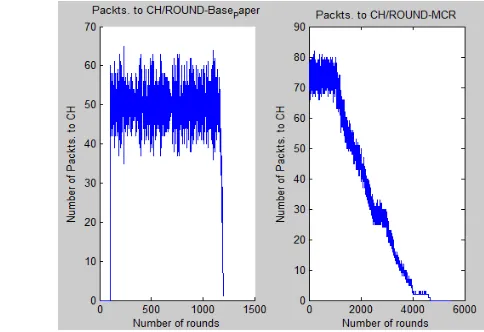
Each non cluster head node sends its result to the cluster head to which it is associated, result is send in the form of tiny packets. In figure 2Packets to cluster heads are sent by the network sensor nodes only for 28.57% of its life time while the packets are sent to cluster heads in the proposed algorithm for 87.46% of its life time.
C. Packets Send to Base Station per Round:-
After all non cluster head nodes have send their data to the cluster head nodes; each cluster head node aggregates the data to remove the redundancy and forwards this data to the BS. A protocol should transmit maximum number ofpackets to BS before energy of all nodes goes below the given threshold. In figure 3, Packets to BS in case of Base paper ranges from 60% to 0% of the number of nodes present in the network while in case of proposed algorithm this percentage is modified and achieved at max 35% to 0%.
D. Number of Dead Nodes per Round:-
In figure 4 numbers of dead nodes takes the 68.57% of the network life time from first node dead to last node dead in the network while in case of proposed work it takes 74.48% for the network life time of the network.When the nodes begin to transmit they start to consume their energy and their energy goes down after every transmission, and when the energy of node goes below the threshold value node is declared as a dead node. The time from beginning of transmission to first node dies is the stability period of the network and time when all nodes have died describes the overall life time of the network.
E. Number of Cluster Heads Elected per Round:-
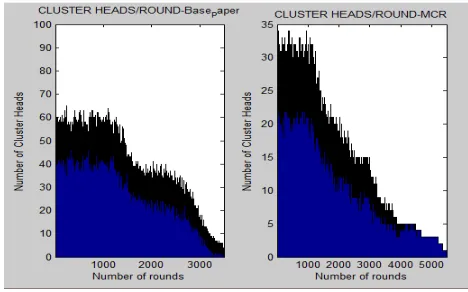
In figure 5 number of cluster head max. Percentage observed in case of base paper is 65% around while it is reduced by the proposed algorithm to 35% at maximum value. Cluster heads are elected randomly as in the traditional Base Paper protocol. Advance nodes are more likely to be the cluster heads. New cluster heads are elected for each round, the number of cluster heads, elected should be balanced, neither more nor less, because a large amount of energy is consumed in transmission of packets to the base station. If number of cluster heads is large more energy will be consumed.
ISSN(Online): 2320-9801
ISSN (Print) : 2320-9798
I
nternational
J
ournal of
I
nnovative
R
esearch in
C
omputer
and
C
ommunication
E
ngineering
(An ISO 3297: 2007 Certified Organization)
Vol. 3, Issue 9, September 2015
Figure 3: No. of Packets to Base Station per round Figure 4: Dead Nodes per round
Figure 5: Cluster heads per round
VII. CONCLUSION AND FUTURE WORK
Dynamic clustering with the help of G.A. is implemented and compared with proposed work of [1]. The difference in their performance is clearly visible from the comparison graphs obtained as a result of the comparison. The objective to increase the stability time of the network is achieved by developing the dynamic clustering with the help of G.A. The difference achieved is greater in case of G.A. as it increases the stability time by 350 rounds. As a future development increase in efficiency based on real time fuzzy input is expected. This makes the network more efficient and adjusts to the situation and scenario. As a result a further increase in the network efficiency can be seen.
REFERENCES
1. Laveena Mahajan “Improving the Stable Period of WSN using Dynamic Stable Leach Election Protocol” Issues and Challenges in Intelligent Computing Techniques (ICICT), vol-11, pp: 393-400, 2014.
2. Guisheng Yin I,Guang Yang I, 2 , Wu Yang I,2, Bingyang Zhang I ,2, Wenjin Jin I ,2 “An energy efficient routing algorithm for Wireless Sensor Networks”, International Conference on Internet Computing in Science and Engineering (IEEE) (2008),28-29 Jan; Harbin, pp.181-186.
ISSN(Online): 2320-9801
ISSN (Print) : 2320-9798
I
nternational
J
ournal of
I
nnovative
R
esearch in
C
omputer
and
C
ommunication
E
ngineering
(An ISO 3297: 2007 Certified Organization)
Vol. 3, Issue 9, September 2015
4. S. Lindsey, C.Raghavendra, “PEGASIS: Power Efficient Gathering in Sensor Information Systems”,published in: IEEE Aerospace Conference Proceedings. 2002, VoL.3, pp. 1125-1130.
5. Reetika Munjal, Bhavneesh Malik "Approach for Improvement in LEACH Protocol for Wireless Sensor Network", Second International Conference on Advanced Computing & Communication Technologies (IEEE) (2012),7-8 Jan; Rohtak, Haryana, pp.517-521. 6. Rathna and Sivasubramanian, "Improving Energy Efficiency in Wireless Sensor Networks through Scheduling and Routing", Research Scholar,
Sathyabama University, TamilNadu, India, International Journal of Advanced Smart Sensor Network Systems, vol: 2, pp: 21-27, January 2012. 7. Bhaskar Krishnamchari, Deborah Estrin, “ Impact of Data Aggregation in WSN”, IEEE Journal Selected Areas in Communications,
pp.1333-1336, Aug.2009.Al-Karaki, J.N, “Routing Techniques in WSN: A Survey”, Wireless Communications, IEEE, vol: 11, pp: 6-28, Dec. 2004. 8. Smaragdakis. Georgios. Ibrahim Matta. And Azer Bestavros. “SEP: A Stable election protocol for clustered heterogeneous wireless sensor
network”, Boston University Computer Science Department, 2004.
9. Huu Nghia Le,Vyacheslav Zalyubovskiy, Hyunseung Choo “Delay-minimized Energy-efficient Data Aggregation in Wireless Sensor Networks”, International Conference on Cyber Enabled Distributed Computing and knowledge Discover (IEEE) (2012),10-12 Oct; Sanya, ppAOI-407.
10. Al-Karaki, J.N, “Routing Techniques in WSN: A Survey”, Wireless Communications, IEEE, vol: 11, pp: 6-28, Dec. 2004.