ISSN(Online): 2320-9801
ISSN (Print): 2320-9798
International Journal of Innovative Research in Computer
and Communication Engineering
(An ISO 3297: 2007 Certified Organization)
Vol. 3, Issue 8, August 2015
Multicast Packet Delivery and QoS Oriented
Routing Protocol for Hybrid Wireless
Networks
R.Gowthami1, N.Kohila2
Research Scholar, Dept. of CS, Vivekanandha College of Arts and Sciences for Women (Autonomous), Namakkal, India1
Associate Professor, Dept. of CS & Application, Vivekanandha College of Arts and Sciences for Women (Autonomous), Namakkal, India2
ABSTRACT: The escalating intensity of wireless communication in today’s environment, individuals often mandatory QOS for sharing their data between the nodes. A wireless hybrid network that join together a Mobile Wireless Ad hoc Network (MANET) and a wireless infrastructure network has been proven to be a better alternative for the next generation wireless networks. By directly approve resource hesitation based QOS routing for MANET in a hybrid network Inherit invalid hesitation and race condition problems in MANET. To propose a Neighbor selection algorithm, in that an intermediate node assigns the highest priority to the packet with the closest deadline and forwards the packet with the highest priority first. The propose Packet Scheduling for packet routing. This algorithm assigns earlier generated packets to forwarders with higher queuing delays and scheduling feasibility, while assigns more recently generated packets to forwarders with lower queuing delays and scheduling Feasibility, so Data redundancy elimination algorithm that the transmission delay of an entire packet stream can be reduced. To propose a QoS Oriented Distributed Routing Protocol (QOD) for hybrid networks to provide QoS services in a highly dynamic scenario. The advantage of the unique features of hybrid networks. The proposed is an efficient secure distributed QOS protocol that addresses some issues specific to Hybrid wireless networks which are communication delay, cost, mobility, and link unreliability.
KEYWORDS: Neighbor selection, Packet Scheduling, QoS Oriented Distributed Routing Protocol (QOD).
I. INTRODUCTION
ISSN(Online): 2320-9801
ISSN (Print): 2320-9798
International Journal of Innovative Research in Computer
and Communication Engineering
(An ISO 3297: 2007 Certified Organization)
Vol. 3, Issue 8, August 2015
II. LITERATURE SURVEY
A majority of QoS routing protocols are based on resource reservation, in which a source node sends probe messages to a destination to discover and reserve paths satisfying a given QoS requirement. Perkins extended the AODV routing protocol by adding information of the maximum delay and minimum available bandwidth of each neighbor in a node’s routing table. Jiang proposed to reserve the resources from the nodes with higher link stability to reduce the effects of node mobility. Liao proposed an extension of the DSR routing protocol by reserving resources based on time slots. Venataramanan et al. proposed a scheduling algorithm to ensure the smallest buffer usage of the nodes in the forwarding path to base stations. These works focus on maximizing network capacity based on scheduling but fail to guarantee QoS delay performance. Some works consider providing multipath routing to increase the robustness of QoS routing. Conti proposed to use nodes’ local knowledge to estimate the reliability of routing paths and select reliable routes. The works in and balance traffic load among multiple routes to increase routing reliability. Shen proposed to let a source node fetch the lost packets from its neighbors to recover the multicast traffic. Shen and Thomas proposed a unified mechanism to maximize both the QoS and security of the routing. Li proposed a centralized algorithm to optimize the QoS performance by considering cross-layer design among the physical layer, MAC layer, and network layer. QOD aims to provide QoS guaranteed routing. QOD fully takes advantage of the widely deployed APs, and novelly treats the packet routing problem as a resource scheduling problem between nodes and Access Points.
III. EXISTINGSYSTEM
Reservation-based QoS routing protocols have been proposed for MANETs that create routes formed by nodes and links that reserve their resources to fulfil QoS requirements. Although these protocols can increase the QoS of the MANETs to a certain extent.
Disadvantages of existing system:
Continuously changing network topology makes conventional wireless routing protocols incapable of providing satisfactory performance in the data transaction environment.
IV. PROPOSED SYSTEM
With the improvement of the wireless network for solving the QOS issues, of hybrid networks, to propose a QoS-Oriented Distributed routing protocol (QOD). To propose protocol adopts the resource reservation based QOS routing scheme. The proposal a QOS Oriented Distributed Optimal Routing Protocol (Q-ORP) to enhance the QoS support capability of hybrid networks.
ADVANTAGES OF PROPOSED SYSTEM:
A QoS-guaranteed neighbour selection algorithm to meet the transmission delay requirement. A distributed packet scheduling algorithm to further reduce transmission delay. A mobility-based segment resizing algorithm that adaptively adjusts segment size according to node mobility in order to reduce transmission time. A traffic redundant elimination algorithm to increase the transmission throughput and a data redundancy elimination-based transmission algorithm to eliminate the redundant data to further improve the transmission QoS.
V. ARCHITECTURE
ISSN(Online): 2320-9801
ISSN (Print): 2320-9798
International Journal of Innovative Research in Computer
and Communication Engineering
(An ISO 3297: 2007 Certified Organization)
Vol. 3, Issue 8, August 2015
Fig 1 The network model of the hybrid networks.
VI. ALGORITHM
Neighbor selection algorithm:
In this algorithm, an intermediate node assigns the highest priority to the packet with the closest deadline and forwards the packet with the highest priority first. Queue length threshold is set to avoid queuing congestion, we set up a space utility threshold TUs for each node as a safety line to make the queue scheduling feasible. In QOD, after receiving a forward request from a source node, an intermediate node Ni with space utility less than threshold e TUs replies the source node. The replied node Ni informs the source node about its available workload rate, and the necessary information to calculate the queuing delay of the packets from the source node. The source node selects the replied neighbor nodes that can meet its QoS deadline for packet forwarding based on the calculated queuing delay.
Similar to the random early detection (RED) algorithm, in which a queue length threshold is set to avoid queuing congestion, a space utility threshold TUs is set up for each node as a safety line to make the queue scheduling feasible. Let Uas(i) denote the available space utility and Uas(i) = TUs – Us(i) . In QOD, after receiving a forward request message from a source node, an intermediate node ni with space utility less than threshold TUs replies the source node. The replied node ni informs the source node about its available workload rate Uas(i) ∗ Wi , and the necessary information to calculate the queuing delay of the packets from the source node. Based on the calculated queuing delay, the source node then selects the replied neighbour nodes that can meet its QoS deadline for packet forwarding. After the source node determines the qualified nodes that can satisfy the deadline requirement, the source node needs to distribute its packets to these qualified nodes based on their available workload rate Uas(i) ∗ Wi to make the scheduling feasible in each of the adjacent nodes. Consider the packet generating rate of the source node is Wg kb/s, the number of QoS qualified neighbours is Nq , the available workload rate of the intermediate node i is Uas(i) ∗ Wi , and the workload rate allocation from source node to immediate node i is Ai = (Sp(i))/Ta(i), where 0 < i < n. Then, the following equations is solved to get an allocation set A:
Any results that satisfy this equation can be used by the source node.
Nearest Neighbour Finding Algorithm
Algorithm: Distance Measurement Input: Objects positions (o1, o2) Output: Distance (in points)
Step1: Identify object A Step2: Identify Object B
ISSN(Online): 2320-9801
ISSN (Print): 2320-9798
International Journal of Innovative Research in Computer
and Communication Engineering
(An ISO 3297: 2007 Certified Organization)
Vol. 3, Issue 8, August 2015
Step5: difference between (x1-x2) and (y1-y2) Step6: Return value
Source code for nearest neighbor algorithm
for {set i 0} {$i<$val(nn)} {incr i} { set NL($i) [list]
set x_pos1 [$n($i) set X_] set y_pos1 [$n($i) set Y_]
for {set j 0} {$j<$val(nn)} {incr j} { if {$j!=$i} {
set x_pos2 [$n($j) set X_] set y_pos2 [$n($j) set Y_]
set x_pos [expr $x_pos1-$x_pos2] set y_pos [expr $y_pos1-$y_pos2]
set v [expr $x_pos*$x_pos+$y_pos*$y_pos] set d [expr sqrt($v)]
set nd($i,$j) $d
puts "Distance from $i to $j:$d" if {$d<$communicationrange} {
$n($i) add-neighbor $n($j) }
} }
set neighbor1 [$n($i) neighbors] foreach nb1 $neighbor1 {
set now [$ns now]
puts "The neighbor for node $i are:$nb1" set idv [$nb1 id]
puts "$idv"
lappend NL($i) $idv }
}
Distributed packet scheduling algorithm:
After qualified neighbors are known, this algorithmic program schedules packet routing. It assigns earlier generated packets to forwarders with higher queuing delays, while assigns a lot of recently generated packets to forwarders with lower queuing delays to decrease total transmission delay. In order to further reduce the stream transmission time, a distributed packet scheduling algorithm is propose for packet routing. This algorithm assigns earlier generated packets to forwarders with higher queuing delays and scheduling feasibility, while assigns more recently generated packets to forwarders with lower queuing delays and scheduling Feasibility, so that the transmission delay of an entire packet stream can be reduced.
ISSN(Online): 2320-9801
ISSN (Print): 2320-9798
International Journal of Innovative Research in Computer
and Communication Engineering
(An ISO 3297: 2007 Certified Organization)
Vol. 3, Issue 8, August 2015
where x denotes a packet with the xth priority in the queue, and TI→D (j) and Ta (j) respectively denote the
transmission delay and arrival interval of a packet with the jth priority. is the number of packets arriving during the packet’s queuing time Tw (x) , which are sent out from the queue before this data packet. After receiving the reply messages from neighbouring nodes along with the scheduling information of all flows in their queues, the source node computes the queuing time Tw of its packets in each intermediate node and then chooses the intermediate node ni that meets the condition Tw(i) < TQoS − TS→I − TI→D. After scheduling data packets to qualified intermediate nodes based on equation (3), the previously generated packet from source node is transmitted to a node with longer queuing delay but still within the deadline bound. Taking advantage of the different values of Tw in different neighbouring nodes, the entire traffic stream transmission time can be decreased by making the queuing of previously generated packets and the generation of new packets be conducted in parallel.
Source code for Distributed packet scheduling algorithm:
for {set des 0} {$des<$val(nn)} {incr des} { for {set j 0} {$j<$val(nn)} {incr j} {
if {$des!=$j} {
lappend route($j,$des) $j
for {set i 0} {$i<$val(nn)} {incr i} { set flg($i) 0
} set s $j set flag 0 set RN $s
puts "Route from $j to $des" while {$RN!=$des} { puts "RN:$RN" foreach rn $NL($RN) { if {$rn==$des} {
set flag 1 }
}
if {$flag==1} { set RN1 $des } else {
set x_pos1 [$n($des) set X_] set y_pos1 [$n($des) set Y_]
set dL [list]
if {$mindis==$dis($des,$ni)} { set RN1 $ni
set flg($ni) 1 puts "Node:$RN1" }
ISSN(Online): 2320-9801
ISSN (Print): 2320-9798
International Journal of Innovative Research in Computer
and Communication Engineering
(An ISO 3297: 2007 Certified Organization)
Vol. 3, Issue 8, August 2015
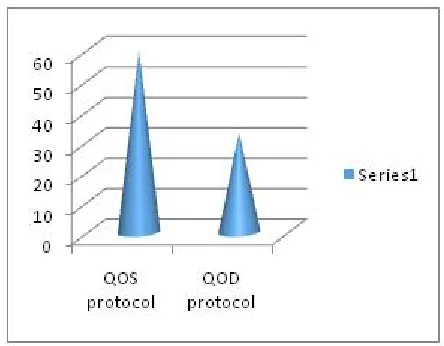
VII. RESULT ANALYSIS
Fig 2: Packet Delivery ratio comparison
The packet delivery ratio of the QoS oriented Distributed Routing protocol is higher than the existing QoS protocol.
Fig 3: Bandwidth comparison of proposed and existing.
VIII. CONCLUSION AND FUTURE WORK
ISSN(Online): 2320-9801
ISSN (Print): 2320-9798
International Journal of Innovative Research in Computer
and Communication Engineering
(An ISO 3297: 2007 Certified Organization)
Vol. 3, Issue 8, August 2015
REFERENCES
1. Dr. Shuchita Upadhayaya and Charu Gandhi “Quality of service routing in Mobile ad hoc networks using Location and energy parameters”, International Journal of Wireless & Mobile Networks (IJWMN), Vol 1, No 2, November 2009
2. Sunil Taneja and Ashwani Kush “A Survey of Routing Protocols in Mobile Ad Hoc Networks” International Journal of Innovation, Management and Technology, Vol. 1, No. 3, August 2010 ISSN: 2010-0248.
3. V.G.Muralishankar et al, “Routing Protocols for MANET:A Literature Survey”, International Journal of Computer Science and Mobile Applications, Vol.2 Issue. 3, March- 2014, pg. 18-24
4. H. Luo, R. Ramjeey, P. Sinhaz, L. Liy, and S. Lu, “UCAN: A Unified Cell and Ad-Hoc Network Architecture,” Proc. ACM MobiCom, 2003. 5. P.K. Mckinley, H. Xu, A. Esfahanian, and L.M. Ni, “Unicast-Based Multicast Communication in Wormhole-Routed Direct Networks,” IEEE
Trans. Parallel Data and DistributedSystems, vol. 5, no. 12, pp. 1252-1265, Dec. 1992.
6. H. Wu, C. Qiao, S. De, and O. Tonguz, Integrated Cell and Ad Hoc Relaying Systems: iCAR,” IEEE J. Selected Areas in Comm., vol. 19, no. 10, pp. 2105-2115, Oct. 2001.
7. J. Zhou and Y.R. Yang, “PAR CelS: Pervasive Ad-Hoc Relaying for Cell Systems,” Proc. IFIP Mediterranean Ad Hoc Networking Workshop (Med-Hoc-Net), 2002.
8. R. Braden, D. Clark, and S. Shenker, Integrated Services in the Internet Architecture: An Overview, IETF RFC 1633, 1994.
9. Z. Li and H. Shen, “A QoS-Oriented Distributed Routing Protocol for Hybrid Networks,” Proc. IEEE Seventh Int’l Conf. Mobile Adhoc and Sensor Systems, 2010.
10. J. Li, C. Blake, S. Douglas, H. Lee, and R. Morris, “Capacity of Ad Hoc Wireless Networks,” Proc. ACM MobiCom, 2001. 11. E. Crawley, R. Nair, B. Rajagopalan, and H. Sandick, Resource Reservation Protocol RSVP, IETF RFC 2205, 1998.
12. I. Jawhar and J. Wu, “Quality of Service Routing in Mobile Ad Hoc Networks,” Network Theory and Applications, Springer, 2004.
13. T. Reddy, I. Karthigeyan, B. Manoj, and C. Murthy, “Quality of Service Provisioning in Ad Hoc Wireless Networks: A Survey of Issues and Solutions,” Ad Hoc Networks, vol. 4, no. 1, pp. 83-124, 2006.
14. X. Du, “QoS Routing Based on Multi-Class Nodes for Mobile Ad Hoc Networks,” Ad Hoc Networks, vol. 2, pp. 241-254, 2004.
15. S. Jiang, Y. Liu, Y. Jiang, and Q. Yin, “Provisioning of Adaptability to Variable Topologies for Routing Schemes in MANETs,” IEEE J. Selected Areas in Comm., vol. 22, no. 7, pp. 1347-1356, Sept. 2004.
16. M. Conti, E. Gregori, and G. Maselli, “Reliable and Efficient Forwarding in Ad Hoc Networks,” Ad Hoc Networks, vol. 4, pp. 398-415, 2006. 17. G. Chakrabarti and S. Kulkarni, “Load Balancing and Resource Reservation in Mobile Ad Hoc Networks,” Ad Hoc Networks, vol. 4, pp.
186-203, 2006.
18. A. Argyriou and V. Madisetti, “Using a New Protocol to Enhance Path Reliability and Realize Load Balancing in Mobile Ad Hoc Networks,” Ad Hoc Networks, vol. 4, pp. 60-74, 2006.
19. C. Shen and S. Rajagopalan, “Protocol-Independent Multicast Packet Delivery Improvement Service for Mobile Ad Hoc Networks,” Ad Hoc Networks, vol. 5, pp. 210-227, 2007.