ISSN(Online): 2320-9801
ISSN (Print) : 2320-9798
I
nternational
J
ournal of
I
nnovative
R
esearch in
C
omputer
and
C
ommunication
E
ngineering
(An ISO 3297: 2007 Certified Organization)
Vol. 3, Issue 9, September 2015
Performance Enhancement for SLM, PAPR
Reduction of OFDM A New Phase Sequence
Using M-QAM Technique
Aashish Anand
UG Student, Dept. of Electronics, Bharati Vidyapeeth College of Engineering, Pune-Satara Road, Pune, Maharashtra,
India
ABSTRACT: Multiple-input multiple-output orthogonal frequency division multiplexing (MIMO-OFDM) technology is in order to increase the diversity gain and system capacity over the time variant frequency-selective channels. The current work is proposed to design an efficient scheme for orthogonal frequency division multiplexing (OFDM) using CCDF multiple input multiple output (MIMO). However, the major drawback of MIMO-OFDM system is the transmitted signals on different exhibit high peak-to-average power ratio (PAPR). We mainly investigate the PAPR reduction performance with PAPR reduction methods selective mapping (SLM) & improved SLM. The PAPR of original OFDM is near about 5.14dB. By using SLM technique with original OFDM PAPR is reduced nearly about 1.56dB by using m-QAM in phase sequences and by using the modified SLM technique PAPR is reduced nearly about 3.91dB in comparison to original OFDM.Results are verified using MATLAB software.
KEYWORDS:M-QAM, CCDF, SLM, OFDM etc.
I. INTRODUCTION
A capable modulation method that is increasingly being approved in the telecommunication field is Orthogonal Frequency Division Multiplexing (OFDM).The Orthogonal Frequency Division Multiplexing (OFDM) is a Multi-Carrier Modulation very important technique in which a single high rate data-stream is separated into multiple low rate data-streams and is modulated using subcarriers which are orthogonal to each other [2]. OFDM is a “Multi-Carrier Transmission Scheme.” ODFM is a good solution for high speed digital communications. The data to be transmitted is speeded over a large number of orthogonal carriers, each being modulated at a low rate[3].The carriers can be made orthogonal by appropriately choosing the frequency spacing between them. Orthogonal frequency division multiplexing (OFDM) is a widely used modulation and multiplexing technology, which has become the basis of many telecommunications fields. Therefore OFDM is an advanced modulation technique which is suitable for high-speed data transmission due to its advantages in dealing with the multipath propagation problem, high data rate and bandwidth efficiency. [4]
II. PROBLEM DEFINITION
ISSN(Online): 2320-9801
ISSN (Print) : 2320-9798
I
nternational
J
ournal of
I
nnovative
R
esearch in
C
omputer
and
C
ommunication
E
ngineering
(An ISO 3297: 2007 Certified Organization)
Vol. 3, Issue 9, September 2015
III. SYSTEM MODEL
PAPR & OFDM SYSTEM MODEL
Let A = [A0 A1 ··· AN−1] T signify an input symbol vector in the frequency domain, where Ak represents the complex
data of the kth subcarrier and N is the number of subcarriers.
The input symbol vector is also called the input symbol sequence. The OFDM signal is created by summing all the N modulated subcarriers each of which is separated by 1/N ts in the frequency domain, where ts is the sampling period. Then, a continuous time baseband OFDM signal is defined as
The discrete time baseband OFDM signal an sampled at the Nyquist rate t = nts can be given as
Let a = [a0 a1 ··· aN−1] T denote a discrete time OFDM signal vector. Then, a corresponds to the inverse fast Fourier transform (IFFT) of A, that is, a = QA, where Q is the IFFT matrix. The block diagram of OFDM transmitter is described in Fig. 1.
Let aL = [a0,L a1,L ··· aLN−1,L] T be an oversampled discrete time OFDM signal vector where an,L is the oversampled discrete time OFDM signal sampled at t = nts/L written as
where A k is
Continuous time baseband OFDM signals can be approximately represented by L times oversampled discrete time baseband OFDM signals. It is shown in [10] that choosing L = 4 is sufficient to approximate the peak value of the continuous time OFDM signals
Peak-to-Average Power Ratio
The PAPR of the discrete time baseband OFDM signal is de- fined as the ratio of the maximum peak power divided by the average power of the OFDM signal [4], that is,
………….1 with
ISSN(Online): 2320-9801
ISSN (Print) : 2320-9798
I
nternational
J
ournal of
I
nnovative
R
esearch in
C
omputer
and
C
ommunication
E
ngineering
(An ISO 3297: 2007 Certified Organization)
Vol. 3, Issue 9, September 2015
From Parseval’s theorem, the average power Pav(a) in (2) is σ2. An alternative measure of the envelope variation of the OFDM signals is the crest factor ζ which is the ratio of the maximum to the root mean square of the signal envelope, defined as
The PAPR of the continuous time baseband OFDM signal at defined as the ratio of the maximum instantaneous power divided by the average power of the OFDM signal, can be expressed as
Where
And the PAPR of the continuous time passband OFDM signal gt is also defined as
The discrete time baseband OFDM signals, which constitute the output of the IFFT block, are transformed to continuous time baseband OFDM signals by a low-pass filter called DAC, where the peak power can be increased while maintaining a constant average power. Usually, the PAPR of the continuous time baseband OFDM signals is larger than that of the discrete time baseband OFDM signals by 0.5∼1.0 dB [1]. Mixing the continuous time baseband OFDM signal with the radio frequency generates the continuous time pass band OFDM signal. It does not change the peak power but the average power of the baseband OFDM signal is half the average power of the continuous time baseband OFDM signal. Thus, the PAPR of the continuous time passband signal is generally larger than that of the continuous time baseband OFDM signal by 3 dB. Then, the relationship between PAPRs is given as PAPR(an) ≤ PAPR(at) < PAPR(gt).
In some literature on coding schemes, the peak-to-mean envelope power ratio (PMEPR) also denotes the PAPR of the continuous time baseband OFDM signals [12]. For a code Ω and any code word A ∈ Ω with the probability p(A), the mean envelope power of the continuous time baseband OFDM signals is expressed as
whereat is the continuous time baseband OFDM signal corresponding to the code word A and ||A|| denotes the vector norm of A. Then, based on the above definition, the PMEPR of the codeword A can be defined as
ISSN(Online): 2320-9801
ISSN (Print) : 2320-9798
I
nternational
J
ournal of
I
nnovative
R
esearch in
C
omputer
and
C
ommunication
E
ngineering
(An ISO 3297: 2007 Certified Organization)
Vol. 3, Issue 9, September 2015
IV. PROPOSED METHOD
To do the PAPR analysis and to evaluate performance of the pre and post non-linear polynomial function based OFDM systems, the proposed algorithm is implemented using MATLAB by undertaking the following steps:
1. To do the PAPR analysis of OFDM system with the proposed non-linear polynomial based function, firstly binary data is generated randomly.
2. The generated binary data is then converted into symbols and is then modulated by M-QAM (where M=4, 16). 3. The serial data is then converted into parallel data and IFFT is performed as normal in OFDM procedure.
4. The parallel signal is then converted to serial data and a non-linear polynomial function is applied to reduce the PAPR. The PAPR is then calculated and the serial OFDM signal is then passed through a multipath channel with AWGN noise added.
5. The received signal is again passed through the post non-linear polynomial to recover the original signal. This signal is then converted from serial to parallel data. The final demodulated signal is parallel data, which is then converted into serial data. The serial data is then demodulated to retrieve back the signal. The BER is calculated by taking the difference of the demodulated data and the input data.
PAPR is a random variable .Therefore PAPR can be measured using Complementary Cumulative Distribution Function (CCDF).It is defined as Probability that PAPR greater than the threshold value (PAPRo). CCDF=Pr(PAPR>PAPRo)
Modified SLM Technique
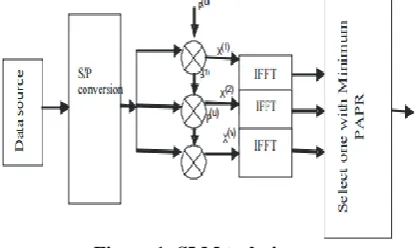
Selective mapping is considered as a promising technique for PAPR reduction [3,4] because it does not produce distortion yet maintain the system performance to a great extent. In this scheme, data blocks are firstly converted into several independent blocks and the block with lower PAPR is sent, in which converting process involves multiplying data sequences to random phase sequences generated.
The selected index is called side-information index which must also be transmitted to allow recovery of the data block at the receiver side. SLM leads to the reduction in data rate. In this method, main complexity occurs in recovering the side information.
In selected mapping method[5], firstly M statistically independent sequences which represent the same information are generated and next the resulting M statistically independent data block m=[ ܵm,0, ܵm,1,…, ܵm,N-1]T, ܵ=1,2,…,ܯ are then forwarded into IFFT operation simultaneously.
Finally, at the receiving end, OFDM symbols xm =[x1,x2…,xN]T in discrete time-domain are acquired, and then the PAPR of these M vectors are calculated separately.
Eventually, the sequences with the smallest PAPR will be elected for final serial transmission. The key point of selected mapping (SLM) method lies in how to generate multiple OFDM signals when the information is same. Fig. 2 shows the detailed block diagram of SLM technique
Figure 1: SLM techniques
CCDF OF PAPR
The cumulative distribution function (CDF) is one of the most regularly used parameters, which is used to measure the efficiency of any PAPR Technique. The cumulative distributed function (CDF) of the signal is
ISSN(Online): 2320-9801
ISSN (Print) : 2320-9798
I
nternational
J
ournal of
I
nnovative
R
esearch in
C
omputer
and
C
ommunication
E
ngineering
(An ISO 3297: 2007 Certified Organization)
Vol. 3, Issue 9, September 2015
The complementary cumulative distributed function (CCDF) is used instead of CDF which helps us to measure the probability that the PAPR of a certain data block exceeds the given threshold.
P (PAPR > z) = 1 − P (PAPR ≤ z) = 1 − F (z) N
= 1 − (1 − exp (−z)) N
AWGN
The parallel signal is then converted to serial data and a non-linear polynomial function is applied to reduce the PAPR. The PAPR is then calculated and the serial OFDM signal is then passed through a multipath channel with AWGN noise added.
In order to evaluate the performance of the proposed method with SLM, simulations have been performed as per parameters shown in Table 1.
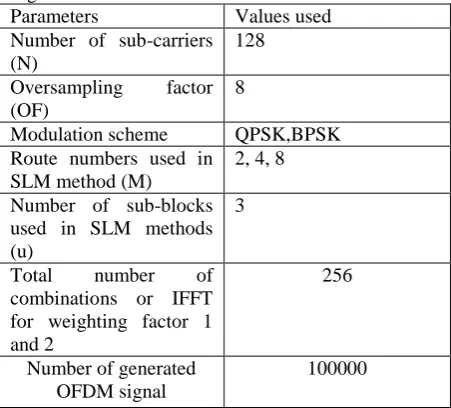
Table 1 Parameters used in SLM algorithm
Parameters Values used
Number of sub-carriers (N)
128
Oversampling factor (OF)
8
Modulation scheme QPSK,BPSK
Route numbers used in SLM method (M)
2, 4, 8
Number of sub-blocks used in SLM methods (u)
3
Total number of
combinations or IFFT for weighting factor 1 and 2
256
Number of generated OFDM signal
100000
Table 1 show the parameters of OFDM signal which is used for PAPR reduction. Here, the number of sub-carriers used are N=64, 128 and the pseudo-random partition scheme is applied for each carrier, adopting QPSK constellation mapping, weighting factor being bv∈ [±1, ±j]. The flow chart used for PAPR reduction technique is given in Figure 3.
V. RESULT ANALYSIS
Now discussed the simulation result proposed SLM technique, there are varying parameters which impact the PAPR reduction performance these are:
1) The number of sub-blocks V, which influences the complexity strongly; 2) The number of possible phase value W, which impacts the complexity; and
3) The sub-block partition schemes. Here, only one parameter is considered that is sub-block size V.
SLM algorithms are typical non-distortion techniques for reduction of PAPR in OFDM system with CCDF [2]-[6]. SLM method [5] applies scrambling rotation to all sub-carriers independently.
In our proposed flow chart, we first start the simulation with Initialization of parameters, branch number etc. for SLM scheme.
Generate OFDM symbols for QPSK modulation scheme for each sub carriers and set weights for SLM technique.
Generate all possible combinations for given weight factors for SLM approach.
Apply SLM technique along with different encoding schemes separately with 1000 generated symbols. Calculation corresponding PAPR and empirical cumulative distribution function.
ISSN(Online): 2320-9801
ISSN (Print) : 2320-9798
I
nternational
J
ournal of
I
nnovative
R
esearch in
C
omputer
and
C
ommunication
E
ngineering
(An ISO 3297: 2007 Certified Organization)
Vol. 3, Issue 9, September 2015
Figure 2:Proposed flow chart
Create a 64-QAM modulator and an OFDM modulator. The QAM modulated signal will be evaluated by itself and evaluated again after OFDM modulation is applied.
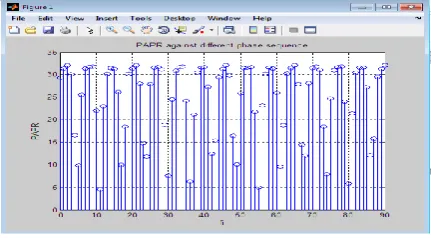
Fig. 1 shows the different phase sequence against PAPR phase sequences, from this figure PAPR reduction with random phase sequence outperforms the other types and hence this type of phase sequence is applied in the following simulations.
Figure 1: Different phase sequence against PAPR
Fig. 2 shows a comparison of CCDF of the proposed method SLM. It can be observed that the PAPR reduction for the proposed SLM scheme degrades slightly, even though complexity is improved as shown in Table 1.
ISSN(Online): 2320-9801
ISSN (Print) : 2320-9798
I
nternational
J
ournal of
I
nnovative
R
esearch in
C
omputer
and
C
ommunication
E
ngineering
(An ISO 3297: 2007 Certified Organization)
Vol. 3, Issue 9, September 2015
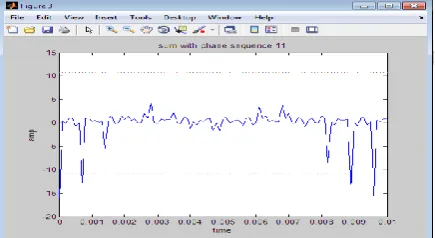
Determine the average signal power, the peak signal power, and the PAPR ratios for the two signals. The two signals being evaluated must be the same length so the first 1000 symbols are evaluated.
Figure 3: Sum of all phase sequence level amplitude w.r.t time
From the simulation results, it is clear that proposed technique can achieve more PAPR reduction when compared to base SLM, Iterative flipping and New SLM techniques. Moreover, the performance of proposed technique becomes better & better as the number of sub-blocks increase.
VI CONCLUSION
The explanation and research of several techniques of PAPR reduction was discussed and Proposed SLM technique which is the best solution for PAPR. The selected technique provides us with a good range in performance to reduce PAPR problem. SLM technique which is proposed will reduce the PAPR with respect to CCDF transmission subcarrier is much better as compare to SLM but PAPR reduction is high for initial users with same Total number of combinations or IFFT for weighting factor 1 and 2 in M-QAM modulation.
This research will continue in directions Firstly, PAPR reduction concepts will be expanded for distortion less transmission and identifying the best alternatives in terms of performance increase Secondly, PAPR reduction technique will be develop for low data rate loss and efficient use of channel. A study of the complexity issues of the PAPR reduction technique is required, especially looking at ways of further reducing the complexity of the sphere decoder
REFERANCES
[1] University of Alberta, “Home page - High capacity digital communications laboratory,” 2007. Available:http://www.ece.ualberta.ca/~HCDC/mimohistory.html.
[2]M.Palanivelan, Dr. Sheila Anand, M.Gunasekaran, “Matrix based low Complexity PAPR Reduction in OFDM Systems”, IJECT Vo l. 2, Issue 2, June 2011.
[3] ReenaChackochan, Dr. HimanshuSoni, “Comparative Analysis of Distortive and NonDistortiveOFDM Techniques for PAPR Reduction in Systems”, Proc. of Int. Conf. on Advances in Electrical & Electronics 2011.
[4] M. Schwartz, Mobile Wireless Communications. Cambridge University Press, 2005.
[5] Tao Jiang and Yiyan Wu,“AnOverview: Peak to Average power Ratio Reduction Techniques for OFDM signals”, IEEE Transactionon Broadcasting, Vol.54, no.2, 2008,pp.257-268.
[6] S. H. Han, J. H. Lee, “An Overview of Peak – to – Average Power Ratio Reduction Techniques for Multicarrier Transmission”, IEEE Transaction on Wireless Communication, April 2005.
[7] B. Karakaya, H.Arslan, and H. A. Cirpan, ”Channel estimation for LTE uplink in high Doppler spread,” Proc. WCNC, pp. 1126-1130, April 2008. [8] M. Salah, G. Abdel-Fadeel, and Zaki B. Nossair , Peak to Average Power Ratio Reduction in Single Carrier OFDMA Systems .