International Journal of Innovative Research in Science, Engineering and Technology
An ISO 3297: 2007 Certified Organization Volume 6, Special Issue 5, March 2017
National Conference on Advanced Computing, Communication and Electrical Systems - (NCACCES'17)
24th - 25th March 2017
Organized by
C. H. Mohammed Koya
KMEA Engineering College, Kerala- 683561, India
Comparison of PAPR Reduction of DWT
Based OFDM System with Hadamard
Transform and Different Windowing Methods
Vishnu P 1, Sajini T 2
P.G. Student, Department of Electronics & Communication, KMEA Engineering College, Aluva, Kerala, India1
Assistant Professor, Department of Electronics & Communication, KMEA Engineering College, Aluva, Kerala, India2
ABSTRACT:Orthogonal Frequency Division Multiplexing is an important modulation technique used in both wired and wireless communication. It is considered as an advanced technology in realizing high speed digital communication. The OFDM technique has several advantages such as elimination of inter symbol interference (ISI) and inter carrier interference (ICI), efficient use of spectrum, dividing wide band channel in to narrow band sub-channels and so on. However high Peak to Average Power Ratio of transmitted signals is a major problem for multicarrier modulation systems like orthogonal frequency division multiplexing and discrete wavelet division multiplexing. In this paper, a novel scheme is introduced, which combines wavelet transform with Hadamard transform and windowing technique to reduce PAPR. It deals with a new PAPR reduction technique of DWT based OFDM that combines Hadamard transform with three different peak windowing techniques interchangeably and compares the same with conventional OFDM.The performance of the PAPR reduction technique is analysed using MATLAB Software.
KEYWORDS: OFDM, FFT, Wavelet transform, PAPR, Hadamard Transform, Peak windowing.
I.INTRODUCTION
An Orthogonal Frequency Division Multiplexing is one of the techniques used for transmission of number of frequency signals as orthogonal through a channel at same duration. This technique is an advanced technology in realizing high speed wireless digital communication. Today, the OFDM transmission technique is applied for wide band communication systems integrated into a cellular mobile communication environment. However, the high peak to average power ratio of transmitted signal is a major disadvantage for multicarrier modulation systems such as FFT-OFDM and DWT-FFT-OFDM. Conventionally FFT-OFDM is implemented using FFT, but it can be improved by using orthogonal wavelets. By changing the conventional sinusoidal carriers of the FFT OFDM with suitable wavelets can improve benefit of OFDM and PAPR reduction in wavelet based OFDM system. It has been seen rising popularity in wireless applications. In wireless communication an OFDM based system can provide greater immunity to multi-path fading and reduce the complexity of equalizers [2]. Some applications of OFDM system are [6] Digital Audio Broadcast (DAB), Digital Video Broadcast (DVB),The IEEE 802.11 Wireless Local Area Network (WLAN) ,Wireless Metropolitan Area Networks (IEEE 802.16d) WiMAX.
Many advantages and disadvantages are in Orthogonal Frequency Division Multiplexing (OFDM) system. The main advantages of OFDM are Eliminating Inter Symbol Interference (ISI) and Inter Carrier Interference (ICI), which makes efficient use of the spectrum and dividing the channel into narrowband flat fading sub channels. The main drawback of OFDM signal is its large peak-to-average power ratio (PAPR). It is calculated from the peak power of waveformdivided by the average power of waveform.
PAPR =
( )( ) (1)
It limits the application of OFDM in communication systems. If flexibility and adaptation of spectrum is focused in future, the wavelet is suitable for the future wireless communication. Comparing with Fourier transform, the spectral efficiency of the channels is better in Wavelet transform, since it does not use Cyclic Prefix (CP) [1].For PAPR reduction in OFDM system, two techniques are available. They are signal scrambling techniques and signal distortion techniques. Signal scrambling techniques are all variations on how to scramble the codes to decrease the PAPR. Coding techniques can be used for signal scrambling [3].
In this paper, a scheme is introduced, which combines wavelet transform with Hadamard transform and windowing technique to reduce PAPR. It deals with a novel PAPR reduction scheme of DWT based OFDM that combining Hadamard transform with three different peak windowing techniques and comparing the same with conventional OFDM. The thesis paper is organized as follows. Section 2 discussed about system design. Section 3 deals with the results and discussions and finally, Section 4 presents conclusion.
II. SYSTEM DESIGN
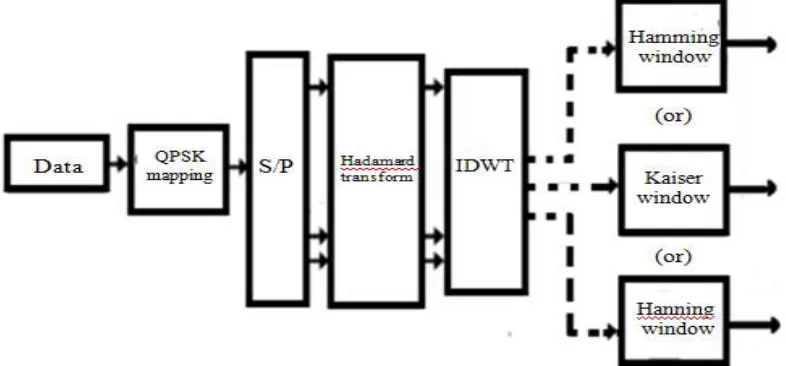
In conventional OFDM system there have been introduced a technique for PAPR reduction which combines Hadamard Transform and Different Windowing Methods. Here Hamming window, Kaiser Window and Hanning window methods are used. Here Discrete Wavelet Transform is used instead of Fast Fourier Transform in OFDM system. And this system is combined with Hadamard transform and Different Peak windowing schemes such as Hamming window, Kaiser Window and Hanning window. In the Discrete Wavelet Transform based OFDM, the transformation takes place along the time and frequency planes by shifting or by time and by scaling or by frequency, unlike the regular Fourier transform where the transformation takes place only in frequency domain. So the performance of PAPR reduction of above mentioned OFDM scheme with conventional OFDM scheme or FFT based OFDM scheme is implemented. In this scheme, the given data is applied to mapped block. This mapped data is then modulated and is gone through Hadamard transform. This Hadamard transformed data is then performed through Inverse Discrete Wavelet Transform operation. The IDWT operation performance is with respect to scaling coefficient or shifting coefficient. Then the signals from output of IDWT get peak windowed with the help of windows such as Hanning window, Hamming window and Kaiser Window. This windowed signal is then transmitted through the channel. The Peak to Average Power Ratio of the transmitted part of the Orthogonal Frequency Division Multiplexing system is measured. The Block diagram representation of the scheme is illustrated in figure 1.
Fig. 1: Discrete Wavelet Transform Block Diagram with PAPR reduction technique
Algorithm:-Step1: Enter the Random Data input based on number of subcarriers. Step2: Modulate the randomized Data by using QPSK modulator.
Step3: Select a wavelet from appropriate wavelet family for providing Wavelet transform block. Step4: Implementing the Peak windowing technique combined with DWT OFDM system.
Step5: Comparing the PAPR reduction value of DWT-OFDM with Peak windowing technique and FFT based OFDM system with the Peak windowing technique.
Step6: Implementing the Hadamard transform technique combined with DWT OFDM system.
Step9: Comparing the PAPR reduction results of combined Hadamard transform with peak windowing function in DWT-OFDM and FFT based OFDM system combined Hadamard transform with Peak windowing technique.
Materials and Methods used for System design
Wavelet Transform: The wavelet transform takes place in the domain of frequency. It happens through shifting and scaling which has time frequency localisation. There are two types of wavelet transform. They are continuous wavelet transform (CWT) and discrete wavelet transform. DWT performed better and easy to implement. It has less computational complexity. The OFDM system replaces the discrete wavelet transform [5]. As they are not using cyclic prefix these gives a better channel performance. Here, the wavelet transform makes use the low pass filter (LPF) and High Pass Filter (HPF), for the better and perfect construction, the quadrature mirror filter is used at the receiver side. In LPF and HPF an approximate and detailed filter coefficient are used respectively. The approximated coefficient and detailed coefficients are refixed as scaling coefficients and wavelet coefficients respectively. In the transmitter end and receiver end, the synthesis filter bank and analysis filter respectively is used in DWT based OFDM [1]. The Inverse Discrete Wavelet Transform can reconstruct the discrete signal s (n). It is given by:
( ) =√ ∑ ( , ) , ( ) +∑ ∑ ( , ) , ( ) (2)
Hadamard Transform: The Hadamard transform is a technique based on the relationship between correlation property of OFDM input sequence and PAPR probability. The peak value of the autocorrelation is represented by the average of the input sequence [4]. Using the binary (base2) representation of indices n and k, the transform of the Hadamard can be defined recursively.
=
√ − (3)
WHT has no band width expansion, no power increases, and no data rate loss.
Peak Windowing technique: In signal analysis and estimation, digital filter and speech processing various windowing functions are used. In order to minimize PAPR of OFDM a signal distortion technique is used which is known as peak windowing technique. Using the peak windowing, the signal can be multiplied with proper window function. If a signal peak exceeds a certain threshold the peak is then windowed [7]. As an improved clipping technique, peak windowing attenuates peak signals. For this purpose certain windows like Hanning window, Kaiser window or hamming window are used. The out of bands radiation can be reduced by this method.
III.RESULTSANDDISCUSSIONS
To verify the performance of proposed technique, the parameters used for simulation are as follows. In this project, the number of subcarriers represented as N is taken as 256, QPSK is used for modulation operation, and IDWT is used in primary stage in which the wavelet used is daubechies1. For analysing this technique, the software MATLAB R2015a is used to simulate the different OFDM system comparison for PAPR Reduction. Maximum symbols used are 1e4 for the simulation. The PAPR value is plotted based on the complimentary cumulative distribution function. By using these parameters, the analysis of PAPR Reduction in DWT-OFDM scheme of system is done and compared with the conventional OFDM scheme of the system. The parameters are illustrated in the Table 1:
Table.1: System Parameters
Parameters Specifications
No: of subcarriers 256 Wavelet Haar or db1
Modulation QPSK
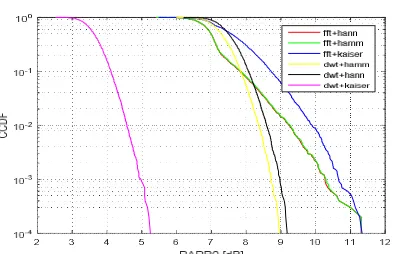
PAPR Plot of DWT and FFT OFDM system with Different Windowing functions:
Fig.2: PAPR Plot of DWT and FFT OFDM with different Windowing techniques.
Table 2: PAPR of DWT and FFT OFDM with Different Windowing technique.
The figure 2 shows the PAPR plots of three different window functions combined with conventional OFDM and DWT OFDM. By comparing the results of PAPR reduction of DWT-OFDM system with three window functions provides different reduction range. The difference between the amount of value of PAPR in FFT and DWT OFDM system combined with three windowing techniques such as Hanning, Hamming and Kaiser Windows are obtained respectively as 2.4dB, 2.7dB and 6.2dB. By combining this amount of reduction of each scheme the Kaiser window function with OFDM system exhibit better performance to compare with other window functions. The Hamming window and Hanning window schemes are window techniques used for good PAPR reduction.
PAPR plot of Hadamard transform with different Window techniques based On FFT and DWT OFDM:
From these three schemes, the amount of PAPR reduction in Hadamard transform with Hanning window is better thanHadamard transform with Hamming window and the Kaiser window.
TABLE 3: PAPR of Hadamard Transform with different Window Techniques based on FFT and DWT OFDM
IV.CONCLUSION
The Peak to Average Power Ratio is one of the major problems in developing multicarrier transmission systems. It is an inevitable part of OFDM system. In this thesis, the peak windowing technique along with Hadamard transform in DWT-OFDM to reduce PAPR is implemented and compared the same with conventional OFDM .By comparing these schemes, it is concluded that DWT based OFDM system with Hadamard transform and Hanning window performed better comparing with other windowing techniques.
REFERENCES
[1] BhawanaMohantyl, SrinivasRamavath, “A Companding Technique for PAPR Reduction in DWT OFDM Systems”, IEEE on Advanced Communication Control and Computing Technologies, May 2014.
[2] Kawsar Pervez and Md. MahbubHossain, “A New Proposed Scheme for PAPR Reduction of OFDM System Combining Hadamard Transform and Hann Peak Windowing”, IJCIT, 2012.
[3] Martha C. Paredes and M. Julia Fen´andez-Getino Garcia, “The Problem of Peak-to-Average Power Ratio in OFDM Systems”, Spain, March 2013.
[4] MohammadNoshad, Maite Brandt-Pearce and Charles L. Brown “Hadamard Coded Modulation: An Alternative to OFDM for Wireless Optical Communications” IEEE transaction on Optical Networks and Systems Symposium, 2014.
[5] RohitBodhe, Shirish Joshi and SatishNarkhede “Performance Comparison of FFT and DWT based OFDM and Selection of Mother Wavelet for OFDM”, IJCSIT, Vol. 3, March 2012
[6] HermannRohling, “OFDM Concepts for Future Communication Systems” TechnischeUniversität Hamburg-Harburg, Springer-Verlag Berlin Heidelberg 2011