RF-Pilot Based Frequency Offset Estimation
and Phase Noise Compensation for CO-OFDM
Systems
S.F. Safna1, S. Ratheesh2, V. Vandana pillai3, Devi. V. R4
P.G Student, Dept of Electronics and Communication Engineering, MACE, Trivandrum , Kerala, India1
P.G Student, Dept of Electronics and Communication Engineering, MACE, Trivandrum , Kerala, India 2 P.G Student, Dept of Electronics and Communication Engineering, MACE, Trivandrum , Kerala, India 3 Assistant Professor, Dept of Electronics and Communication Engineering, MACE, Trivandrum ,Kerala, India 4
ABSTRACT: One of the most severe impairments that affect coherent optical systems employing high-order modulation
formats is phase noise due to transmit and receive lasers. The vulnerable sensitivity to laser linewidth induced inter-carrier interference (ICI) has long been recognized as a major problem to coherent optical orthogonal frequency-division multiplexing (CO-OFDM) systems. Among the existing phase noise compensation algorithms, the RF-pilot aided phase recovery (RAPR) method shows a better compensation capability to laser linewidth. However, RAPR may fail to extract the pre-inserted RF-pilot at the receiver due to the influence of carrier frequency offset (CFO). An effective frequency offset estimation (FOE) is thus required to implement before performing RAPR. In consideration of the fact that the conventional FOE algorithm not only has high computational complexity, but more importantly cannot work in coordination with RAPR, a new RF-pilot aided frequency offset estimation (RAFOE) algorithm is proposed, in which CFO can be easily estimated by searching the peak of spectral samples. Furthermore, in order to obtain the optimum compensation performance with lower computing cost at combining RAFOE and RAPR, a joint frequency offset and phase noise compensation scheme is also performed in this paper.
KEYWORDS:Frequency offset estimation, phase noise compensation, OFDM.
I. INTRODUCTION
Orthogonal frequency division multiplexing (OFDM) is a modulation technique which is now used in most new and emerging broadband wired and wireless communication systems, because it is an effective solution to intersymbol interference caused by a dispersive channel. OFDM is also a promising technology for optical communications. Due to the rapid growth of bandwidth demand on optical transport network, many efforts have been made on developing high-speed optical transmission systems. Among various emerging techniques and applications, coherent optical orthogonal frequency-division multiplexing (CO-OFDM) is one of the most promising candidates due to its excellent spectral efficiency, flexible constellation modulation, and low demand for oversampling rate. The CO-OFDM signal is extremely sensitive to phase noise, and system performance penalty induced by the line width in CO-OFDM is more obvious with respect to the single carrier systems.
partially overlapped, resulting in high optical spectral efficiency. Third, by using direct up/down conversion, the electrical bandwidth requirement can be greatly reduced for the CO-OFDM transceiver, which is extremely attractive for
the high-speed circuit design, where electrical signal bandwidth dictates the cost. At last, the signal processing in the OFDM transceiver can take advantage of the efficient algorithm of Fast Fourier Transform (FFT)/Inverse Fast Fourier Transform (IFFT), which suggests that OFDM has superior scalability over the channel dispersion and data rate.
Multi-pilot subcarriers phase estimation algorithm (MSPE), which compensates for only the common phase impairments after OFDM demodulation was commonly used for carrier phase estimation. However, the laser linewidth must be small enough and the OFDM symbol should be short as well in order to mitigate the impact of the inter-carrier interference (ICI) and obtain a satisfying performance of phase noise compensation. These requirements will consequently increase the device cost and the overhead ratio of cyclic prefix (CP). Hence RF-pilot aided phase recovery algorithm (RAPR), compensates for the laser phase noise by extracting the phase of RF-pilot that is inserted beforehand at the transmitter in the center of OFDM spectra. The ICI-induced effects can thus be prevented effectively and spontaneously without such strict restrictions of MSPE, because the carrier phase compensation is performed prior to OFDM demodulation by using RAPR.
An important influencing factor is the change in frequency offset (FO). Due to the impact of uncertain Frequency Offset (FO), the RF-pilot cannot be filtered out directly, regardless of using whether a low pass filter (LPF) or a band pass filter (BPF) in coherent receivers. Therefore, frequency offset estimation (FOE) is necessarily required and implemented before RAPR. Also to obtain a good phase compensation performance, RF-pilot is required with large power in RAPR so as to suppress the interferences from OFDM signal and ASE noise.
The new technique involves the use of RF- pilot aided frequency offset estimation (RAFOE) algorithm, in which the
high power characteristic of RF-pilot, regarded as a positive factor, is further exploited. FO can be easily estimated in RAFOE by searching the peak value of frequency domain samples without requiring any extra training overhead. Moreover, a large FOE range of fs/2 (fs is the sampling rate of analog to digital converter (ADC)) can be obtained, with the estimation accuracy that is definitely determined by the number of samples participated in the operation of RAFOE. A joint compensation scheme is also developed, in which only IFO needs to be estimated by RAFOE based on the aid of the pre-estimation of the fractional part of frequency offset (FFO). After that, RAPR utilizes a BPF to filter and compensate all the phase impairments simultaneously, depending on a known centre frequency provided by RAFOE.
II . THE RF-PILOT AIDED FREQUENCY OFFSET ESTIMATION (RAFOE)
III. PROPOSED APPROACH
The proposed method uses a combination of RAPR and RAFOE algorithms to generate a new joint frequency offset estimation and phase noise compensation scheme. In this scheme, RAFOE is implemented prior to RAPR.
The block diagram of the proposed approach is shown in Figure 1.
Figure 3.1: Block Diagram
First the OFDM spectrum signal is generated. A high power RF-pilot tone will be inserted in the middle of the OFDM band. Then the RF pilot inserted OFDM signal is transmitted. At the receiver the proposed RAFOE algorithm is performed to estimate the frequency offset. After estimating the frequency offset RAPR algorithm is performed by utilizing a band pass filter with the frequency offset as the centre frequency. Thus phase noise compensation can be performed with the help of frequency offset estimation by combining RAFOE and RAPR algorithms.
A. RAFOE ALGORITHM
Figure 3.2: The block diagram of the RAFOE algorithm
Figure above shows the block diagram of the RAFOE algorithm, with three computational steps being taken into consideration. The steps are:
1. The signal discrete spectrum is obtained by performing FFT on NFOE received samples. The intensity of signal discrete spectrum can thus be formulated as:
| ( )| = ( ) −. 2 .
OFDM SPECTRUM SIGNAL
GENERATION
INSERTION OF RF-PILOT CARRIER
TRANS-MISSION
RECEIVER
RAFOE ALGORITHM
RAPR ALGORITHM OUTPUT
where R and r represent the discrete spectrum samples and received digital samples, respectively. The FFT window bandwidth is determined by the ADC sampling rate, and the discrete spectral resolution fspace is related to NFOE under a certain fs as
=
2. In order to observe spectral shift and estimate FO conveniently, the discrete spectrum is reshaped based on the frequency distribution characteristic of FFT. After that, the out-of-order spectral samples are rearranged where the zero frequency component is returned to the middle of spectra (i.e., it is exactly located at the location of the NFOE th sample).
3. The FO can therefore be estimated by finding an index of the sample that has the maximum intensity value, i.e.,
∆ = , ,… , ( ) −
2 −1 .
B. JOINT FREQUENCY OFFSET ESTIMATION AND PHASE NOISE COMPENSATION
Figure 3.3: The block diagram of the proposed frequency offset and phase noise compensation
For obtaining the optimal compensation performance with less calculation cost, we design a joint FO and linewidth compensation scheme, as depicted in Fig. 3.3. In the proposed scheme, after OFDM symbol synchronization, the obtained correlation function is further utilized to estimate FFO so as to relax the fine granularity requirement on RAFOE. In RAFOE, the computational cost is independent of the estimation range, which is predominantly contributed by a FFT operation.
In order to avoid unnecessarily repeat operations for phase compensation, the estimated FO value is directly set as the central frequency for a BPF instead of employing a LPF to filter the RF-pilot after IFO correction. In this case, the extracted RF-pilot will include all the phase impairments, which are induced by not only the laser phase noise but the IFO as well as residual FFO (RFFO).
IVSIMULATIONRESULTS
The proposed system is simulated using MATLAB. First step involves the generation of OFDM spectrum signal. It is generated using a Pseudo Random sequence as input. 16 subcarriers Quadrature Amplitude Modulation (QAM) is used. Figure 4.1 shows the OFDM spectrum signal generated by performing FFT on the time domain signal.
Figure 4.1: OFDM signal spectrum
After generating the OFDM signal, the pilot carrier is inserted at the centre of OFDM signal. Figure 4.2 shows RF-pilot carrier inserted OFDM signal spectrum which is transmitted.
Figure 4.2 : RF-pilot carrier inserted OFDM signal spectrum
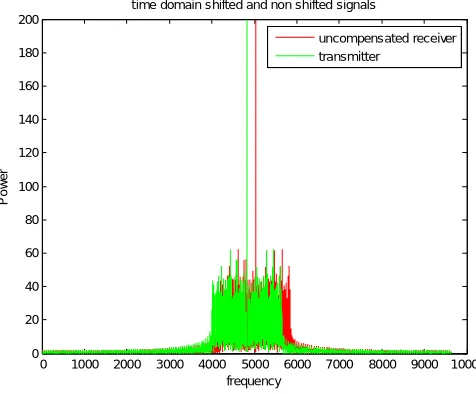
Figure 4.3 : Transmitted and received signal spectrums
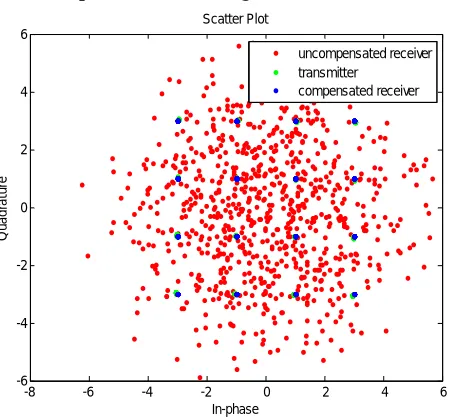
Figure 4.4 shows the scatter plot of received signal which implies that the received signal is distorted. The signal points are highly scattered. Hence the frequency offset leads to improper and distorted received signal.
Figure 4.4: Scatter plot of received signal
Figure 4.5 is the compensated received signal spectrum which shows the overlapped blue spectrum signal over the transmitted green signal. Thus the frequency offset is compensated.
0 1000 2000 3000 4000 5000 6000 7000 8000 9000 10000 0
20 40 60 80 100 120 140 160 180 200
frequency
P
o
w
e
r
time domain shifted and non shifted signals
uncompensated receiver transmitter
-6 -4 -2 0 2 4 6
-6 -4 -2 0 2 4 6
Q
u
a
d
ra
tu
re
Figure 4.5 : Compensated receiver signal spectrum
Figure 4.6 shows the scatter plot of compensated received signal.
Figure 4.6 : Scatter plot of compensated received signal
The scatter plot shows the compensated received signals in blue overlapped over the transmitted green signal points. This depicts clearly distortion free received signal obtained after the joint frequency offset estimation and phase noise compensation scheme. Whereas the uncompensated received signal shown in red is completely distorted. Thus by combining RAPR and RAFOE algorithms an error free reception of OFDM signal is achieved.
-5000 -4000 -3000 -2000 -10000 0 1000 2000 3000 4000 5000 20
40 60 80 100 120 140 160 180 200
frequency
P
o
w
e
r
compensated and uncompensated receiver and transmitted signals
uncompensated receiver transmitter
compensated receiver
-8 -6 -4 -2 0 2 4 6
-6 -4 -2 0 2 4 6
In-phase
Q
u
a
d
ra
tu
re
Scatter Plot
uncompensated receiver transmitter
V.CONCLUSION
This paper deals with a joint frequency offset estimation and phase noise compensation scheme for OFDM systems. The use of RF pilot carrier insertion in the OFDM band for optical communication leads to error free reception of signal using the proposed scheme. Thus for obtaining the optimum compensation performance with lower computing cost when combining RAFOE and RAPR, a joint compensation scheme is designed, in which RAFOE based on the aid of FFO estimation only estimates IFO, and the estimated IFO is provided to RAPR as the BPF central frequency. After that, all the phase impairments, including residual FFO, IFO and linewidth induced phase noise, are filtered out simultaneously by using the BPF. The enhancement work involves a carrier recovery method applying a simple moving average filter (MAF) to extract the central RF-pilot for phase noise compensation.
REFERENCES
[1]. Xian Zhou, Xiaolong Yang, Rui Li, Keping Long, “Efficient Joint Carrier Frequency Offset and Phase Noise Compensation Scheme for High-Speed Coherent Optical OFDM Systems” IEEE Journal of Lightwave Technology, Vol. 31, No. 11, June 1, 2013.
[2] . Y. Tang and W. Shieh, “Coherent optical OFDM transmission up to 1 Tb/s per channel,” J. Lightw. Technol., vol. 27, no. 16, pp. 3511–3517, Aug. 2009.
[3]. S. Randel, S. Adhikari, and S. L. Jansen, “Analysis of RF-Pilot-based phase noise for coherent optical OFDM systems,” IEEE Photon. Technol. Lett., vol. 22, no. 17, pp. 1288–1290, Sep. 2010
[4]. S. L. Jansen, I. Morita, T. C. W. Schenk, N. Takeda, and H. Tanaka, “Coherent optical 25.8-Gb/s OFDM transmission over 4160-km SSMF,” J. Lightw. Technol., vol. 26, no. 1, pp. 6–15, Jan. 2008.
[5]. X. W. Yi, W. Shieh, and Y. Tang, “Phase estimation for coherent optical OFDM,” IEEE Photon. Technol. Lett., vol. 19, no. 12, pp. 919–921, Jun. 2007.
[6]. W. Shieh, H. Bao, and Y. Tang, “Coherent optical OFDM: Theory and design,” Opt. Exp., vol. 16, no. 2, pp. 841–859, Jan. 2008.
[7]. T. M. Schmidl and D. C. Cox, “Robust frequency and timing synchronization for OFDM,” IEEE Trans. Commun., vol. 45, no. 12, pp. 1613–1621, Dec. 1997.
[8]. Z. Zhang, W. Jiang, H. Zhou, Y. Liu, and J. Gao, “High accuracy frequency offset correction with adjustable acquisition range in OFDM systems,” IEEE Trans. Wireless Commun., vol. 4, no. 1, pp. 228–237,Jan. 2005.
[9]. C. J. Youn, X. Liu, S. Chandrasekhar, Y. H. Kwon, J. H. Kim, J. S. Choe, D. J. Kim, K. S. Choi, and E. S. Nam, “Channel estimation and synchronization for polarization-division multiplexed CO-OFDM using subcarrier/polarization interleaved training symbols,” Opt. Exp., vol. 19, no. 17, pp. 16174–16181, 2011.
[10]. A. Barbieri, G. Colavolpe, T. Foggi, E. Forestieri, and G. Prati, “OFDM versus single-carrier transmission for 100 Gbps optical communication,” J. Lightw. Technol., vol. 28, no. 17, pp. 2537–2551, Sep. 2010.
[11]. X. Zhou,K.P. Long,R. Li, X.L.Yang,and Z. S.Zhang,“A simple and efficient frequency offset estimation algorithm for high-speed coherent optical OFDM systems, ” Opt. Exp., vol.20, no.7,pp.7350–7361, Mar. 2012.
[12]. F. Yang, Z. Zhang, and Y. Chen, “Maximal-likelihood estimator for coarse carrier frequency offset estimation in OFDM systems,” Wireless. Pers. Commun., vol. 49, no. 1, pp. 55–66, 2009.
[13]. S. L. Jansen, I. Morita, N. Takeda, and H. Tanaka, “20-Gb/s OFDM transmission over 4160-km SSMF enabled by RF-pilot tone phase noise compensation,” presented at the Proc. Opt. Fiber Commun. Conf., 2007, Paper PDP 15.