ISSN (Online) : 2319 – 8753 ISSN (Print) : 2347 - 6710
I
nternationalJ
ournal ofI
nnovativeR
esearch inS
cience,E
ngineering andT
echnologyVolume 3, Special Issue 3, March 2014
2014 International Conference on Innovations in Engineering and Technology (ICIET’14) On 21st & 22nd March Organized by
K.L.N. College of Engineering, Madurai, Tamil Nadu, India
ABSTRACT- In this paper an algorithm based on analytical technique is formulated for solving Dynamic Emission and Economic Dispatch using Lagrangian method. The Algorithm takes low computation time facilitating online dispatch. Emission dispatch is considered under both Static and dynamic dispatch conditions. Economic Dispatch is operated in dynamic condition. The nonlinear terms in Emission cost equation and Economic cost equation is converted into algebraic equation with the help of Taylor‟s series. The Lagrangian algorithm is used for modelling final emission equation with valve point effect and participation factor. The obtained equation is tested in MATLAB with in IEEE 30 bus 6 unit static and dynamic system with and without consideration of losses. Similarly the fuel cost equation for a 5 unit system is tested. It is observed that the results obtained from emission and economic dispatch are less than the other methods.
KEYWORDS-Dynamic Economic Emission Dispatch(DEED), Lagrangian method, Valve point Effect, Ramp rate limits.
I. INTRODUCTION
The increase in the environmental awareness and the passage of environmental regulations, the environmental constraints are having a significant impact on the operation of power systems. So the traditional economic dispatch to minimize the fuel cost is inadequate when environmental emission costs are also to be included in the operation of power plants. So utilities would like to supply power to its customers with minimum total emission as well as minimum total fuel cost. Dynamic Economic Emission Dispatch (DEED) is an extension of
the conventional economic dispatch problem used to determine the optimal generation schedule of online generators, so as to meet the predicted load demand over certain period of time at minimum operating cost under various system and operational constraints. Due to ramp rate constraints of a generator, the operational constraints at any time interval„t‟ may affect the operational decisions at a later hour. The typical cost function of a generator has been approximately represented by a single quadratic equation where the valve point effects are usually ignored. This would often introduce inaccuracy in the dispatch result. However, in reality the large steam turbines contribute non-convexity in the fuel cost function of the generating unit. Accuracy in the modeling of DEED problem will be highly improved when the valve point effects are taken into account. Therefore the cost curve of a generator should not be too much simplified for practical power system operation. However, the increase of accuracy of the cost function usually results in the nonlinear non smooth and non-convex function wherein the classical gradient based method fails to be applied. Since the cost of power generation cost is exorbitant an optimum dispatch saves a considerable amount of money.
A vast amount of literature is available which deals with the optimization of both the convex and non-convex cost function. The stochastic search algorithms such as Genetic Algorithm [8, 14], Gravitational Search Algorithm [10], Evolutionary Programming [16], Simulated Annealing, and Particle Swarm Optimization and other optimization techniques may prove to be very effective in solving nonlinear DEED problems without any restrictions on the shape of the cost curves. They often provide nearly global optimum solutions. One of the best advantages of using the traditional methods is the very small computation time it requires unlike some modern optimization algorithms which take a comparatively higher computation time.
Deed Solutions For Non Linear
Cost Characterized Generators Using
Lagrangian Method
Shanmuga Vadivoo.N , Karthikeyan.MA
This paper utilizes the computation time advantage of the traditional method and also proposes a new approach where the non-convex and non-linear cost function can also be solved using in traditional method.
II. DEEDPROBLEMFORMULATION
A. Objective function
Let Fi be the cost, expressed for example in dollars
per hour, of producing energy in the generator unit „i‟. The total controllable system production cost „F‟ for N generator system is,
The generated real power Pi accounts for the major
influence on Fi. The individual real power generation
are raised by increasing the prime mover torques and this requires an increased expenditure of fuel.
The reactive generations Qgi do not have any measurable
influence on Fi because they are controlled by controlling
the field current. The individual production cost Fi of
generator unit „i‟ is therefore for all practical purposes a function only of Pi.
The economic dispatch cost curve is expressed as a function of real power as below [8]
where ai, bi, ci, di and ei are the cost coefficients described
for each generator. Pi,min is the minimum power generation
limit set for the generator.
The emission dispatch cost curve is expressed as a function of the real power as given below.
where αi, βi, γi, δi and ηi are the emission coefficients
described for each generator.
B. Operational and Dynamic constraints
The minimization of the Objective function is subjected to the following equality and inequality constraints
i. Real power Balance Constraint
where t= 1,2,3,…T. PDt is the total power demand at
time „t‟ in megawatts. PLt is the total transmission power
loss at time t in megawatts. The transmission loss is generally calculated using Kron‟s formula with B-coefficient matrix[10]
ii. Real power generation limit
The KVA loading in a generator should not exceed a pre specified value of power because of the temperature rise conditions. The maximum active power generation of a source is limited again by thermal consideration and also minimum power generation is limited by the flame instability of a boiler. If the power output of a generator for optimum operation of the system is less than a pre-specified value of Pimin, the unit is not put
on the bus bar because it is not possible to generate that low value of power from the unit .Hence the generator power Pit cannot be outside the range stated by the
inequality [10]
where Pimin is the minimum limit and Pimax is the
maximum limit of real power of the ith unit at time t in megawatts.
iii.
Generating unit ramp rate limitsWhen the demand of the system increases then to satisfy the equality constraint the power produced by the generator must also increase. The power produced by the generator cannot be increased or decreased immediately beyond a certain value owing to the fact of inertia of the rotor of the generator. So this limiting value of change in power production limit is known as ramp limit. During dynamic economic dispatch the generator power allocation must also take this constraint into account[11].
where URi and DRi are the Up and Down ramp rate
limits of the ith unit respectively. The power generation constraint limits given by are modified as shown below according to the ramp rate limits [11]
such that
III. CALCULATIONOFPARTICIPATIONFACTORBASED
ONLAGRANGIANMETHODUSINGTAYLOR’SSERIES
computation algorithms a near global optimum solution may be achievable irrespective of the presence of any transcendental terms in the objective solution but at the cost of increased computation time.
The transcendental part in the emission dispatch cost function is the exponential term. The Taylor‟s series algebraic expansion for the exponential term is given by
Fig. 2. Approximation of ex in Taylor‟s series when n=8.
The curves drawn for the expressions on the R.H.S for n=0,1,2,3,4 do not coincide with the ex curve in figure 1. In figure 2, the same curve coincides with the ex curve for the equations developed upto n=0,1,…..8.
Equation 13 is applied in equation 3. The exponential term is replace by the equation 13.The equation 14 is obtained as
(14)
The evaluation of economic dispatch cost function is as given below.
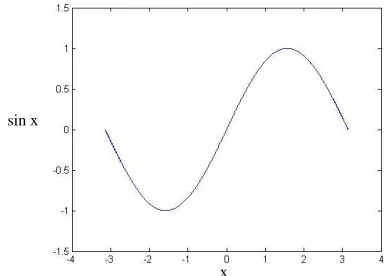
The transcendental part in the economic dispatch cost function is the sine term. The Taylor‟s series algebraic expansion for the sine term is given by
Fig. 3. Taylor‟s series expansion for sinx when n=0 for sine curve.
Figure 3 represents Taylor‟s series expansion of a sine curve when n=0 on x. Figure 4 represents the same expansion when the terms are expanded for n=0 up to n=9. The curves drawn for the expansion coincide with each other forming a single sine curve.
Fig. 4. Taylor‟s series approximation for sinx n=0,1….9 for a sine curve.
The economic cost equation is given by Equation (2). Replacing the sine term with the Taylor‟s series expansion by equation (15) is applied in equation (2).
(17) Fig. 1. Taylor‟s series approximation for ex.
x ex
x ex
x sin x
The economic dispatch has to be solved repeatedly by moving the generators from one economically optimum schedule in the operating region to another operating point as the load changes by a reasonable amount. The final equation for emission and cost are obtained separately from equations 14 and 17. These equations are used to find the Lagrangian multiplier and its change. Finally the change in demand is obtained from the change in Lagrangian multiplier. From the change in demand participation factor is obtained.
IV. TESTSYSTEMDATA
The IEEE 30 bus 6 generator system is taken as test system for emission dispatch in static dispatches with and without the consideration of losses. The load on the system is 2.834 p.u. The same test system is used for dynamic dispatch with consideration of losses for 24 hour varying load. The test system used for economic dispatch is 5 unit dynamic system with the consideration of losses.
The IEEE 30 bus 6 unit system data required for emission dispatch for static system are taken from [1]. The data required for dynamic system are taken from [9,18]. The 5 unit system data is taken from [19] for economic dispatch under dynamic conditions.
V. RESULTSANDDISCUSSION
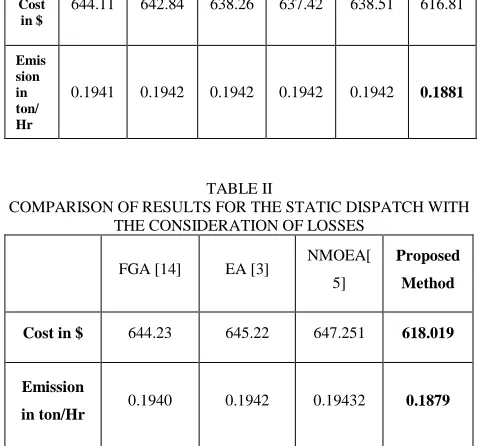
An algorithm based on analytical technique is formulated for solving Dynamic Emission and Economic Dispatch using Lagrangian method. Emission Dispatch under both Static and dynamic dispatch conditions and Economic dispatch under dynamic condition is validated by valve point effect base point participation method. The simulation taken is compared with the available literature with results of methods like Evolutionary Algorithm [2, 3] in Table I for a loss less system. The emission and the costs obtained for the proposed method is compared with the emission in tons mentioned by other methods available and it is seen that the proposed method has the lowest emission and the cost. Obtained emission is 0.1881 tons/hr. The work is also done including loss conditions given in Table II. Obtained emission is 0.1879 tons/hr for a static with loss condition.
TABLE I
COMPARISON OF RESULTS FOR STATIC DISPATCH
MOSS T [7]
MODE
[17] EA [3] MOPS O [4] MOEA [2] Propo sed Metho d
P1 0.4095 0.3926 0.4058 0.4015 0.4116 0.3606
P2 0.4626 0.4625 0.4592 0.4590 0.4532 0.4073
P3 0.5426 0.5631 0.5380 0.5332 0.5329 0.4897
P4 0.3884 0.4030 0.3830 0.3891 0.3832 0.6451
P5 0.5427 0.5676 0.5379 0.5456 0.5383 0.4897
P6 0.5142 0.4782 0.5101 0.5057 0.5148 0.4415
∑ PG 2.86 2.867 2.834 2.834 2.834 2.834
Total Cost in $
644.11 642.84 638.26 637.42 638.51 616.81
Emis sion in ton/ Hr
0.1941 0.1942 0.1942 0.1942 0.1942 0.1881
TABLE II
COMPARISON OF RESULTS FOR THE STATIC DISPATCH WITH THE CONSIDERATION OF LOSSES
FGA [14] EA [3] NMOEA[
5]
Proposed
Method
Cost in $ 644.23 645.22 647.251 618.019
Emission
in ton/Hr 0.1940 0.1942 0.19432 0.1879
Table III shows the result of dynamic system with loss conditions. Emission obtained for dynamic dispatch condition is 526.375 tons/hr. which is compared with the emission cost obtained from other methods mentioned in available literatures. The proposed method results are better than the other methods results.
TABLE III
COMPARISON OF RESULTS FOR DYNAMIC DISPATCH WITH LOSSES. MAMODE [9] GSOMP [18] MOPSO [9] NSGA-II [9] Proposed method
Cost in $ 25732 25493 25633 25507 25441
Emission
tons/hr
572.83 568.47 568.63 568.8 526.375
TABLE IV
COMPARISON OF COMPUTATION TIME FOR VARIOUS
METHODS WITH THEPROPOSED METHOD FOR DYNAMIC
DISPATCH.
MAMODE [9] GSOMP [18] MOPSO [9] NSGA-II [9] Proposed Method
Time in seconds
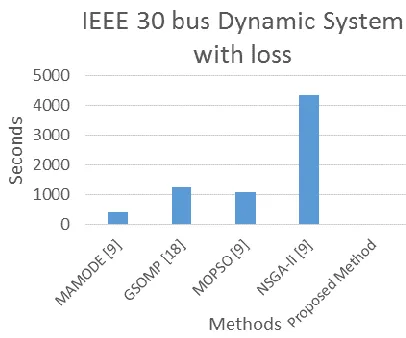
Fig. 5. Comparison of computation time for various methods with the proposed method.
The results shown in Table 1, 2, 3 and 4 validate the feasibility of the proposed method. Table 4 shows the comparison of computation time obtained from various methods. The comparison of computation time shown in figure 5. It shows that the proposed method has the lowest computation time.
The difference between the cost of the proposed method and global optimum is small when we compare the loss incurred by operating the system for the full computation time until the global optimum solution is achieved by other methods reported in the literature. Fig 5 shows the comparison of computation time for various methods reported in literature [9, 18].
TABLE V
COMPARISON OF RESULTS FOR THE ECONOMIC DISPATCH WITH THE CONSIDERATION OF LOSSES.
Method Production
cost($)
Computing time(seconds)
PSO[19] 50,124.00 258
MSL[19] 49216.81 1.48
Proposed 49506.8 0.203112
Table V shows results obtained for Economic dispatch for a 5 generator system under dynamic dispatch condition. The comparison of the costs obtained from various techniques reported in literature. However, the total cost is higher than cost mentioned in MSL and lesser than PSO when compared to cost mentioned by methods but the computation time is lesser than other methods (0.20s).
The system is simulated using MATLAB 2013 on Intel Core i5 CPU at 2.3 GHz with 4 GB RAM capability. All computation time reported in the study are from the performance of system in above configuration.
VI. CONCLUSION
This paper has proposed a method for dynamic emission and economic dispatch. An attempt is made to find the global optimum solution by approximating the non-smooth cost curve of a generator considering its valve point effect. The feasibility of the proposed method is
demonstrated using an IEEE 30 bus 6 generator system, and 5 generator system. The comparison of the obtained results with other methods in literature validates the capability of the proposed method for solving non smooth DEED problems in power systems. The method is very simple, easy to implement, convergence rate is fast and computation time is less. The performance of this approach is better in exhibiting the consistency of reaching near global optima and also guarantee on solution without violating the constraint. The proposed method is a generalized approach which can be extended to any test systems.
REFERENCES
[1] Abedinia, O., N. Amjady, K. Kiani, H.A. Shayanfar, A. Ghasemi; “International Journal on Technical and Physical Problems of Engineering”, Issue 11, Volume 4, Number 2,pp no: 63-70, June 2012.
[2] Abido, M.A., "Environmental/economic power dispatch using multi-objective evolutionary algorithms," IEEE Transactions on Power Systems , Volume.18, no.4, pp.1529,1537, Nov. 2003
[3] Abido, M.A., "Multiobjective evolutionary algorithms for electric power dispatch problem," IEEE Transactions on Evolutionary Computation, Volume 10, no.3, pp no: 315-329,June2006.
[4] Abido, M.A., “Multiobjective particle swarm optimization for environmental/economic dispatch problem,” Electric Power Systems Research, Volume 79, Issue 7, pp no: 1105-1113, July 2009.
[5] Abido, M.A., “A novel multiobjective evolutionary algorithm for environmental/economic power dispatch,” Electric Power Systems Research, Volume 65, Issue 1, Pages 71-81, April 2003.
[6] Basu, M., “Dynamic economic emission dispatch using nondominated sorting genetic algorithm-II,” International Journal of Electrical Power & Energy Systems, Volume 30, Issue 2, Pages 140-149, February 2008.
[7] Das, D.B.; Patvardhan, C., "New multi-objective stochastic search technique for economic load dispatch," Generation, Transmission and Distribution, IEE Proceedings-on , Volume 145, no.6, pp.747-752, Nov 1998.
[8] Gopalakrishnan, R.; Krishnan, A. “A Novel Combined Economic and Emission Dispatch Problem Solving Technique using Non-Dominated Ranked Genetic
Algorithm,” European Journal of Scientific
Research;11/13/2011, Vol. 64 Issue 1, p141-151.
[9] Guo.C.X., J.P.Zhan, Q.H.Wu, “Dynamic Economic Emission Dispatch based on Group Search Optimisers with Multiple producers, ” Electric Power Systems Research, Volume 86, May 2012, Pages 8-16.
[10] U.Guvenc, Y.Somnez, S.Duman, N.Yorukeren, “Combined economic and emission dispatch solution using Gravitational search algorithm,” Scientia Iranica, Volume 19, Issue 6, pages 1754- 1762, December 2012.
[11] Nicole Pandit et al.,”An improved bacterial foraging algorithm for combined static/dynamic environmental economic dispatch,”Applied softcomputing, Volume 12, Issue 11, Pages 3500-3513, November 2012.
[12] Niknam.T et al., "𝜃-Multiobjective Teaching–Learning-Based Optimization for Dynamic Economic Emission Dispatch," Systems Journal, IEEE, Volume 6, no.2, pp.341-352, June 2012.
[13] T. Ratniyomchai et al., “Particle Swarm Optimization for Solving Combined Economic and Emission Dispatch Problems," Recent Advances In Energy & Environment, pp. 978-960, Volume 5, May 2012.
Engineering and Innovative Technology (IJEIT)Volume 1, Issue 4, April 2012.
[15] Venkatesh, P.; Lee, K.Y., "Multi-Objective Evolutionary Programming for Economic Emission Dispatch problem," Power and Energy Society General Meeting - Conversion and Delivery of Electrical Energy in the 21st Century, 2008 IEEE , vol., no., pp.1,8, 20-24 July 2008.
[16] Venkatesh, P.; Gnanadass, R.; Padhy, N.P., "Comparison and application of evolutionary programming techniques to combined economic emission dispatch with line flowconstraints," Power Systems, IEEE Transactions on vol.18, no.2, pp.688,697,May 2003.
[17] L.H. Wu et al., Environmental/economic power dispatch
problem using multi-objective differential evolution
algorithm, Electric Power Systems Research, Volume 80, Issue 9, September 2010, Pages 1171-1181.
[18] Xingwen Jiang et al., Dynamic environmental economic dispatch using multiobjective differential evolution algorithm with expanded double selection and adaptive random restart, International Journal of Electrical Power & Energy Systems, Volume 49, July 2013, Pages 399-407.
[19] S Hemamalini and Sishaj Simon} {Article: Dynamic Economic Dispatch Valve-Point Effect Using Maclaurin Series Based Lagrangian Method, International Journal of Computer Applications 1(17):60–67, February 2010. Published By Foundation of Computer Science.