Design and Performance Evaluation of
DWDM based Metropolitan Ring Networks
Jaspreet Minhas, Rajesh Kochher
Research Scholar, Dept. of CSE., PTU University, DAVIET Jalandhar, Punjab, India
Assistant Professor, Dept. of I.T., PTU University, DAVIET Jalandhar, Punjab, India
ABSTRACT: Dense wavelength division multiplexed (DWDM) optical transport technology has revolutionized the
telecommunication industry. With the advent of wideband fiber-optical amplifiers, DWDM optical transmission systems are now capable of providing capacities in excess of hundreds of gigabits per second over hundreds of kilometers on a single pair of fibres in long-haul networks. In this paper the investigations on DWDM-OADM optical ring network for six nodes, 30 wavelengths on unidirectional non linear single mode fiber at data rates of 10Gbps for BPSK modulation format has been reported. The main target of this research work is to increase the data rate from 100Gbps on optical fiber with different ring span length. In this manuscript we investigate the performance on the basis of Q factor, Eye diagram, timing Jitter and BER from the simulation setup designed on DWDM based Metropolitan ring network that can provide data transfer rate up to 300Gbps.The performance is quantitatively analyzed for above network setup for ring span lengths of 50km, 60km & 70km respectively.
KEYWORDS: OADM, MPLS, SRP, RPR, DWDM, UW-WDM, SONET, SDH, EDFA.
I.INTRODUCTION
DWDM based Metropolitan ring networking represents a unique opportunity for a service provider to begin deploying a data-centric high Bandwidth Services infrastructure. DWDM technology indeed now offers an unprecedented bandwidth as currently available systems support up to about 100 wavelengths per fiber, enabling a single fiber to carry several hundred gigabits per second of information. The metro network is the section of the telecommunication network that bridges the core segment to the access segment of the network. It typically spans a metropolitan region, covering distances from a few tens to a few hundreds of kilometers and is traditionally based on ring topologies exploiting the deep-rooted technology of synchronous optical networking/synchronous digital hierarchy, or the more recent metro Ethernet and resilient packet ring.
Commercial DWDM systems use wavelengths modulated at 2.5, 10, or 40 GB/s covering the C and L band spectral range with typical frequency spacing between channels of 100 GHz or 50 GHz. These wavelengths are added and dropped from the multi-wavelength network fiber at geographical locations where the optical information is converted to electronic format for processing and switching. Such network nodes, known as optical add/drop multiplexer (OADM) nodes use optical filters to add/drop the desired wavelengths, while passing through all other wavelengths towards other OADM nodes in the network. Over the past few years, there has been a growing trend to add wavelength reconfigurability to OADM nodes (ROADMs), thereby allowing remote changes to the add/drop traffic pattern across the network [7]. The optical add-drop multiplexer is one of the key components for dense wavelength division multiplexing (DWDM) and ultra wide wavelength division multiplexing (UW-WDM) optical networks. The OADM is used for selectively dropping and inserting optical signals into a transparent DWDM network.
II.LITERATURE REVIEW
without underlying optical cross connects (OXCs) that is, with one or more wavelength links between each pair of IP switches. These options also include restoration choices [1].
Yi Chen et al. [1999] they examined the market needs for metro optical networking, introduce the concept, network topology, and architectures for metro optical rings and describe the key requirements that address the needs of service providers. They also discuss the components of the network and review the general requirements that will enable the next step in the evolution-extending the DWDM ring architecture to business access customers [7].
Wayne Grover et al [2002]they reviewed the selection of recent topics in survivable networking. New ideas in capacity
design and ring-to-mesh evolution are given, as well as a systematic comparison of the capacity requirements of several mesh-based schemes showing how they perform over a range of network graph connectivity [5].
C. Develder et al [2004] they discussed optical packet switching (OPS) has been proposed as a strong candidate for future metro networks. This paper assesses the viability of an OPS-based ring architecture as proposed within the research project DAVID (Data and Voice Integration on DWDM), funded by the European Commission through the Information Society Technologies (IST) framework. Its feasibility is discussed from a physical-layer point of view, and its limitations in size are explored. Through dimensioning studies, they show that the proposed OPS architecture is competitive with respect to alternative metropolitan area network (MAN) approaches, including synchronous digital hierarchy, resilient packet rings (RPR), and star-based Ethernet[6].
Sorin Tibuleac and Mark Filer [2010] they described Reconfigurable optical add/drop multiplexers (ROADMs) based on 1˟N wavelength-selective switches (WSS) are evolving to support DWDM networks with higher capacity and increased flexibility in wavelength routing. Different WSS technologies can be employed to provide colourless and steerable functionality for ring, or meshed architectures. Improvements in specifications of WSS modules operating on the 50 GHz wavelength grid have enabled 40 GB/s transmission rates through extensive ROADM networks. The same ROADMs are also expected to support 100 GB/s transmission in the near future [9].
Cristina Rottondi et al [2013] they proposed methods based on integer linear programs and heuristic approaches to solve the routing, modulation level, and spectrum assignment problem in optical rings with elastic transceivers and rate-adaptive modulation formats. Moreover, they discuss how to analytically compute feasible solutions that provide useful upper bounds. Results show a significant reduction in terms of transceiver utilization and spectrum occupation [14].
III.MATHEMATICAL FORMULATION
N: Set of nodes of the ring network.
L: Length between the different nodes of the ring network.
K ={1,2}: set of directions (1 =clockwise and 2 = counter clockwise).
F: Spectral width of a frequency slice.
S: Total available spectrum width on each link, expressed as an integer multiple of F.
G: Width of the guard band (GHz) used to separate adjacent spectrum paths, expressed as an integer multiple
of F.
T : Maximum channel bandwidth of a transceiver (GHz), expressed as an integer multiple of F.
P: Power Laser
C: Number of channels.
λ : Channel wavelength.
CS: Channel Spacing.
TABLE I
KEY SPECIFICATIONS OF DWDM BASED METROPOLITAN RING NETWORK FOR 50KMS TO 70 KMS RING SPAN LENGTH
Parameters Typical specification
Power Laser(P) 0dbm
No. of channels(C) 30
First channel wavelength (λ) 1.550 µm
Channel Spacing(CS) 0.0004 µm
Length(N1-N2) (L) 50KM
Total ring span length (T) 300KM
Objective function
Wavelength (λ) = Channel Spacing(CS) + Previous Channel Wavelength (λ)
IV.RESULT AND DISCUSSIONS
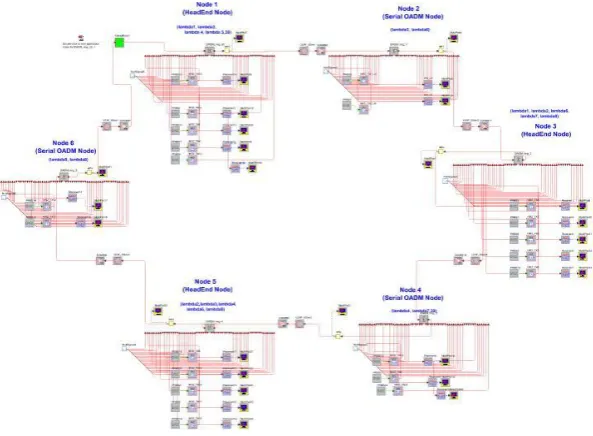
In Fig. 1 the simulation set up of 300Gbps, 300Kms Multichannel DWDM based OADM Ring Network is shown. Ring is set up with different host control nodes. Each control node is connected with another control node with the help of optical fiber. Data is transfer on the optical fiber with different wavelengths. There is also a null pointer which helps to control the errors during data transfer or the wavelength which is not used currently is also control by null pointer. Here one channel transmits 10 Gbps data on the network. We can attach 30 no of channel and the data transfer rate with these are 30*10=300Gbps. Each node has the ability to access any wavelength of each data channel. EDFA (erbium doped fiber amplifier) after each fiber span is inserted to compensate the fiber attenuation. The power per channel of 0dBm was used at transmitters. We used 30 wavelengths at 0.4nm spacing ranging from 1550nm to 1561.6nm wavelength. After each node multiplot is used to observe optical performance matrix. Time delay block is used to connect signal form last node back to first node for performing ring simulation with multiple iterations.
Fig. 2: Enables different lambda.
In Fig. 2 different lambda (lambda1, lambda3, lambda4, lambda5 and lambda30) are enabled and rest all are disabled.
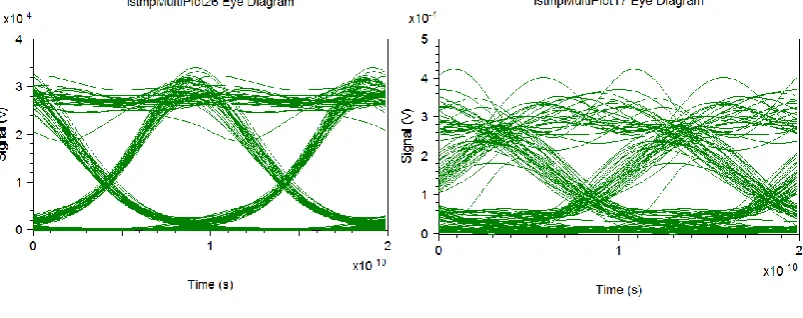
The performance characteristics obtained from the simulation set up of the proposed DWDM based ring network using network parameters listed in Table 1 are described as follows. Fig.3 show the eye diagram corresponds to lambda 1 value (signal and time).
Fig. 3: Eye diagram of Lambda 1. Fig. 4 Eye diagram of Lambda 30.
Fig. 5: Signal Spectrum
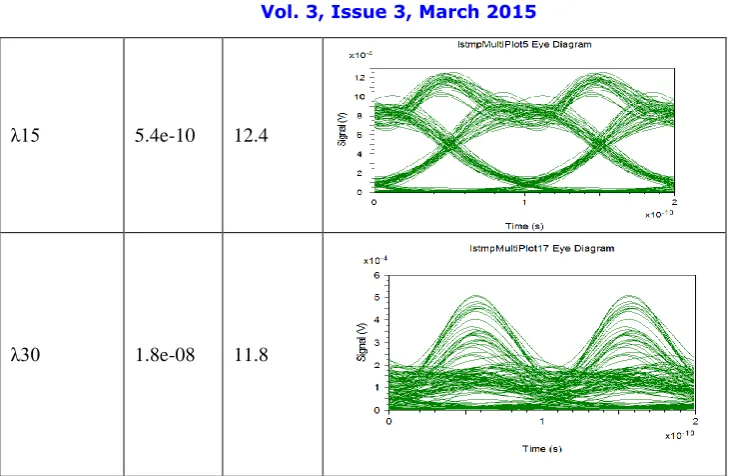
The performance of DWDM-OADM optical ring network is reported on the basis of eye diagram, BER and Q factor in db at different fiber lengths. The slope of eye diagram determines how sensitive the signal is to timing error. A smaller slope allows eye to be opened more and hence less sensitivity to timing error. The width of the crossover represents the amount of jitter present in the signal. With all these methods it becomes very easy to distinguish between two eyes at different fiber length.
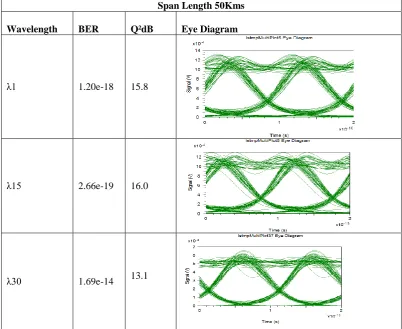
Table 2: Value of BER, Quality factor and Eye Diagram of DWDM at ring length 50 Span Length 50Kms
Wavelength BER Q²dB Eye Diagram
λ1 1.20e-18 15.8
λ15 2.66e-19 16.0
λ30 1.69e-14 13.1
and Q factor for channel 1, 15 & 30 on ring span length 50km. It has been observed that the eye diagram of the system changes as fiber length increases.
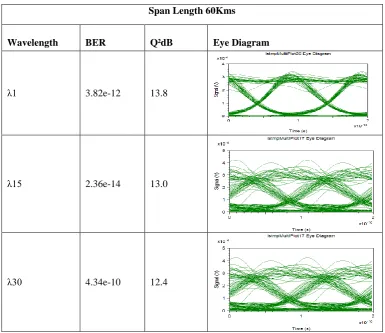
Table 3: Value of BER, Quality factor and Eye Diagram of DWDM at ring length 60
Span Length 60Kms
Wavelength BER Q²dB Eye Diagram
λ1 3.82e-12 13.8
λ15 2.36e-14 13.0
λ30 4.34e-10 12.4
Table 3 shows the BER, Q factor and Eye diagram of DWDM at ring length 60km. It has been observed that the eye opening of the system changes with increase in fibre length and results in more sensitivity to timing errors.
Table 4: Value of BER, Quality factor and Eye Diagram of DWDM at ring length 70
Span Length 70Kms
Wavelength BER Q²dB Eye Diagram
λ15 5.4e-10 12.4
λ30 1.8e-08 11.8
Table 4 shows the BER, Q factor and Eye diagram of DWDM at ring length 70km. It has been observed that the eye opening of the system changes due to crosstalk and span loss and results in more sensitivity to timing errors.
V.CONCLUSION AND FUTURE SCOPE
The design of DWDM based Metropolitan ring Network is proposed in this paper for enhancing the data rate from 100Gbps to 300Gbps. The various performance parameters are analyzed and presented in this manuscript that are obtained from the simulation of this DWDM based metropolitan ring network with 30 channels starting from wavelength of 1.550µm & channel spacing of 0.0004µm in optsim. The main performance parameters analyzed in this research work are Q factor, eye diagram, timing jitter and BER for BPSK, QPSK etc modulation formats. The optimized set up of the DWDM based metropolitan ring network is investigated for three different ring span length of 50km, 60km & 70km respectively. It has been observed that the values of BER at wavelength 1 (1550nm) is 1.20, 3.82 and 7.6 for ring span length of 50km, 60km and 70km. It has been concluded that the timing error of the system is increases as we increase the fiber length in the DWDM-OADM optical ring network.
Further the optimized performance can be obtained by investigating the DWDM based Metropolitan ring network for different modulation format like QPSK and DPSK on the bases of Q factor, eye diagram, OSNR, Optical Power & BER.
REFERENCES
[1] Bharat T. Doshi et al., “A Comparison of Next-Generation IP-Centric Transport Architectures”, Vol. 4, pp- 63-85, 1998.
[2] K. Shrikhande et al, “HORNET: A packet-over-WDM multiple access metropolitan area ring network”, IEEE press, Vol. 18, pp-2004-2016, 2000.
[3] Muralikrishna Gandluru, “Optical Networking and Dense Wavelength Division Multiplexing (DWDM)”, IEEE/ACM Transactions,Vol. 6,pp- 788-799,2000.
[4] Christophe S. Jelger et al, “Photonic Packet WDM Ring Networks Architecture & Performance”, IEEE Communications Magazine, Vol.2, pp-110-115,2002.
[5] Wayne Grover et al, “New Options and Insights for Survivable Transport Networks” IEEE Conference Publications, pp- 34-41,2002.
[6] C. Develder et al., “Benchmarking and Viability Assessment of Optical Packet Switching for Metro Networks “IEEE Publications, pp- 2435 – 2451,2004.
[7] Yihong Chen, Daniel Al-Salameh, “Performance of Wavelength Blockers in 80xlO Gb/s Metro Core Add-drop Network,” Quantum Electronics and Laser Science Conference (QELS), pp-1726-1728, 2005.
[10] Abd El–Naser A. Mohammed et al.,” Optical Add Drop Multiplexers with UW-DWDM Technique in Metro Optical Access Communication Networks” International Journal of Computer Science and Telecommunications.
, vol. 2, pp- 5-13,2011.
[11] Zhang et al,” Collision-Free Bandwidth-Variable Optical Burst Switching Ring Network”, vol. 5, pp- 1043-1056, 2013.
[12] Can Tunca et al., “Ring Routing: An Energy-Efficient Routing Protocol for Wireless Sensor Networks with a Mobile Sink”, vol. 31, pp- 1-15,2013.
[13] I-Fen Chao et al.,” Toward Wireless Backhaul Using Circuit Emulation over Optical Packet-Switched Metro WDM Ring Network” IEEE Journal of Light wave Technology, vol. 31, pp- 3032-3042, 2013.