ISSN(Online): 2319-8753 ISSN (Print) : 2347-6710
International Journal of Innovative Research in Science,
Engineering and Technology
(A High Impact Factor, Monthly, Peer Reviewed Journal)
Visit: www.ijirset.com
Vol. 8, Issue 5, May 2019
Mining Competitor from Large Unstructured
Data sets using C Miner
Abhijit Vetal, Akash Kakade, Sanjana Bhot, Shubham Pathak, Prof. S. A. Deshpande
Department of Information Technology, PVG’s COET Pune, India
ABSTRACT: In Present World’s competitive business, the achievements is totally in light of capacity to make things more engaging to clients than the oppositions. Data mining approach for identifying and monitoring firm’s competitors and to solve number of question like formalizing and quantifying the competitiveness between two items, finding the main competitors of given item And the features of item are effective or not, finding competitiveness between two items based on the market segments that they can both cover is calculated hereby obtaining a wide source of information and customer reviews, the new formalization of the competitiveness between two items based on market segments that they can both cover is made. Proficient strategies for assessing aggressiveness in extensive audit datasets and address the regular issue of finding the best k contenders of a given thing. Our assessment of aggressiveness uses client surveys, a plenteous well-spring of data that is accessible in an extensive variety of spaces. We display proficient strategies for assessing intensity in huge survey datasets and address the characteristic issue of finding the best k competitors of a given item.
KEYWORDS: Data mining, Web mining, Information Search and Retrieval.
I.INTRODUCTION
Figure No 1. A (simplified) example of our competitiveness
A.OBJECTIVE
1) To evaluate competitiveness bet ween items in large review data sets. 2) To evaluate the quality andstabilityof proposed approach.
II. REVIEW OF LITERATURE
Our work has connections to past work from different domains. “Web impressions of firms: Utilizing on the web isomorphism for contender identification” this paper by G. Gaspand O. R. Sheng is another online measurements is utilized which depends on the substance, in-connections and out links of firm’s sites to gauge thenearnessof online isomorphism just as reveal its utility in anticipating contender relationships.[1]
Identifying customer preferences about tourism products using an aspect-based opinion mining approach is the another work done which uses opinions available on the web as reviews.[2] This uses similarity concept. There are some other methods like using a map-reduce techniques and processing parallel data which is in massive amount[3] and another approach is mining competitor relationships from online news[4] etc.
Recognizing client inclinations about the travel industry items utilizing an angle based on in particle mining approach is the another work done which utilizes assessments accessible on the web as reviews.[2] This uses comparability idea. There aresomedifferent strategies like utilizing an outline methods and preparing parallel information which is in huge amount [3] an danother methodology is mining contender connections from online news [4] and soon.
ISSN(Online): 2319-8753 ISSN (Print) : 2347-6710
International Journal of Innovative Research in Science,
Engineering and Technology
(A High Impact Factor, Monthly, Peer Reviewed Journal)
Visit: www.ijirset.com
Vol. 8, Issue 5, May 2019
Contender Mining Algorithms: Zheng et al. [12] distinguish key aggressive measures (for example piece ofthepie, offer of wallet) and indicated how a firm can gather the estimations of these measures for its rivals by mining (I) its own definite client exchange information what’s more, (ii) total information for every contender. As opposed toourown system, this approach isn’t suitable for assessing the aggressiveness between anytwothings or in agiven market. Rather, the creators accept that the arrangement of contenders is given what’s more, in this way; they will probably figure the estimation of the pickedmeasuresfor every contender. Furthermore, the reliance on value-based information is a confinement we don’t have Doanatl. Investigate client appearance information, for example, the geocoded information from area based social systems, as a potential asset for contender mining [13].
Whilethey report promising results, the reliance on appearance information restricts the arrangement of spaces that can benefit from this methodology. Gasp and Sheng conjecture and confirm that contending is likely to have comparative web impressions, a wonder that they allude to as online isomorphism [2]. Their examination considers different sorts of isomorphism between two firms, for example, the cover between the in-connections and outlines of their separate sites, just asthe occasions that they seem together on the web (for example in query items or new articles).
Finding Competitive Products: Recent work hasinvestigated intensity in thesettingof item structure. The first venture in these methodologies is thedefinitionof a predominance work that speaks to the estimation ofanitem. The objective is then to utilize this capacity to make things that are not overwhelmed by other, or amplify things with the most extreme conceivable strength esteem. A comparable profession speaks to things as focuses in a multidimensional space andsearchesfor subspaces where theintrigueof the thing is augmented. While significant, the above ventures have a totally different center from our own, and henceforth the proposed methodologies are not material in oursetting.
Contender distinguishing proof is a key errand for administrators keen on checking theirfocusedlandscape, shoring up their barriers against likely aggressive invasions, and arranging focused assault and reaction systems. It is an important antecedent to the undertaking of contender investigation, and the beginning stage for examining the elements of aggressive system (Smith et al., 1992). Previously one can evaluate the relative qualities and shortcomings of opponents, or track aggressive moves and countermoves, one should initially distinguish thefocusedset and build up anexact feeling of the space in which key associations are probably going to happen. The motivation behind this paper is to givealot of tractable structures for contender ID what’s more, rival examination that encourages expansive natural filtering. To illuminate our structures, we obtainfromPeteraf and Bergen’s (2001) structure for contender examination. Their work obtains from Chen’s (1996) model of contender examination, adjusting his develops to our motivations by illustration on the advertising writing onbuyer conduct (Levitt, 1960; Nedungadi, 1990; Peter and Olson, 1993, Mowen what’s more, Minor, 1995). In particular, we bring intosharpcenter the job of client needs in characterizing the commercial center to indicate how a more prominent acknowledgment of client needs can grow consciousness of what sneaks on the aggressiveskyline
III.SYSTEM ARCHITECTURE/SYSTEM OVERVIEW
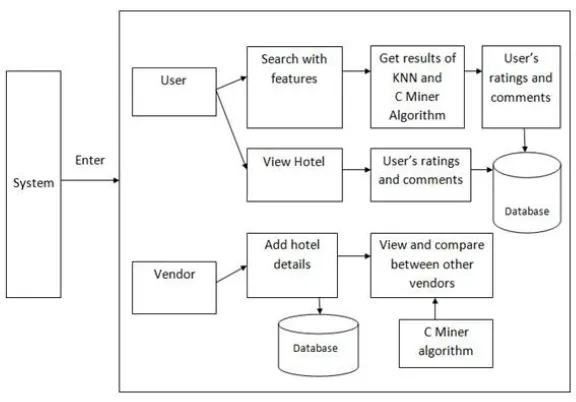
Figure No 2. Proposed System Architecture
A. Explanations:-
Module 1 - User (Customer)
Users first register to the system and search the hotel with features then get top k hotels according to C Miner ++ Algorithms Result.
Module 2 - Vendor (hotel Owner)
Vendor’s first registered and login intosystemafter vendor Addown Hotel and vendor also show comparison results according to CMiner++.
B. Advantage:-
1. Our work is the first to address the evaluation of competitiveness via the analysis of large unstructured data sets, without the need for direct comparative evidence.
2. A formal definition of the competitiveness between twoitems, based on their appeal to the various customer segments in their market
3. A formal philosophy for the recognizable proof of the distinctive kinds of clients in a given market, just as for the estimation of the level of clients that have a place with each sort.
4. A highly scalable framework for finding the top-k competitors of a given item in very large data sets
C. Algorithms
1) C MinerAlgorithm
Input: Set of items I, Item ofinteresti I, feature space F, Collection Q 2F of queries with non-zero weights, skyline pyramid DI, intk
ISSN(Online): 2319-8753 ISSN (Print) : 2347-6710
International Journal of Innovative Research in Science,
Engineering and Technology
(A High Impact Factor, Monthly, Peer Reviewed Journal)
Visit: www.ijirset.com
Vol. 8, Issue 5, May 2019
Steps
1.
TopKmasters(i)2.
if ( k —TopK— ) then 3 returnTopK3.
end if4.
k ← k| TopK|5.
LB ← 16.
X ← GET SLAV ES(TopK; DI)DI[0]7.
While (|X|! = 0)do8.
X ← UP DAT ET OP K(k; LB; X)9.
If (|X|! = 0)then10.
Top K ← MERGE(TopK; X)11.
if (|TopK| = k)then12.
LB ← W ORST IN(TopK)13.
Endif14.
X ← GET SLAV ES(X; DI)15.
Endif16.
endwhile17.
return TopK18.
RoutineUP DAT ET OP K(k, LB, X)19.
Local TopK20.
Low (j) ←P 0; jX. q21.
up(j) ← q∈Qpq∗i,vj22.
for every q Q do23.
maxV ← vq24.
for every item j ∈Xdo25.
up(j) ← up(j)- maxV + p(q) vq26.
if ( up(j) ¡ LB ) then27.
X ← X j28.
Else29.
low(j) ← low(j)+p(q) vq30.
LB ← W ORST IN(local TopK)31.
Endif32.
endif33.
end if or34.
if (|X|k)then35.
break36.
endif39.
foreveryremainingqQdo40.
low(j) ← low(j)+ p(q) vq41.
end for42.
localTopK:update(j; low(j))43.
end for44.
returnTOPK(localTopK)IV.CONCLUSION
Our displayed work formalizes meaning of aggressiveness between two things, which we have approved both quantitatively and subjectively. Our formalization is pertinent cross- wise over areas, defeating the deficiencies of past methodologies. We consider various components that have been to a great extent disregarded before, for example, the situation of the things in the multi-dimensional element space and the inclinations and suppositions of the clients. Our work acquaints an end-with end approach for mining such data from expansive datasets of client surveys. In light of our intensity definition, we tended to the computationally difficult issue of finding the best k contenders of a given thing. The proposed system is effective and appropriate to areas with extremely expansive populaces of things.
REFERENCES
[1] G. Pant and O. R. Sheng, Web footprints of firms: Using online isomorphism for competitor identification, Information Systems Research, vol. 26, no. 1, pp. 188209, 2015.
[2] E. Marrese-Taylor, J. D. Velasquez, F. Bravo-Marquez, and Y. Matsuo, Identifying customer preferences about tourism products using an aspect-based opinion mining approach, Procardia Computer Science, vol. 22, pp. 182191,, 2013.
[3] K.-H. Lee, Y.-J. Lee, H. Choi, Y. D. Chung, and B. Moon, Parallel data processing with map reduce: a survey,AcM sIGMoD Record, vol. 40, no. 4, pp. 1120, 2012.
[4] S Z. Ma, G. Pant, and O. R. L. Sheng, Mining competitor relation- ships from online news: A network-based approach, Electronic Commerce Research and Applications, 2011.
[5] B. H. Clark and D. B. Montgomery, Managerial Identification of Competitors, Journal of Marketing. 1999.
[6] J. F. Porac and H. Thomas, Taxonomic mental models in competitor definition, TheAcademy of Management Review, 2008.
[7] F. Porac and H. Thomas, Taxonomic mental models in competitor definition, Academy of Management Review, vol. 15, no. 2, pp. 224240, 1990. [8] M. E. Porter, Competitive Strategy: Techniques for Analyzing Industries and Competitors. Free Press, 1980.
[9] M. Bergen and M. A. Petered, Competitor identification and competitor analysis: a broad-based managerial approach, Managerial and Decision Economics, 2002.
[10] M.-J. Chen, Competitor analysis and interfere rivalry: Toward a theoretical integration, Academy of Management Review, 1996
[11] W. T. Few, Managerial competitor identification: Integrating the categorization, economic and organizational identity perspectives, Doctoral Dissertation, 2007
[12] Z. Zheng, P. Fader, and B. Padmanabhan, from business intelligence to competitive intelligence: Inferring competitive measures using augmented site-centric data, Information Systems Research, vol. 23, no. 3-part-1, pp. 698720, 2012.
[13]T.-N. Doan, F. C. T. Chua, and E.-P. Lim, mining business competitiveness from user visitation data, in International Conference on Social Computing, Behavioral-Cultural Modeling, and Prediction. Springer, 2015, pp. 283289.