ISSN(Online): 2319-8753 ISSN (Print): 2347-6710
I
nternational
J
ournal of
I
nnovative
R
esearch in
S
cience,
E
ngineering and
T
echnology
(A High Impact Factor, Monthly, Peer Reviewed Journal)
Visit: www.ijirset.com
Vol. 7, Issue 12, December 2018
Efficient and Robust System to Recognize
Gestures of Hands
Gaurav Sahu1, Dr. Sonam Mittal2
Assistant Professor, Dept. of Electronics & Communication Engineering, B K Birla Institute of Engineering &
Technology, Pilani, Rajasthan, India1
Associate Professor, Dept. of Computer Science Engineering, B K Birla Institute of Engineering & Technology, Pilani,
Rajasthan, India2
ABSTRACT: Gesture recognition is a tough task because of the complexity in the background, the uneven movements
of hands and also the intensity of light in an image. This paper proposes new technique for hand gesture recognition starting with detection of hands, determining center and tracking hands to examine the variation in the location of hands and ending with the gesture recognition. The technique proposed above overwhelms the problem of background complexity and the distance from the webcam / camera should be fixed (maximum 2 meters). The results obtained are studied and it shows that the gestures are recognized at a good rate.
KEYWORDS: Gesture recognition of hands, Detection of skin and Tracing of hands.
I. INTRODUCTION
Gesture comprises of motion expressed by human body, face and hands. The most often and most communicative among all the gestures is the hand gesture. The easiest way to communicate with computers nowadays is the use of gestures. With the help of such interfaces the gesture of hand can be used extensively to control the variety of devices. The work which is done so for on this topic exempted the complex background and only concentrates on the stable background so as to recognize the gestures easily [1-6]. The necessary condition of glove-based interfaces is to wear the clumsy devices which contain the lots of cables connected to the computer. The gesture recognition system was proposed that can detect and recognize 46 ASL letter spelling alphabet and digits the gestures are static i.e., without any motion [7].
This paper focuses on recognition of dynamic gestures of hand and of which a single gesture is executed in a complex background. The proposed system does not use any marker or glove to recognize gesture [2]. The proposed techniques uses 2D image as an input, which further detects the hands tracks the movements of hands and examines the variation in the position of the hands, the obtained position is used to recognize the gesture of the hand.
II. SYSTEM WORKFLOW
The main approach is to design the low cost system that can be easily installed into the machine with the enabled webcam or camera, and the machine should be able to work under different intensity of lights and complex background. Fig 1 shows the proposed framework of the system.
Input image from Camera
/ Webcam
Centre detection of hand
Tracing the center region
ISSN(Online): 2319-8753 ISSN (Print): 2347-6710
I
nternational
J
ournal of
I
nnovative
R
esearch in
S
cience,
E
ngineering and
T
echnology
(A High Impact Factor, Monthly, Peer Reviewed Journal)
Visit: www.ijirset.com
Vol. 7, Issue 12, December 2018
The steps for the proposed techniques are as follows:
i. Acquisition: a frame of image is captured from the webcam / camera.
ii. Segmentation & detection: the image is sectioned into two parts, both of them are controlled simultaneously before analyzing the resultant data, skin pixel and moving patterns are detected. The image containing the location of the center of the moving hand is created for further processing.
iii. Tracing: The successive frame are traced endlessly, the center of the moving hands is detected for every frame.
iv. Pattern Recognition: The database is created which contains several images of hand gestures, the detected image is compared with the database image, and the one which matches the most determines the gesture of hands.
III. HAND DETECTION
This technique is developed in such a way that it divides the input video frame into two parts and processes each of them separately keeping in mind that the processing for both the parts is alike and concurrent. For fast processing of image the operators should be kept low time consuming in order to achieve real time speed. The steps followed for detection are as follows:
i. Skin tone detection: The skin is easily detected by using color tone information. RGB based color classifies as skin if:
0.08 < 3∗ ∗
( + + ) < 0.12
AND
1.5 < ∗ ∗
∗ < 1.8
AND
+ +
3∗ +
+ +
− < 1.4
ii. Motion detection: By using the above mentioned formula for skin detection it is observed that the non-skin regions are also appearing. By viewing only these non-skin regions will be excluded, by subtracting two successive frames [8] and thresholding the output the moving objects are detected.
iii. Combining motion and skin color: The gesture of hand comprises of skin color and motion both so the logical AND operation is applied to combine them:Pi(x,y) = Mi(x,y) ^ Si(x,y)
Fig 2. (a) Original hand detected image, (b) Skin color region, (c) Combination of skin and motion pixels [10].
iv. Region identification: The approach to determine the center of the hand is as follows:
a. The center of each motion and skin color is calculated with the help of Eq.1, and is stored in an array so as to store row’s number as an address. The process of handling the midpoint is clarified in Fig 3.
b.
ISSN(Online): 2319-8753 ISSN (Print): 2347-6710
I
nternational
J
ournal of
I
nnovative
R
esearch in
S
cience,
E
ngineering and
T
echnology
(A High Impact Factor, Monthly, Peer Reviewed Journal)
Visit: www.ijirset.com
Vol. 7, Issue 12, December 2018
Fig 3. Hand center determination [10]
Light grey, dark grey and pink color pixels are satisfying both the motion and skin tone pixels and are hit pixels. Rows which contains more than 15-20 motion and skin tone pixels are colored as dark grey and are also counted under hit pixels.The table in left comprises of two columns. Left column shows the center of each row of hit pixels and right column contains the number of motion and skin pixels if each row.The red and pink color denotes the center of row in which pixels are not found.
c. Calculating average by adding up all stored center values and then dividing by total number of rows which are stored in an array which results in the equitable lines, the calculation is depicted in Eq.2 and Eq.3.
− = ---Eq.2
− = ---Eq.3
The particular for detection of center of hand is mentioned in Algorithm I.
Algorithm I Detection of center of hand [10] for i←0 to imageHeight
for j←0 to imageWidth ifPx(i,j) satisfiy Motion AND inSkinRange then TruePixel ← TruePixel + 1 XTruePx ← XTruePx + j end if
end for
ifTruePixel> 15 then
MPArray[i] ← ( XTruePx / TruePixel) Else
MPArray[i] ← 0 end if
end for
for i←0 to ImageHeight
ifMPArray[i] 0 then
MPSum ← MPSum + MPArray[i] TrueRow ←TrueRow + 1
ISSN(Online): 2319-8753 ISSN (Print): 2347-6710
I
nternational
J
ournal of
I
nnovative
R
esearch in
S
cience,
E
ngineering and
T
echnology
(A High Impact Factor, Monthly, Peer Reviewed Journal)
Visit: www.ijirset.com
Vol. 7, Issue 12, December 2018
end for
ifTrueRow> 0 AND YTrueRow> 0 AND MPSum> 0 then
X_Center ← MPSum / TrueRow Y_Center ← YTrueRow / TrueRow end if
Fig 4 depicts the results of the detection of hands in the variety of backgrounds.
Fig .4. Hands detected in an image [10]
IV. TRACING HAND GESTURE
The complete system for tracing hands is divided into two steps: the first step is to take care of the motion pixels and keep the record of them as shown in Fig 5(a & b), and the second step is to examine and work on these points as mentioned below:
From the centroid P(x, y) select the position of x-axis and store it in the variable named as Xarrayand repeat the same
procedure for the y-axis and obtain Yarray with dropping the vale at P(0, 0) as mentioned in the Table 1.
Fig 5 (a&b). Depicts the latest manipulated points [10].
Table 1(a): Actual array [10]Table 1(b): Array after elimination [10]
In this particular system only 10 frames per second are considered because it is not possible for the human to give more than 25 gestures in a second [9] or in other words it is concluded that tracking is not done for the complete analysis of the frame. The proposed work is in real time and has the application in the same.To calculate the angle and distance between each successive center in the midpoint array the Pythagoras formulas are used as shown in Fig 6.
(a) ( , )= + (b) ( , )=
ISSN(Online): 2319-8753 ISSN (Print): 2347-6710
I
nternational
J
ournal of
I
nnovative
R
esearch in
S
cience,
E
ngineering and
T
echnology
(A High Impact Factor, Monthly, Peer Reviewed Journal)
Visit: www.ijirset.com
Vol. 7, Issue 12, December 2018
The above points (a), (b) denotes the equations which are used to find the distance and angle between successive points.Thus four variables are colligated with four main directions as shown below. To attain most appropriate results ±15° tolerance [10] is given at every angle as depicted in Fig 7.
Variables =
_0, ℎ 0°
_90, ℎ 90°
_180, ℎ180°
_270, ℎ 270°
Fig 6. Variations in two successive points at different angles [10] Fig 7.Four major angles with ±15° tolerance [10]
The motions which were not related to any specified range are neglected and counting is done for predefined variables that were in the range.In the tracing stage two variables are to be created as: angleCounter to measure the number of movements from the reference value and sumDistance to add up all the distance travelled by hands from the reference angle. The evaluated angle is checked if the prestored angle lies within the four major directions then increment the angleCounter for that particular angle. Proceeding in this particular direction the information about the movements of hands is obtained. Algorithm II specifies the tracing of human hand.
Algorithm II Tracing human hand [10] fori ← 0 to array.Length
d = distance between Ci(x,y) and Ci-1(x,y) θ = angle between Ci(x,y) and Ci-1(x,y)
if -15 < θ <15 then rtl ← rtl + 1
Sum_rtl ← Sum_rtl + d else if 75 < θ <105 then dtu ← dtu + 1
Sum_dtu ← Sum_dtu + d else if 165 < θ <195 then ltr ← ltr + 1
Sum_ltr ← Sum_ltr + d else if 255 < θ < 285 then utd ← utd + 1
Sum_utd ← Sum_utd + d end if
end for
V. RECOGNITION OF HAND GESTURE
ISSN(Online): 2319-8753 ISSN (Print): 2347-6710
I
nternational
J
ournal of
I
nnovative
R
esearch in
S
cience,
E
ngineering and
T
echnology
(A High Impact Factor, Monthly, Peer Reviewed Journal)
Visit: www.ijirset.com
Vol. 7, Issue 12, December 2018
second in which both the hands are moving. The centroid, angle and the motion counter is used for recognition of gesture. The Algorithm III&IVdepicts recognition of one moving hand and both the moving hands respectively.
Algorithm III Recognition of one moving hand [10] ifSum_rtl> 150 AND rtl>4
AND ltr* < 2 then DoEvent(Right To Left)
else if Sum_ltr> 150 AND ltr>4 AND rtl* < 2 then
DoEvent(Left to right)
else if Sum_utd> 200 AND utd>4 AND utd* < 2 then
DoEvent(Up to down)
else if Sum_dtu> 200 AND dtu>4 AND dtu* < 2 then
DoEvent(down to up)
Algorithm IV Recognition of both the moving hands [10] ifSum_utd> 200 AND Sum_utd*>200
AND utd> 3 AND utd*>3 then DoEvent(Both hand up) else if Sum_dtu> 200
AND Sum_dtu * > 200 AND dtu>3 AND dtu*> 3 then
DoEvent(Both hand Down) else if Sum_ ltr> 150
AND Sum_rtl * > 150 AND ltr>3 AND rtl*> 3 then
DoEvent(Zoom In) else if Sum_ rtl> 150
AND Sum_ltr * > 150 AND rtl>3 AND ltr* > 3 then
DoEvent(zoom Out)
VI. EXPERIMENTAL RESULTS
ISSN(Online): 2319-8753 ISSN (Print): 2347-6710
I
nternational
J
ournal of
I
nnovative
R
esearch in
S
cience,
E
ngineering and
T
echnology
(A High Impact Factor, Monthly, Peer Reviewed Journal)
Visit: www.ijirset.com
Vol. 7, Issue 12, December 2018
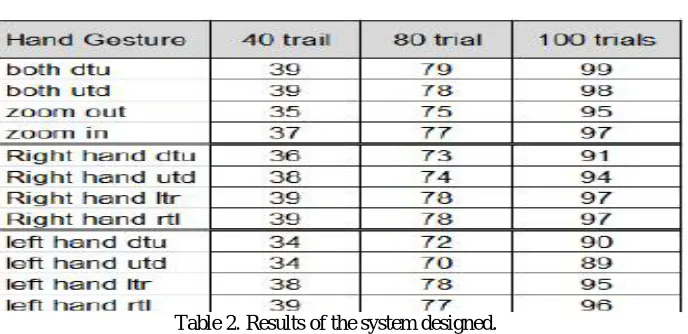
Table 2. Results of the system designed.
*
dtu = down to up; utd = up to down; rtl = right to left; ltr = left to right.
VII. CONCLUSION
A new system is designed to increase the robustness, adaptability and efficiency of the gesture recognition system. The minimum possible hardware is used in the designing of the system. The implemented algorithm works well and provides the efficiency of around 90-95%.
REFERENCES
[1] T. Baudel, M. Baudouin-Lafon, Charade: Remote control of objects using free-hand gestures, Comm. ACM 36 (7) (1993) 28–35. [2] D.J. Sturman, D. Zeltzer, A survey of glove-based input, IEEE Computer Graphics and Applications 14 (1994)30–39.
[3]J. Davis, M. Shah, Visual gesture recognition. IEE Proc. Vis. Image Signal Process, 141(2) :101-106, 1994.
[4] A. Bobick, A. Wilson, A state-based technique for the summarization and recognition of gesture. In Proc. IEEE Fifth Int. Conf. on Computer Vision, Cambridge, pp. 382-388, 1995.
[5] E. Hunter, J. Schlenzig, and R. Jain.Posture Estimation in Reduced- Model Gesture Input Systems. Proc. Int´lWorkshop Automatic Face and Gesture Recognition, pp. 296-301, 1995.
[6] C. Maggioni. Gesturecomputer. New Ways of Operating a Computer, Proc. Int´l Workshop Automatic Face and Gesture Recognition, 1995. [7] R. Lockton, A.W. Fitzgibbon, Real-time gesture recognition using deterministic boosting, Proceedings of British Machine Vision Conference
(2002).
[8] R. Gonzales, and E. Woods, “Digital Image Processing,” Prentice Hall, Inc, New Jersey, 2002.
[9] E. Sanchez-Nielsen, L. Anton-Canalis, M. Hernandez-Tejera, Hand gesture recognition for human machine interaction, Journal of WSCG, Vol.12, No.1-3, 2003.
[10] Mohamed Alsheakhali, Ahmed Skaik, Mohammed Aldahdouh, Mahmoud Alhelou, Hand Gesture Recognition System, International Conference on Information & Communication Systems, Irbid-Jordan, ISBN – 9781450782081
[11] Randive, A. A., H. B. Mali, and S. D. Lokhande. "Hand Gesture Segmentation." International Journal of Computer Technology and Electronics Engineering, Vol. 2, No. 5, pp. 125-129, (2012)
[12] H. Khaled, S. Sayed, E. S. Mostafa, H. Ali, "Hand Gesture Recognition Using Average Background and Logical Heuristic Equations ", International Journal of Computers and Technology, Vol. 11, No. 5, pp. 2634-2640, 2013.
![Fig 2. (a) Original hand detected image, (b) Skin color region, (c) Combination of skin and motion pixels [10]](https://thumb-us.123doks.com/thumbv2/123dok_us/1561465.1191786/2.595.205.414.591.672/original-detected-image-skin-region-combination-motion-pixels.webp)
![Fig 3. Hand center determination [10]](https://thumb-us.123doks.com/thumbv2/123dok_us/1561465.1191786/3.595.131.474.204.356/fig-hand-center-determination.webp)
![Fig .4. Hands detected in an image [10]](https://thumb-us.123doks.com/thumbv2/123dok_us/1561465.1191786/4.595.86.510.471.548/fig-hands-detected-image.webp)