ISSN(Online): 2320-9801
ISSN (Print): 2320-9798
I
nternational
J
ournal of
I
nnovative
R
esearch in
C
omputer
and
C
ommunication
E
ngineering
(An ISO 3297: 2007 Certified Organization)
Vol. 3, Issue 7, July 2015
Perceiving Kernel-Level Rootkits Using Data
Structure Invariants
G.Vijayalakshmi
1, A.Anusha Priya
2Research Scholar, Department of CS, Muthayammal College of Arts & Science, Rasipuram, Namakkal, India1
Associate Professor, Department of CS, Muthayammal College of Arts & Science, Rasipuram, Namakkal, India2
ABSTRACT: Rootkits affect system security by modifying kernel data structures to achieve a variety of malicious
goals. While early rootkits modified control data structures, such as the system call table and values of function pointers, recent work has demonstrated root kits that maliciously modify non control data. Most prior techniques for root kit detection have focused solely on detecting control data modifications and, therefore, fail to detect such root kits. This paper presents a novel technique to detect rootkits that modify both control and non control data. The main idea is to externally observe the execution of the kernel during an inference phase and hypothesize invariants on kernel data structures. A root kit detection phase uses these invariants as specifications of data structure integrity. During this phase, violation of invariants indicates an infection. We have implemented Gibraltar, a prototype tool that infers kernel data structure invariants and uses them to detect root kits. Experiments show that Gibraltar can effectively detect previously known rootkits, including those that modify non-control data structures.
KEYWORDS: Kernel-level rootkits, non control data attacks, invariant inference, static and dynamic program
analysis.
I. INTRODUCTION
ISSN(Online): 2320-9801
ISSN (Print): 2320-9798
I
nternational
J
ournal of
I
nnovative
R
esearch in
C
omputer
and
C
ommunication
E
ngineering
(An ISO 3297: 2007 Certified Organization)
Vol. 3, Issue 7, July 2015
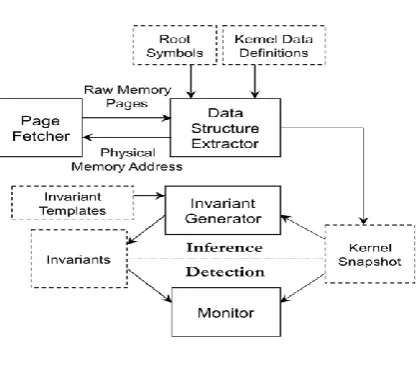
Fig 1.System Architecture
II. LITERATURE SURVEY
The evolution of root kits and the techniques to detect them has traditionally been an arms race between attackers and defenders. Early root kits operated by replacing system binaries on disk with infected versions. Root kits have more recently evolved to infecting the system by modifying kernel code, control data, and non control data. Gibraltar is the latest in a long list of root kit detection tools, but is one of only two techniques that can detect malicious modifications of non control data. Defending system utilities. Root kits can hide malicious user-space objects by replacing key system utilities with infected versions. For example, a root kit can replace the ps utility with a version that hides a malicious process from a system administrator. Such root kits can be detected using a number of prior tools, such as Tripwire and Strider Ghost buster, and several commercial tools Most of these tools operate by comparing the kernel’s view of user-space object (e.g., a cryptographic hash of system utilities) against known values. Any inconsistencies are indicative of rootkits. Root kits often spread as kernel modules that affect kernel code and data after they have been loaded. Such kernel modules can also use techniques such aspolymorphism to evade detection by virus scanners. Static analysis of kernel modules (e.g., using symbolic execution) can detect these root kits, but conservative approximations made by static analysis may result in false alarms. Instead of checking kernel modules, Gibraltar focuses on observing and validating data modifications to kernel memory, including those made by kernel modules. The recent addition of Trusted Platform Modules (TPM) to commodity hardware has allowed the development of protocols to verify the integrity of the software stack executing on a remote machine. Such techniques can detect certain kinds of root kits, in particular, those that modify kernel code and critical data structures. However, we are not aware of the use of trusted computing to .detect root kits that modify arbitrary kernel data structures.
III. EXISTINGSYSTEM
Recent studies have shown a phenomenal increase in malware that use stealth techniques commonly employed by rootkits. The increase in the number and complexity of rootkits can be attributed to the large and complex attack surface that the kernel presents. The kernel manages several hundred heterogeneous data structures, most of which are critical to its correct operation. A root kit can subvert kernel integrity by subtly modifying any of these data structures. In particular, kernel data structures that hold control data, such as the system call table, jump tables, and function pointers, have long been a popular target for attack by root kits.
Disadvantages of existing system:
ISSN(Online): 2320-9801
ISSN (Print): 2320-9798
I
nternational
J
ournal of
I
nnovative
R
esearch in
C
omputer
and
C
ommunication
E
ngineering
(An ISO 3297: 2007 Certified Organization)
Vol. 3, Issue 7, July 2015
IV. PROPOSED SYSTEM
We propose a novel approach that automatically generates kernel data structure integrity specifications. In our approach, these integrity specifications take the form of data structure invariants properties that must hold for the lifetime of a data structure. The key idea is to monitor the values of kernel data structures during an inference phase in order to hypothesize invariants that are satisfied by these data structures. These invariants can encompass both control and non control data structures. For example, an invariant could state that the values of elements of the system call table are a constant (an example of a control data invariant). Similarly, an invariant could state that all the elements of the running-tasks linked list These invariants are then checked during a root kit detection phase, in which violation of an invariant is assumed to indicate the presence of a root kit.
Advantages of Proposed System:
Gibraltar was able to detect all 23 root kits that we tested it against, while imposing a runtime monitoring overhead of under 0.5 percent.
V. GIBRALTERFOR ROOTKIT DETECTION
The Page Fetcher
Gibraltar executes on the observer, which is isolated from the target system. Gibraltar’s page fetcher is a component that takes a physical memory address as input, and obtains the corresponding memory page from the target. The target runs a Myrinet PCI card with an enhanced version of the original firmware, which directly interprets and services requests from the page fetcher, without intervention from the target’s kernel. For each request, the firmware on the target initiates a DMA request for the requested page, and sends the contents of the physical page to the observer upon completion of the DMA.
The Data Structure Extractor:
The extractor uses a set of root symbols and type definitions to locate data structures in raw physical memory pages received from the target. Root symbols denote kernel data structures whose physical memory locations are fixed. All data structures on the target’s heap are reachable from root symbols. This module presents the algorithm that the data structure extractor uses to locate data structures in physical memory. The extractor first adds the addresses of the roots to a worklist and issues requests to the page fetcher for memory pages containing the roots. It extracts the values of the roots from these pages, and uses their type definitions to identify pointers to previously unseen data structures. For example, if a root is a C struct, the data structure extractor adds all pointer-valued fields of this struct to the work list to locate more data structures in the kernel’s physical memory. This process continues in a recursive fashion until the traverser identifies all the data structures target .
Instruction Sequences Analyzer (ISA). Using all the instruction sequences distilled from the instruction sequences distiller as the inputs, this module analyzes these instruction sequences to determine whether one of them is (a fragment of) a program.
The Invariant Generator
During invariant inference, Gibraltar uses the output of the data structure extractor to infer likely data structure invariants. These invariants are used as specifications of data integrity.Malicious executable code are normally binary strings. In order to guarantee the throughput and response time of the protected web system, if the query parameters of the request-URI and request-body of a request are both printable ASCII ranging from 20-7E in hex, SigFree allows the request to pass we will discuss a special type of executable codes called alphanumeric shellcodes that actually use printable ASCII .
The Monitor
ISSN(Online): 2320-9801
ISSN (Print): 2320-9798
I
nternational
J
ournal of
I
nnovative
R
esearch in
C
omputer
and
C
ommunication
E
ngineering
(An ISO 3297: 2007 Certified Organization)
Vol. 3, Issue 7, July 2015
VI. SOPHISTICATED ALGORITHM IN ROOTKIT DETECTION
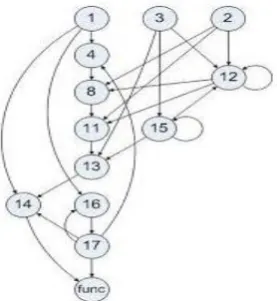
A more sophisticated algorithm based on the control flow graph of the binary is necessary. In a suitable algorithm is presented that is based on dominator trees. This algorithm operates on the control flow graph and can detect (and remove) the back-edges of loops. Simply speaking, a back-edge is the jump from the end of the loop body back to the loop header, and it is usually the edge that would be identified as the “loop-defining-edge” by a human looking at the control flow graph. For example, Figure shows a control flow graph with a loop and the corresponding back-edge. For our system, we first create a control flow graph of the kernel module code after it has been preprocessed. Then, a loop detection algorithm is run and the back-edges are detected. Each conditional branch instruction that has a back-edge as a possible continuation is tagged appropriately. During symbolic execution, no machine state is saved at these instructions and processing continues only at the non-back-edge alternative.
Fig 3: Control flow graph with loop.
VII. COMPUTATION
VIII. Algorithm
Input (a) R: addresses of roots; (b)Data Structure definitions
Output: Set of all data structures reachable from R; worklist =R;
visited=Φ; snapshot=Φ;
While worklist is not empty do
Addr=remove an entry from worklist; visited=visited U {addr};
M=physical memory page containing addr; Obj=object at address addr in M;
Snapshot=snapshot U value of obj; foreach pointer p in obj do
if p£ visited
worklist = worklist U {p}; return snapshot;
ISSN(Online): 2320-9801
ISSN (Print): 2320-9798
I
nternational
J
ournal of
I
nnovative
R
esearch in
C
omputer
and
C
ommunication
E
ngineering
(An ISO 3297: 2007 Certified Organization)
Vol. 3, Issue 7, July 2015
IX. RESULT ANALYSIS
We measured three aspects of Gibraltar’s performance:
1) Inference time, i.e., the time taken by Gibraltar to observe the target and infer invariants; 2) Detection time, i.e., the time taken for an alert to be raised after the root kit has been installed; 3) Performance overhead, the overhead on the target system as a result of periodic page fetches via DMA.
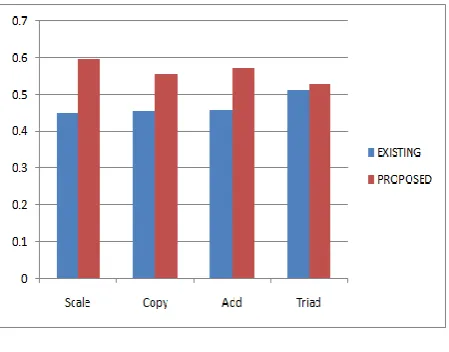
In performance overhead, Measurement is performed over four vector operations, namely, copy, scale, add, and triad and averaged over 100 executions. The vectors were chosen so that they clear the last-level cache in the system, forcing data to be fetched from main memory. Graph presents the bandwidth measurements for these four vector operations, both with Gibraltar’s monitoring turned off, and turned on. Bandwidth measurements and time taken for the four vector operations are shown. This figure shows the maximum and minimum time taken for each operation, and the average over 100 executions. As this figure shows, Gibraltar imposes a negligible overhead of 0.49 percent on the operation of the target system. There is no significant difference between the average of the Copy & Scale kernels and the average of the Add & Triad kernels. Resulting in a 50% increase in memory operations for the Copy and Scale kernels and a 33% increase in memory operations for the Add and Triad kernels.
Fig 4: Result Analysis Graph
X. CONCLUSION AND FUTURE WORK
Several recent root kits and research papers have demonstrated that attacks against control and non control
data in dynamically allocated kernel memory are a realistic and growing threat. Such root kits are challenging to detect because the vast number and heterogeneity of kernel data structures makes writing correctness specifications for these data structures a challenging exercise. Motivated by this challenge, we sought to develop an automated approach to detect such root kits. In this quest, we developed Gibraltar, a tool that detects kernel-level root kits using data structure invariants. Gibraltar uses an anomaly detection-based approach: it uses an automatic technique to infer invariants on kernel data structures, including both control and non control data structures, and uses these invariants to detect root kits. Gibraltar was able to detect all 23 root kits that we tested it against, while imposing a runtime monitoring overhead of under 0.5 percent. We also found that the automatically inferred invariants were quite precise. For example, we observed spurious warnings on only 0.035 percent of the persistent invariants during a 42-minute testing phase. The approach, described in this paper, therefore, demonstrates the feasibility of automatic invariant inference for root kit detection.
ISSN(Online): 2320-9801
ISSN (Print): 2320-9798
I
nternational
J
ournal of
I
nnovative
R
esearch in
C
omputer
and
C
ommunication
E
ngineering
(An ISO 3297: 2007 Certified Organization)
Vol. 3, Issue 7, July 2015
REFERENCES
1. Chkrootkit: Locally checks for rootkits, http://www.chkrootkit. org, 2010.
2. F-Secure Rootkit Information Pages: Fu Rootkit, http://www. f-secure.com/v-descs/fu.shtml, 2010.
3. Myricom: Pioneering High Performance Computing, http:// www.myri.com, 2010.
4. Packetstorm,http://packetstormsecurity.org/UNIX/ penetration/rootkits, 2010.
5. “Rootkits, Part 1 of 3: A Growing Threat,” white paper, MacAfee AVERT Labs, Apr. 2006.
6. “2010 Threat Predictions,” white paper, MacAfee AVERT Labs, Dec. 2009.
7. A. Baliga, X. Chen, and L. Iftode, “Automated Containment of Rootkit Attacks,” Computers and Security J., vol. 27, pp. 323-334, 2008.
8. A. Baliga, V. Ganapathy, and L. Iftode, “Automatic Inference and Enforcement of Kernel Data Structure Invariants,” Proc. Ann. Computer
Security Applications Conf., 2008.
9. A. Baliga, P. Kamat, and L. Iftode, “Lurking in the Shadows: Identifying Systemic Threats to Kernel Data,” Proc. IEEE Symp. Security
and Privacy, 2007.
10. D. Beck, B. Vo, and C. Verbowski, “Detecting Stealth Software with Strider GhostBuster,” Proc. Int’l Conf. Dependable Systems and
Networks, 2005.
11. K. Butler, S. McLaughlin, and P. McDaniel, “Rootkit-Resistant Disks,” Proc. ACM Conf. Computer and Comm. Security, 2008.
12. M. Carbone, W. Cui, L. Lu, W. Lee, M. Peinado, and X. Jiang, “Mapping Kernel Objects to Enable Systematic Integrity Checking,” Proc.
ACM Conf. Computer and Comm. Security, 2009.
13. T. Chilimbi and V. Ganapathy, “HeapMD: Identifying Heap-Based Bugs Using Anomaly Detection,” Proc. Int’l Conf. Architectural Support
for Programming Languages and Operating Systems, 2006.
14. B. Cogswell and M. Russinovich, “RootkitRevealer v1.71,” Rootkit detection tool by Microsoft, 2006.
15. A. Cozzie, F. Stratton, H. Xue, and S. King, “Digging for Data Structures,” Proc. ACM/USENIX Symp. Operating Systems Design and
Implementation, 2008.
16. C. Csallner and Y. Smaragdakis, “DSD-Crasher: A Hybrid Analysis Tool for Bug Finding,” Proc. Int’l Symp. Software Testing and Analysis, 2006.
17. B. Demsky, M. Ernst, P. Guo, S. McCamant, J. Perkins, and M.Rinard, “Inference and Enforcement of Data Structure Consistency
Specifications,” Proc. Int’l Symp. Software Testing and Analysis, 2006.
18. M.D. Ernst, W.G. Griswold, Y. Kataoka, and D. Notkin, “Dynamically Discovering Program Invariants Involving Collections,” Technical
Report UW-CSE-99-11-02, Univ. of Washington, 2000.
19. M.D. Ernst, J.H. Perkins, P.J. Guo, S. McCamant, C. Pacheco, M.S. Tschantz, and C. Xiao, “The Daikon System for Dynamic Detection of
Likely Invariants,” Science of Computer Programming, vol. 69, pp. 35-45, 2007.
20. T. Fraser, M.R. Evenson, and W.A. Arbaugh, “VICI: Virtual Machine Introspection for Cognitive Immunity,” Proc. Ann. Computer Security
Applications Conf. 2008.
BIOGRAPHY
Mrs.A.ANUSHA PRIYA M.C.A.,M.Phil.,[Ph.D] She received her B.Sc (computer science)from Vysya College of Arts and Science and MCA from Vysya College of Arts and Science and M.Phil from Periyar University,Salem.She is Pursuing Ph.D from Karpagam University, Coimbatore. She is having 9 Years Experience in collegiate teaching and She is working in department of Computer science in Muthayammal College of Arts and Science, Rasipuram, Affiliated by Periyar University, Salem, Tamilnadu, India. Her main research interested include Cloud Computing in Computer Networks.