ISSN(Online): 2320-9801
ISSN (Print): 2320-9798
International Journal of Innovative Research in Computer
and Communication Engineering
(An ISO 3297: 2007 Certified Organization)
Vol. 3, Issue 7, July 2015
Object Tracking Using Embedded Platform
for Video Surveillance
Samar D. Gajbhiye1, Pooja P. Gundewar2
M.E. Student, Department of Electronics & Telecommunication, MIT College of Engineering, Pune, India1
Assistant Professor, Department of Electronics & Telecommunication, MIT College of Engineering, Pune, India2
ABSTRACT: A real-time object tracking approach is important in video surveillance. Security and surveillance system are main problem’s which disturbs the industry, shops, hospitals and other places. The proposed algorithm is entirely based on color concept of an object. It simple and robust method which is effective in video surveillance system. Hue, saturation and value property based on features are used to track the object in real time. We implemented the proposed algorithm on Raspberry Pi board using OpenCV on Linux background. It is a novel and efficient object tracking method which solve the tracking problems and removed the drift problem.
KEYWORDS:ARM, Color-Based Algorithm, Raspberry Pi, Object Tracking, OpenCV, Real Time Embedded System, Video Surveillance Application.
I. INTRODUCTION
Object detection, object classification and object tracking are the basic steps for tracking an object. Object tracking is important in computer vision and machine learning. It have wide scope in video surveillance applications and other various applications in medical, retail, industrial, traffic, security, military region.
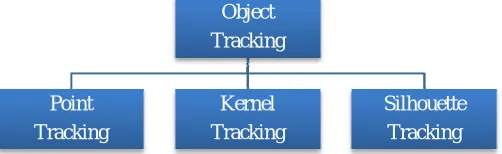
Tracking is the problem of approximating the path of an object in the image plane as it moves around scene [1]. Fig. 1 shows the three tracking-based approaches: point, kernel and silhouette.
Fig. 1. Tracking based approaches
Point tracking is feature based tracking used for complex and occlusion condition. It is have three methods kalman filter, particle filter and multiple hypothesis tracking. Kernel tracking is based on the object features and shape from one frame to next which used for moving object. It have four methods such as Simple Template Matching, Mean Shift Method, Support Vector Machine and Layering Based Tracking. Silhouette tracking is based on shaped description in every frame used for complex shape such as hand, fingers.it have two methods such as Contour and Shape Matching [1].
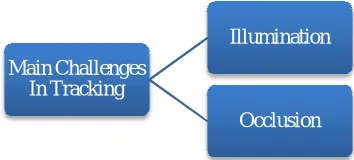
Tracking objects is considerable more challenging in videos to improve recognition and tracking performances [2]. It is major problem that comes into interest among researchers of computer vision. The objective of tracking is to establish the correspondence of objects in the consecutive frames of video [3]. Tracking have some limitations but main are illumination and occlusion as shown in fig. 2. Both have pivotal role in failing of tacking. Illumination is due to the
Object Tracking
Point Tracking
Kernel Tracking
ISSN(Online): 2320-9801
ISSN (Print): 2320-9798
International Journal of Innovative Research in Computer
and Communication Engineering
(An ISO 3297: 2007 Certified Organization)
Vol. 3, Issue 7, July 2015
unlike light surroundings and occlusion is due to overlapping of multiple object [3]. Even some researcher’s develop the real time algorithms to remove illumination problems and succeeded but they did not get much success in occlusion problem. And it is main as well as important problem in today’s video surveillance applications.
Fig. 2. Challenges in Object Tracking
To run the image processing algorithms on hardware platform in real time domain is a challenge. Today’s most research scholar could not solve these difficulties in cross hardware platform.
The aim of our system is to implement and design the image processing algorithm for object tracking and implement it on embedded hardware platform.
We introduced an effective color based algorithm that automatically detect and track every object in surveillance application using embedded raspberry Pi model.
This paper consists of the following sections: First, we introduced object tracking. In section II, we studied the literature related to our proposed algorithm. Proposed algorithm is described in section III. The experimental setup and results are explained in section IV and V respectively. The last section deals with conclusion.
II. LITERATURE SURVEY
In literature survey, we studied the related work done on object tracking.
A. H. Mazinan et al. [4] have implemented tracking algorithm in color video. They used the kalman Filter approach. Mean shift is used to search in each frame to find the location of an image region, who’s the color histogram is closest to the referenced color histogram of the object. The kalman filter estimates the state of a dynamic system, even if the system is unidentified. Outcomes that show the algorithm is efficient under sever situations, but speed of the object might be constant.
Weiming Hu et al. [5] have presented contour-based visual tracking. In proposed algorithm, the contour is initialized in the first frame. The contour is developed by color, adaptive shape, dynamic shape and abrupt motion control models. They implemented all these methods and successfully evaluated it. These algorithm gives more robust, efficient and more accurate results.
Yan-FeiRen et al. [6] have proposed the algorithm of salient object detection. The global contrast methodology is used to calculate the sparse histogram and region based texture contrast. The salient object is segmented as white pixels associates to the pixels of salient object and black pixels redirect the background. Advantage of these approach is precise and efficient in nature.
W.S.K. Fernando et al. [7] have addressed an approach for real-time event tracking under different background conditions. They presented a technique to find Adaptive Gaussian mixture model that handle dynamic background differences. These method also used to estimates clustering pixels into silhouettes based on objects. Occlusion is handle using feature correspondence matching technique.
Hong Zheng et al. [8] have implemented color attention preserved sparse generative object model (SGM) for tracking. They compared the proposed method with Intermediate Value Theorem (IVT) method and applied on databases like Caviar, Girl, Occlusion and Woman. It handle occlusion and illumination. They improved the SGM tracker by adding a color clue to make the tracker more accurate and efficient.
GuangShu et al. [9] have proposed Part-based multiple-person tracking framework. They explained Support vector machine (SVM) classifiers approach in multiple object tracking to challenge occlusion and appearance variation
Main Challenges In Tracking
Illumination
ISSN(Online): 2320-9801
ISSN (Print): 2320-9798
International Journal of Innovative Research in Computer
and Communication Engineering
(An ISO 3297: 2007 Certified Organization)
Vol. 3, Issue 7, July 2015
problems. It proposed a dynamic occlusion handling technique to learn and predict partial occlusions and it improved tracking performance. The method is highly discriminative and robust against appearance changes and occlusions.
We present the literature survey of tracking related algorithms. They used several algorithms like the kalman filter, mean shift, contour-based global contrast, adaptive gaussian mixture, sparse collaborative appearance and generative model, support vector machine methodology which are based on color features and histogram.
III.PROPOSED SYSTEM
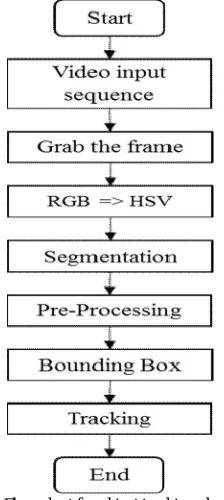
We proposed a color-based algorithm for object tracking. Fig. 3, shows the flow chart of color-based algorithm.
Fig. 3. Flow chart for object tracking algorithm
The flow chart have different steps such as RGB to HSV conversion, segmentation, pre-processing process, bounding box etc. For every video input sequence, we grab the frame from video. The grab frame is RGB frame which converted into HSV frame. We segmented the HSV frame. The segmented frames are tracked in the successive frames. We applied pre-processing process on segmented frame which contains morphological and filtering operation. Then, bounding box is used to track the object. The basic block of our flow chart are explain as:
A. RGB to HSV Conversion:
The two basic color space are RGB and HSV. The RGB color space is a composition of Red, Green and Blue color and the HSV color space is a composition of Hue, Saturation and Value respectively. RGB color space is simple way to show color. In RGB color space change in color is very small and it could not be detectable by human eyes. It cannot be used directly in image processing and we cannot get proper result frame in RGB color space. Whereas HSV color space is very sensitive to human eyes as compared to RGB color space, HSV color space have direct impact on human perception [10] so, HSV color space is used.
B. Segmentation
ISSN(Online): 2320-9801
ISSN (Print): 2320-9798
International Journal of Innovative Research in Computer
and Communication Engineering
(An ISO 3297: 2007 Certified Organization)
Vol. 3, Issue 7, July 2015
C. Pre-Processing Process
In pre-processing, morphological operation such as erosion and dilation are applied. The erosion and dilation is used to get proper size of segmented frame. Filtering operation is performed after morphological operation. Smoothing and median filter are used to remove the noise from result frame.
D. Bounding Box
The bounding box is applied on the result frame to track the object. It uses predefined coarse shape models, such as rectangles or ellipses. To represent objects, contour tracking is used [5].
IV.EXPERIMENTAL SETUP
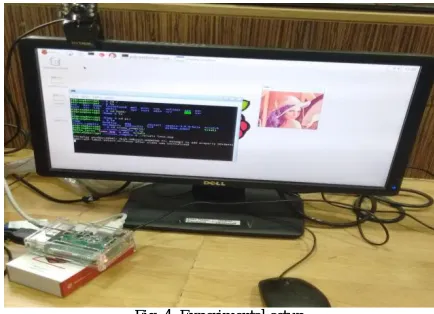
Fig. 4, shows the experimental setup for object tracking based on embedded hardware platform.
Fig. 4. Experimental setup
A. Hardware requirement
There are different boards which can be used in image processing, mainly Arduino, Beagle Bone and Raspberry Pi are used. The table I show the comparison of this three hardware [12] [13] [14].
TABLEICOMPARISON OF HARDWARE
Specification Arduino
(Mega)
Beagle Board (black bone)
Raspberry Pi 2 (Model B)
Processor Atmega
2560
Microcontroller
AM3358 Sitara Processor ARM CortexA8 Microprocessor
Broadcom BCM2836 ARM Cortex A7 Quad-core Microprocessor
Operating system (OS) --- Linux, RISC OS,
Android, Windows
Linux, RISC OS, Windows 10
Speed (CPU) 16 MHz 1 GHz 900 MHz
RAM (GPU) 8 KB (SRAM) 512 MB @ 800MHz 1 GB @ 450MHz
ROM 4 KB(EEPROM) 4 GB (inbuilt) Micro SD Card (up to 32GB)
USB --- 1 x 2.0 4 x 2.0
ISSN(Online): 2320-9801
ISSN (Print): 2320-9798
International Journal of Innovative Research in Computer
and Communication Engineering
(An ISO 3297: 2007 Certified Organization)
Vol. 3, Issue 7, July 2015
Fig. 5. Block diagram of Raspberry Pi 2 Model BFig. 6. Raspberry Pi 2 model B
Fig. 6, shows the Raspberry Pi 2 model B which is six times faster than other raspberry Pi models. It is low cost board with high Speed, more RAM, and Graphics features as compared to other two boards. Pi have Broadcom BCM2836 processor with ARM CortexA7 core. It has speed of 900 MHz and 1GB RAM @ 450 MHz. It has 4 x USB 2.0, Micro SDHC slot (up to 32GB), audio port, video port and ethernet port [14].
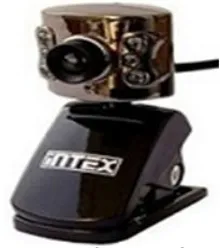
Fig. 7. Intex Night Vision Webcam
Also, it supports camera serial interface and external USB webcam. We used Intex Night Vision Webcam as shown in Fig. 7. It has excellent quality of CMOS sensor with 8.0 Mega pixels, Image Capture Resolution 3264 x 2448 and frame rate 30fps.
The other hardware required is Monitor, keyboard and mouse to show the results, HDMI to VGA adapter to connect Pi board with monitor, Memory card is used to run programs in Pi board which has Raspbian OS for embedded Linux background.
B. Software requirement
We have installed OpenCV 3.0.0 beta using Eclipse IDE on Ubuntu which is Linux operating system for our proposed color based algorithm. Fig. 8, shows the Software configuration for proposed system [15] [16] [17].
ISSN(Online): 2320-9801
ISSN (Print): 2320-9798
International Journal of Innovative Research in Computer
and Communication Engineering
(An ISO 3297: 2007 Certified Organization)
Vol. 3, Issue 7, July 2015
OpenCV (Open Source Computer Vision) is a library of programming functions mainly aimed at real-time computer vision. The library supports cross-platform real time applications. MATLAB also has image processing toolbox but as compared to OpenCV, it has less frame rate so the real time processing speed becomes less and it could not be used in real environment. OpenCV supports the many programming languages such as C, C++, Python and Java. We are using C/C++ language for programming in OpenCV. The OpenCV is installed on Ubuntu-Linux platform using Eclipse IDE. We compiled the C/C++ code in Eclipse integrated development environment using GCC compiler and got exe file which runs on system. The exe file again compiled by arm based GCC compiler and executed on embedded platform.
V. EXPERIMENTAL RESULTS
To verify the proposed novel color based algorithm, we tested our approach on several video databases with resolution of 426x240. It has been applied for a human tracking.
The complete system is implemented on raspberry pi 2 board using OpenCV on the Linux platform on generated database. We compared the ground truth frames with result frames. Fig. 6, shows the generated database with result frame.
The experimental results is shown in Fig. 6. The Black Object is trackedsuccessfully in (a) frame 35, (b) frame 163, (c) frame 279 and (d) frame 348 which is implement on the ARM based Raspberry Pi board in real time domain. It shows the object tracking in moving video sequence. The black object tracked using HSV ranges of black color.In Fig. 6, thetracked object in moving sequence are shown by frames i.e. result frames 35, 163, 279 and 348.
(a) frame 35 (b) frame 163
(c) frame279 (d) frame 348
ISSN(Online): 2320-9801
ISSN (Print): 2320-9798
International Journal of Innovative Research in Computer
and Communication Engineering
(An ISO 3297: 2007 Certified Organization)
Vol. 3, Issue 7, July 2015
The performance of any algorithm is based on the accuracy and sensitivity of that algorithm. The accuracy and sensitivity is depend on the all frames. Here, we calculated the accuracy (A) and sensitivity (S) of video database using the true positive (TP), true negative (TN), false positive (FP) and false negative (FN) values of total frame (N) as shown in table II. Color based algorithm gives 94.43% accuracy.
TABLEIICALCULATION OF RESULT
Video Database N TP TN FP FN S(%) A(%)
Black Object 467 401 40 0 26 93.91 94.43
VI.CONCLUSION AND FUTURE WORK
In this paper, we proposed the color based algorithm to track the object. The object is tracked using HSV color space concepts and segmentation operation. The algorithm is implemented on the Raspberry Pi board in real time. Proposed algorithm is robust in nature and applied on the black object with color video database. For proposed algorithm, the accuracy is 94.43% and sensitivity is 93.91% in real time environmen2t.
In future, the proposed algorithm will be used to remove the illumination, rotation and occlusions problems by adding color specification in proposed algorithm, which will be furtherresearch topic.
REFERENCES
1. Himani S. Parekh, Darshak G. Thakore, Udesang K. Jaliya, “A Survey on Object Detection and Tracking Methods,” in International Journal of
Innovative Research in Computer and Communication Engineering (IJIRCCE), Vol. 2, pp. 2970-2978, February 2014.
2. BargaDeori, Dalton Meitei Thounaojam, “A Survey on Moving Object Tracking in Video,” in International Journal on Information Theory
(IJIT), Vol. 3, pp. 31-66, July 2014.
3. Samar D. Gajbhiye, Pooja P. Gundewar, “A Survey on Object Tracking and Occlusion Handling,” in CiiT International Journal of Digital
Image Processing, Vol 7, No 3, pp. 85-88, 2015.
4. A. H. Mazinan, A. Amir-Latifi, M. F. Kazemi, “A knowledge-based objects tracking algorithm in color video using Kalman filter approach,” in
2012 International Conference on Information Retrieval & Knowledge Management (CAMP),pp. 50-53, March 2012.
5. Weiming Hu, Xue Zhou, Wei Li, WenhanLuo, Xiaoqin Zhang, and Stephen Maybank, “Active Contour-Based Visual Tracking by Integrating
Colors, Shapes, and Motions”, in IEEE Transactions On Image Processing, Vol. 22, pp. 1778 – 1792, May 2013.
6. Yan-FeiRen, Zhi-Chun Mu, “Salient object detection based on global contrast on texture and color,” in International Conference on Machine
Learning and Cybernetics (ICMLC), pp. 7-12, 13-16 July 2014.
7. W.S.K. Fernando, H.M.S.P.B. Herath, P.H. Perera, M.P.B. Ekanayake, G.M.R.I. Godaliyadda and, J.V. Wijayakulasooriya, “Object
Identification, Enhancement and Tracking under Dynamic Background Conditions,” in 7th International Conference on Information and Automation for Sustainability (ICIAS), pp. 1-6, 22-24 December 2014.
8. Hong Zheng, ChunnaTian ; Wei Wei, “Visual tracking based on the color attention preserved sparse generative object model,” in IEEE
International Conference on Orange Technologies (ICOT), pp. 1-4, 20-23 September 2014.
9. GuangShu, Afshin Dehghan1, Omar Oreifej, Emily Hand, Mubarak Shah, “Part-based Multiple-Person Tracking with Partial Occlusion
Handling,” in IEEE Conference on Computer Vision and Pattern Recognition (CVPR), pp. 1815 – 1821, 16-21 June 2012.
10. Liu Dong, Xi Lin, “Monocular-Vision-Based Study on Moving Object Detection and Tracking,” in 4th International Conference on New
Trends in Information Science and Service Science (NISS), pp. 692 – 695, 11-13 May 2010.
11. Qian Zhang, King NgiNgan, “Segmentation and Tracking Multiple Objects under Occlusion from Multiview Video,” in IEEE transactions on
image processing, Vol. 20, pp. 3308 - 3313, November 2011.
12. Arduino Detailed Information Available at:
https://www.arduino.cc/, https://en.wikipedia.org/wiki/Arduino
13. Beagle Bone Detailed Information Available at:
http://beagleboard.org/, https://en.wikipedia.org/wiki/BeagleBoard
14. Raspberry Pi Detailed Information Available at:
https://www.raspberrypi.org/, https://en.wikipedia.org/wiki/Raspberry_Pi
15. http://design.ubuntu.com/wp-content/uploads/ubuntu-logo14.png
16. https://eclipse.org/eclipse.org-common/themes/solstice/public/images/logo/eclipse-800x188.png
ISSN(Online): 2320-9801
ISSN (Print): 2320-9798
International Journal of Innovative Research in Computer
and Communication Engineering
(An ISO 3297: 2007 Certified Organization)
Vol. 3, Issue 7, July 2015
BIOGRAPHY
Mr. Samar D. Gajbhiye is pursuing M.E. in VLSI & Embedded System from MIT College ofEngineering, Pune, India and received B.E. degree in Electronics and Telecommunication Engineering. His research interests include Digital and Embedded Image Processing, Signal Processing, VLSI and Embedded System Design.