ISSN(Online) : 2320-9801
ISSN (Print) : 2320-9798
I
nternational
J
ournal of
I
nnovative
R
esearch in
C
omputer
and
C
ommunication
E
ngineering
(An ISO 3297: 2007 Certified Organization)
Vol. 3, Issue 6, June 2015
An Energy Efficient QoS Based
Replication Strategy
Reena S. More
1,
Prof.Nilesh V. Alone2PG Student, Department of Computer Engineering, R H. Sapat College of Engineering, Nashik, M.S. India1
Head, Department of Computer Engineering, R H. Sapat College of Engineering, Nashik, M.S. India2
ABSTRACT
:
Cloud computing is a model that relies on sharing computing resources rather than having local servers or personal devices to handle applications.Data-intensiveapplications draw more and more attentions in the last few years.Cloud computing provides the tools and technologies to build data intensive parallel applications with much more affordable prices. Data Corruption occurrence on these data intensive applications does not meet the QoS Requirements. Different applications are having different quality of service (QoS). Every data is not being replicated on the high performance node. Data Intensive Application requires high cost to replicate data and as cloud computing includes number of different nodes it consumes large amount of energy. Huge amounts of energy is consumed by cloud which results in high operating costs and carbon dioxide emissions to the environment. So, to avoid this we propose a system that will reduce the cost for replication and also reduce the large amount of energy consumption of heterogeneous nodes.KEYWORDS
:
QoS, Data Intensive Application.I.
INTRODUCTION
Large scale distributed systems are becoming more and more popular as data is being shared in data-intensive scientific applications. Cloud computing is evolved by addressing the Quality of Service and reliability problems. Compared to traditional parallel computing techniques Cloud computing provides the tools and technologies to build data intensive parallel applications with much more affordable prices. Applications that explore, query, analyse, visualise, and, in general, process very large scale data sets are known as Data Intensive Applications. In this information age, digital data in the scale of hundreds of petabyte are being generated every day. This includes electronic transactions, publications and media managed by government establishments and commercial organisations, electronic records from numerous sensors, social contents created by casual internet users, results from huge scientific experiments and many more. At such an astonishing information growth rate, it is not surprising that many organisations recognised the critical needs for data-intensive applications to process and analyse these ever-growing data in order to gain competitive advantages.Cloud computing provides scalable computing and storage resources to applications via the Internet. With the flexible and transparent features in the resource allocation various types of data-intensive applications are developed in the cloud computing environment.
ISSN(Online) : 2320-9801
ISSN (Print) : 2320-9798
I
nternational
J
ournal of
I
nnovative
R
esearch in
C
omputer
and
C
ommunication
E
ngineering
(An ISO 3297: 2007 Certified Organization)
Vol. 3, Issue 6, June 2015
Cloud computing includes many storage nodes. Mainly Power consumption of the computing nodes is mostly determined by the CPU, disk storage, memory, network interfaces. The goal is to minimize the energy consumption inthe storage nodes.Energy is saved by processing the large amount of data on the high performance node. By this approach it is easy to replicate the data in less access time.
The paper is organized as follows: Section II overviews the related work carried out different methods for data replication, QoS requirement and energy consumption, while Section III Problem Statement. Section IV Consists of System Architecture. Section V Mathematical model. Section VI Implementation Section VII Experimental results regarding efficiency parameters of the proposed algorithm.
II. RELATED WORK
There are many survey related to different research topics, like Lazy Update, replica for content distribution.High availability and service level agreement must be satisfied for the application and deployment in the cloud.Huge storage cost is required for Data Intensive application to store data in the cloud.
Gao and L. Diao [2] use lazy update approach to improve the throughput of data access and to reduce the response time to separate the process of data replication and data access. Replica is placed in the appropriate server of the system.
W. Li, Y. Yang et. Al. [3] used a cost effective mechanism namely PRCR for the effective data management. For maintaining the data reliability this mechanism checks the availability of replicas. The disadvantage of the mechanism is it is not considering the performance of data access. X. Tang and J. Xu [4] described two classes of service models is being used: replica-aware services and replica-blind services. By knowing the location information, servers are capable of optimizing request to improve responsiveness. Hsiangkai Wang et al. [5] determines the positions of replicas to satisfy the quality requirements imposed by data requests. For heterogeneous environment Quality assurance is important. Data replication is an important technique to speed up data access in Data Grid.Anton Beloglazov et al. [6] says that cloud data centers consume enormous amounts of electrical energy resulting in high operating costs and carbon dioxide emissions. The goal is to improve the utilization of computing resources and reduce energy consumption under workload independent quality of service constraints
III.PROBLEM STATEMENT
Due to a large number of nodes in the cloud computing system, the probability of hardware failures is more. Some hardware failures will damage the disk data of nodes. As a result, the running data-intensive applications may not read data from disks successfully. To tolerate the data corruption, the data replication technique is extensively adopted in the cloud computing system to provide high data availability. However, the QoS requirement of an application is not taken into account in the data replication. When data corruption occurs, the QoS requirement of the high-QoS application cannot be supported continuously.Heterogeneous nodes are included and mainly Power consumption of the computing nodes is mostly determined by the CPU, disk storage, memory, network interfaces. The goal is to minimize the energy consumption in the storage nodes. Energy is saved by processing the large amount of data on the high performance node. By this approach it is easy to replicate the data in less access time.
IV.SYSTEM ARCHITECTURE
ISSN(Online) : 2320-9801
ISSN (Print) : 2320-9798
I
nternational
J
ournal of
I
nnovative
R
esearch in
C
omputer
and
C
ommunication
E
ngineering
(An ISO 3297: 2007 Certified Organization)
Vol. 3, Issue 6, June 2015
main aim is to improve resource utilization as efficiently as possible.To handle the high energy use problem, it is required to eliminate inefficiencies of the resources that are utilized to serve application workloads. In the proposed system we achieve this goal by dynamically processing the large amount of data on high performance node.We have used hive to show the difference between the partition and nonpartition input data. The large amount of data is being processed on the high performance node. As data is not processed on low performance node their energy will be saved.
Figure 1. System architecture
V.
MATHEMATICAL MODEL
Let S be a technique for Data Replication Such That S= {s, e, X, Y, F} Where,
s represents Start state - Gets the data
e represents End state - View the results X represents the set of inputs:
X= {D} i. D= Data Y is the set of outputs:
Y = {C}
i. C= Data Replication F is the set of function
F= {F1, F2}
ii. F1= Divides the data into blocks of 64MB
iii. F2= Process the blocks into <key, value >pair using Map-Reduce.
Custom Partitioning
ISSN(Online) : 2320-9801
ISSN (Print) : 2320-9798
I
nternational
J
ournal of
I
nnovative
R
esearch in
C
omputer
and
C
ommunication
E
ngineering
(An ISO 3297: 2007 Certified Organization)
Vol. 3, Issue 6, June 2015
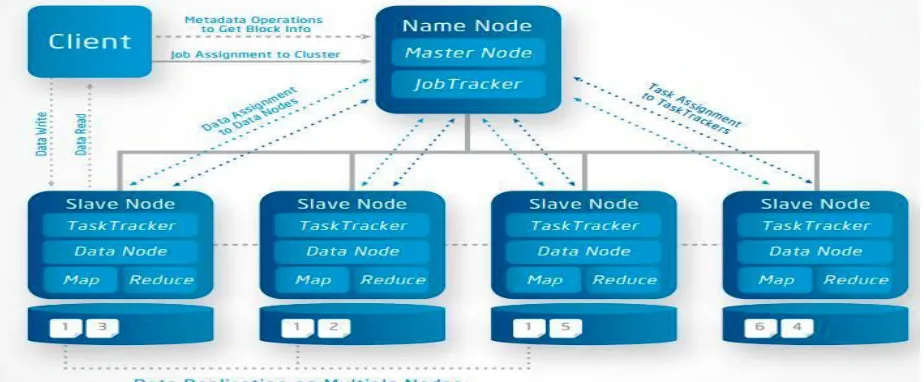
the reducers according to the partitioning function. The basic idea is to partition a large problem into smaller subproblems. To the extent that the sub-problems are independentMap-Reduceprovides a very effective tool for tackling large-data problems. MapReduce is a programming model and an associated implementation for processing and generating large data sets.Users specify a map function that processes a key/value pair to generate a set of intermediate key/value pairs, and a reduce function that merges all intermediate values associated with the same intermediate key. Figure 2 shows how the Map-Reduce execute the kay-value pair.
Figure 2. Map-Reduce
VI.IMPLEMENTATION
The system is implanted in Hadoop Framework. We have created Hadoop cluster. HDFS Components are used to form the cluster.Java is used for partitioning the data into data block. We have also used Hive to Show the comparative results between Partition and Non-partition data. Hadoop is installed on CentOS 6.4 Linux Operating System.
VII.SIMULATION RESULTS
ISSN(Online) : 2320-9801
ISSN (Print) : 2320-9798
I
nternational
J
ournal of
I
nnovative
R
esearch in
C
omputer
and
C
ommunication
E
ngineering
(An ISO 3297: 2007 Certified Organization)
Vol. 3, Issue 6, June 2015
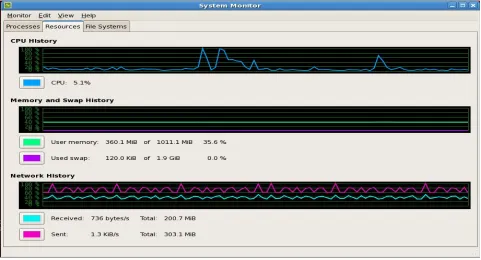
Figure 3-Health of current cluster
Figure 1. Shows the health of the resources. Out of Total Memory how much memory is in used and the available memory is shown. CPU use in this cluster and network history.
Figure 4- Custom Partitioning result
ISSN(Online) : 2320-9801
ISSN (Print) : 2320-9798
I
nternational
J
ournal of
I
nnovative
R
esearch in
C
omputer
and
C
ommunication
E
ngineering
(An ISO 3297: 2007 Certified Organization)
Vol. 3, Issue 6, June 2015
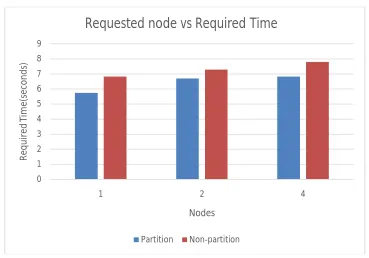
Figure 5.Partitioning and Non-Partitioning Requested node vs RequiredTime
Figure 5 shows the difference between partition and non-partitioning data. From this figure we conclude that partitioning the data and replicating is much better that replicating the data without partition.
VII. CONCLUSION
The simulation results showed that the proposed algorithm performs better with the total transmission energy metric. In this work, result of how the energy is being consumed in cloud infrastructure is tried to predict. The proposed system replicate the data on the high performance node and reduce the energy by processing the data on high performance node and also reduce the replication cost.So in this replication process we replicate the data on the highly qualified node and keep only the required nodes in the activate nodes. This save the energy of the computing nodes in the cloud computing environment.
ACKNOWLEDGMENT
R. S. More thanks Prof. N.V.Alone,Head of Comp. Engg Department, GES’s R. H. Sapat College of engineering for his valuable suggestions and comments to improve the quality of this paper and also thanks toMrs. Archana Vaidya, PG Co-ordinator,GES’s R. H. Sapat College of Engineering, Nashik.With a great sense of attitude the authors acknowledge Dr.Prafulla C. Kulkarni, Principal,GES’s R. H. Sapat College of Engineering,Nashik for his kind support and blessings. We are also very much thankful to all those who indirectly helped in making this paper.
REFERENCES
[1] Jenn-Wei Lin,Chien-Hung Chen, and J. MorrisChang "QoS Aware Data Replication for Data Intensive Applications in Cloud Computing Systems", IEEE Transaction, Year 2013.
[2] A.Gao and L.Diao, “Lazy Update Propagation for Data Replication in Cloud Computing,” in Proc. 2010 5th Int Conf. Pervasive Computing and Applications (ICPCA), Dec. 2010.
[3] W. Li, Y. Yang, J. Chen, and D. Yuan, “A Cost-Effective Mechanism for Cloud Data Reliability Management Based on Proactive Replica Checking,” in Proc. 2012 12th IEEE/ACM Int. Symp. Cluster, Cloud and Grid Computing (CCGrid), May 2012.
0 1 2 3 4 5 6 7 8 9
1 2 4
R eq u ir ed T im e( se co n d s) Nodes
Requested node vs Required Time
ISSN(Online) : 2320-9801
ISSN (Print) : 2320-9798
I
nternational
J
ournal of
I
nnovative
R
esearch in
C
omputer
and
C
ommunication
E
ngineering
(An ISO 3297: 2007 Certified Organization)
Vol. 3, Issue 6, June 2015
[4] X. Tang and J. Xu, “QoS-Aware Replica Placementfor Content Distribution,” IEEE Trans. Parallel and Distributed System, vol. 16, no. 10, pp. 921–932, Oct. 2005.
[5] H. Wang, P. Liu, and J.-J. Wu “A QoS-Aware Heuristic Algorithm for Replica Placement,” in Proc. 7th, IEEE/ACM Int. Conf. Grid Computing, Sep. 2006, pp. 96–103.
[6] Anton Beloglazov,Jemal Abawajyb, Rajkumar Buyyaa “Energy- aware resource allocation heuristics for efficient management of data centers for Cloud computing”. Year 2013.
[7] Eduardo Pinheiro, Wolf-Dietrich Weber and Luiz Andr´e Barroso “Failure trends in a large disk drive population” Appears in the Proceedings of the 5th USENIX Conference on File and Storage Technologies (FAST’07), February 2007.
[8] Feng Wang, Jie Qiu, Jie Yang, Bo Dong, Xinhui Li, Ying Li“Hadoop High Availability through Metadata Replication” CloudDB'09, November 2, 2009, Hong Kong, China.
[9] K. Shvachko, H. Kuang, S. Radia, and R. Chansler, “The Hadoop Distributed File System,” in Proc. IEEE 26th Symp. Mass Storage Systems and Technologies (MSST), Jun. 2010, pp. 1–10.
[10] Huangke Chen, Laurence T. Yang Ji Wang, Shu Yin, and Xiaocheng Liu “Real-Time Tasks Oriented Energy-Aware Scheduling in Virtualized Clouds”, IEEE Transactions on Cloud Computing, vol. 2, no. 2, april-june 2014.
[11] Apache Hadoop Project. [Online]. Available: http://hadoop. apache.org.
[12] A. M. Soosai, A. Abdullah, M. Othman, R. Latip, M. N. Sulaiman, and H. Ibrahim, “Dynamic Replica Replacement Strategy in Data Grid,” in Proc. 2012 8th Int. Conf. Computing Technology.
BIOGRAPHY
Reena S. More received her BE degree from Pune University. She is currently pursuing her master degree in computer science.