Parallel Clustering of Gene Expression
Dataset in Multicore Environment
Pranoti Kamble, Prof. Rakhi Wajgi
Dept. of Computer Technology, Yeshwantrao Chavan College of Engineering, Nagpur, India
Professor, Dept. of Computer Technology, Yeshwantrao Chavan College of Engineering, Nagpur, India
ABSTRACT: Clustering has become the powerful and widely used method in gene expression dataset analysis to obtain biological information. Clustering using sequential approach is time consuming task. So as to save time and to increase speedup we have applied parallel clustering on single machine utilizing computational power of multicore processors in the system. In this work, we have also done comparison of sequential clustering and the parallel clustering in terms of time consumed for clustering of yeast gene expression dataset. With the use of multicore processor the speedup gained from 5 to 7% on intel core 2 duo processor with 2Gb RAM.
KEYWORDS: Clustering, Gene expression dataset, Multicore.
I. INTRODUCTION
Data mining extracts knowledge from large amount of dataset. Clustering is the process of grouping data objects into a set of disjoint sets, called clusters So that objects within a class have high similarity to each other while objects in different classes are more dissimilar [1]. Clustering of gene expression data can be divided into two main categories: Gene-based clustering and Sample-based clustering. In gene based clustering, genes are treated as objects and samples are features or attributes for clustering. The goal of gene-based clustering is to identify differentially expressed genes and sets of genes with similar expression pattern or profiles, and to generate a list of expression measurements. In Sample based clustering, samples are treated as objects and genes are features for clustering. Sample based clustering can be used to reveal the phenotype structure or substructure of samples. The purpose of clustering gene expression data is to reveal the natural structured inherent data and extracting useful information from noisy data.
We are implementing clustering on the yeast gene expression dataset with 494 significantly identified genes. Yeast dataset contains information about bacterial microorganism. These organisms are useful in the development of foreign proteins. These proteins are useful in the production of insulin.
Clustering tells about the biological structure of the gene expression dataset. For the clustering process we have proposed the k-means algorithm with better centred method. The basic k-means clustering have some drawbacks: (1)selection of randomized k-value which sometime can form wrong cluster So to overcome this drawback we have proposed k-means centred algorithm. (2) Conventional k-means consumes lot of time.
F
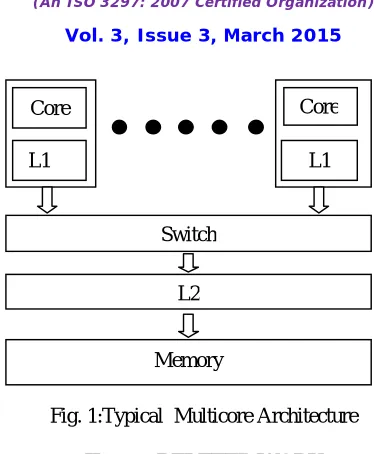
Fig. 1:Typical Multicore Architecture
II. RELETED WORK
Analysis of gene expression dataset is very important research topic in bioinformatics to identify diseases and other factors. Data mining have widely useful in gene expression dataset. The author Daxin Jiang et al. has analysed different clustering methods. The author categorised methods into gene based clustering consists of K-means and hierarchical clustering, model based clustering and density based hierarchical clustering. The author applied clustering methods to assess the quality and reliability of clustering results in [1]. Author T.Chandrasekhar et al. proposed new algorithm ECIA (Enhanced Centroid Initialization Algorithm) to overcome the drawback of k-means algorithm of randomized selection of K-values [9]. Author K.Y.Yeung et al. proposed method FOM (figure of merit) for assessing the quality of cluster results [10]. Soriful Horique et al. presents static methods to find regulation of gene from statistical gene expression data, comparison of genes having similar regulation and extraction of sub cluster from bib cluster and perform hierarchical analysis [8]. Author Sanjay Kumar Sharma et al. describes the parallel algorithms for computing the solution of dense system of linear equation using OpenMP interface [2]. The author Noha A. Yousri investigated the application of a novel validity measure to gene expression clustering. The leukaemia and breast cancer dataset are used to evaluate the applicability of the proposed validity to discover the natural connectedness of expression patterns [7].
III. METHODOLOGY USED
3.1 Sequential k-means Clustering:
means clustering algorithm have drawback of forming wrong cluster because of randomized selection of K-value i.e. cluster centroid. To overcome this drawback and to improve the quality of clusters we proposed better centred K-means clustering algorithm. In this, first we select initial random K- data points. Then again the K- data points will be selected from the formed clusters where we will assign the calculated data points again to the clusters centroid. Euclidean distance:
( , ) = ( − ) + ( − ) +⋯. +( − ) ……equation (1)
K-means Pseudocode:
Core
L1
Core
L1
Switch
L2
D= Gene expression dataset K – Number of clusters 1) Enter the number of cluster 2) Choose randomized k value
3) Calculate Euclidean distances with respect to k value 4) Make clusters with minimum distances values
5) For the better clusters, choose again the pre-selected k- value centre from the clusters formed. 6) Again execute step 3) and step 4).
7) Exit
3.2 Multicore Clustering:
We have multicore processor in our system but the utilization of multicore system don’t happen the way it should be. So in order to harvest the full power of a multi-core processor the software application must be able to execute tasks in parallel utilizing all available CPUs. Parallelization of a process consist of breaking up a large single process into multiple smaller tasks that can run in parallel and once finalized can be combined obtaining an overall improvement in performance. The result is the execution of a single task or process by multiple processors or CPUs “Parallel Processing”, not to be confused with concurrency.
Executor framework (java.util.concurrent. Executor) was released with jdk 5 in package java.util.concurrent to achieve asynchronous parallelization, improve performance and take advantage of a multicore environment.
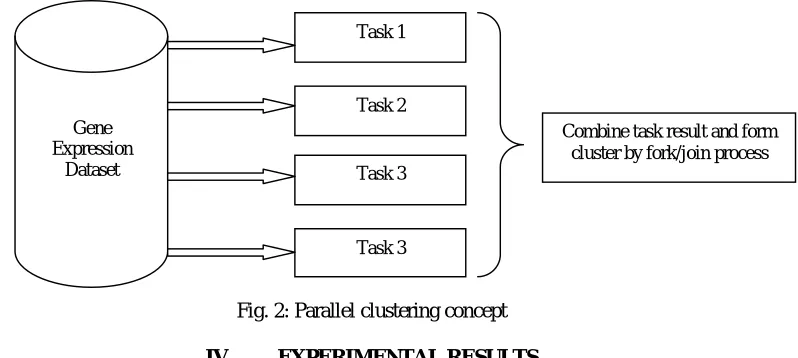
The introduction of the ExecutorService in the concurrent package make it easy to submit tasks and the service will execute them and hand us back a future object that we can use to test the progress and to obtain the result of a given executed task once it finishes. The ExecutorService will use threads internally to achieve parallelization and since the tasks are submitted we can also execute the tasks asynchronously, once all the tasks at hand are submitted we can move ahead in the main thread and do something else or just wait and monitor for the tasks that end to get the results making possible to achieve fork/join processing. With the executor class the gene expression dataset divides threads to multiple core. The core will execute threads internally as in clustering we have selected randomized K- value. so core will be allocated with the selected k-value Euclidean distances will be calculated parallel. And the formed cluster will be joined by fork/join method. In the end we get the combined clusters.
Gene Expression
Dataset
Task 1
Task 2
Task 3
Task 3
Fig. 3: Serial Clustering
Fig. 4: Parallel Clustering
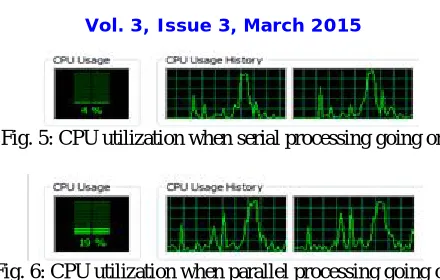
Fig. 5: CPU utilization when serial processing going on
Fig. 6: CPU utilization when parallel processing going on
Comparison Of Sequential Clustering and Multicore Clustering:
I have core 2 duo Intel processor. The speedup will increase with i3, i5 and i7 processor. Table 1:Comparison of Clustering on different platforms
Core 2 duo processor:
Dataset used
Data Points
No. of Clusters
Time(in sec) Sequential Multicore
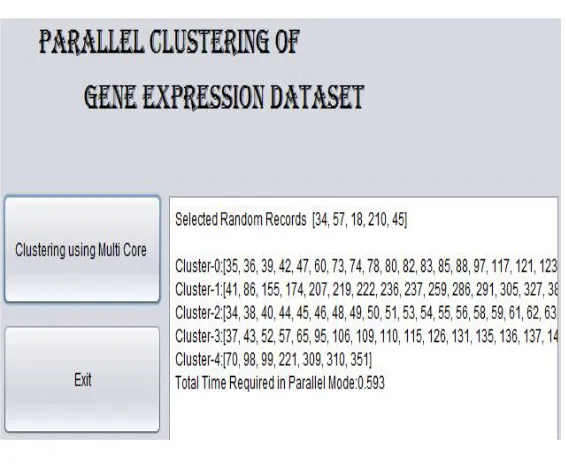
Yeast 419 5 3.042 0.593
Minimum Speedup=5.1%
V. CONCLUSION
We have executed clustering on dual core processor in which we got increased speedup of 5.1. With the execution of java utility provided concurrent package ExecutorService we have successfully increased the utilization of processors from 4% to 19%.
REFERENCES
1. Daxin Jiang, Chun Tang, and Aidong Zhang, “Cluster analysis for gene expression data: a survey”, IEEE Transactions on knowledge and data engineering, vol. 16, no. 11, November 2004.
2. Sanjay Kumar Sharma and Dr. Kusum Gupta, “Performance analysis of parallel algorithms on multi core system using OpenMP”, International journal of computer science, engineering and information technology (IJCSEIT), vol.2, no.5, October 2012.
3. Kittisak Kerdprasop and Nittaya Kerdprasop, “Parallelization of K-means clustering on multi-core processors”, ACS'10 Proceedings of the 10th WSEAS international conference on applied computer science pages 472-477 2010.
4. S. N. Tirumala Rao, E. V. Prasad and N. B. Venkateswarlu, “A critical performance study of memory mapping on multi-core processors: an experiment with k means algorithm with large data mining data sets”, International journal of computer applications pages 0975 – 8887 volume 1, no. 9, 2010.
5. Xiaohong Qiu, Geoffrey Fox, Huapeng Yuan, SeungHee Bae, George Chrysanthakopoulos and Henrik Nielsen, “parallel data mining on multicore clusters”, 7th International conference on grid and cooperative computing, pages 41-49, Oct 2008.
6. Ping Guo and Xiaoyan Deng, “Gene Expression Data Cluster Analysis”, IEEE WASE International conference on information engineering 2009.
11. K.Y.Yeung, D. R. Haynor and W. L. Ruzzo, “Validating clustering for gene expression dataset”, Oxford university press, vol. 17, pages 309-318, 2001.
BIOGRAPHY
Pranoti Kamble is a student of M.Tech Computer Science Final Year. She has received B.E. (Computer Science) from P. R. Pote College of engineering, Amravati. Her research interests are bioinformatics, data mining, parallel computing.