HIGHLIGHTED ARTICLE
| INVESTIGATION
Beyond Thermodynamic Constraints: Evolutionary
Sampling Generates Realistic Protein
Sequence Variation
Qian Jiang,*,†,1Ashley I. Teufel,*,1Eleisha L. Jackson,* and Claus O. Wilke*,2 *Department of Integrative Biology, The University of Texas at Austin, Texas 78712 and†State Key Laboratory of Crop Genetics and Germplasm Enhancement, College of Horticulture, Nanjing Agricultural University, 210095, China ORCID IDs: 0000-0002-2877-1179 (Q.J.); 0000-0002-1076-0439 (A.I.T.); 0000-0002-7470-9261 (C.O.W.)
ABSTRACT Biological evolution generates a surprising amount of site-specific variability in protein sequences. Yet, attempts at modeling this process have been only moderately successful, and current models based on protein structural metrics explain, at best, 60% of the observed variation. Surprisingly, simple measures of protein structure, such as solvent accessibility, are often better predictors of site-specific variability than more complex models employing all-atom energy functions and detailed structural modeling. We suggest here that these more complex models perform poorly because they lack consideration of the evolutionary process, which is, in part, captured by the simpler metrics. We compare protein sequences that are computationally designed to sequences that are computationally evolved using the same protein-design energy function and to homologous natural sequences. Wefind that, by a wide variety of metrics, evolved sequences are much more similar to natural sequences than are designed sequences. In particular, designed sequences are too conserved on the protein surface relative to natural sequences, whereas evolved sequences are not. Our results suggest that evolutionary simulation produces a realistic sampling of sequence space. By contrast, protein design—at least as currently implemented—does not. Existing energy functions seem to be sufficiently accurate to correctly describe the key thermody-namic constraints acting on protein sequences, but they need to be paired with realistic sampling schemes to generate realistic sequence alignments.
KEYWORDSprotein evolution; site specific variability; protein structure
A
LIGNMENTS of protein sequences can display largeamounts of position-specific variability. This variability exists because selective pressures for proteins to fold and function are not experienced uniformly across a protein se-quence. The relative variability of a position in a sequence is often associated with where that position is located in the protein structure (Thorne 2007; Liberleset al.2012; Arenas et al. 2015; Echaveet al. 2016). For example, patterns of sequence variation differ between the core and surface of proteins. The core tends to evolve more slowly, and be more
conserved, than sites on the surface (Kimura and Ohta 1974; Overington et al. 1992; Mirny and Shakhnovich 1999; Franzosa and Xia 2009; Ramseyet al.2011; Tóth-Petróczy and Tawfik 2011). These core sites also tend to have more hydrophobic residues, while sites on the surface tend to have more polar residues (Jones and Thornton 1996; Bastollaet al. 2007; Jackson et al. 2013). In general, sites that are con-served are assumed to be more important for protein struc-ture, stability, and, ultimately, function, even though most sites in a protein are not directly involved in function.
While a significant body of literature exists examining how protein structure and thermodynamic constraints interact with evolutionary processes to shape site-specific variability, current models explain, at best, 60% of variability (Echave et al.2016). Existing models span from ones using very sim-ple metrics, such as relative solvent accessibility (RSA) or weighted contact number (WCN), to ones using complicated all-atom energy functions and protein design. One surprising result from these efforts is that the simple models tend to Copyright © 2018 by the Genetics Society of America
doi:https://doi.org/10.1534/genetics.118.300699
Manuscript received January 4, 2018; accepted for publication January 25, 2018; published Early Online January 30, 2018.
Supplemental material is available online atwww.genetics.org/lookup/suppl/doi:10. 1534/genetics.118.300699/-/DC1.
1These authors contributed equally to this work.
2Corresponding author: Department of Integrative Biology, The University of Texas
perform as well as, or better than, the complicated models. In particular, protein design has worked particularly poorly in predicting site variability observed in natural sequence align-ments (Jacksonet al.2013, 2016; Shahmoradiet al.2014).
Why the more complex models fail to explain observed sequence variation is unknown. All-atom stability models should account for the same properties reflected in RSA and WCN, as well as an array of other features. For example, the mean interaction energy of a site with the rest of the protein is a function of a site’s contacts, reflected in WCN (Halle 2002). And thermodynamic stability is related to RSA through the energetic cost of burying a side chain in the protein core (Zhou and Zhou 2004). At the same time, all-atom models remain limited in important aspects. They generally do not accurately estimate the entropic contribu-tion of the unfolded protein ensemble, and they tend to be-come increasingly inaccurate as more changes are introduced into the original protein sequence.
In addition to any biophysical limitations exhibited by all-atom models, there is another critical aspect by which protein design methods deviate from the process of protein evolution as it plays out in living organisms: Under evolution, mutations are introduced one by one and eitherfix or are lost to drift. As a consequence, a mutation that is deleterious in the current genetic background will rarelyfix, even if it were acceptable in other genetic backgrounds. Protein design, by contrast, allows the replacement of multiple amino acids at once, and, thus, theoretically can create sequence configurations that are thermodynamically allowed but not easily accessible by evo-lution (Huanget al.2016). In fact, a number of recent studies have begun to examine how the state of the background se-quence affects a the ability of a protein to accumulate substi-tutions (Pollocket al.2012; Shahet al.2015; Goldstein and Pollock 2016; McCandlishet al.2016). These studies suggest that the order in which changes to a sequence occur can affect the propensity of a position to tolerate further mutations. Therefore, the evolutionary history of a protein may infl u-ence how mutational space is sampled, and the order in which states were sampled, and the length of time any spe-cific state has been resident, may also influence sampling behavior. Hence, the effect the evolutionary process has on shaping site-specific variability could be considerable.
Here, we explore the influence of evolutionary history in the generation of site-specific variability. By comparing protein sequences produced under a model that combines evolutionary history and stability constraints to sequences produced by a model that considers stability constraints alone, we can begin to tease apart the relationship between evolutionary history, protein stability, and sequence variability. To generate sequences in the absence of evolutionary history, we employ protein design as implemented in the RosettaDesign suite (Kuhlman et al. 2003). In this method, all of the residues are replaced simulta-neously. To add evolutionary history, we use the same Rosetta forcefield but introduce substitutions sequentially, in a process that mimics evolution under natural selection (Teufel and Wilke 2017). We then compare the sequences produced by each of
these methods to one another and to natural sequences. Wefind that proteins generated by simulating evolution display similar site-specific variability to natural proteins, whereas designed sequences do not.
Methods
Protein structures and alignments
We analyzed a set of 38 proteins with available structures from Saccharomyces cerevisiae. This dataset had previously been studied in the context of protein design by Jackson et al. (2013), and it had originally been assembled by Ramsey et al. (2011). For each structure, Ramseyet al.(2011) had also assembled alignments of homologous sequences con-taining at least 50 sequences each. Supplemental Material, Table S1 inFile S1lists the protein data bank identifier (PDB ID) for each of the template structures, and the number of homologous sequences available in the respective alignment.
Generation of protein sequences
For each of the 38 protein structures, we computationally generated alignments of 500 variant sequences via both protein design and protein evolution. In all cases, wefirst minimized the structures with Rosetta (Leaver-Fay et al. 2011). This minimization ensures that the energy difference observed upon subsequent mutation can be attributed to the effect of the mutation and is not simply caused by improved amino-acid side-chain packing. Unless explicitly noted other-wise, we initialized both protein design and protein evolution simulations with the exact structures and amino-acid se-quences corresponding to the PDB and chain identifiers listed in Table S1 inFile S1.
For protein design, we used thefixed-backbone method implemented in RosettaDesign (Kuhlman et al.2003). This method only allows for movement of the side chains, while the backbone is held fixed. The following command was used:
./fixbb.linuxgccrelease -database rosetta_ database -s input.pdb -resfile ALLAA.res -ex1 -ex2 -extrachi_cutoff 0 -nstruct 1 -overwrite -minimize_sidechains -linmem_ig 10
stability into fitness, we use a soft-threshold model (Chen and Shakhnovich 2009; Wylie and Shakhnovich 2011; Serohijoset al.2012), where thefitnessfiof a proteiniwith stabilityDGiis given by
fi¼ 1
ebðDGi2DGthreshÞþ1: (1)
Here,bis the inverse temperature,DGiis the stability of the mutant protein, and DGthresh is the stability value at which
fitness has declined to 50% of its maximum. For the majority of our simulations, we set DGthresh to the average score obtained for the proteins designed on the same template struc-ture. This was done to ensure that proteins generated by the evolutionary model have similar stabilities as those produced by the design method. In an additional set of simulations, we setDGthresh to the maximum score (i.e., corresponding to the least stable protein) obtained for the designed proteins.
To calculate the probability offixation of a new mutation, wefirst log-transformedfitness,
xi¼logðfiÞ ¼2log h
ebðDGi2DGthreshÞþ1
i
: (2)
We then calculated the probability offixation of a new mu-tationjin a background population of genotypesias
pði/jÞ
1 for xj.xi;
e22Neðxi2xjÞ otherwise; (3)
whereNeis the effective population size. In all simulations, we setNe¼100 andb¼1:
We used a uniform mutation model throughout,i.e., every amino acid was equally likely to mutate into every other amino acid. However, we disallowed mutations to or from cysteines, because cysteine disulfide bonds are not properly handled by the Rosetta energy function. We ran each simu-lation until 5000 substitutions had occurred. Simusimu-lations were run for afixed number of substitutions to ensure similar amounts of divergence from the each of the starting tem-plates, allowing for a fair comparison to the designed se-quences. However, we note that this choice is equivalent to selecting a random substitution rather than selecting a se-quence at a random time point, and it enriches for genotypes with high substitution rates.
Data analysis
Site-specific variability and amino acid distributions:We separately aligned the 500 resulting sequences produced by each method for each of the 38 structures. To quantify the variability of sites in these alignments, we calculated the site entropy
Hi¼2X j
pijlnpij; (4)
wherepijis the frequency of amino acidjat columniin the alignment. ExponentiatingHi;we obtain the effective num-ber of amino acids,
neff¼expðHiÞ: (5)
This number falls between 1 and 20, and can be interpreted as the number of different amino-acid types present at a given site.
To compare an amino-acid distribution to a reference distribution (e.g., to compare the amino-acid distribution of designed sequences to that of natural sequences), we used the Kullback-Leibler (KL) divergence, defined as
DKLi ¼
X
j
pijlnðpij=qijÞ: (6)
Hereqij is the frequency of amino acidjin columniof the sequence alignment to compare, and pij is the relative fre-quency in the reference alignment. If anyqijorpijwere zero, we added 1=20 to each amino acid count before calculating the frequencies. To compare natural alignments to themselves, we randomly split each alignment into two equal-sized sets of sequences, and then calculated the KL divergence of thefirst half against the second.
Residue buriedness:To estimate the buriedness or exposure of a residue, we calculated its RSA. RSA ranges from 0 for completely buried residues to 1 for completely exposed ones (Tienet al.2013). Wefirst calculated the Accessible Surface Area (ASA) of each residue in each structure, using the soft-ware DSSP (Kabsch and Sander 1983). ASA indicates the surface area of a given residue that is accessible to water. These ASA values were then normalized by the maximum ASA value for a given amino acid to obtain RSA (Tienet al. 2013). Residues at sites with higher RSA have a larger part of the residue surface exposed to solvent and are generally closer to the protein surface, while residues with lower RSA are closer to protein core. We defined sites with RSA#0:05 as buried sites, and sites with RSA.0:05 as exposed.
Packing density: We estimated residue packing density via the side-chain WCN, defined as
WCNi¼
X
j6¼i
1r2ij; (7)
whereiindicates the focal residue,rijis the distance between the geometric centers of the side chains of the focal residue iand of residuej, and the sum runs over all residuesjin the protein. Since packing density tends to have a negative cor-relation with site entropy and RSA, here we use the inverse of WCN (iWCN¼1=WCN) for all correlation calculations, as was done previously by Shahmoradiet al.(2014).
We used side-chain WCN as defined above rather than WCN calculated from distances of Caatoms because side-chain WCN provides the more robust determinant of evolutionary var-iation (Marcos and Echave 2015; Shahmoradi and Wilke 2016).
sequences, we generated, for each template protein structure, subset alignments with matched stability scores between the designed and evolved sequences. We carried out this matching as follows. Wefirst identified the intersection of the stability ranges between designed and evolved proteins. This inter-section generally coincided with the stability range of the evolved proteins,i.e., evolved proteins had a narrower stabil-ity range than the corresponding designed proteins. We then identified, for each designed protein in that range, the evolved protein with the most similar score. Each designed protein was matched with exactly one unique evolved pro-tein, and we stopped the matching step when there were no more designed or evolved proteins available for matching in the stability-range intersection. The resulting matched align-ments consisted of between 19 and 433 sequences, with a median of 70.
Data availability
All data and analysis scripts are available in a git repository at:
https://github.com/reductase4/evol_sim_vs_rosetta.gitAn
archive of this repository has been deposited with Zenodo, and is available at DOI 10.5281/zenodo.1160646.
Results
To examine how evolutionary history affects the emergence of sequence variability, we analyzed two distinct sets of protein sequences: one produced by protein design (no evolutionary history, all amino acids are replaced at once) and one pro-duced by evolutionary simulation (amino acids are intropro-duced one at a time and the protein need to remain viable at all times). Importantly, for both approaches, we used the same methods to replace amino acids and evaluate the energy of the resulting protein structures, based on the fixed-backbone protein-design algorithm implemented in Rosetta (Kuhlman et al.2003; Leaver-Fayet al.2011). For each approach, we generated 500 sequences each from 38 template structures. To compare these sequences to natural sequences, we ana-lyzed alignments of at least 50 homologs for each of the 38 protein structures, taken from Jacksonet al.(2013) (see also Table S1 inFile S1). We found that the sequence diver-gence in the simulated alignments was comparable to that of the natural sequences, even though divergence in designed sequences was somewhat larger than divergence in evolved sequences (Figure S1 inFile S1).
Amino-acid distributions
We first compared the overall amino-acid frequencies be-tween natural and simulated sequences (Figure S2 in File S1), because prior work comparing designed sequences to the same alignments of natural sequences had shown signif-icant discrepancies, in particular for hydrophobic residues in buried sites (Jacksonet al.2013). We found that these dis-crepancies had mostly disappeared in our newly generated dataset. This difference may be due to an additional round of energy minimization we performed here, or (more likely) to
recent updates to the energy function in Rosetta (Leaver-Fay et al.2011).
However, there was now a substantial discrepancy for lysine, in that it was much more prevalent at exposed sites in designed sequences than in natural sequences. We also saw a moderate excess of arginines. We note that both are amino acids with a large number of rotamers, which the design algorithm biases toward. Importantly, there were only minor differences in amino-acid frequencies between evolved se-quences and natural sese-quences. Because our evolutionary simulation made all mutations to different amino acids equally likely, we might have expected that amino acids encoded by four- or sixfold degenerate codon families would have been under-represented in comparison to their frequen-cies in natural alignments, which evolve at the DNA level, and, hence, can be affected by codon degeneracy. Though these amino acids are not under-represented, neither in the evolu-tionary simulations nor in protein design, this suggests that the energetic interactions between amino acids at different sites impose stronger constraints on amino-acid frequencies than does mutation bias. In summary, while evolutionary simulations outperformed protein design specifically for lysine and arginine, overall the differences between both approaches and natural sequences were minor.
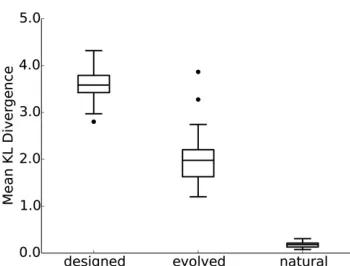
While the analysis of aggregate amino-acid frequencies is useful as afirst sanity check, it does not address whether either simulation approach places the correct amino acids at indi-vidual sites. Therefore, we next calculated the average KL divergence for each protein, which quantifies the extent to which site-specific amino-acid distributions of simulated se-quences are comparable to those of natural sese-quences. The lower the KL divergence, the more similar the distributions. As a control, we compared natural sequence to themselves, by randomly dividing each alignment into two groups and then comparing one to the other. We found that the evolutionary simulation produced sequences that were more similar to natural sequences than were the designed sequences (paired t-test,p,2:2310216;Figure 1). Two exceptions (indicated as outliers in the middle boxplot of Figure 1) were chain D from the Sfi1p/Cdc31p complex (PDB ID: 2GV5) and initia-tion factor 5a (PDB ID:1XTD). This analysis suggests that accounting for evolutionary history is an important compo-nent in simulating realistic protein sequences.
Patterns of site variability
observation implies that designed sequences, relative to the evolved sequences, experienced changes at a larger number of sites but toward a smaller set of different amino acids.
Just because two alignments have a comparable meanneff does not mean that the same sites are more variable or more conserved in the two alignments. Therefore, we next calcu-lated the correlations betweenneffamong alignments gener-ated by different methods (designed sequences, evolved sequences, and natural sequences). We found that the corre-lations in site variability between evolved and natural se-quences were much higher than those between designed and natural sequences (Figure 3). The former were all posi-tive and ranged between0:2 and 0.7, whereas the latter did not exceed0:3;and several fell below zero. Thus vari-able and conserved sites in evolved sequences tend to coin-cide with the same types of sites in natural sequence alignments, but the same is not true for designed sequences.
Site variability in the context of structural features
Site-specific variability tends to correlate with features in the protein structure, most notably solvent exposure and packing density (Kimura and Ohta 1974; Changet al.2013; Yehet al. 2013; Huang et al.2014; Echaveet al. 2016). Since these variability patterns are likely driven by biophysical con-straints generated from the protein structure, we would ex-pect that they would be recapitulated in computationally designed proteins. Yet, prior work had shown that site-variability patterns in designed proteins did not recapitulate the patterns observed in natural sequences—buried sites in designed sequences were not sufficiently conserved, or, alter-natively, exposed sites not sufficiently variable (Jacksonet al. 2013).
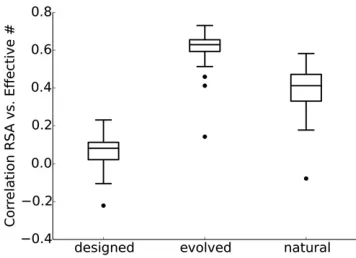
We found here again that site variability in designed proteins did not appreciably correlate with RSA (Figure 4). Correlations betweenneffand RSA ranged between20:2 and 0.2. In comparison, for natural sequences, these correlations fell mostly between 0.2 and 0.6. For evolved sequences, we observed even higher correlations, with most values falling
between 0.5 and 0.7 (Figure 4). Results were similar when we used inverse Weighted Contact Number (iWCN) instead of RSA (Figure S3, D–F inFile S1).
One potential caveat to thesefindings is that designed and evolved sequences may fall into a different range of thermo-dynamic stability, assessed in our model via the Rosetta score. Indeed, even though we calibrated the stability threshold DGthreshused during evolution to the mean stability for pro-teins designed to the same template (seeMethods), we found that evolved proteins generally had a narrower range of sta-bilities than designed proteins and were, on average, more stable (Figure S4 inFile S1). In principle, these differences in stability distributions could be the cause for the other ob-served differences between designed and evolved sequences. We addressed this caveat in two ways. First, we generated alignment subsets for each template structure such that each designed sequence retained in an alignment was matched one-to-one to a unique evolved sequence with comparable stability score and homologous structure. This procedure yielded near-identical stability distributions in most cases (Figure S5 inFile S1). Yet the observed pattern of RSA–neff correlations was virtually unchanged from that in the original dataset (Figure S6A inFile S1). Second, for five arbitrarily chosen structures, we ran evolutionary simulations, where we used the stability of the least stable designed structure (i.e., the maximum observed score among the designed struc-tures) as stability threshold value. In those simulations, evolved structures were indeed much less stable than before (Figure S7 in File S1). Yet again, there was virtually no change in the observed pattern of RSA–neffcorrelations (Fig-ure S6B inFile S1).
Evolving designed sequences
To recap, we have found that, by any metric considered, evolved sequence alignments looked much more realistic than
Figure 2 Mean effective number of amino acids for designed, evolved, and natural sequences. Evolved and natural sequences had comparable mean effective numbers of amino acids (pairedt-test,p¼0:68), whereas designed sequences had significantly lower mean effective num-bers (pairedt- test,p,2:2310216). One exception was chain D of the Sfi1p/Cdc31p complex (PDB ID: 2GV5, outlying data point in the boxplot for evolved sequences), for which evolutionary simulation yielded a much smaller mean effective number of amino acids relative to all other cases.
designed sequence alignments. Further, we have seen that these differences between evolved and designed sequences are not caused by differences in protein stability. However, there do remain two potential reasons why we may have obtained these results: (i) evolutionary simulation adds an important element to sequence generation, one that is missed in the currently used protein design algorithm; (ii) evolved sequences look more similar to natural sequences simply because they have not diverged as much, and, thus, retain much historical information about the natural ancestral se-quence. To distinguish between these two scenarios, we ran an additional set of evolutionary simulations, where we started each replicate evolutionary trajectory from one of the pre-viously designed sequences. We performed this additional set of simulations for a subset of 10 arbitrarily chosen structures (Table S1 inFile S1). We refer to sequences generated in this manner as“evolved from design.”Importantly, the mean se-quence divergence in these sese-quences was significantly higher than in the corresponding natural or evolved se-quences, and almost as high as in the designed sequences (Figure S8 inFile S1).
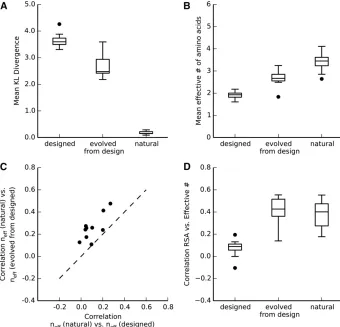
From these additional simulations, we found that the evolutionary process produced more naturally looking align-ments, even when designed proteins were used as starting points (Figure 5). Sequences that were evolved from design had a lower KL divergence than designed sequences (Figure 5A), a higher mean effective number of amino acids (Figure 5B), higher correlations of site-variability patterns to natural alignments (Figure 5C), and higher correlations betweenneff and RSA (Figure 5D). However, by all these metrics, se-quences evolved from design were intermediate between designed sequences and sequences evolved from a natural sequence. These intermediate metrics reflect that the designed sequences have a site-wise preference for a smaller set of amino acids than do the evolved sequences (Figure 2), and
this preference is only partly undone by subsequent evolution. While evolution could expand the set of acceptable amino acids at some sites, other sites remained frozen in the narrow area of sequences space supplied by design, and might require much longer evolutionary simulations to become unfrozen.
Using simulated sequences as a predictor of site variability
Finally, we asked how well neff from simulated sequences performed as predictor of natural site variability relative to the other commonly used predictors RSA and WCN. In agree-ment with prior work (Shahmoradiet al.2014; Jacksonet al. 2016), we saw that the neff from designed sequences per-formed poorly relative to RSA (Figure S9A inFile S1). How-ever, thenefffrom evolved sequences performed similarly to RSA (Figure S9B inFile S1), andneff from evolved from de-sign sequences displayed intermediate performance (Figure S9C in File S1). Results were similar for the iWCN, except that correlations betweenneff and iWCN tended to be some-what stronger than they were betweenneffand RSA (Figure S9, D–F inFile S1), consistent with a large body of prior work
finding that WCN tends to correlate more strongly with evo-lutionary variation than does RSA (Yeh et al. 2013, 2014; Shahmoradi et al.2014; Marcos and Echave 2015; Echave et al.2016). Unlike RSA, WCN measures both the local struc-tural constraint around a residue and the global arrangement of amino acids in the entire structure Shahmoradi and Wilke (2016). The elevated correlations seen with WCN relative to RSA may thus, in part, be driven by factors other than folding constraints, such as the location of active sites in enzymes (Jacket al.2016).
Discussion
We have examined how evolutionary history affects the emer-gence of sequence variability by comparing protein align-ments generated by two different methods. The first was a
Figure 4 Spearman correlations between RSA andneff for designed, evolved, and natural sequences. Correlations for designed sequences were significantly lower than for natural sequences (paired t-test,
p¼1:5310214). By contrast, correlations for evolved sequences were significantly higher than for natural sequences (paired t-test,
p¼6:48310212). The individual correlation coefficients for each struc-ture are shown in Figure S3, A–C inFile S1.
traditional protein-design algorithm implemented in RosettaDesign (Kuhlmanet al.2003). The other was an evolu-tionary method that used the Rosetta energy function to simulate protein evolution according to population-genetics principles (Teufel and Wilke 2017). Both methods impose the same thermodynamic constraints on the simulated sequences, but they impose different constraints in their sampling of se-quence space. For both methods, we compared the simulated alignments to homologous alignments of natural sequences. We found that sequences generated by simulated evolution displayed site-specific variation quite similar to that of natu-ral sequences, whereas patterns of variation were substan-tially different in designed sequences. Our evolved sequences also showed correlations between sequence variation and residue burial or packing similar to that of natural sequences whereas the designed sequences did not. Finally, by simulat-ing additional evolution with designed sequences as startsimulat-ing points, we demonstrated that the improvements in site-variability metrics were caused by the evolutionary process itself, and not by insufficient divergence from the starting sequence during the evolutionary simulations.
While both evolutionary and protein-design methods can be used to generate proteins that fold and function, they differ in how they explore sequence space. In particular, the widely used RosettaDesign (Kuhlmanet al.2003) takes a template structure, strips all residue side chains, and then simulta-neously replaces them by different side chains. Subsequently,
additional side-chain replacements are made with the goal of maximizing protein stability. This process of designing a se-quence can be repeated a number of times to generate a set of diverse sequences. This and similar approaches have proven fruitful for protein engineering. For example, protein design methods have been used to engineer proteins that bind an influenza virus (Fleishman et al.2011), to create enzymes (Röthlisberger et al. 2008), and to develop novel protein folds (Kuhlmanet al.2003). However, this method of gener-ating functional proteins is very unlike how natural systems generate them. Natural proteins accumulate changes mostly sequentially, one mutation at a time, rather than having their entire sequence modified in a single instance.
Protein design is frequently billed as being able to explore a much larger sequence space than does evolution, because the design process starts from scratch with a random sequence, and, thus, in theory should be able to reach any place in sequence space, whereas evolution can only explore near neighbors to already existing sequences (Huanget al.2016). However, we did notfind this to be the case in our simulations. Specifically, even though our designed sequences had a higher mean se-quence divergence than did evolved or natural sese-quences (Fig-ure S1 in File S1), designed sequences had, on average, smaller effective numbers of amino acids at each site (Figure 2). Thus, on average, individual sites were less variable under design than they were under evolution, natural or simulated. We were able to explain this unexpected result by investigating
Figure 5 Comparison between designed se-quences and sese-quences evolved from de-sign. (A) Mean KL divergence of designed, evolved from design, and natural sequences. The KL divergence was lower for evolved from design sequences than for designed sequences (paired t-test, p¼2:5731026). (B) Mean effective number of amino acids for designed, evolved from design, and nat-ural sequences. The mean effective number (neff) was higher for evolved from design sequences than for designed sequences (paired t-test, p¼1:9131025) (C) Spear-man correlations of neff between natural and evolved from design sequences and nat-ural and designed sequences. Each dot rep-resents one correlation coefficient value for one protein. Correlations withnefffrom nat-ural sequences were significantly higher for
neff from evolved from design sequences than for neff from designed sequences (pairedt-test, p¼6:2331025). (D) Spear-man correlations between site entropy and RSA of designed, evolved from design, and natural sequences. Correlations were signif-icantly higher for evolved from design se-quences than designed sese-quences (paired
how exactly the initial sequences are chosen under design. The initial sampling of side chains is done from a rotamer library (Kaufmann et al. 2010), rather than uniformly from the 20 amino acids. Consequently, amino acids with many rotamers are over-represented in the initially chosen sequence. The sub-sequent optimization algorithm is constrained by the biased pool of initial sequences, and cannot undo the unequal sam-pling. We can see the remnants of the oversampling of certain amino acids in the excess of lysine and arginine in the overall amino-acid frequencies (Figure S2 in File S1), as both are amino acids with a very large number of rotamers. When we subjected the designed sequences to further evolution, a wider range of substitutions became allowed. Therefore, we saw the evolved-from-design sequences approaching site variabilities similar to those displayed by the original evolved and natural sequences (Figure 5).
Ourfindings are consistent with recent works on evolu-tionary entrenchment (Pollocket al.2012; McCandlishet al. 2015, 2016; Shahet al.2015; Goldstein and Pollock 2016), which argue that the propensity of a protein to acquire position-specific substitutions varies over time, as previously accumu-lated mutations become entrenched in the protein structure and slowly alter the constraints imposed on other amino acids in the structure. Here, entrenchment was visible in particular for designed and evolved-from-design sequences, which were highly and somewhat biased by the initial sampling process of protein design.
Even though our evolutionary simulations considered both structural constraints and a realistic, sequential sampling of sequence space, we found that they did not fully capture the relationship between sequence variability, buriedness, and packing density observed in natural sequences. In particular, site-specific variability was correlated more strongly with RSA in our evolved sequences than is observed in nature. This exaggerated relationship between sequence variability and RSA may be caused by the simplistic assumption of our model that selection acts exclusively on protein stability. In natural organisms, numerous selection pressures beyond just protein stability act on protein sequences (Thorne 2007; Teufelet al. 2012; Serohijos and Shakhnovich 2013, 2014; Chi and Liberles 2016; Echave and Wilke 2017), and these other selection pres-sures should weaken the observed relationship between RSA and sequence variability.
There are several caveats to our work. First, throughout this project, we have used afixed backbone model, even though allowing for aflexible backbone during design may produce more natural-looking sequences (Jacksonet al.2013; Ollikainen and Kortemme 2013). However, since we used the samefixed backbone model for both protein design and protein evolution, we do not expect it to have much bearing on the observed dif-ferences between designed and evolved sequences. Moreover, Jackson et al. (2013) had previously shown that, even with
flexible backbone design, the correlation between solvent ac-cessibility and site variability was lower than observed in natural sequences. Second, the accelerated origin-fixation model we used for evolution changes the order in which substitutions
are accumulated, but we expect this reordering to be of little consequence for the metrics considered in this work (Teufel and Wilke 2017). Third, the amount of divergence generated during simulated evolution depends on the length of time for which the simulations are run, and, thus, is highly dependent on the parameter choices made for the simulations. We chose to run the evolutionary simulations for 5000 substitutions in each trajectory (for proteins of at most several hundred amino acids in length), to ensure that the amount of diver-gence generated during simulation would exceed that ob-served in typical natural homologs. Finally, it is possible that a modified design algorithm that samples initial sequences from a uniform distribution of amino acids rather than from a distribution of rotamers would produce sequence align-ments on par with those we generated here under simulated evolution. Testing this hypothesis, however, falls beyond the scope of the present paper.
Acknowledgments
This work was supported by National Institutes of Health grants R01 GM088344 and National Science Foundation (NSF) Cooperative agreement no. DBI-0939454 (BEACON Center). Computational resources were provided by The University of Texas at Austin2s Center for Computational Biology and Bioinformatics and the Stampede cluster at the Texas Advanced Computing Center. Q.J. was a visiting scholar at UT Austin (September 2015–September 2017) sponsored by the China Scholarship Council (CSC). E.L.J. was supported by NSF GRFP DGE-1110007.
Literature Cited
Arenas, M., A. Sánchez-Cobos, and U. Bastolla, 2015 Maximum-likelihood phylogenetic inference with selection on protein fold-ing stability. Mol. Biol. Evol. 32: 2195–2207.
Bastolla, U., M. Porto, H. E. Roman, and M. Vendruscolo, 2007 The structurally constrained neutral model of protein evolution, pp. 75–112 inStructural Approaches to Sequence Evo-lution: Molecules,Networks,Populations. Springer, Berlin. Chang, C.-M., Y.-W. Huang, C.-H. Shih, and J.-K. Hwang,
2013 On the relationship between the sequence conservation and the packing density profiles of the protein complexes. Pro-teins 81: 1192–1199.
Chaudhury, S., S. Lyskov, and J. J. Gray, 2010 Pyrosetta: a script-based interface for implementing molecular modeling algo-rithms using Rosetta. Bioinformatics 26: 689–691.
Chen, P., and E. I. Shakhnovich, 2009 Lethal mutagenesis in vi-ruses and bacteria. Genetics 183: 639–650.
Chi, P. B., and D. A. Liberles, 2016 Selection on protein structure, interaction, and sequence. Protein Sci. 25: 1168–1178. Echave, J., and C. O. Wilke, 2017 Biophysical models of protein
evolution: understanding the patterns of evolutionary sequence divergence. Annu. Rev. Biophys. 46: 85–103.
Franzosa, E. A., and Y. Xia, 2009 Structural determinants of pro-tein evolution are context-sensitive at the residue level. Mol. Biol. Evol. 26: 2387–2395.
Goldstein, R. A., and D. D. Pollock, 2016 The tangled bank of amino acids. Protein Sci. 25: 1354–1362.
Halle, B., 2002 Flexibility and packing in proteins. Proc. Natl. Acad. Sci. USA 99: 1274–1279.
Huang, P.-S., S. E. Boyken, and D. Baker, 2016 The coming of age of de novo protein design. Nature 537: 320–327.
Huang, T.-T., M. L. del Valle Marcos, J.-K. Hwang, and J. Echave, 2014 A mechanistic stress model of protein evolution accounts for site-specific evolutionary rates and their relationship with packing density andflexibility. BMC Evol. Biol. 14: 78. Jack, B. R., A. G. Meyer, J. Echave, and C. O. Wilke, 2016
Func-tional sites induce long-range evolutionary constraints in en-zymes. PLoS Biol. 14: e1002452.
Jackson, E. L., N. Ollikainen, A. W. Covert, III, T. Kortemme, and C. O. Wilke, 2013 Amino-acid site variability among natural and designed proteins. PeerJ 1: e211.
Jackson, E. L., A. Shahmoradi, S. J. Spielman, B. R. Jack, and C. O. Wilke, 2016 Intermediate divergence levels maximize the strength of structure–sequence correlations in enzymes and viral proteins. Protein Sci. 25: 1341–1353.
Jones, S., and J. M. Thornton, 1996 Principles of protein–protein interactions. Proc. Natl. Acad. Sci. USA 93: 13–20.
Kabsch, W., and C. Sander, 1983 Dictionary of protein secondary structure: pattern recognition of hydrogen-bonded and geomet-rical features. Biopolymers 22: 2577–2637.
Kachroo, A. H., J. M. Laurent, C. M. Yellman, A. G. Meyer, C. O. Wilke
et al., 2015 Systematic humanization of yeast genes reveals con-served functions and genetic modularity. Science 348: 921–925. Kaufmann, K. W., G. H. Lemmon, S. L. DeLuca, J. H. Sheehan, and
J. Meiler, 2010 Practically useful: what the Rosetta protein modeling suite can do for you. Biochemistry 49: 2987–2998. Kimura, M., and T. Ohta, 1974 On some principles governing
mo-lecular evolution. Proc. Natl. Acad. Sci. USA 71: 2848–2852. Kuhlman, B., G. Dantas, G. C. Ireton, G. Varani, B. L. Stoddard
et al., 2003 Design of a novel globular protein fold with atomic-level accuracy. Science 302: 1364–1368.
Leaver-Fay, A., M. Tyka, S. M. Lewis, O. F. Lange, J. Thompsonet al., 2011 ROSETTA3: an object-oriented software suite for the simula-tion and design of macromolecules. Methods Enzymol. 487: 545–574. Liberles, D. A., S. A. Teichmann, I. Bahar, U. Bastolla, J. Bloom
et al., 2012 The interface of protein structure, protein biophys-ics, and molecular evolution. Protein Sci. 21: 769–785. Marcos, M. L., and J. Echave, 2015 Too packed to change:
side-chain packing and site-specific substitution rates in protein evo-lution. PeerJ 3: e911.
McCandlish, D. M., J. Otwinowski, and J. B. Plotkin, 2015 Detect-ing epistasis from an ensemble of adaptDetect-ing populations. Evolu-tion 69: 2359–2370.
McCandlish, D. M., P. Shah, and J. B. Plotkin, 2016 Epistasis and the dynamics of reversion in molecular evolution. Genetics 203: 1335–1351. Mirny, L. A., and E. I. Shakhnovich, 1999 Universally conserved positions in protein folds: reading evolutionary signals about sta-bility, folding kinetics and function. J. Mol. Biol. 291: 177–196. Ollikainen, N., and T. Kortemme, 2013 Computational protein
design quantifies structural constraints on amino acid covaria-tion. PLOS Comput. Biol. 9: e1003313.
Overington, J., D. Donnelly, M. S. Johnson, A. Sali, and T. L.ˇ Blundell, 1992 Environment-specific amino acid substitution
tables: tertiary templates and prediction of protein folds. Protein Sci. 1: 216–226.
Pollock, D. D., G. Thiltgen, and R. A. Goldstein, 2012 Amino acid coevolution induces an evolutionary stokes shift. Proc. Natl. Acad. Sci. USA 109: E1352–E1359.
Ramsey, D. C., M. P. Scherrer, T. Zhou, and C. O. Wilke, 2011 The relationship between relative solvent accessibility and evolu-tionary rate in protein evolution. Genetics 188: 479–488. Röthlisberger, D., O. Khersonsky, A. M. Wollacott, L. Jiang, J.
De-Chancieet al., 2008 Kemp elimination catalysts by computa-tional enzyme design. Nature 453: 190–195.
Serohijos, A. W., and E. I. Shakhnovich, 2013 Contribution of selec-tion for protein folding stability in shaping the patterns of polymor-phisms in coding regions. Mol. Biol. Evol. 31: 165–176.
Serohijos, A. W., and E. I. Shakhnovich, 2014 Merging molecular mechanism and evolution: theory and computation at the in-terface of biophysics and evolutionary population genetics. Curr. Opin. Struct. Biol. 26: 84–91.
Serohijos, A. W., Z. Rimas, and E. I. Shakhnovich, 2012 Protein biophysics explains why highly abundant proteins evolve slowly. Cell Rep. 2: 249–256.
Shah, P., D. M. McCandlish, and J. B. Plotkin, 2015 Contingency and entrenchment in protein evolution under purifying selec-tion. Proc. Natl. Acad. Sci. USA 112: E3226–E3235.
Shahmoradi, A., and C. O. Wilke, 2016 Dissecting the roles of local packing density and longer-range effects in protein se-quence evolution. Proteins 84: 841–854.
Shahmoradi, A., D. K. Sydykova, S. J. Spielman, E. L. Jackson, E. T. Dawson et al., 2014 Predicting evolutionary site variability from structure in viral proteins: buriedness, packing,flexibility, and design. J. Mol. Evol. 79: 130–142.
Teufel, A. I., and C. O. Wilke, 2017 Accelerated simulation of evolutionary trajectories in origin-fixation models. J. R. Soc. In-terface 14: 20160906.
Teufel, A. I., J. A. Grahnen, and D. A. Liberles, 2012 Modeling proteins at the interface of structure, evolution, and population genetics, pp. 347–361 inComputational Modeling of Biological Systems. Springer, Berlin.
Thorne, J. L., 2007 Protein evolution constraints and model-based techniques to study them. Curr. Opin. Struct. Biol. 17: 337–341. Tien, M. Z., A. G. Meyer, D. K. Sydykova, S. J. Spielman, and C. O. Wilke, 2013 Maximum allowed solvent accessibilities of resi-dues in proteins. PLoS One 8: e80635.
Tóth-Petróczy, Á., and D. S. Tawfik, 2011 Slow protein evolution-ary rates are dictated by surface–core association. Proc. Natl. Acad. Sci. USA 108: 11151–11156.
Wylie, C. S., and E. I. Shakhnovich, 2011 A biophysical protein folding model accounts for most mutational fitness effects in viruses. Proc. Natl. Acad. Sci. USA 108: 9916–9921.
Yeh, S.-W., J.-W. Liu, S.-H. Yu, C.-H. Shih, J.-K. Hwang et al., 2013 Site-specific structural constraints on protein sequence evolutionary divergence: local packing densityvs.solvent expo-sure. Mol. Biol. Evol. 31: 135–139.
Yeh, S.-W., T.-T. Huang, J.-W. Liu, S.-H. Yu, C.-H. Shih et al., 2014 Local packing density is the main structural determinant of the rate of protein sequence evolution at site level. BioMed Res. Int. 2014: 572409.
Zhou, H., and Y. Zhou, 2004 Quantifying the effect of burial of amino acid residues on protein stability. Proteins 54: 315–322.