A Study on Recognition of Devnagari
Alphabet by Using Sign
Aasawari A. Joshi1, Anita S. Walde2
PG Student, Dept. of E&TC, Deogiri Institute of Engineering and Management Studies, Aurangabad, India1
Assistance Professor, Dept. of E&TC, Deogiri Institute of Engineering and Management Studies, Aurangabad, India2
ABSTRACT: Deaf people have difficulty in communicating with others who do not understand sign language, are use for communication, by which the gestures made by the user. This paper focus on the system, in which are created by the different researcher. In the recent years some researchers used hand glove or sensor etc to understand the sign, different microcontroller to recognize the sign.
KEYWORDS: Deaf People, Sign Language, Hand Glove, Microcontroller.
I. INTRODUCTION
Deaf and dumb people facing the communication problem at the time, when they talk with other deaf or dumb people and with other normal people. Normal people hear new information and knowledge through the daily noises, communication ways and language that is spoken around them, but the Deaf and hard-of-hearing people do not. Hence the Deaf and hard-of-hearing people uses the Sign languages, they covey their feeling with symbols, and objects combination of words and symbols i.e. Gestures (which are different patterns made by the curls and bends of the fingers) provides the best way for communication. Figure 1 shows the simple gestures [7].
In 2001 Ryan Patterson was designed Hand Talk glove for the sign language Translator, which contains mainly two parts a leather golf glove and microcontroller. Leather golf glove ten flexible sensors sewn into it which monitor the position of the fingers by measuring the electrical resistance created by the fingers as they bend and microcontroller converts the change in the electrical current into digital signals and transmit them wireless to a computer, computer converts them into the letters which appear on the screen [6].
II. LITERATURE SURVEY
Prof. Mrunal Pathak et al. [1] propose the Marathi sign language recognition system, which provides the communication barrier between deaf-dump and a normal Person. This proposed system translates hand gesture into textual and vocal format without any requirement of special sign language interpreter. This proposed system is having two steps; in the first step i.e. Registration Module system to Create the database of Marathi sign language. Proposed system tacks the input from the webcam or video camera and then processes this image and stored into the system database, as shown in figure 1. In the second step i.e. Recognition Module, here b camera capture the image and then complete image processing process is done, as shown in figure 2. Camera takes the image and Edge detection is applied on it. In which an image processing technique for finding the boundaries of objects within images. Then this image is compared with data base.
Figure 1 Marathi Sign Language Registration Process [1]
P A S Ram kumar et la. [2] proposed a new technique called artificial speaking mouth for dumb people. It based on the motion sensor, because for every motion dumb people have a meaning and this meaning is kept in a database. Figure 4 shows the block diagram of hand gesture system. Every action the motion sensors get accelerated and give the signal to the ardiuno microcontroller (ARDUINO MEGA 2560). Then arduino microcontroller matches the motion with the database and produces the speech signal. This proposed system contains the DIGITAL GLOVES DESIGN (the digital gloves are designed by using small metal strips that are fixed on the five fingers of the glove), GSM module (used to send/ receive messages and make/receive call just like a mobile phone), Arduino mega 2560 (runs on Mac, Windows, and Linux) and ISD1740 voice recording and playback module (based on ISD1740, which is a chip single-message record/playback device).
Figure 3 Block diagram of hand gesture [2]
Mukul Singh Kushwah et al. [3] present communication system for the people who are unable to speak. The proposed system is integrate with a program embedded in a microcontroller chip and flex sensor, which will capable of correctly determining the specified alphabets from the hand positions. Figure 4 shows the block diagram of proposed system, contains Flex Sensors (depict the change in terms of resistance on bending and convert the change in bend to electrical resistance). Bluetooth Module (to get the output on any Bluetooth-enabled device), Playback IC (will play the clip stored corresponding to that alphabet), 16 _ 2 LCD Screen (to display the alphabets decided on the basis of sensor values), and Microcontroller (ATmega16).
Figure 4 block diagram [3]
Glove
Digital Data
Arduino
mega
Speech
Module
GSM
Module
LCD
Display
Keyboard
III. COMPARISON OF DIFFERENT TECHNIQUE
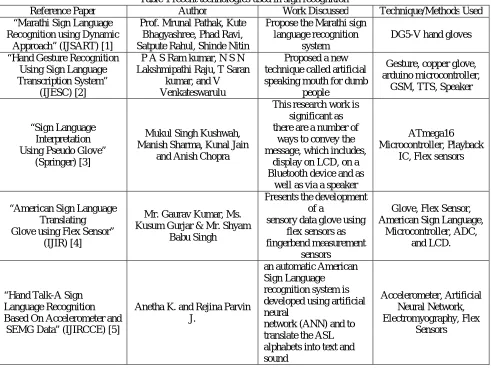
Table 1 gives the quick view on the recent technologies used by the researchers in the recent years.
Table 1 recent technologies used in sign recognition
Reference Paper Author Work Discussed Technique/Methods Used
“Marathi Sign Language Recognition using Dynamic
Approach” (IJSART) [1]
Prof. Mrunal Pathak, Kute Bhagyashree, Phad Ravi, Satpute Rahul, Shinde Nitin
Propose the Marathi sign language recognition
system
DG5-V hand gloves
“Hand Gesture Recognition Using Sign Language Transcription System”
(IJESC) [2]
P A S Ram kumar, N S N Lakshmipathi Raju, T Saran
kumar, and V Venkateswarulu
Proposed a new technique called artificial speaking mouth for dumb
people
Gesture, copper glove, arduino microcontroller,
GSM, TTS, Speaker
“Sign Language Interpretation Using Pseudo Glove”
(Springer) [3]
Mukul Singh Kushwah, Manish Sharma, Kunal Jain
and Anish Chopra
This research work is significant as there are a number of
ways to convey the message, which includes,
display on LCD, on a Bluetooth device and as
well as via a speaker
ATmega16 Microcontroller, Playback
IC, Flex sensors
“American Sign Language Translating Glove using Flex Sensor”
(IJIR) [4]
Mr. Gaurav Kumar, Ms. Kusum Gurjar & Mr. Shyam
Babu Singh
Presents the development of a
sensory data glove using flex sensors as fingerbend measurement
sensors
Glove, Flex Sensor, American Sign Language,
Microcontroller, ADC, and LCD.
“Hand Talk-A Sign Language Recognition Based On Accelerometer and
SEMG Data” (IJIRCCE) [5]
Anetha K. and Rejina Parvin J.
an automatic American Sign Language recognition system is developed using artificial neural
network (ANN) and to translate the ASL alphabets into text and sound Accelerometer, Artificial Neural Network, Electromyography, Flex Sensors IV. CONCLUSION
Communication problem between deaf-mute and a normal person have always been a difficult task. This paper provides the overview on Sign Language, also provides the literature survey on different method used in recognition of sign language. Table 1 provides the quick look of existing system in the recent years.
REFERENCES
[1] Prof. Mrunal Pathak, Kute Bhagyashree, Phad Ravi, Satpute Rahul, Shinde Nitin, “Marathi Sign Language Recognition using Dynamic Approach”, International journal for Science and Advance Research in Technology (IJSART),Volume 2, Issue 4, APRIL 2016.
[3] Mukul Singh Kushwah, Manish Sharma, Kunal Jain and Anish Chopra, “Sign Language Interpretation Using Pseudo Glove”, Proceeding of International Conference on Intelligent Communication, Control and Devices, Advances in Intelligent Systems and Computing 479, Springer Science, Business Media Singapore 2017.
[4] Mr. Gaurav Kumar, Ms. Kusum Gurjar & Mr. Shyam Babu Singh, “American Sign Language Translating Glove using Flex Sensor”, Imperial Journal of Interdisciplinary Research (IJIR), Vol-2, Issue-6, 2016.
[5] Anetha K, Rejina Parvin J.. “Hand Talk-A Sign Language Recognition Based On Accelerometer and SEMG Data”, International Journal of Innovative Research in Computer and Communication Engineering (IJIRCCE), Vol. 2, Special Issue 3, July 2014.
[6] AmbikaGujrati, Kartigya Singh, Khushboo, Lovika Soral, Mrs. Ambikapath, “Hand-talk Gloves with Flex Sensor: A Review”, International Journal of Engineering Science Invention, Volume 2, Issue 4, April 2013.
![Figure 1 Simple Gesture [7]](https://thumb-us.123doks.com/thumbv2/123dok_us/1573449.1193538/1.595.167.439.599.727/figure-simple-gesture.webp)
![Figure 1 Marathi Sign Language Registration Process [1]](https://thumb-us.123doks.com/thumbv2/123dok_us/1573449.1193538/2.595.68.526.355.759/figure-marathi-sign-language-registration-process.webp)
![Figure 3 Block diagram of hand gesture [2]](https://thumb-us.123doks.com/thumbv2/123dok_us/1573449.1193538/3.595.135.461.573.769/figure-block-diagram-hand-gesture.webp)