University of Windsor University of Windsor
Scholarship at UWindsor
Scholarship at UWindsor
Electronic Theses and Dissertations Theses, Dissertations, and Major Papers
1-1-2007
Complete and equivalent query rewriting using views.
Complete and equivalent query rewriting using views.
Minghao Li
University of Windsor
Follow this and additional works at: https://scholar.uwindsor.ca/etd
Recommended Citation Recommended Citation
Li, Minghao, "Complete and equivalent query rewriting using views." (2007). Electronic Theses and Dissertations. 6993.
https://scholar.uwindsor.ca/etd/6993
C
o m p l e t e
a n d
E
q u i v a l e n t
Q
u e r y
R
e w r i t i n g
u s i n g
v i e w s
by
Minghao Li
A Thesis
submitted to the Faculty of Graduate Studies and Research
through Computer Science
in Partial Fulfillment of the Requirements for
the degree of Master of Science at the
University of Windsor
Windsor, Ontario, Canada
2007
Library and Archives Canada
Bibliotheque et Archives Canada
Published Heritage Branch
395 W ellington S treet O ttaw a ON K1A 0N4 C a n a d a
Your file Votre reference ISBN: 978-0-494-35018-8 Our file Notre reference ISBN: 978-0-494-35018-8
Direction du
Patrimoine de I'edition
395, rue W ellington O ttaw a ON K1A 0N4 C a n a d a
NOTICE:
The author has granted a non exclusive license allowing Library and Archives Canada to reproduce, publish, archive, preserve, conserve, communicate to the public by
telecommunication or on the Internet, loan, distribute and sell theses
worldwide, for commercial or non commercial purposes, in microform, paper, electronic and/or any other formats.
AVIS:
L'auteur a accorde une licence non exclusive permettant a la Bibliotheque et Archives Canada de reproduire, publier, archiver,
sauvegarder, conserver, transmettre au public par telecommunication ou par I'lnternet, preter, distribuer et vendre des theses partout dans le monde, a des fins commerciales ou autres, sur support microforme, papier, electronique et/ou autres formats.
The author retains copyright ownership and moral rights in this thesis. Neither the thesis nor substantial extracts from it may be printed or otherwise reproduced without the author's permission.
L'auteur conserve la propriete du droit d'auteur et des droits moraux qui protege cette these. Ni la these ni des extraits substantiels de celle-ci ne doivent etre imprimes ou autrement reproduits sans son autorisation.
In compliance with the Canadian Privacy Act some supporting forms may have been removed from this thesis.
While these forms may be included in the document page count,
their removal does not represent any loss of content from the
Conformement a la loi canadienne sur la protection de la vie privee, quelques formulaires secondaires ont ete enleves de cette these.
Abstract
Query rewriting using views is a technique for answering a query using a set o f views
instead of accessing the database relations directly. There are two categories of rewritings,
i.e., equivalent rewriting using materialized views applied in query optimization, and
maximally contained rewriting used in data integration. Although maximally contained
rewriting is acceptable in data integration, there are cases where an equivalent rewriting
is desired. More importantly, the maximally contained rewriting is a union of all the
contained queries, many o f which are redundant. This thesis gives an efficient algorithm
to find a complete and equivalent rewriting that is a single conjunctive query. We proved
that the algorithm is guaranteed to find all the complete and equivalent rewritings, and
that the produced rewriting is guarantee to be equivalent without additional containment
checking. We showed that our algorithm is much faster than other algorithms by
complexity analysis and experiments.
Acknowledgements
I would first like to thank my supervisor, Dr. Jianguo Lu, for his constant encouragement
and guidance. He has walked me through all the stages of my research work and thesis
writing. Without his support, the work presented in this thesis would not have become a
reality.
I would extend my appreciation to Calisto Zuzarte, Xiaoyan Qian and Wenbin Ma from
IBM Toronto Lab, for their enlightening discussion and help when I studied DB2 Query
Rewriting in IBM CAS Toronto. I would also like to thank Mr. Kenneth Cheung for his
excellent work on a preliminary version of query translating and rewriting system.
Most of all, I would like to express my deepest gratitude to my dear fiancee Ms. Juan Liu.
It is her unconditional love and support that helps me overcome all the difficulties and
finish this work eventually. My thanks would also go to my parents for their loving
considerations and great confidence in me all through these years.
Many others, too numerous to mention, provided encouragement and support as I carried
Table of Contents
Abstract... , ... ... I
Acknowledgements... II
Table of Contents ... Ill
List of Tables... VI
List of Figures... VII
Chapter
1 Introduction... ... ... ... ... ... 1
1.1 Application Background...1
-1.2 Data Integration... . 2
-1.2.1 Introduction... 2
-1.2.2 Data Source M odeling ... 3
-1.3 Query Rewriting U sing Views... 5
-1.4 Thesis motivation and contribution... 7
-1.5 Thesis overview... 8
-2 Overview o f Query Rewriting Using Views ... 9
-2.1 Query Language ... 9
-2.2.2 Containment M apping ... -1 2
2.2.3 Query Rewriting Using Views... 14
2.2.4 Query Expansion... - 17
2.2.5 Rewriting Containment Verification ...-19
2.3 Previous Algorithms for Query Rew riting... - 20
3 Finding Complete and Equivalent Rewriting - 23
3.1 M otivation .... ... ... ... -23
3.2 Expanding equivalent rewriting algorithms... - 25
3.3 Expanding Complete Rewriting Algorithms... ... ... -27
3.4 TCM Bucket Algorithm... - 30
3.4.1 Definitions... ... ...-31
3.4.2 Expanding Bucket Algorithm with TCM ...- 34
3.4.3 TCM Bucket Algorithm Implementation...- 43
3.4.4 Time Com plexity ....- 47
4 Experiments... -49
4.1 Overview... ... ... ...- 49
4.1.1 Experiment Design... ... - 49
4.1.2 Experiments Data... ... - 51
4.1.3 Experiment Environment...- 52
4.2 Experiment Results... - 52
4.2.2 Correctness Validation 57
-4.2.3 Efficiency Validation 59 -4.2.4 Summary ... 63
-4.3 Implementation... 64
-5 Conclusion... 67
-5.1 Sum m ary 67 -5.2 Future w o rk ... 69
-Appendices 70 -Appendix A Rewriting Environm ent... 70
-Appendix B Demonstration o f QrwApp... 76
-Appendix C Demonstration of QrwGUI ... 82
-Bibliography ... 85
-List of Tables
Table 2-1: Bucket table for bucket algorithm ... - 22
Table 2-2: Table of view combinations... - 22
Table 3 -1: Query and views for example 3.1... -28
Table 3-2: Contained rewritings and expansions for example3.1... ... - 29
Table 3-3: Queries in example for tail containment mappings... .-31
i Table 3-4: all possible mappings in example 3.3... ...- 32
Table 3-5: Views in example 3.4... ... ... ... - 35
Table 3-6: Buckets after the first stage ... -35
Table 3-7: Buckets after applying Rule 1... ...-37
Table 3-8: Buckets after applying rule 2 ... ... ... ... - 42
Table 3-9: Matching sets for subgoals of view V I ... -4 4 Table 3-10: Constructed m appings... ...- 45
Table 4-1: The number of queries having contained or CE rewritings . .... - 53
Table 4-2: Average number of contained rewritings per query... - 55
Table 4-3: The number o f queries having CE rewritings ... - 57
Table 4-4: The total number of CE rewritings for all testing queries...-58
Table 4-5: Rewriting time for 200 queries(in m s ) ... -6 0
List of Figures
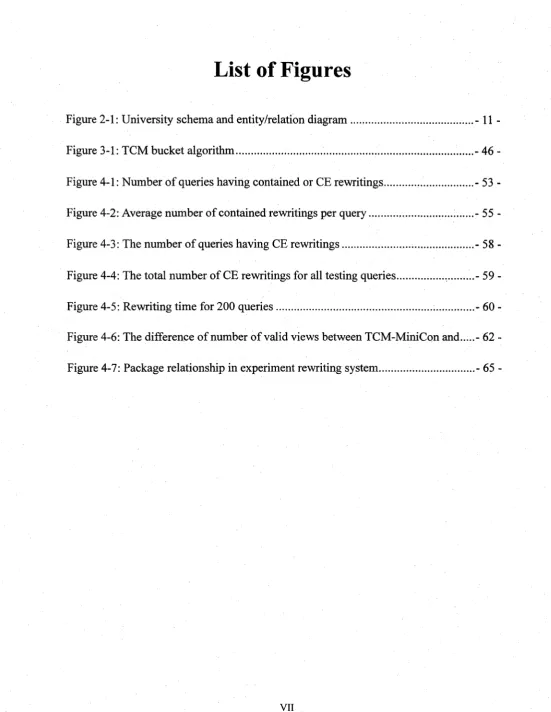
Figure 2-1: University schema and entity/relation diagram ... -11
Figure 3-1: TCM bucket algorithm... ...- 46
Figure 4-1: Number o f queries having contained or CE rewritings ...- 53
Figure 4-2: Average number of contained rewritings per query ... ...-55
Figure 4-3 : The number of queries having CE rewritings... ... ... - 58
Figure 4-4: The total number of CE rewritings for all testing queries... ... - 59
Figure 4-5: Rewriting time for 200 queries ... ...- 60
Figure 4-6: The difference o f number o f valid views between TCM-MiniCon and... 62
Chapter 1
Introduction
1.1 Application Background
Query rewriting using views is also known as answering query using views [1] or query
folding [2]. Informally speaking, the problem can be described as following: given a
i query on a database schema, and a set of views over the same schema, how can the query
be rewritten so that it partially or completely refers to the set of views? Query rewriting
plays a very important role in many database management applications, such as query
optimization [3, 4], data integration [5, 6, 7, 8], and data warehouse [9, 10, 11].
In query optimization, some views are created to perform the frequently executed query
operations, and the results of these views are stored in disk for future uses. These views
are called materialized views. Given a query posed over database relations, if it can be
answered using materialized views, then the evaluation process of this query will become
more efficient, because some computations are pre-performed by the materialized views.
Therefore, from the query optimization point of view, query rewriting is to generate
logical plan that is equivalent to the original query using materialized views.
In the context of data integration, query rewriting using views is also unavoidably
systems, such as Information Manifold [5] and Infomaster [12], provide a uniform query
interface to a number of heterogeneous data sources. In order to do so, the data
integration system first defines a global schema according to a particular application, and
then describes all data sources as views over the global schema. Users pose queries over
the global schema as well. Global schema, however, is a set of virtual relations, which
means there is no actual data stored in them. In order to answer those queries, the system
has to find rewritings of the queries that only refer to data source descriptions (views).
The rewriting result might be a union of several queries that are contained in the original
query.
This thesis focuses on the discussion of query rewriting algorithms for data integration
applications. Thus in the next section, we will talk about data integration architecture in
more detail.
1.2 Data Integration
1.2.1 Introduction
Along with the booming o f World Wide Web, there is tons of information on the Internet.
Apart from the Web, there is also a large number of public databases and many other
can we make efficient use of all those information? Data integration system is one of the
solutions to this problem.
Data integration system provides uniform access to various distributed heterogeneous
information sources. The information sources can include traditional database systems,
structured data like XML files, or even semi-structured data like information in HTML
pages. Data integration system frees the users from finding information from many
t different sources and then manually combining them together. Taking advantages of data
integration architecture, users are able to pose queries against a uniform schema, without
knowing the type of data sources that is used behind.
In previous researches, several information integration systems have been proposed.
• Information manifold, a project of AT&T Lab [5].
• TSIMMIS, a cooperative project between Stanford University and IBM [6].
• Infomaster, a practical integration system from Stanford University [12].
• SIMS, a service and information management system for decision support [13].
1.2.2 Data Source Modeling
Data integration system is also known as mediator system. The two approaches to define
1. Global-As-View (GAV) approach defines the mediator schema as views in terms of
the schema of information sources. The mediator schema is considered as a set of
query patterns. A query is defined in terms of mediator schema. A query can be
answered by the mediator if it matches one of those patterns, otherwise it cannot be
handled. When a data source is added into or removed from the mediator, the
mediator schema has to be reformulated. Some known data integration systems are
based on GAV approach, for example, TSIMMIS, a cooperative project between
Stanford University and IBM [6], TSIMMIS uses GAV approach although it adopts
a different rule language.
2. Local-As-View (LAV) approach is the opposite of GAV. The mediator schema in
LAV is a global virtual schema designed according to the need of specific
application. It is called virtual schema because there is no data actually stored in the
mediator schema. Both user queries and source descriptions are defined in terms of
the global schema.. In order to answer a query, the system first rewrites the query
using source description views, and then retrieves the best result from the rewritings.
Since the virtual mediator schema contains no data, the rewritten query must only
refer to data descriptions (views). Because some data sources might be incomplete,
the system allows a rewritten query not equivalent to the original query, but to be
Adding or deleting an information source is just creating or removing a source
descriptor. Therefore, the data integration system based on LAV approach has
excellent extendibility and is suitable for Internet based applications. Information
Manifold system from AT&T Lab [5] and Infomaster system from Stanford
University [12] are two famous data integration systems that use LAV approach.
In these two systems, query rewriting plays an essential role. In the following
sections, we will introduce some existing query rewriting algorithms used in data
integration applications.
1.3 Query Rewriting Using Views
Query rewriting using views is a technique that offers a way to answer a query referring
to pre-defmed views instead of database relations. According to different criteria, query
rewritings can be categorized into:
1. Complete Rewriting vs. Partial Rewriting
• Complete Rewriting is a rewriting of query that only refers to views.
• Partial Rewriting is a rewriting of query that refers to both views and database
2. Equivalent Rewriting vs. Maximally Contained Rewriting
• Equivalent Rewriting is a rewriting having the same answer set as the original
query.
• Contained rewriting is a rewriting whose answer set is contained by the answer
set of the original query.
• Maximally contained rewriting is a contained rewriting whose answer set
contains the answer set of any other contained rewriting of the query.
Different applications require different type of query rewritings. Query optimization
application looks for an equivalent rewriting that has the shortest evaluation time, while
data integration application needs a rewriting that only refers to views and has the same
answering set as the original query. Therefore, complete and equivalent rewriting, also
known as CE rewriting is the best solution for data integration application. However,
some queries might not have equivalent rewriting based on all available views, and then
complete maximally contained rewriting can work as an alternative solution.
Many algorithms have been proposed to solve the query rewriting problem for data
integration applications. These algorithms generally fall into two classes: bucket-based
algorithm and inverse rule-based algorithm. The primary bucket algorithm was first
proposed by A.Y. Levy in [5]. More recently, some other bucket-based algorithms, such
CoreCover algorithm [16] were developed to improve the performance o f primary bucket
algorithm.
The idea of inverse rule was first proposed by X. Qian in [2], and presently the inverse
rule algorithm was formally discussed in [17]. We are going to review these algorithms
in section 2.3.
1.4 Thesis motivation and contribution
Existing complete query rewriting algorithms [5] [14] [15] [16] are designed to produce
complete maximally contained rewritings. The result of those algorithms is a union of all
complete contained rewritings that can be found. In application where there is a large
number of views available for query rewriting, there might exist a single conjunctive
query that is equivalent to the original query. This equivalent rewriting itself is sufficient
to answer the query. However, existing complete query algorithms include all the other
contained conjunctive queries into the result, which in fact are redundant and make the
evaluation of the rewriting inefficient.
In order to find the complete and equivalent conjunctive rewriting, we propose a TCM
(Tail Containment Mapping) Bucket algorithm that expands the bucket algorithm to
inappropriate views from being added to the buckets generated in the first stage of the
bucket algorithm, so that the rewritings produced in the combination stage are
automatically CE rewritings without any extra containment checking.
In the experiments o f this thesis, we implement MiniCon algorithm, an advanced bucket
based algorithm, with our TCM checking rules and compare this combination with some
other algorithms. All testing data we use in our experiments, containing hundreds of
relations, views and queries, are extracted from real e-commerce projects, rather than
generated by ourselves.
1.5 Thesis overview
The main body o f this thesis is organized as follows. Chapter 2 introduces the relevant
notations, gives the formal definition of the query rewriting problem and some important
concepts, and briefly goes over two previous query rewriting algorithms in the last
section. In chapter 3, we first discuss the motivation and benefit of answering query
using complete equivalent rewriting, and then we present our TCM bucket algorithm.
Chapter 4 provides the results and analyses of the experiments that we conduct. Chapter
Chapter 2
Overview of Query Rewriting Using Views
In this chapter, we will first introduce some concepts that are related to query rewriting
using views and are used throughout this thesis. Secondly, we will describe some
different kinds of query rewritings surveyed in [1]. And at last, we will discuss some
related works that have been already done under this topic.
2.1
Query Language
All the queries and views discussed in this thesis are SPJ queries, whose relational
algebra expressions only contain project, select and join operations. We also assume that
no queries contain redundant subgoal, and that neither query nor view contains
comparison predicates.
We use Datalog to define all the queries and views in this paper. Datalog [18] is a
powerful query language that is widely used to express queries and views in [16, 15, 14,
19]. Using Datalog expression, a SPJ query Q can be conveyed to a rule in the following
form:
where Q and n , • • •, rn are predicate names, and X, Xi, • • •, Xn are tuples of variables
or constants. Q( X) is the head of query, denoted by H(Q). Variables in X are called
distinguished variables or head variables. The variables in X i, • • • , X„ but not in X are
called existential variables. To be safe, distinguished variables must also appear in
subgoals of relations or views. ri( Xi), • • • , rn( Xn) are called source subgoals, which
refer to database relations or views. And we use Subgoal(Q) to denote all source relations
of a query Q.
In a datalog clause, we always assume that the ith variable of a subgoal r(X) refers to the
th
i attribute o f the relation table that r(X) refers to. And the fact that the same variable
appears in two source subgoals implicates that there is a join predicate on this variable
between the two relations or views referred by these two subgoals. Such variables are
called join variables. A Datalog clause may also include subgoals of arithmetic
comparison predicates, such as <, =, >• These subgoals are called comparison subgoals.
Variables in a comparison subgoal must also appear in subgoals of relations or views.
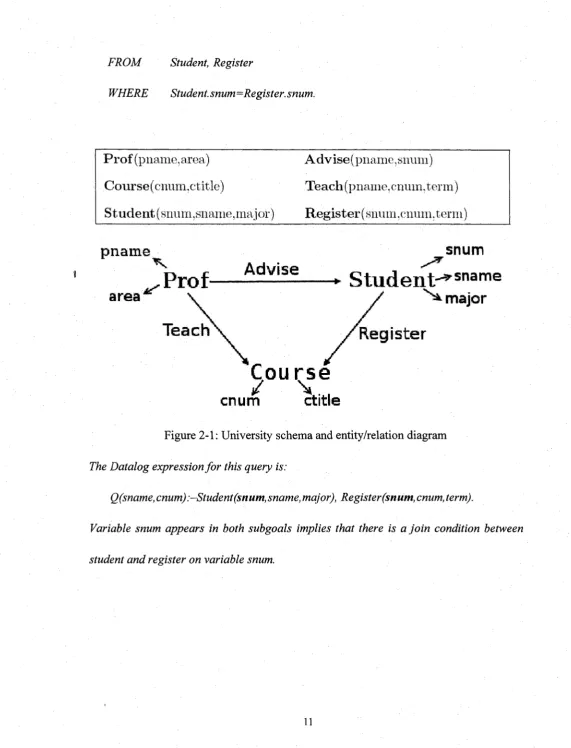
Example 2.1 Here we give an example o f Datalog notation based on a university
schema as in Figure 2-1 [1J. We will use this schema throughout this thesis. Based
on this schema, suppose there is a query that asks fo r the name o f a student and the
course this student registered. The SQL expression fo r this query is as follows:
FROM Student, Register
WHERE Student. snum= Register, snum.
P r o f
(pname, area)
A dvise(pna
me .snum)
'Course
(cnum, ctitle)
S tu dent
(simiiijSiianiejiiajo
Teachfpnau
f)
R eg iste r
(si
ie, cnum, term)
turn.cnum. term)'
pname
snum
Advise
S tu d e n t^ sname
major
Register
Course
/
V
cnum
ctitle
Figure 2-1: University schema and entity/relation diagram
The Datalog expression fo r this query is:
Q(sname, cnum):-Student (snum, sname, major), Register (snum, cnum, term).
Variable snum appears in both subgoals implies that there is a jo in condition between
2.2 Query Rewriting
2.2.1 Query Containment and Equivalence
The problem of conjunctive query containment was first studied in [20]. Query
containment is used to decide the containing relationship between two queries, and is
important to check the correctness o f a query rewriting. The formal definition of query
containment and equivalence is as below [1].
Definition 2.1 (Query containment and equivalence)
A query Qi is sa id to be contained in another query Q2, denoted a s Qj c : Q2, i f f o r any
database D, the set o f tuples com puted f o r Qi is a subset o f those com puted f o r Q2, i.e.,
Qi(D) cr Q2(D). The tw o queries are sa id to be equivalent, den oted as Qi = Q2, i f Qi cr
Q2 and Q2c " Qi.
2.2.2 Containment Mapping
Generally speaking, whether a query Qi is contained in query Q2 is undecidable. For
conjunctive queries that are considered in this thesis, the containment relationship is
decidable [21]. Containment mapping [20] provides a method to decide containment
relationship between conjunctive queries.
It maps a variable in ith position of a source subgoal in query Qi to a variable in ith
position of a subgoal referring to the same relation in query Q2. A formal definition of
containment mapping is given below [18]:
Definition 2.2 (Containment Mapping)
Given two queries Qi and Q2 over database schema S, and a mapping cp from variables
o f Q2 to variables o f Qi. Mapping cp is a containment mapping from Q2 to QI, i f
1. The head o f Q2 maps to the head o f Qi; and
2. Every subgoal o f Q2 is mapped to a subgoal o f Qi.
Intuitively, a containment mapping from Q2to Qiguarantees that all join relationships in
query Q2 are retained in query Qj. In addition, query Q; may have more subgoals than
query Q2.Thus, comparing to Q2,query Qi has same or even stricter conditions to select
tuples. There is a well-known and important conclusion based on containment mapping
as below [18].
Theorem 2.1 Given conjunctive queries Qi and Q2, Qi c; C hif and only if there is a
containment mapping from Q2 to Qi.
Example 2.2 Suppose we have three queries as below:
Q i(pnal,cnul,snul):-Teach(pnal,cnul,terl), R egister(snul,cnul,terl)
Student (snul,snal,m ajl)
Q3(pnaS, cnu3, sna3):-Teach(pna3, cnu3, ter3), Register(snu3, cnu3, ter3)
We can form a mapping (p2ifrom Q2 to Qi as following:
<P2P {pna2 -^pnal, cnu2 ->cnul, ter2 ->terl, snu2 ->snul ter2 ’-U teri’}
(P2 1 satisfies the conditions o f containment mapping, so QI is contained by Q2. For query
Q3, the only possible mapping cp 3 1 we can construct from Q3 to Qj is shown below.
<P3d {pna3 ~>pnal, cnu3 ->cnul, ter3 ->terl, snu3 ->snul ter3 ->terl ’}
However, it is not a containment mapping because variable ter3 o f Q3 is mapped to two
different variables terl and terl ’ o f Qj. As a result, Qi is not contained by Q3.
Theorem 2.1 provides a basic way to check whether a conjunctive query Qi contains
another query Q2. Finding containment mapping from Qi to Q2 is an NP-complete
problem [20]. In the worst case, its time complexity is 0(m n), where n is the number of
subgoals in Qi and m is the number of subgoals in Q2. In practice, the size of queries or
views is usually not large; hence, the execution time for containment checking is
acceptable. More important, the performance of an algorithm could be significantly
improved if the use of containment checking is avoided or reduced.
2.2.3 Query Rewriting Using Views
The problem of query rewriting using views, a.k.a. answering query using views, is about
instead of accessing the database relations. The formal definitions of two kinds of query
rewritings are shown below.
Definition 2.3 (Equivalent Rewriting) [1]
Given a query Q referring to database relations o f a schema, and a set o f views V =
Vi, ■ ■ ■, Vm over the same schema, the query Q ’ is an equivalent rewriting o f Q using V
i f
• Q ’ refers to one or more views in V; and
• Q ’ is equivalent to Q.
Definition 2.4 (Maximally-Contained Rewriting) [1]
Given a query Q referring to database relations o f a schema, and a set o f views V =
Vj, ■ ■ -, Vm over the same schema, Q ’ is a rewriting o f Q using views from V, then
1) Q ’ is a contained rewriting o f Q, i f Q ' c:Q.
2) Q ’ is a maximally-contained rewriting o f Q if:
• Q ’ c:Q; and
• There is no another rewriting Q ” o f Q using the same query language, such
that Q ’ c Q ” c Q , i.e., fo r any database D, Q ’(D) cr Q ”(D) cr Q(D).
Definition 2.5 (Complete and Equivalent Rewriting) [1]
Given a query Q referring to database relations o f a schema, and a set o f views V =
V i , " - ; V m over the same schema, Q ’ is a rewriting o f Q using views from V, then
2) Q ’ is a complete and equivalent rewriting o f Q if:
• Q ’ is complete rewriting; and
• G’« 0 .
In this thesis, we abbreviate the complete and equivalent rewiring to CE rewriting.
Here are some examples of different types of query rewritings.
Example 2.3 Suppose that we have a query over the schema defined above which
asks fo r student names who are taught by professors in “Database ” area in winter
term.
Q(sname):—Register(sname, cnum, term), Teach(pname, cnum, term, year),
P ro f (pname, area), area= “Database ”, term=“w in ”.
Besides the database relations, we have two views Vj and V% Vj shows the professors in
Database area and the courses they teach. V2 shows the registration information in
winter term.
Vj (pname, cnum):-Prof(pname, area), Teach(pname, cnum, term),
area= “Database
V2 (sname, cnum):-Register (sname, cnum, term), term=“w in ”.
There are three rewritings o f query Q using Vj and V2 shown below. We can see both Q )
and Q '2 are partial rewritings, while Q ’3 is a complete rewriting o f Q.
Q ’i(sname):-V](pname,cnum), Register (sname, cnum, term), term =“w in ”.
Prof(pname,area), area= ’’Database
Q ’3(sname):-Vi(pname,cnum),V2(sname,cnum).
Query rewriting is used in various database applications. Different applications require
different kinds of query rewritings. For the purpose of query optimization, equivalent
rewriting is required, but both complete and partial rewritings are acceptable. While in
data integration applications, the rewriting must be complete rewriting, because data
* relations in this case are virtual relations and actual data sources are described as views.
When equivalent rewriting cannot be approached, maximally-contained rewriting is
accepted then. In this thesis, we only discuss the problem of finding complete rewriting.
2.2.4 Query Expansion
For a query Q over a database schema referring to not only relations but also views, the
expansion of Q is a query Qx constructed by substituting the views in the body of Q with
their definitions and renaming the variables to maintain the equivalence with the original
query Q.
Suppose the original query is as below:
Q(X):- ri(X i),. ., rn(Xn), V (Y).
V (Z ):-p1(Z1) , . ; . , p m(Zm).
then the expansion o f Q is o f the form:
Q x ( X ) : -nCXO,. . . , rn(Xn), pK V O ,. . . , pm(Vm). Q x is created in two steps:
1. Replace the subgoal V(Y) in Q with the body o f the definition of view V.
2. Rename all variables from V definition, Z \ ,... ,Zm, using the following rules:
(a) If variable Zj is a distinguished variable o f V, i.e., z; e Z, rename Zj as a
corresponding variable in Y from the original query.
(b) If variable z; is an existential variable of V, i.e., z* gZ, rename Z; as a new
variable of Q which is not in Xi U . . . U Xn.
Example 2.4 Consider the following query and views:
Q(pname, cnum,sname):-V](pname,area,snum), V2(pname,area, cnum),
Student (snum,sname,majo).
Vi(pnal,arel,snul) Advise(pnal,snul), Prof(pnal,arel.)
V2(pna2,are2,cnu2) Prof(pna2,are2), Teach(pna2,cnu2,ter2).
The expansion o f Q is as below:
Qx(pname, cnum, sname):—Advise(pname,snum), Prof(pname,area),
Prof(pname,area), Teach(pname,cnum,ter2)
2.2.5 Rewriting Containment Verification
Given a query Q on a database schema S, and a rewriting Q ’ o f Q referring to some
views over the same schema, it is not applicable to compare Q and Q ’ directly, but taking
advantage of Q ’x , it can be decided whether Q ’ is contained or equivalent to Q .
The rewriting Q ’ referring to Y is computed using view instance d. While in Q ’x , all
subgoals referring to views are substituted by the definitions o f these views, so that Q ’eXp
refers to database relations. Based on our assumption that the instance of any view
contains all tuples that satisfy its definition, we can infer that Q ’ and Q ’x yield the same
set of resulting tuples, i.e., Q ’ = Q ’x.
For a rewriting Q ’ o f query Q, both Q ’x and Q refer to schema S, therefore according to
Theorem 2.1, it can be decided whether Q ’x is contained or equivalent to Q by finding
containment mapping between Q and Q’x. Furthermore, it can be inferred whether Q ’ is
contained or equivalent to Q using corollary 2.1.
Corollary 2.1 Given a database schema S, a set o f views V is defined on S. Suppose Q is
a conjunctive query on S, and Q ’ is a rewriting o f Q referring to V.
1) Q ’ c Q i f f Q f c z Q .
2.3 Previous Algorithms for Query Rewriting
Two types of rewriting algorithms have been proposed for data integration applications
in previous researches: bucket based algorithm and inverse rule based algorithm. The
primary bucket algorithm was first proposed by paper [5] for Information Manifold
system. In the later research, several improved version of bucket algorithm were
developed, such as MiniCon algorithm [14], shared variable bucket algorithm (SVB) [15]
and CoreCover algorithm [16]. The basic idea about inverse rule was proposed by paper
[2], and was then developed into the inverse rule algorithm in [17]. Other inverse rule
based algorithms were proposed in [22], [19]. Both bucket based algorithms and inverse
rule based algorithms aim to find maximally contained rewriting, so that output o f these
algorithms are a union of all contained rewritings that can be found.
Before continuing the thesis, it may be necessary to introduce the bucket algorithm in
more detail.
Bucket Algorithm
The input of bucket algorithm is a conjunctive query Q referring to database relations and
a set of views V: Vi, • • • , Vn. Both the query Q and view Vi are non-recursive SPJ
(project-select-join) queries. The output of bucket algorithm is a union of conjunctive
With the input Q and V, bucket algorithm proceeds in following two steps.
1. bucket constructing
For each source subgoal r e subgoal(Q), create a bucket, and put the views V; e V ,
which can satisfy the following condition, into the bucket o f subgoal r.
• View Vi has a subgoal ryi, representing the same relation to r, and there exists a
partial containment mapping \|/ from r to rv i.
When a view is added to a bucket, the view variables in the domain of \jr are renamed
as the corresponding variables of Q, while other variables are renamed as new
variables (primed).
2. making Combination and containment checking
First, make a Cartesian product within all buckets, and for each tuple of the result of
Cartesian product, create a conjunct query Q ’ by joining all elements in the tuple.
Then proceed a containment checking to decide if Q ’ c Q. If so, add Q ’ to the output
union.
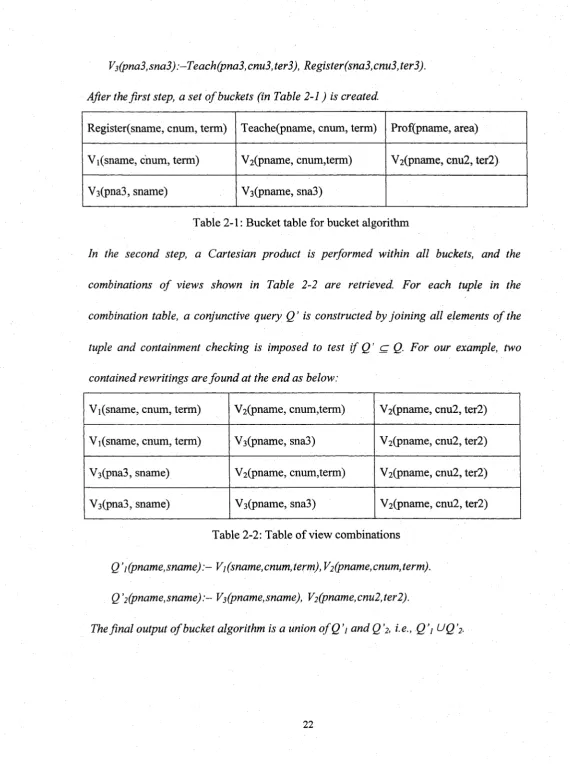
Example 2.5 Suppose we have the query and views as following.
Q(pname,sname).-Register(sname, cnum, term), Teach(pname, cnum,term),
Prof(pname,area).
Vfsnal, cnul, terl) .-Register(snal, cnul, terl), Course(cnul, ctil).
V3(pna3, sna3):-Teach(pna3, cnu3, ter3), Register(sna3, cnu3, ter3).
After the first step, a set o f buckets (in Table 2-1) is created.
Register(sname, cnum, term) Teache(pname, cnum, term) Prof(pname, area)
Vi(sname, cnum, term) V2(pname, cnum,term) V2(pname, cnu2, ter2)
V3(pna3, sname) V3(pname, sna3)
Table 2-1: Bucket table for bucket algorithm
In the second step, a Cartesian product is performed within all buckets, and the
combinations o f views shown in Table 2-2 are retrieved. For each tuple in the
combination table, a conjunctive query Q ’ is constructed by joining all elements o f the
tuple and containment checking is imposed to test i f Q ’ cr Q. For our example, two
contained rewritings are fo u nd at the end as below:
Vi (sname, cnum, term) V2(pname, cnum,term) V2(pname, cnu2, ter2)
Vi (sname, cnum, term) V3(pname, sna3) V2(pname, cnu2, ter2)
V3(pna3, sname) V2(pname, cnum,term) V2(pname, cnu2, ter2)
V3(pna3, sname) V3(pname, sna3) V2(pname, cnu2, ter2)
Table 2-2: Table of view combinations
Q ’](pname,sname)V](sname,cnum, term), V2(pname,cnum,term).
Q jfpnam e,snam e):-V3(pname,sname), V2(pname,cnu2,ter2).
Chapter 3
Finding Complete and Equivalent Rewriting
In the last chapter, we have introduced some algorithms of answering query using views.
The objective of those algorithms is to find maximally contained rewriting. In this
chapter, we will present our TCM (Tail Containment Mapping) Bucket algorithm, which
is designed to find equivalent and complete rewritings for a conjunctive query. We will
first explain the motivation of our research in section 3.1. Then, we will discuss two
solutions for finding complete and equivalent (CE) rewritings. In section 3.3, we will
propose our TCM Bucket algorithm, and the analysis of its time complexity will be given
in the last section.
3.1 Motivation
In the context of data integration, most of query rewriting algorithms [5][14] [15] [16]
are designed to produce maximally contained rewriting. The output of those algorithms is
a union of all contained rewritings they can find. We denote such maximally contained
rewriting as Q ’m, Q ’m = Q ’ i U , . . . , U Q ’n, where Q ’i, 1 < i < n, is a conjunctive
However, among all those contained rewritings Q ’ i, . . . , Q ’n, there might be an
equivalent single conjunctive rewriting, say it is Q ’i, Q ’j = Q , and i is in {1, ..., n}.
Obviously, answering Q using Q ’i will be much more efficient than using Q ’m- Since Q ’i
is already equivalent to Q , there is no need to evaluate all other contained rewritings in
Q ’ l, • • • ,Q ’n •
In application where a large number of views are available for query rewriting, the
number of contained rewritings for a query could also be very large. Among those
contained rewritings, there usually exist CE rewritings. For example, in our experiment
in section 4.2.1, when the number of views is 450, 158 queries have 3273 contained
rewritings in total. On average, a query Q has 20 contained rewritings. 116 out of these
158(73%) queries have CE rewritings. Suppose a query Q has 20 contained rewritings,
and one of those rewritings, say Q ’e is equivalent to Q , then using Q ’e instead of Q ’m to
answer query Q will have following significant benefits:
• Save the time on generating other 19 contained rewritings.
• Avoid evaluating all other 19 contained rewritings.
• Save the time on making a union of the results of all rewritings.
Suppose it takes the same time to evaluate every single conjunctive contained rewriting,
then using Q ’e to answer Q will be at least 20 times faster than using Q ’M .
rewritings for data integration applications. We have explored two approaches to find CE
rewriting. One is expanding equivalent rewriting algorithms, and the other one is
utilizing complete rewriting algorithms.
3.2 Expanding equivalent rewriting algorithms
Equivalent query rewriting algorithms [23, 24] are designed for the purpose of query
♦ optimization. The result of those algorithms are required to be equivalent rewritings, but
not necessary to be complete.
In an equivalent rewriting algorithm, the rewriting is achieved by a sequence of
substitutions. Each substitution replaces one or more subgoals o f the original query with
that of the given views. In order to obtain an equivalent rewriting in the end, the
algorithm guarantees the result of each substitution to be equivalent to the original query.
In general, it requires that every substitution is a safe substitution [23], which means all
subgoals and predicates o f the view must be able to be mapped to their counterparts of
the original query.
Due to the sequential application of the substitutions and the strict restriction on safe
substitution, in certain cases such algorithm cannot find any complete rewriting even if
and two views refer to R. In this case, one view is used and the relation R is removed,
hence the second view can never be used and some possible CE rewritings may be
missed.
Example 3.1 Given one query Q and two views V/ and V2 as below:
Q(a, d) :-A (a, b), B(b, c), C(c, d).
Vj(a, b, c) :-A (a, b), B(b, c).
V2(b, c, d) B(b, c), C(c, d).
Obviously, Vi can substitute subgoals A and B in Q, and V2 can substitute subgoals B
and C in Q. Because both two substitutions are safe substitutions, after the first iteration,
an equivalent rewriting algorithm will generate two partial equivalent rewritings:
Q’i(a, d) V,(a, b, c), C(c, d).
Q’2( a ,d ) :- A ( a ,b ) ,V2(b ,c ,d ).
Nevertheless, in the next iteration, we find out that subgoal C in Q ’i cannot be safe
substituted by V2. Because subgoal B has been replaced by Vi already, B in V2 is not
able to be mapped to any subgoal in Q’i. Likewise, situation exists between Q2and Vi.
As a result, the algorithm stops, and Q’i and Q’ 2 are the final result. However, the
algorithm misses two CE rewritings:
Q’3( a ,d ) : - V1( a ,b ,c ’) ,V2(b ,c,d ).
In order to make use of equivalent query rewriting algorithms to find CE rewritings, we
have to adjust the query to be rewritten, in every iteration of substitution, by adding some
extra subgoals and predicates, so that we can continuously conduct safe substitutions
until all source subgoals in the query are replaced by views. However, adding extra
subgoals will add unnecessary overhead, and make the algorithm very complicated.
Equivalent query rewriting algorithm, therefore, is not a proper start point for CE
4 . .
rewritings.
3.3 Expanding Complete Rewriting Algorithms
Complete rewriting algorithms are designed for data integration applications.
Accordingly, the result of this kind of algorithms must be complete rewriting. There are
two major types of complete rewriting algorithms, bucket based algorithm [5, 14, 15] and
inverse rule based algorithm [2, 17]. Complete rewriting algorithms can always find
maximally contained rewritings. It implies that if there exist equivalent rewritings of the
original query based on the given views, these algorithms can find at least one of them.
The only problem is that such algorithm does not generate any single conjunctive query
as its result; instead, it produces a union of all contained conjunctive queries.
remove contained conjunctive queries from the resulting contained rewritings of a
complete rewriting algorithm. For each contained rewriting, we can conduct a
containment checking with query Q. If the conjunctive rewriting contains Q, it is a CE
rewriting, otherwise it is not equivalent to Q and will be eliminated.
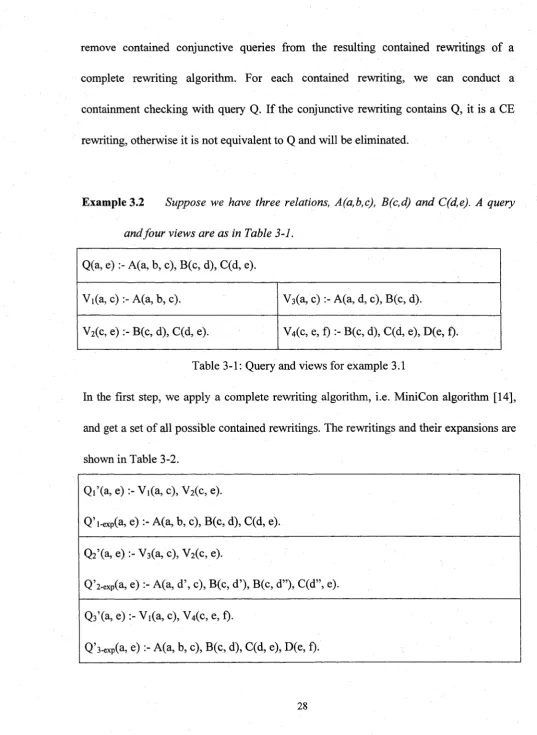
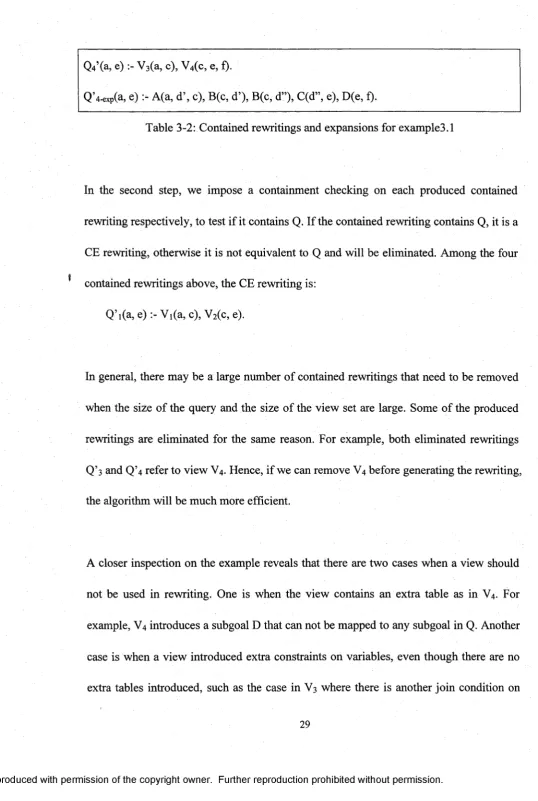
Example 3.2 Suppose we have three relations, A(a,b,c), B(c,d) and C(d,e). A query
and four views are as in Table 3-1.
Q(a, e ) :- A(a, b, c), B(c, d), C(d, e).
Vi(a, c ) : - A(a, b, c). V3(a, c ) :- A(a, d, c), B(c, d).
V2(c ,e ):-B (c ,d ),C (d ,e ). V4(c, e, f) :- B(c, d), C(d, e), D(e, f).
Table 3-1: Query and views for example 3.1
In the first step, we apply a complete rewriting algorithm, i.e. MiniCon algorithm [14],
and get a set of all possible contained rewritings. The rewritings and their expansions are
shown in Table 3-2.
Q i’(a,e) :-V !(a,c), V2(c, e).
Q ’ i-exp(a, e) :- A ( a , b, c), B(c, d), C(d, e).
Q2’(a, e) :- V3(a, c), V2(c, e).
Q ’2-exp(a, e) :- A ( a , d \ c), B(c, d ’), B(c, d”), C(d”, e).
Q3’(a, e ) : - V1(a ,c ),V4(c, e, f).
Q4’(a, e) V3(a, c), V4(c, e, f).
Q’4-exP(a, e ) A ( a , d’, c), B(c, d’), B(c, d”), C(d”, e), D(e, f).
Table 3-2: Contained rewritings and expansions for example3.1
In the second step, we impose a containment checking on each produced contained
rewriting respectively, to test if it contains Q. If the contained rewriting contains Q, it is a
CE rewriting, otherwise it is not equivalent to Q and will be eliminated. Among the four
contained rewritings above, the CE rewriting is:
Q’](a,e) : - Vi(a, c), V2(c, e).
In general, there may be a large number of contained rewritings that need to be removed
when the size of the query and the size of the view set are large. Some of the produced
rewritings are eliminated for the same reason. For example, both eliminated rewritings
Q’ 3 and Q’ 4 refer to view V4. Hence, if we can remove V4 before generating the rewriting,
the algorithm will be much more efficient.
A closer inspection on the example reveals that there are two cases when a view should
not be used in rewriting. One is when the view contains an extra table as in V4. For
example, V4 introduces a subgoal D that can not be mapped to any subgoal in Q. Another
case is when a view introduced extra constraints on variables, even though there are no
the second attributes o f A and B. In this case, variable d’ in expansions of Q’ 2 and Q’4,
which is introduced by V 3 , can not be mapped to any variable in Q. Hence, Q’ 2 and Q’ 4
are not equivalent to Q.
Based on the observations above, we can see that view V 3 and V4 should not be used to
generate CE rewriting of Q. Therefore, we should eliminate V 3 and V4 before rewritings
are constructed, hence prevent non-equivalent rewriting Q ’2, Q’ 3 and Q’ 4 from being
generated, and avoid afterward containment checking.
3.4 TCM Bucket Algorithm
We now propose an algorithm that expands the bucket algorithm, a complete rewriting
algorithm, to generate CE rewriting, which is much efficient than the naive approach in
section 2.3. The main idea is to prevent inappropriate views from being added to the
buckets in the first stage of the bucket algorithm, so that the rewritings produced in the
combination stage are automatically CE rewriting without any extra containment
3.4.1 Definitions
Before going into the detail of TCM bucket algorithm, we first introduce some
definitions and terms used in the algorithm.
Definition 3.1 (Tail Containment Mapping)
Given queries V and Q, and a mapping (p from the variables in V to the variables in
Q. cp is called a TCM mapping i f each subgoal o f V can be mapped to one o f the
subgoals in Q.
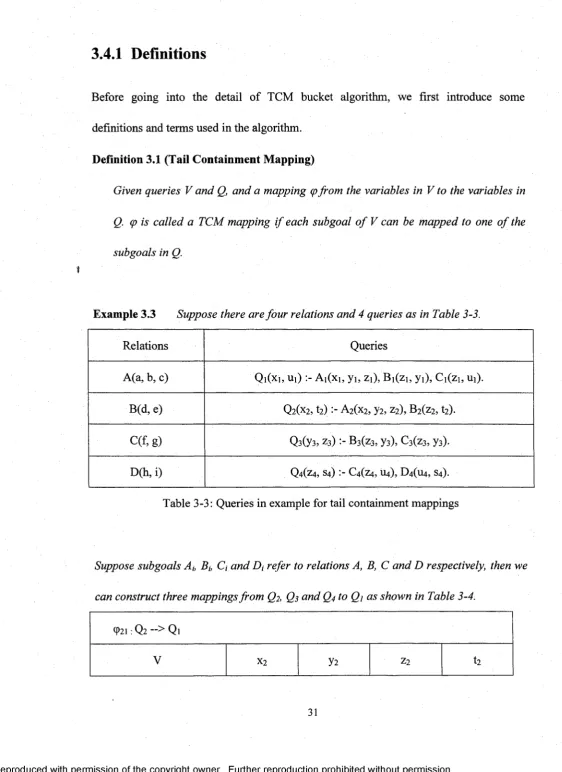
Example 3.3 Suppose there are four relations and 4 queries as in Table 3-3.
Relations Queries
A(a, b, c) Q i(xb ui) Ai(xb yi, zO, Bi(zi, yi), Ci(zi, ui).
B(d, e) Q2(x2, t2) A 2(x2, y2, z2), B2(z2, t2).
C(f, g ) QaCys, z3) B3(z3, y3), C3(z3, y3).
D (h,i) Q4(z4, s 4) C4(Z4, m), D4(u4, s 4).
Table 3-3: Queries in example for tail containment mappings
Suppose subgoals A„ Bi:C, and Dt refer to relations A, B, C and D respectively, then we
can construct three mappings from Q2, Q3 and Q4 to Qj as shown in Table 3-4.
921 : Q2 Ql
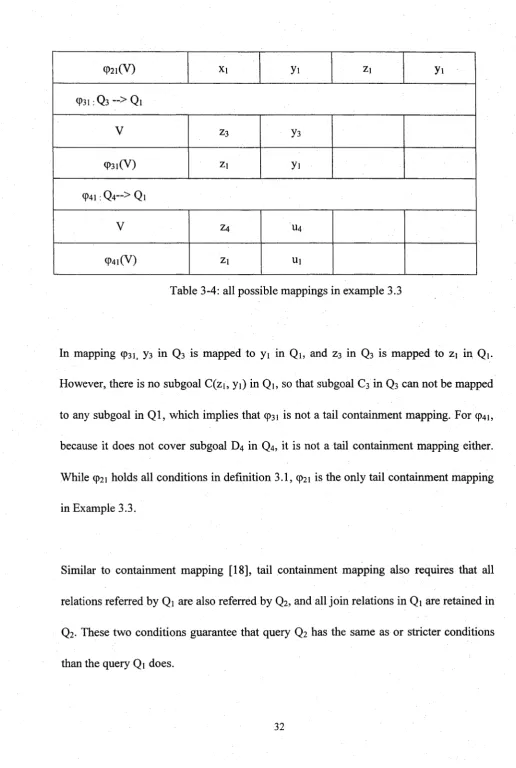
9 2 i ( V ) X i y i Z i y i <P31 :Q 3 “ > Ql
V Z 3 Y3
9 3 i ( V ) Z i y i
941 : Q 4 ” > Ql
V z4 u4
q>4i(V) Z i U i
Table 3-4: all possible mappings in example 3.3
In mapping (p^ y3 in Q3 is mapped to yi in Qi, and z3 in Q3 is mapped to z\ in Qi.
However, there is no subgoal C(zi, yi) in Qi, so that subgoal C3 in Q3 can not be mapped
to any subgoal in Q I, which implies that cp3i is not a tail containment mapping. For cp4i,
because it does not cover subgoal D4 in Q4, it is not a tail containment mapping either.
While 9 2 1 holds all conditions in definition 3.1, 9 2 1 is the only tail containment mapping
in Example 3.3.
Similar to containment mapping [18], tail containment mapping also requires that all
relations referred by Qi are also referred by Q2, and all join relations in Qi are retained in
Q2. These two conditions guarantee that query Q2 has the same as or stricter conditions
The difference between tail containment mapping and containment mapping is that tail
containment mapping does not require that all head variables of Q2 can be mapped to
head variables of Qi. Intuitively, a tail containment mapping from Q2 to Qi represents
that without considering projection to head variables, tuples that satisfy Qi also satisfy
q2.
f In order to verify TCM mapping, we first introduce some definitions and theorems.
Definition 3.2 (Variable Range)
Given a query Q, fo r any variable x e Q, the range o f x in Q, denoted by R(x, Q), is
the set o f relation attributes to which x refers.
For example, there are two relations A(a,b,c) and B(d,e), and a query Q(z) A(x,y,z),
B(z,u). Then the range of variable x in Q is {A.a}, i.e. R(x,Q) = {A.a}, and the range of z
in Q is {A.c,B.d}, i.e. R (y,Q )= {A.c,B.d}.
The range o f variable x in query Q reflects the specific join relationship in query Q. If
R(x,Q) contains only one attribute, it means there is no join on that attribute. If R(x, Q)
has more than one attributes, it implicates that in query Q, all those attributes are joined
Definition 3.3 Given subgoal S j( x i,.., x j from query Qi, and S2(yi,. . .,yr) from query Q2,
Si can be mapped to S2, i f
1. Si and S2 refer to the same database relation, and
2. The r a n g e o f any variable o f Si is a subset o f the range o f corresponding variable in S2,
i.e. R(xit Qi) c R (y u QT), 1 < i <n.
Intuitively, the fact that subgoal Si can be mapped to S2 means all the join predicates
applied on Si in query Qi can be mapped to some join predicates on S2 in query Q2. This
is very important to tell whether a tuple satisfying Q2 can also satisfy Qi, i.e., there is a
TCM mapping from Qi to Q2.
3.4.2 Expanding Bucket Algorithm with TCM
We now propose an algorithm that expands the bucket algorithm to generate CE
rewriting, which is much efficient than the naive approach in section 3.3. The main idea
is to refine the buckets generated in the first stage of the bucket algorithm, so that the
rewritings produced in the combination stage are automatically CE rewriting without any
extra containment checking.
We illustrate the TCM bucket algorithm with the following example.
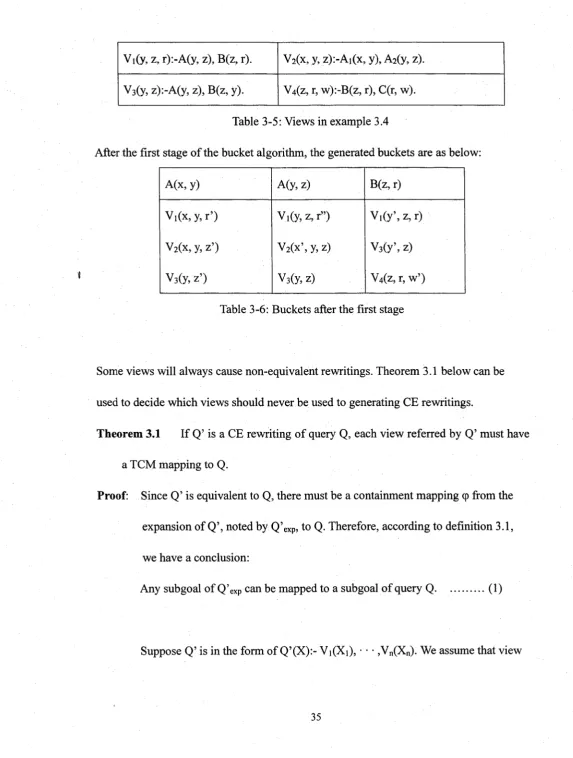
Example 3.4 Given a query Q(x, r):-A(x, y), A(y, z), B(z, r)., and four views as
Vi(y, z, r):-A(y, z), B(z, r). V2(x, y, z):-Ai(x, y), A2(y, z).
V3(y, z):-A(y, z), B(z, y). V4(z, r, w):-B(z, r), C(r, w).
Table 3-5: Views in example 3.4
After the first stage of the bucket algorithm, the generated buckets are as below:
A(x, y) A(y, z) B(z, r)
V i(x ,y ,r’)
V2(x, y, z ’)
V3(y ,z ’)
V i(y ,z ,r”)
V2(x’, y, z)
v 3( y , z)
Vi(y’, z, r)
V3(y’,z )
V4(z, r, w ’)
Table 3-6: Buckets after the first stage
Some views will always cause non-equivalent rewritings. Theorem 3.1 below can be
used to decide which views should never be used to generating CE rewritings.
Theorem 3.1 If Q’ is a CE rewriting o f query Q, each view referred by Q’ must have
a TCM mapping to Q.
Proof: Since Q ’ is equivalent to Q, there must be a containment mapping cp from the
expansion of Q \ noted by Q ’exp, to Q. Therefore, according to definition 3.1,
we have a conclusion:
Any subgoal of Q ’exp can be mapped to a subgoal of query Q... (1)
Vi( X;):- Si( Yi), • • • ,Sm( Ym) does not have TCM mapping to Q. So there
must be a subgoal of view Vj, say S( Y) that can not be mapped any subgoal of
Q-Suppose in the Q ’exp, subgoal S(yi,...,yn) of Vj is changed to S(zi,...,zn), where
Zj is renamed from yb 1 < i < n. There are two cases of zb
a) Variable Zj is a fresh new variable in Q ’exp, which means Zj does not
appear in any views other than Vj. Then R(zi, Q ’exp ) = R(yi,vo.
b) Variable z; is a variable in Q, so that R(zb Q ’exp)= R(yi,Vj) U ... U R(xn,
Vn), where xn is the variable in view Vn that is also renamed to zb Then
we have R(zi, Q’exp) e R (y i5Vi).
Based on a) and b), for any variable yi of subgoal S(yi,...,yn), R(zb Q ’eXp) £
R(yi,Vi), where Zj is the corresponding variable in subgoal S(zi,...,Z n). Thus we
can draw another conclusion:
A subgoal S(yi,.. .,yn) in view Vj can be mapped to the corresponding subgoal
S (Z i,...,Z n ) in Q exp- ...( 2 )
While according to conclusion (1), subgoal S(zi,...,zn) can be mapped to a
subgoal, say it is Sq, of Q. Then it is easy to infer that S(yi,.. .,yn) can also be
mapped to any subgoal of Q. It means that any view Vi must have a TCM
mapping to Q.
Q.E.D.
Intuitively speaking, Theorem 3.1 proves that views having no TCM mapping to a query
Q can never be used to generate CE rewritings of Q, no matter how they are combined
with other views. Based on the theorem 3.1, we develop the first rule of our algorithm,
i Rule 1: If a view does not have a TCM mapping to the given query, remove it before
running the bucket algorithm.
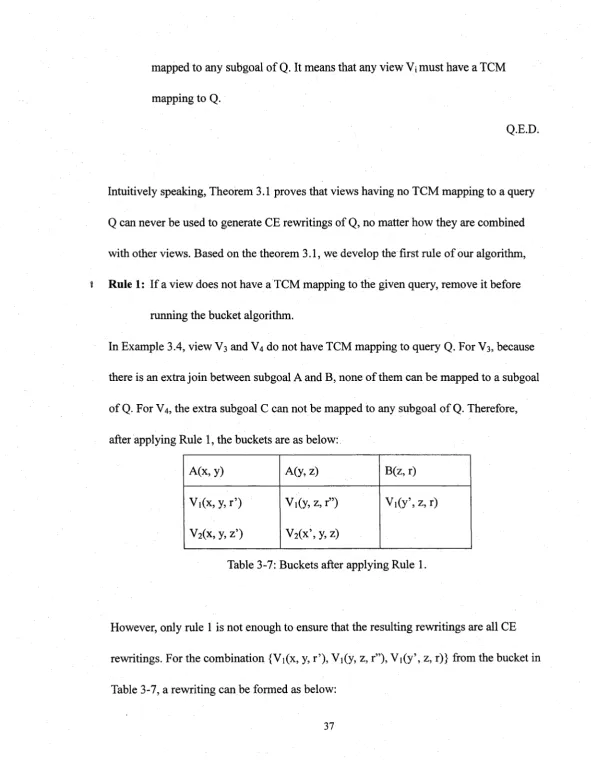
In Example 3.4, view V 3 and V 4 do not have TCM mapping to query Q. For V 3 , because
there is an extra join between subgoal A and B, none of them can be mapped to a subgoal
of Q. For V 4 , the extra subgoal C can not be mapped to any subgoal of Q. Therefore,
after applying Rule 1, the buckets are as below:
A(x, y) A(y, z) B(z, r)
V i(x ,y ,r’)
V2(x, y, z ’)
V i(y, z, r”)
V2( x \ y, z)
Vi(y’,z ,r )
Table 3-7: Buckets after applying Rule 1.
However, only rule 1 is not enough to ensure that the resulting rewritings are all CE
rewritings. For the combination {Vi(x, y, r ’), Vi(y, z, r”), V i(y’, z, r)} from the bucket in
Q i’(x, r):- Vi(x, y, r ’), Vi(y, z, r ” ), V i(y \ z, r).
After optimization, Q i’ becomes:
Q’i(x, r)> Vi(x, y, r ’), Vi(y, z, r).
Q’i.eXp(x, r):-A(x, y), B(y, r ’), A(y, z), B(z, r).
Q’i is a properly contained rewriting, i.e. Q’icQ , because in the expansion of Q’i,
subgoal B(y, r ’) cannot be mapped to any subgoal of Q.
In order to prevent generating a contained rewriting like Q ’ i, we need to refine the TCM
mapping to Bucket-TCM mapping as below.
Definition 3.4 (Bucket-TCM mapping)
Given a bucket (or subgoal) S(xj, x f in query Q, and a subgoal S(yi,...,yn) in a
view V. A mapping cp is a Bucket-TCM mapping from V to Q wrt S ( x i ,x j if
• S(yi, ...,yr) is mapped to the subgoal S(xj, x„); and
• All other subgoals in V are mapped to some subgoals in Q.
Different from the TCM mapping, Bucket-TCM mapping is relevant to one particular
subgoal. Through this definition, we are aware of that Vi does not have a Bucket-TCM
mapping to Q wrt the bucket S(x, y), hence Vi cannot be added to this bucket.
Generalizing from this observation, we developed the following theorem:
Theorem 3.2 Given a rewriting Q ’:-Vi, • • •, Vn. of query Q:-Si, ..., Sn., the rewriting
from a bucket of the Si. Q’ is a CE rewriting iff each Vj has a Bucket-TCM mapping
to Q wrt Sj.
Proof:
Part 1 (If Q ’ is a CE rewriting, each Vj has a Bucket-TCM mapping to Q wrt Sj.)
First, we assume that Q ’ is equivalent to Q, and Q ’ refers to a view V that does
not have a Bucket-TCM mapping to Q wrt any Ai; 1 < i < n.
* Because Q’ is generated from bucket algorithm, Vj must be selected from a
bucket, say it is Bj. Assume that Bj is of query subgoal Sj, according to the bucket
algorithm, V; must have a subgoal S(xi,...,xn) that refers to the same database
table as Sj(yi,...,yn) does. And based on the assumption given at the beginning of
this proof,
S(xi,...,xn) can not be mapped to Sj(yi,...,yn) ...(1)
Suppose in the Q ’eXp, subgoal S (yi,.. .,y„) is changed to S (zi,.. ,,zn), and S(xi,.. .,xn)
can be mapped to S(zi,... ,zn). And because Q’ is an equivalent rewriting, there is
a containment mapping from Q’eXp to Q. Therefore S (zi,.. ,,zn) can be mapped to a
subgoal S (ti,...,tn) of query Q. Furthermore, we have:
S(xi,... ,xn) can be mapped to S(ti,... ,tn) ... (2)
of query Q.
On the other hand, because Q ’ is an equivalent rewriting of query, the bucket
algorithm ensures that there is a containment mapping for Q to Q ’eXp that maps
subgoal S(yi,...,yn) to S(zi,...,zn), which means S i(yi,...,yn) can be mapped to
S(zi,...,zn). Because S(zi,...,zn) can be mapped to query subgoal S(ti,...,tn), the
conclusion can be drawn that Si(yi,...,yn) can be mapped to S(ti,...,tn). As
Si(yi,...,yn) and S (ti,...,tn) are different subgoals of Q , it can be proved that
Si(yi,...,yn) is redundant in query Q . This is contradictory to the earlier
assumption in this paper that no queries contain redundant subgoals.
In conclusion, the assumption at the beginning of this proof is not true.
Part 2 4r (If each V j has a Bucket-TCM mapping to Q wrt S j , Q ’ is a C E rewriting.)
Because the bucket algorithm guarantees that Q ’ is a complete rewriting and Q ’ c ; Q ,
we only need to prove Q c Q ’.
Because there is TCM mapping from Vj to Q , upon Theorem 3.1, any subgoal
S(xi,...,xm) ofV j can be mapped to a subgoal S(yi,. ..,ym) of Q , which means for any
Suppose in the Q’exp, subgoal S(xi,..,,xm) is changed to S (zi,...,zm), and variable zj,
1< j < m, is renamed from Xj using following rule:
a) If Xj is not a distinguished variable from subgoal S v i , Zj is a fresh variable in Q ’ eXp which does not appear in subgoals from views other than V j . So R ( z j ,
Q ’exp) = R ( X J , V i ) c R ( y j , Q ) .
b) If Xj is a distinguished variable from subgoal Svi, Xj is renamed to y ], i.e. Zj =
yj. According to the bucket algorithm, all variables that are mapped to yj are
renamed to Zj. So R(Zj, Q ’eXp) = R(xj, V j ) U ... U R(t, V t) . Because Svi can be
mapped to S q i, R(xj, V j ) c=R(yj, Q), same as all other variables that are
renamed to zj. So R(zj, Q ’exp) cR (yj5 Q).
Based on the two situations a) and b) above, any subgoal of V i in Q ’eXp can be
mapped to a subgoal of query Q . Similarly, all other subgoals in Q ’exp can also be
mapped to subgoals in query Q . Based on Definition 3.1, there is a TCM mapping
from Q ’exp to Q .
In addition, the bucket algorithm guarantees that all the head variables of Q ’exp have
1:1 map to the head variables of query Q. Overall, a conclusion can be drawn that
there is a containment mapping from Q ’eXp to Q, which proves Q c Q ’.
Based on Theorem 3.2, we develop the second rule for our algorithm:
Rule 2: When a view V is added to a bucket A of query Q, V must have a Bucket-TCM
mapping to Q wrt A.
For the buckets in Table 3-7, the only view that does not satisfy rule 2 is view Vi(x, y, r ’)
in the bucket of A (x, y). It can be verified that subgoal A(y, z) of Vi can only be mapped
to subgoal A(y, z) of Q, but not A(x, y) of Q. Based on rule 2, Vi should not be added to
the bucket of A(x, y). After rule 2 is applied, the buckets in Table 3-7 are changed as
below:
Ai(x, y) A2(y,z) B(z, r)
V2(x, y, z ’) V i(y, z, r”)
V2(x’, y, z)
Vi(y’,z ,r )
Table 3-8: Buckets after applying rule 2
In the combination stage of the bucket algorithm, with the buckets in Table 3-8, two
rewritings are generated as below. It can be verified that both Q’ 2 and Q’ 3 are CE
rewritings.
Q’2(x, r):-V2(x, y, z ’), Vi(y, z, r).
Q ’2-exP( x , r):-Ai(x, y), A2(y, z’), A(y, z), B(z, r).
Q’3(x, r):-V2(x, y, z), V i(y’, z, r).
Theorem 3.1 and 3.2 prove that by applying rule 1 and 2 in the first stage of the standard
bucket algorithm, the algorithm only produces CE rewriting. We refer to this expanded
bucket algorithm as TCM Bucket algorithm. Many rewritings that can be generated using
standard bucket algorithm will not be produced by TCM bucket algorithm.
According to Theorem 3.2, none of those rewritings are equivalent to the original query.
In another word, all CE rewritings that the standard bucket algorithm can create are also
1 in the output o f our TCM Bucket algorithm. Because the bucket algorithm can always
produce maximally contained rewriting, if there exist CE rewritings, the bucket
algorithm is guaranteed to find one. The same conclusion applies to TCM bucket
algorithm.
3.4.3 TCM Bucket Algorithm Implementation
The TCM bucket algorithm expands the bucket algorithm, so that all produced rewritings
are automatically CE rewritings without extra containment checking. Based on the first
stage of bucket algorithm, TCM bucket algorithm needs to apply an extra TCM mapping
to test which view should be put into which bucket.
First, we need to implement a procedure to find TCM mapping from a view to the given
that there is a TCM mapping from V to Q falls into two steps.
In the first step, the algorithm attempts to find out all possible mappings from variables
of V to variables of Q that cover all subgoals of view V. It first creates a matching set for
each subgoal of V. Every matching set contains all subgoals of Q that refer to the same
database relation as the corresponding view subgoal does. If any matching set is empty,
which means the view has an extra subgoal that does not exist in query Q, the
verification fails immediately, because in that case, there would be no tail containment
mapping from Q to V.
Here we use the query Q and view Y i in Example 3 to illustrate the procedure of finding
TCM mappings.
Q(x, r):-A(x, y), A(y, z), B(z, r).
Vi(y, z, r):-A(y, z), B(z, r).
The matching set o f the two subgoals A(y, z) and B(z, r) are as in Table 3-9,
A(y,z) A(x, y), A(y, z)
B(z, r) B(z, r)
Table 3-9: Matching sets for subgoals of view VI
Then, the procedure selects one subgoal from each matching set, and constructs a
mapping from the view subgoals to those query subgoals. As for the example above, two
V, A(y, z) B(z, r) y z r
<Pi(Vi) A (x,y) B(z, r) X y r
CP2(Vl) A(y, z) B(z, r) y z r
Table 3-10: Constructed mappings
In the second step, we check all mappings found in the first step, to see if there exists a
tail containment mapping. For view Vi, (pi is not a tail containment mapping, because cpi
maps subgoal B(z, r) to B(y, r) which is not included in query Q. Mapping 9 2
satisfies all conditions required to be a tail containment mapping.
To apply rule 1, TCM mapping verification procedure is used to test each view. If a view
V does not have any TCM mapping to Q, V will not be added to any bucket.
To apply rule 2, we make use of the TCM mappings found in the previous step. If there is
a Bucket-TCM mapping from V to Q wrt the query subgoal o f the bucket, the head o f V will be
The whole TCM bucket algorithm is described as in Figure 3-1.
/* TCM bucket algorithm*/
Begin
/* The first stage*/
For every view V in the bucket set B
Call TCM mapping verification procedure
If there is NO TCM mapping from V to Q
Continue Else
For every bucket Bi of query subgoal Si
If has a Bucket-TCM mapping to Qwrt Si
Rename head variables o f V Add V into Bi
Endif Endfor Endif Endfor
/* The second stage*/
Execute the combination stage algorithm of the bucket algorithm with bucket sets B to generate CE rewritings.
End
Figure 3-1: TCM bucket algorithm
In fact, the two rules in TCM bucket algorithm can also be applied to other bucket based
algorithms, such as MiniCon, SVB Bucket, etc. Since all bucket based algorithms consist
o f bucket construction stage and combination stage, it is very easy to apply the two rules