GENETIC EQUILIBRIUM AND SELECTION*
W. B. KEMP
University of Maryland, College Park, Maryland
Received June 9, 1928
TABLE OF CONTENTS
Preliminary considerations. ...
Selection. . .
. . .
. . . PAGE
.
. 85.
.
85Mutation.. . . 87
Reproduction v e ~ m s production. . . 87
Scope of present paper. . . 88
The selective processes for reproduction (natural selection). ... 89
Under self-fertilization . . . 91
Under random-fertilization.. . . 94
Multiple factors.. . . 98
Linkage. . . 98
More complex cases.. . . 100
General considerations. . . 103
The selective processa for man’s production of economic goods (artificial selection). ... 105
Simple selection.. . . 106
More complex breeding. . . 114
Incidental selection. . . 120
General conclusions.. . . 121
LITERATURE CITED. . . . 126
SUMMARY.. ... ~ ... 122
PRELIMINARY CONSIDERATIONS
Discoveries by Mendel and later scientists indicate the prevalence of a mathematical regularity underlying much of genetic behavior in inher- itance. Before an intelligent evaluation of the various practices in plant and animal improvement may be made, it is essential to know more of the fundamental principles upon which these practices are based. It is esscn- tial to know more of this mathematical regularity, the extent to which it is operative, and the ultimate results of its action. Of equal value is a knowledge of the extent to which these results are desirable for utilization
by man. The present study represents an effort to ascertain more of the underlying principles of plant and animal improvement.
Selection
One may logically concede that, in so far as genetic constancy exists selection cannot modify the characteristics of a population. It must have variability to play upon.
86 W. B. KEMP
The only types of sexual populations that remain constant under a given environment would appear to be: (1) a single homozygous biotype either inbred or random bred; (2) a homozygous inbred population, con- sisting of different biotypes in which all members reproduce equally;(3) a population held in equilibrium by (a) recurring mutation, (b) balanced detrimentals, or (c) a combination of these two. In the case of any other population selection occurs. The inevitable result of selection is approach toward uniformity as produced by one or more of the foregoing conditions. This approach toward uniformity has been discussed by HAGEDOORN
(1921). More detailed mathematical consideration of some of the con- ditions underlying the phenomenon have been presented by
R.
A. FISHER(1922) and by WRIGHT (1921). The intensity of selection in any population depends upon: (1) the proportion of parents and (2) the variability in progeny number from individual parents. In a population of constant size the proportion of parents is influenced (1) by size of progenies, and (2) by degree of inbreeding. In an inbred form producing many descendants per parent, natural selection is intense; therefore a small proportion of the population is apt to engage in reproduction. In such a type uniformity should be approached with relative rapidity.
On the other hand, the proportion of the total population that engage in reproduction is probably greater in man than in any of the domestic plant or animal forms, hence the effects of selection should be most gradual in man.
As a result of the “Hagedoom effect”, which tends to eliminate factors in low frequency, an approach toward homozygosis may take place in a population, even when all factors are equally beneficial. This effect should be rapid when great numbers of progeny are produced by each parent o r when a small proportion of the population engage in reproduction. This process should be more rapid when factors of a single allelomorphic series differ in their value. In such a case members of the population are var- iable in genetic vigor. Detrimental factors are eliminated from the pop-
GENETIC EQUILIBRIUM AND SELECTION 87
selection is more effective. When a small proportion of the population en- gage in reproduction, a large proportion of factors in low frequency should be eliminated. Under such conditions those factors that are retained should be thrown into higher frequency where selective elimination is more rapid. It seems evident, therefore, that, other things being equal, the pro- portion of factors in low frequency is lower, and the mean level of frequency for each factor is higher when few individuals become parents.
Mutation
Factors that are produced by recurring mutation are not completely eliminated by the foregoing processes. It is possible that a beneficial factor may mutate to a detrimental or a detrimental factor may mutate to a beneficial one. However, since selective elimination should keep detri- mentals in very low proportion in the population, there may be relatively few a t hand to mutate; hence typical mutations would probably be de- trimental. When inbreeding a normally cross-bred form, certain detrimen- tals approach a frequency of unity, hence it is possible that beneficial mutations in any allelomorphic series are more easily observed in such artificially inbred forms.
Reproduction versus production
In order that there may be no confusion of terms, i t seems advisable to distinguish between reproduction and production. By reproduction is meant the relative number of progeny in which the germ plasm, through ovule or pollen, is distributed. By production is meant th2 yield in quan- tity or quality of that commodity of the plant that makes it economically valuable; as, grain of cereals, beauty of shrubbery, or luxuriance, palatabil- ity, and nutritive qualities of forage. It may be accepted as a general principle that the selective processes are either natural or artificial. Each one tends to reduce genetic variability, but in these two cases the end re- sult may be different. Natural selection produces a highly reproductive plant; that is, natural selection tends to favor the type best able to pro- pagate itself. On the other hand, intelligent artificial selection produces a
88 W. B. KEMP
ciency as its ultimate goal. In so far as the objective of artificial selection happens to favor reproduction, the two processes select for the same end product; therefore in such a case efforts at artificial selection yield little beyond that accomplished by nature. On the other hand, man’s economic goods may be a product that is not associated with reproduction or that runs counter to it. Under such conditions, man’s selection should be highly effective, but the natural processes may be opposed to his effort. When this occurs man must exercise incessant vigilance to maintain the pop- ulation in its consequent unstable equilibrium.
It seems evident, then, that the processes of plant and animal improve- ment must depend upon: ( l ) the extent to which equilibrium exists in the population; (2) the reproductive behavior a t equilibrium; and (3) the margin between reproduction and production.
Scope of present paper
The primary aim in this paper is to discuss the germinal purpose of selection. This purpose aims only to isolate germ plasm capable of the greatest production when properly selected. This paper is not interested in the somatic purpose of selection which aims to isolate mature, viable seed that will not convey diseases to the progeny. It is assumed as self- evident that somatic selection is frequently and necessarily essential. To plant decayed potatoes or frozen corn kernels would be absurd. To plant seeds infected with certain diseases might produce even more disastrous results. As considered in this study, germinal selection might be defined as that type of selection which induces the tendency toward a heavier pro- duction from seed on one generation than was possible from seed subjected to equally careful selection in a previous generation.
This paper is limited to a discussion of (1) some conditions that may in- duce equilibrium, (2) the reproductive behavior a t equilibrium, and (3)
the margin between reproduction and production. It makes no attempt to discuss the extent to which equilibrium exists in a population, the relative value of different agencies in inducing equilibrium, or the reproductive behavior of interacting factors when the result is different in kind from that of the constituent individual factors.
GENETIC EQUILIBRIUM AND SELECTION 89
challenge. I t is true that he may induce combinations which she has found it difficult to effect, but this process is outside the scope of selection and is productive only of material for selection to play upon. I t does not follow that artificial selection is useless. I t performs an important function aside from isolating specific germ plasm. However, there is probably no plant in which man’s aim coincides with the result obtained by nature. But, an essential service for the breeder is performed if the field of usefulness of
selection may be clearly defined, and if, for each group of plants, the diff- erent objectives are brought into relief.
The first division, then, that is made for purposes of the present discus- sion, separates plants into two groups; those grown for the production of
vegetative products, and those for the production of grain. In the former, the overlapping of artificial and natural selection is a t a minimum. In the latter, it is at a maximum. From this observation it follows that, in the former, the field of possible accomplishment by man is broad, while in the latter it may be more restricted.
Confining further discussion to those plants grown for the production of grain, it is clear that this group may be subdivided. In one division are those plants in which self-fertilization is the rule; in the other, cross- fertilization usually occurs. In the fromer, variability is too slight for nat- ure to make as rapid adaptive progress as she can accomplish in cross- fertilized plants; hence, artificial crossing to induce variability has long been utilized. In cross-fertilized plants new seed is frequently introduced to increase the germinal diversity as material for selection. In an attempt to outline the margin between productive and reproductive ability within these groups, it is first desirable to observe the selective processes for re- production in nature, and then to consider the selective processes for pro- duction by man.
THE SELECTIVE PROCESS FOR REPRODUCTION (NATURAL SELECTION)
I t is now generally believed that the factors of heredity behave accord- ing to the laws formulated by MENDEL. Most cases with which one has to deal are too complex for any simple analysis, but, if the principle of this underlying regularity is accepted, many orderly results must follow. According to PEARSON (1904) a population composed of 25 per cent A A , 50 per cent A a , and 25 per cent a4 maintains these proportions in later generations under random-fertilization if all are equally reproductive.
WRIGHT (1921) summarizes the work of HARDY (1908) in the following
90 W. B. KEMP
heterozygotes is twice the square root of the product of the two homozy- gous classes.” With a single factor pair, this condition is reached in the first generation after random mating begins. According to WENTWORTH and REMICK (1916), when many factors are involved, equilibrium is ap- proached more slowly. Formulas for a number of genetic series are pre- sented by JENNINGS (1916). Formulas presented by ROBBINS (1918) show the rate at which equilibrium is approached under different conditions of linkage. The rate at which complete homozygosis is approached under conditions of inbreeding is demonstrated by JENNINGS (1912).
I n plant populations, however, it is usually not the individuals that are considered, but the proportion their product includes within the pop- ulation or mass. Under such conditions, if the allelomorphs of a factor series possess unequal reproductive capacity, most of the foregoing formu- las apply no longer. However, JENNINGS (1916) and WENTWORTH and REMICK (1916) present series showing the rate a t which recessives and heterozygotes are lost from population when only dominants are selected for reproduction. WRIGHT (1921) showed the effect of selection toward a definite type.
The most extensive mathematical interpretation of selection that has appeared was presented by HALDANE (1924-1925). FISHER (1922) showed that when selection favors the heterozygote, a random-bred population comes into an equilibrium determined by the relative vigor of the classes present. His formula for equilibrium is expresses by WRIGHT’ in the form
L’
Q
= Ll+Lfl in which Q =proportion of recessive gametes, 1 -L‘ =vigorof homozygous dominant, 1 = vigor of heterozygote, and 1 -L”= vigor of homozygous recessive.
Of particular interest in this connection is the following statement by FISHER: “If selection favors the homozygote, no stable equilibrium will be possible, and selection will then tend to eliminate whichever gene is below its equilibrium proportion; such factors will therefore not commonly be found in nature. If, on the other hand, the selection favors the heterozy- gote, there is a condition of stable equilibrium, and the factor will continue in the stock. Such factors should therefore be commonly found, and may explain instances of heterozygote vigor, and to some extent the deleterious effects sometimes brought about by inbreeding.”
If the sum total of accomplishment by natural selection toward repro- ductive ends has been productive of important results, they have evidently
GENETIC EQUILIBRIUM AND SELECTION 91
been brought about by trying out different genetic combinations and discarding, with a lavish hand, from among the factors that are from time to time exposed to the selective agencies. And, if all natural forces within the plant are directed toward its numerical dissemination, those factors that are retained should be the ones from each series which contribute most to a highly reproductive plant. The only detrimental factors that escape the processes of elimination should be those so closely linked with benefi- cial ones that this sorting out can not take place. However, detrimental factors are apparently retained within a population. I t is worth while, therefore, to consider the processes of factor elimination, the rate a t which these processes may take place, and the conditions under which a factor may remain in equilibrium in the germinal complex and hence be a regular contributor to the genetic behavior of the plant population. Only from the results of such a consideration is i t possible to judge accurately what type of factor complex may exist in the germ plasm, when artificial selec- tion begins.
Some plants are wholly self-fertilized. Others are completely cross- fertilized. Many present degrees of intermediacy between these two ex- tremes. Frequently the proportion of self-fertilization within a given variety or species vanes, depending upon conditions external to the plant. Clearly it is beyond the scope of one short paper to present in detail the behavior for every different degree of intermediacy. It is considered sufficient, therefore, to deal first with conditions under self-fertilization, and then to consider conditions under random-fertilization. Complete cross-fertilization probably occurs nowhere else, except in the presence of self-sterility, dichogamy, or dioeciousness. For mathematical simplicity, studies are confined to those forms in which generations do not overlap. Among these it is desirable to know the rate a t which a factor on any de- trimental reproductive level disappears from the population. It is equally worth while to know the conditions under which equilibrium may be main- tained to prevent the complete elimination of such detrimental factors.
Case 1. Under sdf$ertilizatim
To obtain a logical starting place for calculation, it is assumed that the genetic factor under consideration has been introduced through crossing or by mutation. In either case tlie immediate progeny is a heterozygote Such an isolated heterozygote is termed the first filial generation, or Fl.
The second filial generation is composed of
+
A A , $ A a , and aaa. Let U,V, and W represent the reproductive capacities of A A , A a , and aa respect- ively and R, S, and T represent the corresponding proportions. Then UR
92 W. B. KEMP
represents the product of the reproductive capacity of A A multiplied by the proportion of the total population that it represents. The following formulas permit the proportions R’, S’, and T’ in any generation, to be derived from the preceding generation:
4
R ’ =
UR+VS+WT
S‘= L
UR+VS+WT
vs
W T + - 4
T f I
UR+VS+WT
When equilibrium is reached the propotion of R, S, and T remains con- stant from one generation to the next. From this fact it follows that, at equilibrium, U R
.
This equation may be expressed inthe form Also
4UR V = -
2R-S 4WT
v=-
2 T - S
(4)
An examination of these values for V shows that a state of equilibrium occurs in which segregating heterozygotes are retained, only when V is more than twice as great as either
IT
or W.Since every member of the population is homozygous dominant, heter- ozygous, or homozygous recessive, it follows that R+S+T = 1. Accmding
4UR 4UR 4WT
to (4)
v=-
2R - S hence S = 2 R - - + Similarly S = 2 T - - - .
V V
4UR 4WT R ( V - 2 U )
Therefore 2R
--
= 2T-
-
and T -.
Substituting forV V
v-2w
S and T their values in terms of R , the formula “ R + S + T = l” becomes
4UR R ( V - 2 U )
3R-”+ = 1.
GENETIC EQUILIBRIUM AND SELECTION 93
In like manner it may. be demonstrated that
Doctor SEWALL WRIGHT has made the following suggestion:
"These formulae seem to take the most instructive form if
U,
V,
and Ware broken up into portions necessary for maintenance of the size of the population and a uniform general factor (K) for rate of increase and also express one of the rates for maintenance as deviations from one. Thus let
K ( 1 - U ' ) , K ( 1 - V ' ) , K ( l - W 1 ) , be the reproductive capacities for A A , A a and aa respectively. In the case of A a , (1 -V') necessarily has the value 2 , that is heterozygotes must double (under self-fertilization) to maintain their absolute numbers. Formulae for R, S, and
T
then take the forms:W' U'+W'+2U'W'
2U'W'
U'+W'+2U'W'
U'
U'+W'+2U'W' R =S=
T -
R + S + T = l
U = K ( l - U ' )
W = K ( l - W ' )
R U + S V + T W = K . "
It becomes apparent from these formulas that R, S, and T for an inbred population a t equilibrium may be determined if
U,
V and W are known.To find
U,
V , and W, when R, S, and T are known, is equal value. Since4UR
4WTv=--
--
J. it follows that2R-S 2T-S
V(2R
-S)
U =
4R
and W = V ( 2 T - S )
4R
2R-S 2t-5
4R
,' 4TLet V - 1. Then
U
becomes-
1 Also W becomes-
94 W. B. KEMP
4R R(2T-SI
Similarly, let
U
= 1. ThenV
becomes - and W becomes2 R - S T ( 2 R - S )
The only conditions under which equilibrium may be established by these processes is when V is greater than 2 U and is also greater than 2
W.
Therefore, before equilibrium can be established for a segregating de- rimental factor in an inbred population, the heterozygote must be more than twice as reproductive as either homozygote. Also, any factor whose heterozygote does not meet these requirements can be held in equilibrium in the population only by recurring mutation. As a corollary to this it is obvious that, in, the absence of successive mutations, and when such excess reproductivity'of the heterozygote is lacking, the only allelomorphs of a series that can be maintained in a mixed inbred population are those that are equal in reproductive value under the given environment. Thus, starting with equal proportions of A A and aa when the reproductive vigor of A A1 0" 10n+9n
= 1, and aa = 9/10, the formulas for the n generation are = A A ,
O n
and =aa. By the tenth generation the elimination process has proceeded until the population is composed of approximately 3/4 A A and
1/4 aa.
Finally, if all classes in the successive generations of any inbred genetic series that approaches equilibrium are multiplied by their reproductive values, the totals for the different generations are such as to permit the following general statement: When under inbreeding hybrid vigor is sufficient to maintain finite equilibrium, the reproductive capacity of the population as a whole continues to decrease from F1 to equilibrium.
10n+9"
Case 2. Under Random Fertilization
The principles laid down by PEARSON (1904) and by HARDY (1908),
GENETIC EQUILIBRIUM AND SELECTION 95
the proportion in which they occur. The elimination curve of the detri- mental is an S-shaped curve that approaches the horizontal a t zero and a t unity, but is relatively steep when the two factors are present in equal proportion.
One of the conditions that maintains equilibrium is equal reproductivity for all classes. Another condition that accomplishes the same result is compensating reproductivity for the different classes. The effectiveness of natural selection is based upon differences in reproductivity in any case. In deriving genetic series under random-fertilization, when reproduc- tive differences do exist, much laborious preliminary calculation is saved by using a few equations that suggest themselves from the behavior of factors under random breeding.
If U, V, and W represent the reproductive capacities of A A , Aa, and aa
respectively, and
R,
S, andT
represent the corresponding proportions, asis assumed in the series for inbreeding, it may be random-fertilized generation of R', S', and
T'
in generation would be as follows:( U R + y y
(UR+VS+WT)2 R'
( U R + Y ) I
\ ,G/
R'
(UR+VS+WT)2
2 ( U R + 3
(W.+?)
S' =
(UR+VS+WT)a
( W T + Y Y
l"=-
(UR+VS+WT)2
demonstrated that one terms of the preceding
V S R
2 s
At equilibrium UR+-=-(2WT+VS)
or 2R(US-2WT)
S(2R - S ) V =
Thus, under random-breeding, segregating heterozygotes are retained in the population if
V
shows any superiority over U and W. Since R + S + T= 1 and since the proportion of each corresponds to that found in an ex- panded binomial it follows that R = (1
-
dT)z
96 W. B. KEMP
Also V S
R
2
s
UR+-=-(2WT+VS)
To solve for
&
at equilibrium, substitute for R and S their values expressed in terms of T, The resulting formula may be simplified to( l - . \ / T ) ( V - U ) = 4 / - T ( V - W ) '
v - U
4T=
2V-(U+W)
Substitute
Q
for4?,
1 -L' for U, 1 for V , and 1 -L" for W . ThenL1
Q =
L'+Lt/ *This is Fisher's formula as modified by Wright.
V ( 1 - 2 d T ) + W d T
1-43?
U - d T ( U + W )
1 - 2 4 7
U =
V =
d T ( 2 V - U ) -(V
-
U)0
W =
(15)
4 T =
V - U-
12V-(U+W)
-
u-W
2
+-
v - U1
l - W
2+- V-1 Let
U
= 1, then47
=l - W - 1
v-l
Let
--
-H,
then4
T =-2 + H
1
2/"T(2V -,U) - (V
-
U )dF
(21) W = = l -
d T
( V - U ) - 2 / T ( 2 V - U - l )1 -
4T
( V - l ) ( l - 2 d T )
GENETIC EQUILIBRIUM AND SELECTION 97
Let
d-F
( V - 1 ) ( 1 - 2 d T ) =L. 1
L
Then W = l - - .
To find V in terms of H and L.
U - d T ( U + W ) 1 - 2 d T - V =
Let U = l
1
l - W In the formula H =-
v - l
1 - 2 d - F
47
simplify to H =
Then V = l - d T ( l + W ) 1 - 2 d T
1 - 2 d T = l +
d
- T(1 -W>l - d T ( l + W )
1 - 2 d F
substitute for V its value and
Also substitute the same value for V in
0
1L =
-
and simplify to L =-( V - 1 ) ( 1 - 2 d T ) l - W
1
But
Therefore V = l + - 1
H L
By using the foregoing formulas it is readily demonstrated that, under random-fertilization, detrimental recessives are eliminated in the same manner as under self-fertilization, except a t a slower rate. I t is also ap- parent that all equilibrium series approach 1 as a limit just as they ap- proach 2 under self-fertilization. Hence, to keep productivity unequal allelomorphs in equilibrium in a random-bred population it is essential that the heterozygote be more reproductive than either homozygote.
98 W. B. KEMP
upon reproduction of a population. If U = l , V = 2, W =
0,
a population comes into equilibrium a t 4/9 A A , 4/9Aa, and 1/9aa. The reproductive capacity of this population is (4/9 X 1)+
(4/9 X2)+
(1/9 XO) = 12/9 = l .333The seed that produces such a generation is
3
A A and+
Aa. Now change these proportions and use a seed mixture consisting of 3/8AA and 5/8Aa.The new progeny consists of 64/169 A A , 80/169 Aa, and 25/169 aa,
while its reproductive capacity is 1.326. All possible similar changes produce a series of numbers. It starts a t 1 for AA, rises to 1.333 for
3
AAand +Aa, then drops to 1.25 for Aa. Thus for the population as a whole, the level of highest reproduction is obtained where equilibrium is estab- lished. Any other population similarly tested would bring about the same result. That genetic equilibrium is established in a random-bred pop- ulation a t the reproductive maximum is the inevitable conclusion.
Multiple Factors
The foregoing discussion demonstrates the behavior of individual factors in heredity when the factors of one allelomorphic series differ in repro- ductivity. That typical characteristics of plants and of animals are determined by many factors and not by one alone is becoming a generally accepted principle. In general, the behavior of single factors is usually applicable only to the extent that it contributes to multiple factor behavior. JENNINGS (1917) showed that the general tendency in multiple factors is the same as when only a single pair of factors is involved.
Linkage
The facts of heterosis and the detrimental effects of inbreeding indicate that beneficial vigor usually accompanies heterozygosis. If successive mutation is eliminated and if a difference in reproductivity is manifest in the factors of a series remaining in equilibrium, excess vigor in the heter- ozygote should be the rule. JONES (1917) explains this hybrid vigor on
the basis of linkage between beneficial and detrimental factors. Evidently linkage is the most plausible explanation that has been presented for this phenonenon.
That “in random mating the effect of incomplete linkage between two factors is only temporary” was shown by ROBBINS (1918). He dealt with those cases in which reproduction is equal for all classes. For such cases any crossovers, no matter how few, cause the linked factors to reach the same equilibrium as if no linkage existed. Only the rate a t which equilibrium is approached is altered by: linkage. Hence complete linkage
GENETIC EQUILIBRIUM AND SELECTION 99
But, if such complete linkage is the rule, any experimental effort to measure dominance of factors in equilibrium should show excessive effect for factors influencing reproduction.
Conversely, experimental determination, that a reproductively im- portant factor in the heterozygous condition is not favored by selection, demonstrates that the detrimental allelomorph either is in process of
elimination from the population or is reproduced by recurring mutation.
HALDANE (1927) demonstrates that under mutation the population is in
equilibrium when
PU3+(2P-Q)U2+(P-2Q-K+KQ)U-Q+KQ=0.
In the foregoing formula P =proportion A to a mutations, Q =proportion a to A mutations, K=coefficient of selection, U =gametic ratio.
To illustrate the effect of complete compensation linkage, assume linkage between series A and
B
in each of which dominance is complete, but aa has a reproductive capacity of 0, and bb has a reproductive capacity of8 .
A b 1 1 A b aB
A b 2 2 aB a B
Thus U--=lx-=--, V - = 1 ~ 1 = l , W - = O ~ 1 = 0 . I t is ap-
A b A b
aB A b
parent that V- = 2U-
.
The following calculation shows where this population comes into equilibrium.U - l
W=l-"= 1 0. L = l
L
1
4 9 S = 2 2 / ? ( 1 - d T ) = -
Proof: (1 1)
100 W. B. KEMP
[ ( + 4 + ( 1 X 3 + ( O X 3 ] 2 9
' The population in equilibrium consists of
4
A b 4 A b 1 aB9 A b 9 aB 9 aB
" >""l.
Let A A represent the presence of a rest period in seed of an annual such that it prevents germination before spring, and let aa represent the lack of a rest period. Such recessive seed may germinate in the fall and be killed. Let BB represent dense chlorophyll and let bb represent sparse chlorophyll. I n the wild state the population produces seed from which the plants are
4/9 sparse chlorophyll bearers, 4/9 dense chlorophyll bearers, and 1/9 are killed by winter. The dense chlorophyll group is twice as reproductive as the sparse chlorophyll group, but the ratio between the two groups remains constant.
If such a plant population be brought under domestication with ripe seed gathered annually and saved for spring planting, the 1/9 aB/aB
becomes reproductive and, because of dominant B, W aB/aB becomes 1. As a result R and S approach zero as a limit and T approaches unity, hence no equilibrium is reached until the entire population is aB/aB.
The chlorophyll deficiency disappears and carries with i t the rest period in the seed. This process takes place so rapidly that, by the expiration of one hundred generations after domestication, only about two plants out
of one thousand can survive in the wild state.
More Complex Cases
GENETIC EQUILIBRIUM AND SELECTION 101
recessive of another set. The formulas for such cases may be somewhat involved, but they are of simple derivation.
In a two-factor case of the type A A BB, U 1 represents the reproductive capacity of BB as U has represented the reproductive capacity of A A .
Also
RI
represents the proportion of BB in the population asR
has repre- sented the proportion of A A . In such a case the type A A BB shows a reproductive capacity of UU1 and a proportion in the population of RR1.It may easily be demonstrated that, in terms of the Nth generation, the generation indicated by N + l contains a proportion of A A BB that, under inbreeding, is found by expanding the formula (1) to
Under random-breeding an expansion of formula (11) gives
Further expansion of these formulas should apply to any compound case so long as the interacting factors produce the same result in degree as produced by the constituent individual factors. On the other hand, where there is a reproductive effect of the interacting factors different in degree from that produced by the constituent individual factors, it becomes necessary to add symbols for the different effect caused by this factor
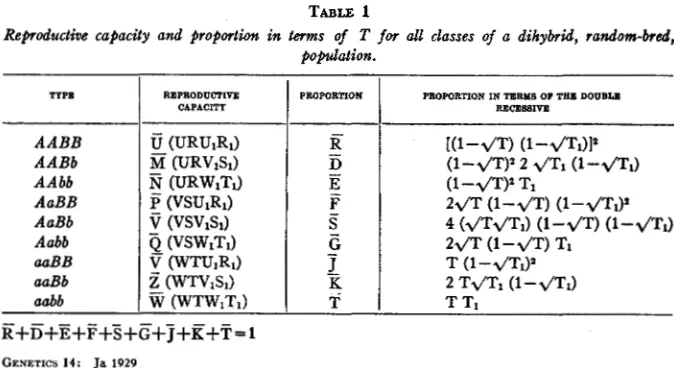
TABLE 1
Reproductive capacity and proportion in ternts of T for all classes of a dihybrid, random-bred, population.
TYPE
A A B B AABb AAbb AaBB AaBb Aabb auBB auBb aubb
REPRODUCFlVE CAPACITY
PROPORTION PROPORTION IN TERM8 OF TEE D O I J B U RECE88IW
E+D+Z+F+S+G7j+E+T=l
102 W. B. KEMP
interaction. Let
g
represent any reproductive effect of the interaction ofA A and BB that is different from that expected on account of the effect of U and U1 acting individually. Also
E
represents the proportion of A A BB that was formerly represented by RR1. Table 1 shows all nine types in the population with their appropriate symbols. This table also presents the proportion of each type in terms of the double recessive.One table should be sufficient to illustrate the effect of interacting factors. Assuming a random-bred strain of corn that possesses two factors for albino seedlings, both of these factors must be homozygous recessive for albinism to appear. The factors are a and b. Only aabb is albino. In such a case U = l , V = l , W = l , U 1 = l , V 1 = l , and W l = l . Bar letters are taken a t one, except \.y which is zero. T = .09.
Then R = ( l
-z/T)z=
.49S = 2 1 / ( 1 - 4 ? ) = . 4 2
Ti= .25
Then R I = .25, and
S1=
. SAlso
T =
.09X.25 = .0225 of the population that appear as albinos. The entire population is constituted as follows:-
R = R R l = . 4 9 X . 2 5 = .l 2 2 5
D=RS1= . 4 9 X . S = .2450
E=RT1= . 4 9 X . 2 5 = . l 2 2 5 F=SR1= .42X . 2 5 = .l050
S=SS1 = . 4 2 X . S = .2100
G=STI = . 4 2 X . 2 5 = ,1050 3 = T R , = . 0 9 X . 2 5 = . 0 2 2 5
-
-
-
-
K =
TS1= . 0 9 X . S = .0450I T = T T 1 = . 0 9 X . 2 5 = .0225
1
.
0000”
Of this population .0225 do not reproduce; hence the reproductive pop- ulation is .9775. The lost genes are .25 of a and .09 of b. The proportions of all types remaining in the reproductive population may be computed as follows:
.09 - .0225
.9775
GENETIC EQUILIBRIUM AND SELECTION 103
.42 S=--
.9775
-
.430,9775 --501 .49
R=----”
.25 - .0225
.9775
TI = = .233
. 5
.g775
.25 .9775
S1=-= .S12
R1 =-”-- = .256
In the next generation the proportion of albinos is-
( W T + Y T ( W I T I + - ) VlSl 2
Since the reproductive vigor of all types is unity, this formula becomes-
In one generation the proportion of albinos drops from .0225 to .0193. The T curve of elimination is asymptotic to zero while T 1 curve of elimin- ation is asymptotic to a value between T1 and TrT.
The foregoing illustration demonstrates the fact that, when the inter- action of non-detrimental factors produces a detrimental result, the pro- portion of all contributing factors is reduced until one essential for the detrimental result is eliminated.
It seems clear then that not the fact of elimination but the rate is changed when a detrimental result is produced by the interaction of factors.
General Considerations
I t has been recognized that a detrimental dominant can not maintain itself in a population because it can not be concealedor protectedagainst selection. However, it apparently has not been so generally recognized that a detrimental recessive can not maintain itself under ordinary con- ditions. If the laws of heredity are mendelian, and if one allelomorph in
104 W. B. KEMP
upon the facility with which the factor may be affected by the selective processes.
Unless equilibrium can be maintained in some way, only one factor of any allelomorphic series can persist in a population subjected to the action of natural selection. This principle is universal in both self-fertilization and random-fertilization. The only difference between the two types is manifested in the rate a t which elimination takes place. However, different allelomorphs of a series apparently persist. It seems evident, therefore, that equilibrium can be established short of extinction for the super- numerary factors. If frequent factor mutation be barred, the only two conditions under which multiple allelomorphs of a single factor series may be maintained within any population are equal reproductivity of the factors and compensating reproductivity by the heterozygote.
It does not of necessity follow that the most reproductive allelomorphs of each series are the only ones remaining within the entire species, even though they may be the only ones remaining within a variety of that species in one environment. For others to be eliminated from the species, all possible combinations must have existed under each environment.
It is possible that the slowly changing environment of a community may cause factors, once beneficial, to become reproductively detrimental.
A modification of cultural practice or the advent of a disease may represent such an environmental change. But it does follow that, in the absence of
GENETIC EQUILIBRIUM AND SELECTION 105
heterozygote must be more than twice as reproductive as the normal dominant if equilibrium is ever to be maintained. Under random fertil- ization, on the other hand, any equilibrium series approaches one as a limit. Hence, finite equilibrium is maintained if the heterozygote possesses any appreciable superiority in reproduction. I n any case, when equilibrium is attained under random-fertilization, it holds the genetic types in such proportion that reproduction for the population is at its maximum. It is demonstrated that if a plant possesses a lethal factor in equilib- brium-no matter how small the proportion might be-and if such plant be domesticated, this factor, if robbed of its lethal effect, will begin immediately to replace its normal allelomorph. Since the curve for such
a procedure approaches unity as a limit, equilibrium is never established again until the normal type is completely obliterated. Hence lack of ability to persist in nature is not proof of long domestication. This fact leads to important conclusions, because by the operation to the principles underlying it one may expect that, when a plant or animal comes into such an environment that factors once detrimental are no longer
so,
bizarre forms may gain the ascendency and wipe out characteristics once essential to the existence of the species. This phenomenon may show a genetic basis for the old theory of loss by disuse.THE SELECTIVE PROCESSES FOR MAN’S PRODUCTION OF ECONOMIC GOODS (ARTIFICIAL SELECTION)
An effort is made, in the first part of this paper, to present a picture of
106 W. B. REMP
Such linkage would cause the increased vigor of the heterozygote to hold detrimental factors in the germinal complex. Under self-fertilization only those cases persist in which the heterozygote is more than twice as repro- ductive as the more reproductive homozygote. Therefore, balanced detri- mentals should be present in greater numbers under cross-fertilization in which this great reproduction is not required. Also, the hybrid vigor that accompanies their presence should be a more general phenomenon in cross fertilized forms.
It is assumed that such a condition is left by natural selection. There is present that germinal complex most conducive to reproduction under the given environment. However, man is usually concerned with reproduction only to the extent that it induces production of his economic goods. He seizes upon this natural state and endeavors to manipulate its forces to his own advantage. His possibility of further accomplishment depends upon the margin between his ideal and the result obtained by nature. I n dealing with vegetative parts the margin between these two is broad, but, when dealing with quantity of seed, the margin may be exceedinly narrow. In the first case the two lines of development tend to diverge, in the second they tend to coincide. The methods that man has employed are simple selection and more complex breeding. Simple selection is the first to be considered.
SDdPLE SELECTION FOR SEED PRODUCTION
Simple artificial selection has a two-fold purpose. One is somatic, the other is germinal. The interest here is with the latter purpose. If natural selection isolates that germinal complex most conducive to reproduction, artificial germinal selection should reduce reproduction to the extent that i t limits the field within which natural selection may operate. Hence, if any type of artificial selection does not accomplish positive results in increasing production in proportion to reproduction, i t is probably detrimental.
For sexual reproduction pollen is essential. As an economic crop it is
GENETIC EQUILIBRIUM AND SELECTION 107
pollen and many ovules, but the productive difference may be enormous. It is conceivable that difference in proportion between pollen and ovules on any reproductive level may be the result of one of the following possibilities:
(1) A single pair of equally reproductive factors may be the cause. (2) Equilibrium may be maintained by linkage between factor sets
(3) An environment may prevent complete development of pistillate for pollen and for ovules, or,
inflorescence and thus reduce its proportion.
Any one of these conditions may result in a wide variation between pro- ductive and reproductive efficiency; hence the equilibrium that nature has maintained may be altered to the benefit of man. To illustrate the first possibility, one may assume a single pair of equally reproductive factors with a difference in production. Of these factors A is conducive to the production of sparse pollen and many ovules, while a induces much pollen and few ovules. Neither is dominant.
UAA =
{
1 for pollen 1.5 for pollen 2 for pollen 2 for ovules V A a = 1.5 for ovules W a a = 1 for ovulesRAA - 1 1 1
4 = 4.10818
2
+-
1.5diij
SAa
Tau
2 Z 1 .5 2.10818
-
-
"-=2 4
4%
4.108182+-
1 . 5
1 1 1
- "
4
dB-
4.108182+- 1 .5
108 W. B. KEMP
such a condition, selection for sparse pollen may be selection for yield increase. This purpose is effective in so far as it utilizes the mar- gin between productive ability and reproductive ability. It must be pointed out, however, that in isolating homozygous A A , the field of natur- al selection is restricted, and for this reason the actual production may drop below 2, particularly if A A is linked with a system of balanced de- trimentals.
It is also possible that heavier planting of plants homozygous for the less productive aa increases the level of comparative production per unit area beyond the level of relative production per plant. The net yield iq- crease probably lies between one-third, as calculated, and the gain due to
-
substituting grain for the weight of excess anthers and pollen.For consideration of the second possibility, namely that equilibrium is maintained by linkage,
a
factor A for much pollen is linked with a factor 1 for ovules A b 1.S
b for few ovules, and vice versa. IfU-
= V-={
2 fo-r pollen, aB 1
.S
for ovules
for pollen and W - = the first group is relatively twiceas productive of pollen as of ovules; the second group produces equal pro- portions of each; while the third group is twice as productive of ovules as of pollen. 'Therefore, the situation is similar to the first condition. It is possible to assume any number of other situations in which the repro- ductive vigor of A b / A b may differ widely from that of aB/aB. For any of these cases equilibrium may be maintained a t almost any level, if there is a degree of dominance in one or both linked factors to make Ab/aB
sufficiently more reproductive than either homozygous class. Here a'gain, artificial selection for many ovules or for sparse pollen raises the repro- ductive value of aB/aB and permits it to eliminate A b / A b in the same manner that the winter rest period is eliminated in the hypothetical case of the plant under domestication which becomes unfit for existence in the wild state.
GENETIC EQUILIBRIUM AND SELECTION 109
ment. When such a condition exists, the plant that produces a heavy yield, and is suppressed a t the same time by reproductive competition, should be a plant with total inflorescence sufficiently sparse so that all ovules may develop.
A concrete illustration of the third possibility should make clear this action. For this illustration it is necessary to make an assumption that has not been verified. The assumed premise asserts that, since they are homologous organs, there are characteristics of the maize ear associated with like characteristics of the tassel.
.
If the assumed premise is valid, then the conclusion must be that a plant bearing a tassel with many rows of branches or of inflorescence and close-set flowers, should bear an ear with many rows of close-set kernels. Likewise, a plant bearing a tassel, sparsely branched with wide-spaced flowers, should bear an ear with few rows of wide-spaced kernels.
In a corn field of normal fertility all pollen is usually shed from every flower on the tassel, but all ovules on the ear develop into kernels only when the number is small enough so that the plant is able to develop each ovule. An ear with many rows of close-set kernels is likely to carry an un- developed tip that may contain a large proportion of the total pistillate inflorescence. On the other hand, the ear on which the total inflorescence is small develops completely. Therefore, the pollen-ovule ratio changes when the environment prevents the development of all ovules.
If the foregoing assumption proves to be true, and if i t is desirable to increase yield by utilizing the margin between production and reproduction
as influenced by the effect of environment upon pollen-ovule ratio, the type of ear to select for poor soils would be the ear bearing few rows of
thickened kernels. A more fertile soil is able to develop a more abundant total inflorescence, hence these ear characters should tend to lose their im- portance on such a soil.
It is not to,<$e assumed that the foregoing statements represent unquali- recommendations of characteristics to select for in corn. They merely represent logical deductions, if the assumption in the premise be true. It is o f interest, however, to note the close agreement of these conclusions with the actual findings from individual ear tests a t different places in this country. Results of earlier tests are summarized by RICHEY (1922). Later results have since appeared (KYLE and STONEBERG (1925), GAR-
110 W. B. KEMP
When plant selection is practised in cross-fertilized populations, for the purpose of increasing yields, the method used is based upon the as- sumption that unaided natural selection can not accomplish the desired result, whether it be permanent or only temporary. It seems clear, there- fore, that the selective processes should modify the germ plasm in its con- tent of equally reproductive allelomorphs that differ in production, or in its content of balanced detrimentals.
Such plant selection should be productive of permanent beneficial effect in only those cases for which the controlling factors are reproduc- tively equal, but differ in productive capacity. Even in such cases, if arti- ficial selection is not carried so far as to completely eliminate the un- sirable factor, the result will be only temporary and, after selection ceases, the former equilibrium will be restored.
Among the balanced detrimntals, under cross-fertilization, selection for yield should also have only a temporary effect. Any benefit that re- sults should be manifest on account of natural or artificial elimination of
undesirable plants, or on account of the tendency for a plant in competi- tion in part to make up for the deficiencies of its neighbors. All of these processes, whether artificial or natural, may be designated by the term “Selective Progeny Elimination.”
As an illustration of the fact that reproductive benefit should not result from such selection, independent of progeny elimination
U-=-,
A b 1A b 2
A b aB
aB aB
V - = 1, and W-=O. At equilibrium, this population consists of
4 A b 4 A b 1 aB
9 A b 9 aB 9 aB
”“and
-
- Assuming that the factors designated byA and
B
are of such a nature that pmductbn equals reproduction, the production of the population is:4/9 X
3
= 4/18 4/9 X 1 = 8/18 1/9XO=OTotal= 12/18 or .667
GENETIC EQUILIBRIUM AND SELECTION l 1 1
1/4X$ = 1/8 2/4X1=4/8 1/4XO=O
Total = 5/8 or .625.
If lethal uB/uB is a zygote lethal, which prevents development of the seed possessing it, or if selective progeny elimination occurs so that sur- viving plants make up in part for deficiencies of their neighbors, yield of the unselected seed may reach as a maximum:
4/8 X
4
= 4/16 4/8Xl=6/16Total = 12/16 or .75.
By planting only seed of Ab/uB, the population becomes: 1/3X$=1/6
2/3 X 1 =4/6
Total = 5/6 or .883.
The degree to which these conditions operate determines the degree to which yield of seed from unselected plants rises from .667 to .75 and seed from selected plants from .625 to $38.
No
consideraticn is given to the amount of self-fertilization that may take place in such a population, or to the effect of overtopping of Ab/& by Ab/&. The reproductive values assigned to different types are the values a t equilibrium. Presumably one gains what the other loses. This calculation is presented to show that,for those cases where p r o d u c h and reproductioll are equal,
a
plant selection of breeding stock, among cross-fertilized grain crops, mayrest upon a precarious ggnetie foundation.
The foregoing illustrations make it clear that there may be essential merences between production and reproduction, even when grain
yield
is the quality desired. However, the objection may be raised that only
single sets or single linked sets of factors are dealt with. Many sets of
factors, or many linked sets, may be contributory to such differences a s those enumerated. It seems clear, though, that, if such. a situation exists in one factor set or linkage set, it should exist to the extent that such set contributes to the ultimate result. Hence, to the extent that equally re- productive factors and compensatingly linked factors are the only al-
112 W. B. KEMP
lelomorphs remaining in equilibrium, this situation should exist for the factors that contribute to differences in production.
There are other methods of approaching the problem, however, that do not deal with individual factors, but only with the gross results of their interaction. Kernel size serves for illustration. Figure 1 shows the margin between production and reproduction in this characteristic. On this chart the straight line labeled “Seed Size” slopes from 1 toward zero. The curved line of crop production extends in a horizontal direction until a seed size of .8 is reached, when it begins to curve downward. The repro-
FIGURE 1.-In relation to production, reproduction is the reciprocal of seed size. The repro- ductive maximum, that is, the greatest number of progeny per plant, is produced beyond the point at which yield per plant begins to decrease.
GENETIC EQUILIBRIUM AND SELECTION 113
A t one extreme it is possible to imagine a seed so large that mere size is not a productive factor. Assuming such a size and such a production as unity, size may be reduced without reducing production, but repro- production is increased. For, with the yield unaffected, and with the size dropping below unity, the numbers should rise above unity. When vari- ability occurs, therefore, natural selection reduces size until production is affected by the process. It is highly probably-in fact practically cer- tain-that, when production is affected by loss of size, the effect is a t first slight and becomes more severe as size is further reduced; hence the line of production becomes a curve.
At the other extreme, because a seed is an organized resting plant, to- gether with food material to nourish i.t through its early stages of growth, some size is necessary in the smallest seed that can function. If all grad- ations in size are considered, reproduction, or the growth of progeny from the seed, becomes zero before seed size becomes zero. Therefore, some dharacteristics of this curve of production are a t hand. As seed size be- comes smaller and smaller, production is in the early stages unaffected and reproduction is increased. Finally, a size is reached where production is progressively decreased, thus causing the line of production to curve downward more steeply as it approaches zero before the line of seed size reaches zero. The production line may approach the zero line abruptly, or it may flatten out forming an S shaped curve. This difference is im- material for the present consideration, however, because only the early stages of the curve are of immediate interest. A curve of the shape y = 1
-
.01x2 possesses the essential requirements.If the characteristics of the production curve have been correctly des- cribed, i t must continue to rise until i t reaches its maximum height at a point, in reduced seed size, appreciably beyond that where production be-
gins
to drop. Under natural selection, equilibrium is reached where the curve of reproduction is a t its greatest height and seed size, in equilibrium, fluctuates about the corresponding value. Hence, selection for seed size greater than that a t reproductive equilibrium should increase production. Figure 1 shows these curves. All begin a t unity. Seed size is reduced a t auniform rate. The curve for production possesses the essential require- ments that have been enumerated. At .8 for seed size, the production curve begins to drop. Since size is .8, and production is 1, reproduction is 1 1 . 8 = 1.25. This means that 1.25 units in number must be present per unit of volume if the size of each unit in number is .8. At the reproductive maximum size has dropped to about .62 and production has dropped to about .87.
114 W. B. KEMP
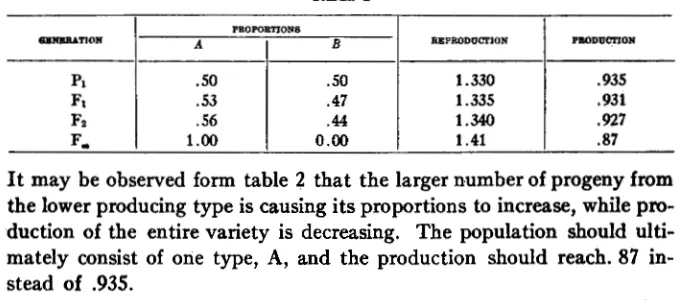
For a simple illustration of the results of seed size, one may assume a self-fertilized plant in which one variety consists of equal numbers of two pure lines identical in all respects except seed size and the results arising from this difference in size. In figure 1 reproductive equilibrium is a t a seed size of about .62. Productive maximum is not attainable below a seed size of 30. Assuming, therefore, that pure line A has a seed size of .62 and pure line B has a seed size of 3 0 , the following table shows the pro- portions and yields of consecutive generations of such a variety:
TABLE 2
PROPOBTIONS
SENEUATION
A B
p1
0.00 1 .oo
F,
.44
.56 Fz
.47 .53
FI
.50 .50
RJ3PRODOCTION PILODUCVION
1.330
.87 1.41
. B 7
1.340
.g31 1.335
.g35
It may be observed form table 2 that the larger number of progeny from the lower producing type is causing its proportions to increase, while pro- duction of the entire variety is decreasing. The population should ulti- mately consist of one type, A, and the production should reach. 87 in- stead of 9 3 5 .
Therefore, in a mixed population, equilibrium is established at such a
seed size that, within limits, artificial selection for increase in seed size should cause increase in production or yield. Here again the total expected effect may not be found, for disturbing factors need to be considered. For
instance, when plants are grown under conditions of competition, large seed may give the plants from them a sufficient start to tend to overtop and hence injure their less vigorous neighbors. To the extent that such a condition is operative, reproductive equilibrium should move up the
scale of seed size. Also, thicker planting of the smaller seed may make up for a part of the deficiency in yield per plant. On the average, however, it may be expected that artificial selection for large seed will result in in- creased yield per plant, even though in some cases the result may be over- shadowed by other forces.
More complex breeding
The domesticated plants of a given species in a given geographical division may all have a common, recent origin, but the environment of
GENETIC EQUILIBRIUM AND SELECTION 115
complex best adapted to a typical environment to which the plant is sub- jected. Hence, the breeder searches for types new to the section, types probably not so well adapted as those already present, and endeavors by natural or by artificial crossing to bring about further variation in the local strains. If a disease has appeared to which all local strains are sus-
ceptible, the poorest and least adapted foreign type may possess the one necessary .factor for resistance. By crossing and judicious selection, this one factor may be saved and the undesirable germinal material eliminated. After man has introduced the resistant factor, along with all of its detri- mental companions, the question might be raised as to whether he can effect elimination better than nature can. The answer depends upon the completeness of his knowledge. For, given a segregating germinal complex, and excluding those rare cases where man knows the specific factors in- volved, together with their mode of inheritance, nature may make a better job of selecting for reproductive efficiency than can man. Apparently every genetic factor, reproductively detrimental under the conditions in which the plant is grown, will be gradually replaced if a more beneficial allelomorph is a t hand. This process should operate under any type of fertilization, provided only that inseparable linkage with factors of re- ciprocal action is not present. Presumably any reproductively detrimental factor can be maintained in equilibrium in the population only by increased reproductive capacity of its heterozygote, or by frequent mutant origin, or by the interference of man. What man can accomplish he may bring about more rapidly than nature, and, in self-fertilized plants, he may isolate favorable biotypes that nature holds in subjection by the overtop- ping vegetation or early maturity of neighboring plants. However, the normal environmental fluctuation, which has aspects of time and place, and the ability for one plant to make up for the deficiencies of its heighbor, are so pronounced that the best general average yield obtained might be produced, not by a single uniform line, but by a mixture of these. If link- age is found under inbreeding such that hybrid vigor is produced greater than that of either homozygote, then it seems certain that man can main- tain proportions in the progeny as of
FZ
by persistent selection of the heterozygote and hold a higher reproductive level for the population thanat equilibrium.
There remains one field of complex breeding that can not be overlooked.
SHULL (1908) and EAST (1908) called attention to the detrimental effects