Spatial-Temporal and Lossless Compression
of JPEG Coded Image Collections
Manjula D1, Aravinda T V2
P.G. Student, Department of CSE,SJMIT, Chitradurga, Karnataka, India1
Professor and PG Coordinator, Department of CSE, SJMIT, Chitradurga, Karnataka, India2
ABSTRACT: The blast of advanced photographs has represented a significant test to photograph stockpiling and transmission for both individual gadgets and cloudstages. This paper proposes a novel lossless pressure strategy to additionally lessen the extent of an arrangement of JPEG coded associated pictures with no loss of data. The proposed strategy mutually expels bury/intra picture excess in the component, spatial, and recurrence areas. For every gathering, it first sorts out the pictures into a pseudo video by limiting the worldwide expectation taken a toll in the component do-fundamental. It then presents a half and half uniqueness pay strategy to better adventure both the worldwide and neighbourhood connections among the pictures in the spatial space. Furthermore, the repetition between each repaid flag and the relating target picture is adaptively diminished in the recurrence area. Experimental comes about exhibit the adequacy of the proposed lossless pressure technique.
KEYWORDS: Image compression, lossless, image set, image collection, JPEG, recompression, image coding.
I. INTRODUCTION
The expanding number of advanced photographs on both individual gadgets and the Internet has represented a major test for capacity. With the quick improvement and winning utilization of handheld cameras, taken a toll and additionally required photography aptitudes are much lower than some time recently. Clients today have become used to taking and posting photographs iniquitously with cell phones, computerized cameras, and other convenient gadgets to record everyday life, share encounters, and advance organizations. As indicated by late reports, Instagram clients have been posting a normal of 55 million photographs each day. Facebook clients are transferring 350 million photographs every day. The most effective method to store, reinforcement, and keep up this tremendous measure of photographs in a proficient way has turned into a critical issue. The most mainstream approach to lessen stockpiling sizes of photographs is by means of JPEG pressure. It is intended for decreasing the measure of photographs brought in reasonable scenes with smooth varieties of tone and shading.
A. Benchmark jpeg compression
The JPEG amass has indicated a group of picture coding principles. The most well-known one is the gauge JPEG. Fig. 1 demonstrates the key parts of the gauge encoder. As appeared in this figure, an info picture is partitioned into 88 squares. Each piece is then changed over into a recurrence area by a 8 DCT, trailed by the scalar quantization which is typically actualized with an arrangement of quantization frameworks listed by a quality component Q 2 f1; 2; :::; 100g. The quantized DC coefficients are anticipated by DPCM (Differential heartbeat code tweak) while the AC ones are crisscross checked before experiencing the Huffman-based entropy coding.
The most clear approach to decrease the capacity size of a JPEG coded picture losslessly is to supplant the Huffman coding by a number-crunching coder. Truth be told, the JPEG augmentation has officially bolstered a versatile double number-crunching coder which can decrease the document estimate by 8-10%, as revealed.
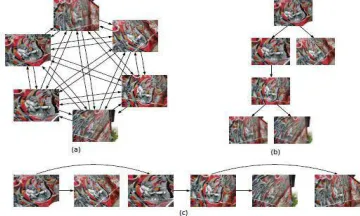
Fig 2: architecture of the proposed encoder. For each input JPEG coded image collection, images are first decoded. Then the prediction structure of the collection is determined using local features via MST. For the root images. HEVC- like intra prediction is used to exploit intra correlation
between images
B. Picture set compression
For most advanced cameras and PDAs being used today, photography is very basic and shabby. Taking various shots ends up plainly one of the best and general approaches to guarantee the nature of caught photographs, bringing about expansive quantities of profoundly connected picture accumulations in individual photograph collections.
Fig 3: Architecture of proposed decoder. The input bitstream is firest entropy decoded, resulting in the residues. For intra coded images/blocks, the intra compensation is performed followed by DCT transformation and quantization.
C. Outline of the proposed scheme
In this framework, this paper proposes another coding strategy for lossless pressure of JPEG coded picture accumulations. In particular, it packs a JPEG coded picture gathering by making utilization of both the entomb relationship among pictures and the intra connection inside each picture in the element, spatial, and recurrence spaces mutually.
Fig. represents the engineering of the lossless encoder. For each info JPEG coded picture gathering (the JPEG symbol in Fig.4), it unravel all JPEG records before further pressure, bringing about the comparing YUV picture set. At that point the forecast structure of the picture set is resolved in light of the comparability between each combine of pictures in the element area.
II. RELATEDWORK
In this section, we first briefly introduce the JPEG image compression scheme and then review related work on both lossless compression of individual JPEG images and image set compression.
A. Baseline JPEG Compression
The JPEG group has specified a family of image coding standards. The most popular one is the baseline JPEG. Fig. 1 shows the key components of the baseline encoder.As shown in the figure, an input image is divided into 8 × 8 blocks. Each block is then converted into a frequency domain by an 8 × 8 DCT, followed by the scalar quantization which is usually implemented with a set of quantization matrices indexed by a quality factor Q∈{1, 2, . . . , 100}. The quantized DC coefficients are predicted by DPCM (Differential pulse code modulation) while the AC ones are zig-zag scanned before going through the Huffman-based entropy coding.
B. Lossless Compression of Individual JPEG Images
The most straightforward way to reduce the storage size of a JPEG coded image losslessly is to replace the Huffman coding by an arithmetic coder. In fact, the JPEG extension has already supported an adaptive binary arithmetic coder which can reduce the file size by 8-10%, as reported in [14].
C. Image Set Compression
For most digital cameras and smart phones in use today, photography is quite simple and cheap. Taking multiple shots becomes one of the best and general ways to ensure the quality of captured photos, resulting in large numbers of highly correlated image collections in personal photo albums. Such collections may also come from various image sets, e.g. geo-tagged photo collections and burst images.
III.EXPERIMENTALRESULTS
In this section, the proposed system evaluates the performance of the hybrid lossless compression scheme for JPEG coded image sets. Ten image collections as shown in Fig. 5 with different kinds of disparities are used in the following tests. Collection A contains photos of a natural scene with limited panning and rotation, Collection B contains photos with zooming in and out, Collection C contains two people in a slow motion, Collection D is a set of indoor images with different sleep posture, Collection E is composed of multi-view images,
Table I summarizes the properties of each collection, e.g. resolution and format. In the test, it convert CollectionE to H to JPEG format using the library in the Independent JPEG Group(IJG). The quality factor of all the JPEG coded files is 90.
The coding performance is measured by the bit-saving of the compressed bitstream (with a size of Sc ) compared to thesize of the set of the original baseline JPEG files So
Sc
bit-saving = (1 - ― ) x 100%
So
Fig. 5. Sample images of 10 test image collections
TABLE I
PROP ERTIES OF THE TES T PHOTO COLLECTIONS
Collection A B C D E Number Resolution Orig Format 9 960x640 JPEG 8 4288x2848 JPEG 17 2048x1152 JPEG 10 720x480 JPEG 9 1800x1500 PPM Collection F G H I J Number Resolution Orig Format 13 800x640 PPM 6 900x600 PNG 8 832x480 YUV 99 Multiple JPEG 250 Multiple JPEG
A. Overall Performance
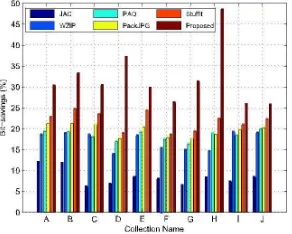
The proposed system evaluate the overall performance of the scheme with respect to several state-of-the-art lossless JPEG recompression methods, including JPEG arithmetic coding (JAC), WinZip,5 PAQ,6 PackJPG7 and StuffIt,8 Fig. 8 shows the compression performance in terms of bit-savings compared with the file sizes of the original JPEG coded photo collections. Among the six compression schemes, the proposed one achieves the best performance by exploring both inter and intra image correlations.
Fig 6. Bit-savings of the scheme in comparison with some individual JPEG recompression methods
This paper also shows the performance of JPEG2000 [4], H.264 [8] and H.265 [9] lossless coding profiles (individual compression of each image). Compared with the file size of the original JPEG coded photo collections in Table II, all these three schemes increase the file sizes.
TABLE II
BIT-SAVINGS (%) OF JPEG2000, H.264 AND H.265 (LOS S LES S MODE)IN COMPARIS ON WITH THE FILE
SIZES OF THE ORIGINALJPEG CODED IMAGES
B. Efficiency of the Feature-Based Prediction Structure
In this subsection, the proposed system evaluate the efficiency of the feature-domain determination of the prediction structure in the lossless compression scheme. Fig. 7 shows the coding performance with and without the feature domain prediction structure (FPS) using Collection F, respectively.
TABLE III
Fig. 7.Bit-savings with (“FPS ON”) and without (“FPS OFF”) feature-domain determination of prediction structure
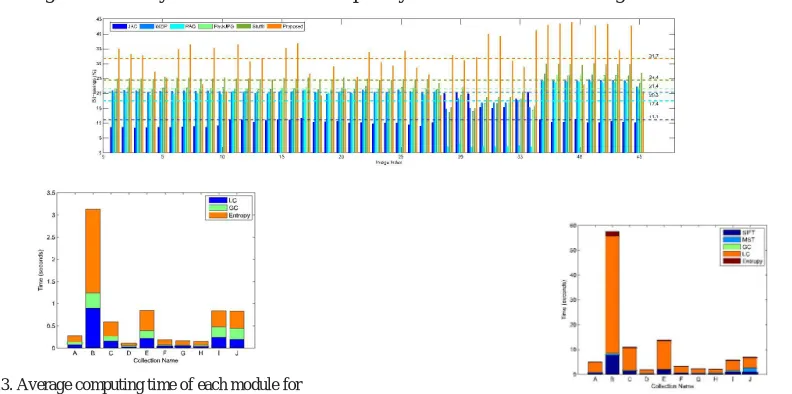
The bit-savings of all frames with FPS are shown as “FPS ON”. Since different prediction orders are used, the bit-saving of each image fluctuates in different ways, resulting in the decrease or increaseof bit-savings at different images for scheme “FPS ON”. The average bit-savings of these two schemes are presented by the dashed-lines in Fig. 9. In this case, the feature-domain prediction structure contributes 4.87% bit-saving on average to the lossless collection compression.
C. Efficiency of the Disparity Compensation
In this subsection, the paper explains about the effectiveness of the spatial domain disparity compensation. The two stages, global and local compensation, are evaluated separately in the following tests.
TABLE IV
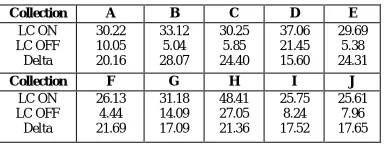
BIT-SAVINGS (%) IN COMPARIS ON WITH THE FILE SIZES OF THE ORIGINAL JPEG FILES WITH AND WITHOUT THE LOCAL COMP ENS ATION
D. Efficiency of the Entropy Coding
This paper further evaluates the efficiency of the context adaptive entropy coder with respect to the entropy coding methods in JPEG and HEVC. It generates the test results by encoding the prediction residues of the quantized DCT coefficients using the Huffman coding method in JPEG baseline,9 the CABAC10 in HEVC, and the proposed algorithm.
Fig. 8 shows the comparison results in terms of bit-savings with respect to the size of the original JPEG coded files. Collection A B C D E
GC ON GC OFF Delta 30.22 20.84 9.38 33.12 30.66 2.45 30.25 29.78 0.47 37.06 37.06 0 29.69 28.70 0.99 Collection F G H I J
GC ON GC OFF Delta 26.13 17.40 8.73 31.18 28.13 3.05 48.41 48.41 0 25.75 - - 25.61 - -
Collection A B C D E LC ON LC OFF Delta 30.22 10.05 20.16 33.12 5.04 28.07 30.25 5.85 24.40 37.06 21.45 15.60 29.69 5.38 24.31 Collection F G H I J
LC ON LC OFF Delta 26.13 4.44 21.69 31.18 14.09 17.09 48.41 27.05 21.36 25.75 8.24 17.52 25.61 7.96 17.65
E. Impact of Quality and Resolution of JPEG Coded Images
In the above tests, the quality factors of all the input JPEG coded images are 90. In this subsection, it discuss the impact of the quality of JPEG coded images on the performance of the scheme. It use Collection E to H to generate JPEG coded test image sets with quality factors ranging from 75 to 90.
Fig. 11.Sample Images of Collection NotreDame.
F. Complexity
The coding scheme is asymmetrical and the complexity of the encoder is much higher than that of the decoder.
Fig. 9. Impact of quality factors of JPEG coded images (Collection E to H) on the coding performance of the scheme
Fig. 10. Impact of resolution of JPEG coded images (Collection E) on the coding performance of different scheme
Fig. 13. Average computing time of each module for decoding a photo in each collection. “LC”, “GC” and
IV. CONCLUSION
In this framework, we propose another half and half pressure technique to additionally decrease the document size of JPEG coded picture accumulations with no devotion misfortune. In our proposed technique, we decide the expectation structure of each picture gathering by an element area separate measure. The divergence between pictures is then lessened by joint worldwide and neighbourhood remunerations in the spatial area. In the recurrence area, the excess between the repaid and target pictures is lessened and the staying feeble intra relationships are additionally misused in our entropy coding. By misusing the relationships in the component, spatial, and recurrence spaces, our plan accomplishes up to 48.4% piece investment funds and beats all best in class JPEG recompression plans. We trust it can enormously diminish the capacity fetched for reinforcement and chronicle of JPEG coded picture accumulations for both individual and cloud applications. In this paper, we concentrate on the productive pressure strategy for an arrangement of bunched JPEG pictures. We see that the grouping can be tedious in the event that one accumulation is too vast. Conceivable arrangements may include propelled quick grouping techniques and presenting associate data. For instance, we can make utilization of the time stamps or GPS data in the meta information of pictures to isolate an extensive gathering to littler ones. We might want to focus on diminish the unpredictability of the grouping module for huge scale picture sets in the future work. Also, the execution of the proposed plan could be additionally enhanced in a few ways. To start with, we could accelerate the encoding and translating process by presenting parallel procedures. Second, we can additionally lessen the unpredictability of the nearby remuneration in the plan by not just utilizing some quick calculations proposed for HEVC additionally diminishing multifaceted nature by direct working on the JPEG coded DCT coefficients. At last, we see that the component based separation estimation may not be constantly proficient.
REFERENCES
[1] [Online]. Accessible: http://jennstrends.com/instagram-measurements for-2014
[2] [Online]. Accessible: http://www.businessinsider.com/facebook-350-million-photographs every day-2013-9
[3] G. K.Wallace, "The JPEG still picture pressure standard," Consumer Electronics, IEEE Transactions on, vol. 38, no. 1, pp. xviii–xxxiv, 1992. [4] C. Christopoulos, A. Skodras, and T. Ebrahimi, "The JPEG2000 still picture coding framework: an outline," Consumer Electronics, IEEE
Transactions on, vol. 46, no. 4, pp. 1103–1127, 2000.
[5] F. Dufaux, G. J. Sullivan, and T. Ebrahimi, "The JPEG XR picture coding standard," Signal Processing Magazine, IEEE, vol. 26, no. 6, pp. 195–199, 2009.
[6] M. J. Weinberger, G. Seroussi, and G. Sapiro, "The LOCO-I lossless picture pressure calculation: standards and institutionalization into JPEGLS," Image Processing, IEEE Transactions on, vol. 9, no. 8, pp. 1309–1324, 2000.
[7] X. Wu and N. Memon, "Setting based, versatile, lossless picture coding," Communications, IEEE Transactions on, vol. 45, no. 4, pp. 437–444, 1997.
[8] T. Wiegand, G. J. Sullivan, G. Bjontegaard, and A. Luthra, "Review of the H.264/AVC video coding standard," Circuits and Systems for Video Technology, IEEE Transactions on, vol. 13, no. 7, pp. 560–576, 2003.
[9] G. J. Sullivan, J.- r. Ohm, W.- j. Han, and T. Wiegand, "Review of the High Efficiency Video Coding (HEVC) Standard," Circuits and Systems for Video Technology, IEEE Transactions on, vol. 22, no. 12, pp. 1649-1668, Dec. 2012.
[10] A. Stated, "Prologue to number-crunching coding-hypothesis and practice," Hewlett Packard Laboratories Report, 2004.
[11] I. Matsuda, Y. Nomoto, K. Wakabayashi, and S. Itoh, "Lossless reencoding of JPEG pictures utilizing piece versatile intra expectation," in Signal Processing Conference, 2008 sixteenth European, Aug 2008, pp. 1–5.
[12] N. Ponomarenko, K. Egiazarian, V. Lukin, and J. Astola, "Extra lossless pressure of JPEG pictures," in Image and Signal Processing and Analysis, 2005. ISPA 2005. Procedures of the fourth International Symposium on, 2005, pp. 117–120.