• No results found

Database Performance Tuning and Query Optimization

N/A
N/A
Protected

Academic year: 2020

Share "Database Performance Tuning and Query Optimization"

Copied!
33
0
0

Loading.... (view fulltext now)

Full text

(1)

Database Performance Tuning and

Query Optimization

(2)

Learning Objectives

In this chapter, you will learn:

Basic database performance-tuning concepts

How a DBMS processes SQL queries

About the importance of indexes in query processing

About the types of decisions the query optimizer has to

make

Some common practices used to write efficient SQL

code

(3)

Database Performance-Tuning

Concepts

Goal of database performance is to execute queries as

fast as possible

Database performance tuning: Set of activities and

procedures that reduce response time of database

system

Fine-tuning the performance of a system requires that

all factors must operate at optimum level with

(4)

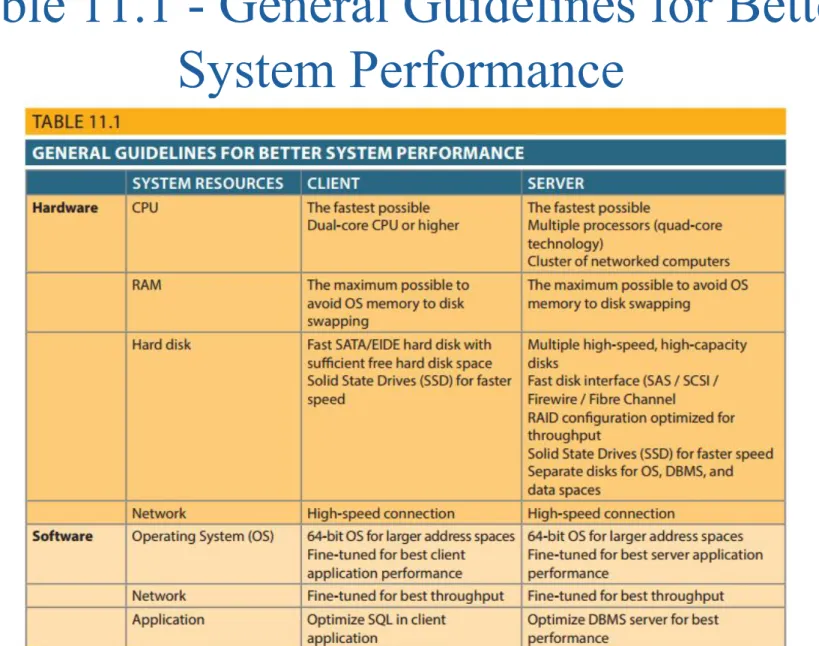
Table 11.1 - General Guidelines for Better

System Performance

(5)

Performance Tuning: Client and Server

Client side

SQL performance tuning: Generates SQL query that

returns correct answer in least amount of time

Using minimum amount of resources at server

Server side

DBMS performance tuning: DBMS environment

configured to respond to clients’ requests as fast as

possible

(6)

DBMS Architecture

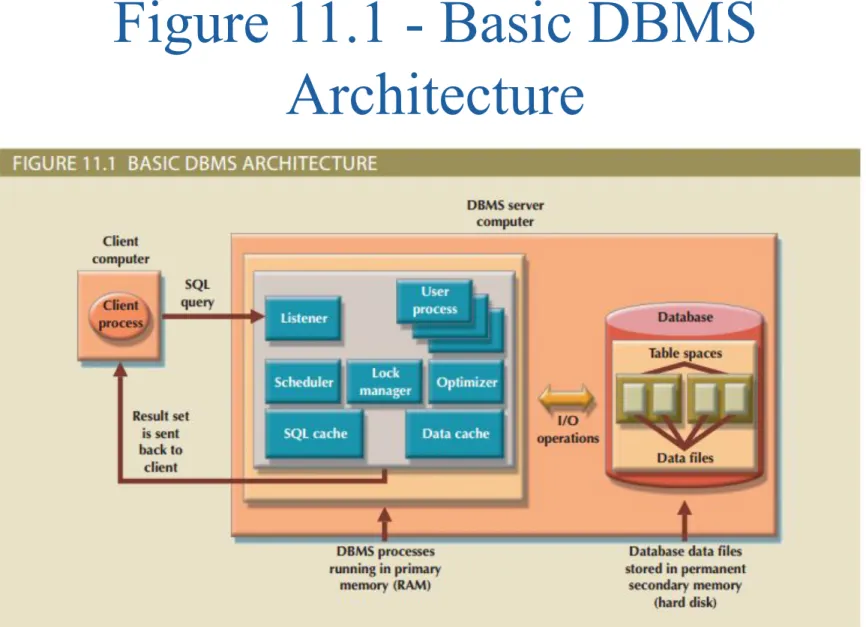
All data in a database are stored in data files

Data files automatically expand in predefined

increments known as extends

Data files are grouped in file groups or table spaces

Table space or file group: Logical grouping of several

data files that store data with similar characteristics

Data cache or buffer cache: Shared, reserved

memory area

(7)

DBMS Architecture

SQL cache or procedure cache: Stores most

recently executed SQL statements or PL/SQL

procedures

DBMS retrieves data from permanent storage and

places them in RAM

Input/output request: Low-level data access

operation that reads or writes data to and from

computer devices

Data cache is faster than working with data files

(8)

Figure 11.1 - Basic DBMS

Architecture

(9)

Database Query Optimization Modes

Algorithms proposed for query optimization are

based on:

Selection of the optimum order to achieve the fastest

execution time

Selection of sites to be accessed to minimize

communication costs

Evaluated on the basis of:

Operation mode

(10)

Classification of Operation Modes

Automatic query optimization: DBMS finds the

most cost-effective access path without user

intervention

Manual query optimization: Requires that the

optimization be selected and scheduled by the end

user or programmer

(11)

Classification Based on Timing of

Optimization

Static query optimization: best optimization

strategy is selected when the query is compiled by the

DBMS

Takes place at compilation time

Dynamic query optimization: Access strategy is

dynamically determined by the DBMS at run time,

using the most up-to-date information about the

database

(12)

Classification Based on Type of

Information Used to Optimize the Query

Statistically based query optimization algorithm:

Statistics are used by the DBMS to determine the best

access strategy

Statistical information is generated by DBMS through:

Dynamic statistical generation mode

Manual statistical generation mode

Rule-based query optimization algorithm: based on a

set of user-defined rules to determine the best query

(13)

Table 11.2 - Sample Database

Statistics Measurements

(14)

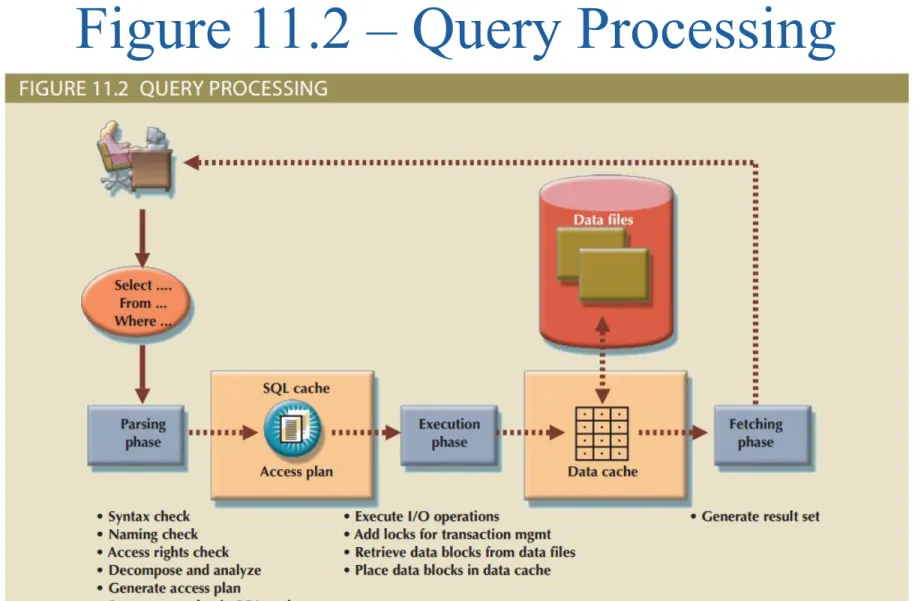
Query Processing

• DBMS parses the SQL query and chooses the

most efficient access/execution plan

Parsing

• DBMS executes the SQL query using the chosen

execution plan

Execution

• DBMS fetches the data and sends the result set

back to the client

(15)
(16)

SQL Parsing Phase

Query is broken down into smaller units

Original SQL query transformed into slightly different

version of original SQL code which is fully equivalent

and more efficient

Query optimizer: Analyzes SQL query and finds most

efficient way to access data

Access plans: DBMS-specific and translate client’s SQL

query into a series of complex I/O operations

If access plan already exists for query in SQL cache,

DBMS reuses it

(17)

SQL Execution Phase

All I/O operations indicated in the access plan are

executed

Locks are acquired

Data are retrieved and placed in data cache

(18)

SQL Fetching Phase

Rows of resulting query result set are returned to

client

DBMS may use temporary table space to store

temporary data

Database server coordinates the movement of the result

set rows from the server cache to the client cache

(19)

Query Processing Bottlenecks

Delay introduced in the processing of an I/O

operation that slows the system

Caused by the:

CPU

RAM

Hard disk

Network

Application code

(20)

Indexes and Query Optimization

Indexes

Help speed up data access

Facilitate searching, sorting, using aggregate functions,

and join operations

Ordered set of values that contain the index key and

pointers

(21)

Indexes and Query Optimization

Data sparsity: Number of different values a column

could have

Data structures used to implement indexes:

Hash indexes

B-tree indexes

Bitmap indexes

(22)

Optimizer Choices

Rule-based optimizer: Uses preset rules and points

to determine the best approach to execute a query

Cost-based optimizer: Uses algorithms based on

statistics about objects being accessed to determine

the best approach to execute a query

(23)

Using Hints to Affect Optimizer

Choices

Optimizer might not choose the best execution plan

Makes decisions based on existing statistics, which

might be old

Might choose less-efficient decisions

Optimizer hints: Special instructions for the

optimizer, embedded in the SQL command text

(24)
(25)

SQL Performance Tuning

Evaluated from client perspective

Most current relational DBMSs perform automatic

query optimization at the server end

Most SQL performance optimization techniques are

DBMS-specific and thus rarely portable

Majority of performance problems are related to

poorly written SQL code

(26)

Index Selectivity

Measure of the likelihood that an index will be used

in query processing

Indexes are used when a subset of rows from a large

table is to be selected based on a given condition

Index cannot always be used to improve performance

Function-based index: Based on a specific SQL

function or expression

(27)

Conditional Expressions

Expressed within WHERE or HAVING clauses of a

SQL statement

Restricts the output of a query to only rows matching

conditional criteria

Guidelines to write efficient conditional expressions

in SQL code

Use simple columns or literals as operands

Numeric field comparisons are faster than character,

date, and NULL comparisons

(28)

Conditional Expressions

Equality comparisons are faster than inequality

comparisons

Transform conditional expressions to use literals

Write equality conditions first when using multiple

conditional expressions

When using multiple AND conditions, write the

condition most likely to be false first

When using multiple OR conditions, put the condition

most likely to be true first

(29)
(30)

Query Formulation

Identify what columns and computations are required

Identify source tables

Determine how to join tables

Determine what selection criteria are needed

(31)

DBMS Performance Tuning

Managing DBMS processes in primary memory and the

structures in physical storage

DBMS performance tuning at server end focuses on

setting parameters used for:

Data cache

SQL cache

Sort cache

Optimizer mode

In-memory database: Store large portions of the

database in primary storage

(32)

DBMS Performance Tuning

Recommendations for physical storage of databases:

Use RAID (Redundant Array of Independent Disks) to

provide a balance between performance improvement

and fault tolerance

Minimize disk contention

Put high-usage tables in their own table spaces

Assign separate data files in separate storage volumes

for indexes, system, and high-usage tables

(33)

DBMS Performance Tuning

Take advantage of the various table storage

organizations in the database

Index-organized table or clustered index table:

Stores the end-user data and the index data in

consecutive locations in permanent storage

Partition tables based on usage

Use denormalized tables where appropriate

Figure

Table 11.1 - General Guidelines for Better  System Performance
Figure 11.1 - Basic DBMS  Architecture
Figure 11.2 – Query Processing

References

Related documents