IMAGE ENHANCEMENT AND ANALYSIS OF VARIOUS IMAGES USING
STANDARD TECHNIQUES OF IMAGE PROCESSING
1
S.SUBATHRA,2M.SUMATHI, 3G.BHARATHA SREEJA,
1,2UG Student, 3Assistant Professor/ECE,
PET Engineering College, PET Engineering College,
Vallioor Vallioor
ABSTRACT
In this paper, the image is enhanced without error using different techniques. Image Enhancement is mainly used to improve the visual effects and the clarity of an image. The aim of Image Enhancement is to improve the perception of information in image. The standard techniques are used to enhance the image. Here, Histogram Equalization is mainly used to enhance the contrast of the images. Gamma Correction can be used to control the level of contrast enhancement. Median filter and Wiener filter are used to remove the salt and pepper noise. The image is enhanced by applying with histogram equalization, wiener filtering and median filtering which is fused with Gamma Corrected image. The performance is measured using parameters such as Peak Signal to Noise Ratio (PSNR), Mean Square Error (MSE) and Correlation Coefficient. The result shows that the proposed method gives the better performance while comparing with various techniques. Index Terms: Digital image processing, Image Enhancement, Histogram Equalization, Wiener Filter, Median Filter, Gamma Correction, Fusion.
I. INTRODCTION
Image enhancement is one of the important techniques in digital image processing [4]. To understand and analyze the images, various image enhancement techniques are used. So the low quality and low contrast images will be brightened. Histogram Equalization method is applied to low contrast images [12], [9], [15]. This method improves the contrast of the images but the disadvantage is that the over enhancement. Wiener filter method is mainly used for noise smoothing and it also performs the inverse filtering operation and it removes the salt and pepper noise. Median filter also removes the impulse noise i.e., salt and pepper noise. The non-linear method of Median filter can restore the image perfectly compared to the linear method [18]. Median filter produces better result than the mean filter. Gamma Correction method adjusts the level of contrast enhancement and also maintains the brightness level [11]. Gamma Correction is based on non-linear operation. This non-linear method code or decode the luminance value and it produce better result [1], [8].
II. HISTOGRAM EQUALIZATION (HE)
Histogram Equalization (HE) is one of the important techniques to enhance the image. It consists of local Histogram Equalization and Global Histogram Equalization [7]. The histogram of an image is a plot or graph drawn between gray level values (0 to 255) in the X – axis and the number of pixels having the corresponding gray levels in the Y-axis. Various enhancement schemes are used
for enhancing an image which includes filtering and Histogram Equalization (HE). Histogram equalization is one of the well known image enhancement technique. This method is simple and effective so it is a popular technique for image enhancement [14], [12], [11].
This method is based on the probability distribution of the input gray levels. It produces a significant change of the brightness. This method is not commonly used in consumer electronics such as TV [16].
III. WIENER FILTER (WF)
The main aim of the Wiener Filter is to remove the noise that will affect the quality of an image. Most of the filters are designed for a desired frequency response. Wiener Filter is based on statistical approach and deals with the filtering of image from a different point of view. In Wiener Filter, signal and AWGN noise are stationary linear random processes with the known spectral characteristics. Minimum Mean-Square Error is the performance criteria of Wiener Filter [17].
Wiener Filter is also known as a Least Mean Square Filter. The main objective of LMS filter is to approximate the original image in such a way that the mean square error between the original image and approximated image is minimized [10]. Capability of Wiener Filtering is to handle both degradation function and noise. In Global Weiner Filtering, the Weiner Filter is applied over the whole image. Then Minimizing the Mean Square Error (MSE) between the image and true image for this design of Weiner Filter. This filter efficiently removes the blur of the image.
IV. MEDIAN FILTER (MF)
In Median Filter each pixel is replaced by the median of gray level in the neighborhood pixel [17]. It is used for bipolar and unipolar noise. It is also known as smoothing spatial filter. It is a non-Linear method which is used to remove the impulse noise. By using Non-Linear Filter, noisy image can be restored compared to linear filtering algorithms. The response of median filter is image pixels can be ordered. Then this can be encompassed by this median filter and replacing the value of the centre pixel with the value determined by ranking value. Median Filter is the class of Edge Preserving Smoothing Filters [18].
Median Filter is mainly used to remove the salt and pepper noise. Other name of median filter is Ranking Filter. Median Filtering is a non-liner operation used in image processing [17]. Median Filter is better than Mean Filter.
V. GAMMA CORRECTION (GC)
Gamma Correction is nothing but a function that compresses the dynamic range of images so that we can view the image more properly [11], [6]. Gamma Correction
can be used to control the level of contrast enhancement by adjusting the weighting coefficients; it is not only avoiding the excessive enhancement and makes the contrast enhancement adjustable, but also maintain the brightness level. Gamma Correction can be written as
g(x, y) =c*f(x, y) (1)
Where f(x, y) is the original image and g(x, y) is the enhanced image and then „c‟ is a positive constant image. Gamma Correction is a transform based histogram modification technique [1], [5].
The Gamma correction is based on a non-linear multiplication-based conversion. So the effect of light can be overcome by this method. It defines the relationship between a pixel‟s numerical value and its actual luminance value. That has been used to gray-value image analysis [8]. A number of devices used for image capture, printing and display record according to a power law. The process used to correct this power law response phenomenon is known as Gamma Correction [5].
VI. IMAGE FUSION
Image Fusion is the process of combining relevant information from two or more images into a single image. The image will be more informative than any of the input image. The ideas of using image fusion to combine different enhanced results come from fusion technology in combining bracketed exposure images [3]. The fusion method is introduced to improve the deficiency of image enhancement. To achieve a better fusing performance, we propose an image fusion method based on the evaluation of local image quality. Image fusion produces a single image by combining information from a set of source images together, using pixel, and feature or decision level techniques. Image fusion requires that images be registered first before they are fused so the reliability and overall detail of the image is increased [13].
VII. PROPOSED ALGORITHM
In order to overcome the problems caused by some noises, the proposed algorithm done by combination of Histogram equalization, Wiener filter, Median Filter Image is fused with Gamma Correction of the original image. Firstly the Histogram Equalization (HE), Wiener filter (WF) and Median Filter (MF) is applied for the input image. Then Gamma Correction (GC) of image with the fusion method is proposed to improve the effects of image enhancement.
Basic steps for the proposed algorithm are as follows:-
Step-1 Image Acquisition.
Step-2 Histogram Equalization is applied for the input image.
Step-3 Wiener Filter is applied for the Histogram Equalized image.
Step-4 Median Filter is applied for the Wiener Filtered image.
Step-5 Gamma Correction is separately applied for the input image.
Step-6 Gamma Corrected image is fused with Wiener Filtered image i.e., output from step 4 for final image enhancement.
Step-7 Performance measured for proposed method using Error (MSE), Peak-Signal to Noise Ratio (PSNR) and Correlation Coefficient.
Flow chart for the proposed method:
VIII. PERFORMANCE PARAMETERS
A. Mean-Square Error (MSE)
Mean Square Error of an Estimator produces the difference between the values. Mean Square Error measures the average of the square of the “errors”, The error value is the value difference between the actual data and resultant data [17].
MSE= 1/MN * 𝑀−1𝑖=0 𝑁−1𝑗 =0[𝑓^(𝑖, 𝑗)] − 𝑓(𝑖, 𝑗)] (2) Where
M is the Height of the image implying the number or pixel rows.
N is the Width of the image, implying the number or pixel columns.
f^(i , j) is the reconstructed output image. f (i, j) is the original image.
B. Peak-Signal to Noise Ratio (PSNR)
PSNR is the evaluation standard of the reconstructed image quality and it is the important measurement feature. PSNR is measured in decibels (dB) and is given by:
PSNR =10log 10(MAXI2/ MSE) (3) Where MAXI is the maximum possible pixel value of the image [17]. Mean square error (MSE) is defined as Where M*N is the size of the original image. The greater the PSNR, the better the output image quality [18]. It is the ratio between the maximum possible power of a signal and the power of corrupting noise that affects the fidelity of its representation. Image Acquisition Histogram Equalization Wiener Filter Median Filter Gamma Correction
Fusion of two images
Measure the enhancement through MSE, PSNR and Correlation Coefficient
C. Correlation Coefficient
Correlation coefficient is a measure of difference between two variables. It predicts the changes in one variable with reference to the other variable. Normally correlation coefficient values ranges between -1 to +1 where +1 refers to the positive correlation and -1 refers to the negative correlation [2].
The population correlation coefficient 𝜌𝑋,𝑌 between two random variables X and Y with expected values µ𝑋 and µ𝑌 and standard deviations 𝜎𝑋 and 𝜎𝑌 is defined as
𝜌
𝑋,𝑌= corr(X,Y)=
𝑐𝑜𝑣 (𝑋,𝑌) 𝜎𝑋𝜎𝑌
=
𝐸[ 𝑋−µ𝑋 𝑌−µ𝑌 ]
𝜎𝑋𝜎𝑌
(4)
Where, „E’ is the expected value operator, cov means covariance, and corr is a widely used alternative notation for the correlation coefficient.IX. SIMULATION RESULT
The original image considered for the enhancement i.e., pout image. That image is a inbuilt image in MATLAB that is shown in Fig.1.The clarity of the image is not well. So to improve the clarity or to enhance the image Histogram Equalization (HE) is performed. The output of the image is over enhancement that is shown in Fig.2. To overcome the problem of over enhancement, Wiener filter (WF) is applied for the original image that is shown in Fig.3. The output of the Wiener Filtered image is not properly enhanced. So another method that is Median Filter (MF) is applied for the original image, the output is shown in Fig.4. This output is also not giving better clarity. To overcome the disadvantages of above methods, we perform Gamma Correction (GC) for the input image. The output is shown in Fig.5. The Gamma Corrected output image is properly enhanced. To improve performance parameters, we used wavelet fusion technique with the Gamma Correction.
First the Histogram Equalization is applied for the input image. Then the Wiener filter is applied for the Histogram Equalized image. Then the Median Filter is applied for the Wiener Filtered image. Then the Gamma Correction is applied for the input image. The input image is applied with histogram equalization, wiener filtering and median filtering which is fused with Gamma Corrected image. The quality of the input image will be enhanced by this proposed method. The performance parameters such as Peak-Signal to Noise Ratio (PSNR), Mean-Square Error (MSE) and Correlation Coefficient are calculated for the output image. The Mean-Square Error for the output image is less when compared to the other techniques. The Peak-Signal to Noise Ratio is higher and the value of Correlation Coefficient is higher when compared to other techniques. The output figures are shown below:
Fig.1-Gray image Fig.2-Histogram Equalization
Fig.3-Wiener Filter Fig.4-Median Filter
Fig.5-Gamma Correction
From the above results (Fig.5) the Gamma Corrected image gives the better enhancement. To improve the enhancement and to improve the performance parameters the original image is applied with histogram equalization, wiener filtering and median filtering which is fused with Gamma Corrected image.
Fig.6-HE+WF Fused with Fig.7-HE+WF Fused with
Fig8-WF+HE Fused with Fig.9-WF+GC Fused with
GC+MF MF+HE
Fig.9-GC+WF+MF+HE Fig.10-WF+GC+MF+HE
Fused with HE Fused with HE
Fig.11-GC Fused with HE+WF+MF
In the proposed method we are using fusion techniques between various image enhancement techniques. The output figures of various techniques are shown above. But the Fig.11 that is the image is applied with histogram equalization, wiener filtering and median filtering which is fused with Gamma Corrected image gives the better enhancement.
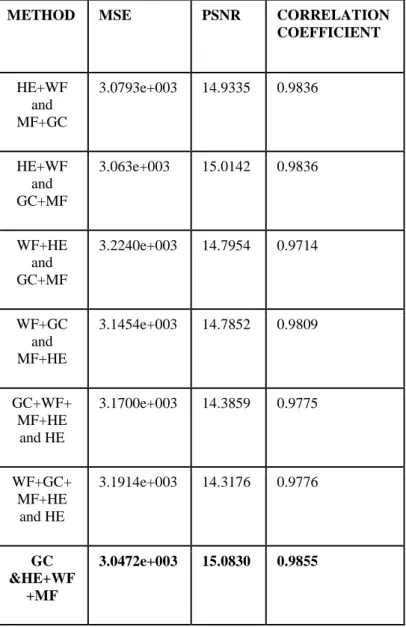
The performance parameters such as Mean-Square Error (MSE), Peak-Signal to Noise Ratio and Correlation Coefficient are measured and they are compared to find which method gives the better enhancement. The comparison table is shown in below table 1.
Table 1.Comparison of MSE, PSNR and Correlation Coefficient
METHOD MSE PSNR CORRELATION
COEFFICIENT HE+WF and MF+GC 3.0793e+003 14.9335 0.9836 HE+WF and GC+MF 3.063e+003 15.0142 0.9836 WF+HE and GC+MF 3.2240e+003 14.7954 0.9714 WF+GC and MF+HE 3.1454e+003 14.7852 0.9809 GC+WF+ MF+HE and HE 3.1700e+003 14.3859 0.9775 WF+GC+ MF+HE and HE 3.1914e+003 14.3176 0.9776 GC &HE+WF +MF 3.0472e+003 15.0830 0.9855
From the above table, the output from GC fusion with HE+WF+MF gives the better result that is the Mean-Square Error is less and the Peak-Signal to Noise Ratio is high and the Correlation Coefficient is high.
X. CONCLUSION
Gamma Correction is one of the major image enhancement techniques. It is used to improve the visual appearance of an image and it is an important need for better human visualization. In this work, the different image enhancement techniques were analyzed. The novelty of the proposed technique is that, the fusion of Gamma Corrected image with the image which applied with Histogram Equalization, Wiener Filter, and Median Filter. The proposed method has been implemented on the pout image in Tagged Image File Format to check experimental results. Mean-Square Error (MSE), Peak-Signal to Noise Ratio (PSNR) and Correlation Coefficient are calculated to measure the performance of the proposed algorithm. From the experimental results we observed that the proposed algorithm gives the better result and enhances the visual quality of the image.
XI. FUTURE SCOPE
The work which has been done up to the current stage shows that the image enhancement using Histogram Equalization (HE), Wiener Filter (WF), Median Filter (WF) and Gamma Correction to enhance the image. Next our purposed method is to work with the various image enhancement techniques such as Contrast Limited Adaptive Histogram Equalization, Adaptive Gamma Correction, Brightness Preserving Bi-Histogram Equalization, etc. to preserve the brightness of the image.
REFERENCES
[1] Amandeep Kaur, Mandeep Singh,”Image Enhancement Using Recursive Adaptive Gamma Correction”, IJIET, Volume 4 Issue 3 October 2014.
[2] Ana Elisa Castro Sotos, Stijn Vanhoof, Wim Van Den Noortgate, Patrick Onghena, “The Transitivity Misconception of Pearson‟s Correlation Coefficient”, International Association for Statistical Education, November 2009.
[3] Anju Rani, Gagandeep Kaur, “Image Enhancement using Image Fusion Techniques”, IJARCSSE, 2014.
[4] R.Arun, Madhu S.Nair, Member, IAENG, R.Vrinthavani and Rao Tatavarti,”An Alpha Rooting based Hybrid Technique for Image Enhancement”, IEEE, August 24, 2011.
[5] S.Asadi Amiri, H.Hassanpo, “A Preprocessing Approach For Image Analysis Using Gamma Correction”, International Journal of Computer Applications, Volume 38– No.12, January 2012.
[6] S.Gayathri, N.Mohanapriya, Dr.B.Kalaavathi, ”Survey on Contrast Enhancement Techniques”, International Journal of Advanced Research in Computer and Communication Engineering, Vol. 2, Issue 11, November 2013.
[7] Jeena Baby, V. Karunakaran, “Survey on Various Image Contrast Enhancement Techniques”, IJRASET, Vol. 1 Issue V, December 2013.
[8] Karamjeet Kaur, Navdeep Kanwal, Jaskaran Singh Bhullar, “A Technique for Enhancement of Gray Image using Local Gamma Correction”, International Journal of Computer Applications (0975 – 8887), Volume 105 – No. 5, November 2014.
[9] Khairunnisa Hasikin, Nor Ashidi Mat Isa, “Enhancement of the low contrast image using fuzzy set theory”, 14th International Conference on Modeling and Simulation, 2012.
[10] Krishan Kant Lavania, Shivali, Rajiv Kumar, “Image Enhancement using Filtering Techniques”, International Journal on Computer Science and Engineering (IJCSE), Vol. 4 No. 01 January 2012.
[11] Er.Kritika Vaid, Mr.Bhushan Dua, “Image Enhancement of Aerial Images Using Adaptive Gamma Correction: A Review”, IJEDR, Volume 2, Issue 2, 2014.
[12] Er. Mandeep Kaur, Er. Kiran Jain, Er Virender Lather, “Study of Image Enhancement Techniques: A Review”, IJARCSSE, Volume 3, Issue 4, April 2013.
[13] Navneet kaur, Madhu Bahl, Harsimran Kaur, “Review On: Image Fusion Using Wavelet and Curvelet Transform”, International Journal of Computer Science and Information Technologies, Vol.5 (2), 2014.
[14] Rajesh Garg, Bhawna Mittal, Sheetal Garg,” Histogram Equalization Techniques For Image Enhancement”, IJECT Vol. 2, Issue 1, March 2011.
[15] Seung-Won Jung, Jae-Yun Jeong, and Sung-Jea Ko, Senior Member, IEEE,“ Sharpness Enhancement of Stereo Images Using Binocular Just-Noticeable Difference”, IEEE Transactions On Image Processing, Vol. 21, No. 3, March 2012.
[16] Soong-Der Chen, Abd. Rahman Ramli,“Contrast Enhancement using Recursive Mean-Separate Histogram Equalization for Scalable Brightness Preservation”,IEEE, Vol.49, No. 4, pp. 1301-1309, 2003.
[17] Vinod Kumar, Dr. Priyanka, and Kaushal Kishore,” A Hybrid Filter for Image Enhancement”, International Journal of Image Processing and Vision Sciences (IJIPVS) Volume‐1 Issue‐1, 2012.
[18] Vivek Singh Rathore, Vivek Dubey, Santosh varshney, ”A Study to Improve the Quality of Image Enhancement Based on Different Filtering Design Techniques”, IJRET: International Journal of Research in Engineering and Technology, Volume: 02, Issue: 08 , Aug-2013.