Simulation Based Comparative Analysis of Voice over
Internet Protocol over MPLS and Traditional IP Network
Jyoti Aggarwal1 Akansha Dhall2
M-Tech Student1, Assit. Prof. 2 & Department of ECE & Shri Ram College of Engg. & Mgmt Palwal, Haryana, India
Abstract— Multiprotocol Label Switching (MPLS) is a rising technology which assures the reliable delivery of the Internet services with lower delays and high transmission speed. The primary characteristic of MPLS is its Traffic Engineering (TE) which is utilized for efficient handling the networks for effective usage of network resources. Because of lower network delay, effective forwarding strategy, scalability and expected performance of the services offered by MPLS technology builds it more appropriate for implementing real-time applications i.e. Voice and video. In this paper performance of Voice over Internet Protocol (VoIP) application is compared in MPLS network and traditional Internet Protocol (IP) network. OPNET Simulator 14.5 is utilized to model the both networks and the comparison is made depending on the metrics i.e. Voice packet end-to-end delay, Voice jitter, voice delay variation, voice packet send and obtained. The simulation results are examined and it indicates that MPLS based solution offers better performance in implementing the VoIP application. In this paper by utilizing Voice packet end-to-end delay performance metric a mechanism is made to evaluate the least number of VoIP calls that can be made in MPLS and traditional IP networks with suitable quality. This mechanism can support the network operators or designers to find the number of VoIP calls that can made for a provided network by simulating the real network on the OPNET modeler.
Keywords: Multiprotocol Label Switching (MPLS), Traffic Engineering (TE), Voice over Internet Protocol (VoIP) and Optimized Network Engineering Tool (OPNET)
I. INTRODUCTION
MPLS is a elegant solution for the problems that are available in present networks, e.g. scalability, speed, traffic engineering and quality of service (QoS) management. MPLS is also a flexible solution to satisfy the needs related to service needs and bandwidth management for the 4G generation IP based core networks [1]. MPLS is a predicting technology which superiors the abilities of large scale IP networks and the routers forwarding speed is also exaggerate. Over the last few years the internet is employed everywhere and is needed a variety of new relevancies that can achieve the business and enterprise network needs. This variety of applications needs the ensured bandwidth and speed. The increasing users and volume of traffic is a major issue to the available internet infrastructure. In spite of these initial issues and to meet the service and bandwidth needs through the next generation networks MPLS will have to play an important role in packet
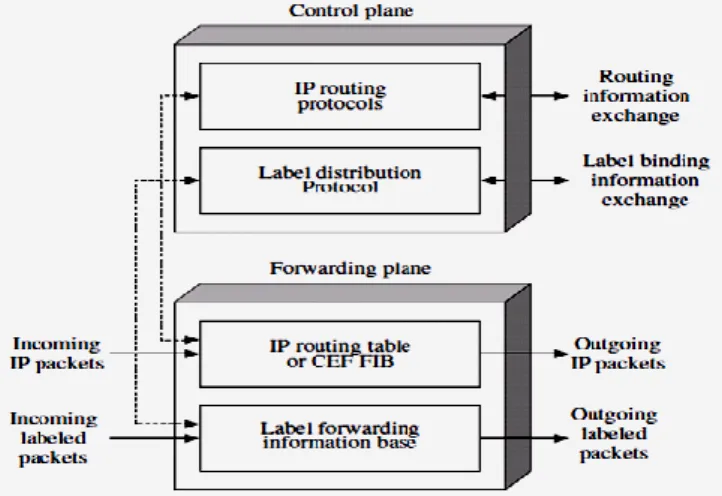
forwarding, switching and routing. The objective of MPLS is to amplify the efficiency of data throughput by optimizing packet processing overhead in the IP networks. The MPLS technology utilizes a short fixed-length label to forward packets in the network. The edge routers in the network, known as the Label Edge Routers (LERs), add this label to the packet. The core routers in the network, known as the Label Switching Routers (LSRs), then forward the packet depending on the given label rather than the original packet header. The label allocations depend on the Forwarding Equivalence Class (FEC) of the packet, where packets relating to the same FEC are given the same label and normally traverse across the same path through the MPLS network. An FEC may composed of packets that have universal ingress and egress nodes, or same service class and same ingress/egress nodes, etc. A path travelled by packets in the same FEC is known as a Label Switched Path (LSP). The Label Distribution Protocol (LDP) and an extension to the Resource Reservation Protocol (RSVP) are utilized to demonstrate, maintain (refresh), and tear-down LSPs. MPLS performs a much faster forwarding as compared to IP since the packet headers do not necessitate to be examined at each hop in the path. MPLS also offers Traffic Engineering (TE) by allowing traffic to be explicitly routed in the network to attain proficient load balancing. The MPLS architecture in a network node is described in Figure 1 below [26].
II. RELATED WORK
In [1], the author did a comparative analysis of MPLS over Non-MPLS networks and displays MPLS have a better performance over conventional IP networks. In this paper a comparative study is done on MPLS signaling protocols (CR-LDP, RSVP and RSVP-TE) for Traffic Engineering by talking about their classification and functionality. Simulation of MPLS and Non-MPLS network is performed, performance is compared by assuming the parameters i.e. throughput, packet loss, and end-to-end delay on the network traffic. QualNet 4.0 modeler is employed for simulation aim.
In [2], the paper mainly concentrates on the analytical models to evaluate efficiency of voice over IP network with applications on MPLS network. In this paper network models are introduced to support quality of service (QoS) needs and traffic engineering standards supported by MPLS. The author utilizes mathematical expressions for measuring the models for both MPLS and IP networks.
In [13], the primary aim of the paper was to compute least number of VoIP calls that can be demonstrated in a business IP network. The paper introduces designing of the real-world network model on the OPNET modeler. The model is designed considering the engineering factors required to be considered when implementing the VoIP application in the IP network. Simulation is performed for computing the number of calls that IP network model can be made.
III. PROPOSED METHODOLOGY
Simulation is classified in two tasks to satisfy the objective of the paper.
Task 1: In this part of the simulation the VoIP traffic is routed from source node (VoIP_West) to destination node (VoIP_East) in the two networks (MPLS and conventional IP networks).The primary task is to compare the performance of VoIP traffic in the both networks by employing performance metrics, such as packet End-to-End delay, voice jitter, packet loss and throughput. The simulation results received are examined to find the effective technology utilized for transmitting VoIP traffic.
Task 2: In this part, a mechanism is made to compute the approximate least number of calls that can be made in the both networks. This mechanism can be utilized to calculate the number of calls, in a real network. This is performed by designing the real network in the OPNET. We employ the End-to-End delay performance metric received from the simulation to calculate the approximate least number of calls maintained in both networks.
IV. SIMULATION TOOL USED
Network R&D is no longer a process that can be established to spreadsheets or conventional software. In order for Network R&D organizations to introduce, they require robust network simulation software to efficiently and naturally model
also be capable to powerfully evaluate the performance of these protocols and technologies in network infrastructure models of realistic scale. OPNET (Optimized Network Engineering Tool) offers a comprehensive development environment for the simulation, specification and performance analysis of communication networks. OPNET yields four tools known as editors to develop a representation of a system being simulated. These editors, the Network, Node, Process and Parameter Editors, are organized in a hierarchical way, which supports the concept of model level reuse. For this simulation, OPNET evidenced to be a necessary entity and observing the several variables of complex network architecture efficiently and effectively.
V. RESULTS AND ANALYSIS 5.1 Comparison of Performance metrics
The results displayed in the Figure 5.1, Figure 5.2, Figure 5.3 and Figure 5.4 are the performance metrics received for MPLS and traditional IP networks. From the graphs it is realized that there is an enhancement in the performance when the VoIP traffic is transmitted employing MPLS technology. For every scenario the simulation time is taken as 420 seconds. The VoIP traffic begins at the 100th second and ends at the 420th second of the simulation time. In both scenarios VoIP calls are added at fixed time intervals i.e., for each two seconds beginning from 100th second till 420th second.
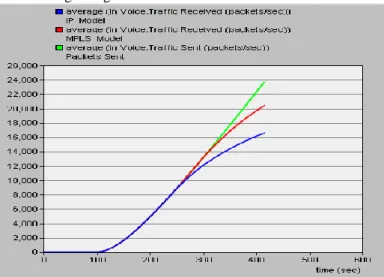
Figure 5.1: voice packet sent and received
The Figure 5.1 shows the mean number of packets sent and obtained in both MPLS and conventional IP networks. By the end of simulation it is realized that MPLS model offers more throughput as compared to the IP model.
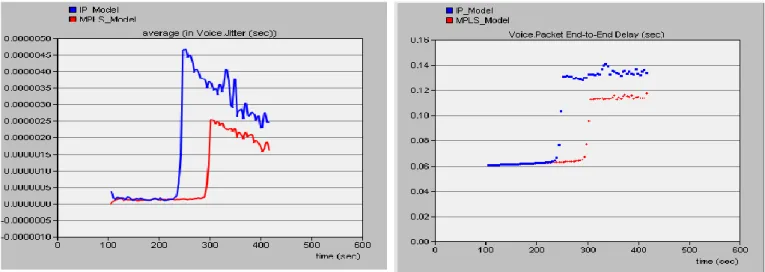
Figure 5.2: Voice packet jitter
The packet drop begins at 240 seconds; this improves the throughput in the MPLS network. The Figure 5.2 displays the Voice packet jitter of MPLS and IP network model. It is observed that Voice Jitter begins to increase at 240 sec in IP network for MPLS network it begins to increase at 300 second. The voice packet delay variation displayed in Figure 5.3 has same variations in graphs as described here.
Figure 5.3: Voice packet delay variation
Figure 5.4: Voice packet End-to-End Delay
The Figure 5.4 displays the packet end-to-end delay of MPLS and IP network model. The End-to-end delay in a network shouldn’t enhance above the threshold value of 80 milliseconds for establishing VoIP calls are of suitable quality. From the Figure 5.4 it is observed that end-to-end delay in IP network increases the threshold at 240 sec and the MPLS network arrives the end-to-end delay threshold at 300 seconds. The IP network arrives the threshold sooner than MPLS network, is because of that TE is implemented in MPLS network. MPLS utilizes CR-LSPs for managing the temporary congestion. In simulation CR-LSPs is adjusted from Ingress_R1 to Egress_R2 through R3 which is displayed by „blue‟. In the MPLS network the network resources are effectively used compared to IP network.
Calculating the number of VoIP calls
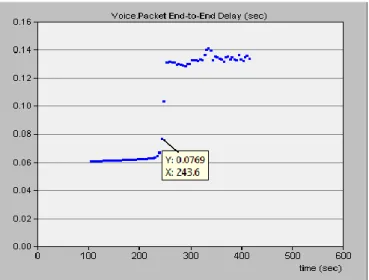
As described above the delay in the network must not increase the threshold value of 80ms to make the least number of VoIP calls with suitable quality. The numbers of VoIP calls that can be made in the MPLS and IP networks are calculated utilizing the End-to-End delay graph. Figure 5.5 displays the end-to-end delay statistics of the IP network and Figure 5.6 displays the end-to-end statistics of MPLS network model.
Figure 5.5: IP networks End-to-End Delay
From the Figure 5.5 it is observed that in traditional IP network the end-to-end delay crosses the threshold value of 80ms at 243 seconds, while in MPLS network from Figure 5.6 the end-to-end delay crosses threshold value at 298 seconds.
Figure 5.6: MPLS networks End-to-End Delay
In every scenario the total number of calls demonstrated is provided by computing total simulation time i.e., from 100 to 420 seconds. Since for each 2 seconds one call is added to the network so the total number of calls established in the network is (420-100)/2 = 170 VoIP calls.
CONCLUSION
The primary aim of the paper is based on the performance analysis of traditional IP network and MPLS network in terms of VoIP traffic. The performance analysis is followed by introducing a method in OPNET to calculate the least number of VoIP calls that can be established in the MPLS and IP networks. The performance analysis in both networks is done
delay variation, Voice jitter, Voice packet send and received, Voice End-to-End delay. Based on the simulation results it can be observed that MPLS offers best solution in implementing the VoIP application (Internet Telephony) as compared to traditional IP networks because of the following reasons
Routers in MPLS consider less processing time in routing the packets, this is more appropriate for the applications i.e. VoIP which posses less tolerant to the network delays.
Implementing of MPLS with TE reduces the congestion in the network. TE in MPLS is implemented by utilizing the signaling protocols i.e. CR-LDP and RSVP
MPLS suffers least delay and ofefrs high throughput as compared to traditional IP networks.
.
FUTURE WORK
This paper work primarily concentrates on the performance comparison of VoIP traffic between IP and MPLS network involving TE. The Future work can be conducted to study the performance of MPLS Traffic Engineering signaling protocols RSVP and CR-LDP when VoIP application is implemented in them. It would be interesting if one takes into consideration different codec’s while establishing a VoIP application. The work can be further extend.
REFERENCES
[1] Yan Chen, Toni Farley and Nong Ye, “QoS Requirements of Network Applications on the Internet”, International Journal of Information Knowledge Systems Management, 2004, IOS Press (55-76).
[2] Er. Sourabh Jain. July, “Performance Analysis of Voice over Multiprotocol Label Switching Communication Networks with Traffic Engineering”, International Journal of Advanced Research in Computer Science and Software Engineering, Volume 2, Issue 7, 2012
[3] Junaid Ahmed Zubairi., “Voice Transport Techniques over MPLS”, International Symposium of High Capacity Optical Networks and Enabling Technologies, 2008.
[4] Aruna Kapoor, Sunila Godara, Sanjeev Khambra, Amandeep, “Comparative Analysis of Signaling Protocols in Mpls Traffic Engineering”, National Workshop-Cum- Conference on Recent Trends in Mathematics and Computing (RTMC), 2011.
[5] Dr. Reyadh Shaker Naoum and Mohanand Maswady, ”Performance Evaluation for VOIP over IP and MPLS” , World of Computer Science and Information Technology Journal (WCSIT), Vol. 2, No. 3, 2012, 110-114. [6] Jasmina Barakovic Himzo Bajric, and Amir Husic., “Multimedia Traffic Analysis of MPLS and non-MPLS Network”, International Symposium ELMAR-2006, Zadar,
[7] Mahesh Kr. Porwal, Anjulata Yadav, S. V. Charhate. July, “Traffic Analysis of MPLS and Non MPLS Network including MPLS Signaling Protocols and Traffic distribution in OSPF and MPLS”, International Conference on Emerging Trends in Engineering and Technology, ICETET, June 2008. [8] Md. Arifur Rahman, Ahmedul Haque Kabir, K. A. M. Lutfullah, “Performance Analysis and the Study of the behavior of MPLS Protocols”,\ International Conference on Computer and Communication Engineering, Kuala Lumpur, Malaysia, May 2008.
[9] Abdellah Jamali, Najib Naja and Driss El Ouadghiri, “An Enhanced MPLS-TE for Transferring Multimedia packets”, International Journal of Advanced Computer Science and Applications, (IJACSA), Vol. 3, No.8, 2012.
[10] Keerthi P. Jannu. June, “OPNET simulation of voice over MPLS with Considering Traffic Engineering”, M.Sc. Thesis, School of Computing, Blekinge Institute of Technology, Sweden, 2010.
[11] Faiz Ahmed and Dr. Irfan Zafar, “Analysis of traffic engineering parameters while using multi-protocol label switching (MPLS) and traditional IP networks”, Asian Transactions on Engineering (ATE ISSN: 2221-4267) Volume 01 Issue 03, 2011.
[12] Anupkumar M Bongale and Nithin N., “Analysis of Link Utilization in MPLS Enabled Network using OPNET IT Guru”, International Journal of Computer Applications (0975 – 8887), Volume 41– No.14, March 2012.
[13] E. Rosen, A. Viswanathan, R. Callon. January, “Multiprotocol Label Switching Architecture", Network Working Group RFC 3031, 2001
[14] Wei Sun Praveen Bhaniramka, Raj Jain, “Quality of Service using Traffic Engineering over MPLS: An Analysis”, 25th Annual IEEE Conference, Local Computer Networks, LCN Proceeding, 2000.
[15] Abdellah Jamali, Najib Naja, Driss EI Ouadghiri and Redouane Benaini, “Improving Quality of Service (QoS) in Multi-Protocol Label Switching Module”, IEEE Mediterranean Microwave Symposium, Nov 2009.
[16] Hang Man and Yang Li, “Multi-Stream Video Transport Over MPLS Networks”, IEEE Workshop of Multimedia Signal Processing, Dec 2002.
[17] Jeevan Kharel, “Performance Evaluation of Voice Traffic over MPLS Network with TE nd QoS Implementation”, M.Sc. thesis, School of Computing Blekinge Institute of Technology, Sweden, Nov 2011.
[18] Muhammad R. A. Rahimi, Habibah Hashim, Ruhani Ab Rahman, “Implementation of Quality of Service (QoS) in Multi-Protocol Label Switching (MPLS) Networks”, International Colloquium on Signal Processing & Its Applications (CSPA), 2009
[19] Jawad Oubaha, Adel Echchaachoui, Ali Ouacha, and Mohammed Elkoutbi, “New Method: Mapping of 802.11e into MPLS Domains, Conception and Experimentation”, Springer-Verlag Berlin Heidelberg CCIS 189, 2011, pp. 470– 483.
[20] Mohsin Khan, “MPLS Traffic Engineering in ISP Network”, International Journal of Computer Applications (0975 – 8887), Volume 59– No.4, Dec 2012.
[21] Tatiana Onali, “Quality of Service Technologies for Multimedia Applications in Next Generation Networks”, Ph.D. thesis, University of Cagliari, Italy, 2009