http://wrap.warwick.ac.uk
Original citation:
Shao, Z., Wang, Q., Xuejiao, X., Jin, H. and He, Ligang (2011) Analyzing and improving
MPI communication performance in overcommitted virtualized systems. In: 19th Annual
Meeting of the IEEE Symposium on Modelling, Analysis and Simulation of Computer and
Telecommunication Systems (MASCOTS'11), Singapore, 25-27 July 2011. Published in:
2011 IEEE 19th International Symposium on Modeling, Analysis & Simulation of
Computer and Telecommunication Systems (MASCOTS) pp. 381-389.
Permanent WRAP url:
http://wrap.warwick.ac.uk/45691
Copyright and reuse:
The Warwick Research Archive Portal (WRAP) makes this work by researchers of the
University of Warwick available open access under the following conditions. Copyright ©
and all moral rights to the version of the paper presented here belong to the individual
author(s) and/or other copyright owners. To the extent reasonable and practicable the
material made available in WRAP has been checked for eligibility before being made
available.
Copies of full items can be used for personal research or study, educational, or not-for
profit purposes without prior permission or charge. Provided that the authors, title and
full bibliographic details are credited, a hyperlink and/or URL is given for the original
metadata page and the content is not changed in any way.
Copyright statement:
“© 2011 IEEE. Personal use of this material is permitted. Permission from IEEE must be
obtained for all other uses, in any current or future media, including reprinting
/republishing this material for advertising or promotional purposes, creating new
collective works, for resale or redistribution to servers or lists, or reuse of any
copyrighted component of this work in other works.”
A note on versions:
The version presented here may differ from the published version or, version of record, if
you wish to cite this item you are advised to consult the publisher’s version. Please see
the ‘permanent WRAP url’ above for details on accessing the published version and note
that access may require a subscription.
Analyzing and Improving MPI Communication Performance in Overcommitted
Virtualized Systems
Zhiyuan Shao, Qiang Wang, Xuejiao Xie and Hai Jin
Services Computing Technology and System Lab Cluster and Grid Computing Lab School of Computer Science and Technology Huazhong University of Science and Technology
Wuhan, 430074, China Email: [email protected]
Ligang He
Department of Computer Science University of Warwick Coventry, CV4 7AL, United Kingdom
Email: [email protected]
Abstract—Nowadays, it is an important trend in the system domain to use the software-based virtualization technology to build the execution environments (e.g., Clouds) and serve high performance computing (HPC) applications. However, with the extra virtualization layer, the application performance may be negatively affected. Studies revealed that the communication performance of the MPI library, which is widely used by the HPC applications, would suffer a high penalty when a physical host machine becomes overcommitted by virtual processors (VCPU). Unfortunately, the problem has not received enough attention and has not been solved yet in literature. In this paper, we investigate the reasons behind the performance penalty, and propose a solution to improve the communication performance of running MPI applications in the overcommitted virtualized systems. The experimental results show that by our proposal, most HPC applications can gain performance improvement to different extents among the overcommitted systems, depending on their communication patterns and the overcommitting level.
Keywords-virtualization; cloud; MPI; performance;
I. INTRODUCTION
It is an important trend nowadays to use virtualization technologies to build execution environments (e.g., Clouds [1]) and serve scientific applications [2, 3]. Among these virtualization technologies, the Xen hypervisor [4], which allow users to execute hundreds of virtual machines on a single physical machine with low extra overhead, is widely adopted for such purposes, e.g., in Amazon EC2 [5] and GoGrid [6].
With the introduction of this extra virtualization layer, the communication performance of the MPI library, which is widely used by the HPC applications, would suffer a high penalty [7, 8] when the virtualized platform by Xen is overcommitted, i.e., the number of executable VCPUs is more than the number of available PCPUs in the sys-tem. This overcomitting situation is very likely to happen in Cloud Computing environments, because Cloud service providers tend to consolidate several virtual machines to limited physical server nodes in order to fully exploit the computing resources. For example, the work in [9] analyzed
17 real-world datacentres and the customer data show that the average VCPUs-to-core ratio is 4:1. The work in [10] investigated the impact of virtualization on Amazon EC2. The work revealed that there were several virtual machines (called instances) running on one physical server, and conse-quently, one instance only receives a share of the processor (e.g., a small instance typically receives only a 40% to 50% share of the processor). The performance problem caused by overcommitting was also clearly exhibited in [3]. In [3], the NAS EP benchmark [11] was run on Amazon EC2 with the requested number of cores increasing from 4 to 32. For each requested number of cores (VCPUs), the results show that the execution performance greatly fluctuates among the different runs of the same configuration, especially when the benchmark was run by a large number of requested cores.
In this paper, we investigate the MPI communication performance problem in overcommitted virtualized systems, and reveal that the underlying reasons behind the perfor-mance hit is the busy-polling mechanism employed by the MPI libraries. Further, we propose a solution to improve the MPI communication performance in the overcommit-ted systems, and implemenovercommit-ted the proposed solution into MPICH2-1.2.1, which is one of the most popular MPI libraries. Extensive experiments have been conducted for the implementation. The results show that in the worst-case overcommitted scenarios with two VCPUs, our solution can improve the MPI communication performance by up to about 700 times in the Credit scheduler and about 4 times in the SEDF scheduler. And in the real-world overcommitted virtualized systems, the execution performance of most HPC applications can be improved to different extents, depending on their communication patterns and the overcommitting level.
The rest of the paper is organized as follows: Section II gives a brief survey on the related works. Section III conducts the benchmarking experiments to demonstrate the performance penalty occurring in the overcommitting sit-uation, as well as the impacts of such penalty on the performance of benchmark programs. Section IV thoroughly analyzes the performance problem and reveals its underlying causes. Our solution to address the problem is presented in Section V. The proposed solution is then evaluated in Section VI. Section VII concludes the paper.
II. RELATEDWORK
The research work related to our study can be categorized into three aspects:
A) Performance studies of HPC workloads on Xen and HPC-in-the-Cloud
Since the Xen virtualization technology was introduced, many performance studies [2, 3] were conducted to investi-gate the feasibility of using virtualized platforms to run HPC workloads. Among these studies, only a few of them [3, 7] noticed the high performance penalty on MPI communica-tion in overcommitted virtualized systems. However, some of these research studies erroneously attribute the reason of this performance problem to the scheduler of the hypervisor. In recent years, we have seen an increasing adoption of cloud computing in a wide range of scientific applications, such as high-energy and nuclear physics, bioinformatics, astronomy and climate research [2]. However, in a typical Cloud environment, the users have no control over the underlying physical resources, and overcommitting may occur unwittingly, which results in unexpected performance penalty.
B) Improving MPI communication performance on Xen
The research work in this aspect concentrates on im-proving the performance of the underlying networks (e.g., InfiniBand, 10Gbps Ethernet and the TCP/IP stack) in vir-tualized environments. The techniques proposed by these studies include VMM-bypassing [12], using XenLoop [13] alike techniques to replace the loopback network with the shared memory [14], and using a dedicated CPU core to handle all communications [15]. However, none of these studies addressed the overcommitted scenarios.
C) Research on the Xen scheduler
During the short development history of the Xen hy-pervisor, at least three scheduling algorithms [16] have been introduced, including Borrowed Virtual Time (BVT), Simple Early Deadline First (SEDF) and Credit. As the BVT scheduling algorithm is no longer supported by the latest Xen releases, only the SEDF and the Credit schedulers are investigated in this paper.
Simple Earliest Deadline First (SEDF) is a real-time scheduling algorithm. In the SEDF scheduler, each domain Domi specifies its CPU requirements with a tuple (si,pi,
xi), where the slicesi and the periodpi together represent the CPU share that Domi requests: Domi will receive at leastsiunits of time in each period of lengthpi. The boolean flag xi indicates whetherDomi is eligible to receive extra CPU time. SEDF distributes this slack time in a fair manner after all runnable domains receive their CPU shares.
The Credit scheduler is currently the default scheduler in Xen. The scheduler allocates the CPU resources to VCPU according to the weight of the domain that the VCPU belongs to. It usescreditsto track VCPU’s execution time. Each VCPU has its own credits. If one VCPU has credits greater than 0, it gets UNDER priority. When it is scheduled to run, its credit is deducted by 100 every time it receives a scheduler interrupt that occurs periodically once every 10ms (called a tick). If one VCPU’s credit is less than 0, its priority is set to OVER. All VCPUs waiting in the run-queue have their credits topped up once every 30ms, according to their weights. The higher weight a domain has, the more credits are topped up for its VCPUs every time. An important feature of the Credit scheduler is that it can automatically load-balance the virtual CPUs across PCPUs on a host with multiple processors. The scheduler on each PCPU can “steal” VCPUs residing in the run-queue of its neighboring PCPUs once there are no VCPUs in its local run-queue. The biggest shortcoming of the Credit scheduler is its poor support for I/O events. The improvement works, such as the introductions of the BOOST priority [17] and BCredit [18], which essentially works by changing the dom0 VCPUs’ credits so that dom0 remains in UNDER state and keeps its BOOST priority, have been made to alleviate the problem.
III. PERFORMANCEPENALTY
256, thecapvalue 0; On the SEDF scheduler, the scheduling parameter for dom0 is (15ms, 20ms, 1) and that of the domUs is (0ms, 100ms, 1).
As for the MPI library, we chose MPICH2-1.2.1 [19]. We also noticed that other MPI libraries, such as MPICH-1.2.7p1 [20] and OpenMPI-1.4 [21] have similar commu-nication performance problem on overcomitted virtualized systems.
A. Communication Performance
The benchmark we used to collect MPI communication performance data is Beff [22]. We only show the com-munication performance of the Send/Receive tests in this subsection, since the performance data from other tests (e.g., all-to-all, non-blocking, and etc.) follows the similar pattern. We boot the testbed with a 2.6.28-rc2 Linux kernel that does not have SMP support to form a uni-processor (UP) en-vironment, and obtain the MPI communication performance (we call it native up) between two benchmark processes of Beff, and use the native up data as the reference for communication performance.
Since some schedulers of Xen, such as the Credit sched-uler, employs the aggressive VCPU migration policy and spreads VCPUs across PCPUs to achieve load-balancing, the VCPUs may switch PCPUs during execution. Therefore, it is difficult to determine whether and in which periods the VCPUs are overcommitted on the fly. In order to facilitate further discussions and effectively evaluate the communi-cation and execution performance of the applicommuni-cations, we manually pinned the VCPUs on one PCPU, which should be the worst-case overcomitted situation. As by using MPI primitives, the processes running in the virtualized system may communicate via two possible channels: the network system of dom0 (i.e., the inter-VM case) and shared memory (i.e., the intra-VM case), we defined the four worst overcom-mitted cases as follows:
• inter vm credit pin: The hypervisor uses the Credit scheduler and is booted with two processing cores. Two domUs are created, each of which has only one VCPU, and all of their VCPUs are pinned to the same physical core. The MPI communication performance between these two domUs is then measured.
• inter vm sedf pin:The same as inter vm credit pin, except that the Xen hypervisor uses the SEDF sched-uler.
• intra vm credit pin: The hypervisor uses the Credit scheduler and is booted with two processing cores. One domU with two VCPUs is created, and both of its VCPUs are pinned to the same physical core. The MPI communication performance inside the domU is measured.
• intra vm sedf pin:The same as intra vm credit pin, except that the Xen hypervisor uses the SEDF sched-uler.
1 2 4 8 16 32 64
1
2
8
2
5
6
5
1
2
1
0
2
4
2
0
4
8
4
0
9
6
8
1
9
2
1
6
3
8
4
3
2
7
6
8
0.00195 0.00391 0.00781 0.01563 0.031250.0625 0.1250.25 0.51 2 4 8 16 32 64 128 256 512
B
a
n
d
w
id
th
(
M
B
/s)
[image:4.612.348.526.72.204.2]Packet Size (Bytes) intra_vm_sedf_pin intra_vm_credit_pin inter_vm_sedf_pin inter_vm_credit_pin native_up
Figure 1: MPI communication performance in the worst-case overcommitted scenarios
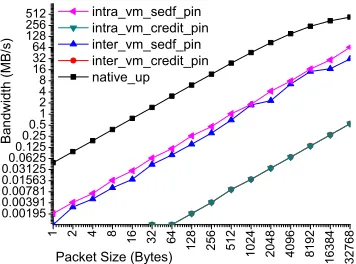
The performance data is illustrated in Fig. 1 (The in-ter vm credit pin curve and intra vm credit pin curve overlap with each other as the data in these two cases are close).
From Fig. 1, it can be observed that compared with the native up case, the MPI communication performance of the defined overcomitted cases is much worse. In all such four overcommitted cases, the communication performance in the SEDF scheduler is always better than that obtained in the Credit scheduler. This is because the SEDF scheduler defines smaller time slices than the Credit scheduler, and the frequent scheduling reduces the performance loss caused by the busy-polling mechanism employed by the MPI commu-nication library, which will be discussed in detail later.
B. Performance of Selected Benchmark Programs
To further investigate the performance problem in over-committed systems, we employ three benchmark programs from the NPB suite of version 3.3 [11], i.e., is.A.2 (in-teger sorting, which relies on all-to-all communication to exchange intermediate results), lu.A.2 (solving five coupled parabolic/elliptic partial differential equations, which needs to communicate to exchange data during computation) and ep.A.2 (random number generator, which is “embarrass-ingly” parallel computing in that no communication is required for generating the random numbers). The reason we choose these three benchmarks is that they exhibit three typical characteristics of HPC applications: communication intensive with little computation, i.e., IS; CPU intensive with little communication, i.e., EP; and that lies in the middle, i.e., LU. The execution times of these benchmark programs (MPI version) are presented in Table I (each figure in the table as well as in other tables in this paper is the average over four independent runs).
Table I: The execution times of selected benchmark pro-grams in the worst-case overcommitted scenarios (in Sec-onds)
is.A.2 lu.A.2 ep.A.2
native up 3.39 193.84 31.26
inter vm credit pin 106.2 1039.28 36.51
inter vm sedf pin 4.61 228.65 37.86
intra vm credit pin 45.08 275.56 36.31
intra vm sedf pin 3.97 195.92 37.74
intra vm credit pin case, the execution time of is.A.2 and lu.A.2 is about 12 times and 0.5 times longer, respectively. The performance penalty is less serious in the SEDF scheduler: Compared with the native up data, in in-ter vm sedf pin case, the execution time of is.A.2 only increases by 35%, and that of lu.A.2 increases by about 18%. In intra vm sedf pin case, the execution time of is.A.2 is increased by 17% while that of lu.A.2 is close to the native performance. This is because the SEDF scheduler schedules the VCPUs with smaller time slices and this greatly reduces the chances of wasting the CPU cycles caused by the busy-polling mechanism employed by the MPI library.
It can also be observed that the performance of ep.A.2 seems not to be significantly affected. This is because the processes of ep.A.2 do not need to communicate with each other during the computing phase. However, it can be observed that the execution time of ep.A.2 in the SEDF scheduler is slightly higher than that in the Credit scheduler. This is because with smaller time slices, the VCPUs will be scheduled more frequently in the SEDF scheduler, which results in the higher overhead in the hypervisor.
C. Discussions
We created the worst VCPU overcommitting cases by deliberately pinning the VCPUs to the same physical proces-sor. Although in reality people seldom deliberately confine multiple VCPUs to running on the same PCPU, performance penalty similar to that in these four overcommitted cases may still occur in real overcommitted virtualized systems. There are at least two main reasons:
First, in the current Xen architecture, the scheduling decisions are made locally: Each PCPU of a multi-processor system maintains its VCPU run-queue and schedules them to run without any coordination with other PCPUs in the system. Therefore, in real overcommitted systems, it is highly likely that two VCPUs that host the processes communicat-ing with each other via MPI primitives are not scheduled to run in parallel. When the VCPU that hosts the message receiving process is running in one PCPU but the VCPU that hosts the message sending process is scheduled out in another PCPU, the busy-polling receiving may still occur (the difference is just that the two VCPUs now reside in the run-queues of different PCPUs).
inter_vm_credit_fre e inter_vm_cre
dit_pin intra_vm_cre
dit_pin
0 20000 40000 60000 80000 100000 120000 140000
E
ve
n
t:
C
P
U
_
C
L
K
_
U
N
H
A
L
T
E
D
1
0
0
0
0
0
0
:1
[image:5.612.84.266.114.171.2]xen dom0 Kernel domU Kernel is.A.2 MPI Library domU libc+libpython
Figure 2: A comparison of XenOprofile data
Second, in the load-balancing strategy of the Credit scheduler, which is the current default scheduler in Xen, VCPUs are allowed to be migrated among all available PCPUs of the system. This strategy may cause the VCPUs communicating with each other to run on the same PCPU, which forms exactly the same overcommitting scenario as those described in Subsection III-A and III-B. And this situ-ation is more likely to happen in the overcomitted virtualized systems, since there are more runnable VCPUs.
IV. CAUSES OF THEPERFORMANCEPENALTY
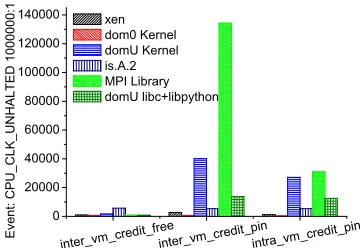
We use XenOprofile [23] to collect statistical perfor-mance data when running is.A.2 in the configurations of inter vm credit pin and intra vm credit pin. For compar-ison, we also collect the performance data when running is.A.2 in the configuration of inter vm credit free, in which the VCPUs of two domUs are not pinned to the same PCPU (i.e., to simulate the non-overcommitted case). Fig. 2 illustrates the performance data1.
From Fig. 2, it can be observed that compared with the non-overcommitted case, the number of CPU cycles spent on domU kernels, MPI library and the user-level libraries of domU increases dramatically in the overcommitted cases, while the application (i.e., is.A.2) itself always consumes almost the same amount of CPU cycles.
From the XenOprofile performance data, we found that in the inter vm credit pin case, the MPI functions in the library (i.e., MPICH2-1.2.1) that consumes most CPU cy-cles are MPID nem tcp connpoll, MPIDI CH3I Progress
as well as MPID nem network poll. While in the in-tra vm credit pin experiments, the function that consumes most CPU cycles is lmt shm recv progress. A close look into the source code of the library reveals that these functions belong to the message receiving mechanism of MPI: For block receiving operations (e.g., MPI Recv and MPI Wait), the library will continuously poll the socket file descriptor (FD) set (the inter-VM case) or the shared memory (the intra-VM case) until a message is received. During this process, non-blocking operations on the socket FD set or
the shared memory are performed. Therefore the polling mechanism will not bring the VCPU that hosts the message-receiving process into the block status, which makes the VCPU keep running until the end of the time-slice.
In order to prevent this busy-waiting message receiving (we call it “busy-polling”) mechanism from lasting so long as to consume large quantities of processing resources, MPI library uses a threshold based yielding mechanism: When the library polls up to the pre-defined times (e.g., 1000 times for MPICH2-1.2.1), the message receiving process should give up its possession of the processor by issuing a yielding syscall (i.e., sched yield in Linux) in the guest operating system. However, in virtualized environment, for the overcommitted case of inter vm credit pin, there is only one process running inside each of the domUs. The process that polls the socket FD set to receive messages will be scheduled to run again immediately after its yielding syscall, and therefore continue to consume more CPU cycles in vain. In the meanwhile, the VCPU hosting the message sender is not running, but waiting to be scheduled in the run-queue of the same physical processor. This explains the high performance penalty experienced when running is.A.2 in the overcommitted case of inter vm credit pin, since is.A.2 heavily relies on all-to-all communications (i.e., MPI Alltoall and MPI Alltoallv) to exchange intermediate results between the processes residing in different domUs, which results in frequent busy-polling. Consequently, the frequent polling and yielding within the guest systems will inevitably cause high CPU consumptions of the guest OS kernel as well as the user-level libraries.
However, the previous analysis cannot explain the perfor-mance penalty experienced in the intra vm credit pin case, since two communicating processes of is.A.2 co-exist in the same domU with two VCPUs. Normally, if one process gives up its possession of the processor due to block receiving and polling up to the pre-defined times, another process should be scheduled to run, and this should not have such high performance loss. In order to explain the performance problem in this case, we propose a hypothesis: For the processes communicating with each other using blocking MPI message receiving primitives, each of the processes will be eventually scheduled to execute on each of the VCPUs of the SMP domU. After that, when one of the processes that is blocked in message receiving tries to give up the processor possession by yielding, the scheduler of the guest OS will find that the other process is still running on another processor (i.e., VCPU from the hypervisor’s point of view), and therefore the yielding process will be scheduled in the same processor to run immediately again, which continues to consume more CPU cycles in vain until the end of the VCPU time slice. To verify this hypothesis, we employ a simple ping-pong benchmark, which invokes two processes exchanging a message buffer of 1000 bytes by using MPI Send and MPI Recv, to run in the domU of
0 200 400 600 800 1000
0 10 20 30 40 50 60 70 80 90 100
T
im
e
(
m
ill
ise
co
n
d
s)
times Round Trip Time
Figure 3: RTT of ping-pong benchmark in
intra vm credit pin case
the intra vm credit pin case. The message round trip time (RTT) is recorded and illustrated in Fig. 3.
From Fig. 3, it can be observed that for the first 813 times (the 814th time is the breaking point) of communications, the RTT is rather small (below 0.05ms), while after the breaking point, the RTT jumps to 60ms for most of the time and never comes down.
The performance data can be explained as follows. When the benchmark program is invoked, the two communicating processes (denoted as process A and B) are scheduled concurrently on one virtual processor (since it is in the overcommitted scenario and only one VCPU is scheduled to execute at a time). This results in the low RTT before the breaking point, as the yielding operation causes actual process scheduling. However, after the VCPU hosting these two processes uses up its 30ms time slice defined by the Credit scheduler, the VCPU is going to be scheduled out. At this moment, there is a high possibility that one of the pro-cesses (assume it is process A) is still running on the VCPU. After that, the hypervisor schedules the other VCPU of the domU to run, which will in turn put the other communicating process (process B) in execution. Nevertheless, the yielding of process B will not cause the actual process scheduling in the guest system again, since process A is considered “running” on the scheduled-out VCPU. This situation will last until the termination of the block receiving operations.
Another noticeable observation that can be observed from Fig. 3 is that after the breaking point, the RTT stabilizes at around 60ms (90ms in some occasions), which is twice of the length of the time slice defined by the Credit scheduler. This further verifies our deduction that the busy-polling mechanism adopted by MPI will result in meaningless CPU consumptions until the VCPU time slice is used up in the intra-VM cases.
performance penalty is also due to the lack of commu-nication between the scheduler of the hypervisor and the scheduler of the guest operating system. On one hand, since these two schedulers work independently in the current Xen architecture, the scheduler of the guest OS may have the misperception that a processor is still running even after its container (i.e., the VCPU) has actually been scheduled out by the hypervisor. On the other hand, the scheduler of the hyervisor does not really understand whether the workload inside a VCPU is meaningful.
V. OURSOLUTION
From the discussion in Section IV, we can deduce that the key to improve the communication performance in the overcommitted virtualized systems is to avoid wasting processing resources on unnecessary message polling. There are at least three possible ways to achieve this goal: 1) replacing the busy-polling mechanism with block-polling, 2) improving the scheduling algorithm of the hypervisor, and 3) exposing the scheduling information of the guest OS to the hypervisor or vice versa.
For the first possible solution, the non-blocking polling operations on the socket FD set or shared memory can be substituted with the blocking operations. For example, for the inter-VM cases, blocking operations should be performed on the FD set, instead of the original non-blocking ones used in the current MPI library implementation. It seems that this method can avoid wasting CPU resources unnecessarily on message polling. However, this solution will inevitably cause frequent and expensive VCPU context switching, and will therefore damage the performance. Moreover, it is hard, if not impossible, to implement blocking polling operations on the shared memory.
It is also possible to improve the communication perfor-mance from the perspective of the hypervisor’s scheduling algorithm. However, the smaller time slices also mean more frequent scheduling, which consequently results in heavier scheduling overhead in the hypervisor and negatively af-fects the performance of applications that do not perform much communications, such as EP from NPB. It is also a promising solution to schedule the VCPUs by groups on multiprocessor hosts (i.e., Gang-scheduling [24]) according to which VCPUs communicate with each other. Although the group scheduling approach has the potential to become a general solution to mitigate the performance penalties in overcommitting VCPU scenarios, adopting such a technique will result in the complexity in the system design, and require addressing many difficult issues, such as how to collect the communication pattern among the VCPUs, how to ensure other non-HPC workloads are not negatively affected, and so forth. We plan to investigate this approach in our future work.
In this paper, we take the third approach to improve MPI communication performance in the overcommitted
virtual-pollcount = 0; do{
polling for message;
if( pollcount > Threshold_Times){ pollcount = 0;
T1 = now(); yield in guest OS; T2 = now();
if( (T2-T1) < Sched_Gap )
notify the hypervisor to reschedule. }
[image:7.612.339.527.71.187.2]++pollcount; }till a message is received;
Figure 4: The pseudo-code for revised busy-polling
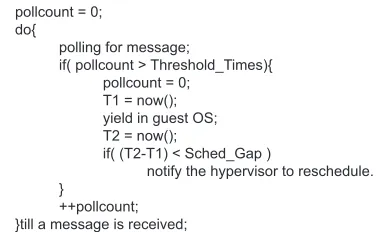
ized systems, i.e., exposing scheduling information of the guest OS to the hypervisor. We employ a straightforward solution: When the process that is blocked at receiving mes-sages is ready to give up its processor possession (because the polling times reach the threshold in the guest OS), it will notify the hypervisor to reschedule if it is appropriate. The pseudo-code of the revised busy-polling mechanism is demonstrated in Fig. 42.
Before notifying the hypervisor to conduct rescheduling operations, agap value is recorded from the time when the process is yielded to the time when the process is scheduled to execute again within the guest OS. The gap value is then compared with a threshold value (i.e., Sched Gap) we defined. Only when the value is smaller than Sched Gap, the process will invoke hypercall in the guest OS to notify the hypervisor for rescheduling. This is because we have to consider the case where multiple processes execute on one processor concurrently. In this case, it is not appropriate to reschedule the VCPU as a whole, since the concurrent scheduling may suggest some communicating tasks are in progress. While in the overcommitted cases, the process blocked in message receiving is likely to be the sole running process on the processor as we have analyzed in the previous section. This means the measured time gap will be rather small (below 2µs for most of the time), and will trigger the reschedule operation in the hypervisor. We setSched Gap
to be 100µs empirically after conducting some supporting experiments.
We apply this revision to both network polling and the shared memory polling mechanisms in the MPI library (i.e., MPICH2-1.2.1 examined in this paper), and have submitted the code patch to the maintainers of the MPICH2 project3.
After a MPI program using our code patch is invoked, during initializing phase (i.e., when MPI Init is being called), it will first detect if it is running inside a PV guest system created by Xen or not. The detection is performed by trying to open the PRIVATE CMD interface (i.e., /proc/xen/privcmd, which is typically provided by the
2T hreshold T imes= 1000for MPICH2-1.2.1
3The code patch can also be downloaded from
Linux PV guests). Only when running inside a PV guest system (i.e., PRIVATE CMD interface is available), will the MPI program adopt the revised busy-polling mechanism as shown in Fig. 4. In this way, the same code can run on both virtualized guests and native environments. The hypercall that notifies the hypervisor of rescheduling is also issued via this PRIVATE CMD interface.
VI. PERFORMANCEEVALUATION
We conducted extensive experiments to evaluate the per-formance of our solution. The experiments were carried out not only on the predefined worst-case overcommitted sce-narios we used to benchmark and analyze the performance penalty in Section III and IV, but also on a 4-core PC server to simulate overcommitted virtualized systems in real-world.
A. Experiments on the Worst Overcommitting Cases
1) Communication Performance: The performance of MPI communications in the worst-case overcommitted sce-narios with our revised MPI library is shown in Fig. 5.
In Fig. 5, the performance data labeled with the “rev ” prefix correspond to the data with the revised MPICH2-1.2.1. From Fig. 5, it can be observed that compared with the original data, the communication performance by employing our solution is improved greatly: For the Credit scheduler, the communication performance is improved by up to about 300 times in the inter-VM case, and by up to 700 times in the intra-VM case, while for the SEDF scheduler, the performance is increased by up to about 3 times in the inter-VM case and by up to about 4 times in the intra-inter-VM case. Moreover, in the intra-VM cases, the communication per-formance obtained by the revised MPI library is very close to the performance in the native UP environment. This is because in the intra-VM cases, most of the communications are conducted via the shared memory, which is very similar as the inter-process communication in the native case. In the inter-VM cases, the communication data exchanged between domUs needs to be relayed by the loopback network of dom0. This results in worse performance than that in the intra-VM cases although it is still much higher than that with the original MPI library.
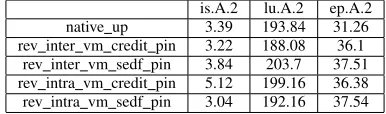
2) Performance of Selected Benchmark Programs: Table II presents the execution times of the benchmark programs (i.e., is.A.2, lu.A.2 and ep.A.2) from the NPB suite that is linked with the revised MPICH2-1.2.1.
[image:8.612.339.532.114.171.2]From Table II, it can be observed that after applying our solution, the execution time of is.A.2 and lu.A.2 is very close to that of running inside the native UP environment in the inter vm credit pin case. Compared with Table I, the performance penalty caused by poor communication is eliminated. There is almost no change in the execution time of ep.A.2, since the benchmark program does not invoke MPI communications during the computing phase, which also shows that our solution does not have negative impact on the application execution with little communications.
Table II: The execution times of selected benchmark pro-grams after improvement in the worst-case overcommitted scenarios (in Seconds)
is.A.2 lu.A.2 ep.A.2
native up 3.39 193.84 31.26
rev inter vm credit pin 3.22 188.08 36.1
rev inter vm sedf pin 3.84 203.7 37.51
rev intra vm credit pin 5.12 199.16 36.38
rev intra vm sedf pin 3.04 192.16 37.54
Table III: The execution times of selected benchmarks with different overcommitting levels in the Credit scheduler (in Seconds)
number of domU(s) 1 2 3 4
is.A.4 original 0.85 11.01 16.62 22.48
revised 0.85 11.13 6.79 7.46
lu.A.4 original 72.763 214.35 332.21 466.04
revised 72.64 198.04 272.69 353.45
ep.A.4 original 13.33 26.66 43.24 56.19
revised 13.33 26.49 39.74 52.92
B. Experiments on the Real Overcommitted Systems
In order to exhibit the performance penalty on benchmark programs and verify the effectiveness of our solution in the real use cases, we conduct experiments on a 4-core overcommitted host. The host has two way Intel Xeon 5110 processor (Woodcrest), each of which has two 1.6GHz pro-cessing cores with 4MBytes shared L2 cache. It is configured with 2GB DDR2 memory, 160GB SATA hard disk drive, and one NetXtreme II BCM5708 Gigabit Ethernet interface. On this platform, each domU is configured with four VCPUs. Theovercommitting levelof the system is controlled by the number of domUs running on the platform. As the number of the domUs increases (hence, the number of VCPUs), the
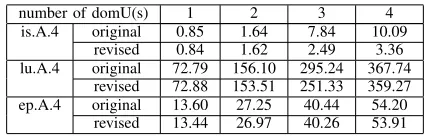
overcommitting levelalso increases. Unlike the experiments in subsection VI-A, the VCPUs are not deliberately pinned to run on a certain core. In the experiments, identical bench-mark programs from NPB (i.e. is.A.4, lu.A.4 and ep.A.4) are invoked simultaneously in these domUs, and their execution times are recorded. Table III and IV demonstrate the average execution time of these benchmark programs in the Credit scheduler and in the SEDF scheduler, respectively.
[image:8.612.325.545.226.294.2]1 2 4 8 16 32 64 1 2 8 2 5 6 5 1 2 1 0 2 4 2 0 4 8 4 0 9 6 8 1 9 2 1 6 3 8 4 3 2 7 6 8 0.00195 0.00391 0.00781 0.01563 0.031250.0625 0.1250.25 0.51 2 4 8 16 32 64 128 256 512 B a n d w id th ( M B /s ) Packet Size(Bytes) rev_intra_vm_credit_pin rev_inter_vm_credit_pin intra_vm_credit_pin inter_vm_credit_pin native_up
(a) for the Credit scheduler
1 2 4 8
1 6 3 2 6 4 1 2 8 2 5 6 5 1 2 1 0 2 4 2 0 4 8 4 0 9 6 8 1 9 2 1 6 3 8 4 3 2 7 6 8 0.00195 0.00391 0.00781 0.01563 0.031250.0625 0.1250.25 0.51 2 4 8 16 32 64 128 256 512 B a n d w id th ( M B /s ) Packet Size(Bytes) rev_intra_vm_sedf_pin rev_inter_vm_sedf_pin intra_vm_sedf_pin inter_vm_sedf_pin native_up
[image:9.612.102.510.82.230.2](b) for the SEDF scheduler
Figure 5: The improved performance of MPI communications in the worst-case overcommitted scenarios
Table IV: The execution times of selected benchmarks with different overcommitting levels in the SEDF scheduler (in Seconds)
number of domU(s) 1 2 3 4
is.A.4 original 0.85 1.64 7.84 10.09
revised 0.84 1.62 2.49 3.36
lu.A.4 original 72.79 156.10 295.24 367.74
revised 72.88 153.51 251.33 359.27
ep.A.4 original 13.60 27.25 40.44 54.20
revised 13.44 26.97 40.26 53.91
MPI library.
However, when the overcommitting level becomes higher (in the cases of three and four domUs), the execution times of the benchmark programs with the revised MPI libraries are significantly shorter than those with the original MPI libraries. This is because with more VCPUs running, the possibility that the VCPUs in the same domU are not sched-uled to run in parallel is significantly higher, which generates the similar performance penalty as that experienced in the intra vm credit pin case. Meanwhile, with the increase of candidate VCPUs, the possibilty of scheduling VCPUs with actual workload to run by our scheme is much higher.
From Table IV, it can be observed that in most cases (except for is.A.4), the performance improvement in the SEDF scheduler is smaller than that in the Credit scheduler. This is because the SEDF schedules the VCPUs with smaller time slices than the Credit scheduler, which results in less performance penalty due to the busy-polling mechanism em-ployed by the MPI library. The reason why our solution can still achieve significant improvement for is.A.4 in the SEDF scheduler is because is.A.4 has very high communication-to-computation ratio, which counteracts the gains achieved by the shorter time slices in SEDF.
Another observation from both Table III and Table IV is that for the benchmark programs with original MPI library that need communication during computation (e.g., is.A.4 and lu.A.4), the proportion of the increase in their execution
time is much higher than that of the increase in the num-ber of competing domUs. This explicitly exhibits the high performance penalty on MPI communication placed on the applications due to overcommitment. Our solution provided in this paper can alleviate this performance degradation. For example, in the SEDF scheduler, the execution time of is.A.4 increases proportionally with the increment on the number of competing domUs.
VII. CONCLUSION ANDFUTUREWORKS
In this paper, we focus on investigating the performance problem of MPI communication in the overcommitted virtu-alized systems. By benchmarking the worst-case overcomit-ted scenarios and thorough analysis, we revealed the reason behind such performance penalty is the “busy-polling” mes-sage receiving mechanism employed by the MPI libraries. Such penalty significantly degrades the execution perfor-mance of the MPI applications that contain communications and run in the overcomitted virtualized computer systems. We proposed our solution in this paper to mitigate the penalty and implemented our solution into a popular MPI library. We have carried out experiments to verify the effectiveness of the solution in the real-world overcommitted virtualized systems. The results show that compared with the original MPI library, the library that patches our solution can improve the performance of applications to different extents, depending on their communication patterns and the overcommitting level.
[image:9.612.68.283.308.376.2]ACKNOWLEDGMENT
This work is supported by National 973 Basic Research Program of China under grant No.2007CB310900, Na-tional Natural Science Foundation of China under grant No.60903022 and the MoE-Intel Information Technology Special Research Foundation under grant No. MOE-INTEL-10-05.
REFERENCES
[1] NIST definition of cloud computing. [Online]. Avail-able: http://csrc.nist.gov/groups/SNS/cloud-computing/ index.html
[2] C. Evangelinos and C. N. Hill, “Cloud Computing for Parallel Scientific HPC Applications: Feasibility of Running Coupled Atmosphere-Ocean Climate Models on Amazon EC2,” in Proc. of Cloud Computing and Applications Conference, October 2008.
[3] S. Akioka and Y. Muraoka, “HPC benchmarks on Amazon EC2,” in Proc. of IEEE 24th International Conference on Advanced Information Networking and Applications Workshops, 2010, pp. 1029–1034. [4] B. Dragovic, K. Fraser, S. Hand, T. Harris, A. Ho,
I. Pratt, A. Warfield, P. Barham, and R. Neugebauer, “Xen and the Art of Virtualization,” in Proc. of the ACM Symposium on Operating Systems Principles (SOSP’03), October 2003, pp. 164–177.
[5] Amazon EC2 Cloud. [Online]. Available: http://aws. amazon.com/ec2
[6] Gogrid Cloud. [Online]. Available: http://www.gogrid. com
[7] A. Ranadive, M. Kesavan, A. Gavrilovska, and K. Schwan, “Performance Implications of Virtualizing Multicore Cluster Machines,” in Proc. of the ACM 2nd workshop on System-level virtualization for high performance computing, 2008, pp. 1–8.
[8] G. Vallee and S. L. Scott, “XenOSCAR for cluster virtualization,” in Proc. of ISPA Workshop on XEN in HPC Cluster and Grid Computing Environments (XHPC’06), March 2006, pp. 381–383.
[9] V. Soundararajan and J. M. Anderson, “The Impact of Management Operations on the Virtualized Dat-acenter,” in Proc. of the 37th annual international symposium on Computer architecture (ISCA’10), 2010, pp. 326–337.
[10] G. Wang and T. S. E. Ng, “The Impact of Virtualiza-tion on Network Performance of Amazon EC2 Data Center,” in Proc. of The IEEE 29th Conference on Computer Communications (INFOCOM’10), 2010, pp. 1–9.
[11] NPB: NAS Parallel Benchmarks. [Online]. Available: http://www.nas.nasa.gov/Resources/Software/npb.html [12] W. Huang, J. Liu, B. Abali, and D. K. Panda, “A
case for high performance computing with virtual
ma-chines,” inProc. of the ACM 20th annual international conference on Supercomputing, 2006, pp. 125–134. [13] J. Wang, K. L. Wright, and K. Gopalan, “XenLoop: a
transparent high performance inter-vm network loop-back,” inProc. of the 17th international symposium on High performance distributed computing (HPDC’08), October 2008, pp. 109–118.
[14] W. Huang, M. J. Koop, Q. Gao, and D. K. Panda, “Virtual Machine Aware Communication Libraries for High Performance Computing,” in Proc. of the 2007 ACM/IEEE conference on Supercomputing (SC’07), 2007.
[15] J. Liu and B. Abali, “Virtualization polling engine (VPE): using dedicated CPU cores to accelerate I/O virtualization,” inProc. of the ACM 23rd international conference on Supercomputing, 2009, pp. 225–234. [16] L. Cherkasova, D. Gupta, and A. Vahdat, “Comparison
of the three CPU schedulers in Xen,”ACM SIGMET-RICS Performance Evaluation Review, vol. 35, no. 2, pp. 42–51, September 2007.
[17] D. Ongaro, A. L. Cox, and S. Rixner., “Scheduling I/O in Virtual Machine Monitors,” in Proc. of ACM SIGPLAN/SIGOPS International Conference on Virtual Execution Environments (VEE’08), 2008, pp. 1–10.
[18] Boost Credit. [Online]. Available:
http://www.mailinglistarchive.com/xen-devel@lists. xensource.com/msg58284.html
[19] MPICH2: High Performance and Widely Portable MPI. [Online]. Available: http://www.mcs.anl.gov/research/ projects/mpich2/
[20] MPICH: A Portable Implementation of MPI.
[Online]. Available: http://www.mcs.anl.gov/research/ projects/mpi/mpich1/
[21] Open-MPI: Open Source High Performance Comput-ing. [Online]. Available: http://www.open-mpi.org/ [22] Effective bandwidth (beff) benchmark. [Online].
Available: https://fs.hlrs.de/projects/par/mpi//b\ eff/ [23] A. Menon, J. R. Santos, Y. Turner, G. Janakiraman, and
W. Zwaenepoel, “Diagnosing Performance Overheads in the Xen Virtual Machine Environment,” inProc. of the First ACM/Usenix Conference on Virtual Execution Environments (VEE’05), June 2005, pp. 13–23. [24] D. G. Feitelson, “Packing schemes for gang