University of Warwick institutional repository: http://go.warwick.ac.uk/wrap
This paper is made available online in accordance with
publisher policies. Please scroll down to view the document
itself. Please refer to the repository record for this item and our
policy information available from the repository home page for
further information.
To see the final version of this paper please visit the publisher’s website.
Access to the published version may require a subscription.
Author(s): Debattista, K.; Dubla, P.; Peixoto dos Santos, L.P.;
Chalmers, A.;
Article Title: Wait-Free Shared-Memory Irradiance Caching
Year of publication: 2011
Link to published article:
http://dx.doi.org/10.1109/MCG.2010.80
Publisher statement:” © 2011 IEEE. Personal use of this material is
permitted. Permission from IEEE must be obtained for all other uses, in
any current or future media, including reprinting/republishing this
material for advertising or promotional purposes, creating new
Wait-Free Shared-Memory Irradiance Caching
Kurt Debattista1, Piotr Dubla1, Luís Paulo Santos2and Alan Chalmers1
1International Digital Laboratory, WMG, University of Warwick, United Kingdom
2Departamento de Informática, Universidade do Minho, Portugal
Abstract
Parallelizing rendering algorithms to take advantage of multicore machines is not a straightforward task. Certain methods require frequent synchronization among threads to obtain benefits similar to the sequential algorithm. One such algorithm is the Irradiance Cache (IC), an acceleration data structure which caches indirect diffuse irradiance values. In multicore systems the IC must be shared among threads in order to achieve high efficiency levels. We propose a novel wait-free access mechanism to the shared IC, which does not make any use of the com-monly used blocking or busy waiting methods, avoiding most serialization and reducing contention. We compare with two classical approaches: a lock based mechanism and a local write technique. We demonstrate, using two systems with up to 24 cores, that the wait-free approach significantly reduces synchronization overheads, thus resulting in improved performance.
Categories and Subject Descriptors(according to ACM CCS): Computer Graphics [I.3.7]: Three Dimensional Graph-ics and Realism—Ray Tracing Computer GraphGraph-ics [I.3.1]: Hardware Architecture—Parallel Processing
1. Introduction
The advent of multicore computing to the desktop has meant that in order to maximize the use of available resources, traditional rendering algorithms need to be modified to ac-count for the parallelism. While, for certain algorithms, such as classical ray tracing, this conversion can be rela-tively straightforward, when computing more complex light-ing conditions, methods which share data among multiple parallel threads do not afford the same opportunities. Un-der such conditions careful consiUn-deration must be paid to synchronization among threads to ensure that overheads are kept to a minimum and computation can proceed unhin-dered [Her09]. In this paper we present a parallel solution to one such method, the irradiance cache (IC). The IC offers an interesting challenge for shared memory processing due to the frequent access of a shared data structure by multiple threads. We demonstrate how to parallelize this algorithm using a wait-free approach, which may inspire other solu-tions to similar problems in computer graphics.
Rendering global illumination light transport effects within a ray tracing context is a computationally demand-ing task. Recent improvements in the field of ray tracdemand-ing have made it possible to interactively compute many of the global effects, such as specular phenomena and correct
shad-ows [WMG∗07]. Indirect diffuse interreflections, however, require dense sampling of the hemisphere at each shading point, dramatically increasing rendering times. Ward et al. [War88] exploited the fact that the indirect diffuse compo-nent is generally a continuous smooth function over space not affected by the high frequency changes common with the specular component. They proposed the IC data struc-ture to allow sparse evaluation of indirect diffuse irradiance. Sparsely calculated irradiance values are stored in the IC and reused to extra(inter)polate irradiance values at nearby loca-tions. By exploiting spatial coherence, the IC can achieve an order of magnitude improvement in rendering time over unbiased Monte Carlo integration.
non-blocking data structures. Non-blocking data structures can take the form of obstruction-free, lock-free or wait-free data structures, that offer considerable performance advan-tages. The most powerful of these are the wait-free methods. For further details see Section (Box) 3. In reality, practical wait-free data structures are considered difficult to construct and are relatively rare [HLM03].
In this paper we propose an efficient wait-free algo-rithm which allows all threads to concurrently access an un-bounded shared IC, without using any locks or critical sec-tions. We take this approach and compare it with two other mechanisms which share the IC among threads on a shared memory system. The first is based on traditional locking techniques and locks the shared IC every time a thread ac-cesses it, both for reading and writing. The second is a lo-cal copy method which avoids concurrent access control by maintaining a local IC, per thread, and merging at the end of each frame. Efficient sharing of the IC in multithreaded sys-tems is mandatory in order to achieve high efficiency levels, since computed irradiance values become readily available to all threads, thus avoiding work replication. This is espe-cially relevant because utilization of the IC has increased significantly over the last few years and has been used as an inspiration for a myriad of new caching algorithms which could benefit from our approach, see Box (Section) 2 for fur-ther details.
This paper’s contributions are the proposal of an effi-cient wait-free algorithm for sharing the IC among ren-dering threads on shared memory systems and a compar-ison of the proposed algorithm’s efficiency with two tra-ditional data access control mechanisms: a lock-based ap-proach and a local copy one. This is an extension of our pre-vious work [DDSC09], where we presented an initial version of the wait-free algorithm and tested it on an eight core ma-chine. The previous wait-free algorithm could only handle fixed sized arrays in the IC structure. Furthermore, the al-gorithm caused some data to be discarded when a conflict among threads occurred. These limitations have been fixed in the current work by handling dynamically allocated mem-ory, thus supporting an unbounded number of cache sam-ples, and guaranteing the successful insertion of all new irra-diance values. We assess this algorithm’s efficiency on two highly concurrent multicore systems with up to 24 physi-cal cores and show that it exhibits superior performance and scalability properties than the lock-based and local cache al-ternatives.
This paper is structured as follows. Section (Box) 2 presents the motivation and reasoning behind the irradiance cache, while Section (Box) 3 briefly discusses non-blocking synchronization. In section 4 we present related work and in Section 5, we present the algorithms for the three data access control mechanisms. Section 6 compares results and, finally, in Section 7 we conclude and describe possible future work.
2. Irradiance Caching (Box)
Physically-based computation of the radiance reflected at a pointpalong a directionΘis dictated by the rendering equa-tion [Kaj86]:
Lr(p→Θ) =
∫
Ωfr(p,Θ↔Ψ)Li(p←Ψ)cos( −→ Np,Ψ)dΩΨ
where fr(p,Θ↔Ψ)is the BRDF at pointpfor the pair of directionsΘandΨ,Li(p←Ψ)is the incident radiance at palong directionΨ,−N→p is the surface normal atpandΩ, the integration domain, is the hemisphere centered atpand oriented around−N→p.
Ray tracing approximates Lr(p→Θ)by shooting rays along a number of directionsΨ, thus samplingLi(p←Ψ) for these directions. Certain light transport phenomena, such as specular scattering of light and direct illumination, can usually be computed with a limited number of rays; other phenomena, due to their lack of directionality, require hemi-sphere sampling, i.e., stochastically selecting and shooting a large number of rays acrossΩ– this is a stochastic in-tegration method known as Monte Carlo inin-tegration, which usually accounts for a large amount of the computation.
One such phenomenon is indirect diffuse reflection, de-fined as diffusely reflected radiance at pointpalong a given direction due to indirect irradianceE(p).E(p)is the indirect incident radiant flux per unit area atp. Accurately comput-ingE(p)requires densely samplingΩ, which in a ray trac-ing context is achieved by shoottrac-ing hundreds or thousands of rays distributed across this hemisphere (while carefully avoiding directions corresponding to light sources, since we only want to include indirect lighting, i.e., light that has been reflected by at least one object).
Indirect diffuse reflections are crucial to convey a percep-tion of realism (See Figure 1), but sampling the hemisphere at all shading points results in very long rendering times, deemed unacceptable even for most offline renderings. Ward et al. [War88] realized back in 1988 that indirect diffuse reflection is generally a continuous smooth function over space, not affected by the high frequency changes common with specular reflections. They proposed accelerating the computation of indirect diffuse reflections by densely sam-pling the hemisphere at a sparse set of shading points only and interpolating for the remaining ones. Sparsely calculated indirect irradiance values are stored in the irradiance cache (IC) data structure and later reused to extra(inter)polate irra-diance values at nearby locations.
Indirect irradiance atp,E(p), can be interpolated from a setS(p)of previously evaluated irradiance valuesE(pi)at pointspi, by using a weighted average:
E(p) =∑i∈S(p)wi(p)E(pi) ∑i∈S(p)wi(p)
where the weightswi(p) = (∥p−Ripi∥+ √
1− −N→p· −→Npi)−
1
(a) Direct only (b) Indirect only (c) Full Figure 1: The contribution of indirect lighting
mean distance to objects visible frompi,Ri, and on the rel-ative orientation of the normals atpandpi. The setS(p)of pointspithat can be used to interpolateE(p)is determined by requiring that the weightswi(p)are larger than the recip-rocal of the maximum acceptable error,a, which is a user supplied parameter:S(p) ={i:wi(p)>1/a}. When indi-rect irradiance at any point pis required the renderer first determines the setS(p)by querying the IC. IfS(p)is empty, E(p)is evaluated by Monte Carlo integration, otherwise it is interpolated from theE(pi)belonging toS(p). Querying the IC to determineS(p)amounts to locating all samplespi stored in the cache that satisfy the above criterium; this is referred to as a range search, a computationally demanding task that can be optimized by spatially ordering the IC by resorting to 3D hierarchical data structures, such as octrees or kd-trees.
By exploiting spatial coherence, the IC offers an order of magnitude improvement in rendering time over Monte Carlo integration. Performance is further improved when render-ing animations of static scenes, since the indirect diffuse ir-radiance remains constant and the IC samples can thus be reused across frames.
The IC has been extended as a stand-alone algorithm in many guises recently: as an acceleration data structure for rendering glossy surfaces by storing radiance [KGPB05], participating media phenomena [JDZJ08] and translucency [KLC06], or used in conjunction with photon mapping [Jen01]. It has been extended to exploit coherence in the temporal domain [SKDM05, GBP07, DDB∗09]. Similar methods have also been used to accelerate the rendering in production renderers at PDI/Dreamworks [TL04].
References
[DDB∗09] DEBATTISTA K., DUBLA P., BANTERLE F., SANTOSL. P., CHALMERSA.: Instant caching for inter-active global illumination. Comput. Graph. Forum 28, 8 (2009), 2216–2228.
[GBP07] GAUTRONP., BOUATOUCHK., PATTANAIKS.: Temporal radiance caching. IEEE Transactions on Visu-alization and Computer Graphics 13, 5 (2007), 891–901.
[JDZJ08] JAROSZ, DONNER, ZWICKER, JENSEN:
Radiance caching for participating media.ACM Trans. on Computer Graphics 27, 1 (March 2008).
[Jen01] JENSEN H. W.: Realistic image synthesis using photon mapping. A. K. Peters, Ltd., 2001.
[Kaj86] KAJIYAJ. T.: The rendering equation. In SIG-GRAPH ’86: Proceedings of the 13th annual conference on Computer graphics and interactive techniques (New York, NY, USA, 1986), ACM, pp. 143–150.
[KGPB05] KRIVANEK J., GAUTRONP., PATTANAIK S., BOUATOUCH K.: Radiance caching for efficient global illumination computation. IEEE Trans. on Visual-ization and Computer Graphics 11, 5 (2005), 550–561.
[KLC06] KENG S.-L., LEEW.-Y., CHUANGJ.-H.: An efficient caching-based rendering of translucent materials. Vis. Comput. 23, 1 (2006), 59–69.
[SKDM05] SMYK M., KINUWAKI S., DURIKOVIC R., MYSKOWSKI K.: Temporally Coherent Irradiance Caching for High Quality Animation Rendering. Com-puter Graphics Forum 24, 3 (2005), 401–412.
[TL04] TABELLIONE., LAMORLETTEA.: An Approxi-mate Global Illumination System for Computer Generated Films.ACM Trans. on Graphics 23, 3 (2004), 469–476.
[War88] WARDG.: A ray tracing solution for diffuse in-terreflection. Computer Graphics - SIGGRAPH’88 22, 4 (August 1988).
End Irradiance Caching Box
3. Non-blocking Synchronization (Box)
When using shared memory multithreading to execute par-allel computations, care must be taken when accessing data structures that are accessible to all the threads concurrently. When multiple threads can read and write from a shared data structure, a data access control mechanism is required to en-sure that the data structure is not corrupted.
frequent access to a shared data structure may be required, the cost of blocking may be prohibitive. In such case a thread is made to busy wait, usually using a spin lock, if another thread lies within the critical section, until access is allowed. Such control mechanisms incur overheads, such as serialization of accesses to the shared data structure. Block-ing entails expensive context switches and busy waitBlock-ing of frequently-accessed resources leads to contention which can drastically reduce performance as the number of threads in-creases [ALL89].
Alternatives that avoid mutual exclusion do exist in the form of non-blocking synchronization. By carefully order-ing instructions, non-blockorder-ing algorithms can guarantee that none of the code is serialized, due to the removal of all crit-ical sections, resulting in a reduction in contention [HS08]. The weakest form of non-blocking data structures take the form of obstruction-free methods that guarantee that a thread can complete in finite time if it operates in isolation. When non-blocking data structures can guarantee that at least one among a set of concurrent threads will complete in finite time, they are said to be lock free. All lock free algorithms are obstruction free. Lock-free and obstruction free meth-ods rely on retrials and cannot guarantee an upper bound on the number of executed instructions. When all threads are guaranteed to complete in finite time the algorithm is said to be wait free. Wait-free algorithms can guarantee an upper bound on the number of instructions, thus avoiding starva-tion, deadlock and livelock, priority inversion problems and are ideal for multiprogrammed multiprocessors, for exam-ple when a thread holding a lock is preempted causing all other threads to busy wait uselessly. Clearly all wait-free data structures are also lock free.
The construction of non-blocking algorithms requires the use of powerful atomic primitives which are executed as a single instruction, without any interruption, on modern architectures. These algorithms can be seen as a limiting case on the reduction of the size of critical sections, reduc-ing them to these individual machine instructions. We show pseudo code (Listings 1 and 2) for the two atomic instruc-tions, compare and swap (CAS) and fetch and add (XADD), that we will be using for our wait-free IC. Herlihy [Her91] provides a hierarchy of the effectiveness of such primitives, the most effective being those that can be used to implement any wait-free data structure which he described as being compare and swap (or load-link store-conditional instruction pair, which are an alternative to compare and swap found on some architectures).
Listing 1: Fetch and Add
1 atomicXADD(address location)
2 {
3 intvalue =∗location;
4 ∗location = value + 1;
5 returnvalue 6 }
Listing 2: Compare and swap
1 atomicCAS(address location, value cmpVal, value newVal)
2 {
3 if(∗location == cmpVal) {
4 ∗location = newVal;
5 return true;
6 }else return false; 7 }
References
[ALL89] ANDERSON T. E., LAZOWSKA E. D., LEVY
H. M.: The performance implications of thread man-agement alternatives for shared-memory multiprocessors. IEEE Trans. Computers 38, 12 (1989), 1631–1644.
[Her91] HERLIHYM.: Wait-free synchronization. ACM Trans. Program. Lang. Syst. 13, 1 (1991), 124–149.
[HS08] HERLIHYM., SHAVITN.: The Art of Multipro-cessor Programming. Morgan Kaufmann, March 2008.
End Non-blocking Synchronization Box
4. Related Work
The IC is an acceleration data structure which caches indi-rect diffuse irradiance samples, within the framework of a distributed ray-tracing algorithm [War88]. Irradiance values can then be interpolated for regions within a given neigh-borhood of these samples, thus reducing rendering time by exploiting spatial coherence. Section (Box) 2 describes the motivation and mechanism behind this data structure.
In order to accelerate range searches, performed to locate valid samples within the IC, an octree is incrementally built every time a new sample is added; writing to the cache re-quires both storing the new indirect diffuse irradiance value and updating the octree topology. In parallel systems each rendering process, or thread, might evaluate new indirect dif-fuse irradiance values and add them to the IC. In order to in-crease efficiency, the IC must be shared among all processes, thus avoiding replicated work, where one process evaluates an irradiance value that could have been interpolated from irradiance values evaluated by other processes. The IC be-comes a shared data structure, thus requiring some sharing mechanism assuring that all processes can access the avail-able data, that the data is not corrupted and that overheads do not compromise efficiency.
in poor performance when using inefficient file lock man-agers. Koholka et al. [KMG99] broadcast IC values amongst processors after every 50 samples calculated at each slave. Robertson et al. [RCLL99] presented a centralized parallel version of Radiance whereby the calculated IC values are sent to a master process whenever a threshold is met. Each slave then collects the values deposited at the master by the other slaves. [DSC06] propose restricting diffuse irradiance evaluations to a subset of the available processors and syn-chronizing the IC among these at a higher frequency than with the remaining processors.
We are not aware of any publication describing a data access control mechanism for sharing the irradiance cache among rendering threads in a shared memory parallel sys-tem, other than our previous wait-free algorithm [DDSC09]. The algorithm proposed in this paper extends this previ-ous one, supporting extendable memory for inserting an un-bounded number of IC samples and also successfully insert-ing of all new irradiance values, some of which were dis-carded when a conflict occurred in the previous method. Fur-thermore, the algorithm is evaluated on two highly concur-rent multicore architectures, demonstrating its superior per-formance and scalability properties.
5. Algorithms
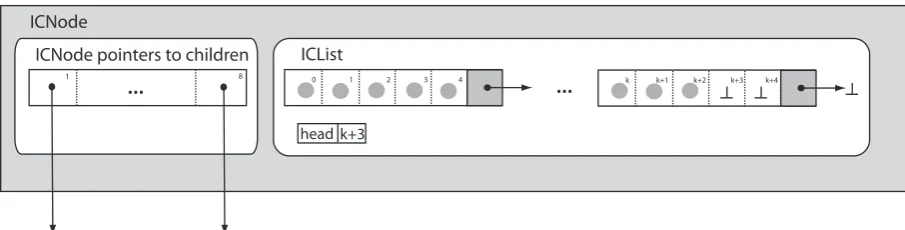
In this section the algorithms for the three evaluated data ac-cess control mechanisms are presented. To begin with we show a traditional single-threaded IC with no access control in Listing 3. IrradianceCache is the data structure that repre-sents the IC. It is composed of an octree of recursive nodes. The individual node is termed ICNode. Each ICNode con-tains pointers to another eight nodes and an ICList storing the list of IC samples. Figure 2 shows the ICNode structure for the wait-free method. For the other methods the ICList is just a single dynamic array. In the subsequent sections we demonstrate how the traditional approach can be modified to enable the different access control algorithms.
Listing 3: Traditional sequential IC
1 IrradianceCacheIC; 2
3 ComputeIndirectDiffuse() {
4 //get irradiance from IC if there are valid records
5 inIC = IC.getIrradiance();
6 if(!inIC) {// no valid records found
7 // compute it by sampling the hemisphere
8 ICsample= ComputeIrradianceRT ();
9 // insert new IC sample into the octree
10 IC.insert(ICsample);
11 }
12 } 13
14 IrradianceCache::getIrradiance(Irr) {
15 Irr = {0,0,0};
16 <Traverse the octree>
17 <verify validity of sample> 18 <extrapoloate irradiance; add to Irr>
19 if(found)return true;
20 else return false;
21 } 22
23 IrradianceCache::insert(ICsample) {
24 // recursively traverse the octree
25 // starting at root
26 IC.root.insert(ICsample);
27 } 28
29 ICNode::insert(ICSample) {
30 if(correct insertion node) {
31 IClist.Add (ICsample);
32 }else{
33 // go deeper in the octree
34 xyz = EvaluateOctant();
35 if(children[xyz] == NULL)
36 children[xyz] =newICNode ();
37 children[xyz].insert(ICsample);
38 }
39 } 40
41 ICList::Add (ICsample) {
42 // insert new record in head of list
43 IClist.records[head++] =ICsample;
44 }
5.1. Lock-Based Irradiance Cache (LCK)
The lock-based access control algorithm locks the IC when-ever a read or write is made to it (Listing 4 lines 4 - 6, 12 - 14). However, the code responsible for hemisphere sam-pling, ComputeIrradianceRT(), is not a critical region, thus allowing concurrent evaluation of irradiance. The major dis-advantage of the LCK approach is that it serializes all ac-cesses, both reads and writes, to the shared IC. As the num-ber of threads increases, contention will also increase, pre-venting performance from scaling with the degree of paral-lelism.
Listing 4: Lock-based IC
1 ComputeIndirectDiffuse() 2 {
3 //get irradiance from IC if there are valid records
4 IC.lock();
5 inIC = IC.getIrradiance(Irr);
6 IC.unlock(); 7
8 if(!inIC) {// no valid records found
9 // compute it by sampling the hemisphere
10 ICsample= ComputeIrradianceRT ();
11 // insert new IC sample into the octree
12 IC.lock();
13 IC.insert(ICsample); 14 IC.unlock();
15 }
5.2. Local-Write Irradiance Cache (LW)
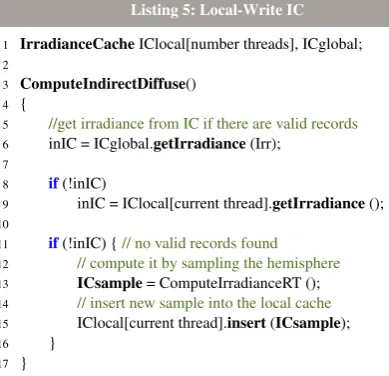
An alternative approach is to have a global IC readable by all threads and an additional local IC per thread; each thread writes only to its local IC but reads from both. At certain pre-defined execution points, such as the end of a frame, the local ICs are sequentially merged into the global IC. This form of synchronization uses an end of frame as a barrier, effectively constituting a blocking approach to synchronization.
The major drawback of this approach is that it does not allow for any sharing within a single frame, thus resulting in work replication. The LW algorithm has a much higher IC sample count than the other two approaches, since each thread must locally evaluate all irradiance values required by its assigned image tiles. Additionally, memory consump-tion is dictated by the number of threads being used and the complexity of the octree itself.
Listing 5: Local-Write IC
1 IrradianceCacheIClocal[number threads], ICglobal; 2
3 ComputeIndirectDiffuse() 4 {
5 //get irradiance from IC if there are valid records
6 inIC = ICglobal.getIrradiance(Irr);
7
8 if(!inIC)
9 inIC = IClocal[current thread].getIrradiance();
10
11 if(!inIC) {// no valid records found
12 // compute it by sampling the hemisphere
13 ICsample= ComputeIrradianceRT ();
14 // insert new sample into the local cache
15 IClocal[current thread].insert(ICsample);
16 }
17 }
5.3. Wait-Free Irradiance Cache (WF)
The wait-free algorithm does not rely on any critical sections to both read and write to the shared IC. The algorithm makes changes to three methods from the traditional IC.
The first method we describe is the ICList::Add function, see Listing 6. The insert onto the node itself takes the form of an insertion onto an array or an unbounded queue. For the sake of completeness we demonstrate how the method works for an unbounded queue. Insertion onto a fixed sized array is just a specialized case of this algorithm. The version of the fixed size array is the same as the enqueue function of the Herlihy Wing concurrent queue [HW90]. The structure used for ICList is an unbounded queue composed of a queue of arrays, used to maintain coherence and to ensure that the extending of the queue does not occur frequently, see Figure 2. In Listing 6 the array type is denoted as qNode. qNode contains an array of qNodeSize elements and a pointer to another qNode. Initially the queue of arrays contains only
one qNode, whenever required a new qNode is created and attached to the previous one. An array is always initialized with a list of NULL pointers (or some other symbol that is not used by the computation) to denote that an ICsample has not yet been added. When adding samples to an IC node the atomic XADD operator (Listing 6 line 3) is used, returning a unique index into the list of records, which ensures that samples are never over-written; simultaneously, the index to the next free position is incremented.
[image:7.595.72.267.280.468.2]When the structure needs to be extended (Listing 6 line 13) a new qNode is created and a CAS is used to insert it onto the previous qNode (Listing 6 line 19). If the queue has not yet been extended (by another thread), indicated by the pointer still being NULL, then CAS completes successfully and the associated ICsample is inserted onto the structure (Listing 6 line 26). If, however, another thread extended the queue, then CAS will fail and this thread will discard the created qNode (Listing 6 line 20) and insert the associated sample onto the qNode that some other thread must have created (otherwise the CAS would have succeeded).
Figure 3 demonstrates an example of this method being executed by three concurrent threads,R,G,Bfor a qNode-Size of five. This will help illustrate how the ICList:Add() method functions. At 3a the ICList is completely empty. At 3b,Rhas just incremented the head but has not yet inserted the sample.Rinserts the sample at 3c. At 3d, bothBandG
have just incremented the head but not inserted the samples. At 3e,Bhas not inserted its sample andRhas inserted an-other sample, butGis yet to insert the sample and is still on the same line of code that it was on at 3d.
3f demonstrates the scenario when the list needs to be ex-tended and possible conflict may occur.Rhas just filled in the first qNode andGandBare about to insert another two samples, they have in fact already incremented head. Since both threadsGandBhave checked that the last qNode is full and has no successor (Line 16), both created a new qNode. However, due to the CAS at Line 19 only one will succeed in attaching it to the previous qNode. In this case, at 3g, we can see thatGhas succeeded andBis deleting the qNode it created.Ghas inserted the sample onto the new qNode. At 3h,Binserts the sample onto the qNode thatGhad created.
Listing 6: Wait-Free IC Add
1 ICList::Add (ICsample) {
2 // get index of new sample in node list
3 intindex =XADD(&head);
4 intiteration = index / qNodeSize;
5 intpos = index % qNodeSize;
6 qNode∗tail;
7 intcount = 0;
8
9 // identify node−can be optimized with a local tail
10 for(tail = qHead; tail−>next != NULL && count < iteration;
0 1 2 3 4 8
1
...
k k+1 k+2 k+3 k+4...
ICListICNode pointers to children
[image:8.595.72.525.80.195.2]head k+3 ICNode
Figure 2: The structure of an ICNode for the wait-free method. For the other methods ICList is just a single dynamic array which is extended whenever required.
12
13 if(iteration > count){
14 for(intn = 0; n < iteration−count; n++) {
15 // this is where we add the new Array
16 if(tail−>next == NULL) {
17 // all entries are initialized as NULL
18 qNode∗newN =newqNode;
19 if(!CAS(&tail−>next, NULL, newN))
20 deletenewN;
21 }
22 tail = tail−>next;
23 }
24 // if this thread did not update
25 // some other thread must have updated
26 tail−>records[pos] =ICsample;
27 returnindex; 28 }
The second method that is changed from the traditional IC is the insert onto the octree structure, see Listing 7. When adding a new child node to the octree, the new node is built using a temporary pointer. Once built, the node is attached to the octree using the CAS operator (Listing 7 line 10). The reasoning used for this method is similar to that used for ICList::Add. Either this thread creates the subtree or some other thread does and computation proceeds notwithstand-ing.
Listing 7: Wait-Free IC insert
1 ICNode::insert(ICSample) {
2 if(correct insertion node)
3 IClist.Add (ICsample);
4 else{// go deeper in the octree
5
6 xyz = EvaluateOctant();
7 if(children[xyz]==NULL) {
8 temp =newICNode();
9 // Update new branch into the octree
10 if(!CAS(children[xyz], NULL, temp))
11 free temp;
12 }
13 // irelevant to whether this thread created the subtree
14 // someone must have created anyway
15 // recurse the insertion of ICsample onto the subtree
16 children[xyz].insert(ICsample);
17 }
18 }
The final method that is modified is Irradiance-Cache::getIrradiance(), see Listings 8. The modifications to this function are just there to reflect the change in structure to ICList. This method makes use of the fact that qNode el-ements are initialized to NULL. All elel-ements that are not NULL are queried and are used to calculate the irradiance if the valid neighborhood criterium is satisfied.
Listing 8: Wait-Free IC getIrradiance
1 IrradianceCache::getIrradiance(Irr) {
2 Irr = {0,0,0};
3 <Traverse the octree>
4 for(qNode∗tNode = qHead; tNode != NULL; tNode =
tNode−>next) {
5 for(i = 0; i < qNodeSize; i++)
6 if(tNode−>records[i] != NULL) {
7 <verify validity of sample>
8 <extrapoloate irradiance; add to Irr>
9 }
10 }
11 if(found)return true;
12 else return false;
13 }
The wait-free approach ensures that the single shared IC can be accessed concurrently by all threads. As we shall show in the next section, this results in faster execution times both when interpolating and creating IC samples and also it does not suffer the larger memory requirements associated with the LW approach.
6. Results
0 1 2 3 4
0 head
(a)R=out,G=out,B=out
0 1 2 3 4
head 1
(b)R=4,G=out,B=out
0 1 2 3 4
head 1
(c)R=27,G=out,B=out
0 1 2 3 4
head 3
(d)R=out,G=6,B=7
0 1 2 3 4
head 4
(e)R=27,G=6,B=out
0 1 2 3 4
head 7
5 6 7 8 9
5 6 7 8 9
(f)R=27,G=19,B=18
0 1 2 3 4
head 7
5 6 7 8 9
5 6 7 8 9
(g)R=out,G=27,B=20
0 1 2 3 4
head 7
5 6 7 8 9
[image:9.595.78.535.92.395.2](h)R=out,G=out,B=27
Figure 3: An example of how three threads (R,GandB) would concurrently add samples to a node using our novel wait-free method. Numbers refer to the thread’s location within Listing 6.outentails the thread is not executing this function.⊥represents the NULL pointer.
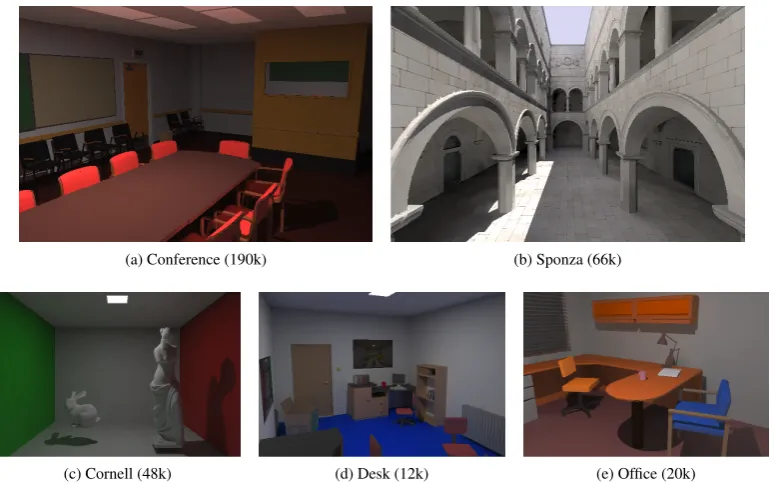
(a) Conference (190k) (b) Sponza (66k)
(c) Cornell (48k) (d) Desk (12k) (e) Office (20k)
[image:9.595.108.496.437.678.2]legacy front side bus, and support hyper-threading, enabling two threads per core and thus reporting a total of sixteen logical processors to the operating system. Hyper-threading replicates certain resources of the processor, but not the main execution units; performance is not duplicated, with Intel claiming up to 30% speed improvement, compared to oth-erwise identical, non hyper-threaded, processors [MBH∗02]. The second system is a quad hexa-core machine based on the Intel Xeon E7450 (Dunnington architecture), running at 2.40 GHz with 64 gigabytes of RAM; with a total of 24 physical cores this system enables us to evaluate the scalability of the wait-free access control mechanism proposed in this paper. Both systems run CentOS 5.2, with the code being compiled with Intel Compiler Suite Professional v. 11.0.
For all experiments we used our own interactive ray tracer, which does not make use of packetisation or explicit SIMD operations. The only exception is the ray-bounding volume intersection test used to traverse the acceleration data-structure, which is a BVH implementation based on [WBS07]. Five different scenes (Figure 4) were utilized in the experiments. These scenes were picked to provide a range of geometric complexity, physical dimensions and lighting conditions. All scenes were rendered at a resolu-tion of 640×480. We use the following labels for the meth-ods: traditional sequential method (TRA), lock (LCK), local-write (LW) and wait free (WF).
6.1. Still images
[image:10.595.312.535.82.214.2]Results are presented by varying the number of threads, and thus the number of used cores, up to 16 for the Nehalem architecture and 24 for the Dunnington architecture. The re-sults for a single thread were obtained using TRA, with no access data control, and speed-up for the different techniques is computed with respect to the sequential timings. Each im-age was calculated with an empty IC to show a worst-case scenario with maximal irradiance calculations occurring.
Figures 5 and 6 present, in graphical form, the speed-up, the normalized number of evaluated IC samples and effi-ciency, for both architectures. Each of the presented metrics is the average over the five different scenes used in experi-ments. Since all reported metrics are normalized with respect to the results obtained for the same scene with one single thread and the traditional approach to the IC (no data access control), absolute values, particular to each scene, are not relevant. The later proposition is true as long as behaviour is similar across the different scenes for each access con-trol mechanism. We measured worst-cases standard devia-tions of 14.2% and 4.2% for absolute speedup and normal-ized number of generated IC samples, respectively; these low worst-case values indicate that we can use these aver-ages as reliable statistics to analyse our results. For absolute speedup we include a dashed line, depicting linear speedup, which would be obtainable if no algorithmic or implemen-tation penalties were incurred; for the Nehalem
architec-(a) Speedup (lines and left axis) and normalized number of IC samples (bars and right axis)
(b) Efficiency
Figure 5: Still Images: results for the Nehalem architecture. (All values are averaged over the 5 different scenes used in experi-ments)
ture above 8 threads, linear speed-up increases only 30% with each additional logical core, following Intel’s claim that hyper-threading can provide a maximum 30% speed im-provement [MBH∗02].
For all experiments with the Nehalem system, and up to 14 threads in the Dunnington case, LW performs and scales worse than the two other algorithms. This is because no shar-ing is actually occurrshar-ing since only one frame is rendered and merging of the local caches only happens at the end of the frame. Each thread must evaluate all irradiance samples that project into its assigned tiles of the image plane, lead-ing to work replication. This can be seen by the number of evaluated irradiance samples (see Figure 5a and Figure 6a), which increases dramatically with the level of concurrency.
[image:10.595.310.533.85.382.2](a) Speedup (lines and left axis) and normalized number of IC samples (bars and right axis)
[image:11.595.71.294.73.396.2](b) Efficiency
Figure 6: Still Images: results for the Dunnington architec-ture.(All values are averaged over the 5 different scenes used in experiments)
increases, more range searches are performed; since these are serialized in LCK, a performance penalty is incurred. Figures 5a and 6a clearly show that the performance loss incurred by LCK is not due to work replication; in fact, the total number of IC samples evaluated by WF and LCK de-creases above a certain number of threads. Success in finding valid samples to interpolate from depends on the order upon which samples are requested and evaluated; concurrent ren-dering of multiple image plane tiles results in quickly filling the IC with samples that are better distributed over object space thus resulting in more successful range searches than with the sequential approach. Above a significant number of threads, LCK’s serialization penalty becomes larger than the overhead associated with work replication and it performs even worse than LW (figure 6).
Parallel algorithms seldom exhibit linear speedup due to overheads, such as load imbalance, work replication and communication/synchronization costs. The wait-free access control mechanism to a shared IC is able to minimize the last two overheads thus exhibiting almost linear speedup and, consequently, a nearly constant efficiency of 0.9 on systems
up to 24 cores (see figures 5b and 6b). With around 14 cores on the Dunnington system, LCK speedup reaches an inflec-tion point and starts decreasing, showing that lock-based ap-proaches do not scale with increasing levels of concurrency. On the other hand, WF speedup grows linearly up to 24 cores, although at a rate slightly lower than the increase on the number of cores; the shape of the WF curve suggests that any eventual inflection point is still far from being reached, which demonstrates its superior scalability potential. Note that the shared memory parallel ray tracer incurs additional overheads, such as workload distribution and gathering of results, which are themselves also partially responsible for the small deviation from linear speedup observed with the WF approach.
6.2. Animations
(a) Sponza
[image:11.595.309.533.266.526.2](b) Conference Room
Figure 7: Animation Results: Dunnington system with 24 cores.Frames per second (lines and left axis) and number of IC samples per frame (bars and right axis)
still images above, where the cache is totally empty and all the samples needed to be generated.
Clearly, LCK performs worse than LW and WF. Since for all frames (except the first) the IC will not be empty, many irradiance samples can be reused, but LCK serializes all range searches performed to locate these samples, thus severely impacting on performance. In fact, with LCK the best rendering time is achieved for the first frame, suggest-ing that temporal re-utilization of previously calculated ir-radiance samples is worse than recalculating these values, which completely contradicts the rationale behind the IC [War94]. We can thus conclude that synchronization over-heads make the utilization of such lock-based access mecha-nisms prohibitive when rendering animations of static scenes on highly concurrent shared memory systems.
WF outperforms LW because the former shares irradi-ance samples immediately without any extra synchroniza-tion overhead associated with reading, while the latter does not share samples within a frame, thus resulting in costly extensive evaluations of more indirect diffuse irradiance val-ues. The bars in Figure 7 clearly show that, for WF and LW, variations in performance from frame to frame are highly correlated with the number of IC samples evaluated per frame. More importantly, these graphs also show that the better results achieved with WF are due to evaluating less irradiance samples, which is a consequence of efficient shar-ing of data among threads.
In summary, LCK is mostly penalized by reading serial-ization, LW is penalized by work replication, whereas the wait-free approach efficiently shares IC values while min-imizing writing overheads and eliminating synchronization overheads associated with concurrent reads.
7. Conclusions
We have presented a wait-free data access control mecha-nism for sharing the IC among multiple rendering threads on a shared memory parallel system and evaluated it against two traditional data access algorithms: a lock-based approach and a local write one. We demonstrated that the proposed approach outperforms the others and scales better with the number of threads.
The lock-based algorithm serializes all accesses to the shared data structure, reads included. Range searches per-formed in the octree to locate valid irradiance samples are serialized, resulting in performance losses; this problem is aggravated with the number of threads and the resulting con-tention. The local write algorithm does not share any irradi-ance values evaluated within each frame, thus suffering a performance penalty as a result of work replication. Neither of these two algorithms scales well as the number of threads increases.
The wait-free algorithm does not require any critical
sec-tions to the shared data structure and the irradiance val-ues are immediately shared among all threads without any synchronization overhead associated with reading. By min-imizing the synchronization and work replication overheads which usually plague parallel systems, the wait-free algo-rithm exhibits the best rendering times for both still images and walkthroughs within static scenes and scales well with the number of threads, achieving a near linear speedup for up to 24 threads.
Multicore systems now represent the standard form of desktop computing. Since in the near future such systems will have a degree of parallelism which is expected to be larger than that on current machines, the relevance of effi-cient, scalable and reliable shared data structures for max-imizing performance is ever increasing. Alternatives to the status quo of locking and blocking in the form of wait-free data structures can offer a number of advantages. These methods can make it possible for traditional graphics algo-rithms to exploit modern hardware. In this paper we have demonstrated the potential of such techniques in the form of a shared memory IC. Our algorithm has made it possible to achieve close to interactive rates for ray tracing with global illumination. We hope that our solution will motivate similar parallel methods in other areas of computer graphics.
8. Acknowledgement
This research was partially funded by project IGIDE, PT-DC/EIA/65965/2006 funded by the Portuguese Founda-tion for Science and Technology, and UK-EPSRC grant EP/D069874/2. We thank Greg Ward for the Office and Con-ference scenes from the Radiance package and the ford’s Graphics Group for the Bunny model from the Stan-ford 3D Repository. Finally, we thank Alberto Proença for granting us access to the two multicore systems.
References
[DDSC09] DUBLA P., DEBATTISTA K., SANTOS L. P.,
CHALMERS A.: Wait-Free Shared-Memory Irradiance Cache. Debattista K., Weiskopf D., Comba J., (Eds.), Eurographics As-sociation, pp. 57–64.
[DSC06] DEBATTISTAK., SANTOSL. P., CHALMERSA.:
Ac-celerating the irradiance cache through parallel component-based
rendering. InEurographics Symp. on Parallel Graphics and
Vi-sualization(2006).
[Her09] HERLIHYM.: Technical perspective highly concurrent
data structures.Commun. ACM 52, 5 (2009), 99–99.
[HLM03] HERLIHY M., LUCHANGCO V., MOIR M.:
Obstruction-free synchronization: Double-ended queues as
an example. In ICDCS ’03: Proceedings of the 23rd
In-ternational Conference on Distributed Computing Systems (Washington, DC, USA, 2003), IEEE Computer Society, p. 522.
[HW90] HERLIHYM. P., WINGJ. M.: Linearizability: a
cor-rectness condition for concurrent objects.ACM Trans. Program.
[KMG99] KOHOLKA R., MAYER H., GOLLER A.:
MPI-parallelized Radiance on SGI CoW and SMP. InParNum’99:
4th Int. ACPC Conf.(1999), pp. 549–558.
[MBH∗02] MARRD., BINNS F., HILL D., HINTON G., KO
-UFATYD., MILLERA., UPTONM.: Hyper-threading technol-ogy architecture and microarchitecture.Intel Technology Journal 6, 1 (February 2002), 4–15.
[RCLL99] ROBERTSOND., CAMPBELLK., LAUS., LIGOCKI
T.: Parallelization of radiance for real time interactive lighting
vi-sualization walkthroughs. InACM/IEEE Supercomputing(1999),
ACM Press, p. 61.
[War88] WARDG.: A ray tracing solution for diffuse
interreflec-tion.Computer Graphics - SIGGRAPH’88 22, 4 (August 1988).
[War94] WARDG.: The radiance lighting simulation and
render-ing.Computer Graphics - SIGGRAPH’94(1994).
[WBS07] WALDI., BOULOSS., SHIRLEYP.: Ray tracing
de-formable scenes using dynamic bounding volume hierarchies. ACM Trans. Graph. 26, 1 (2007), 6.
[WMG∗07] WALDI., MARKW. R., GÜNTHERJ., BOULOSS.,
IZET., HUNTW., PARKERS. G., SHIRLEYP.: State of the
art in ray tracing animated scenes. InSTAR Proceedings of
Eu-rographics 2007(September 2007), Schmalstieg D., Bittner J., (Eds.), pp. 89–116.
Appendix A: Tables of results
1 2 4 8 12 16 TRA LCK L W WF LCK L W WF LCK L W WF LCK L W WF LCK L W WF Cor nell T ime (s) 9.33 4.14 4.36 4.10 2.40 2.54 2.27 1.40 1.67 1.43 1.47 1.54 1.26 1.41 1.40 1.15 IC samples 4885 4939 5286 4916 4854 5427 4863 4406 5471 4416 4196 5454 4198 4220 5472 4171 Speed-up 1.00 2.25 2.14 2.28 3.88 3.67 4.12 6.67 5.60 6.53 6.45 6.05 7.41 6.61 6.68 8.14
Desk Time
(s) 8.96 4.20 4.72 4.50 2.24 2.57 2.31 1.21 1.47 1.23 1.04 1.20 1.00 1.02 1.10 0.89 IC samples 3953 3957 4426 3916 3914 4520 3955 3684 4552 3751 3538 4577 3581 3444 4591 3516 Speed-up 1.00 2.13 1.90 1.99 4.00 3.48 3.88 7.38 6.11 7.30 8.64 7.47 8.98 8.81 8.17 10.04 Conf . T ime (s) 16.46 9.26 10.10 8.71 4.57 5.25 4.61 2.37 2.79 2.36 2.18 2.64 2.02 1.95 2.27 1.91 IC samples 5378 5345 5842 5310 5319 6046 5278 5159 6207 5120 4867 6185 4876 4837 6207 4790 Speed-up 1.00 1.78 1.63 1.89 3.60 3.13 3.57 6.96 5.91 6.98 7.56 6.74 8.15 8.44 7.25 8.63
Office Time
(s) 8.63 3.95 4.53 3.96 1.96 2.29 1.98 1.05 1.26 1.02 0.96 1.06 0.85 0.92 0.92 0.75 IC samples 3910 3808 4253 3835 3738 4523 3847 3495 4518 3537 3388 4505 3431 3370 4566 3351 Speed-up 1.00 2.18 1.90 2.18 4.41 3.77 4.37 8.19 6.86 8.43 9.00 8.18 10.10 9.39 9.38 11.58
Sponza Time
[image:14.595.74.318.143.700.2]1 2 4 8 16 24 TRA LCK L W WF LCK L W WF LCK L W WF LCK L W WF LCK L W WF Cor nell T ime (s) 9.17 4.78 5.55 4.76 2.46 3.07 2.39 1.31 1.69 1.23 1.29 1.06 0.70 2.03 0.91 0.50 IC samples 4888 5018 6027 5048 5069 6683 5040 4939 7106 4963 4820 7320 4803 4677 7353 4323 Speed-up 1.00 1.92 1.65 1.92 3.74 2.99 3.84 7.02 5.43 7.48 7.11 8.64 13.02 4.52 10.11 18.38
Desk Time
(s) 8.71 4.92 6.10 4.88 2.45 3.23 2.42 1.29 1.76 1.19 1.78 0.97 0.59 2.31 0.78 0.40 IC samples 3849 3964 5056 3939 4055 5629 4088 3984 5974 3987 3821 6101 3677 3664 6121 3349 Speed-up 1.00 1.77 1.43 1.79 3.55 2.69 3.59 6.72 4.95 7.30 4.88 8.97 14.82 3.77 11.16 21.69
Conf Time
(s) 18.14 9.92 12.22 9.87 5.26 6.94 5.22 2.62 3.68 2.59 1.55 1.95 1.24 1.77 1.40 0.83 IC samples 5153 5315 6651 5330 5464 7391 5457 5427 7965 5429 5225 8218 5114 5103 8384 4982 Speed-up 1.00 1.83 1.49 1.84 3.45 2.61 3.48 6.91 4.93 7.01 11.71 9.32 14.60 10.27 12.99 21.73
Office Time
(s) 8.31 4.92 5.73 4.74 2.51 3.20 2.39 1.43 1.66 1.15 1.57 0.89 0.56 1.93 0.69 0.39 IC samples 3770 4067 4915 3955 4033 5540 3955 3936 5947 3985 3883 6149 3749 3744 6179 3654 Speed-up 1.00 1.69 1.45 1.75 3.31 2.59 3.48 5.80 5.00 7.25 5.31 9.37 14.79 4.31 12.07 21.17
Sponza Time
[image:15.595.72.318.146.697.2]