University of Warwick institutional repository: http://go.warwick.ac.uk/wrap
A Thesis Submitted for the Degree of EngD at the University of Warwick
http://go.warwick.ac.uk/wrap/36416
This thesis is made available online and is protected by original copyright. Please scroll down to view the document itself.
Integration of Self Assessment with a
Change Management Process for
Deploying Concurrent Engineering
Matthew Ainscough
Executive Summary
Submitted in Partial Fulfilment of the Degree of
Engineering Doctorate
Department of Engineering
University of Warwick
Abstract
The main research theme of this engineering doctorate was as follows: 'How can UK
industry effectively leverage concurrent engineering practices within the organisation?' To address this problem, a review of implementation tools was
undertaken, where a number of 'do it yourself' methodologies were identified within the literature for implementing Concurrent Engineering (CE). These were 'change
management workbooks' and 'self-assessment tools'. Change management workbooks
provide a means for managing an implementation program, and self-assessment measures and benchmarks the deployment of practices and identifying areas for improvement. However, both were found to operate independently from one another. Therefore, it has been proposed that the deployment of CE practice can be further enhanced through an integrated approach. This approach combines both disciplines, because as a system it could measure the deployment of practices, identify future improvements, and enable an organisation to manage the transition to better CE.
To solve this problem a self-assessment tool, which encapsulated practice from the automobile, power generation, aerospace, pneumatics and mechatronics industry sectors was developed. The tool consisted of both a practice and performance dimension to ensure that practices deployed impacted the bottom line. The self-assessment tool allows for a company to assess its current state, and decide where it wants to go. Furthermore, a change management process was developed, which integrated with the self-assessment tool, and a series of additional tools developed specifically for the task such as the generic planning tool, a decision tool for deciding an implementation strategy, and additional tools, which have been selected from the literature.
Acknowledgements
There are many individuals of whom I would like to give thanks, and acknowledge for their help during the course of this project.
Dr Charles Tennant for stepping in as a supervisor at a difficult and critical time, and showing absolute commitment to ensure that the work was completed.
Dr Kevin Neailey for his assistance, and advice during the course of the Engineering Doctorate.
My family for supporting me through the ups and downs of the last four years. Dr. Baback Yazdani who supported me during the first three years of this project. Finally, to selected WMG staff who were always willing to help when asked. These were Trevor Broughton, Mike James-Moore, and Dr. John Garside.
Dedaration
I, Matthew Ainscough hereby declare that this work is of my own, and has not been
Contents
Abstract
Acknowledgements Declaration
Glossary of Terms
Cha pter 1 Backg round to the Project 1.0 Introducing Concurrent Engineering
1.0.1 Executing CE 1.0.2 Benefits of CE 1.0.3 Components of CE
1.1 Introduction to the Problem 1.2 Objectives
Chapter 2 Research Methodology
2.0 Introduction 2.1 Research Process
2.2 Research Techniques Deployed 2.2.1 Literature Research
2.2.2 Quantitative Techniques 2.2.3 Qualitative Techniques 2.2.4 Action Research
2.3 Overview of Submissions
2.3.1 A Critique of New Product Introduction Auditing Tools 2.3.2 Defining a Conceptual Model for Enabling CE
2.3.3 Investigating CE within British Industry
2.3.4 Verification of a Conceptual Model for Enabling CE
2.3.5 The Development of a Change Model for Implementing CE 2.3.6 Definition and Verification of a Tool for Assessing and
Implementing CE
2.4 Reading the Submissions 2.5 Summary
Chapter 3 Selectin g a Tool for Im plementin g CE
3.0 A Review of Potential Tools for Enabling Change to CE 19 3.1 Introducing Tools & Processes for Enabling Change 19 3.1.1 Self-Assessment
3.1.2 Benchmarking
3.1.3 Strengths, Weaknesses, Opportunities & Threats 3.1.4 Auditing
3.1.5 Kaizen
3.1.6 Project Management & Control 3.1.7 Policy Deployment
3.1.8 Work-book Change Management Tools 3.2 Comparing and Contrasting Tools
3.3 Critique of Current Self-Assessment Tools and Workbook 3.3.1 Current Self-Assessment Tools
3.3.2 Current Workbook Change Management Tools for Implementing CE
3.4 Requirements for a New Tool 3.5 Sunimary
Chapter 4 Developing the Models 4.0 Introduction
4.1 Developing a Model of Good Concurrent Engineering Practice 4.1.1 Survey of UK Industry
4.1.2 Verifying the Conceptual Model 4.2 Development of the Change Model
4.2.1 Comparison of the Change Model against Two Case Study Companies
4.3 Summary
Chapter 5 Definin g an Inte g rated App roach to De p loyin g CE
5.0 Introduction
5.1 Introduction to the Self-Assessment Tools 5.1.1 The Assessment Tool
5.1.2 Tailoring the Assessment Model 54
5.1.3 Assessing the Current State 57
5.1.4 Deciding a Future State 59
5.1.5 Supporting Tools 60
5.2 Planning Tools 61
5.2.1 A Tool for Deciding the Speed of Implementation 60
5.2.2 A Generic Planning and Guidance Tool 66
5.2.3 Project Management Tools 64
5.3 Tools for Deployment 65
5.3.1 Process Mapping Tools 65
5.3.2 Organisational Re-Design Methods 65
5.3.3 Benchmarking 66
5.3.4 Training 66
5.3.5 Systems Standards 66
5.4 The Change Management Process 67
5.5 Integrating the Tools with the Process 68
5.6 Summary 71
Cha pter 6 Development of an N.P.I. Process
6.0 Introduction to the Case Study 73
6.1 Measure the Current State 73
6.1.1 Initiate the Self Assessment Investigation 6.1.2 Tailor Framework to be Industry Specific 6.1.3 Collect Data
6.1.4 Establish Scores
6.1.5 Define Strengths & Opportunities 6.2 Communicate to Management 6.3 Identify and Elect Guiding Coalition 6.4 Identify How Areas Can Be Improved 6.4.1 Identify and Select Required Components 6.4.2 Identify Required Criteria
6.5 Communicate the Vision 6.6 Select Implementation Strategy
73 74 75 75 77 79 79 79 79 81 83 83
6.7 Develop Implementation Plan 84 6.7.1 Define Overall Implementation Time Lines 84 6.7.2 Define Overall Implementation Resource 85 6.7.3 Define Overall Implementation Budgets 85
6.8 Deploy the Implementation Plan 85
6.8.1 Deploy the Implementation 85
6.8.2 Undertake Work Packages 85
6.8.3 Deploy within Projects 88
6.9 Summary 88
Chapter 7 A Tool for Leveraging Concurrent En g ineerin g Practice
7.0 Introduction 89
7.1 Performance of the System 89
7.1.1 Allowing Change Objectives to be Set and Achieved 89 7.1.2 Impact of Components upon Project Performance 92 7.1.3 Comparing Implementation Performance against Rover Group 95
7.2 Usability of the System 97
7.3 Summary 97
Chapter 8 Conclusions & Further Work
8.0 Conclusions 98
8.1 Further Work 102
8.1.1 Further Validation 102
8.1.2 Development of Further Modules 103
8.1.3 Automating the Process 103
8.1.4 Further Research to Investigate Diversification of the Application 103
References 104
Appendix 1 Criterion Parts & Requirements for Consistency Appendix 2 Maturity Assessment Flow Diagram
Figures
Chapter 1 Background to the Project Page
Figure 1 Product Introduction Using Concurrent Engineering
Figure 2 Percentage of Industrial Sectors Practising Concurrent Engineering Chapter 2 Research Methodology
Figure 3 Research Process 8
Figure 4 Order of Reading the Submissions 18
Cha pter 3 Selecting a Tool for Implementing CE
Figure 5 A Generic Framework for Implementing CE 35 Figure 6 Cranfield's Implementation Process for CE 36 Chapter 4 Developing the Models
Figure 7 A Change Management Process Model for Implementing CE 47 Chapter 5 Defining an Inte g rated Approach to Deploying CE
Figure 8 A System for Assessing and Implementing CE 51
Figure 9 Framework for Assessment 52
Figure 10 Example of Categorised Assessment Criteria 53
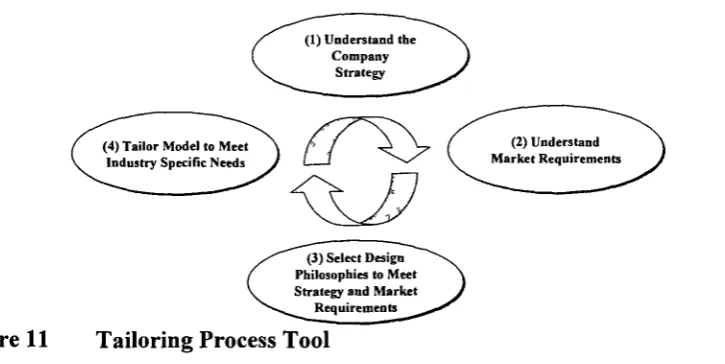
Figure 11 Tailoring Process Tool 54
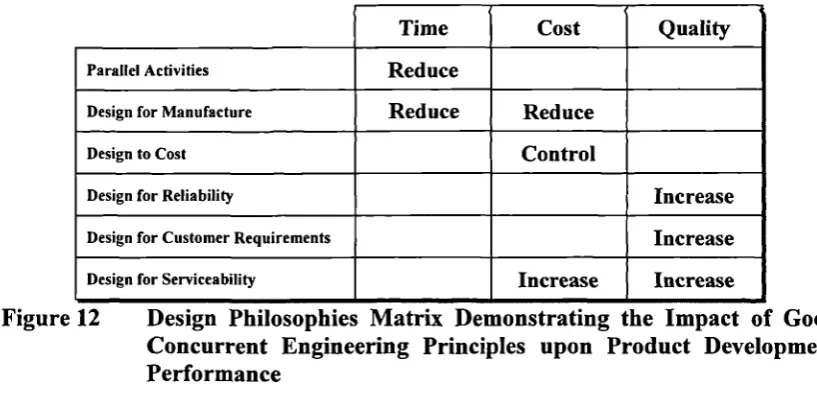
Figure 12 Design Philosophies Matrix Demonstrating the Impact of Good 55
Concurrent Engineering Principles upon Product Development Performance
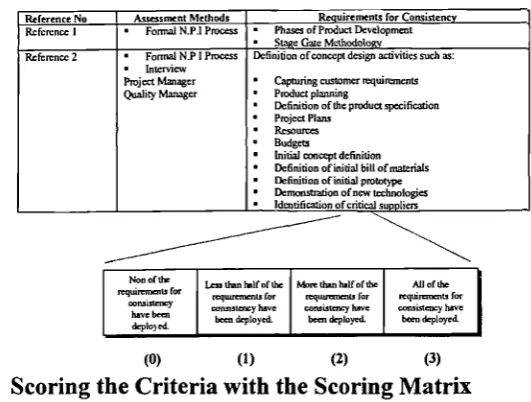
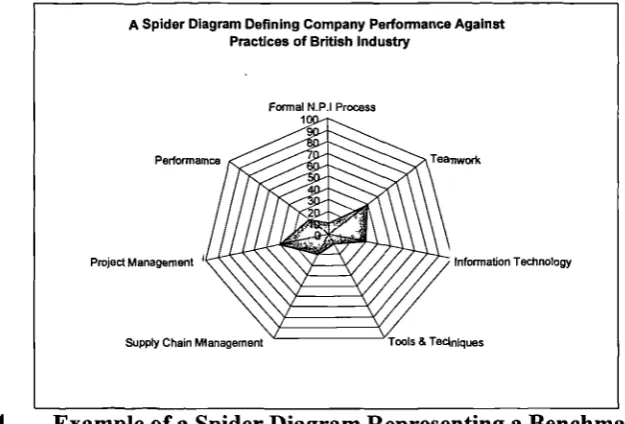
Figure 13 Scoring the Criteria with the Scoring Matrix 57 Figure 14 Example of a Spider Diagram Representing a Benchmark Profile 58
Figure 15 A Tool for Deciding a Change Strategy 62 Figure 16 A Generic Planning Tool for Developing the Project Plan 64
Figure 17 The Change Management Process 67
Figure 18 Deploying Tools for Executing the First Phase of the 68 Change Management Process
Figure 19 Deploying Tools for Executing the Second Phase of the 69 Change Management Process
Figure 20 Deploying Tools for Executing the Third Phase of the 70 Change Management Process
Figure 21 Deploying Tools for Executing the Fourth Phase of the 71 Change Management Process
Chapter 6 Development of an N.P.I. Process
Figure 22 Applying the Tailoring Process 74
Figure 23 A Spider Diagram illustrating a Current State Benchmark Profile of 76 London Taxis International
Figure 24 Maturity Profile at London Taxis International 76 Figure 25 Factors Contributing to Poor Performance 80 Figure 26 Benchmarks Stating London Taxis International Desired Future State 82 Figure 27 Maturity Profile Stating London Taxis Future State 82 Figure 28 Deciding an Implementation Strategy at London Taxis International 83 Figure 29 Systems Definition of the London Taxis International N.P.I. Process 86 Figure 30 Formalised Project Structure at London Taxis International 87
Tables
Chapter 2 Research Methodology Page
Table 1 Company's which participated within the Study 13 Chapter 3 Selecting a Tool for Implementing CE
Table 2 Barriers to Implementing CE 24
Table 3 Comparison of Tools for Implementing CE 26 Table 4 A Summary of Available Self-Assessment Tools 32 Table 5 Strengths and Weaknesses of Self-Assessment Tools 34 Table 6 Strengths and Weaknesses of Implementation Workbooks 38 Chapter 4 Developing the Models
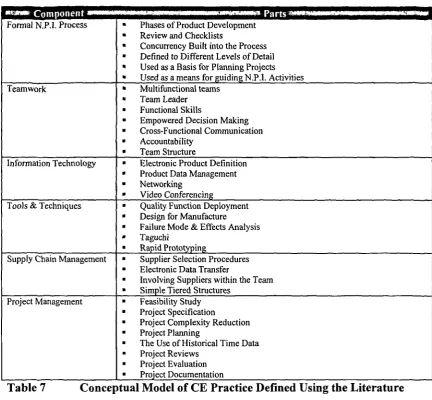
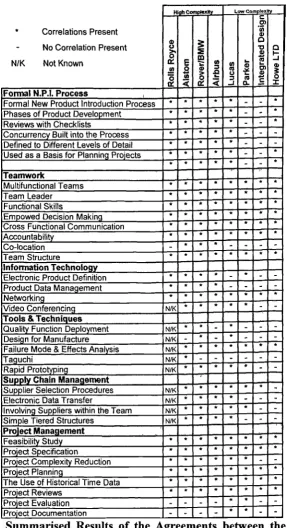
Table 7 Conceptual Model of CE Practice Defmed Using the Literature 43 Table 8 A Summary of the UK Industiy Survey 44 Table 9 Summarised Results of the Agreements between the Conceptual 45
Model and the Case Study Companies
Table 10 Comparisons between the Conceptual Model and the Case Study 49 Companies
Chapter 5 Defining an Inte g rated App roach to De p loy in g CE
Table 11 Performance Maturity Criteria 58
Table 12 Performance Maturity Criteria 59
Table 13 Generalised Criteria for Selecting Required Components 60 Chapter 6 Development of an N.P.I. Process
Table 14 Strengths and Opportunities for a Formal N.P.I. Process 77 Table 15 Strengths and Opportunities for Teamwork 77 Table 16 Strengths and Opportunities for Information TechnGlogy 78 Table 17 Strengths and Opportunities for Tools & Techniques 78 Table 18 Strengths and Opportunities for Supply Chain Management 78 Table 19 Strengths and Opportunities for Project Management 78 Chapter 7 A Tool for Leveraging Concurrent En g ineerin g Practice
Table 14 Measuring Performance 93
Table 15 Comparison of Measures 96
Chapter 8 Conclusions & Further Work
Glossary of Terms
Benchmarking:
A technique that allows an organisation to analyse practices and performance of direct or non-related industries as a means of understanding the state of the art and comparing an organisations current practices against best practice.
Components Selection Matrix:
A matrix to assist the selection of CE components as a means to decide the organisations future state.
Concurrent Engineering (CE):
CE is the systematic approach to the integrated concurrent design of products and their related processes, including manufacture and support.
Design for Manufacture (DFM):
DFM considers manufacturing related issues during product design. Design for Cost (DFC):
DFC aims to design and deliver a product to a known set of cost targets. Design for Customer Requirements (DFCR):
DFCR ensures that customers requirements are encapsulated within the product design.
Design for Reliability (DFR:
DFR aims to design a product to meet set of specified reliability targets. Design Philosophies Matrix Tool:
A matrix that is applied for understanding the impact of design philosophies upon performance measures.
Generic Planning Tool:
A tool to assist the organisation to plan the implementation of product introduction practices.
Implementation Strategy Decision Toot:
A tool responsible for assisting the selection of a change strategy, be it a big bang, incremental or a pilot approach.
Model:
The word model has been used to refer to a theoretical framework describing the main parts arid inter-relationships between those parts that constitute a process or the application of a philosophy.
Process:
The word process has been used with reference to a road map defining a series of chronological activities.
Project Management & Control:
A process based approach which encapsulates four phases, feasibility, planning, implementation and closedown. Its purpose is to enable a project to be planned and executed to meet initial targets.
Scoring Matrix:
A matrix that is applied to the assessment criteria for allocating a score. Self-Assessment:
A technique for enabling an organisation to self-measure using a set of criteria, and benchmark its performance against a model of best practice.
System:
The word system has been used to define the complete configuration of tools and processes that constitute the self-assessment tool integrated with a change management.
Tailoring Process Tool:
A tool that is applied for tailoring the assessment model towards an organisations specific strategy and customer requirement.
Tool:
The word tool has been used with reference to an aid that assists with achieving an end objective or a set of objectives.
Workbook Change Management Tools:
Integration of Self Assessment with a Change Mana gement Process for Deploying Concurrent Engineering
Cha pter 1 Backg round to the Project
1.0
Introducing Concurrent EngineeringNumerous statements exist within the literature that define Concurrent Engineering (CE). However, a commonly quoted definition is stated as follows.
'Concurrent Engineering is the systematic approach to the integrated, concurrent
design of products and their related processes, including manufacture and support
1, 2, 3,
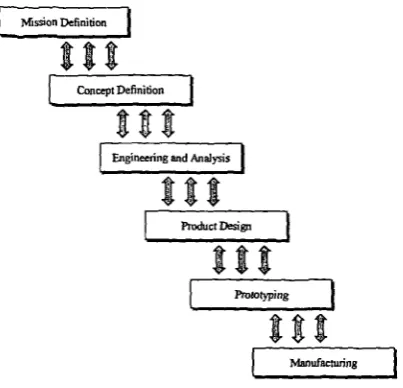
In addition to this, it is important to state that good practice CE represents an organisations ability to not only overlap the process, but to deliver a product on time, to cost, and quality. To further elaborate upon the definition, Prasad believes that a typical concurrent process requires product development phases to be executed as overlapping phases as figure 1 illustrates .
II
_nesnition[ concept Definition
[neeing and Analysis
it"
Pmluctflesign
fl
Ptsstotping
[image:14.595.170.372.533.727.2]it"
[
ManufnctwingFigure 1 Product Introduction Using Concurrent Engineering4
Inte gration of Self Assessment with a Change Management Process for Deploying Concurrent Engineering
1.0.1) Executing CE: According to Clark and Fujimoto CE requires both two way
communication and the partial release of information to downstream processes, where both the designer and manufacturing engineers concurrently take into consideration design and manufacturing requirements at an early stage5. However, in addition, Turino also states that CE requires the execution of design philosophies such as: design for manufacture, design for serviceability, design for reliability, design for cost, and design for customer requirements6. This is to ensure that a product is designed and delivered to meet cost, quality, and time performance measures.
1.0.2) Benefits of CE: The main objective of CE is to improve new product
introduction (N.P.I.) by compressing product development lead-times, and enabling upstream and downstream processes to be considered early within the process. Each will be discussed.
First and foremost, the main benefit from overlapping product development activities, is the ability to compress product development lead-times. This can provide competitive advantage in that an organisation could be a first mover to market, which results in a number of benefits such as7:
1) Increased company profits through delivering breakthrough products to market first.
2) Establishing the company as a pioneer of new technologies.
Integration of Self Assessment with a Change agçment Process for Deolo_ying Concurrent Engineering
4) Establishing protection by filing patents for new technologies and inventions. These provide their owners with exclusive rights for commercially exploiting their inventions.
Secondly, due to CE requiring upstream and downstream functions to communicate and share data early in the process, design decisions can be taken much earlier, where the cost of making design iterations is much lower than if they occurred later within the process1. The consequences of design iterations are longer product introduction lead-times due to the length of time it takes to undertake the corrections and an increase in budget spend, due to their high cost8. Furthermore, a right-first-time philosophy can lead to a better quality product, as it can be designed to take into consideration downstream processes9.
1.0.3) Components of CE: CE requires a number of components to be put in place
to enable its execution. Nevertheless, although a number of components have been accepted as being enablers of CE, according to Prasad, these have yet to be formalised4. However, that is not to say that there is no agreement with respect to how CE is executed. A number of experts within the field commonly refer to a formal N.P.I. process'°, cross-functional teamwork" 12 information technology13, tools and techniques'3 'i', supply chain management, and project management and control for controlling the execution of the project as components of CE'°. Each of these can be defined as follows:
• A formal N.P.I. process is defined by Phillips et al as 'a route map which aids the
process and enables the efficient and effective movement of a new product from
Integration of Self Assessment with a Change Management Process for Deploying Concurrent Engineering
idea to launch ,15 The purpose of the N.P.I. process is to provide a basis for planning and guiding projects.
The execution of teamwork within a CE environment requires a team, which Katzenbach and Smith define as 'a small number of people with complementary
skills who are committed to a common purpose, performance goals, and approach
for which they hold themselves mutually accountable In the context of CE a team has to be cross-functional to ensure a process perspective for developing a product, and led by a team leader who has authority to make decisions.
Information technology as defined by Daniels is 'the application of
IT.
to business processes, gathering data and creating information that is valuable tomanagers who make business decisions' 17 In the context of CE, I.T. can act as an
integrating mechanism between functions or dispersed teams where information is centralised, managed and distributed to ensure data integrity and speed.
Tools and techniques are an enabling technology of CE, in that they aim to define systematic procedures in which decisions can be made early within the process, to ensure that a right-first-time philosophy is taken during product design.
Supply chain management aims to manage flows through the supply chain, organise its structure to maximise its flow, and continuously aim to improve its links'8. Within a CE environment, the main objectives of supply chain management are to include the supplier as early as possible during the process, and to ensure that the supply chain is aligned to support CE activities.
Project management as defined by Lock is the process of predicring and
foreseeing as many dangers as possible during the life-cycle of a project, and to
plan and control activities so that a project can be completed on time to cost,
Integration of Self Assessment with a Change Management Process for Deploying_Concurrent Engineering
is essential for planning and driving a project to meet the objectives set for the project.
1.1 Introduction to the Problem
As established within the previous section, CE brings many competitive benefits to an organisation. Yet, although considerable evidence exists within the literature which demonstrates that CE is being applied within industry, recent research has concluded that not all UK organisations had taken up CE20. Within certain industry sectors such as Power Generation, Petrochemical and Aerospace, CE was found to be high. In other industry sectors such as Automobile and Machinery its take up was found to be relatively low as figure 2 illustrates. Nevertheless, it has to be said that the relatively low maturity of the car industry was surprising, as a higher percentage of companies practising CE was expected due to the amount of literature focusing upon CE within the Automobile industry.
Percentage of Industrial Sectors Practicing Concurrent Engineering
Power Generation While Goods
1
Petrochemical
Automobile Aerospace
[image:18.595.51.489.494.727.2]Medical
Figure 2 Percentage of Industrial Sectors Practising Concurrent
Engineering20
Integration of Self Assessment with a Chan ge Management Process for Deolovin g Concurrent Engineetjpg
Furthermore, questions must also be asked of those companies who claim to practice CE, as to whether they are mature in its execution, and whether they deliver a product on time, to cost and quality. Viness et a! found that when assessing the deployment of CE and its level of maturity within large UK companies, 50% stated that they were not fully mature, whilst only 38% claimed to be mature21.
Therefore, the following question can be asked. Why is CE and its deployment within UK industry relatively low? An investigation into the problems associated with change suggest that the low take up of CE is due to poor management of the change process as the following quote suggests, '70% of all companies who embark upon a
business process re-engineering program will fail ,22 In addition to this, Kotter also states that companies often struggle to manage change, because they do not take a process based approach, and they look to take short cuts by expecting individuals to execute new working practices without training or any awareness of its need 23 . Yet, evidence suggests that there is not a lack of motivation to manage change, as a recent survey implies. Due to globalisation of markets, and increased competition, 96.6% of business managers believe that achieving change is the foremost business issue of the day24. Therefore this suggests that the low take up of CE within UK industry is not due to a lack of motivation for its implementation, but may well be attributed to managers not knowing how CE should be deployed within the organisation.
1.2
Objectives
- Intcggfon of Self Assessment with a Change Management Process for Deploying Concurrent Engineering
'How can industry effectively leverage concurrent engineering practices within the
organisation?'
This resulted in the following research objectives.
To develop a system, which will enable the implementation of CE practices. To verify that the system is effective by applying it within an organisation.
A system, which will enable the implementation of practices could help to assist those organisations, who have yet to take up CE or are currently in the process of doing so.
Integration of Self Assessment with a Change Management Process for Deploying Concurrent Engineering
(Chapter 2 Research MethodoIoq
2.0
IntroductionThis chapter aims to present the research process and the research techniques deployed for developing the tool.
2.1
Research ProcessTo develop the tool for assessing and implementing CE, a research process consisting of four phases was applied as shown in figure 3.
1denti!'ing and Assessing Tools for Solving the
Objectives
Phase(1)
Identifying Areas for Innovation
Phase(2)
Development of the Models
Phase(3)
Development of the System
Phase(4)
Figure 3 Research Process
. Phase one of the research process was executed to investigate with a literature
review (see section 2.2.1), the different tools available, which could potentially provide a solution for companies to implement CE. Furthermore, once identified, each tool was compared to one another so that an appropriate tool could be identified. This identified self-assessment integrated with a change management process as being a potential solution.
self-Integration of Self Assessment with a Chan ge Management Process for Deploying Concurrent Engineering
assessment tools and change management workbook tools available within the literature (see section 2.2.1), and developed specifically for implementing CE. By reviewing and understanding their strengths and weaknesses, gaps were identified, which resulted in a set of requirements for a new tool.
During phase three of the research process, a model of CE practice, and a change management process model, which could potentially direct a change program was defined using a literature review (see section 2.2.1). Furthermore, this phase also aimed to verify that the conceptual models defined were representative of practices adopted by British Industry; this was achieved by comparing and. contrasting both approaches. To execute this phase, the survey (see section 2.2.2), and the case study method (see section 2.2.3), were used to ensure further validation and more in-depth understanding.
Finally, during the fourth phase of the research process, a self-assessment tool integrated with a change management process was developed and tested. The requirements defined in phase two were used to guide its development, with the CE model and the change management process model developed in phase three being central to the tool. To test its applicability, the potential solution was applied within an organisation. To execute this, an action research methodology was deployed (see section 2.2.4).
2.2
Research Techniques Deployed
2.2.1) Literature Research:
As previously stated, a literature research was conducted during phases 1, 2, and 3 of the research process, so that current state of the art could be identified and understood. A number of database sources were used:Integration of Self Assessment with a Change Management Process for Deploying Concurrent Engineejing
OPAC, University of Warwick Library system; BIDS an online literature data base;
Pro-Quest Direct; a literature database accessed via the internet; Infotrac, a literature database accessed via the internet;
EBSCO, a literature database accessed via the internet; Index to thesis, a library resource used for reviewing PhD's.
Within these databases both journals and business books were accessed.
2.2.2) Quantitative Techniques: As previously stated, the survey method was deployed in phase 3. This method can be classed as a quantitative approach where a researcher looks to collect quantifiable data, which can be analysed through using statistical techniques25. This normally requires the definition of a set of hypotheses, and the analysis of quantifiable data for finding proof. The survey method was deployed to gain quantifiable evidence, to verify whether the components of CE defined within the conceptual model were representative of industry. To apply this approach, a survey was designed, which targeted 1400 companies, representing a diverse range of industrial sectors. An external data base source, where specific characteristics can be queried to select these companies was used. Particular queries were whether the company undertook new product development, whether the individuals targeted were senior management, and whether they operated within a specified range of industry sectors. A 10% response rate was received that led to 140 responses being analysed.
Inte gration of Self Assessment with a Chan ge Management Process for Deploying Concurrent Engineering
Hypothesis One: Organisations that practice CE have a greater dependency upon
utilising a new product introduction process as a means of guiding product development activities than organisations who bring their products to market by using a sequential process.
Hypothesis Two: Organisations that practice CE have a greater dependency upon
cross-functional team working practices for executing product development in parallel than organisations who bring their products to market by using the sequential process.
Hypothesis Three: Organisations that practice CE have a greater dependency
upon process orientated tools as a means for integrating product development than organisations who practice the sequential process.
• Hypothesis Four: Organisations that practice CE have a greater dependency upon tools such as Quality Function Deployment, Failure Mode & Effects Analysis and Design for Manufacture for enabling product development than organisations who practice a sequential process.
Hypothesis Five: Organisations that practice CE have a greater dependency upon
supply chain management techniques, which emphasise upon communication than organisations who practice a sequential approach to product development.
• Hypothesis Six: Organisations that practice CE have a greater dependency upon project management tools than organisations who practice a sequential approach to product development.
These were defined because within the literature a number of tools and methodologies were reported to be essential for enabling CE. Therefore, a greater dependency upon these tools would be expected within organisations that are highly concurrent. To test
Inte gration of Self Assessment with a Chan ge Management Process for Depipyin g Concurrent Engineering
these hypothesis, companies were segregated into three distinct categories, 'high concurrent' organisations, 'medium concurrent' organisations, and 'low concurrent' organisations. This approach was achieved by asking the respondent to state when they began their manufacturing concept definition relative to the product development life cycle so that they could be classified. To test whether significant differences were found between these groups, contingency tables were used, which is a non-parametric test for analysing tables of counts.
2.2.3) Qualitative Techniques: As previously stated, within phase 4 a qualitative
technique was deployed for verifying the model of CE practice and the change management model. A qualitative approach is a technique, which cannot be easily reduced to numbers and in some cases to do so, would not provide any value25. To further verify the components of CE, and to find evidence to support the change model, a qualitative approach was deployed through developing case studies. Yin describes the case study as follows.
'An approach, which investigates a contemporary phenomena within its real Ife
context, when the boundaries between phenomena and context are not clearly
evident and which multiple sources of evidence are used26'.
Inte gration of Self Assessment with a Chan ge Management Process for Denloyin g Concurrent Engineering
organisations in which to collect data. A face-to-face interview and a questionnaire meant that interactive questions could occur, and documentation could be achieved. Nevertheless, there were limitations in that the information could not be cross-checked with actual operations to see if it represented reality.
Table 1 Companies which Participated within the Study
The companies selected were representative of the automobile, power generation, aerospace, pneumatics, and mechatronics industry sectors, they developed either complex or non-complex products and they operated within a site, a national multi-site or a European multi-multi-site domain. These companies were selected for a number of reasons.
1. A diverse range of development locations was selected to ensure that the model of practice represented these product development scenarios.
2. A diverse range of industry sectors was selected as opposed to one because it was important to gain a representation of industry so that commonalities could be identified. However, there were limitations with respect to selecting companies in that their consent was essential, and this proved at times to be difficult to achieve.
Integration of Se!f Assessment with a Change Management Process for Deploying Concurrent Engineering
3. The companies selected were known to practice CE. Questionnaires, literature confirming CE practice and recommendations from experts in the field of CE were used to confirm their applicability.
4. The influence of product complexity in company selection was due to an observation made within the questionnaire survey. A potential correlation was identified between product complexity and the use of specific CE components.
To compare the case studies against the CE model, so that correlations could be observed, a comparative analytic technique was deployed. The comparative analytic technique is a method of investigation that aims to identify commonalities between two or more sets of data. To verify the model, key practices of the CE model were compared to practices, which had been deployed within each case study company. The number of companies that agreed with the model denoted the level of correlation.
To verify the change model, the literature of two case companies who undertook change toward competitive new product introduction was used. The Rover/BMW case study was defined using the Executive Summary of Dr. Charles Termant, titled
'Deployment of a Company Wide Quality Strategy in the Automotive Business' 27. The
Lucas case study on the other hand was defined using the paper written by Dr. Allen Parker 'Implementation of Product Introduction Management in a Large
Multi-National Company'28 Again to identify the relationships between the cases and the
Inte gration of Self Assessment with a Chan ge Management Process for Deolovin g Concurrent Engineering
2.2.4) Action Research: To verify that the solution identified was useable and added
value to organisations, it was tested at London Taxis International. A re-engineering project took place, which aimed to define and implement a fonnal N.P.I. process. To test the solution, an action research methodology was deployed, which can be defined as the following.
'The process of systematically collecting data about an on going system relative to
some objective, goal or need of that system; feeding back data into the system;
taking action by altering selected variables within the system based on the data and
hypothesis, and evaluating the results of the actions by collecting more data29'
The action research methodology was used, because the Research Engineer (R.E.), and the change management team agreed to work together. This provided the R.E. with the opportunity to test the following hypothesis.
'A
self assessment tool integrated with a change management process, can facilitatea change program within an organisation toward effective product development
practice'.
The role of the R.E. was to facilitate the workshops, capture knowledge, process map the N.P.I. process, and to provide tools and guidance. The role of the change management team was to provide knowledge of internal business processes so that they could be captured within the process mapping sessions, and to implement the process within the business.
Integration of Self Assessment with a Chan ge Management Process for Deploy ing Concurrent Engineering
2. Overview of Submissions
To assist the research process, six submissions were written, which documented key parts of the development of a tool for implementing CE as a means for improving N.P.I..
2.3.1) A Critique of New Product Introduction Auditing Tools: Phase two of the
Research process (see section 2.1) was reported within Submissions One and Five, where potential areas for innovation were identified.
2.3.2) Defining a Conceptual Model for Enabling CE: The first part he three.
of the research process (see section 2.1) was reported within Submission Two, where a conceptual model of CE practice was defined.
2.3.3) Investigating CE within British Industry: The second part of phase three of
hstegration of Self Assessment with a Change Mana gement Process for Deploy ing Concurrent Engineering
2.3.4) Verification of a Conceptual Model for Enabling CE: The third part of
phase three of the research process 'verifying the models' was documented within Submission Four (see section 2.1). This reported on the comparison of eight case study companies against that of the CE model (see section 2.2.4) as a means to verify whether the conceptual model represented their practices. This work led to a paper titled 'Concurrent Engineering for Complex Products and Projects', which was presented at TMCE 2000, Third International Symposium on Tools and Methods for Competitive Engineering, Deift University, Holland.
2.3.5) The Development of a Change Model for Implementing CE: The final part
of phase three of the research process was documented within Submission Five (see section 2.1). This presented a conceptual model for enabling change, and reported a study, which aimed to verify that the concept model defined compared with two case study company's approaches to change.
2.3.6) Definition and Verification of a Tool for Assessing and Implementing CE:
Phase four of the research process was documented within Submission Six. This describes the development and verification of the self-assessment tool integrated with a change management process.
2.4 Reading the Submissions
Each submission can be read in a chronological order from submission one to six, and their purpose is to support the Executive Summary. In addition to these, two papers were included, which have been presented and published within International
Integration of Self Assessment with a Change Management Process for Deploying Concurrent Engineering
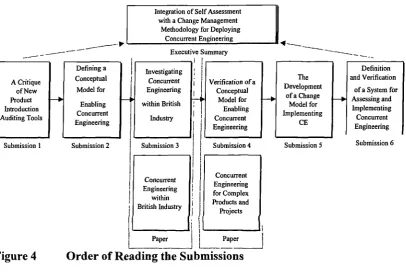
Conferences, and Journals. Each paper should be reviewed simultaneously with each appropriate submission. This overall process is documented within figure 4.
Integration of Self Assessment
th a Change Management
___j
Methodology for Deploying Concurrent Engineering
Executive Summary
I I Defining a
investigating Definition
r A CUe I Concepinal I I Concurrent Verification of a The and Verification Product
of New I Model for Engineering Concepal Development
I
ofa System forI introduction Enabling within British r4'J
Model for J_.. of a Change J-*] Assessing and Concurrent
Concurrent implementing Concurrent I Enabling Model for implementing Auditing Tools
J
EngineeringIndustr'
Engineering CE
I J Engineering Submission I Submission 2 Submission 3 Submission 4 Submission 5 Submission 6
Concurrent J Concurrent
I Engineering Engineering within for Complex Productsand British industry
[image:31.595.71.478.143.421.2]I Projects I Paper Paper
Figure 4 Order of Reading the Submissions
2!5 Summary
Inte
g
ration of Self Assessment with a Change Manag
ement Process for Dep
loy
ing
Concurrent EngineeringChapter 3 Selectin g a Tool for Implementin g CE
.o A Review of Potential Tools for Enabling Change to CE
According to the Oxford Dictionary, change is defined as 'the act or the instance of
making change or becoming different'. This implies that change is not only the
phenomena of becoming different, but also the process of getting there. Furthermore, Grundy believes that three types of change exist: smooth incremental, bumpy incremental and discontinuous change 30. Smooth incremental change is characteristic of a business environment which evolves slowly and at a predictable rate. Bumpy incremental change represents periods of slow and fast change, where often at its peak, major restructuring is required. Finally, discontinuous change represents a period where a major shock to the system leads to major unpredictable change.
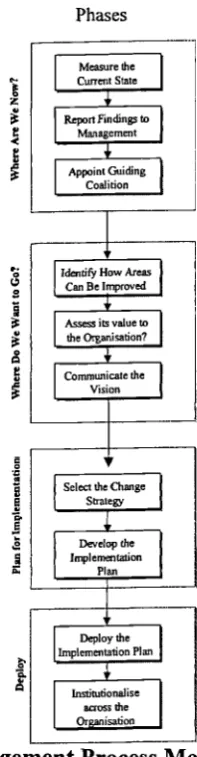
The purpose of this chapter is to identify a system, which could enable industry to manage change toward CE and improve N.P.T.. According to Carter and Baker, this requires the execution of three phases, 'where are we now', 'where do we want to go',
and 'how do we get there '. To do this, a literature review was executed by the R.E. to
identify tools that could enable organisations to implement CE.
t.i Introducing Tools & Processes for Enabling Change
A number of tools were identified within the literature, which could address the issue of understanding an organisation's current and future state against a model of practice, and enable change to be controlled. These are self-assessment,
Inte gration of Self Assessment with a Change Management Process for Deplo y ing Concurrent Engineering
benchmarking, SWOT, auditing, kaizen, project management and control, policy deployment, and workbook implementation approaches.
3.1.1) Self-Assessment: Self-assessment is a tool that enables an organisation to
measure its performance against a number of dimensions. This tool allows an organisation to translate qualitative evidence, representing the deployment of practices, into a quantifiable score for understanding its maturity and identifying areas in which it can improve. Therefore, self-assessment is a tool that can measure the current state and assist in planning the future state of an organisation. A more formal definition is quoted as follows:
'A comprehensive, systematic and regular review of an organisation 's activities and
results referenced against a model of business excellence. The self-assessment
process allows the organisation to discern clearly its strengths and weaknesses,
which improvements can be made and culminates in planned actions, which are then
monitored for progress'3'
3.1.2) Benchmarking: Benchmarking is a tool that allows an organisation to analyse practices and performance of direct competitors, or non-related industries as a means of comparing an organisation's current state against best practice. This allows it to understand its gap as the following definition implies32
'Benchmarking is aformal process for rigorously measuring your performance versus
the best in class companies and for using the analysis to meet and surpass the best in
Integration of Self Assessment with a Change Management Process for Deoloving Concurrent Engineering
Benchmarking often requires a visit to a competitors facility or an industry sector leader, where a review of the targeted operations is undertaken.
3.1.3) Strengths, Weaknesses, Opportunities, Threats: SWOT is a tool that can
assist the strategic management process by allowing information to be organised so that a company can understand its Strengths, Weaknesses, Opportunities and Threats. SWOT analysis is a powerful tool as it can be applied to a series of problems such as identifying an organisation's current strengths and weaknesses, and identifying opportunities for improvement. However, SWOT does not provide knowledge; but it does provide a means for its structuring.
3.1.4) Auditing: Auditing is a tool used by management or an external body to
understand a company's current status with respect to evaluating assertions. Furthermore, Anderson states that auditing is a method for evaluating internal controls, and enforcing the current status quo33. A definition of Auditing is given as follows.
'The systematic process of objectively gathering and evaluating evidence relating to
assertions about economic actions and events in which the individual or organisation
making the assertions has been engaged, to ascertain the degree of correspondence
between those assertions and established criteria, and communicating the results to
users of the reports in which the assertions are made
Auditing can be classified into three categories: financial, compliance, and operational audits. Financial audits are concerned with analysing a company's financial statement.
Integration of Self Assessment with a Change Management Process for Deploying Concurrent Engineering
Compliance audits aim to determine whether a company or an individual is acting in accordance with procedures and regulations. Finally, operational audits focus on company operations to identify areas for improvement.
To understand an organisation's current and future state, operational audits can be used. Operational criteria should be defined within the audit, and the role of the auditing team is to collect evidence, and assess the organisation against the criteria. This can be used to determine whether the organisation complies against the criteria specified. Once completed, the auditing team reports their findings to senior management, so that action can be taken.
3.1.5) Kaizen: Kaizen is a continuous improvement process to enable change35
Central to Kaizen is the Deming Cycle, which includes the phases, 'Plan', 'Do, 'Check', and 'Act'. The ability to achieve change is central to this cycle, as it allows an organisation to understand its current and future state, and plan how to get there. Kaizen is fully leveraged when a company forms quality circles for creating an environment of teamwork. Each quality circle consists of a complementary group of individuals, who are responsible for finding and implementing new solutions.
3.1.6) Project Management & Control: Traditionally 'Project Management &
Control' was associated with the delivery of big budget construction projects.
Integration of Self Assessment with a Chan ge Management Process for Deploying Concurrent Engineering
3.1.7) Policy Deployment: Policy deployment is tool used for deploying Total
Quality Management36. Arguably TQM has a broad scope, which can include the implementation of CE. The execution of policy deployment requires top management to define policies and specific means for their realisation. The means defined at this level then become the policy at the next level, and this requires middle management to develop specific means for its realisation. Thus, the process cascades down each management tier level36
3.1.8) Workbook Change Management Tools: Numerous models for enabling
change exist within the literature such as those proposed by Cummins and Worle?7, Bullocks and Battens38, Lewin39, and Kotter's23 model of change. However, these models are top level in nature, and they require tailoring for implementing CE. Workbook change management tools on the other hand are process-based approaches that have been designed specifically for implementing a particular practice such as CE, through using a project management and control related approach40'41'42. The purpose of these tools is to provide organisations with the means to leverage practice through a 'do it yourself approach'. The argument for such an approach is that an organisation can develop its own competence and expertise, rather than use expensive alternatives such as consultants or undertake a major benchmarking exercise.
.2 Comparing and Contrasting Tools
A number of tools and processes were introduced in the previous section for enabling organisations to review their current state, plan where they want to go, and assist the control of change. To select a tool or a process for implementing CE, each was
Inte gration of Self Assessment with a Chan ge Management Process for Derloying Concurrent Engineejing
compared and contrasted against one another as a means of identifying the best tool for meeting the objectives. This was achieved by defining a set of criteria with which to compare them by using the survey of Lawson and Karandikart43. Among 70 US companies, the survey identified a number of common barriers to implementing CE. These are shown in table 2.
.i anie. narriers ro impiemenring
Based on these survey findings, the following criteria were defined for identifying a solution that could assist UK organisations to implement CE.
1. Provide built in knowledge of CE to enable transfer of best practice.
A solution that provides built in knowledge of CE can ensure that an organisation defines an effective CE process quickly and easily. This addresses the survey findings 'a poorly defined CE process' and a 'lack of CE standards' as barriers to its implementation as knowledge will be provided to assist its definition.
2. Allow an organisation to identt5i its current state and compare itself against best
Integration of Self Assessment with a Chan ge Management Process for Deplo ying Concurrent Engineering
Measuring 'where you are now' and 'where do you want to go' addresses a number of barriers to CE. 'Little understanding of the need to change' would be addressed by a gap analysis emphasising an organisations current and future state, as it will demonstrate its need to change. In addition by understanding the gap between 'where are you now' and 'where do you want to go' on a periodical basis, 'no good measurements to guide change' would also be addressed because as change takes place, progress would be observed.
3. Provide a scoring method that allows quantflable comparisons to be made to
ensure that an accumulated score is robust, and not based on anecdotal evidence.
A scoring system further addresses the barrier 'no good measurements to guide change' as it will provide a method that will enable a quantifiable score for measuring the maturity of CE and its progress to be defined.
4. Provide a system that is easy to apply and enables an organisation to use a do it
yourself methodology.
To overcome the barrier 'little experience of the change process', a solution is required that is easy to apply, so that a do it yourself approach can be utilised.
5. Involves Everybody
According to Deming, to create an environment for enabling continuous improvement requires the input of everybody; this includes both management and the worker'.
Inte gration of Self Assessment with a Change Management Process for Deploying Concurrent Engineering
Therefore, to overcome the barrier 'a natural tendency to not change' requires a system that will include a breadth .of individuals from the organisation to focus upon enabling change. In reality to 'involve everybody' in the process would not be feasible but, individuals who are included must represent a sample of top, middle, lower management and the workforce to enable change.
6. Enables organisations to ident5' key phases for managing change, thus allowing
for activities to be planned.
A tool that identifies key phases to enabling change and provide a route map for defining a project plan, can address the barriers 'little experience of the change process' and a 'natural tendency to not change'. A route map defining phases of change can assist the organisation by making clear the key activities required for leveraging practice to ensure a successful change program.
0
.c i— . t
0 0 & ci) . ,. •0 . =
w ci) > cci 0
____________ _g2_ 2L ^
Knowledge of CE Yes No No Yes No No No Yes Measure Current & Identify a Future CE State Yes Yes Yes Yes No No No No Provide a Scoring System Yes No No No No No No No
Integration of Self Assessment with a Change Management Process for Deo!oying Concurrent Engineering
To assess the tools, table 3 demonstrates how they compare against one another with respect to achieving the criteria defined above. To undertake this task, the research engineer (RE) used each criterion for comparing and contrasting the tools with respect to their ability at achieving it. The results of this will be discussed.
• Knowledge of CE: Self-assessment, operational audits and workb000k change management tools compare and contrast in a number of ways as table 3 illustrates31'33'4' ,42• They compare in that they provide a knowledge base of CE within the tool and hence a 'yes' has been placed within table 3. Nevertheless, they contrast in that knowledge of CE within self-assessment and operational audits are documented in detail using criteria defined for assessing the organisation31'33. Workbook change management tools on the other hand define a model of CE at a relatively top level, and it is not used for conducting self-assessment41'42. Further contrasts are found with benchmarking, SWOT, kaizen, policy deployment, and project management & control, as knowledge of CE is not automatically provided. As part of a benchmarking exercise this knowledge has to be sought for and understood by visiting best practice companies; this requires a lot of preparation in establishing the research question and data collection methods. Self-assessment, operational audits and workbook change management tools on the other hand already provide this knowledge and therefore a 'no' has been placed against benchinarking within table 330 A SWOT analysis assumes that this knowledge is already known prior to its application and therefore a 'no' has been placed within table 3. Finally, kaizen, policy deployment, and project management and control are different from the above in
Integration of Self Azsessment with a Change Management Process for Deploying Concurrent Engineering
that they provide a process for enabling change and therefore a 'no' has been placed within table 335,36,19
• Measure Current and Identify a Future CE State: Self-assessment, operational audits, benchmarking , and SWOT can assist the organisation to
measure its current and future state as table 3 illustrates31'33'32 and therefore a
'yes' has been placed in table 3. Self-assessment and auditing achieves this by
identifying which pre-defined criteria representing best practice has or has not been satisfied by the company31'33 . Benchmarking requires good practice to be
identified as part of the exercise and a current and future state is established by comparing the current organisation against best practice and defining a target organisation30. SWOT can provide a current picture of the organisation and assist in identifying future improvement activities by understanding its strengths, weaknesses, opportunities and threats. Further contrasts are found with workbook change management tools. Workbook change management tools do not provide a facility for a current and future states to be established, only a target model is provided and therefore a 'no' has been placed within table 341,42, Finally, tools such as kaizen, policy deployment, and project management and control provide a process for change but do not provide a clear means for an organisation to undertake a gap analysis against CE and therefore a 'no' has been placed within table 335,36,19
• Provides a Scoring System: Self-assessment provides a method to score practice
Integration of Self Assessment with a Change Management Process for De p loying Concurrent Engineering
and control and workbook change management tools for the following reasons. Whereas self-assessment tools provide a method for scoring the organisation, benchmarking and auditing require a scoring method to be developed prior to the execution and therefore a 'no' has been placed within table 33233 SWOT and workbook change management tools do not provide a scoring systegn to support a gap analysis and therefore a 'no' has been placed within table 341,42, Finally, tools such as kaizen, policy deployment, project management and control and workbook implementation tools further contrast, because their purpose is to guide the change process and a scoring system is not provided to assess CE and therefore a 'no' has been placed within the box35'36"9'41'42.
• Easy to Apply: Arguably self-assessment, SWOT, auditing, and work-book change management tools are all easy to apply and therefore a 'yes' has been placed in table3. Self-assessment, operational audits, and workbook change management tools generally provide instructions and some training for the application to occur 31 '32'41 '42, and therefore can be beneficial to companies that do not have the resources to undertake benchmarking. Benchmarking, kaizen, policy deployment, and project management and control contrast further, because due to their generic and top level nature, they have to be tailored for a specific problem which requires expertise in that area and therefore a 'no' has been placed in table 3323536 19
• Involves Everybody: Self-assessment, Benchmarking, SWOT, Kaizen, policy deployment workbook change management tools and project management and control aim to involve a wide scope of people from within the organisation to motivate change (see point 5, section 3.2 for clarification) and therefore a 'yes' has been placed within table 331,35,36,41,42 However, each tool uses a breadth of
Integration of Self Assessment with a Change Management Process for Deploying Concurrent Engineering
individuals in different ways. Self-assessment requires a facilitator and a breadth of individuals from across the organisation to collect information, and to assess each criterion for a current and future state to be defined31. SWOT requires a group of individuals from across the organisation to brainstorm and identify the company's Strengths, Weaknesses, Opportunities, and Threats. Kaizen is a continuous improvement philosophy, where the four phases of the Deming wheel, 'plan', 'do', 'check' and 'act' are used for driving improvement32. Kaizen is fully leveraged when a company forms quality circles for creating an environment of teamwork. Each quality circle consists of a complimentary group of individuals, who are responsible for finding and implementing a solution35. Policy deployment is a change technique for deploying organisational policies to the lowest levels of the organisation by using a cascading approach that aims to involve each layer of the organisation36 (see section 3.1.7). Benchmarking can use a breadth of individuals for assessing the organisation. Workbook change management tools are tailored to a specific problem, where again teamwork is central to its execution41'42. Finally, project management and control can involve
Integration of Self Assessment with a Change Mana gement Process for De ploying Concurrent Engineering
• Identifies Key Phases for Change: Kaizen, workbook change management tools and project management and control define key phases for executing a change program and therefore a 'yes' has been placed within table 335,41,42,19, However, they differ for a number of reasons. Both Kaizen and project management and control identify key phases from a generic perspective, and they require tailoring for a specific project35 ' 19. Workbook change management tools on the other hand
have been designed to address the implementation of a specific philosophy or
41,42
practice . Self-assessment, SWOT, benchmarking and operational audits further contrast, because they are tools which support the change process by enabling a company to understand 'where it is now' and 'where does it want to go', but not 'how it will get there' therefore a 'no' has been placed within table
3313233 Finally, policy deployment does not provide a process for change but it
compliments this process by providing a means for deploying company policies to the lowest level of the organisation and therefore a 'no' has been placed within table 336
Clearly, there isn't any one tool that addresses all the criteria defined for implementing CE. However, an integrated approach combining both self-assessment and a workbook change management tool is arguably the best combination for implementing CE. Potentially this system could address all criterion stated in section
3.2 by providing knowledge of CE, a scoring methodology, being easy to apply,
involving everybody and identifying key phases for change. Therefore, the development of an integrated approach could provide greater benefits to organisations who want to implement CE and improve N.P.I. as the system would be able to assist them to measure, plan and control change toward CE.
Inte gration of Self Assessment with a Change Mana gement Process for Deploying Concurrent Engineering
3.l Critique of Current Self-Assessment Tools and Workbooks
A number of self-assessment and workbook change management tools already exist within the literature, and before an integrated system could be developed, it was necessary to critically review these solutions as a means for identifying strengths and weaknesses and potential areas for innovation. The critique of these available tools was documented in detail within Submissions One and Five respectively.
3.3.1) Current Self-Assessment Tools: Arguably self-assessment was brought to the
forefront by the National Quality Awards, these being the 'Malcom Balbridge Award', the 'European Business Excellence Model', and the 'Deming Prize' 45. These
tools were originally developed for encouraging Total Quality Management (TQM) by assessing its standard within an organisation, and rewarding the best company with a prize. Nevertheless, through this process, the potential for using self-assessment as a means for leveraging TQM was realised, and since then a number of organisations have been using it for directing quality endeavours.
Successful Product A self-assessment tool, which measures maturity in product development practice using a gap Development analysis. Its main components are product development strategy, structured product development process, teamwork, tools & techniques, working in parallel, and project and ___________________________ programme management.
Time to Market Association47 This provides guidelines for undertaking self-assessment, but it is not a self-assessment tool. The booklet provides a suggested maturity scale and a set of components for undertaking a potential assessment. These are product strategy, technology management, cross-functional teams, high level teams, reviews, process maps, metrics, re-use, functional excellence, and partnerships. The system does not provide a complete methodology for scoring and undertaking an assessment; it expects you as the user to develop this.
A Technical Innovation Audit A self-assessment tool, which measures maturity in aspects of the innovation process using a gap analysis. Its main components are product development, concept generation, leadership _______________________________ process, process innovation, resourcing process, technology acquisition, and systems and tool.
Readiness Assessment for A self-assessment tool, which measures maturity in concurrent engineering using a gap Concurrent Engineering analysis. This system has two main components a process dimension and a technology dimension. The main components of the process dimension are customer focus, product assurance, leadership, team formation, agility, teams in organisation, process focus, _______________________________ management systems, and discipline.
Integration of Self Assessment with a Chan ge Mana gement Process for Deploying Concurrent Engineering
Self-assessment tools have also emerged for measuring the deployment of CE, and identifying areas for improvement as described in table 4. In total five different self-assessment tools were found, which aim to either assess CE, or the innovation process. In all cases they aim to measure an organisation's current state against best practice, and provide a means to identify future improvements.
To develop an understanding of the strengths and weaknesses of each tool a critical review was undertaken by the R.E. Each tool was assessed as to whether they:
1) Paid enough attention to CE design philosophies such as design for manufacture & assembly, design for cost, design for serviceability, design for reliability and design for customer requirements as these were recognised as critical philosophies of CE2.
2) Considered both a practice and performance dimension; this is essential to ensure that practices implemented are delivering to the bottom line45
3) Could be tailored to an industry's specific needs rather than assuming one set of criteria for all organisations50.
4) Have an implementation methodology?
5) Have any additional attributes, which enhanced or inhibited the ability of the tool to assess or implement CE?
These criteria were used, because the R.E. wanted to critique the current available tools for assessing CE in greater detail than the previous analysis introduced in section 3.2. Furthermore, they were identified as potential weak areas by the R.E.. A summary of the strengths and weaknesses are presented within table 5, which illustrates a number of gaps.
Integration of Self Assessment with a Change Management Process for Deploying Concurrent Engineejjpg
_________________________ T_-::L_u
Successful Product Development46 • Considers Strategic and Operational • Subjective Lacks Robustness Factors • Poor Implementation Method
• Lacks Performance Metrics • Assumes One Model for All • Not Enough Emphasis on CE Time to Market Association47 • Provides Education Aids • Not a Self-Assessment Tool
• Implementation Route Maps • Not Enough Emphasis on CE • Lacks Performance Metrics • Provides One Model for All A Technical Innovation Audit • Includes Performance Metrics • Not Enough Emphasis on CE
• Assumes One Model for All • Lack of Validation
• Lacks an Implementation Approach Readiness Assessment for Concurrent • Considers Strategic and Operational • Assumes One Model for All Engineering49 Factors • Lacks Performance Metrics
• Lacks an Implementation an Approach • Does not Provide Solutions
• Not Enough Emphasis on CE Mentor Graphics Self-Assessment Tool1 Not Enough Emphasis on CE • Lacks Performance Metrics
A Subjective Means for Deciding the Future State
Not Enough Depth • Assumes One Model for All
• Does Not Provide an Implementation ____________________________________________ Process
Tabie 5 Strengths and Weaknesses of Self-Assessment Tools
Current self-assessment tools measure 'where are we now?' and 'where do we
want to go?' However, they do not provide an aid for facilitating implementation.
This provides an opportunity for developing a tool, which assesses and deploys CE practice.
The tools assume one model for all organisations. They do not provide an opportunity for tailoring a model for an organisation's specific circumstances. Each self-assessment tool does not pay enough attention to the application of CE from the perspective of achieving specific design philosophies such as design for manufacture, service, reliability, customer requirements and cost.
3. A.,, C,,JW,,
C,,, /
Integration of Self Assessment with a Change Management Process for Deploying Concurrent Engineering
3.3.2) Current Workbook Change Management Tools for Implementing CE:
Two workbook change management tools exist within the literature that have been designed specifically for implementing CE through using a project management and control related approach. These tools are PACE 40,41 and the Cranfield approach42. As previously stated, the purpose of these was to provide 1.JI( organisations with the means to leverage CE practice by a 'do it yourself method' rather than using expensive alternatives such as consultants or embarking on a major benchmarking exercise. Therefore, each change process will be introduced.
A..,..m,n
SWOT k
- I
Figure 5 A Generic Framework for Implementing CE4O,41
As figure 5 illustrates, PACE consists of seven phases; 'develop a strategy', 'assessment', 'create the culture', 'prioritise improvements', 'plan the change', 'implement improved Situation', and finally 'support imp'ementation'. Each phase will be briefly discussed 40,41
Develop a strategy requires top management to formulate a strategy as a means for creating a sense of urgency that change is required.