LOYALTY PROGRAMS
HOW TO APPLY MOST EFFECTIVELY
Comparison of theory and practice
AUTHOR:
I | P a g e
Colophon
DATE 14th of September, 2015
PLACE Enschede, the Netherlands
ACADEMIC YEAR 2014 / 2015
VERSION 1.4
PROJECT REFERENCE Master Thesis
STATUS Final
AUTHOR R. Stuivenberg (Robin)
STUDENT NUMBER s1502425
E-MAIL [email protected]
EDUCATION Business Administration (BA)
TRACK Service and Change Management
INSTITUTE University of Twente
FACULTY Behavioral, Management and Social sciences (BMS)
E
XAM COMMITTEESUPERVISORS UNIVERSITY
ir J.W.L. van Benthem, MSc (Jann)
II | P a g e
Acknowledgements
This report is the result of my graduation project for the Master study Business
Administration, which is conducted at the University of Twente. I would like to take this
opportunity to thank some people who supported during my research.
First I would like to thank my University supervisor’s ir. van Benthem and dr. Loohuis for
their guidance through the process and critical feedback. This helped me to empower the
construct of my thesis and to get a clear thesis structure. I would also like to thank the
companies that opened up their business for me and allowed me to conduct interviews with
their key employees. Without this field research my thesis would not be as valuable as it is. A
special thank you goes out to the company that gave me the possibility to do a five month
during internship at their company. This experience helped me to improve my skills and
prepared me in an optimal way for this research topic. Due to confidentiality reasons I cannot
mention names of the companies and managers who contributed to this research.
I also would like to thank my fellow graduate students Michel Ophof and Renske Rijpkema.
They gave me the chance to discuss matters at any time which led to inspiring advice. Last
but not least I want to thank my girlfriend, family and friends for their ongoing support during
my research and their trust in my abilities.
Enschede, 14th of September, 2015
III | P a g e
Abstract
There are a lot of theoretical frameworks and guidelines about how to ensure a loyalty
program to be effective (Dowling & Uncles, 1997; Henderson, Beck & Palmatier, 2011;
Oliver, 1999; Uncles, Dowling & Hammond, 2003). These frameworks and guidelines all
differ from each other, they even contradict at some points. In practice companies often
misunderstand or misapply loyalty programs (Yi & Jeon, 2003). There is no systematic
knowledge about the nuances and processes of which practitioners think that they contribute
to an effective loyalty program. This empirical research of qualitative nature combines the
most important aspects from literature and tests them in practice. This enables the scattered
frameworks and guidelines to form the first step to unity. It also collects and analyzes the
nuances from practitioners concerning the key aspects needed in order to apply a loyalty
program most effectively. This research is conducted due to a qualitative field research that
contains six case studies of varying companies that have an active loyalty program.
The results show that there are fourteen key aspects that need to be taking into account
when one wants to apply a loyalty program most effectively. The key aspect ‘developing
relationships’ can be considered as the most important aspect. This means that this aspect
requires more attention when applying a loyalty program and striving for effectiveness.
Another key aspect that stands out is the aspect ‘creating habits’. However, there are also
nuances to these key aspects. The nuances to the key aspect ‘developing relationships’ vary
from each other. Whereas one aims to improve current customer relationships, another prefers
to build sustainable customer relationships for the long term. Others want to give his/her
privileged customers discounts like any other customer, despite the fact that they already
receive discounts due to former arrangements. There are also more practical nuances like
putting saved points on the customers’ receipt when he/she forgot to bring the card. Word of
mouth advertisement is also mentioned as an important nuance.
Concluding it can be said that there are fourteen important key aspects to consider
when one wants to apply a loyalty program effectively. The most important aspects to take
into account are ‘developing relationships’ and ‘creating habits’. This research contributes to
literature with its qualitative nature due to the nuances that spice up the results of this study. It
also creates a first structure within the divided research area of loyalty programs. This paper is
written for anyone who is interested in loyalty programs and in how to apply them most
effectively in practice. However, it can also be used as a guideline to help practitioners
IV | P a g e
Table of Contents
COLOPHON --- I
ACKNOWLEDGEMENTS --- II
ABSTRACT --- III
TABLE OF CONTENTS --- IV
1. INTRODUCTION --- 1
1.1. COMPLICATION AND SITUATION --- 1
1.2. RESEARCH GOALS --- 2
1.3. RESEARCH QUESTION --- 2
1.4. SUB QUESTIONS --- 3
1.5. RESEARCH APPROACH AND METHODS --- 3
1.6. THEORETICAL CONTRIBUTION--- 3
1.7. PRACTICAL CONTRIBUTION --- 3
1.8. OUTLINE --- 3
2. THEORETICAL FRAMEWORK --- 5
2.1. CONSUMER LOYALTY --- 5
2.2. LOYALTY PROGRAMS --- 6
2.3. EFFECTIVENESS --- 6
2.4. HOW TO APPLY LOYALTY PROGRAMS MOST EFFECTIVELY --- 6
2.4.1. Social media --- 11
2.5. KEY ASPECTS --- 12
3. METHODOLOGY --- 14
3.1. RESEARCH APPROACH --- 14
3.2. DATA COLLECTION METHOD --- 15
3.3. CASE STUDIES --- 15
4. FIELD RESEARCH --- 16
4.1. LOYALTY PROGRAM A --- 16
4.2. LOYALTY PROGRAM B --- 17
4.3. LOYALTY PROGRAM C --- 19
4.4. LOYALTY PROGRAM D --- 20
4.5. LOYALTY PROGRAM E --- 21
4.6. LOYALTY PROGRAM F --- 22
4.7. KEY ASPECTS --- 24
4.8. NUANCES --- 25
5. RESULTS: COMPARISON OF THEORY AND PRACTICE --- 28
5.1. SUMMARY OF KEY ASPECTS FROM THEORY AND PRACTICE --- 28
5.2. COMPARISON OF KEY ASPECTS FROM THEORY AND PRACTICE --- 29
5.2.1. Cautious budget allocating --- 29
5.2.2. Providing status --- 30
6. CONCLUSION, DISCUSSION, LIMITATIONS AND CONTRIBUTION --- 32
V | P a g e
6.1.1. Further research --- 35
6.2. DISCUSSION --- 35
6.3. LIMITATIONS --- 36
6.4. CONTRIBUTION --- 37
REFERENCES --- 39
APPENDIX 1: RESEARCH PLANNING --- 42
APPENDIX 2: INTERVIEW QUESTIONS --- 43
1 | P a g e
1.
Introduction
In this research loyalty programs are in the centre of attention. In the first chapter the
complication and situation, including information about the area of topic and why this
research is conducted, is described in paragraph 1.1. Followed by the definition of the goals of
this research in paragraph 1.2. The research questions are listed in paragraph 1.3. and
paragraph 1.4. An explanation about how this research is conducted is described in paragraph
1.5. The theoretical- and practical contributions of this research are described in paragraph
1.6. and paragraph 1.7. Finally the outline of this report is described in paragraph 1.8.
1.1. Complication and situation
There are a lot of theoretical frameworks and guidelines about how to ensure a loyalty
program to be effective and successful (Dowling & Uncles, 1997; Henderson et al., 2011;
Oliver, 1999; Uncles et al., 2003). These frameworks and guidelines all differ from each
other, they even contradict at some points. Therefore there is a lack of consensus in literature
concerning these frameworks and guidelines. In practice companies often misunderstand or
misapply loyalty programs (Yi & Jeon, 2003). During the process from design to
implementation most business managers see rewards as free gifts handed out on a short-term
promotional basis (O’Brien & Jones, 1995). There is no systematic knowledge about the
nuances and processes of which practitioners think that they contribute to an effective loyalty
program; what is really important and what is not?
In established repeat-purchase markets there is fierce competition between
multi-brand/multinational/franchise organizations and their brands/products/services (Abid & Ali,
2014). Repeat-purchase markets include FMCG (Fast Moving Consumer Goods), retail, food
and beverages, personal services like banking and travel agents, hotels, transport,
pharmaceuticals, basic cosmetics and media (Uncles et al., 2003). These organizations
compete on price, product selection, services, location and more (Abid & Ali, 2014). In order
to stay ahead of competitors it is important to attach a positive feeling to brands (Fujiwara &
Nagasawa, 2015). This is often been done by conducting content marketing strategies, where
a certain kind of content is getting linked to a brand, product and/or service in order to pull
customers (Lieb, 2012). With as purpose to give (potential) customers positive
2 | P a g e
of information (Lieb, 2012). A way to achieve this is by applying loyalty programs (Van
Doorn et al., 2010).
A loyalty program is a reward system designed to reward customers with extra product or
supplementary goods and/or services often based on their purchase history (Oliver, 1999; Yi
& Jeon, 2003). Respectively 10 years ago the United States of America had approximately
2,250 loyalty programs and 90 percent of the Americans participated in one or more of these
programs (Berman, 2006). In Canada and the United Kingdom these figures were even higher
than 90 percent (Berman, 2006). Nowadays the USA counts 3.3 billion loyalty program
memberships, this is an average of 29 memberships per household (Carter, 2015).
If a loyalty program is being executed effectively, customer loyalty will increase (Sharp &
Sharp, 1999). Besides customer loyalty the selling volume and the selling frequency may also
increase (Oliver, 1999). Another aspect to take into account is acquiring new customers, this
incidental benefit derives from for example blogging or word-of-mouth advertisement by
satisfied customers (Van Doorn et al., 2010). A company may also apply a loyalty program
for a range of other purposes like: building databases, cross-selling, aiding trade relations,
establishing alliances and assisting brand promotions (Uncles et al., 2003). There will be no
further elaboration on these purposes in this research, but they are taken into account.
1.2. Research goals
The lack of consensus when it comes to theoretical frameworks and guidelines and the
absence of systematic knowledge about important nuances and processes from practice, both
concerning the application of loyalty programs in its most effective way as described above in
the first paragraph of this research, lead us to the following research goals:
To get a better understanding on how to apply a loyalty program in its most effective way by means of a systematic literature review (desk research);
To get a better view of nuances from practitioners concerning loyalty programs and of how the key aspects from the literature review are applied in practice (field
research).
1.3. Research question
To achieve the goals of this research, a proper research question is required. The main
question of this research is listed below:
3 | P a g e
1.4. Sub questions
In order to answer the research question the following sub questions must be answered:
1. What are the key aspects needed to apply a loyalty program most effectively,
according to literature?
2. What are the key aspects and its nuances needed to apply a loyalty program most
effectively, according to business managers?
1.5. Research approach and methods
This explorative research is executed by conducting a literature review concerning loyalty
programs. The most important aspects derived from the literature review, of which multiple
aspects are based on empirical evidence, are processed into questions for a qualitative field
research. The data is collected due to semi-structured interviews and the research is
approached deductively. The selection process of the interviewees is done by purposive
sampling, a non-probability sampling method. To answer the research question the acquired
data from theory and practice are compared to each other. A more detailed description of the
research approach and the applied strategies and methods can be found in chapter three.
1.6. Theoretical contribution
The theoretical contribution of this empirical research is in the unique approach of comparing
literature about the effectiveness of loyalty programs with data from case studies about loyalty
programs in practice. Due to these case studies managerial nuances about loyalty programs
can be added to the investigated literature. These insights may benefit future research about
loyalty programs especially concerning the applicability and effectiveness of them.
1.7. Practical contribution
The practical contribution of this research is a comparison of literature about loyalty programs
and the outcome of case studies with active loyalty programs. The practical contribution can
be used by anyone in the field of research or business willing to learn about loyalty programs
and can also be used as a guideline on how to apply a loyalty program most effectively.
1.8. Outline
In the first chapter of this research the introduction to this study is described. The theoretical
framework of this research is shown in chapter two. The methodology of this research
including the data collection methods and the applied strategies for case selection is explained
4 | P a g e
The results of this research are shown in chapter five. This is done by comparing data from
theory with data from practice. Finally in chapter six the conclusion, discussion, limitations
5 | P a g e
2.
Theoretical framework
In this theoretical framework relevant theory concerning this research is discussed. Starting
with the definitions and explanations of ‘consumer loyalty’, ‘loyalty programs’ and ‘effectiveness’ (paragraph 2.1., 2.2. and 2.3.); followed by multiple theories about how to
apply loyalty programs most effectively in paragraph 2.4. The elaboration concerning the
latter answers the first sub questions of this research, which is mentioned above in paragraph
1.4. This chapter ends with a summary and conclusion of the described theoretical concepts in
paragraph 2.5.
2.1. Consumer loyalty
The definition of consumer loyalty has been modified and adjusted heavily in the last few
decades (Dowling & Uncles, 1997; O’Brien & Jones, 1995; Oliver, 1999; Sharp & Sharp,
1997; Uncles et al., 2003; Yi & Jeon, 2003).
Yi & Jeon (2003, p. 231) define consumer loyalty “as repeated purchases of particular products or services during a certain period of time”. According to Uncles et al. (2003) there
is not a universally agreed definition of consumer loyalty. Instead they use three popular
conceptualizations of consumer loyalty based on brand relationship, purchase behavior and
purchase situation.
In this research the following definition is used to define consumer loyalty: “a deeply held
commitment to re-buy or re-patronize a preferred product/service consistently in the future,
thereby causing repetitive same-brand or same brand-set purchasing, despite situational
influences and marketing efforts having the potential to cause switching behavior” (Oliver,
1999, p. 34).
McAlexander, Schouten & Koenig (2002) state that consumer loyalty in practice is often
misunderstood. This because marketers use strategies and programs to establish and increase
consumer loyalty based on limited information about the impact and consequences (Dowling
& Uncles, 1997; Fournier, Dobscha & Mick, 1998). McAlexander et al. (2002) addressed this
issue by searching for places where loyal consumers could be found and they studied the
processes that were leading to their loyalty. They found that consumers generate a variety of
relationships concerning loyalty, which at their turn leads to competitive advantage (Berry,
6 | P a g e
2.2. Loyalty programs
According to Oliver (1999) “loyalty programs are designed to reward repurchasers with extra product (e.g., flights) or supplementary goods and services”. “A loyalty program, which is
often called a reward program, is usually introduced to build customer loyalty through the
planned reward scheme based on a customer’s purchase history” (Yi & Jeon, 2003, p. 229). This means that loyalty programs are a way to differentiate one’s products (Yi & Jeon, 2003). “The goal of a loyalty program is to establish a higher level of customer retention in profitable segments by providing more satisfaction and value to certain customers” (Bolton, Kannan &
Bramlett, 2000, p. 95). Loyalty programs are being justified by the positive influence of
increased consumer loyalty on long-term financial performance (Anderson, Fornell &
Lehmann, 1994; Reichheld & Sasser, 1990).
2.3. Effectiveness
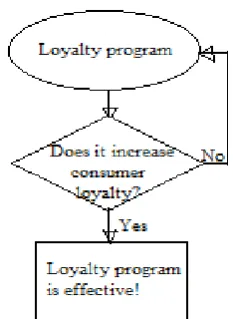
Effectiveness concerning loyalty programs is about
increasing consumer loyalty due to a program that is
designed for this purpose (Sharp & Sharp, 1999).
Consumer loyalty in its turn can increase the number of
sales and the sales volume (Oliver, 1999). It may also
generate new consumers (Van Doorn et al., 2010). A
visualization about how effectiveness is defined in this
research is shown in figure 1.
2.4. How to apply loyalty programs most effectively
In the article “Do customer loyalty programs really work?” Dowling & Uncles (1997) present
a guideline on how to design a loyalty program most effectively. Four steps are central in this
guideline, these steps are explained below:
1. Design the loyalty program to enhance the value proposition of a product or service
It is more worthwhile to let consumers use a program where their benefit increases parallel to
what they buy. Free gifts will only give a short-term boost of loyalty and will possible devalue
the brand over time (Dowling & Uncles, 1997). If a loyalty program is being applied as an
element of the value proposition of a company, the program becomes part of an integrated
[image:12.595.380.497.309.469.2]strategy that develops sustainable loyalty (O'Malley, 1998).
7 | P a g e
2. Fully cost the loyalty program
Certain cost concerning a loyalty program are visible for the management (start-up costs,
maintenance costs, etc.), other, also called less visible costs by Dowling & Uncles (1997), are
costs that are unable to predict. These costs could be time spend by marketing managers on
loyalty program activities. Therefore the allocation of budget to a loyalty program must be
conducted cautiously (Dowling & Uncles, 1997; O'Malley, 1998).
3. Design a reward scheme that maximizes the buyer’s motivation to make the next purchase
Rewards schemes should be targeted at different types of consumers. In this way consumers
can determine their profitability when they are participating in a loyalty program, the kind that
suits their buying behavior best (Dowling & Uncles, 1997). Reinartz & Kumar (2000)
generalize the findings of their empirical study about long-life customers, and highlight that
business managers should focus on short- and long term type of customers at the same time,
as they both can be highly profitable. This study is conducted in the general merchandise
industry and consists of a sample of 9,167 American households (Reinartz & Kumar, 2000).
4. Consider specific market situations in planning
When planning to apply a loyalty program one must consider the product or service its market
situation. There are situations where loyalty programs are not helpful at increasing consumer
loyalty. An example of such a situation is when a brand is highly fashionable. This is because
fashion is the key motivator for consumers in this case (Dowling & Uncles, 1997).
Their research concludes that competition is a major reason to launch a loyalty program;
another reason is to create a demand-pull effect by making the product and/or service more
attractive to distributors. The latter due to the positive relationship between distribution
coverage and market share (Dowling & Uncles, 1997).
Uncles et al. (2003) state in their article “Customer loyalty and customer loyalty programs”
that the demand-side potential of loyalty programs can be analyzed due to a framework. This
framework contains three concepts concerning customer loyalty: customer brand acceptance
(CBA), customer brand commitment (CBC) and customer brand buying (CBB). These three
8 | P a g e
exceptions (CBC and CBB) of customer loyalty in repeat purchase markets. The two
exceptions include: consumers who value function less than psychological and social value
and consumers who show a very low level of loyalty (Uncles et al., 2003). When we look at
the FMCG industry, Uncles et al. (2003) say that customer brand acceptance is most likely to
be the concept that can be linked to brand loyalty. The other two concepts exist but are not
widespread. According to Uncles et al. (2003) behavioral definitions of loyalty differ and
therefore companies should assess their loyalty programs. In their paper, Uncles et al. (2003)
present a checklist for managers to help them start and/or evaluate their loyalty program on a
strategic level. This checklist consists of four elements with demarcations and questions:
(1) Context;
(2) Assessing customer loyalty;
(3) Assessing loyalty programs;
(4) Assessing major traps (Uncles et al., 2003).
A more recent study from Evanschitzky et al. (2012) illustrates that commitment has a
significant positive effect on loyalty towards a company. In other words customer
commitment contributes to the effectiveness of a loyalty program. The empirical study of
Evanschitzky et al. (2012) is conducted at a, as they call it, large European retailer. They
mailed a questionnaire to 20,000 random customers and had 5,189 usable respondents.
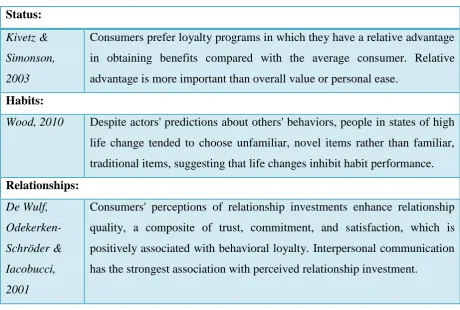
Henderson et al. (2011) state that the theoretical underpinnings of many research concerning
loyalty programs is based on three specific aspects: status, habits and relationships. Loyalty
programs change consumer behavior; the sale of a product and/or service applies a certain
status to customers in comparison with others. Habits, customers build a certain memory to
what have been purchased before and retailers benefit from this. The development of
relationships with consumers may enlarge the chance of becoming the consumers’ favorite
(Henderson et al., 2011). Ou, Shih, Chen & Wang (2011) found a significant positive impact
of ‘relationship commitment’ on ‘consumer loyalty’ in their empirical study about
relationships. This means “that the higher the relationship commitment, the higher the
loyalty” (Ou et al., 2011, p. 202). The study of Ou et al. (2011) is conducted in Taiwan and
included a survey of 480 observations from department store customers.
9 | P a g e
Table 1: explanation of the aspects status, habits and relationships in the FMCG/retail/food industry
Status:
Kivetz &
Simonson,
2003
Consumers prefer loyalty programs in which they have a relative advantage
in obtaining benefits compared with the average consumer. Relative
advantage is more important than overall value or personal ease.
Habits:
Wood, 2010 Despite actors' predictions about others' behaviors, people in states of high
life change tended to choose unfamiliar, novel items rather than familiar,
traditional items, suggesting that life changes inhibit habit performance.
Relationships:
De Wulf,
Odekerken-Schröder &
Iacobucci,
2001
Consumers' perceptions of relationship investments enhance relationship
quality, a composite of trust, commitment, and satisfaction, which is
positively associated with behavioral loyalty. Interpersonal communication
has the strongest association with perceived relationship investment.
Henderson et al. (2011) also mention that if all three aspects are achieved there also must be a
total fit between the aspects. An example of Starbucks is given were their premium rewards
program was fulfilling all three aspects but was still discontinued after a while because of
poor results (Henderson et al., 2011).
Oliver (1999) states in his work “Whence Consumer Loyalty” that in order to ensure a
successful loyalty program an organization must think of three issues: what is loyalty
(because of its changing meaning), is loyalty attainable for the organization (because of the
differences in states of loyalty) and is loyalty profitable (because of the returns to loyalty).
The latter of the three issues is empowered by an empirical study of Reinartz & Kumar (2000)
in the general merchandise industry. Their findings, derived from a sample of 9,167 American
households, show that ‘customer profitability’ is strongly related to ‘customer lifetime
duration’ (Reinartz & Kumar, 2000). This means that the longer the customer lifetime
duration, which can be realized by increasing customer loyalty, the higher the customer
profitability. For all three issues Oliver (1999) listed questions that can be used as a checklist
10 | P a g e
Table 2: checklist to ensure successful loyalty programs (Oliver, 1999)
Checklist
Issues
What is
loyalty?
•What portion of consumers in general are inherently loyal, disloyal, or
ambivalent? What are the determining characteristics of these states? Do
consumers express loyalty differently across product and service categories?
•If satisfaction and loyalty are divergent concepts, what constitutes there
overlap? Alternatively, what best describes their correspondence?
•How is the action-loyal state attained? Is it simple inertia, or does it have
clear behavioral antecedents?
•What is fortitude? Is it a combination of adoration and commitment, or does
it consists of other content?
•What is the transitioning mechanism between action loyalty and fortitude?
How does a consumer move from one state to the other, and how can firms
facilitate this?
•What are the options for constructing a consumption community or village?
How strong are the bonds in a "family" in which consumers might not have
face-to-face contact?
•What is the role of repetition and mere exposure in loyalty in a consumption
community?
•What additional synergistic effects are garnered when fortitude and
community combine? Are these effects additive or synergistic?
Is loyalty
attainable
?
•What product and service categories are most adaptable to the fortitude and
village concepts?
•Does industry structure play a role in loyalty development among its
members?
•Is the rate of innovation a factor in loyalty for individual firms in industries
with varying levels of innovativeness?
•Do management experience, strategy, and resourcefulness play roles in
loyalty programs?
•Can management identify its loyal segments through means other than repeat
purchase patterns?
11 | P a g e
community? What are the nature and variants of such programs?
Is loyalty
profitable
?
•What are the costs, respectively, of various loyalty strategies, including
satisfaction, product superiority, fortitude, community, and their synergy?
•Do these strategies engender different returns in relation to their costs?
•Are there quantifiable benefits to passive loyalty, such as word of mouth and
recommendations?
•Are loyalty programs best managed in-house or contracted out?
•Do loyalty programs have reciprocal internal effects, such as feedback on
employee morale?
•Can loyalty be affected as a secondary result of improving employee morale
generally?
•What are the determining characteristics, more generally, of returns to
loyalty?
According to Wirtz, Mattila & Lwin (2007) switching costs are linked to consumer
participation in a rewards program. Lam, Shankar, Erramilli & Murthy (2004, p. 297) define
switching costs as an “investment of effort, time, and money, which constitutes a significant
barrier to moving to other service providers when the customer is dissatisfied with the
services of a provider”. Switching costs increase when loyalty programs are involved (Wirtz
et al., 2007). The findings of Wirtz et al. (2007) derive from an empirical study with 283
respondents in Singapore. The data of this research is collected due to door-to-door
interviews. According to Dowling & Uncles (1997) psychological costs can also be a part of
switching costs, for example the loss of the feeling of belonging to a program. By making
loyalty programs attractive for their customers, due to offering accumulating benefits for
example, companies can increase switching barriers and lock in their customers (Dowling &
Uncles, 1997; Wirtz et al., 2007). Switching can consist of applying or signing up for a new
program, getting accustomed to the programs’ rules and conditions, and so on (Patterson &
Smith, 2001).
2.4.1. Social media
Anno 2015 it is hard to go around ‘social media’ when it comes to loyalty and loyalty
programs. Social media “describes a variety of new sources of online information that are
12 | P a g e
products, brands, services, personalities, and issues” (Blackshaw & Nazzaro, 2004, p. 2). In
this research ‘social media’ is taken into account but is not further investigated as an aspect
that helps to apply loyalty programs effectively. This decision is made because “social media
encompasses a wide range of online, word-of-mouth forums including blogs,
company-sponsored discussion boards and chat rooms, consumer-to-consumer e-mail, consumer
product or service ratings websites and forums, Internet discussion boards and forums,
moblogs (sites containing digital audio, images, movies, or photographs), and social
networking websites, to name a few” (Mangold & Faulds, 2009, p. 358), which makes it too
complex to demarcate in this research.
2.5. Key aspects
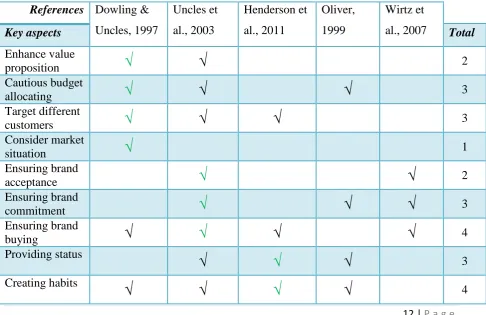
The above explained key aspects are summarized in the table below. Besides key aspects the
references (author(s) and year) and the number of citations of their work are also shown. The
cells are marked with either a green √ or a black √. Green means that the author(s) did research about this particular aspect and consider it a key aspect on how to apply a loyalty
program most effectively. Black means that the author(s) agree upon the aspect to be a key
[image:18.595.66.553.449.764.2]aspect, but do not necessarily have conducted an empirical research about the aspect.
Table 3: summary of key aspects from literature on how to apply a loyalty program most effectively
References Dowling &
Uncles, 1997 Uncles et al., 2003 Henderson et al., 2011 Oliver, 1999 Wirtz et al., 2007
Key aspects Total
Enhance value
proposition
√
√
2Cautious budget
allocating
√
√
√
3Target different
customers
√
√
√
3Consider market
situation
√
1Ensuring brand
acceptance
√
√
2Ensuring brand
commitment
√
√
√
3Ensuring brand
buying
√
√
√
√
4Providing status
√
√
√
3Creating habits
√
√
√
√
13 | P a g e
Developing
relationships
√
√
√
√
√
5Defining loyalty
√
√
2
Determine
attainability
√
1Measuring
profitability
√
√
√
3Create
switching costs
√
√
√
3Citations at Google Scholar (6/2015)
1217 592 53 6320 142
Citations at Web of Science (6/2015)
216 - 18 1040 38
Looking at the summarizing table above it can be said that according to the investigated
literature there are fourteen aspects that can be considered as important when one wants to
apply a loyalty program most effectively. The key aspect ‘developing relationships’ can be
considered as the most important key aspect to bear in mind when one wants to apply a
loyalty program most effectively. This means that companies have to try to become the
customers’ favorite (Henderson et al., 2011) due to interpersonal communication (De Wulf et al., 2001). Other key aspects that can be considered as important are ‘ensuring brand buying’ and ‘creating habits’. For the key aspect ‘ensuring brand buying’ this means that consumers with a low level of loyalty must be persuaded to buy the firms’ brand(s) (Uncles et al., 2003). For the key aspect ‘creating habits’ this means that firms need to give consumers a certain
memory to what have been purchased before, in order to make the next purchase a habit for
14 | P a g e
3.
Methodology
In this methodology chapter the research approach is explained more extensively compared to
the description in paragraph 1.5. Next to the research approach also the data collection
methods of this research are described in this chapter in paragraph 3.2. A more in depth
description about case studies and the applied type of research is shown in paragraph 3.3.
3.1. Research approach
This research is executed by conducting an extensive literature review concerning loyalty
programs. The most important aspects derived from the literature review, of which multiple
aspects are based on empirical evidence, are processed into questions for a qualitative field
research. This is done in order to acquire data for a comparison with the investigated
literature. In this field research the units of analysis are active loyalty programs in and around
(some are also active in Belgium) the Netherlands, concerning repeat-purchase markets. Some
of the participating companies also have experience with loyalty programs in other countries,
this is not taking into account during the field research because of cultural differences. This
means that companies in different countries might need to address their customers differently
in order to reach the same loyalty goals.
The loyalty programs are selected due to purposive sampling, a non-probability sampling
method where the units of observation are selected by the researchers, they determine what
the most useful or representative units are (Babbie, 2010). Probability sampling is excluded
because not all loyalty programs are suited for this research. In order to get a representative
research, the selected loyalty programs differ from each other in size by number of
participants and the number of years that the program is active. The diversity of loyalty
programs due to the selection criteria ensures maximum variation in the sample (Patton,
2002). This enables the researcher to analyze all existing extremes within this field.
This research is conducted according to the deductive research approach, an approach wherein
a theoretical framework is developed before the data is being collected (Saunders, Lewis &
15 | P a g e
3.2. Data collection method
To collect data for sub question two, interviews are held with business professionals who are
responsible for the particular loyalty programs. This is done because in this research personal
interaction with respondents is more valuable than knowledge of respondents expressed
through an anonymous questionnaire (Saunders et al., 2009). Due to industry experience of
the researcher there is access to people in the industry. The duration of the interviews is
around one hour. Interviews may be formalized and structured with standard questions for the
respondents; they may also be informal and unstructured like real life conversations (Saunders
et al., 2009). In this research the interviews are held in a semi-structured way, also called
‘qualitative research interviews’ (King, 2004). This means that there are themes and a list of
questions, but the interviewer has the freedom to go with the flow in a conversational way
during the interview (Saunders et al., 2009). To avoid interpretation errors, the elaboration of
the data is evaluated with the business professionals. The data analysis is done due to a
comparison between literature and data from the interviews. The theoretical concepts from the
literature form the structure of this analysis. An example of this are the three aspects (status,
habits and relationships) stated by Henderson et al. (2011) which are mentioned earlier in this
report. These three aspects are intertwined into the interview questions. This enables a valid
comparison between theory and practice.
3.3. Case studies
The interviews are used as a data collection method for the case studies (Saunders et al.,
2009). Case studies have the ability to answer ‘what’, ‘why’ and ‘how’ questions (Saunders et al., 2009). Case studies can be defined as “a strategy for doing research which involves an
empirical investigation of a particular contemporary phenomenon within its real life context
using multiple sources of evidence” (Robson, 2002, p. 178). According to Yin (2003) there
are single and multiple case studies. It is common for scientists to apply multiple case studies
because a single case study can make it hard to generalize the results (Yin, 2003). Therefore
the decision was made to conduct multiple case studies in order to be able to generalize the
results of this research.
Case studies are best applicable in an exploratory type of research (Saunders et al., 2009). An
exploratory research can be used when one wants to find out “what is happening; to seek new
16 | P a g e
4.
Field research
In this chapter six different loyalty programs are analyzed due to case studies. The loyalty
programs have been kept anonymous due to confidentiality agreements with the participating
companies. The loyalty programs are described program by program starting with an
introduction of their core business, size, age and goals. This is followed by an explanation of
the effectiveness and possible successors of the program. Than the key aspects and its nuances
which are derived from the field research are shown in a table and are being analyzed. At the
end of this chapter the key aspects and the most important nuances are summarized to give a
clear visualization.
4.1. Loyalty program A
The first loyalty program discussed in this chapter is a program ranked 3rd of the loyalty
programs in the Netherlands when it comes to the number of users. The program is based on
giving customers a company card, with this card customers can have an advantage on non
card holders. The program is launched in 2011. There are two main advantages: savings
points in order to buy regular products with a discount and access to buying discounted (day)
offers that are not available to non card holders. The goals of the program are to improve the
relationship with the customer, to stay unique compared to competitors and to offer customers
something extra.
Effectiveness
This program is effective in the way that it increases
the loyalty of customers. This is measured by the
company due to a comparison of turnover figures
and a comparison of the store visitor frequency
figures. To the question: what makes the program
effective, the interviewee answered the point saving
system and the personalized discount (day) offers.
Table 4: key aspects of loyalty program A including nuances when relevant
Loyalty program A
Aspects: Is the aspect a key aspect in becoming effective? / Nuances
Enhance value proposition Yes *
“Not one or two aspects are
making a loyalty program
operate effective, multiple
aspects are required to create an
effective operating loyalty
17 | P a g e
Cautious budget allocating No * Target different customers Yes *
Consider market situation Yes Staying unique in the market Ensuring brand acceptance Yes *
Ensuring brand commitment Yes *
Ensuring brand buying Yes Offer more to customers compared to current situation
Providing status No *
Creating habits Yes *
Developing relationships Yes Improving current relationships as well
Defining loyalty Yes *
Determine attainability No *
Measuring profitability Yes Preliminary calculations Create switching costs No *
*An empty cell in the table means that for the particular aspect the interviewee has no statement beyond
the obvious, no data relevant to mention
As is shown in the table above there are multiple key aspects that help loyalty program A to
be effective. Ten out of the fourteen aspects are appointed as a key aspect by the interviewee.
These are: enhance value proposition, target different customers, consider market situation,
ensuring brand acceptance, ensuring brand commitment, ensuring brand buying, creating
habits, developing relationships, defining loyalty and measuring profitability.
In addition to the regular interview questions the interviewee mentioned the importance of a
total fit between the key aspects. Not one or two aspects are making a loyalty program operate
effective, multiple aspects are required to create an effective operating loyalty program. The
alignment of the aspects is even more important in order to reach the state of effectiveness.
4.2. Loyalty program B
The second loyalty program discussed in this chapter is in use by a third of all households in
the Netherlands. The program is based on giving customers a company card, with this card
customers can have an advantage on non card holders. The program is launched in 2006. The
main advantages of the program are the benefits for customers concerning warranties and the
specific communication towards customers. The latter is made possible due to database
intelligence. The goals of the program are building relationships with customers, collecting
data about customers and giving customer something extra like freebees or discounted offers.
18 | P a g e
This program is effective in the way that it increases
the loyalty of customers. This is measured by the
company due to a comparison of customer spending
habits and a comparison of the store visitor frequency
figures. To the question: what makes the program
effective, the interviewee answered being customer specific and the fact that customers
become more loyal due to the discount card principle. Other successors of the program are the
[image:24.595.64.532.279.519.2]free coffee and free tea, this is offered at the stores.
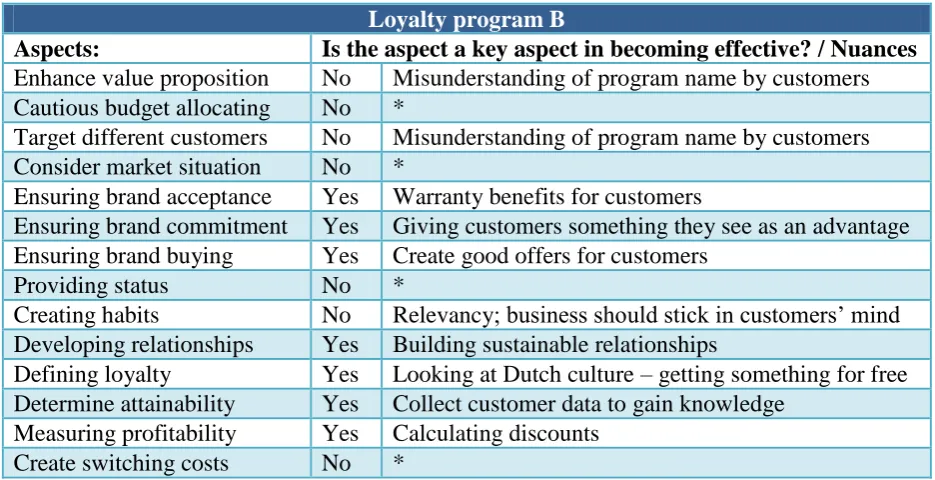
Table 5: key aspects of loyalty program B including nuances when relevant
Loyalty program B
Aspects: Is the aspect a key aspect in becoming effective? / Nuances
Enhance value proposition No Misunderstanding of program name by customers Cautious budget allocating No *
Target different customers No Misunderstanding of program name by customers Consider market situation No *
Ensuring brand acceptance Yes Warranty benefits for customers
Ensuring brand commitment Yes Giving customers something they see as an advantage Ensuring brand buying Yes Create good offers for customers
Providing status No *
Creating habits No Relevancy; business should stick in customers’ mind Developing relationships Yes Building sustainable relationships
Defining loyalty Yes Looking at Dutch culture – getting something for free Determine attainability Yes Collect customer data to gain knowledge
Measuring profitability Yes Calculating discounts Create switching costs No *
*An empty cell in the table means that for the particular aspect the interviewee has no statement beyond
the obvious, no data relevant to mention
As is shown in the table above there are multiple key aspects that help loyalty program B to
be effective. Seven out of the fourteen aspects are appointed as a key aspect by the
interviewee. These are: ensuring brand acceptance, ensuring brand commitment, ensuring
brand buying, developing relationships, defining loyalty, determine attainability and
measuring profitability.
In addition to the regular interview questions the interviewee mentioned that the ‘relevance of
the program’ and ‘building relationships with the customer’ are of great importance when
striving for effectiveness.
[image:24.595.67.538.282.521.2]19 | P a g e
4.3. Loyalty program C
The third loyalty program discussed in this chapter is conducted by using multiple loyalty
interventions. Around 4,000 customers participate to the program after such an intervention.
The interventions of the program are based on giving customers a discount or giving
customers free products/services. The company started with these interventions in 2014. The
main advantage of the interventions of the program is the refund that customers are entitled
to. The goals of the interventions of the program are increasing the buying frequency and
building brand equity/loyalty.
Effectiveness
This program is effective in the way that it increases
the loyalty of customers by an increasing customer
buying frequency. This is measured by the company
due to a comparison of old- and new purchase data
from the stores where they are selling from. To the question: what makes the program
effective, the interviewee answered all of the aspects which are described in the table below
except for the last one ‘create switching costs’. Other successors of the program are the refund
[image:25.595.65.531.487.727.2]possibilities and the ‘on pack’ advertisement. The latter also generates new customers.
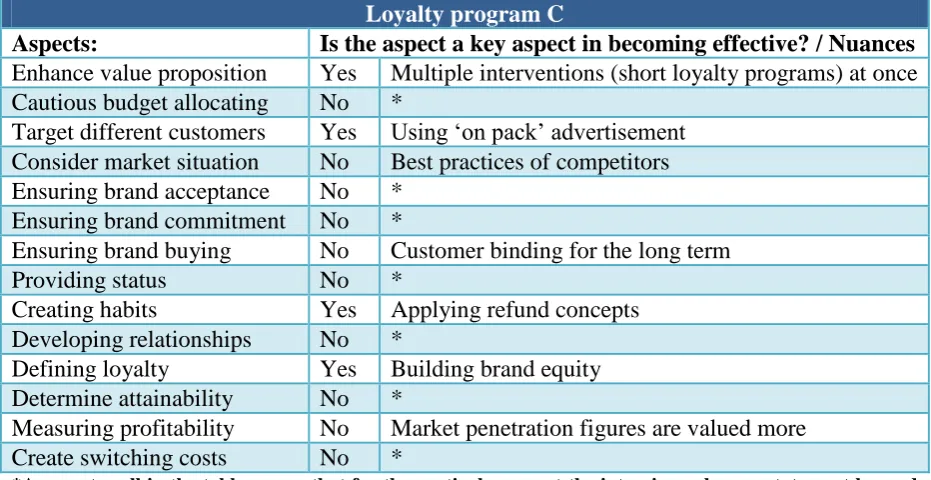
Table 6: key aspects of loyalty program C including nuances when relevant
Loyalty program C
Aspects: Is the aspect a key aspect in becoming effective? / Nuances
Enhance value proposition Yes Multiple interventions (short loyalty programs) at once Cautious budget allocating No *
Target different customers Yes Using ‘on pack’ advertisement Consider market situation No Best practices of competitors Ensuring brand acceptance No *
Ensuring brand commitment No *
Ensuring brand buying No Customer binding for the long term
Providing status No *
Creating habits Yes Applying refund concepts Developing relationships No *
Defining loyalty Yes Building brand equity Determine attainability No *
Measuring profitability No Market penetration figures are valued more Create switching costs No *
*An empty cell in the table means that for the particular aspect the interviewee has no statement beyond
the obvious, no data relevant to mention
20 | P a g e
As is shown in the table above there are multiple key aspects that help loyalty program C to
be effective. Four out of the fourteen aspects are appointed as a key aspect by the interviewee.
These are: enhance value proposition, target different customers, creating habits and defining
loyalty.
In addition to the regular interview questions the interviewee mentioned that the complexity
of short- and long term customer loyalty is an important aspect to take into account.
According to the interviewee there is a large grey area between these two extremes (short
term and long term).
4.4. Loyalty program D
The fourth loyalty program discussed in this chapter is a stamp card with around 5,000
participating customers. The program is based on the collecting stamps principle where
customers can get a discount on products if their stamp card is full. The company introduced
their stamp card in 2010. The main advantage of the program is the discount that customers
get when they have a full stamp card. The goal of the program is to give something extra to
the customer.
Effectiveness
It is unknown if this program is effective or not. It is
also unknown if this program increases the loyalty of
customers or not, because this is not measured by the
company. To the question: what makes the program effective, the interviewee answered the
discount that customers have with a full stamp card and bonding with the customer. Other
successors of the program, provided that the program is effective, are the recognizable logo
on the card and the fact that the company still accepts expired stamp cards (as a favour for the
[image:26.595.65.535.663.755.2]customer).
Table 7: key aspects of loyalty program D including nuances when relevant
Loyalty program D
Aspects: Is the aspect a key aspect in becoming effective? / Nuances
Enhance value proposition Yes Satisfying the customer by giving something extra Cautious budget allocating No *
Target different customers No * Consider market situation No *
21 | P a g e
Ensuring brand acceptance No *
Ensuring brand commitment No Company logo on the card of the program
Ensuring brand buying No Ensuring customer binding by accepting expired cards
Providing status No *
Creating habits Yes Weather depending habits Developing relationships No Word of mouth advertisement
Defining loyalty No *
Determine attainability No * Measuring profitability No * Create switching costs No *
*An empty cell in the table means that for the particular aspect the interviewee has no statement beyond
the obvious, no data relevant to mention
As is shown in the table above there are multiple key aspects that help loyalty program D to
be effective. Two out of the fourteen aspects are appointed as a key aspect by the interviewee.
These are: enhance value proposition and creating habits.
In addition to the regular interview questions the interviewee mentioned that in their case the
weather conditions have a strong impact on the effectiveness of the program.
4.5. Loyalty program E
The fifth loyalty program discussed in this chapter is a program with around 5,000
participating customers and still rising. The program is based on a point saving system
wherein every participating customer gets an account with a card and can get a discount on
products or can get products for free in exchange for saved points on their account. The
company introduced their program in 2015. The main advantages of the program are the
discount and the free products that customers get when they have saved a certain amount of
points. The goal of the program is to increase the turnover of the company.
Effectiveness
The program is launched one month before the
interview, which took place in July, 2015. Not all the
data of the program was already evaluated at that
time, therefore it is unknown if the program is
effective or not. Due to this reason it is also unknown
if the program increases the loyalty of customers or
not. To the question: what makes the program
“The company is focused on
three different customer
segments: current loyal
22 | P a g e
effective, the interviewee answered the invested time and money by the company and its
employees. Other successors of the program, provided that the program is effective, are the
reward system for the customer, the personalized customer communication and the Dutch
[image:28.595.74.533.195.436.2]culture (saving points and getting free products).
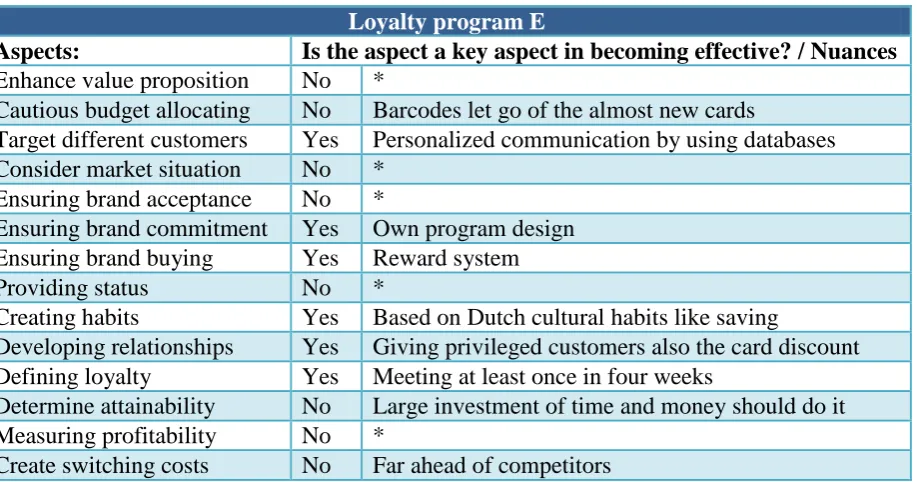
Table 8: key aspects of loyalty program E including nuances when relevant
Loyalty program E
Aspects: Is the aspect a key aspect in becoming effective? / Nuances
Enhance value proposition No *
Cautious budget allocating No Barcodes let go of the almost new cards
Target different customers Yes Personalized communication by using databases Consider market situation No *
Ensuring brand acceptance No *
Ensuring brand commitment Yes Own program design Ensuring brand buying Yes Reward system
Providing status No *
Creating habits Yes Based on Dutch cultural habits like saving
Developing relationships Yes Giving privileged customers also the card discount Defining loyalty Yes Meeting at least once in four weeks
Determine attainability No Large investment of time and money should do it Measuring profitability No *
Create switching costs No Far ahead of competitors
*An empty cell in the table means that for the particular aspect the interviewee has no statement beyond
the obvious, no data relevant to mention
As is shown in the table above there are multiple key aspects that help loyalty program E to
be effective. Six out of the fourteen aspects are appointed as a key aspect by the interviewee.
These are: target different customers, ensuring brand commitment, ensuring brand buying,
creating habits, developing relationships and defining loyalty.
In addition to the regular interview questions the interviewee mentioned that the company
focuses on three different customer segments: current loyal customers, customers that only
come to the store when there are special offers and new or potential customers.
4.6. Loyalty program F
The sixth loyalty program discussed in this chapter is a program with around 370 participating
customers and still rising. The program is based on a point saving system wherein every
participating customer gets an account with a card and can get a discount on products or can
23 | P a g e
their program in 2012. The main advantages of the program are the discount and the free
products that customers get when they have saved a certain amount of points. The goals of the
program are to reward loyal customers and to convince customers to come back to the
company due to the points they have saved.
Effectiveness
It is unknown if this program is effective or not. It is
also unknown if this program increases the loyalty of
customers or not, because this is not measured by the
company. The industry of the company, the restaurant
business, makes it hard to make valid measures
concerning the effectiveness of the program, because the amount of customers per period is
depending on multiple external factors like weather conditions, seasons and times of
recession. To the question: what makes the program effective, the interviewee answered a
positive appearance of the owners and the employees towards customers, because giving
customers a good feeling about their visit is of great importance according to the interviewee.
Other successors of the program, provided that the program is effective, are the discount for
the customer and the free products that are given away randomly to loyal customers by the
[image:29.595.70.531.507.750.2]owner.
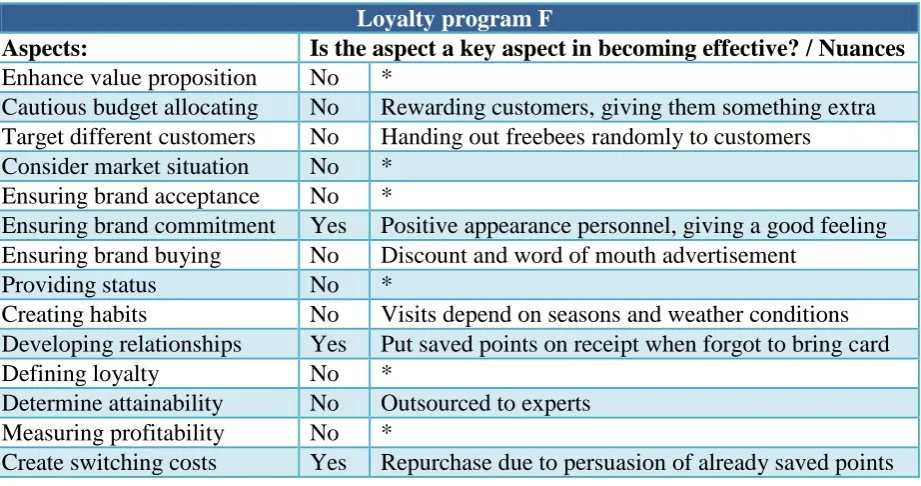
Table 9: key aspects of loyalty program F including nuances when relevant
Loyalty program F
Aspects: Is the aspect a key aspect in becoming effective? / Nuances
Enhance value proposition No *
Cautious budget allocating No Rewarding customers, giving them something extra Target different customers No Handing out freebees randomly to customers Consider market situation No *
Ensuring brand acceptance No *
Ensuring brand commitment Yes Positive appearance personnel, giving a good feeling Ensuring brand buying No Discount and word of mouth advertisement
Providing status No *
Creating habits No Visits depend on seasons and weather conditions Developing relationships Yes Put saved points on receipt when forgot to bring card
Defining loyalty No *
Determine attainability No Outsourced to experts Measuring profitability No *
Create switching costs Yes Repurchase due to persuasion of already saved points
“There is always saved credit left
on the card which makes
24 | P a g e
*An empty cell in the table means that for the particular aspect the interviewee has no statement beyond
the obvious, no data relevant to mention
As is shown in the table above there are multiple key aspects that help loyalty program F to be
effective. Three out of the fourteen aspects are appointed as a key aspect by the interviewee.
These are: ensuring brand commitment, developing relationships and create switching costs.
In addition to the regular interview questions the interviewee mentioned that there is always
saved credit left on the card which makes customers want to come back sometime. According
to the interviewee this definitely contributes to the effectiveness of the program.
4.7. Key aspects
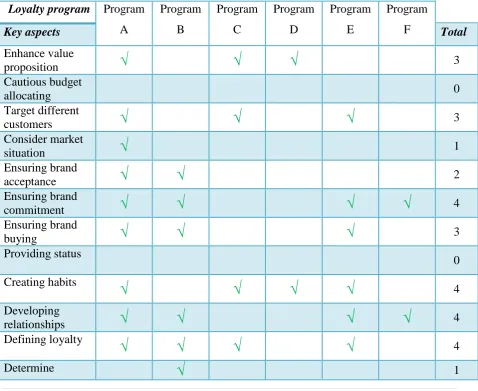
The key aspects derived from the case studies described in this chapter are summarized in the
[image:30.595.67.546.366.757.2]table below to give a clear visualization of the importance of the key aspects:
Table 10: summary of key aspects from practice on how to apply a loyalty program most effectively
Loyalty program Program
A Program B Program C Program D Program E Program F
Key aspects Total
Enhance value
proposition
√
√
√
3Cautious budget
allocating 0
Target different
customers
√
√
√
3Consider market
situation
√
1Ensuring brand
acceptance
√
√
2Ensuring brand
commitment
√
√
√
√
4Ensuring brand
buying
√
√
√
3Providing status
0
Creating habits
√
√
√
√
4Developing
relationships
√
√
√
√
4Defining loyalty
√
√
√
√
425 | P a g e
attainability Measuring
profitability
√
√
2Create switching
costs
√
1Program age
(7/2015) 4 years 9 years < 1 year 5 years 1 month 3.5 years
Program size / users (7/2015)*
Third largest of NL
33.3% of househol ds in NL
4,000 per intervent ion**
+/- 5,000 +/- 5,000 370
*Not all participating companies could give the number of users of their program due to privacy reasons
**This company applies multiple loyalty interventions per year
As is shown in the table above there are four key aspects that score a four, which means that
these have been agreed upon by four different business managers. This means that these four
aspects are key aspects, on how to apply a loyalty program most effectively, for four of the six
questioned loyalty programs. These are the following aspects: ‘ensuring brand commitment’,
‘creating habits’, ‘developing relationships’ and ‘defining loyalty’.
However there are also two aspects that score a zero in the table above. These aspects are not
being considered as a key aspect, in order to apply a loyalty program most effectively, by all
six of the questioned loyalty programs. These two aspects are: ‘cautious budget allocating’ and ‘providing status’.
What stands out from the interviews is that at least half of the interviewees mention the
importance of a total fit between the key aspects.
4.8. Nuances
The nuances of the most important key aspects which are derived from the interviews are
summarized and described in this paragraph. This are the nuances of the following key
[image:31.595.68.547.71.213.2]aspects: ‘ensuring brand commitment’, ‘creating habits’, ‘developing relationships’ and ‘defining loyalty’.
Table 11: nuances of the key aspect 'ensuring brand commitment'
Ensuring brand commitment
Loyalty program: Is the aspect a key aspect in becoming effective? / Nuances
A Yes *
B Yes Giving customers something they see as an advantage
C No *
26 | P a g e
E Yes Own program design
F Yes Positive appearance personnel, giving a good feeling
*An empty cell in the table means that the interviewee has no statement beyond the obvious, no data
relevant to mention
As is shown in the table above the interviewee of loyalty program B wants to give his/her
customers something that they see as an advantage. According to the interviewee this could be
anything like for example a discounted product or freebees. However, the interviewees of
loyalty programs D and E have more practical nuances, respectively placing the company
logo on the programs’ card and designing the program themselves. The interviewee of loyalty
[image:32.595.66.523.331.445.2]program F prefers to give customers a good feeling by a positive appearance of the personnel.
Table 12: nuances of the key aspect 'creating habits'
Creating habits
Loyalty program: Is the aspect a key aspect in becoming effective? / Nuances
A Yes *
B No Relevancy; business should stick in customers’ mind C Yes Applying refund concepts
D Yes Weather depending habits
E Yes Based on Dutch cultural habits like saving F No Visits depend on seasons and weather conditions
*An empty cell in the table means that the interviewee has no statement beyond the obvious, no data
relevant to mention
As is shown in the table above the interviewee of loyalty program B argues that relevancy is
of great importance, the core business of a company should stick in a customers’ mind. The
interviewee of loyalty program C prefers to apply refund concepts to create habits. The
interviewees of the loyalty programs D, E and F mention nuances like weather conditions,
seasons and Dutch cultural habits like saving things.
Table 13: nuances of the key aspect 'developing relationships'
Developing relationships
Loyalty program: Is the aspect a key aspect in becoming effective? / Nuances
A Yes Improving current relationships as well B Yes Building sustainable relationships
C No *
D No Word of mouth advertisement
[image:32.595.67.523.650.756.2]27 | P a g e
F Yes Put saved points on receipt when forgot to bring card
*An empty cell in the table means that the interviewee has no statement beyond the obvious, no data
relevant to mention
As is shown in the table above the interviewees of the loyalty programs A and B aim to
respectively improve current customer relationships and build sustainable customer
relationships for the long term. The interviewee of loyalty program D mentioned word of
mouth advertisement as an important nuance. Whereas the interviewee of loyalty program E
wants to give his/her privileged customers the card discount like any other customer, despite
the fact that they already receive discounts due to former arrangements. The interviewee of
loyalty program F has a more practical opinion and wants to put saved points on the
[image:33.595.65.523.354.471.2]customers’ receipt when he/she forgot to bring the program card.
Table 14: nuances of the key aspect 'defining loyalty'
Defining loyalty
Loyalty program: Is the aspect a key aspect in becoming effective? / Nuances
A Yes *
B Yes Looking at Dutch culture – getting something for free C Yes Building brand equity
D No *
E Yes Meeting at least once in four weeks
F No *
*An empty cell in the table means that the interviewee has no statement beyond the obvious, no data
relevant to mention
As is shown in the table above the interviewee of loyalty program B wants to look at Dutch
cultural aspects like getting something for free for example. However, the interviewee of
loyalty program C prefers to build brand equity. The interviewee of loyalty program E
mentioned to conduct a meeting at least once in every four weeks to define loyalty over and