Submitted on:
_________ Approved on: _________
Student:
Rees Chikwendu
Student Number:
s1575481
E-mail:
[email protected]
Examiner:
Mr. van der Kolk
Substitute:
Mr. van der Kaap
Constructing Corruption as a Social Problem in Nigeria: A Content
Analysis of Four Nigerian Newspapers
Research: Master Thesis Report
Summary
This study has investigated the prevalence of four frames in the coverage of corruption as a social problem in four Nigerian newspapers. The frames include conflict, morality, responsibility, and economic consequences, which were identified through previous studies on frames and based on their frequent use in defining social and policy issues. Social problem scholars agree that social problems do not exist as objective conditions, but are collectively defined through public discourse. Thus, to capture this very essence of collective definition of corruption, this study also developed five frame variables, which include: the nature, causes, actors, consequences, and possible treatment of the problem. Further, twenty-three (23) frame elements – around the main frames and their variables – were deductively and inductively defined through literatures and news articles. The frame elements serve as the lowest factors that inform the present or not present of the main frames in analytic texts. A sample size of 295 news articles were randomly selected and content-analyzed during the period of the 2015 general elections in Nigeria, that coincided with the period of this research. The results showed a uniform pattern across newspapers in how frames are used to construct the problem of corruption. Overall, responsibility, morality, and economic consequences frames, in this order, were dominantly used to frame corruption. To rephrase it, Nigerian newspapers described corruption more meaningfully as a social problem in terms of responsibility, morality, and economic consequences frames.
T
ABLE OFC
ONTENTS1. INTRODUCTION 4
MAIN RESEARCH PROBLEM 4
2. THEORETICAL FRAMEWORK 7
2.1CONFLICT FRAME 8
2.2MORALITY FRAME 9
2.3RESPONSIBILITY FRAME 11
2.4ECONOMIC CONSEQUENCES FRAME 12
2.5CONCEPTUAL FRAMEWORK 13
3. RESEARCH METHODOLOGY 15
3.1SAMPLING AND DATA COLLECTION 15
3.2DATA ANALYSIS AND FRAME MEASURES 16
4. RESULTS 19
5. DISCUSSION AND CONCLUSION 30
REFERENCES 35
1.
I
NTRODUCTIONM
AINR
ESEARCHP
ROBLEMigeria is Africa’s most populous country (with over 180 million people), and according to 2014 statistical review and rebasing of its national GDP, it is also the continent’s largest economy and the 26th largest economy in the world – with a GDP of over 621 billion dollars – a significant increase of 60.7% relative to previous statistics (World Bank, 2015). This recently reviewed statistics of Nigeria’s GDP has heightened public discourse on social problems in the country, since this economic growth has not translated into poverty reduction. According to the World Bank (2014), poverty has remained stubbornly high at 46% of the population on adult equivalent level and 62% in strictly per capita terms. Despite being placed as one of the fastest growing economy in the world, statistically speaking, there is an increasing unemployment rate among younger Nigerians (World Bank, 2013/2014). Arguably, this seems to be at odds with the international pattern of economic growth and development and can be attributed to corruption (World Bank, 2014). Corruption is seen as the foremost social problem in Nigeria and the harbinger of many other problems challenging the country’s public administration and economic progress (Ogundiya, 2009; Imhonpi & Ugochukwu, 2013; Casimir, Izueke, & Nzekwe, 2014; Ikelegbe, 2005).
Corruption1 is a killer of economic growth and development, and according to Transparency International’s Corruption Perception Index (2014), Nigeria scored 27 on scale from 0 (most corrupt) and 100 (least corrupt), and it ranked 136 out of the 175 countries assessed. The Global Corruption Barometer (2013b) shows corruption in Nigeria is not declining, and its assessment indicates that 72% of Nigerians believes that corruption is on the increase, and only 8% thinks it had declined. Moreover, through media discourse, many Nigerians perceive corruption as a problem due to years of failed responsibility. In other words, Nigerian leadership has failed in their responsibility to come up with a vision and policy design that will solve the problem of corruption (The Nation, 2015). The politicians and public officials at the regional and federal levels of government are either complicit to the problem or perpetuate it (The Guardian, 2015). Apart from the responsibility angle to corruption, issues of corruption and the economic impacts have been perceived and interpreted by Nigerians as a moral and conflict problem, too. According to Vanguard (2015), evasive commitment and impunity by public officials have undermined transparency and accountability thereby contributes
1Defined as the “misuse of public office for private benefits considering the costs (Lipset & Lenz, 2000; Anderson & Tverdova, 2003, p.92; Soest, 2013; Glaeser & Goldin, 2004; Seligson, 2002), and which can take place through the interactions of state and non-state actors (Rose-Ackerman, 1978).
to bad governance. Further, it asserts that disregard for rule of law and protection of human rights beget social injustices in the country. Nigerian politics is seen as an environment for self-interests rather than public interests, and politicians see it as an opportunity to enrich themselves and those who are of their ethnic and political groups (Leadership, 2015).
Such perceptions on corruption found within Nigerian public discourse hint on the inability of Nigeria to translate its economic growth into poverty reduction and, is at least, partly the result of the diversion of public funds to personal bank accounts (Okekeocha, 2013). Corrupt practices distort government decisions and undermine the legitimacy of state in providing public services (Seligson, 2002); weakens the institutions of the state that should enable social development; and fuels conflicts and instability (Transparency International, 2014). That is to say, there is a correlation between corruption and other social problems in a country. Corruption leads to imbalance in distribution of resources and wealth due to lack of accountability, and threatens good governance, democracy, and development (World Bank, 2011). The most recognizable forms of corruption include embezzlement, cronyism, bribery, extortion, fraud, money laundering, trading in influence, abuse of office, illicit enrichment, etc. (Ogbeidi, 2012), and could facilitate other serious social problems in the society.
Social problems do not exist as objective conditions in the fabric of any society. Rather, its existence depends primarily on how it is defined and conceived in a society, and how it is shaped by public discourse (Blumer, 1971). Social problems are alienating practices and response to the discrepancies between what is and what ought to be, which can result from the “adaptive failure of society to meet changing individual needs” (Horton, 1966, p. 704). Some of the things that are perceived as social problems today were once not so perceived as social problems, and some of the conditions that are ignored today may undoubtedly someday in the future come to be considered as social problems (Rubington & Weinberg, 2010). In other words, it can only be social problem if it becomes part of those set of issues that are both undesirable and avoidable as defined by the people it affects (Hewitt & Hall, 1973).
public discourse can decide on how social problems are interpreted, unpacked, and presented, or conversely withheld, from public view, in turn, likely to affect societal understanding and reactions (Zamith, Pinto, & Villar, 2012, p.335). Similarly, the media can follow societal recognition and conception – that is, veering with the wind of public identification of social problems (Blumer, 1971; Schoenfeld, Meier, & Griffin, 1979).
This study aims to content-analyze news coverage on corruption and to describe how it has been constructed – that is, its manifest and/or latent nature, actors, causes, consequences, and treatment. This will be achieved by analyzing what is said and how it is framed in four Nigerian newspapers. The relevance of this study lies in understanding how corruption is defined and conceived by the Nigerian public through specific frames. In so doing, social problem is rightly given a face and a name, and without, it might not be addressed with the proper policy measures. How a society would deal with its social problems depend largely on how they are discussed, selected, excluded, and presented – in other words, framed to the public (Hilgartner, 1988). Frames help to identify the sources and implications of social problems (Blumer, 1971). Moreover, since there are no previous studies of this type on Nigerian social problems and the media, this research is an attempt to fill that gap in literatures. To achieve this objective, the following central research question is formulated:
2.
T
HEORETICALF
RAMEWORKThis research is a descriptive study of specific media frames in the collective definition of social problems through newspapers discourses. The media is one of the cornerstone institutions in a democracy. Media define and present social problems through frames (de Vreese, 2005). According to Gitlin (1980) frames are “persistent patterns of cognition, interpretation, and presentation, of selection, emphasis and exclusion by which symbol-handlers routinely organize discourse” (p.7). To put it another way, frames are used to select certain aspects of social reality and make them more salient in discursive text, to promote the way a particular problem is defined and presented (Entman, 1993). Frames can be used to define problems, diagnose the cause(s), and suggest solutions (Terkildsen, Schnell, & Ling, 1998; Entman, 1993). Another thing frames can do is to direct audiences to where they can “locate, perceive, identify, and label” information flow around particular social problem (Goffman, 1974, p.156).
How media frames social problems in a society is an important aspect of a political system because it signals priorities (or what ought to be priority) of policy-makers to members of the public as well as the priority of the public to policy-makers (Atkinson, Lovett, & Baumgartner, 2014) – a form of bidirectional communication – and therefore making it an important variable of political discourse. To rephrase, media can force attention to social problems that demands political attention and political issues that demands public attention, vice versa (McCombs & Shaw, 1972). So frames do shape public perceptions of political issues or institutions (Saris, 1997).
2.1
C
ONFLICT FRAMEConflict frame is distinguished through emphasis on the disagreement between individuals, parties, groups, institutions, or countries (Valkenburg, Semetko, & de Vreese, 1999; Neuman, et al., 1992). It is also used to show between groups who is winning or losing the competition in a rivalry-ridden environment (Zamith, Pinto, & Villar, 2012). In the media, conflict frame occur through labeling and use of words that indicate blame, dispute, and debate on the causes and nature of the issue (Putnam & Shoemaker, 2007). There are no other better times in the political life of nation to turn political discussions on complex issues amongst elites into conflict, though, sometimes lacking substance, than during election campaigns and political debates (Patterson, 1993). This does not mean that this frame cannot be used in other periods of political discourse. This type of frame is often used in media coverage to strategically scorn opponents; take sides (either based on ideology); to show winners or losers (Jamieson, 1992); and to induce public cynicism due to the mistrust of political leaders (Semetko & Valkenburg, 2000; Cappella & Jamieson, 1997). But importantly, conflict frames are used by actors to define or label the situation as problem, and are often done through inference to the causes
and why the nature of the problem (Putnam & Shoemaker, 2007). Conflict frames are the discourse lenses through which dispute or conflict situations are viewed and interpreted (Pinkley, 1990; Prinkley & Northcraft, 1994).
From this perspective of frames, the cause of Nigeria’s corruption through an x-ray of its political discourses can be found in the primordial conflict cardinally imbedded in the absence of genuinecitizenship(Bryce, 1921; Ogundiya, 2009) orwhat Aluko (2003) and other scholars described as ethnic nationalism. This has often resulted in a struggle for dominance (hegemonic control) by
1973; Osaghae, 1995). Above all, such existing structure of power and the endemic corruption patterns in Nigeria disproportionately benefit its elites (Smith, 2001).
Understanding of the cause of corruption within the conflict discourse in Nigeria directs attention to the very nature of the problem. Dike (2002) described the nature as an opportunistic behavior or the ‘corruption of greed,’ and he argued that it primarily takes place at the highest level of political authority as political corruption. Often times those with political authority formulate policies and legislations that are tailored to personal benefit through manipulation of political institutions. Most times such behaviors are substantially evident amongst the few privileged elites who have access to the purse of the state (Ogundiya, 2009), which consequently fosters rampant poverty and insecurity (Imhonopi & Ugochukwu, 2013). So the cause and nature bear complementary elements often used to frame corruption. To mitigate many of the conflict situations fueling corruption in Nigeria, according to Diamond (1987), would require constitutional reforms (and design), which will erase the concept of indigeneity, and that will not categorize Nigerians based on their ethnicity, as indigenes and non-indigenes (Ukiwo, 2003; Ikeegbe, 2005; Ogundiya, 2009). Another way (still a constitutional matter) is through an engineered power structure that would accommodate the diverse ethnic identities and devolves political power to the federating states or units of governance (Adamolekun & Kincaid, 1991). This form of political structure can create a healthy competitive political environment that will inhibit corruption (Montinola & Jackman, 2002). The selfish interest of a selected few (or groups) in the society – from a moral standpoint – works against the common good.
2.2
M
ORALITYF
RAMEcorruption involves an individual moral disengagement and predisposition, which allows the individual to restructure their inhumane actions as less harmless, minimize their role, and reframe the effects of their actions. This can take place in the processes of initiation, facilitation, and perpetuation of corruption. In framing the moral aspects of corruption, news stories could point out expected moral prescriptions on how to behave but also points out when individuals or groups in the society have violated acceptable morals (Neuman et al., 1992).
Morality frame tells whether an action is good or bad – and gives the principles and reasons why it is morally good or bad (Ochulor, 2011). In the context of corruption, the conducts of government, companies, and individuals can be judged as good or bad based on the core values and set of acceptable standards in the society with regards to decisions and actions on public property and services (Gebel, 2012). On the nature of corruption, according to Brooks (1909) corruption can be described as an attack on morals, and it lowers the values or accepted standard of behavior. Over time, the state suffers from it as it spread as bad moral example. It is even worse when the bad values or norms are officially instituted by the authority, and could become a way of doing things (Olivier de Sardan, 1999). Otherwise, corruption becomes legitimized or culturally accepted due to general lack of commitment by the state or its institutions to tackle it (Shah, 2009). This means that corruption cannot be an exclusive choice of conscience of an individual or an actor, but collective expression and construction of the world and the level of awareness around it (Levine, 2005). In this situation, the conviction of corruption puts the actor in a moral universe – a scenario where the individual is said to have lost his/her moral standing – or described as morally bad (Levine, 2005).
lacking. To avert the moral cause of corruption, two important principles, that is, transparency and accountability – often are associated to integrity and ethics – must be enshrined in the procedures of doing things within a society (Gebel, 2012). This would include relying on the existence of competitive supply of contractors (Glaeser & Goldin, 2004). Whatever the decision, the available options to corruption are either to continue lowering the moral standard through bad moral example or hold the unfaithful accountable (Brooks, 1909).
2.3
R
ESPONSIBILITY FRAMEThis is the frame that is often used to define social problems in terms of attributes to responsibility. It is used to present to the public who is responsible to the causes (that is, looking to the past) and the treatment and/or solution (that is, looking to the future) to the alleged problems (Iyengar, 1987; Valkenburg & Semetko, 2000). This frame is attributive, and identifies those (whether individuals, private organizations, or public institutions) responsible to the outcome – that is, the non-integrity keepers and those who make ethical failures (Levine, 2005). Most times, in some countries, the media can easily attribute responsibility of the social problems of the nation to some level of government (Valkenburg & Semetko, 1998; Valkenburg, Semetko, & de Vreese, 1999). Iyengar (1990) pointed out that the government and its public officials are seen as those empowered to control the outcome, and the people look up to them to take that responsibility to establish the prevention or reoccurrence of the outcome. So the people (influenced by the media) will often look to the questions of control and
treatment. The media framing can whip up failed government policies, political climate, economic conditions, etc., when analyzing the issue of responsibility. But the fundamental cause of corruption in Nigeria is attributable to poor leadership (Imhonopi & Ugochukwu, 2013) and lack of institutional structures (Casimir, Izueke, & Nzekwe, 2014). According to Ekeh (1975), corruption exists primarily because there are politicians and public officials who embezzle public fund from public institutions and the solicitation and acceptance of bribes from the private sector seeking contracts and public services (cited in Ogundiya, 2009).
on the one hand, and social justice and the political system, on the other hand (Diamond & Lipset, 1994; Lipset, 1983). The political system must demonstrate that it is running in the best interests of the people by eschewing corruption (Lipset, 1984). The actions of those who rule must conform to the pre-established norms and shared expectations of those who are ruled; and corruption does not demonstrate this neither does it show the effectiveness in the output of the political system; therefore can make the people to withdraw their support (Schmitter, 2001). In the absence of such relationship, corruption can undermine political legitimacy. The information flow coming from the media or political discourse can identify and describe the perceptions about legitimacy (Andreev, 2006).
Therefore, it can be said that bureaucratic corruption2 is the most prevalent form of corruption in Nigeria – and is solicited by private individuals and companies in the procurement services and contracts from government public agencies (Dike, 2003). Authority is used to manipulate and distort the rules of procedures in public institutions thereby perpetuating corruption (Ochulor, 2011). Within Nigeria’s political discourses this form of corruption has been described as responsibility attributes of both public and private actors (Casimir, Izueke, & Nzekwe, 2014). Popular measure to nip bureaucratic corruption in the bud is institutional reforms at all levels of governance. Particularly, civil service reforms that takes patronage out of the hands of politicians and replace them with test-based rules that will serve to limit the opportunity for corruption (Glaeser & Goldin, 2004).
2.4
E
CONOMICC
ONSEQUENCESF
RAMEThis frame interprets and presents social problems or issues in terms of the consequences they have economically – and their financial impacts. Economic consequences frame weighs the actual and potential economic impacts of the current actions and/or social problems in order to make the issue relevant to their audience (Neuman et al., 1992; Gamson, 1992). Especially since some public attention to a problem can easily be drawn when clarity with regards to the consequences either present or future are defined (Valkenburg & Semetko, 2000). Therefore, economic impacts of corruption as a social problem can indeed carry news value (Graber, 1993). Additionally, in the media use of this frame, attention can be drawn to the economic impacts of the problem to investment; market benefit or risk; or its local, national, or global impacts (Zamith, Pinto, & Villar, 2012).
The corruption of a political or bureaucratic system causes economic collapse – including under-provision of public utilities and retard long-term growth (Glaeser & Goldin, 2004). Economic
2Which often exists as a delineation of public service through the exploitation and oppression of the citizens whom public officials are supposed to serve
approach to corruption starts with the costs and benefits by potential corrupt public officials, who engage in corruption when the perceived benefits are high and costs are low (Rose-Ackerman, 1975). The costs are the perceived penalties compared to the benefits of increasing private wealth. According to Seligson (2002), in an environment where the benefits of corruption are higher than the costs, corruption can have pernicious impacts. Pointing to Economists arguments, he surmised that corruption increases transaction costs, reduces investment incentives, and consequently, in general, results in negative economic growth. Ogundiya (2009) pointed out that corruption in Nigeria destroys the welfare of its citizens; and does not allow for economic progress. This can be evidenced in the poor standard of living and infrastructures in the country (Casimir, Izueke, & Nzekwe, 2014), which like a cancer has destroyed Nigeria’s health, education, agriculture, and other economic sectors (Imhonopi & Ugochukwu, 2013). The media can easily rap up some of these economic impacts of corruption to frame public discourse in order to draw attention of the public (Neuman et al., 1992; Gamson, 1992).
2.5
C
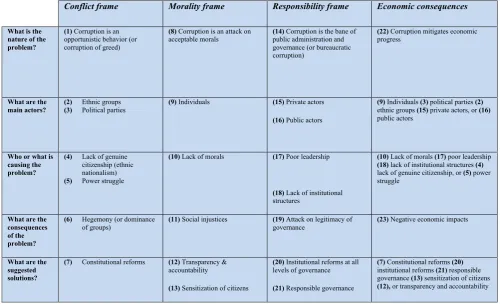
ONCEPTUAL FRAMEWORKBased on the theoretical discussions, we deductively, through literatures, developed a model of four frames (conflict, morality, responsibility, and economic consequences), five frame variables (nature, actors, cause, consequences, and treatment), and 21 frame elements. Two of the frame elements in the table (13 and 21) were inductively developed through news stories. The frame elements were used during coding as the lowest factors that best define and identify the main frames. Using this model in the rest of the research, we investigated: (1) the extent to which different Nigerian newspapers pay attention to the topic of corruption during the general elections; (2) the differences that exist in how Nigerian newspapers frame the nature of corruption; (3) the attribution of responsibility with regards to the actors of corruption; (4) the manifest and latent causes of corruption present or not present; (5) the consequences associated to the problem of corruption in different Nigerian newspapers; (6) the possible treatments or solutions identified in the news stories; and (7) the absolute and relative connections between the main frames and the frame elements.
consequences). The choice of these four frames is because they capture the basic known ways that Nigerian media describe social problems. In every society, media frames can be determined by the societal level of development and/or by the nature of its problems.
TABLE 1: CONCEPTUALIZATION
Conflict frame Morality frame Responsibility frame Economic consequences
What is the nature of the problem?
(1) Corruption is an opportunistic behavior (or corruption of greed)
(8) Corruption is an attack on
acceptable morals (14)public administration and Corruption is the bane of governance (or bureaucratic corruption)
(22) Corruption mitigates economic progress
What are the
main actors? (2)(3) Ethnic groups Political parties (9) Individuals (15) Private actors
(16) Public actors
(9) Individuals (3) political parties (2)
ethnic groups (15) private actors, or (16)
public actors
Who or what is causing the problem?
(4) Lack of genuine citizenship (ethnic nationalism)
(5) Power struggle
(10) Lack of morals (17) Poor leadership
(18) Lack of institutional structures
(10) Lack of morals (17) poor leadership
(18) lack of institutional structures (4)
lack of genuine citizenship, or (5) power struggle
What are the consequences of the problem?
(6) Hegemony (or dominance
of groups) (11) Social injustices (19) governance Attack on legitimacy of (23) Negative economic impacts
What are the suggested solutions?
(7) Constitutional reforms (12) Transparency & accountability
(13) Sensitization of citizens
(20) Institutional reforms at all levels of governance
(21) Responsible governance
(7) Constitutional reforms (20)
institutional reforms (21) responsible governance (13) sensitization of citizens
3.
R
ESEARCHM
ETHODOLOGYContent analysis allows us to understand society’s definition of social problems. In social science research, there are two approaches that can be used to identify media frames in content analysis: inductive and deductive (Deprez & Raeymaeckers, 2010; Tankard, 2001; Semetko & Valkenburg, 2000). The first approach takes place without prior defined frames in mind, whilst the second approach goes with predefined and operationalized frames, and involves a systematic analysis that use list of frames. These two approaches were used in this study, and it took a leaf from previous studies of frames (Semetko & Valkenburg, 2000; Zamith, Pinto, & Villar, 2012; Valkenburg, Semetko, & de Vreese, 1999; DCU School of Communications, 2009). Besides, the study used primarily quantitative approach to describe differences between newspapers in using frames to construct the problem of corruption. The quantitative analyses included how the nature, causes, responsible actors, consequences, and solutions were interpreted, packaged, and presented as frames in the coverage of corruption as social problem in Nigeria within a certain time frame.
3.1SAMPLING AND DATA COLLECTION
This study includes The Vanguard, The Nation, Leadership, and The GUARDIAN newspapers. These newspapers were included because they are ranked among the top ten national newspapers in Nigeria (Uko, 2014), and do have electronic archives (or search engine) with general access to published articles. First, the Vanguard has a wide circulation across Nigeria, with coverage on wide range of topics, including politics. Editorial language is English. Political leaning: right. Second, The Nation is circulated widely across the six geo-political zones in Nigeria (wide/national), and its editorial focus is wide. Editorial language is English. Political leaning: leftist. Third, Leadership is elitist in editorial content, and limited circulation to Nigeria’s major cities (national). Editorial language is English. Political leaning: left. Lastly, The GUARDIAN is elitist in editorial content, and circulates across Nigeria’s urban centers (therefore, wide/national). Editorial language is English. Political leaning: centrist. The different characteristics of these newspapers bring a mix of value into the sample and represent their national-level discourse – as part of the samples’ representativeness.
interests, conflicts, intentions, and objectives are brought to the focal point of public discourse. Fortunately, this period happens to fall within the time frame of this research.
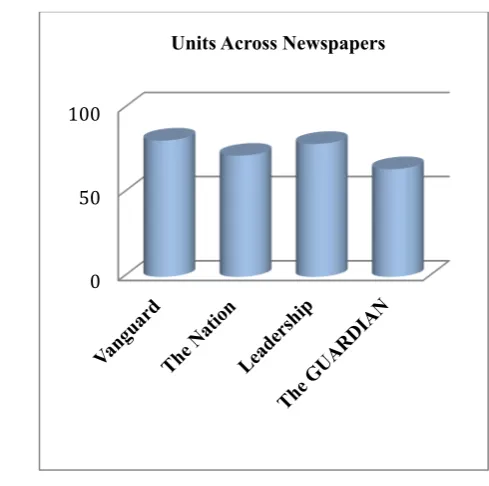
[image:16.595.241.486.335.578.2]To collect articles for analysis from each newspaper, this study focused only on searching for those articles that at least (once) featured the topic of corruption in the newspaper title. And as a first step, the keyword corruption* was entered into each newspaper search engine and/or archive. This keyword search returned a total of (N = 363) articles in the following proportion: Vanguard = 101, The Nation = 87, Leadership = 99, and The GUARDIAN = 76. The generated articles of each newspaper were uniquely numbered starting from 00, 01, 02, and so on. Further, for practical reasons, a fraction of roughly 80% was randomly taken from the sample size of each newspaper. Therefore, this resulted into a total sample size of (N = 295) articles in these proportions: Vanguard (n = 82), The Nation (n = 71), Leadership (n = 80), and The GUARDIAN (n = 62).
TABLE 2: GRAPHICAL BREAKDOWN OF THE UNIT OF ANALYSIS ACROSS NEWSPAPERS
3.2DATA ANALYSIS AND FRAME MEASURES
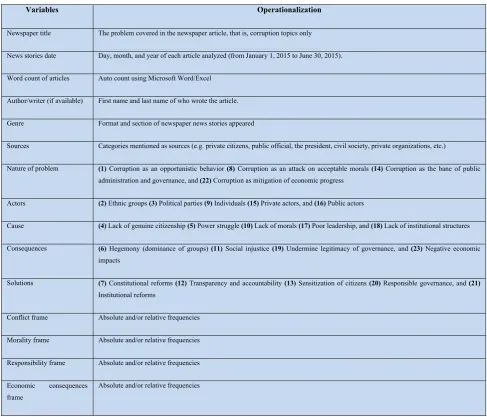
The units of analysis for this study are the individual articles reporting on the topic of corruption. The data analysis involved the construction of a codebook, in which thematic variables were developed to guide data analysis. Table 3 below shows some of the variables that were used. The framing measures adopted for this study followed the principle of scaling (1 = present, 0 = not present) for the frame elements. The coding of the frame elements involved a thorough reading of news stories before coding them in the spreadsheet. This means identifying the manifest mentions of the frame elements in the
0 50 100
Units Across Newspapers
Newspapers Sample size
Vanguard 82
The Nation 71
Leadership 80
The
GUARDIAN 62
articles and/or their latent mentions through association of some keywords and phrases related to them. Additionally, contextual interpretation – taking into consideration the audience of the message – was used to draw some conclusions where frame elements are not clearly visible. The use of latent cues only took precedent when the frame elements are not clearly visible in the news stories.
For example, some of the keywords and phrasal indicators associated to the conflict frame elements included greed, selfishness, lack of trust, betrayal, appetite for acquisition, allegation, disagreement, dispute, attack, debate, accused, etc. Morality frame elements were associated to keywords such as integrity, impunity, conscience (or conscionable), unprincipled, unethical, guilt (or guilty), ungodly, shame, indiscretion, right or wrong, etc. The elements of responsibility frame were associated with incompetence, mediocrity, clueless, complicity, incapacity, inept, etc. Lastly, the elements of economic consequences frame were associated with financial mentions (risks, loss, and gains), costs (unemployment, poverty, insecurity, infrastructures, etc.) and/or degree of expense to the problem. See some examples of selected quotes from news texts (Table A, Appendix). It is important to mention that the randomly selected example text may contain more than one frame element. It was also something taken into consideration during the analyses and coding.
To determine the connections between the frame elements and the main frames, three decision-rule algorithms were used:
I. Simplistic (winner-takes-it-all) algorithm based on simply the main frame with the highest counts of frame elements; that is, the absolute frequency. The limitation of this approach is that the main frames do not all have equal and exclusive frame elements.
II. Weighted average (W) algorithm based on average (counts) of frame elements. This too has its limitation, since it does not recognize frames with equal average counts. Therefore, to eliminate that problem, a third approach is necessary.
Table 3: Variables and operationalization
Variables Operationalization
Newspaper title The problem covered in the newspaper article, that is, corruption topics only News stories date Day, month, and year of each article analyzed (from January 1, 2015 to June 30, 2015). Word count of articles Auto count using Microsoft Word/Excel
Author/writer (if available) First name and last name of who wrote the article. Genre Format and section of newspaper news stories appeared
Sources Categories mentioned as sources (e.g. private citizens, public official, the president, civil society, private organizations, etc.)
Nature of problem (1) Corruption as an opportunistic behavior (8) Corruption as an attack on acceptable morals (14) Corruption as the bane of public administration and governance, and (22) Corruption as mitigation of economic progress
Actors (2) Ethnic groups (3) Political parties (9) Individuals (15) Private actors, and (16) Public actors
Cause (4) Lack of genuine citizenship (5) Power struggle (10) Lack of morals (17) Poor leadership, and (18) Lack of institutional structures Consequences (6) Hegemony (dominance of groups) (11) Social injustice (19) Undermine legitimacy of governance, and (23) Negative economic
impacts
Solutions (7) Constitutional reforms (12) Transparency and accountability (13) Sensitization of citizens (20) Responsible governance, and (21)
Institutional reforms
Conflict frame Absolute and/or relative frequencies Morality frame Absolute and/or relative frequencies Responsibility frame Absolute and/or relative frequencies Economic consequences
frame
4.
R
ESULTSFigure 1 below shows a total sample of (n = 295) articles that were analyzed. This total sample is sum of the sample size of each newspaper, in decreasing order as follows: Vanguard (n = 82), Leadership
(n = 80), The Nation (n = 71), and The Guardian (n = 62). The table also shows the mean word counts of the newspaper articles, in increasing order, these are: Leadership = 479, Vanguard = 704, The Nation = 827, and The Guardian = 895. What these indicate is that there are two main ways to investigate the amount of attention each newspaper gave to the coverage of corruption in Nigeria. The first is based on the sample size of newspapers, which in this case, ranked Vanguard and Leadership as the newspapers that gave highest coverage to corruption. It can be said that The Nation and The Guardian newspapers gave relatively less coverage to the topic. The second way is through the average word count of news articles. With this approach, it seems that The Guardian and The Nation
gave more attention to the topic of corruption, since they are the two with the highest sample size. This would likely mean that Leadership newspaper gave less attention to the topic. Strictly taken, from the two approaches, it can be concluded that there are meaningful differences in the amount of attention that the topic of corruption received across the four newspapers. See more details of frequency distribution of average word counts across newspapers in Appendix, Chart A to D, Plot A and B.
FIGURE 1: AMOUNT OF ATTENTION TO CORRUPTION
Newspaper n Ranking on
freq. Mean (S.D.)
Ranking on
size article Total words
Ranking on total words
Vanguard 82 1 704 (571) 3 57728 2
Leadership 80 2 479 (360) 4 38320 4
The Nation 71 3 827 (735) 2 58717 1
The Guardian 62 4 895 (807) 1 55490 3
Total 295 713 (643) 210335
Nature of corruption
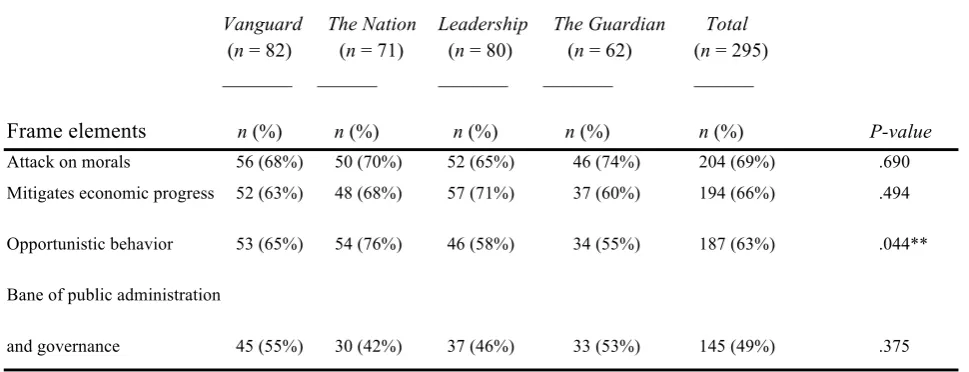
This frame variable is one of the ways frames were used to describe the problem of corruption in this study, and was distinguished by four possible frame elements. The elements are: corruption as an opportunistic behavior, corruption as an attack on morals, corruption as the bane of public administration and governance, and corruption mitigating economic progress. These frame elements were deductively developed through literatures on corruption and related to conflict, morality, responsibility, and economic consequences. In some cases, these frame elements were not visibly present in the newspapers, and that is when the latent cues took precedent in the analysis. The result (see Figure 2 below) shows the total percentage differences, vertically, across frame elements. In decreasing order, corruption as an attack on morals = 69%, corruption mitigates economic progress = 66%, corruption as an opportunistic behavior = 63%, and corruption as the bane of public administration and governance = 49%. Based on these total values, there seem to be no meaningful differences in the use of these frame elements to describe the nature of corruption in Nigeria. A Chi-square test on each frame element, horizontally, across newspapers seems to indicate otherwise a significant difference only on corruption as an opportunistic behavior, with a P-value of 0.04 at Alpha (α = 5%). Looking at the percentage values of this particular frame element across the four
Figure 2: Nature of corruption
Vanguard The Nation Leadership The Guardian Total
(n = 82) (n = 71) (n = 80) (n = 62) (n = 295)
_______ ______ _______ _______ ______
Frame elements n (%) n (%) n (%) n (%) n (%) P-value
Attack on morals 56 (68%) 50 (70%) 52 (65%) 46 (74%) 204 (69%) .690
Mitigates economic progress 52 (63%) 48 (68%) 57 (71%) 37 (60%) 194 (66%) .494
Opportunistic behavior 53 (65%) 54 (76%) 46 (58%) 34 (55%) 187 (63%) .044**
Bane of public administration
and governance 45 (55%) 30 (42%) 37 (46%) 33 (53%) 145 (49%) .375
Note: (α = 5%), **p < .05, two-tailed, significant.
Attribution of responsibility (Actors)
Figure 3: Attributes of responsibility
Vanguard The Nation Leadership The Guardian Total
(n = 82) (n = 71) (n = 80) (n = 62) (n = 295)
_______ ______ _______ _______ ______
Frame elements n (%) n (%) n (%) n (%) n (%) P-value
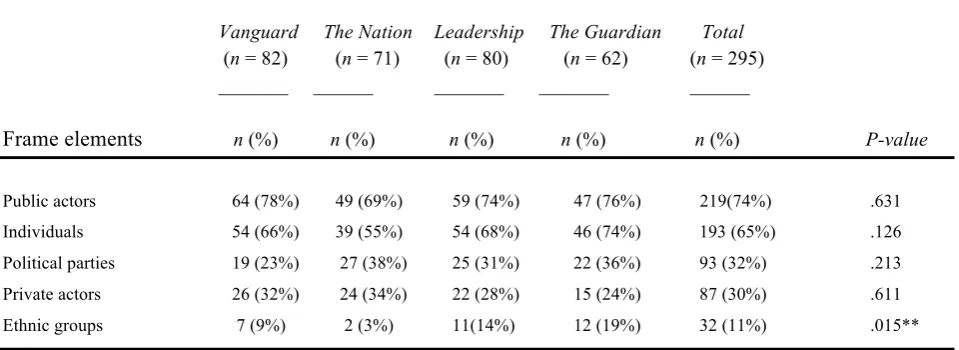
Public actors 64 (78%) 49 (69%) 59 (74%) 47 (76%) 219(74%) .631
Individuals 54 (66%) 39 (55%) 54 (68%) 46 (74%) 193 (65%) .126
Political parties 19 (23%) 27 (38%) 25 (31%) 22 (36%) 93 (32%) .213
Private actors 26 (32%) 24 (34%) 22 (28%) 15 (24%) 87 (30%) .611
Ethnic groups 7 (9%) 2 (3%) 11(14%) 12 (19%) 32 (11%) .015**
Note: (α = 5%), **p < .05, two-tailed, significant.
Causes of corruption
Figure 4: Causes of corruption
Vanguard The Nation Leadership The Guardian Total
(n = 82) (n = 71) (n = 80) (n = 62) (n = 295)
_______ ______ _______ _______ ______
Frame elements n (%) n (%) n (%) n (%) n (%) P-value
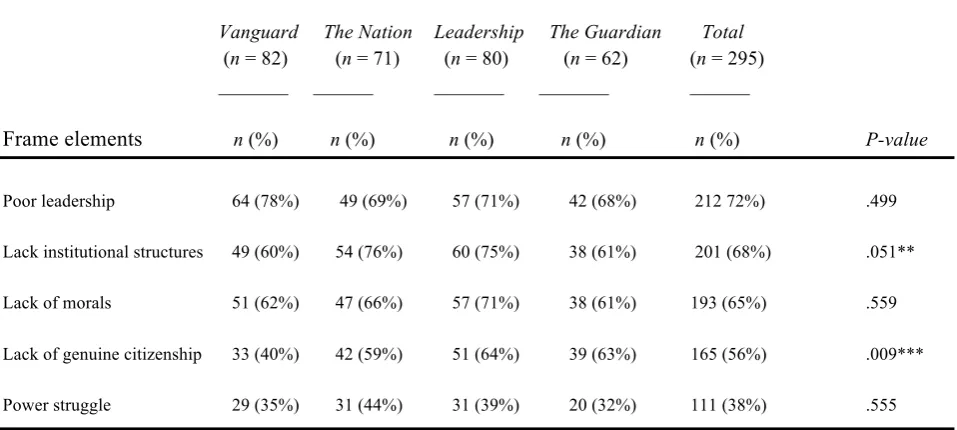
Poor leadership 64 (78%) 49 (69%) 57 (71%) 42 (68%) 212 72%) .499
Lack institutional structures 49 (60%) 54 (76%) 60 (75%) 38 (61%) 201 (68%) .051**
Lack of morals 51 (62%) 47 (66%) 57 (71%) 38 (61%) 193 (65%) .559
Lack of genuine citizenship 33 (40%) 42 (59%) 51 (64%) 39 (63%) 165 (56%) .009***
Power struggle 29 (35%) 31 (44%) 31 (39%) 20 (32%) 111 (38%) .555
Note: (α = 5%), ***p < .05, two-tailed, very significant.
Consequences of corruption
Figure 5: Consequences of corruption
Vanguard The Nation Leadership The Guardian Total
(n = 82) (n = 71) (n = 80) (n = 62) (n = 295)
_______ ______ _______ _______ ______
Frame elements n (%) n (%) n (%) n (%) n (%) P-value
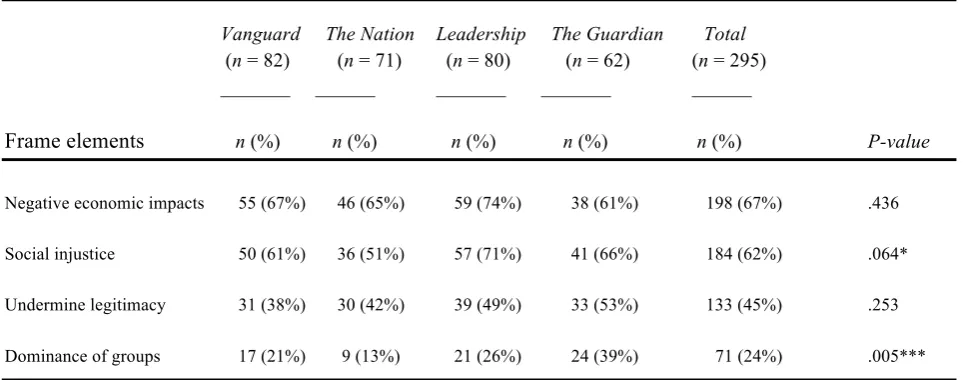
Negative economic impacts 55 (67%) 46 (65%) 59 (74%) 38 (61%) 198 (67%) .436
Social injustice 50 (61%) 36 (51%) 57 (71%) 41 (66%) 184 (62%) .064*
Undermine legitimacy 31 (38%) 30 (42%) 39 (49%) 33 (53%) 133 (45%) .253
Dominance of groups 17 (21%) 9 (13%) 21 (26%) 24 (39%) 71 (24%) .005***
Note: (α = 5%), ***p < .05, two-tailed, very significant.
Treatment
Figure 6: Possible treatments
Vanguard The Nation Leadership The Guardian Total
(n = 82) (n = 71) (n = 80) (n = 62) (n = 295)
_______ ______ _______ _______ ______
Frame elements n (%) n (%) n (%) n (%) n (%) P-value
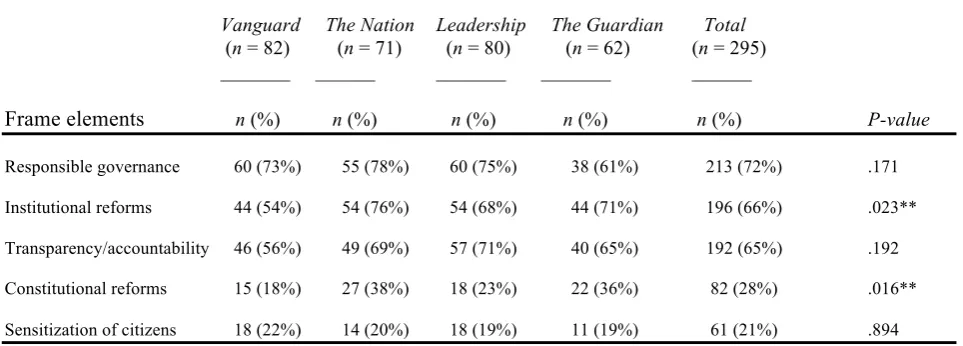
Responsible governance 60 (73%) 55 (78%) 60 (75%) 38 (61%) 213 (72%) .171
Institutional reforms 44 (54%) 54 (76%) 54 (68%) 44 (71%) 196 (66%) .023**
Transparency/accountability 46 (56%) 49 (69%) 57 (71%) 40 (65%) 192 (65%) .192
Constitutional reforms 15 (18%) 27 (38%) 18 (23%) 22 (36%) 82 (28%) .016**
Sensitization of citizens 18 (22%) 14 (20%) 18 (19%) 11 (19%) 61 (21%) .894
Note: (α = 5%), **p < .05, two-tailed, significant.
Salience of Frames
In the model framework, twenty-three (23) frame elements were associated to four main frames – that is, conflict, morality, responsibility, and economic consequences – in order to understand how corruption is collectively defined as a social problem (See Table 1, page 12). The frame elements are factors that can provide meaning to the salience of these main frames. But the challenge is on how to make agreeable connections between the frame elements and the main frames. This is because, looking at the frequency distributions of elements within news stories (See Appendix, Chart E to H), there is no mono-frame article. An article can have some or all of the elements of the main frames. Which means that an article can contain elements of conflict, morality, responsibility, and/or economic consequences frames. Put in another way, there is likely no perfect article that used only one type of frame for corruption.
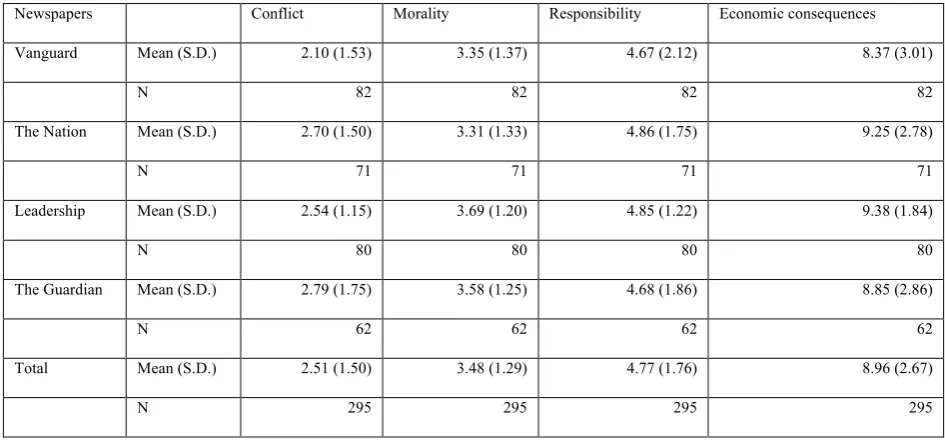
The first decision-rule is a simplistic or winner-takes-it-all algorithm. It is simply based on the highest absolute mean count of frame elements of each main frame. This is unique considering that the main frames do not have equal distribution of frame elements, and some of the elements of economic consequences frame overlap with the elements of the other three frames. For example, conflict frame = 7 elements, morality frame = 6 elements, responsibility frame = 8 elements, and economic consequences frame = 17 elements, making an imperfect distribution. Which means that economic consequences frame is more advantaged than the rest frames, and has higher probability to emerge as the dominant frame in any news articles. Notwithstanding, using this decision-rule, the prevalence of frames in Table 4 below, shows total dominance of the main frames in this decreasing order: economic consequences frame = 9.0, responsibility frame = 4.7, morality frame = 3.5, and conflict frame = 2.5. Obviously, economic consequences frame with the highest frame elements in the model table therefore emerged as the dominant frame.
Table 4: Absolute frequency (simple algorithm)
To ameliorate the unfair distribution of frame elements, a second decision-rule is hereby introduced as weighted average (W) algorithm – and it is a more sophisticated approach than the former. Rather than the absolute frequency, it adopts relative frequency in the analysis of frames across articles of newspapers. It divides the total count of frame elements in an article by the initial number of elements as assigned in the model table. For example, if 5 frame elements were counted for the responsibility frame in an article, its relative mean frequency, therefore, is 5 8=0.6, since responsibility frame in our model table has eight (8) frame elements. This same principle applies to all the other main frames, and therefore reduces the chances of any of the main frame being disadvantaged
Newspapers Conflict Morality Responsibility Economic consequences Vanguard Mean (S.D.) 2.10 (1.53) 3.35 (1.37) 4.67 (2.12) 8.37 (3.01)
N 82 82 82 82
The Nation Mean (S.D.) 2.70 (1.50) 3.31 (1.33) 4.86 (1.75) 9.25 (2.78)
N 71 71 71 71
Leadership Mean (S.D.) 2.54 (1.15) 3.69 (1.20) 4.85 (1.22) 9.38 (1.84)
N 80 80 80 80
The Guardian Mean (S.D.) 2.79 (1.75) 3.58 (1.25) 4.68 (1.86) 8.85 (2.86)
N 62 62 62 62
Total Mean (S.D.) 2.51 (1.50) 3.48 (1.29) 4.77 (1.76) 8.96 (2.67)
by another. Using this decision-rule, Table 5 below shows total mean values different from what was obtained in table 4. The dominance of frames are now in this order from the highest to the lowest: responsibility frame = .596, morality frame = .580, economic consequences frame = .527, and conflict frame = .359. In table 4, economic consequences frame was ranked number 1 in dominance, but in the current table 5, it is ranked number 3. Therefore, this approach of analysis can be seen more as a balancer since it offsets some of the limitations of the previous approach.
Newspapers Conflict Morality Responsibility Economic consequences Vanguard Mean (S.D.) .301(.218) .559 (.229) .584 (.265) .492 (.177)
N 82 82 82 82
The Nation Mean (S.D.) .386 (.214) .552 (.221) .607 (.219) .544 (.164)
N 71 71 71 71
Leadership Mean (S.D.) .363 (.165) .615 (.110) .606 (.153) .552 (.109)
N 80 80 80 80
The Guardian Mean (S.D.) .399 (.250) .597 (.208) .585 (.233) .521 (.168)
N 62 62 62 62
Total Mean (S.D.) .359 (.214) .580 (.216) .596 (.220) .527 (.157)
[image:27.595.69.539.228.465.2]N 295 295 295 295
Table 5: Weighted average (W) algorithm
Table 6: Weighted average algorithm – 3 frames option (Chi-square, P-value = .187, Alpha = 5%)
Lastly, in order to address the problem identified in the weighted average algorithm, we introduced here a third decision-rule of multiple algorithm. A borderline of 0.5 count was created on the weighted average (W) counts. In other words, any article with up to 0.5 of weighted average count on frame elements is assigned a 1 under any of the main frames labels associated to it. The result (see Table 7 below) on the multiple algorithms of frames shows total percentage differences across the four main frames. In the order of dominance, responsibility frame (78%) is ranked first, morality frame (76%) is ranked second, economic consequences frame (59%) is ranked third, and conflict frame (26%) is ranked fourth. These values align with the result of the weighted average algorithm, where the main frames appear in this same order. There seems to be meaningful differences in these percentage values across frames. On the other hand, across newspapers, the frames that recorded significant differences are responsibility, economic consequences, and conflict frames. The Chi-square test (at 5% Alpha) indicates significant differences of each of these frames across newspapers as 0.04, 0.06, and 0.05 respectively. On responsibility frame, Leadership newspaper scored a significant percentage value of 89% than the other newspapers. On economic consequences frame, Leadership
and The Guardian scored significant percentage values of 80% each. While it can be said that The Nation and The Guardian newspapers scored significant percentage values of 32% each.
Vanguard The Nation Leadership The Guardian Total
Fr_S3 Conflict 7 11 4 6 28
9.0% 15.7% 5.3% 9.8% 9.8%
Morality 31 21 38 27 117
39.7% 30.0% 50.0% 44.3% 41.1%
Responsibility 40 38 34 28 140
51.3% 54.3% 44.7% 45.9% 49.1%
Total 78 70 76 61 285
Table 7: Multiple algorithms (WM)
Vanguard The Nation Leadership The Guardian Total
(n = 82) (n = 71) (n = 80) (n = 62) (n = 295)
_______ ______ _______ _______ ______
Frames n (%) n (%) n (%) n (%) n (%) P-value
Responsibility 60 (73%) 55 (76%) 71 (89%) 44 (71%) 230 (78%) .040**
Morality 58 (71%) 53 (75%) 64 (80%) 50 (80%) 225 (76%) .430
Economic consequences 37(45%) 47(66%) 56 (70%) 34 (54%) 174 (59%) .006***
Conflict 15 (18%) 25 (32%) 17 (21%) 20 (32%) 77 (26%) .049**
5.
D
ISCUSSION AND CONCLUSIONThe aim of this study was to examine and describe differences in the use of frames in the coverage of corruption as social problem in Nigeria. Frame in this goal was used to define the nature of the problem, assess causes, actors, consequences and, in addition, the possible treatments. To achieve that objective, this study deductively (through literatures) and inductively (through news articles) developed 23 frame elements around four main frames frequently used in academic literatures to define social and political problems. The next step taken was to analyze the ways these frame elements were used (manifest or latent) in news articles. Overall, in the coverage of corruption as social problem, responsibility, morality, and economic consequences frames dominated the various newspaper articles analyzed. One thing this study has ascertained is that corruption in general can either be a conflict, morality, responsibility, or economic consequences social problem. Dominantly, this problem has been framed in this study more as a responsibility, morality and economic consequences social problem. The amount of attention the topic received across newspapers varied in two ways. On the basis of sample size, Vanguard and Leadership gave the highest amount of coverage to the topic, whilst The Nation gave the highest amount of attention within news articles on the basis of total word count. In summary, based on the findings, it can be said that the collective definition of corruption as a social problem is thus settled.
various ethnic groups, political parties, and religions hurl attacks on one another, in order to consolidate their strategy to grab political power and to subdue other groups. The discourse on dominance and marginalization are evidence of the consequences (including violence) that that has resulted from Nigeria’s conflict situations. Many have argued that to avert the underlying cause of conflict and corruption in Nigeria, there is the need for a constitutional reform that will do away with the current constitution that promote hegemony and protects public officials that perpetuate corruption.
Morality frame embodies human nature and behaviors, and it is mainly attributed to people (Gebel, 2012; Ochulor, 2011). Morality frame references cultural and/or religious embedding of the problem by prescribing certain social and moral beliefs in the society that influence the existence of the problem (Neuman et al., 1992). The nature of corruption in Nigeria significantly erodes acceptable morals due to deep-rooted culture of impunity. The practice of corruption leads to a deterioration of character and contagion of bad example (Brooks, 1909), which is found within individual behavior and lifestyle. It is manifest in the lack of integrity and ethics both on individual and political levels in the procedures of rendering public services. Evidently, public looting, political rigging, and vote buying are some of the ways that corruption has persisted within Nigerian society. Consequently, this forms of corruption has led to poverty and wanton abuse of human rights in the country. The study has shown that morality is one of the dominant frames used to construct corruption as a debilitating social problem. Public discourse on the solution to change this moral behavior, argues for the urgent need to hold individuals especially those holding public offices accountable for the crimes of corruption. This would go a long way in reducing the culture of impunity in the country. Additionally, the day-to-day activities of bureaucratic and political institutions have to be conducted in transparent and ethical manners to restore the people’s confidence in public institutions. Competitive procedures of awarding contracts must be enshrined as a standard rule that cannot be lowered for anyone.
cannot live up to their public tasks. Evidences abound of the misappropriation and misallocation of resources by public officials, and the perpetrators often go unpunished. This has undermined the perceptions of citizens towards government institutions and public officials. The support (legitimacy) that citizens give to a political regime is often based on the trade-off between efficiency and effectiveness (Lipset, 1983). This is what is often called output legitimacy (Diamond & Lipset, 1994), and corruption leads to under-provision (output) of those things the citizens expect from the government. Whereby this is conspicuously lacking, it seriously undermine that support that the political system receive from the citizens. Such can be seen in the citizen perceptions within media discourse. However, to tackle the problem of corruption, there must be institutional reforms at all levels of governance, and it requires commitment and setting or rules that will serve to limit opportunity for corruption (Glaeser & Goldin, 2004). There is also the need for Nigerian leadership to be more responsible to the menaces of corruption in the society.
As limitations, this study did not have enough time to compare the findings of this research to other period of elections in Nigeria. Though this can be used as basis for comparing how media discourse in future elections will be framed around certain social problems in the country. It was also not part of the ambition of this study to venture into the direction of audience frames, therefore cannot verify the effects these frames have on the various newspapers’ audience. This might be a fascinating research in the future within Nigerian media and political ecology. How this frames fit into the ideological positions of the newspapers was not part of the goal of this research, but an aspect that can be investigated in the future. As a worthwhile goal, future studies on frames may investigate how these frames are used in Television news stories on the problem of corruption and other social problems, to ascertain if similar patterns can be obtained.
While it might be difficult to conclude that similar pattern of frames from the findings can be extrapolated, there is a strong confidence that the method applied in this study is replicable. A single coder was used in this research, which therefore makes inter-coder reliability difficult to ascertain. However, the coding followed a high standard of proficiency by keeping errors and biases at the lowest margin. The coder – fluent in English – double-checked and did a thorough reading of articles. Moreover, the validity aspect of this study can also be found within the constructs. This study made sure that the abstract nature of the constructs of frames and their elements correlated, and that they can be found within the body of constructs of other studies and theories.
R
EFERENCESAdamolekun, L. & Kincaid, J. (1991). The Federal Solution: Assessment and Prognosis for Nigeria and Africa. Publius, Vol. 21, No. 4, pp. 173—188.
Aluko, M. A. (2003). Ethnic Nationalism and the Nigerian Democratic Experience in the Fourth Republic. Anthropologist, 5(4): 253-259.
Anderson, C. J. & Tverdova, Y. V. (2003). Corruption, political allegiances, and attitudes toward government in contemporary democracies. American Journal of Political Science 47 (1): 91—109.
Andreev, S. A. (2006). Corruption, Legitimacy and the Quality of Democracy in Central and Eastern Europe and Latin America.ECPR Joint Sessions, Nicosia 2006.
Anugwom, E. (2000). Ethnic Conflict and Democracy in Nigeria: The Marginalization Question. Journal of Social Development in Africa, 15(1): 61-78.
Atkinson, M. L., Lovett, J., & Baumgartner, F. R. (2014). Measuring the Media Agenda. Political Communication, 31: 355—380.
Baumgartner, F. R. & Jones, B. D. (1993). Agendas and Instability in the American Politics. Chicago: University of Chicago Press.
Blumer, H. (1971). Social Problems as Collective Behavior. Social Problems, Vol. 18, No. 3, pp. 298—306
Brooks, R.C. (1909). The Nature of Political Corruption. Political Science Quarterly, Vol. 24(1), pp. 1 – 22.
Cappella, J. N., & Jamieson, K. H. (1997). Spiral of Cynicism. The press and the public good. New York: Oxford University Press.
Casimir, K. C., Izueke, E. M., & Nzekwe, I. F. (2014). Public Sector Corruption in Nigeria: An Ethical and Institutional Framework of Analysis. Journal of Philosophy, Vol. 4: 216—224.
De Vreese, C. H. (2005). News Framing: Theory and typology. Information Design Journal 13(1), 51—62.
Olivier de Sardan, J. P. (1999). A moral economy of corruption in Africa. The Journal of Modern African Studies, Vol. 37, No. 1, pp. 25—52.
DCU School of Communication (2009). Reading the Developing World. A Content Analysis of Irish Print Media Coverage. Final Report
Diamond, L. (1987). Issues in the Constitutional Design of a Third Nigerian Republic. African Affairs, 86(343): 209-226.
Diamond, L. & Lipset, S.M. (1994). “Legitimacy,” entry in the Encyclopaedia of Democracy, 1994, pp. 747 – 751.
Dike, V. E. (2003). Managing the Challenges of Corruption in Nigeria. Center for Social Justice and human Development (CSJHD).
Dike, V. (2002). Corruption in Nigeria: A new paradigm for effective control.
Dix, S., Hussmann, K., & Walton, G. (2012). Risks of corruption to state legitimacy and stability in fragile situations. U4 Issue (May 2012) No 3.
Dudley, B. J. (1973). Instability and Political Order: Politics and Crisis in Nigeria. Ibadan: Ibadan University Press.
Ekeh, P. P. (1975). Colonialism and the Two Publics: A Theoretical Statement. Comparative Studies in Society and History, Vol. 17, No. 1, pp. 91—112.
Entman, R. M. (1993). Framing: Toward clarification of a fractured paradigm. Journal of Communication, 43(4), 51-58. doi:10.1111/j.1460-2466.1993.tb01304.x.
European Union Election Observation Mission (2015). Final Report Federal Republic of Nigeria.
Fawole, O. P. & Olajide, B. R. (2012). Reporting of Climate Change News in Three Nigerian Newspapers. Journal of Agricultural Extension, Vol. 16, No. 1, pp. 31—41
Gamson, W. (1992). Talking politics. New York: Cambridge University Press.
Gebel, A. C. (2012). Human Nature and Morality in the Anti-Corruption Discourse of Transparency International. Public Administration and Development, Vol. 32, pp. 109—128.
Gitlin, T. (1980). The Whole World Is Watching: Mass Media in the Making and Unmaking of the New Left. Berkley: University of California Press. (p.7)
Glaeser, E.L. & Goldin, C. (2004). Corruption and Reform: An Introduction. NBER Working Paper.
Goffman, E. (1974). Frame analysis: An essay on the organization of experience. New York: Harper & Row. (p.156)
Graber, D. (1993). Mass media and American Politics. Washington, DC: CQ Press.
Hilgartner, S. (1988). The Rise and Fall of Social Problems: A Public Arenas Model. American Journal of Sociology, Vol. 94, No. 1, pp. 53—78.
Hofstede, G. (1984). Cultural Dimension In Management And Planning. Asia Pacific Journal of Management, 1(2): 81-99
Horton, J. (1966). Order and Conflict Theories of Social Problems as Competing Ideologies. American Journal of Sociology, Vol. 71, No. 9, pp. 701—713
Imhonopi, D. & Ugochukwu, M. (2013). Leadership Crisis and Corruption in the Nigerian Public Sector: An Albatross of National Development. Journal of African Educational Research Network, Vol. 13, No. 1, pp. 78—87.
Ikelegbe, A. (2005). The Economy of Conflict in the Oil Rich Niger Delta Region of Nigeria. Nordic Journal of African Studies, Vol. 14, No. 2, pp. 208—234.
Irobi, E. M. (2005). Ethnic Conflict Management in Africa: A Comparative Case Study of Nigeria and South Africa. Published on (http://www.beyondintractability.org).
Iyengar, S. (1987). Television news and citizens’ explanations of national affairs. American Political Science Review, Vol. 81, pp. 815—831.
Iyengar, S. (1991). Is anyone responsible? How television frames political issues. Chicago: University of Chicago Press.
Iyengar, S. (1990). Framing Responsibility for Political Issues: The Case of Poverty. Political Behavior, Vol. 12, No. 1, pp. 19—40.
Jamieson, K. (1992). Dirty Politics. New York: Oxford University Press.
Leadership (2015). The Corruption of Politics. Published on May 22, 2015. Retrieved on October 7, 2015, from http://leadership.ng/blogposts/435205/the-corruption-of-politics
Levine, D. P. (2005). The Corrupt Organization. Human Relations, Vol. 58, No. 6, 723—740.
Loseke, D. R. (1992). The Battered Women and Shelters: The Social Construction of Wife Abuse. New York: State University of New York Press.
Lijiphart, A. (1984). Democracies. Yale University Press, New Hawen.
Lipset, S.M. (1984). “Social Conflict, Legitimacy, and Democracy,” reprinted in Conolly, W. (ed.) Legitimacy and the State (Oxford: Basil Blackwell, 1984), originally published in Lipset, S.M. (ed.) Political Man: The Social Bases of Politics (Baltimore, MD: Johns Hopkins University Press, 1981).
Lipset, S.M. (1983). Political Man: The Social Bases of Politics. Aldershot: Gover, 1983.
Lukes, S. (1969). Durkheim’s ‘Individualism and the Intellectuals.’ Political Studies, Vol.17 (1), pp. 14 – 30. DOI: 10.1111/j.1467-9248.1969.tb00622.x
Marc, A., Verjee, N., & Mogaka, S. (2015). The Challenge of Stability and Security in West Africa. Africa Development Forum (2015).
McCombs, M. E., & Shaw, D. L. (1972). The agenda-setting function of the mass media. Public Opinion Quarterly, 36, 176—187. doi:10.1086/267990.
Montinola, G. R. & Jackman, R. W. (2002). Sources of Corruption: A Cross-Country Study. British Journal of Political Science, Vol. 32, No. 1, pp. 147—170.
Moore, C. (2008). Moral Disengagement in the Processes of Organizational Corruption. Journal of Business Ethics (2008) 80: 129 – 139.
Neuman et al. (2014). The Dynamics of Public Attention: Agenda-Setting Theory Meets Big Data. Journal of Communication64, 193—214.
Neuman, W.R., Just, M. R., & Crigler, A. N. (1992). Common knowledge. Chicago: University of Chicago Press.
Patterson, T. (1993). Out of order. New York: Knopf.
Rubington, E. & Weinberg, M. (2010). The study of Social Problems: Seven Perspectives. New York, Oxford University Press.
Ochulor, C. L. (2011). Ethical and Moral Implications of Corruption. Canadian Social Science, Vol. 7. No. 5, pp. 223—228.
Ogbeidi, M. (2012). Political Leadership and Corruption in Nigeria Since 1960: A Socio-economic Analysis. Journal of Nigerian Studies, Vol. 1(2), 1—25.
Ogundiya, I. S. (2009). Political Corruption in Nigeria: Theoretical Perspectives and Some Explanations. Anthropologist, Vol. 11, No. 4, pp. 281—292.