http://wrap.warwick.ac.uk
Original citation:Yau, Jane Yin-Kim and Joy, Mike (2006) Context-aware and adaptive learning schedule for mobile learning. In: International Workshop on Mobile and Ubiquitous Learning Environments (MULE) at the International Conference on Computers in Education (ICCE 2006), Beijing, China, 30 Nov - 4 Dec 2006 pp. 17-24.
Permanent WRAP url:
http://wrap.warwick.ac.uk/61582 Copyright and reuse:
The Warwick Research Archive Portal (WRAP) makes this work by researchers of the University of Warwick available open access under the following conditions. Copyright © and all moral rights to the version of the paper presented here belong to the individual author(s) and/or other copyright owners. To the extent reasonable and practicable the material made available in WRAP has been checked for eligibility before being made available.
Copies of full items can be used for personal research or study, educational, or not-for profit purposes without prior permission or charge. Provided that the authors, title and full bibliographic details are credited, a hyperlink and/or URL is given for the original metadata page and the content is not changed in any way.
A note on versions:
The version presented here may differ from the published version or, version of record, if you wish to cite this item you are advised to consult the publisher’s version. Please see the ‘permanent WRAP url’ above for details on accessing the published version and note that access may require a subscription.
Context-Aware and Adaptive Learning
Schedule for Mobile Learning
Jane Yau, Mike Joy
Department of Computer Science, University of Warwick, UK
{j.y-k.yau, m.s.joy}@warwick.ac.uk
Abstract:Mobile learning has become widespread and students nowadays are able to learn anywhere and at any time, enabled by mobile technologies and wireless internet connections. As a result, context-awareness and adaptation in mobile learning has become increasingly important to support the dynamic and continually changing settings within the learner’s mobile learning environment. The challenges associated with the contexts include that they are difficult to identify, acquire and make use of. We examine the relationship between mobile learning and computing contexts and elements from the Dunn and Dunn learning styles model, and establish many similarities, and use this to form a theoretical framework underpinning our proposed architectureContext-aware and Adaptive Learning Schedule for Mobile Learning.
Keywords: Context-aware, Adaptive Learning, Learning Schedule, Learning Styles, Mobile Learning
Introduction
The field ofcontext-awarecomputing was proposed around a decade ago and is a “mobile computing paradigm in which applications can discover and take advantage of contextual information (such as user location, time of day, nearby people and devices, and user activity)” [1]. An objective of a mobile-aware application is to be adaptive and effective to users’ information needs, taking into dynamic environmental characteristics, such as the contextual information mentioned above, without consuming too much of a user’s attention.
A broad definition of contextgiven by Chen & Kotz [1] is “the set of environmental states and settings that either determines an application’s behaviour or in which an application event occurs and is interesting to the user”. Three categories of context were identified by Schilitet al. [2] and a fourth one was added by Chen & Kotz [1], as follows:
1. Computing context – this includes network connectivity, communication costs, communication bandwidth and nearby resources (e.g. printers and workstations). 2. User context –this includes the user’s profile, location, people nearby and current
social situation.
3. Physical context – this includes lighting, noise levels, traffic conditions and temperature.
4. Time context –this includes the time of a day, week, month and season of the year.
The remainder of this paper is organized as follows. First, the context-awareness and adaptation topic specifically for mobile learning is explored. Second, two different learning styles models are examined closely, and the relation between the Dunn and Dunn model and the mobile learning contexts are investigated. Third, the motivation of our proposed research is discussed and the system architecture of our Context-aware and Adaptive Learning Schedule for Mobile Learningis illustrated. Finally, our conclusion is given.
1. Context-awareness and Adaptation in Mobile Learning
In mobile learning students are able to learn at any time and at any location they wish with their mobile devices. Chanet al. [3] distinguished mobile learning “by rapid and continual changes of context, as the learner moves between locations and encounters localised resources, services and co-learners”. Different learning contexts are instantiated as a result due to this dynamic and continually changing learning setting in the mobile learning environment. For that reason, context-aware mobile learning has become increasingly important and its task is to sense the mobile environment and react to the changing context during a student’s learning process.
Contexts in mobile learning have been categorized by Wang [4] into six dimensions which form a Context Space, as illustrated in Table 1 below.
Table 1 – Wang’s Six Dimensions of Contexts in Mobile Learning
Dimension Explanation
Identity Unique identifier of each learner, recognized usually via a login system, or through special devices such as smart cards.
Spatio-Temporal This consists of Time and Location. The time can be obtained through the clock on the mobile device and the location can be provided through a locating sensor such as Global Positioning System (GPS). Knowing these two elements allows us to indicate an instant or period during which some information will be required by a user. An example is Nottingham Castle museum gallery [5].
Facility This consists of the type of mobile device, such as PDA, mobile phone, smart phone, tablet PC, laptop; and the capabilities of the devices such as the CPU power, display size, colour resolution and input method. Learning materials can be adapted to the mobile device accordingly.
Activity To detect and determine an appropriate set of activities for a learning process may be difficult. Ways to obtain this context include using discussion records online, or by viewing live actions occurring in classrooms, or acquired by web actions that are portfolios of the student’s access log.
Learner This consists of the intrinsic and psychological properties of a learner which are important for learning successfully, such as the learner’s emotional state, focus of attention and background; however, not easy to detect.
1.1 Challenges of Context-awareness for Mobile Learning
Schmidt [6] identified three challenges associated with context-awareness:
1. Context is difficult to identify – there is not a defined set of elicitation methods for obtaining context factors.
2. Context is difficult to acquire – the challenge lies within the question of how to obtain the actual information about the user, once the relevant context features have been identified. Direct methods (such as asking the user) can be applied in only limited cases; Indirect methods (such as observations of the user) have disadvantages associated with them. For example, these methods yield imperfect results, and the observations require a wide range of applications to be attached. Otherwise the data must be obtained from a wide range of data resources.
3. Context is difficult to make use of – “Empirical results on contextual influence on the learning processes are scarce and mostly scattered among various disciplines.” If and how learning efficiency can be improved with context-awareness is not known. Context-aware learning support requires pedagogical theories and methodologies as its foundation.
1.2 Related Work
Martín et al. [ 7 ] designed a system for recommending activities for learners; this recommendation process is dependent on the learner’s personal attributes, previous actions and the current context (location, spare time, available devices). The system also has the option to interrupt the user to recommend appropriate activities to them, according to their context. Ogata & Yano’s [8] designed a context-aware language learning support system for learning Japanese polite expressions.
2. Learning Styles
Keefe [9] defined learning styles as characteristics which are “cognitive, affective and psychological behaviours that serve as relatively stable indicators of how learners perceive, interact with, and respond to the learning environment”. Three major learning styles categories are (1) Instructional and Environmental learning preferences, (2) Information and Processing learning preferences, and (3) Personality Related learning preferences (Curry [10]). The Dunn and Dunn learning styles model (Dunn and Dunn [11]) consists of five components which were formed under the three learning styles categories. Table 2 below lists the components along with their factors.
Table 2 - The Dunn and Dunn learning styles model
Environmental Sound/Noise Level, Temperature, Light, Seating, Layout of Room/Location
Emotional Motivation, Degree of Responsibility, Persistence and Need for Structure
Physical Modality Preferences i.e. for visual, auditory, kinaesthetic/tactile learning, Intake (Food and Drink), Time of Day, Mobility
Sociology Learning Groups, Help/Support from authoring figures, working alone/with peers, motivation from parent/teacher
Another model such as the Felder and Silverman model [15] is formed under the Information and Processing learning preferences category and distinguishes the learning preferences of learners based on the following four dimensions - (1) Active/Reflective, (2) Sensing/Intuitive, (3) Visual/Verbal, and (4) Sequential/Global, as shown in Table 3.
Table 3 – The Felder and Silverman learning styles model
Active Prefer to actively do something with the information in order to process it e.g. discussing it or testing it
1
Reflective Prefer to read and think about the learned material.
Sensing Prefer concrete materials such as facts and data.
2
Intuitive Prefer abstract material such as theories and their underlying meaning.
Visual Learns best from what they can see or visualise.
3
Verbal Learns best with communication and discussion.
Sequential Prefer to know the details of the sub-topics.
4
Global Prefer to see the ‘big picture’ of the topic before learning the details.
2.1 Relation between the Dunn and Dunn learning styles model and the contexts of mobile learning
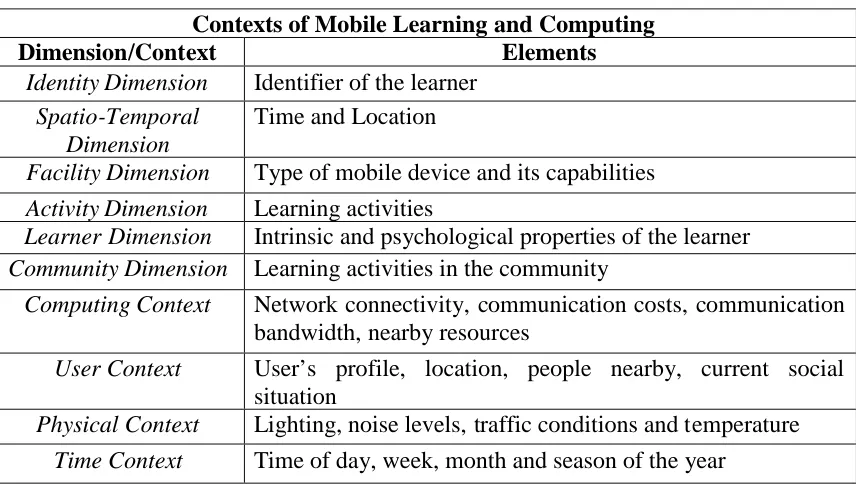
Recall the following contexts of mobile learning (Wang [4]) and the contexts of mobile computing (Schilitet al. [2]; Chen & Kotz [1]), summarised in Table 4 below.
Table 4 – Contexts of Mobile Learning and Computing
Contexts of Mobile Learning and Computing Dimension/Context Elements
Identity Dimension Identifier of the learner
Spatio-Temporal Dimension
Time and Location
Facility Dimension Type of mobile device and its capabilities
Activity Dimension Learning activities
Learner Dimension Intrinsic and psychological properties of the learner
Community Dimension Learning activities in the community
Computing Context Network connectivity, communication costs, communication bandwidth, nearby resources
User Context User’s profile, location, people nearby, current social situation
Physical Context Lighting, noise levels, traffic conditions and temperature
Time Context Time of day, week, month and season of the year
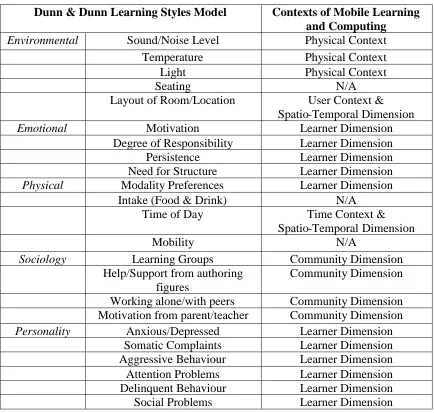
Table 5 – Relationship between the Dunn & Dunn model and the Contexts of Mobile Learning and Computing
Dunn & Dunn Learning Styles Model Contexts of Mobile Learning and Computing
Environmental Sound/Noise Level Physical Context Temperature Physical Context
Light Physical Context
Seating N/A
Layout of Room/Location User Context & Spatio-Temporal Dimension
Emotional Motivation Learner Dimension
Degree of Responsibility Learner Dimension Persistence Learner Dimension Need for Structure Learner Dimension
Physical Modality Preferences Learner Dimension Intake (Food & Drink) N/A
Time of Day Time Context & Spatio-Temporal Dimension
Mobility N/A
Sociology Learning Groups Community Dimension
Help/Support from authoring figures
Community Dimension
Working alone/with peers Community Dimension Motivation from parent/teacher Community Dimension
Personality Anxious/Depressed Learner Dimension
Somatic Complaints Learner Dimension Aggressive Behaviour Learner Dimension Attention Problems Learner Dimension Delinquent Behaviour Learner Dimension Social Problems Learner Dimension
3. Context-aware and Adaptive Learning Schedule Framework
Figure 1 below shows the pedagogical architecture of our framework, which is divided into three parts (1) Learner Context Description, (2) Context Adaptation Rules, and (3) Adapted Learning Activities.
Figure 1 – Pedagogical architecture of our Context-aware Learning Schedule
3.1 Aims and Motivation
We are aiming to construct a system which will have some of the typical functions as illustrated by the following examples:
1. If a learner is commuting on the bus/train for 30 minutes before a lecture, some review material for the lecture will be selected for him/her. (We assume that this environment would be too distracting to undertake assessments). Note that we would need to take into account of overhead time when the learner is getting on and off the transport and time should also be allowed for settling down.
2. If a learner is in a café/restaurant for 30 minutes, some short exercises will be selected for him/her.
3. If a learner is in the library for an hour, some assessments will be selected for him/her.
4. If a learner is at home for two hours, a large review activity will be assigned for him/her.
The motivation for using a Learning Schedule for our system is as follows,
Wang [4] noted that the “effectiveness of the combination of context adaptation with pedagogical approaches needs more research efforts”. We have chosen the Learning Schedule pedagogical approach, which is a research topic which has not yet been explored within the Context-Aware for Mobile Learning paradigm.
A learning schedule can help a learner manage their time for learning more effectively and can help make use of time (such as commuting) which would otherwise be wasted.
We can retrieve information about the user’s learning schedule such as coursework deadlines and course workload. We can also distinguish how much spare time the
Learner Context Description
Learner Profile
Learner Scheduled Events
Learning Styles
Learning Settings
Learning Activities
Context
Adaptation
Rules
learner has and when it would be appropriate to assign which type and length of learning activities for him/her.
3.2 Learner Context Description
The Learner Context Description is further divided into five components – Learner Profile, Learner Scheduled Events, Learning Styles, Learning Settings and Learning Activities.
a) The Learner Profile contains personal information about the learner such as a unique identifier for the learner, surname, forename, address, email address, gender and date of birth.
b) The Learner Scheduled Events component contains all the scheduled events that the learner will be participating in at a specific time; these can either be learning related or unrelated. A unique identifier for the event will be recorded, as well as a name for quick reference, the event start and finish time, the category (whether learning related or unrelated), the event location, subject and type (whether seminar, lecture, tutorial and so on).
c) The Learning Styles section will record the learning preferences of the learner. We have identified the Felder and Silverman Learning Style theory [15] as one which will be appropriate for use within our system. Therefore each of learner’s preferences under the following categories will be recorded - (1) Active/Reflective, (2) Sensing/Intuitive, (3) Visual/Verbal, and (4) Sequential/Global.
d) The Learning Settings component contains contextual-related information affecting the learner’s learning process. For example the current location of the learner, the type of location (such as computer lab, library, café, home etc), the category of the location (public, private, transport), coordinate, and the time.
e) The Learning Activities component records all the activities that the learner will be undertaking (can either be pending or completed). A unique identifier is recorded, as well as a title, the status of the activity (e.g. not started, in progress or accomplished), the type of the activity (such as Review, Exercise or Assessment), Priority of the activity to be undertaken (high, medium, low), Duration of time needed for completion of the activity, time that the activity starts and finishes (if applicable), the subject, description and objective of the activity.
3.3 Context Adaptation specification
We are currently working on theContext Adaptation specification for our system. These specification will take into account the five Learner components –Learner Profile, Learner Scheduled Events, Learning Styles, Learning Settings and Learning Activities – and appropriate learning activities will be assigned for the learner accordingly. The following shows an example of what the specification might look like.
Learner-Context-Description = {Learner-Profile, Learner-Scheduled-Events, Learning-Styles, Learning-Settings, Learning Activities}
Learner-Scheduled-Events = {Time-Available}
Time Available (minutes) = {<10 | > 10 & < 20 | > 20 & < 30 | > 30}
Learning-Styles = {Active/Reflective, Sensing/Intuitive, Visual/Verbal, Sequential/Globall}
3.4 System Design and Development
A prototype will be developed from this model and we have chosen the Windows Mobile 5.0 platform on which to build our system because of the following main benefits:
It uses the .NET Compact Framework 1.0 SP2 – allows .NET programs to be used.
It has a new generation of platform application programming interfaces (APIs) which allows rich multimedia support.
Global Positioning System is built-in.
3.5 System Evaluation
The effectiveness of our system will be evaluated using a series of simulations to provide us with quantitative results. A small number of human users will be employed to work with the system and to provide us with qualitative results.
4. Conclusion
We have described our proposed Context-aware and Adaptive Learning Schedule for Mobile Learning and we are currently designing the system prototype which will be implemented and evaluated.
References
[1] Chen, G. and Kotz, D. (2000) A Survey of Context-Aware Mobile Computing Research. Dartmouth Computer Science Technical Report TR2000-381.
[2] Schilit, B., Adams, N. and Want, R. (1994) Context-aware computing applications. IEEE Workshop on Mobile Computing Systems and Applications, 85-90.
[3] Chan, T., Sharples, M., Vavoula, G. and Lonsdale, P. (2004) Educational Metadata for Mobile Learning. International Workshop on Wireless and Mobile Technologies in Education.
[4] Wang, Y-K. (2004) Context Awareness and Adaptation in Mobile Learning. IEEE Workshop on Wireless and Mobile Technologies in Education, 154-158.
[5] Lonsdale, P., Beale, R. and Bryne, W. (2005) Using context awareness to enhance visitor engagement in a gallery space. International Conference on Human-Computer Interaction.
[6] Schmidt, A. (2005) Potentials and Challenges of Context-Awareness for Learning Solutions, Workshop of the SIG Adaptivity and User Modelling in Interactive Systems.
[7] Martín, E., Andueza, N., Carro, R. & Podríguez, P. (2006) Recommending Activities in Collaborative M-Learning. International Conference on Adaptive Hypermedia and Adaptive Web-Based Systems. [8] Ogata, H. and Yano, Y. (2004) Context-aware Support for Computer-Supported Ubiquitous Learning.
IEEE Workshop on Wireless and Mobile Technologies in Education, 27-34.
[9] Keefe, J. W. (1979) Learning Style: An Overview, in J. W. Keefe (ed.), Student learning styles: Diagnosing and prescribing programs. NASSP.
[10 ]Curry, L. (1987) Integrating concepts of cognitive or learning styles: A review with attention to psychometric standards.Ottawa: Canadian College of Health Service Executives.
[11] Dunn, R. and Dunn, K. (1978) Teaching Students through their individual learning styles:A practical approach. Reston, VA: Prentice-Hall.
[12] Dictionary definition - available athttp://dictionary.reference.com/browse/schedule[Accessed 10/08/06] [ 13 ] Lancaster University (2006) Diaries as Learning Support for the Year Abroad – available at
http://www.lancs.ac.uk/users/interculture/docs/diaryrep.rtf[Accessed 12/10/06]
[14] McKeachie, W. J (1995) Learning Styles can become Learning Strategies. National Teaching and Learning Forum Vol. 4, No. 6.