2014
1/23/2014
Bachelorthesis: “To what extent can personality
predict adherence and effectivity in a positive
online intervention?”
Picture is to find via: http://www.askdoctork.com/how-does- positive-psychology-work-201211223727
Name: Thivvya Gugathas (s1095722) Universiteit Twente (Faculteit van
Gedragswetenschappen) Opleiding Psychologie
1ste begeleider en beoordelaar: Dr. Saskia Kelders
2de begeleider en beoordelaar: Dr. Sanne Lamers
Abstract
Background: Health is more than the absence of disease and especially positive psychology
tries that the focus is not only on ways to reduce illness but also on possibilities to improve
well-being by focusing on e.g. increasing positive emotions because they can increase social
and health benefits. Personality can be an important determinant of well-being because of its
relationship with emotional reactivity. One problem that interferes with intervention seems to
be non-adherence because it could lessen the effect of the intervention and it would be
difficult to derive the maximum benefit from the intervention.
Objective: The purpose of this study was to gain more insight into the relationship between
the big five personality constructs and adherence. In addition to that the study investigated
what the relationship between the personality constructs and the effect of the intervention on
positive and negative emotions is.
Method: The intervention was a quantitative research with a pre-test (BFI-10; PANAS) in the
beginning of the one-week intervention and a post-test (PANAS) to evaluate the difference in
positive and negative affect score after participating on the intervention. The participants
choose one of four positive psychology exercises and received daily a questionnaire in order
to evaluate their exercise (used to measure their adherence). The relationships between the big
five personality constructs and adherence and effect on the positive and negative emotions
were analyzed by using the Pearson correlation.
Results: The result show that only the construct extraversion is significant related to
adherence (negative relationship). Furthermore, the personality construct neuroticism is
significantly positive related to the difference in effect on positive emotions. The personality
constructs extraversion and openness are negative related to the difference in effect on
positive emotions. The results also showed that the construct neuroticism is also positive
related to the difference in effect on negative emotions and that the constructs extraversion
and agreeableness are significantly negative related to the difference in effect on negative
emotions.
Conclusion: In conclusion, it could be suggested that positive psychology exercises could be
especially helpful for people who score high on neuroticism to increase their positive
emotions. Adherence was only significant negative related to extraversion. To get a deeper
insight in adherence, researchers in future interventions could send questionnaires to ask
Samenvatting
:Achtergrond: Bij gezondheid gaat het om meer dan om de afwezigheid van ziekte en vooral
de positieve psychologie probeert mogelijkheden te vinden om welbevinden te verbeteren
door bijvoorbeeld positieve emoties te verhogen omdat daardoor sociale en
gezondheids-voordelen verhoogd worden. Persoonlijkheid kan belangrijk zijn voor het welbevinden omdat
het op de manier hoe mensen emotioneel op externe stimuli reageren van invloed is. Een
probleem dat interventies beinvloedt blijkt non-adherentie te zijn omdat deze het effect van de
interventie kan verminderen en het zo moelijk het maximale baat uit de interventie te trekken.
Doelstelling: Het doel van deze studie was om meer inzicht te krijgen in de relatie tussen de
Big Five persoonlijkheidsconstructen en adherentie. Verder is onderzocht worden wat de
relatie is tussen de Big Five constructen en het verschil in effect op positieve en negatieve
emoties..
Methode: De één-week web-gebaseerde interventie was een kwantitatief onderzoek met een
voormeting (BFI-10; PANAS) en een nameting (PANAS) om het verschil van de positieve en
negatieve effect na de interventie te onderzoeken.De respondenten hebben een van vier
positieve psychologie oefeningen gekozen en hebben dagelijks een evaluatieformulier
ontvangen gebruikt om adherentie te meten). De relatie tussen de Big Five
persoonlijkheidsconstructen en adherentie en het verschil in effect op positieve en negatieve
emoties is met behulp van de Pearson correlatie onderzocht worden.
Resultaten: Uit de resultaten blijkt dat alleen het construct extraversie een significante
(negatieve) relatie toont met adherentie. Het construct neuroticisme laat een significant
positieve relatie zien tot het verschil in effect op positieve emoties, terwijl de constructen
extraversie en openheid erop een negatieve relatie tonen. Verder wordt duidelijk dat het
construct neuroticisme ook een positieve relatie heeft tot het verschil in effect op negatieve
emoties en dat de constructen extraversie en vriendelijkheid een significante negatieve relatie
hebben tot het verschil in effect op negatieve emoties.
Conclusie: Concluderend kan aangemerkt worden dat positieve psychologie oefeningen
vooral hulprijk zijn voor mensen die hoog op neuroticisme scoren, om positieve emoties te
verhogen. Adherentie had alleen een significante relatie tot extraversie. Om een diepere
inzicht in adherentie te krijgen kunnen onderzoekers in toekomstige interventies vragenlijsten
zenden om extraverte respondenten naar hun motieven te vragen waarom deze de interventie
Abstract………...01
Table of Contents………...03
1.1.Introduction………...05
1.2. Positive psychology and well-being………...06
1.3. Positive Psychology exercises………...07
Optimism…….………..…...07
Positivity……….………..……08
Happiness……….………...…...08
Gratitude….………...….…..08
1.4. Effectivity of Positive Psychology Interventions……….09
1.5. Web based interventions in Positive Psychology………....09
1.6. Adherence………....10
1.7. Personality………11
1.7.1. Personality and emotional well-being……….11
Neuroticism……….………...12
Extraversion………..12
Openness to experience……….13
Agreeableness………...13
Conscientiousness……….13
1.7.2. Personality and adherence………...14
1.8. Research questions………...15
2.Method………..18
2.1. Design, Recruitment, Inclusion criteria, study procedures………..………..18
2.2. Measurements PANAS………...19
BFI-10………...19
Adherence……….20
2.3. Analysis……….…...21
3. Results……….…….23
3.1. Demographical data………...23
3.2. Relationship between adherence and the five personality constructs…………....26
3.3. Relationship between PA-scores and the five personality constructs………...26
3.4. Relationship between the NA-scores and the five personality constructs…...28
4. Discussion……….…31
4.1 Some Limitations………....35
4.2. Conclusion……….….35
1.1.Introduction
In the past years it has become obvious that not only physical health is important, but also
positive mental health. But first of all, it is necessary to define health. There are several
definitions of health. One that has become most common and cited in articles is the definition
of the World Health Organization. They describe health as a “state of complete physical,
mental and social well-being and not merely the absence of disease or infirmity” (Slade, 2010,
p. 1).This leads to the point that for improving health it is important to focus not only on
illness-oriented services but also on health-oriented services. Positive Psychology can
therefore be important because it tries to change the point of view. It focuses not only on ways
to reduce illness, but also on possibilities to improve mental health by focusing on the positive
aspects (Seligman & Csikszentmihalyi, 2000). A meta-analysis of Chida and Steptoe (2008)
shows that psychological well-being reduces the mortality rate. In addition, experimental and
longitudinal studies point to the fact that positive emotions increase the social, occupational,
and health benefits (Schueller & Parks, 2012). Positive emotions (e.g. joy, contentment, love)
are markers of well-being or flourishing (Fredrickson, 2001). Sin and Lyubomirsky (2009)
define a positive psychology intervention as an attempt to increase positive feelings, positive
behaviors or positive cognitions. Furthermore, other benefits of well-being are improved
productivity at work, better physical health and having more meaningful relationships (Bolier,
Haverman, Westerhof, Riper, Smit & Bohlmeijer, 2013).
Positive Psychology and Positive Emotions in particular offer many advantages and it is
worth to consider this approach in an attempt to improve (mental) health. This upcoming field
is more and more the topic of several studies. The relationship between positive psychology
and the Big Five personality constructs also have been investigated. The Big Five are broad
categories of personality traits. The five categories are neuroticism, extraversion, openness to
experience and conscientiousness (McCrae & Costa, 1992). But so far this relationship has
barely been investigated in an actual positive psychology intervention. Thus, what is the
relationship between the Big Five personality constructs and the experienced amount of
positive and negative affect actually used in an intervention? Are the personality constructs
related to positive and negative emotions and if so: what is the result of the positive
psychology intervention related to the different personality constructs. Another question is to
the last day) is related to the Big Five constructs in a positive psychology intervention. These
are the topics this study will mainly focus on.
1.2.Positive Psychology and well-being
Positive psychologists play an important role in studying mental health and well-being, in
particular in studying “positive emotions, positive character traits, and enabling institutions”
(Seligman, Steen, Park & Petersen, 2005). Well-being is an important part in the studying of
Positive Psychology and it can be distinguished into the three components: psychological
well-being, social well-being and emotional well-being.
In the context of psychological well-being people are stated as mentally healthy when
they are fully functioning in their life. Aspects which are important for a functioning life are
e.g. self-acceptance, autonomy, personal growth and positive relations with others (Ryff,
1989). In addition to that psychological well-being can also be a protective factor from getting
future episodes of major depression (Schueller & Parks, 2012).
For social well-being it is necessary to function in community life because individuals
are part of social structures and community. According to the definition of social well-being,
individuals are mentally healthy when they understand the society and when they are a part of
it and contribute to it (Keyes, 1998).
The third component of well-being and the component we mainly focus on in this
study is emotional well-being. In contrast to the other two components, this component is
about the balance of positive and negative emotions and the degree of life satisfaction
(Lamers, Westerhof, Kovács & Bohlmeijer, 2012). Feelings that could be considered as
positive affect are enthusiasm, joy or hope and emotions that refer to negative affect are for
example anger, fear and despair. In this study we will focus on both, the positive affect and
also on the negative affect and the difference in effect after the intervention. In the context of
emotional well-being the “broaden and build theory” from Fredrickson should be mentioned.
They stated that positive emotions are not only about feeling well, but that they can also help
on other topics. According to this theory, positive emotions (e.g. happiness, joy, interest,
proud) broadens the awareness of someone and helps them to develop novel thoughts or a
new point of view and help them to explore the environment. This broadened view through
could lead to improved grades in this course. Through the changing attention emotional
well-being could be enhanced (Fredrickson & Joiner, 2002).
Schueller and Parks (2012) assume also that increasing emotional well being can
decrease negative states. This assumption is supported by studies testing the “Undoing hypothesis” (Fredrickson, 2001). This hypothesis states that through positive emotions it is
possible to reduce or undo the aftereffects of negative emotions. In their study, Fredrickson
and Levenson (1998) created for their participants an anxiety provoking situation by asking
them to prepare a speech. Shortly after the participants start to prepare the speech, the
participants get to know that they do not have to hold the speech actually. Instead they were
randomly assigned into a condition where they watch a video that generate positive emotions,
negative emotions or a neutral video that general neither of these two states. Afterwards the
duration of cardiovascular reactivity is measured. This is the time the participants take to
recover from anxiety provoking situation before the film. The results of Fredrickson and
Levenson (1998) show that participants who watch the video that generate positive emotions,
recover faster from the effect of negative emotions than participants in the other conditions
(Fredrickson, 2001). Thus, this clarifies the importance of positive emotions by developing
strategies to reduce negative emotions.
1.3. Positive psychology exercises
In the Positive Psychology are different possibilities and techniques available to increase
emotional well-being. There are several kinds of Positive Psychology exercises in different
core areas like optimism, positivity, happiness and gratitude.
Optimism
Optimistic people are individuals who expect desirable future outcomes (Carver, Scheier &
Segerstrom, 2010) and optimism is for example also associated with reduced stress and
reduced depression among individuals who are about to transit to college. Furthermore,
optimism has been related to interpersonal well-being in several studies (Fincham &
McNulty, 2012). An example for an exercise which is also used in this study is that
participants had to write down about the best event that happened to them during the day and
refer them to stable, global and internal factors. Through this exercise happiness should be
Positivity
Another example for a Positive Psychology exercise is the positivity exercise. As stated
earlier positive emotions are from importance for the emotional well-being. The level of
(emotional) well-being is characterized by the proportion between the amount of positive and
negative emotions (Fredrickson & Losada, 2005). An exercise for increasing positive
emotions is to do five nice things for someone else and to remember the good feeling at the
end of the day and to sum up if they actually were able to do five good things for someone
else. The results from a study of Buchnan and Bardi (2010) showed that participants who
were randomly assigned to perform daily acts of kindness during 10 days were more satisfied
with their lives than participants in the control group.
Happiness
According to a study of Lyubomirsky, King and Diener (2005) happiness can have an impact
on different areas in life, like success in work, relationship with others and also on health.
Results from another study showed that people who reflect on positive moments of their life
have higher levels of positive emotions (Schueller & Parks, 2012) and that positive emotions
are the reason for feeling happy (Lyubomirsky et al., 2005). An exercise in this field is to
reflect each day on what they did to make themselves content or what someone else did to
make them feel good and if they reacted adequately so that the person would repeat this
behavior.
Gratitude
The results from several studies have shown that gratitude is related to life satisfaction and is
therefore integrated as a Positive Psychology exercise. An example in the field of gratitude is
the exercise in which participants had to reflect each day on three good things that happened
to them during the day. They had to write these things down and should also write how they
happened and what kind of impact they had on them (Bannink, 2009). The results of Seligman
et al. (2005) study show that the three good things in life exercise increase happiness and that
it also decrease depressive symptoms up to six months. This is similar to an application on the
social network site “Facebook”. The Facebook app is created by a research group of the University of Michigan who base their idea on Seligman’s studies (Seligman et al., 2005). The aim of the app “three good things” is to create a wellness intervention by using social
exercise in which people write each day three good things down and explain why they
happened to them. The Facebook application was not evaluated for effectivity but it is
reported that an increase in usage of the app was remarked which might be a sign that people
are interested in this kind of exercise (Schueller & Parks, 2012).
1.4. Effectivity of Positive Psychology interventions
In a meta-analysis of 51 interventions with 4162 individuals, about the question if positive
psychology interventions enhance well-being and improve depressive symptoms, the results
show that these Positive Psychology interventions actually have the expected effect (Sin &
Lyubomirsky, 2009). Sin and Lyubomirsky point in their meta-analysis out that several
factors have an impact on the effectiveness of the intervention. These influential factors are:
the depressive status of the participant (non-depressive/depressive), age of participants (the
analysis show that benefits of Positive Psychology interventions increase linearly with age),
self-selection (does the participant self-selected to participate on the intervention or is does
someone else decide that he should participate on the intervention) and the format and time
spend on the intervention. In the intervention of Sin and Lyubomirsky (2009) the duration was
up to 4 weeks, 5-7 weeks, 8-12 weeks or more than 12 weeks. The results show that the
longer participants spent on the intervention the greater the gain in general well-being. Thus,
this shows that it is important for well-being that participants do Positive Psychology
exercises more often. A possible explanation for this relationship could be that through doing
the exercises more often, participants have the possibility to integrate the learned positive
activities into their daily life and to benefit from it by improving their well-being (Sin &
Lyubomirsky, 2009). In our study participants do daily a Positive Psychology exercise to
increase their emotional well-being.
1.5. Web-based interventions in Positive Psychology
Interventions can also be delivered online. This is according to Schueller and Parks (2012)
especially for Positive Psychology exercises reasonable because “the brief duration and
universal appeal of these strategies make Positive Psychology interventions ideal candidates
for online administration.” He also points to the fact that the first empirical tests of Positive
Psychology were conducted via the internet. Positive Psychology interventions are defined as
“treatment methods or intentional activities aimed at cultivating positive feelings, positive
kinds of interventions try to increase positive feelings, positive behavior or cognitions. A
meta-analysis of 39 studies on effectiveness in Positive Psychology in interventions show that
Positive Psychology interventions significantly enhance psychological well-being, subjective
well-being and can also lead also to a decrease in depressive symptoms (Bolier et al., 2013).
The concept of using the internet to deliver health interventions and to provide
information about it, leads to some advantages. In general, in web-based interventions the
intervention is offered online and people who are interested in it can read the provided
information about it and can then choose if they want to take part on the intervention.
Advantages through this kind of interventions could be that everyone who has internet access
is able to participate on the intervention (Griffiths, Lindenmeyer, Powell, Lowe & Thorogood,
2006). Furthermore web-based intervention reduces the cost of an intervention and increases
at the same time the convenience for users and they are able any time to gather more
information or to get in contact via e-mail. In addition to that, people who usually won’t
participate in an intervention, where they have to attend the intervention personally, are thus
given another opportunity (Griffiths, et al., 2006). An upcoming field in the context of health
care, during the past years, is e-health which is also stated to being effective and becoming
more popular (Donkin, Christensen, Naismith, Neal, Hickie & Glozier, 2011). Eysenbach
(2001) defined e-health as a growing field with the aim to deliver or enhancing health services
and information through the Internet and related technologies and to improve health care not
only locally but worldwide by using information and communication technology. This
definition states that one goal of e-health is to enhance the quality of health care and the
distribution of information about this topic and also reach more people through delivering
information worldwide.
1.6. Adherence
One problem that interferes with e-health intervention and interventions in general seems to
be the different adherence rate of participants. Adherence can be defined as “‘the extent to
which a person’s behavior corresponds with agreed recommendations from a health care provider’ “or in the context of web based interventions it may be “defined as ‘the extent to which individuals experience the content of the intervention” (Graham, Cha, Papandonatos,
Cobb, Mushro, Fang, Niaura & Abrams, 2013, page 2). Non-adherence can become a problem
because it could lessen the effect of the intervention and it would be difficult to derive the
found in a meta-analysis of 83 interventions that 50 % of the participants adhere to the
web-based intervention, but there is also a wide range in level of adherence detectable. In six
interventions the adherence rate is below 10 % and in five interventions it is 90% or even
higher. Thus, the variation in adherence rate among the different interventions is high and it is
difficult to make a statement about adherence rate that is generally accepted for all
interventions.
When it comes to adherence, there is often the so called dose-response curve
described. This curve is in the pharmaceutical trial described as the optimal level of
medication that lead to the desired response they wanted from the patient (Donkin et al.,
2011). In other words, the change of effect is caused by different levels of exposure to a
stressor after different time periods and this process helps to conclude which doses might lead
to the best response. A study of Donkin et al., (2011) shows a relationship between
completing an activity/ program and the results of mental health interventions. The more
participants do the activity and spend time on it, the higher the impact on well-being.
1.7. Personality
1.7.1. Personality and emotional well-being
An important determinant of well-being is personality. Garcia (2011) suggests that this could
be caused through its relationship with emotional reactivity, the different individual responses
to an emotional event and the duration of it. In the past years there has been much research
done about the relationship between personality and psychopathology but there was less focus
on the relationship between personality and health in terms of social, physical and emotional
well-being (Cloninger & Zoha, 2011). As stated in the introduction health is more than the
absence of disease and studying the relationship between emotional well-being and
personality could be helpful to understand it better and to improve mental health
interventions.
Personality traits can be categorized into the Big Five model which consists of five
main domains. “Each bipolar factor (e.g. Extraversion vs. Introversion) summarizes other
multiple facets. The five main domains are Neuroticism, Extraversion, Openness to
experience, Agreeableness and Conscientiousness (Soto, John, Gosling & Potter, 2011). In a
meta-analysis from Schmidt, Shultz and Steel (2008) the results show that there is a strong
(happiness, positive and negative affect, overall affect and quality of life), despite the
dimension openness to experience which was close related to well-being facets of positive
affect, happiness and quality of life (Gomez, Krings, Bangerter & Grob, 2009).
Neuroticism
This construct measures the degree of emotional stability (e.g. anxiety). This dimension refers
to the “tendency to experience psychological distress and emotional instability”
(Vazifehdoost, Akbari & Charsted, 2012, p.246). People who tend to be neurotic seem to be
more sensitive when it comes to negative life events and interpret these events in a more
negative way. They are also more likely to spill their negative emotions from one life area to
another, which was actually not even related to it in the beginning. This process is called the
neurotic cascade (Lamers et al., 2012) and could be a possible explanation for the strong
association between neuroticism and the experience of negative emotions.
According to a study of Weiting (2009) the relationship between neuroticism and
positive emotions could also depend on the circumstances the participant is in. The results
show that participants high in neuroticism feel less positive emotions in a slightly unpleasant
situation than participants who are low in neuroticism. But in a slightly pleasant situation it is
possible for participants high on neuroticism to experience positive emotions. This could be a
sign that people who tend to be high neurotic are also capable of feeling nearly the same
amount of positive emotion as low neurotic people under certain circumstances (Weiting,
2009). Thus, studies should not focus only on how to decrease negative affect and negative
emotion but also consider that people who score high on neuroticism are capable of feeling
positive emotions in a certain situation. Researchers could try to focus on how to increase
positive affect or change the circumstances of the person in order to increase emotional
well-being.
Extraversion
Another construct of the Big Five is extraversion. This construct is occupied with the degree
of interpersonal interaction. Extravert people are described as being active, social and to have
a tendency to experience positive emotions (Vazifehdoost et al., 2013). Facets from this
construct are for example also assertiveness, excitement seeking, friendliness (McCrae &
Costa, 1992). People who score high on extraversion experience often more positive life
who are neurotic. An explanation for their higher level of positive emotions could be that
extraverted people engage more in social situations and have therefore a greater possibility to
subsequently experience greater positive affect (Lamers et al., 2012).
Openness to experience
In contrast to the previously described constructs neuroticism and extraversion, there is not
much known about the other three personality constructs when it comes to Positive
Psychology. The third construct of the Big Five is openness to experience and this construct
estimates the willingness of someone to accept novel ideas. For example facets representing
this construct are openness to aesthetics, openness to ideas and emotionality (McCrae &
Costa, 1992). This personality construct shows not such a strong relationship to well-being as
the constructs described earlier but nevertheless has the construct a positive correlation to
well-being (McCrae & Costa, 1992). According to Quevedo and Abella (2011) openness to
experience is related to positive affect and negative affect.
Agreeableness
This construct estimates the quality of interpersonal orientation and has also positive
correlation to well-being (Schmidt et al., 2008), but seems to be stronger associated to life
satisfaction and happiness than to positive affect (PA) and negative affect (NA) (McCrae &
Costa, 1992). According to Vazifehdoost et al. (2012) people who score high on this construct
are sympathetic, trusting and cooperative (e.g. altruism, compliance).
Conscientiousness
The fifth construct estimates motivation in goal directed behavior (e.g. order, self-discipline).
People who score high on this dimension are e.g. well organized and self-disciplined (McCrae
& Costa, 1992). As the personality constructs openness to experience and agreeableness, there
is weaker relationship between the construct conscientiousness and emotional well-being
when you compare them to the first two constructs (neuroticism & extraversion). This
construct seems to be positive related to positive affect and is negative related to negative
Personality constructs and their relationship to results of Positive Psychology
interventions about emotional well-being
Due to the literature research it is detectable that there are many studies about the general
amount of positive emotions and negative emotions people experience in daily life and how
they affect the life of people. Fredrickson (1998) stated that psychologists favored to explore
negative emotions and to build hypothesis about them because many psychologists were in
the opinion that negative emotions can be more problematic for individuals. They can lead to
anger, aggression or violence (Fredrickson, 1998) and that the focus therefore at that time was
merely on positive emotions. According to Bolier et al., (2013) the attention was more on
positive emotions since the publication of Seligman and Csikszentmihaly’s review about
Positive Psychology in 2000. As stated earlier there are studies about the Big Five personality
constructs and their relationship to positive and negative emotions, but there are barely results
about the Big Five personality constructs and their effect on results of Positive Psychology
interventions. The results of this study could be useful to get an insight to what extent the
personality constructs are influential on the results (or effects) of positive and negative
emotions and the conducted intervention.
1.7.2. Personality and adherence
Some researchers were also occupied to explore the relationship between adherence and
personality. The results from one study indicate that conscientiousness is positive related with
adherence to medicament regimens (Emilsson, Berndtsson, Lötvall, Millqvist, Lundgren,
Johansson & Brink, 2011), but according to a study from Jerant, Chapman, Duberstein,
Robbins and Franks (2010) only the domain neuroticism is significantly related to
non-adherence. Courneya and Hellsten (1997) acknowledged also with their study that
Extraversion, Conscientiousness and Neuroticism were the dimensions of personality which
are related to adherence. By comparing these different studies about the effect of personality
on adherence, it is difficult to find a consistent result but it would be interesting to study if
there is a relationship detectable between personality and adherence in the context of Positive
Psychology because in this case this could lead to the opportunity to improve further
1.8. Research questions
Results from Positive Psychology are important to mental health services because they can be
useful for developing strategies to help people to increase their well-being. Positive
Psychology exercises can help them to focus on the good things in life and might help them to
increase positive emotions and to decrease negative emotions. In order to learn more about
effectivity and non-adherence it could be useful to explore what the relationship towards
personality is in this context. The results can help to improve future interventions in the case
of a significant result. The results could be useful by conducting new interventions to increase
positive emotions and decrease negative emotions.
This study will mainly focus on three research questions:
1.) What is the relationship between personality and adherence in this Positive
Psychology intervention?
The aim of this research question is to get a deeper insight to what extent
personality is related to the participation rate (adherence) for the entire Positive
Psychology intervention. And in the case that there is a significant relationship
between the personality constructs and adherence, is the relation between them
positive or negative? Due to the literature research it is difficult to say how the Big
Five personality constructs are related to adherence because of the inconsistent
findings of for example Jerant et al. (2010), Emilsson et al. (2011) and Courneya
and Hellsten (1997). It would be of expectance that there is a negative relationship
between the construct neuroticism and adherence like Jerant et al. (2010) and
Courneya and Hellsten (1997) stated. Emilsson et al. (2011) found a positive
relationship between conscientiousness and adherence to medication regimens but
it is difficult to say, if this positive relationship is also detectable in a Positive
Psychology intervention because it is difficult to say to what extent the two
situations are comparable. If the results show that the different constructs are
significant related to the adherence rate of this Positive Psychology intervention, it
could be worth to consider the personality constructs when conducting new
2. What is the relationship between personality and effectiveness on positive emotions
in this Positive Psychology intervention?
This research question aims to explore the relationship between the Big Five
personality constructs and positive emotions after participating on this
intervention. Is there a significant difference in the amount of experienced positive
emotions noticeable? And in the case of a significant relationship, are constructs
positive or negative related to the effect on positive emotions? Due to the literature
research it is noticeable that there are many studies about exploring the
relationship between the Big Five constructs and positive emotions in general, but
it is actually barely explored, how the Big Five personality constructs are related to
positive emotions after participating on a positive Psychology intervention. It is
therefore difficult to say how the personality constructs are actually related to the
difference in effect after the one week intervention. Based on description of the
construct neuroticism (McCrae & Costa, 1992; Weiting, 2009) I would expect a
significant relationship between this personality construct and the difference in
effect on positive emotions.
a.) In the case of a significant relationship between the Big Five personality
constructs and effectivity of the intervention on positive emotions: To what
extent are the personality constructs related to the positive affect in the
pre-test and post-pre-test of this intervention?
This research question aims to explore the relationship between the Big Five
personality constructs and how the positive emotions before and after the
intervention are related to it. There are results of studies which indicated that
neuroticism could play a role when it comes to the experienced amount of negative
emotions (Lamers et al., 2012) and extraversion in the context of the experienced
amount of positive emotions (De Neve and Cooper, 1998; Lamers et al., 2012;
Weiting, 2009). In this intervention I would expect to find a relationship between
the Big Five construct neuroticism and the amount of experienced positive
emotions. In addition to that I would expect to find a positive correlation for
before the intervention and also a positive correlation for their positive affect score
after the intervention
There is not much known about the relationship between the other three
personality constructs and their relationship to positive emotions and how there are
related to the results of a positive psychology intervention.
3. What is the relationship between personality and effectiveness on negative emotions
in this positive psychology intervention?
During the literature research it is noticeable that there are rarely studies which explore
the relationship of the personality constructs and their influence on negative emotions in
the context of a positive psychology intervention. This study will also explore to what
extent the Big Five personality constructs are related to the negative affect score.
a.) In the case of a significant relationship between a Big Five personality constructs
and effectivity of the intervention on negative emotions: Are the significant
personality constructs also related to the negative affect in the pre-test and
post-test?
It is possible that there is a positive relationship between neuroticism and the
amount of negative emotions in the pre-test. This means that respondents who
score high on the construct neuroticism also will score high on negative emotions
in the pre-test. Respondents who score high on neuroticism interpret negative life
events in a more negative way (Lamers et al., 2012) before participating on the
intervention and have therefore probably in the pre-test a higher amount of
negative emotions. Due to the literature research it is difficult to say how the other
2.
Method
2.1.Design
The intervention was a quantitative research with a pre-test in the beginning of the one-week
intervention and a post-test to evaluate the difference in positive and negative affect score
after participating on the intervention. The intervention was designed by Dr. Saskia Kelders
and we translated the intervention into German.
Recruitment
In this research 49 men and 134women participated in the intervention (M: 29,17; SD:12,68).
These participants were recruited through the snowball principle. This means that that we
send the link with the online intervention to acquaintances from us and that we asked those to
send the link further to other people, so that we gather as many as possible participants to
have a representative sample.
For this intervention were only three inclusion criteria:
1.) Respondents need to have access to the internet
2.) Respondents were only included if they were of full age (18 or older)
3.) They have to complete the pretest questionnaire
Study Procedures
De participants enrolled for the intervention via an online questionnaire, but in the first place
they were informed about the intervention and they had to tick on the agreement box
(informed consent). In the pre-test questionnaire the participants had first to fill out the
BFI-10 (Rammstedt, Kemper, Klein, Beierlein, Kovaleva, 2012) test and afterwards the PANAS
(Krohne, Egloff, Kohlmann and Tausch, 1996) to measure the positive and negative affect
score before the intervention started and later in the post-test questionnaire they had to fill out
the PANAS again because it was necessary for measuring the effect of the intervention
(Krohne et al., 1996).
The instruction for the chosen exercise and the ID number of the participant was
automatically send to them by e-mail. Afterwards they had to do the exercise each day. In
addition to that, the respondents received daily a reminder e-mail to fill out the evaluation
questionnaire. The aim of this daily reminder was to increase the adherence rate of the
website with the questionnaire that asked them if they did the exercise successfully and how
they rated the exercise. The possible options they could select were: “yes/ no or a little bit” for the first question and “easy/doable/ difficult” for the second question. Following the
evaluation, the respondents got automatically a feedback report via email.
During the one-week intervention it was always possible for the participants to contact
the researcher through the given e-mail address on the first day of the intervention (see
enrollment site) or through the feedback e-mail. After seven days they filled out the post-test
and get one last feedback e-mail and they were thanked for their participation on the
intervention.
2.2.Measurements
PANAS
For measuring the affect the PANAS (positive and negative affect schedule) was used
(Krohne et al., 1996). In this self-item report the respondents got a list of 20 words, which
described different feelings and emotions (e.g. hostile, inspired and enthusiastic). There are
two scales and each scale is represented by 10 items. To get the positive affect score the
scores of the ten items are added. The score is ranged from 10 to 50. A higher score on the
positive affect scale represents a higher level of positive affect. The negative affect score is
calculated by the same principle, but lower scores on this scale represent lower levels of
negative affect. The respondents had to answer in a 5-point Likert scale to what extent they
experienced the feeling over the past week. The scale went from “not at all” to “extremely”
(Krohne et al., 1996). They fill the PANAS on the first day out and after the one-week
intervention on the 7th day.
BFI-10
Furthermore, the respondents had to fill out the BFI-10 (Big Five inventory) in the
pre-test measurement. This self-item report consisted of 10 items and was used to assign the
participants to the five dimensions of personality. Each personality dimension was presented
by two items (Rammstedt, et al., 2012). To test the reliability of the personality constructs the
correlation of the two items of each construct were calculated.
The construct neuroticism was measured by two items (r =.343). These were item 4
( r =.625) was measured by item 1 and 6. An example for this construct was the statement: “I
see myself as someone who is outgoing, sociable”). The third construct was openness to
experience (r =.278) and was measured by item 5 and 10. A statement from this construct was
for example: “I see myself as someone who has an active imagination”. The construct
agreeableness consisted also of two items (r =.191). This construct was measured by item 2
and 7 (e.g. “I see myself as someone who is generally trusting”). The last construct was
conscientiousness (r =.369) and it was measured by item 3 and 8. An example for this
construct was: “I see myself as someone who does thorough job”.
The items 1, 3, 4, 5 and 7 were negative scaled (e.g. “I see myself as someone who has few artistic interests”. Respondents could choose in a 6-point Likert scale if the statement had
fit them not at all or if it fits them totally. Afterwards the personality constructs were build by
adding the two items which belonged to the construct and to divide the sum with two to get
the mean score of the construct.
Adherence
In this study we measure the adherence rate by counting the days the respondent actually fill
out the daily questionnaire after doing the daily positive psychology exercise during the
one-week intervention. . The respondents get after their administration the instructions for the
exercise. On the next day they have to fill out the first daily evaluation questionnaire. This is
counted as the first day (adherentie =1) and when they daily fill out the questionnaires the
maximal adherence rate will be 6. The adherence rate can be between 0 - 6.
Positive psychology exercises
The respondents were able to choose one of the four exercise choices from the field of
positive psychology. The possible choices were optimism, positive emotions, happiness or
gratefulness.
Exercise 1: Optimism
In this exercise participants had to write every evening about the best event from the day. For
example, they have to write one sentence in which they relate the positive event to
Exercise 2: Positivity
In this exercise participants had to do five nice things for someone else and to remember the
good feeling at the end of the day and to sum up if they actually did five good things for
someone else. An example for a nice thing they could do, was to give someone a
compliment.
Exercise 3: Happiness
This exercise asked the participant to reflect each day on what they did to make themselves
content or what someone else did to make them feel good and if they reacted adequately so
that the person would repeat this behavior.
Exercise: Gratefulness
In this exercise the participant reflected each day on three good things that happened to them
during the day. They had to written these things down and should also write how they
happened and what kind of impact they had on them.
2.3.Analysis
The results were analyzed through the statistical program SPSS. First of all the demographic
data were being analyzed. The demographic data asked for in the intervention were age,
nationality and education. In addition to that the results from the BFI-10 test were used to
used to build the five constructs neuroticism, extraversion, openness to experience,
agreeableness and conscientiousness and to explore their relationship to adherence and the
PANAS. To test the reliability of the personality constructs the correlation of the two items of
each construct were calculated. In addition the differences between the respondents, who
completed the post-test questionnaire and the respondents who did not complete the
questionnaire were analyzed. The aim of this analysis was to see if there were any differences
in adherence, in positive and negative affect or differences on the personality constructs
between those two groups. The mean scores for adherence, positive and negative affect and
the average score on the Big Five constructs were calculated for the two groups and with the
level of significance (p<.05) it was possible to see if there were any significant differences
Furthermore, the relationship between the constructs of personality and adherence and
effect of the intervention were studied. For analyzing the relationship between personality
constructs and adherence the Pearson correlation was used. The Pearson correlation was used
to find a correlation between the two linear variables. The value of Pearson was between -1
(perfect negative correlation), 0 (no correlation) and 1 (perfect positive correlation).
In addition to that the Pearson correlation was also used as a method to analyze to
what extent the Big Five dimensions (neuroticism, extraversion, openness to experience,
agreeableness and conscientiousness) were related to the effect on positive emotions in the
intervention. To measure the effectivity of the intervention, the difference score was first
calculated. The difference score is calculated by subtracting the PA score from the pre test
from the score on PA from the post test. After calculating the difference score on PA, the
correlation between the difference score and the personality constructs were measured. The
Pearson correlation showed if the personality constructs were significantly correlated to the
effect on positive emotions after participating on the intervention and also if the correlation
between the constructs and the difference score is positive or negative related. To get a deeper
view into the significant relationships of the earlier analysis, for the relevant constructs were
analyzed if they were also significantly related to the score on PA before the intervention
(pre-test score) and significantly related to the post-test score on PA .
The same analysis procedure (with Pearson correlation) was also used to explore to
what extent the personality constructs were related to the effect on negative emotions after
participating on the intervention and how the relationship for the relevant constructs is for NA
3.
Results
Demographical data
In the following Table 1 are the demographic data is shown as total number of participants,
age, education, and how many people actually participated in the pretest and post-test and
differences for respondents who completed the questionnaires and who don’t completed it are
listed. In total, 183 respondents with an average age of 29 years participated in the
intervention and 105 of them completed the intervention. When it comes to the participation
rate, it is detectable that the sample consisted of 49 men and 134 women, so nearly
three-fourths of the sample was women (73, 2%). In the sample itself nearly half of the male
participants decided not to complete the intervention. The sample consisted predominantly of
respondents with a higher education. (Educational levels which were categorized as higher
education were for example “Abitur”, “Fachhochschulabschluss” or “Hochschulabschluss.”)
In the whole sample were only five respondents with a low educational level (graduation
levels which were considered as low education, were having a “Hauptschulabschluss” or
“Volksschulabschluss”). By comparing the average score for positive affect (PA) and the
average score for negative affect (NA) in the pretest, it is observable that respondents, score
on average nearly 12 points higher on PA than on NA. This is also recognizable for the scores
of affect in the posttest.
The results of table 1 also show how the average distribution for the pretest and
posttest between respondents who complete the post-test and the others is. By comparing
these two groups there is a not a significant difference detectable (p > .05). Respondents who
complete the post-test, score in average only two points higher on the positive affect schedule
and one point lower on the negative affect schedule in the pre-test. It stands out that from the
total sample of 183 participants, only 105 respondents also completed the posttest and were
useful for measuring the effect of the intervention. In addition to that the correlation between
PA and NA was measured for the two groups. The Pearson correlation shows in the pre-test a
significant negative relationship between PA and NA for respondents who does not complete
post-test (p < .05). This means that respondents in this group who score high on PA, tend to
score low on NA in the pre-test. For the respondents who completed the post-test
questionnaire is no significant relationship detectable (p > .05). But in the post test the
pearson correlation shows for respondents who completed the intervention a negative
tend to score low on NA.
In addition, the demographic table listed more information. It listed how respondents,
who fill out the post-test and those who do not complete it, score on average on the Big Five
personality constructs. The score range goes from 1 (they score very poor on this construct) to
5 (they score very high on this construct). The respondents who do not fill out the post-test
seem to score higher on extraversion than those respondents who complete the post-test
questionnaire. The level of significance shows that between these two groups only for the
construct extraversion is a significant difference remarkable (p < .05).
In addition to that table 1 show the difference in adherence between respondents who
completed the questionnaires and those who does not complete the questionnaires until the
end of the intervention. It is noticeable that there is significant difference between those
groups. Respondents who don’t complete the questionnaires tend to participate on the
intervention in average 1,33 days and respondents who fill out the post-test questionnaire tend
Table 1. Overview of the demographic data’s from all respondents. Demographic data Respondents (not completed post-test) Respondents (completed post-test)
P Total
Respondents 78 (42,6 %) 105 (57,4%) ---- ---- 183 (100%)
Age (SD) 27,68 30,29 .653 F= 27,39 29,17 (12,68)
Gender 78 105 .165 = 1,930 183
Male 25 (32,1 %) 24 (22,9%) ---- ---- 49 (26,8 %) Female 53 (67,9%) 81 (77,1%) ---- ---- 134 (73,2 %)
Education 78 105 .164 = 3,616 183
Low 2 (2,6 %) 3 (2,9%)
---- ---- 5 (2,7%) Average 13 (16,7%) 30 (28,6 %) ---- ---- 43 (23,5 %) High 63 (80,8%) 72 ( 68,6 %) ---- ---- 135 (73,8%) Adherence (SD) 1,33 (1,84) 4,6 (1,41) .000* F= 185,28 3,21 (2,28) Pre-testing
Pos. Affectscore (M) 34,32 (19-49) 32,68 (16-48) .108 F= 2.61 33, 38 (6,84)
Neg. Affectscore 21,88 (11-36) 20,15 (11-45) .071 F= 3.29 20,89 (6,43)
Correlation
betw. PA & NA -.236* (p=0.037) -.049 (p=.620)
Post-testing
Pos. Affectscore (M) --- 33, 29 (11-45) Neg. Affectscore --- 17, 64 (10-42)
Correlation
betw. PA & NA --- -.225* (p=.021)
Constructs
Neuroticism (M; SD) 2,90 (0,87) 3,07 (1,02) .243 F= 1,37
Extraversion 3,85(0,87) 3,39 (1,04) .002* F= 9,97
Openness 3,66 (0,89) 3,67 (0,97) .937 F= 0.01
Agreeableness 3,24 (0,77) 3,16 (0,89) .495 F= 0,47
*significant at the level of p < .05
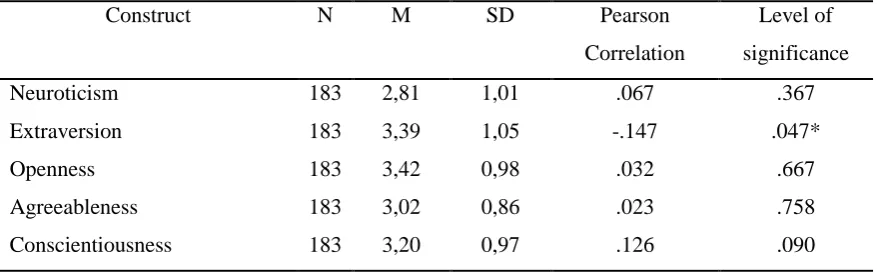
3.2. Relationship between the five personality constructs and adherence
To measure the adherence rate in combination with the five personality constructs, the
Pearson correlation was used. The adherence range goes from 0-6. A higher number means a
higher adherence rate. In the first column of Table 2 are the five personality constructs and
adherence listed. The level of significance shows that only the construct extraversion is
significant for the adherence rate (p=.047). Furthermore is de value from the Pearson
correlation (-.147). So it is a negative relationship between adherence and the construct
extraversion detectable. This means that respondents who score high on the construct
extraversion score low on adherence. For the other four constructs is no significance
[image:27.595.66.505.427.563.2]observable (p>.05).
Table 2. Average adherence rate on the personality constructs (M) and standard deviation (SD) of the personality constructs in relation to adherence
Construct N M SD Pearson
Correlation
Level of significance
Neuroticism 183 2,81 1,01 .067 .367
Extraversion 183 3,39 1,05 -.147 .047*
Openness 183 3,42 0,98 .032 .667
Agreeableness 183 3,02 0,86 .023 .758
Conscientiousness 183 3,20 0,97 .126 .090
*Correlation is significant at the 0.05 level
3.3. Relationship between the five personality constructs and the PA-scores
In table 3 is the correlation illustrated between the difference score on PA and the personality
constructs which were calculated with the Pearson correlation method. It is noticeable that the
constructs neuroticism ( p=.016), extraversion ( p=.002) and openness ( p=.027) are
significantly related to the effect on the intervention. The Pearson correlation shows a positive
correlation between respondents who score high on neuroticism and the difference score on
the intervention. In contrast to that, for respondents who score high on the other two
constructs is a negative correlation detected. For respondents who score high on the constructs
extraversion and openness the effect of the intervention is lower.
Based on the significance level of the constructs agreeableness and conscientiousness there is
[image:28.595.72.451.250.374.2]not a relationship between the constructs and the difference score on PA detectable (p > .05).
Table 3. Difference score on PA in relation to the five personality constructs
N Pearson correlation Level of significance Pos. Affectscore*Neuroticism 105 .235 .016*
Pos. Affectscore*Extraversion 105 -.306 .002*
Pos. Affectscore*Openness 105 -.216 .027*
Pos. Affectscore*Agreeableness 105 -.036 .714 Pos. Affectscore*Conscientiousness 105 -.070 .477
*significant at the level of p < .05
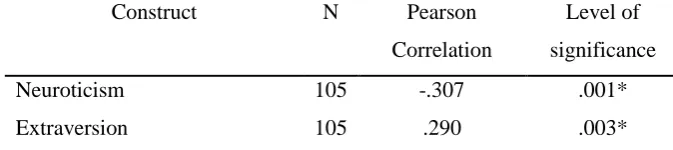
Afterwards the Pearson correlation was used to explore, if the relationship between the
significant personality constructs neuroticism, extraversion and openness and the PA –score
in the pre-test is positive or negative related. Table 4 first shows how the pre-test score on the
positive affect schedule is related to these personality constructs. The positive affect score
before the intervention is negative related to neuroticism and positive to the other two
constructs. Thus, people who score high on neuroticism, score low on the positive affect score
before the intervention and people who score high on the personality constructs extraversion
and openness tend also to score high on the positive affect schedule before they started with
the intervention.
Table 4. Positive Affect scores in relation to the personality constructs in the Pre-test
Construct N Pearson
Correlation
Level of significance
Neuroticism 105 -.307 .001*
[image:28.595.63.400.699.774.2]Openness 105 .255 .009*
*significant at the level of p < .05
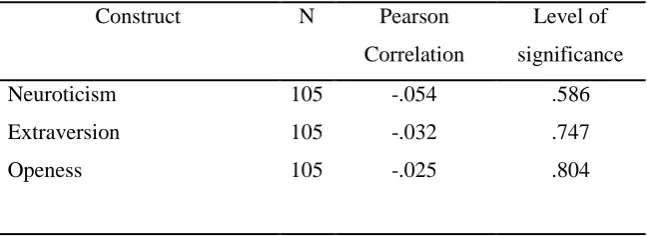
Table 5 shows the correlation between the positive affect score in the post-test related to the
constructs. It is noticeable that none of the three constructs is significantly related to the
isolated post-test score in the measuring after the intervention (p > .05) correlated with the
PA-score for respondents who score high on neuroticism. The isolated post-test score is the
[image:29.595.67.391.312.430.2]value of the PA-score after the intervention, without considering the PA-score in the pre-test.
Table 5. Positive Affect scores in relation to the personality constructs in the Post-test
Construct N Pearson
Correlation
Level of significance
Neuroticism 105 -.054 .586
Extraversion 105 -.032 .747
Openess 105 -.025 .804
*significant at the level of p < .05
3.4. Relationship between the five personality constructs and the NA-scores
Table 6 points out the relationship between the difference scores on NA and the five
personality constructs. The constructs neuroticism (p=.013), extraversion (p=.015) and
agreeableness (p=.031) are significantly related to the difference score on NA value in
relation to the negative effect score shown. The difference score on NA is after the
intervention positive related to neuroticism and negative related to extraversion and
agreeableness. After the positive psychology intervention, respondents who score high on
neuroticism tend to score high on the NA –schedule and respondents who score high
extraversion and agreeableness, score low on the negative affect schedule. As stated for the
relationship between the difference score on PA and the constructs of personality, it is not
possible to make a statement about the relationship between openness and conscientiousness
Table 6. Difference scores on NA in relation to the personality constructs N Pearson correlation Level of significance
Neg. Affectscore*Neuroticism 105 .240 .013* Neg. Affectscore*Extraversion 105 -.238 .015*
Neg. Affectscore*Openness 105 -.125 .203
Neg. Affectscore*Agreeableness 105 -.210 .031* Neg. Affectscore*Conscientiousness 105 -.133 .175 *significant at the level of p < .05
To analyze the relationship further the Pearson correlation is used again. In our intervention
the pre-test score on the negative affect schedule for the relevant constructs is negative related
to neuroticism and positive related to extraversion. Respondents who score high on
neuroticism also tend to score high on the negative affect schedule in the pre-test and
respondents who score high on agreeableness, tend to have a low score on the negative affect
schedule before the intervention. The score for the construct extraversion is not significant (p
> .05).
Table 7. Negative Affectscore in relation to the personality constructs in the Pre-test
Construct N Pearson
Correlation
Level of significance
Neuroticism 105 .414 .000*
Extraversion 105 -.160 .102
Agreeableness 105 -.192 .049*
*significant at the level of p < .05
As stated earlier for the isolated PA-score in the test, it is also for NA-score in the
post-test no significant correlation detectable. The level of significance is for each of the five
[image:30.595.68.406.468.585.2]Table 8. Negative Affect scores in relation to the personality constructs in the Post-test
Construct N Pearson
Correlation
Level of significance
Neuroticism 105 .171 .081
Extraversion 105 .084 .395
Agreeableness 105 .023 .818
4.
Discussion
The Big Five personality constructs and adherence
The purpose of this study was first to investigate the relationship of the Big Five constructs to
adherence. The results show that out of the five personality constructs only the construct
extraversion is significantly related to the adherence rate of participants in our intervention.
The Pearson correlation shows a significant negative relationship between these two
constructs and indicates that respondents who scored high on extraversion tend to spend fewer
days on the intervention. As stated earlier in the introduction there are different findings
about the relationship between the personality constructs and adherence. On the one hand
some researchers come to the conclusion that non-adherence is only related to neuroticism
(Jerant et al., 2010), and on the other hand other researchers who find in their study that
extraversion, conscientiousness and neuroticism are related to adherence (Courneya &
Hellsten, 1997). The result of this intervention is however is barely supported by the findings
of Courneya & Hellsten (1997). They also find a relationship between extraversion and
adherence, but the relationship between those two constructs in their intervention is slightly
positive. They also state that conscientiousness is positive related to adherence and
neuroticism is negative related to adherence but this is not consistent with the results from our
intervention (p > .05). The different result could be related to the exercises the participants do
during the intervention. In the intervention of Courneya and Hellsten, the exercises are about
exercise behavior in the field of fitness/ physical health .In our intervention the focus is on
mental health. In addition to that the effect of the intervention is explored, and not the
exercise itself.
The negative relationship between the construct extraversion and adherence could also be
related to the level of challenge that participants who score high on extraversion experience. It
is important that the goal of an exercise should have the right level of challenge (Slade, 2010).
This means that the goal should not be very straightforward to achieve because it would then
become unexciting, and it should not be very complicated because it could lead to anxiety.
According to McCrae and Costa (1992) a facet of extraversion is excitement seeking. Maybe
respondents who decide to not take further part in the intervention are bored of the chosen
exercise because it does not seem challenging enough for them. Another possible
explanation could be that during the intervention period external influences have an impact on
interpersonal interaction and who are active (Vazifehdoost et al., 2013; McCrae & Costa,
1992). Maybe the extravert respondents were more occupied with other things (e.g. problems
at school, work, having a relationship, doing activities, bereavement in the family, etc.) and
that they therefore decide not to participate further on the intervention.
The Big Five personality constructs and effectiveness on positive emotions
The second major research issue in this intervention is to explore, if there is a relationship
between the Big Five personality constructs and the effect on positive emotions. Through the
Pearson correlation it was shown that there is a significant relationship between the
personality constructs neuroticism, extraversion and openness and the difference score in PA
after completing the intervention (p < .05).
Noticeable is that the effect of the intervention for respondents who score on neuroticism is
positive related to the difference score on PA. Respondents who score high on the construct
neuroticism score higher on PA than before the intervention. This finding could be explained
through the “broaden and built theory” from Fredrickson (2001). In the intervention the
participants choose one of the four positive psychology exercises. This exercise could help
respondents, who score high on neuroticism to broaden the awareness or to view things from
a new point of view, and that they focus less on negative aspects of events. It is possible that
respondents, who score high on the other personality constructs already use better coping
strategies to negative life events and that for them the change in view and learning other
strategies is not as influential as for respondents, who score high on neuroticism. By choosing
the optimism exercise, respondents who score high on neuroticism, are instructed to write
three good things down each day from daily occurring, and refer it to as stable, global and
internal factors. Respondents who scored high on neuroticism who might only prefer positive
events to external factors before the intervention, are now asked to see things from another
point of view. This could strengthen their self-confidence, for example the respondent is
praised by the director and does not think that he is praised because the director was in a good
mood, but rather that he is praised because he did a good job. This change in point of view
could have lead to an increase in positive emotions in the post-test. This shows that the
positive psychology exercises in this intervention could be especially helpful to improve
well-being for people who score high on neuroticism and it is useful to integrate these exercises in