University of Warwick institutional repository:
http://go.warwick.ac.uk/wrap
A Thesis Submitted for the Degree of PhD at the University of Warwick
http://go.warwick.ac.uk/wrap/58569
This thesis is made available online and is protected by original copyright.
Please scroll down to view the document itself.
Some
Problems
In
Ergodic Theory
by Anthony Nicholas Quas
Mathematics Institute, University of Warwick,
Coventry, CV47AL.
Thesis submitted in partial fulfilment of the requirements of the degree of Doctor of
Philosophy at the University of Warwick
Table of Contents
Chapter 1. Invariant Measures for Families of Circle Maps
1·1 Introduction
1·2 Two exam ples showing necessi ty of some conditions for
Theorem 1·1
1·3 Proof of Theorem 1·1
Chapter 2. Expanding Maps, g-Measures and Generalized
Bak-er's Transformations
2·1 Introduction
2·2 Connections between g-Measures, Expanding Maps and
Generalized Baker's Transformations
2·3 Construction of Examples of Expanding Maps
2·4 Some Possible Approaches to Question 1
Chapter 3. Representation of Markov Chains on Manifolds
3·1 Introduction
3·2 Previously Known Results
3·3 Background for Smooth Representation
3·4 Physical Motivation for Theorem 3·3
3·5 Differential Equations Background for Theorem 3·3
3·6 Proof of Theorem 3·3
3·7 Invariant Measures for Smooth Markov Chains
Chapter 4. Representation of Markov Chains on Tori
4·1 Representation of Markov Chains on Tori
4·2 Degree of a Markov Chain on the Circle
4·3 A Markov Chain which cannot be Represented by
Table of Figures
Figure 1·1 Possible arrangement of intervals about a periodic point 6
Figure 1·2 Lift of an iterate of a circle map showing the types of 7
periodic points
Figure 1·3 A family for which the conclusion of the theorem fails 9
Figure 1·4 'Speed Function' for the counterexample 10
Figure 1·5 Typical diagram of periodic points against parameter 16
Figure 1·6 Possible arrangement of chosen periodic points 19
Figure 2·1 Possible graph of <P 34
Figure 2·2 Fundamental partition of Sunder Tf 34
Figure 2·3 Graph of T 44
Figure 2·4 Configuration of J intervals 47
Figure 2·5 Construction of the map
T
47Acknowledgements
I would like to thank my supervisor, Peter Walters, for the encouragement and help which he offered during the work for this thesis. Sebastian Van Strien was of assistance
in suggesting some of the questions which are addressed in Chapter 1. Thanks to Saul
Jacka and Chris Bose for interesting conversations about some of the questions raised in Chapter 2, and to Chris Bose for bringing to my attention his work on generalized baker's transformations. I would also to acknowledge useful conversations and advice from Mario Micallef, Janice Booth and Jim Eells during the preparation of Chapter 3.
Declaration
I declare that the work contained in this thesis is original, except where otherwise
indicated. In particular, Chapter 2 contains a survey of the known results about the
Summary
The thesis consists of a study of problems in ergodic theory relating to one-dimensional
dynamical systems, Markov chains and generalizations of Markov chains. It is divided
into chapters, three of which have appeared in the literature as papers. Chapter 1 looks at continuous families of circle maps and investigates conditions under which there is a weak*-continuous family of invariant measures. Sufficient conditions are exhibited and the necessity of these conditions is investigated. Chapter 2 is about expanding maps of the interval and the circle, and their relation with g-measures and generalized baker's trans-formations. The g-measures are generalizations of Markov chains to stochastic processes with infinite memory and generalized baker's transformations are geometric realizations of
these. The chapter is based around the question of whether there exist expanding maps
preserving Lebesgue measure, for which Lebesgue measure is not ergodic. Results are
known if the map is sufficiently differentiable (for example
C1+
Q), but theCl
case is stillunclear. The chapter contains some partial solutions to this question. Chapter 3 is about representation of Markov chains on compact manifolds by measured collections of smooth maps. Given a measured collection of maps, a Markov chain is induced in a natural fashion. This chapter is about reversing this process. Chapter 4 describes a specialization of the setting of Chapter 3 to Markov chains on tori. In this case, it is possible to demand more of the maps of the representation than smoothness. In particular, they can be chosen to be local diffeomorphisms. The chapter also addresses the question of whether in general the
maps can be taken to be diffeomorphisms and gives a counterexample showing that there
S01l1eProblems
in
Ergodic Theory
Anthony Quas
This dissertation concerns itself with problems of ergodic theory, the branch of
dy-namical systems theory which deals with problems of long-term averages of values of a
measurement taken at discrete intervals of time. In general, the formulation is that T is
a map from some measure space
X
to itself andf
is anL1
functionX
---+ R. The mainobjects of study in ergodic theory are the averages
Ergodic theory gives conditions for these to converge pointwise almost everywhere with
respect to an appropriate measure (or in
L1)
to a function1.
These measures are in factthe invariant measures, which are central in the study of ergodic theory. Further conditions
can be given to ensure that the limit function
j
is constant almost everywhere with respectto the invariant measure for any
L1
functionf.
This turns out to be extremely important.Chapter 1 of this dissertation considers the case where there is a continuously
pa-rameterized family of circle maps (that is orientation-preserving, homeomorphisms of the
circle). Each circle map is known to have at least one invariant measure. In this chapter,
I consider whether the invariant measures for the family of circle maps may be chosen to
vary continuously with respect to the parameter. In general, I show that subject to certain
conditions, this may be arranged by careful choice of the invariant measure. In an
experi
-mental situation, the invariant measure is determined by the initial conditions. Typically,
without special initial conditions, one would not expect to see continuous variations of the
thus show that while typically long-term averages change discontinuously with respect to
small changes in the parameter, they may in special circumstances vary continuously.
Chapter 2 deals with the relationships between the concepts of expanding maps,
9-measures and generalized baker's transformations. The starting point is the question of
uniqueness of absolutely continuous invariant measures for Cl expanding maps of the
interval and the circle. This leads naturally into an investigation of 9-measures, which
may be considered as a generalization of Markov chains to processes which depend on the
entire past, not just the last outcome. These are known to have a geometric realization
as generalized Baker's transformations. This realization is studied in Chapter 2 and made
more explicit. Finally, I present some examples of possible constructions of Cl maps which
might have more than one absolutely continuous invariant measure. Ifcorrect, these would
provide a solution to a question of Keane ([Kea)).
Chapter 3 looks at Markov chains on compact manifolds. Conditions are found for
Markov chains, under which there exists a family of smooth maps from the manifold to
itself and a probability measure on them such that applying the maps at random according
to the probabilities specified by the measure reproduces the Markov chain. This is called
a representation of a Markov chain. A representation of a Markov chain allows it to be
viewed as a Random Dynamical System (RDS), as described in [Ki] and [AC].
Chapter 4 is a specialization of Chapter 3 to the case where the manifold is a torus.
In this case, it is shown that a smooth Markov chain admits a representation by local
diffeomorphisms. It is then natural to ask whether such a Markov chain in fact admits a
representation by diffeomorphisms. It is shown that in general this is not the case.
Chapter
1.
Invariant Measures
for Families of Circle Maps
1.
Introduction
This chapter considers the invariant measures of a continuous family of circle maps.
There is some evidence (see below) that a continuous family of circle maps should have
a continuous family of invariant measures. In fact, this does not always turn out to be
the case, but in this chapter, we give conditions for the conclusion to hold and show the
necessity of some of these. The results of this chapter have appeared in the literature as
[Q2].
Let 7r denote the projection R ---+ SI given by x f-+ exp(27rix). We will denote in
the usual way intervals on the circle (for example, the interval
[a, b]
is the closed intervalstarting at a and going anticlockwise round to
b).
By a circle map, we will always meanan orientation-preserving homeomorphism
T :
SI -e+ SI. For a detailed introduction tothe theory of circle maps, the reader is referred to [CFS], §3·3. The main results, however,
,
are summarized below for convenience. The dynamical behaviour of circle maps is very
well understood, and may be principally characterized by the rotation number of the map.
This is a measure of the 'average rotation' that the map imparts to a point. To define
the rotation number of a circle map
T :
SI ---+ SI, we first need its liftF :
R ---+ R. Thelift of a co"ntinuous map
rP
of the circle (not necessarily a circle map) is a continuous map<I> : R---+ R defined by the equation 7r
0
<I> =rP
0;'.
This is uniquely defined up to an additive.
integer constant. The degree of the maprP
is given by <I>( x+
1) - <I>( x). This is always aninteger and is independent of the point
x
ER
and the lift chosen. In the case of a circlemap, the degree is always 1. The rotation number of the circle map T is then given by
() li
Fn(x)-x
pT
=
m ,Tt-OO n
where
F
is a lift ofT.
This limit exists for all z , and is independent of z , The convergenceof the limit is uniform in z and the rotation number is unique for a map Tup to an additive integer constant (depending on the particular lift chosen to represent
T).
The notion of acircle map with rational rotation number is therefore well-defined, since this property does
not depend on the lift chosen. It can be shown that a circle map has rational rotation
number with denominator q say (with the fraction expressed in its lowest terms), if and
only if it has periodic points of period q. Further, if this is the case, then each point of the
circle converges monotonically to a periodic point under iteration of the map. From these
facts, it follows that a circle map with irrational rotation number has no periodic orbits.
Here, the dynamics are also well-understood: each point has the same w-limit point set
and this is either a Cantor set, or the whole circle. In the former case, the map is
semi-conjugate to a rotation through 211"times the rotation number, and in the latter case, the
map is conjugate to a rotation 'through 211"times the rotation number.
Itmay be shown by elementary means that the map taking a circle map to its rotation
number is continuous with respect to the CD-topology on the space of circle maps; see for
example [CFS], §3.3, theorem 2.
Suppose now that
F
is a lift of a circle mapT.
WriteR( x)
=F( x) - x
andr :
SI ---+R;
y
1--+R(1I"-I(y)).
This is well-defined sinceR
is periodic, and is the amount of rotationwhich the point y undergoes when it is acted upon by
T.
Now, we have1Tt-I. 1
.~L
r
(T' (
11"(X ))) = ~ (r:(
x) - x) .
From this it follows that ~
2:~:01
r(Ti(y))
converges uniformly top(T)
asn
---700.
But, forany invariant measure
v
forT,
J
r(y) dv(y)
=J ~
2:::01
r(Ti(y))
dv(y),
so taking limits,we get
J
r(y) dv(y)
=p(T).
This shows that the rotation number of a circle map is numerically equal to the amount
of rotation at each point integrated with respect to an invariant measure for the circle
map. As
T
changes continuously,r(y)
andp(T)
both change continuously. This suggeststhe invariant measures also depend continuously on the circle map in some sense. The
appropriate sense of continuity turns out to be weak" -continuity, and this chapter contains
an investigation of the weak" -continuity of the invariant measures of circle maps.
In the statement of the theorems, we will need some definitions. We say that a family
(TCI')CI'EJ
of circle maps, with J a compact subinterval of R is acontinuous
family of circle
maps
ifthe mapT:
J XSI
---7S\
(a,e)
1-+TQ'(e)
is continuous.Given a circle map
T
with rotation numberp/q,
letS
be the lift ofTq
fixing thepreimages of the periodic points. Define
u(x)
=
S(x)-x.
Note thatu
satisfies the equationu(x)
=u(x
+
1), since the degree ofT"
is 1. The functionv: SI
---7 Rje
1-+uCrr-l(e))
is then well-defined. Note that the zeros of v are precisely the periodic points of the map
T.
Then given a periodic pointe,
there may be a neighbourhood ofe
on which v takesthe value 0 only at
e
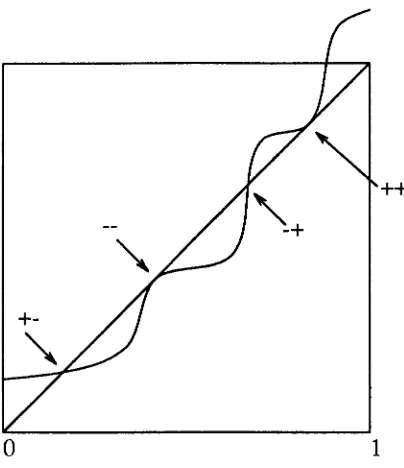
itself. Ifsuch a neighbourhood exists, we say the periodic point is ofdefinite type,
and conversely, if no such neighbourhood exists, we say the periodic point isof
indefinite
type.
Ifthe periodic point is of definite type, it follows that there is an openinterval
II
clockwise frome
withe
as an endpoint on which. the sign of v is constant, and"--I
1Figure 1·1 Possible arrangement of intervals about a periodic point.
We say that
e
is of type++, +-, -+
or -- according to the sign of v on thesetwo intervals. A hyperbolic periodic point is one of type
+-
or-+
(these are stable andunstable respectiv~ly). The types
++
and -- of periodic point are non-hyperbolic andhave stability on one side only. We call a map with non-hyperbolic periodic points (or
sometimes its parameter value) critical. Note that if a point on a periodic orbit is of a
particular type, then all the other points on the orbit are of that type (this follows since
the maps are orientation-preserving homeomorphisms), so that it makes sense to say that
a periodic orbit is of a specific type, or in particular hyperbolic or non-hyperbolic (see
++
[image:13.558.176.378.54.288.2]o
1
Figure 1·2 Lift of an iterate of a circle map showing the types of periodic points.
An invariant Borel probability measure (or briefly invariant measure) for a circle map
T
is a probability measuref..£
on the Borel er-algebran
satisfyingf..£(T-
1(B))
=
f..£(B)
forany Borel set B. A circle map T is uniquely ergodic if it has exactly one invariant measure.
There is a well-known theorem of ergodic theory (see [Wa3], theorem 6·18) saying that if
T
is a circle map with irrational rotation number, thenT
is uniquely ergodic. A map withrational rotation number is uniquely ergodic if and only if it has a unique periodic orbit
(see Lemma 2).
We are now ready to state the theorem:
Theorem 1. '
Suppose that (Ta )aEJ is
acontinuous
family ofcircle
mapssuch that
(i)
for each non-trivial interval K
onwhich the rotation
numberhas
aconstant value,
there
areat most finitely
manyvalues
of ain K for which Ta is critical,
andhyperbolic.
Then there is a weak*-continuously varying family of probability measures
J.La
such thatJ.La
is an invariant measure forTa.
Part of Theorem 1 was previously known to Herman. In particular, Herman showed
that the map taking a circle map with irrational rotation number to its unique invariant
probability measure is weak*-continuous on the sets
Fp,
the collection of circle maps withrotation number equal to p (irrational). He in fact shows (see [He], proposition X.6.1), that
the (semi- )conjugacy h conjugating a circle map
f
EFp
to the rotation by 27rp dependscontinuously on
f.
Since the invariant measure is given byJ.L(A)
=A(h(A)),
this impliesthat the map taking
f
to its invariant measureJ.L
is weak* -continuous when restricted toFp.
This result can easily be recovered from the proof here.2. Two examples showing necessity of some conditions for Theorem 1
Before embarking on a proof of Theorem 1, we first present two examples to show that
some restrictions are necessary for the conclusions of the theorem to hold. In particular,
..
we exhibit families which do not satisfy condition (ii) for which the conclusion fails. It
seems likely that condition (i) is unnecessary for the conclusion of the theorem to hold,
although any significant relaxation of this condition will necessarily make the construction
~Fixed
points points
0<,=0
[image:15.558.68.491.60.238.2]Fixed points
Figure 1·3 A family for which the conclusion of the theorem fails.
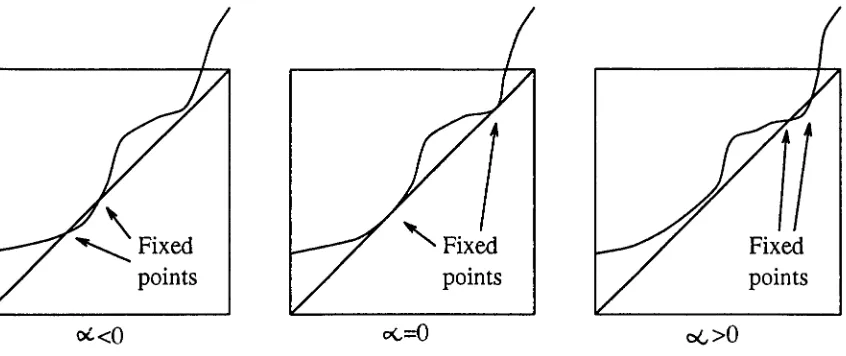
The first example for which the conclusion fails is illustrated graphically in Figure 1·3.
The process which takes place is that a pair of fixed points vanish simultaneously with the
birth of another pair of fixed points. The limits from the two sides in the parameter space
of the invariant measures are concentrated on the dying pair (respectively new pair) for
parameter values lower than (respectively greater than) the critical value (see Lemma 2).
The example shows that even in the one-dimensional case, there exist examples for
which the unrestricted version of this theorem fails. The reliance of this proof on properties
of circle maps suggests that this would fail more spectacularly in higher dimensions.
This example works by having a parameter value such that the probability measures
for parameters on the left converge to a limit and similarly with parameters on the right,
but that the two limits fail to agree. It is then natural to ask if this is the only way that
the theorem .could go wrong. In particular, if a parameter value is on the boundary of an
interval on which the rotation number is rational, then this construction cannot be used.
The question is then whether the condition (ii) needs to apply at the boundary of regions
The next example, which is more complicated, shows that the conclusion of the
the-orem need not hold even if condition (ii) fails only on the boundary of an interval in the
parameter space on which the rotation number is constant. To write down the example,
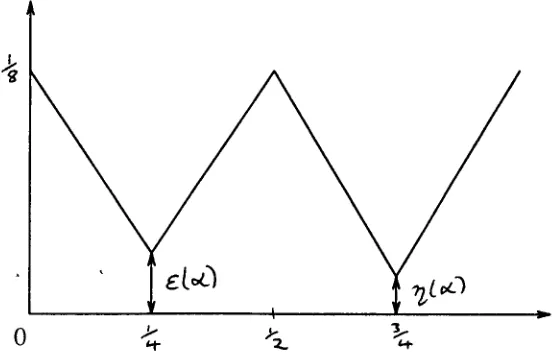
we regard the circle as the interval [0,1) mod 1. The maps which we consider are then of
the form
T( x)
=
z+
v( x)
mod 1. The form of the functions V which we are considering is [image:16.564.140.419.245.424.2]shown in Figure 1·4.
Figure 1·4 'Speed Function' for the counterexample.
The function V depends on the parameters € and TJ. It is ,clear that if € and TJ are
allowed to vary continuously with respect to a parameter a say, then the family of circle
maps given by
TO'(x)
=x +vO'(x)
mod 1 is in fact a continuous family of circle maps. Thefamily VO' is given explicitly by the expression
x
E [O,~]
XE[~,l]·
We then consider a family with the properties that
€(
a) ~
0 and TJ(a) ~
0 asa ~ ao,
and investigate the limit of the invariant measures of the maps TO'asa ~ ao
andas a -t ao. In this case, the limit is a measure
J.L
concentrated at the pointsi
and ~ with(1)
It is clear that there exist examples of continuous functions
t:(
a) and 1](a) with theproperties that t:(a) -t 0 and 1](a) -t 0 as a -t ao, t:(a)
>
0 and 1](a)>
0 for all a<
aosuch that the limit of log
t:/
log1]fails to exist as a -t ao.It is a well-known fact of ergodic theory that each circle map
TC'<
has some invariantmeasure, J.LQ say (see [Wa3], corollary 6.9.1). To evaluate the limiting measure
J.L
describedabove, we take a small set containing
i,
say A =[i -
h,i
+
h) and a similar one containingi,
sayB
=
[i -
h,
i
+
h),
and estimateJ.LQ(A)
andJ.LC'«B)
for a -e+ ao. To do this, we notethat if it takes between nand n
+
1 steps 'for a point to go all the way around the circle'(that is if 0 ~
TQ~l+l(O)
<
TC'«O)
and this is the first suchn),
and if it takes between mand m
+
1 steps for a point to go throughA
(that is, if TQm+l(i -
h) ~
i
+
S
and this isthe smallest such m), then
where XA is the characteristic function of the set A. This follows by invariance of the measure. But for each point, we have
n-l
m-I 1", . m+l
--~-~XAoTQ'(:Z:)~ ,
n n . n
1=0
It follows that
IJ.LQ(A) -
7~I ~ ~.
There is of course a similar result forJ.LQ(B).
Ifwe thenshow that the amount of steps in each cycle spent outside sets
A
andB
is bounded aboveby some constant, then it is clear that we can evaluate the limit of
J.LQ(A)
as a -t ao,calculation which we need to perform is to solve a simple recurrence relation to estimate
the time spent in certain sets of a very simple form. Suppose then we are considering
a set
C
of the form[O,a)
and the 'speed' function is given byv(x)
=
c - (c -b)x/a
where c -
b
<
a,
and we haveT(x)
= X +v(x)j
then the recurrence relation is Xn+l=
c + (1 - (c -
b)/a)x
n. Letp
=
1 - (c -b)/a.
Then we are solving Xn+l=
C +px
n. Thesolutions are Xn
=
c/(1 -
p) + Apn. By substituting the initial conditions, we see thatin fact Xn =
c(1-
pn)/(1_
p).
The number of steps thus spent in the setC
is thus therounded-up value of
log(1 - (1-
p)a/c)/logp
=
(logb/c)/logp.We can now apply this to the collection of circle maps described above. In what follows,
we will require € and 7] to be bounded above by
/6.
The first thing we show is that theamount of steps per cycle spent outside the sets
A
andB
is bounded above by a constantas € and 7]tend to zero. To show this, we note the symmetry of the situation: the number
of steps taken to get from
°
toi -
b is the same as the number of steps to get from±
+ 6 to ~. This number is given by the round up of log(8.v(i -
6))/log(~ + 4€). This ,is bounded above by log( 48)/ log( ~), so we see that the number of steps spent outside
A
andB
is bounded above by 410g(48)/log(i). The number of steps inA
is given by-210g€/logO + 4€) plus a term which is bounded, and similarly the number of steps in
B
is given by -210g7]/logO +47]) plus a bounded term. Setm(€)
= -210g€/logO +4€)and
p(
7])= ~
210g 7]/ logO + 47]). Then given a constant (J'>
0, there exists a T such thatBy elementary analysis, we see that the assertion of equation (1) is now proved, and thus
3. Proof of Theorem 1
A useful lemma is the following:
Lemma 2.
The invariant Borel
probability measures for acircle
mapT with
rationalrotation
numberp/q
areprecisely those
measureswhich
can beexpressed in the
formq-l
1~ .
IL(A)
= -
L.J
v(T-ZA),
q i=O
where v is
a probability measure concentrated onthe fixed points
ofT",
Proof. Certainly any Borel probability measure of the form described is invariant for the
circle map in question. Conversely, in the preliminary discussion, it was noted that each
point of the circle converges monotonically under iteration of the map to a periodic orbit.
From this, it follo~s that the only non-wandering points of the map are the periodic points.
There is then a standard theorem telling us the non-wandering set has full measure (that
is measure
1)
with respect to any invariant Borel probability measure (see [Wa3], theorem6·15). The remainder of the proof follows easily from the invariance of the measure.
Lemma 3.
Suppose that (Ta )aEJ is
acontinuous family
ofcircle maps such that Tao
has ahyperbolic periodic orbit
ofperiod q through
apoint
e
E SI.Then
for eachneighbourhood
M
ofe,
there exists
aneighbourhood
N of aosuch that
if (3 E N,then Tf3has
aperiodic
point
ofperiod q in M.
Proof. Suppose that we are given a neighbourhood M of
e.
Then there must exist aclosed subinterval
1
ofM
withe
E Int(l) with the property thatTao q(l)
C Int(l) orTao
q(Int(l)) ::::>(1)
according to whethere
is stable or unstable. But then for anyT
whichor
Tq(Int(I))
:) I
respectively). But then it follows by Brouwer's fixed point theorem thatT has a periodic point of period q in Int(I).
Lemma 4.
Suppose X is
a compactmetric
space and To :X
-+X is
acontinuous
mapwhich is uniquely
ergodic,with unique invariant
measure Vo, say.Then for
anyweak*-neighbourhood N
of Vo,there is
aneighbourhood U
of Tosuch that for
T EU
and v anyinvariant
measurefor T,
we havev
EN.
Proof. By reducing N if necessary, we may first of all assume that N is a basic neighbour-hood of Vo (that is N
=
{J.L :I
J
fi dJ.L -J
Ii
dvol<
Ei, i=
1, ...,n}
for a finite sequenceUi)l<i<n
of continuous functions and(Edl<i<n
a finite sequence of positive bounds). We-
-
-
-may further assume that n
=
1 as for larger n, we may simply take the intersections of theresulting neighbourhoods
U
obtained from the proof below. We will therefore assume forthis proof that the neighbourhood
N
is given byN
=
{J.L :J
f
dj.£ -J
f
dVQI
<
E}.
Nowassume for a contradiction that for any neighbourhood U of To, there is a map T E U
and an invariant measure v for T such that
I
J
f
dv -J
f
dVQI
2:
E. It follows that thereexists a sequence of maps (Tn)nEN converging uniformly to To, having invariant measures
(2)
Since X is a compact metric space, the space of Borel probability measures on X is weak*-compact, hence weak*-sequentially compact. The sequence of measures
(v
n) therefore hasa convergent subsequence, (vn;) converging to j.£, say. Since vn; is invariant for Tn;, we
have for any continuous g, that
J
9 0r;
dvn;=
J
9 dvn;,Vi.
(3)
Now since
Tn;
converges toTo
uniformly, it follows thatgoTn;
converges togoTo
uniformly,and hence, taking limits of (3) asi -+ 00, we see that
J
goTo dJ.L
=
J
9 dJ.L
for any continuousfunction
g.
It follows thatJ.L
is an invariant measure forTo,
yet taking the same limit in(2), we see that
J.L
=1=va.
This contradicts our assumption thatTo
was uniquely ergodic, and hence proves the Lemma. 0We now proceed to the proof of Theorem 1.
Proof of Theorem 1.
Set C
=
CI{o:
E J :p(Ta)
¢
Q}.
We will show that for those values of 0: in C, themap
Ta
is uniquely ergodic. Ifp(Ta)
¢
Q, then this is a standard ergodic theorem as notedearlier. If
Ta
has a hyperbolic periodic point, of period q say, then by Lemma 3, there is a neighbourhood of parameter values about 0:, such that for maps with parameters in theneighbourhood, there is a periodic point, and hence the rotation number is rational on a
whole neighbourhood of parameter values about 0:. In particular, 0:
¢
C. It follows thatif 0: E C and
p(Ta)
EQ
thenTa
has no hyperbolic periodic points. We therefore see thatTa
must have periodic points, and these must all be non-hyperbolic. By hypothesis (ii) ofthe theorem, we have that
Ta
has a unique periodic orbit. It now follows from Lemma 2,that there is a unique invariant probability measure.
We proceed by defining
J.La
for 0: EJ\C.
First, note that since C is a closed set, wehave that J\C is an open subset of J and hence consists of a countable disjoint union of Open subintervals of J, say J1,J2, • ... Now fix such an interval Jj• Unless J, is one of
the end intervals, J, is open in R, so we write
J;
=(O:j,f3j).
In this case,Ta;
andTj3;
are uniquely ergodic, so the invariant measures are determined at the endpoints of the interval.other. Now set K,
=
CI(Ji)=
[ai,,Bi].
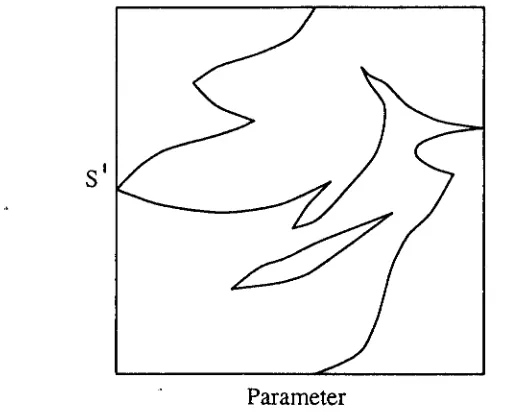
The idea behind the construction is as follows. Plotting the periodic points ofTa
againsta
fora
EK,
gives a graph similar to Figure 1·5.The invariant measure, being concentrated on the periodic points, must be chosen to be a
superposition of 'b-measures', moving along the periodic point curves. Since these curves
can terminate, it may be necessary to transfer to a new periodic curve. This must also
be done continuously, so in the construction, one curve is being phased in, while another
curve is being phased out.
SI
[image:22.549.137.390.258.464.2]Parameter
Figure 1·5 Typical diagram of periodic points against parameter.
We construct an open cover for
Ki.
Suppose the rotation number of the maps withparameters in
Ki
isp!q. This may be assumed by the continuity ofp. Then letSa
be a liftof
Ta
q fixing the preimages (under11")
of the periodic points, and setua(x)
=
Sa(x) -
z ,Clearly the maps
(a,x)
HSa(x)
and(a,a:)
Hua(a:)
are continuous onK,
X R. Givena E
Ki ;
we seek a connected open neighbourhood Na containing a, and a continuous mapcPa :
CI(N
a)
--+ R taking each parameter value to a fixed point ofS
for that parameterIf
the periodic points ofTOI
are all non-hyperbolic, choosee
to be any periodic pointof T
OI.
Note that in this case, there is exactly one periodic orbit, soe
is clearly bounded away from any other periodic points.If
TOI
has a hyperbolic periodic orbit, choosee
to bea hyperbolic periodic point. In either case, there is a neighbourhood of
e
in which thereare no other periodic points of T
OI.
Let a: be a preimage (under71')
ofe.
There is thena neighbourhood of a: which contains no fixed points of SOl' Choose T small such that
[a: -
T,a:
+
T]
is in this neighbourhood. Then set € = min(luOl(a:+
T)I,
luOl(a:-T)I).
Bycontinuity of
u,
there exists a01
>
0 such that 1,8- al<
01
implies thatup
i=
0 at a: - Tand a:
+
T. By hypothesis (i) of the theorem, we also have that there are finitely manyvalues of,8 in
(a -
01,a
+
01) withTp
critical, so it follows that there is a 0>
0 such thato
<
1,8- al<
0 implies thatup
i=
0 at a:- T and a:+
T, and thatTp
has no non-hyperbolicperiodic orbits (note that there may be a non-hyperbolic orbit at a itself, but if so, it must
lie outside [a:-
T,
a:+
T]
orTOI
must have no hyperbolic periodic orbits).We then define
NOI
=
{,8 : la -,81<
o}
n
K,
and define<POI
on this reduced interval bythe equation
<P0i(,8)
=sup{Y E [a:-T,
a:+
T] :
up(y)
=
oj.
We claim that
<POI
is continuous.If
<POI
is not continuous, there exists a sequence (,8i)iENof points in
N
Oi tending to some ,8 EN
o such that <PrA,8dfails to converge to<P0I(,8).
Bypassing to a subsequence, we may assume that the
<POI(,8d
converge to some other limit.If
<P0i(,8)
is smaller than this, then we get a contradiction by noting that up(lim<POI(,8i))
=
0,so that
<P0I(,8)
was in fact not the supremum of those fixed points in the range of interest.point. The orbit at
7r(<Pa(f3))
therefore persists for parameter values nearf3,
which is acontradiction by construction of
<Pa.
This shows that<Pa
is continuous, so for eacha
EKi,
there exists a neighbourhood
N a
ofa
inKi,
and a continuous function<Pa
defined onN a,
such that for all
f3
ENa, <Pa(f3)
is a fixed point ofSp.
By reducing the neighbourhoodNa
if necessary, we may assume the additional properties that
<Pa
is continuous on the closureof
N
o and that the only neighbourhoods containingai
andf3i
areN
C'ti andN
Pi. We havethen found an open cover of
Ki,
and so may apply compactness ofK;
to pick a finitesub cover. We may assume that this sub cover is minimal by inclusion (that is there is no
smaller subcover, each of whose sets is a member of our chosen subcover). We label the sets
in the open cover in the order of the left-most point from left to right as
NI, Nz, ... , N k,
and write
Nj
=
(aj,bj)
for 1<
j<
k; NI
=
[aI,bJ)j
Nk
=
(ak,bkj,
where we have takenbk
=
f3i
andal
=
ai.
Let<Pj
be the <p-function associated to the intervalNj.
We then haveby the minimality ofthe cover. To see this, note that clearly the sequence of
ai
is increasingby construction. The sequence of b, must also be increasing, since otherwise one of the
intervals would be completely contained in another. We need that
NjUNj+z
jJ
Nj+I
givingthe condition that
bj :::;aj+2,
and the conditionaj+I
<
bj
arises from the requirement thatFigure 1·6 Possible arrangement of chosen periodic points.
In Figure 1·6, an example of such a configuration is shown. We are then in a position
to construct the invariant measures for the
Ta
with a EKi,
Defineif a E
[a
j+
I ,bjJif a E [bj, aj+2],
where
0,
is the Dirac o-measure with unit mass concentrated at ( and where we takeak+l
=
bk and bo=
al' Given a continuous functionf
E C(SI):
if a E
[a
j+I ,b
jJif a E
[b
j, aj+2J.Continuity is clear everywhere except at the aj and
b
i, and this can be checked by comparingthe expressions and using the fact that the </>-functionswere chosen to be continuous on the
closures of the subintervals. We can then see that the family
(va
)aEKi is a continuous family of probability measures, and vp is concentrated on the periodic points of Tp. Formingq-l
1~ .
J..ta = -
L...J
V« 0Ta
-1gives a continuous family of invariant measures on
K,
by Lemma 2. Notice that by theconstruction, since we forced NI
=
N
Qi andN
k=
N
pp the limit of the measures as theyapproach the end-points is just the required measure, in the (usual) case where this is
uniquely ergodic.
Repeating this process inductively, we will be able to define a family of invariant Borel
probability measures, one measure for each parameter in the set J\O, and so since we have already shown the uniqueness of the probability measures for maps with parameters lying
in 0, we have defined the whole family of invariant measures. The family thus constructed
has already been shown to be continuous on all intervals contained in
J\
0, and therefore,since J\O is an open set, it follows that the map M :a f-t /-LQ is continuous for a E J\O. It remains to show continuity at points of 0, but this is a straightforward application of
Chapter 2. Expanding Maps,
g-Measures and Generalized
Baker's Transformations
1.
Introduction
In this chapter, we discuss the relationship between expanding maps, g-measures and
generalized baker's transformations.
Throughout this chapter, we take a definition of expanding maps which is slightly
different from the traditional one, as we include also the possibility that the map is not
differentiable.
I
will denote the unit interval. For a subinterval J ofI,
IJI
will denote the length of the interval J.Note that in what follows, we will often refer to maps which are piecewise monotone
and continuous or piecewise monotone and
c-.
These mean that the map is piecewise,
strictly monotonic and on each of those pieces the map is continuous or
c»
respectively.In the latter case, the map is assumed to have a
c-
extension to the closure of any intervalof monotonicity.
Definition
1.Let T :
I ~ I be piecewisemonotone
andcontinuous.
T is
expandingif
there exists
aconstant C
>
1such that
wheneverJ is
asubinterval
ofI,
forwhich the
restriction ofT to J is
ahomeomorphism,
we haveIT(J)I ;:::CIJI.
(i) There is a finite partition of I into subintervals I
=
Io U ... U In-1 such that therestriction ofT to each of these subintervals is a homeomorphism.
(li)
Cl(T(Int Ii)) is a non-empty union ofsome of the Cl(Ij).Note that in this situation, we can define an associated Markov mairiz A by setting
Aij = 1 if CI(T(Int Ii)) ~ Ij and 0 otherwise. This matrix is said to be mizing if the
entries of
An
are all strictly positive for some n>
o.
Note also that this is also at variance with the definition ofthe Markov property given
in [Ma], where additional continuity/differentiability properties are required ofT.
There is another situation, in which we frequently find ourselves, so this will be given
its own definition.
Definition
3..A map T from the interval to itselfwill
be called afull map ifit isexpand-ing, has a finite partition ofI into subintervals I = Io U ... UII-1 such that the restriction
of T to the interior of each subinterval is an orientation-preserving homeomorphism onto
(0,1). T
will
be called ac-
full, map if it has ac»
extension to each ofthe intervals el(Ii).The degree of the map is l, the number of branches.
The reason for this nomenclature is that the symbolic dynamics associated with T
take place on the fulll-shift (see below).
Let T be an expanding map of the interval. An absolutely continuous invariant
mea-sure (or A~IM) for T is a Borel probability measure which is absolutely continuous with
respect to Lebesgue measure and is invariant under T.
Many authors have studied the existence and the number of such measures for
expand-ing maps
T
of the interval. Krzyzewski and Szlenk showed that forC
2 expanding maps ofc
>
1), there is a unique ACIM (see [KS] and [Kr1)). This applies to those maps of theinterval which are obtained from C2 expanding endomorphisms of the circle. Lasota and
Yorke showed in [LaY] that any piecewise
C
2 expanding map ofI
has an ACIM. Kowalski([Ko)) improved this by showing that the same conclusion holds if the map is piecewise
CHI (that is the map has Lipschitz derivative). Mane's book ([Ma)) gives a refined proof showing that this remains true if the map is piecewise cHao Wong ([Wo)) found that the conclusion holds when the assumption is altered to assuming that the map is piecewise Cl
with the reciprocal of the derivative,
liT',
of bounded variation.Krzyzewski ([Kr2)) managed to show that the same conclusions do not in general hold
for Cl maps by showing that for any manifold
M,
there exist Cl expanding maps ofM
which do not have any ACIM. His proof however was not constructive, so there was still
some interest in constructing an explicit example of such a Cl map in (for example) the
simple case of the circle. This was done by Gora and Schmitt (see [GS)).
Various authors then turned their attentions to the number of ergodic ACIMs in the
piecewise C2 case (where ACIMs are known to exist). Papers on this include [LiY], [BS]
,
and [BB]. These in particular imply that if
T
is aC
2 full map, then there is a uniqueACIM for the map
T.
Such an ACIM would therefore necessarily be ergodic.A natural question which remains is the following:
Question
1. Does there exists a Cl full map with more than 1 ACIM?This question has been recently answered -for
CO
maps and even for Lipschitz mapsin the affirmative: There. exist relatively simple examples of Lipschitz full maps which
preserve Lebesgue measure, but for which Lebesgue measure is not ergodic. This was
found a simpler, but less geometric proof of this result using g-measures, which is
pre-sented below. This chapter contains a demonstration of the relationship between the two
approaches, and in general exhibits the connection between expanding maps, generalized
baker's transformations and g-measures.
The general question which remains then is to see what constraints are imposed on
a system by assuming that it is a Cl full map of
I,
preseving Lebesgue measure. Inparticular, is such a system automatically ergodic? The results described below stem from
an attempt, as yet unsuccessful, to answer Question 1.
We now summarize the theory of g-measures. Let A be a mixing Markov 1x 1matrix
as described above. We will assume the indices of A run from
°
to I - 1. ThenEA
is the space of sequences defined by. :EA
=
{X
E {O,1, ... ,l-1}z+ : AXi,Xi+l=
1, Vi2:
O}.This space is endowed with the induced topology on
EA
of the product topology on{a,
1, ...,1 -
l}z+
by giving it the metricd(X'Y)={~_n ifif XXi
=
=YiYi for i= 0,1, ... ,n -I,'but Xn ::j:. Yn.We then consider the map er: :EA --+
EA
defined by er(x)n=
Xn+l. The map eris commonlyknown as the shift map. The topological space (X, d), together with the map er acting on it
is known as a mixing subshift of finite type. We will often work with the special case where
A is the IX I matrix consisting entirely of Is. In this case, :EA is the space of all sequences of symbols of
{a,
1, ... ,I - I}, and is denoted now by:El ..
This space (together with the map er) is known as the full shift on I symbols. Most of this chapter will concentrate onare invariant under the action of the shift map. These measures are called
shift-invariant.
Suppose now that l:A is a mixing subshift of finite type. Let
a
=
(ao,
al, ...,as-I)
be afinite (possibly empty) word satisfying Aai,ai+l
=
1 for each i, let x E l:A and supposeAa,_I,XO = 1, then denote by
ax,
the sequence in l:A given by concatenatinga
onto thefront of e:
if i
<
Si if i ~s.If
x
E l:A, then we define[x]n
to be thenth cylinder
about e:[x]n
=
{y : d(x,y)
<
2-n}.
Iff
E C(l:A), thenth variation
off
is given by varn(J)=
max{lf(x)
- f(y)1
:
x,y
E l:A,d(x,y)
<
2-n}.
The functionf
is Lipschitz if there exists a C>
0 such thatvarn(J) :::;C . 2-n for all n. It is Holder if there exists a C
>
0 and a f3<
1 such thatWe are now in a position to start defining g-measures.
Let 9 : l:A ~ [0,1] be a Borel-measurable function such that
2::
YEI7-1(x)g(y)
= 1 for all x E l:A. Write g or g(l:A) for the set of all such functions. The subclass of those 9which are bounded below by a positive number will be denoted by
g+.
We will usually,
restrict attention to the subclass of those 9 E
g
which are continuous and strictly boundedaway from
o.
We will writegO
for this class of functions. Given 9 Ego,
define theRuelle-Perron-Frobenius
operator Cg :
C(l:A) ~ C(l:A) as follows:Cgf(x)
=
L
g(y)f(y).
yEI7-1(x)
This is a positive operator and it satisfies Cgl
=
1 for all 9 EgO.
Since Cg is a linearmap defined on the Banach space of continuous functions on l:A, it has a dual map
C;
.c;
is thenJ
.cgl dJ.L=
J
I
d.c;J.L. The above facts noted aboutc,
imply that.c;
mapsthe probability measures on ~A into themselves.
A q-measure for 9 E
gO
is simply a probability measure v such that .c;v =v.The following Lemma records some elementary properties of g-measures.
Lemma 1. The following properties ofg-measures hold.
(i)
For each 9 Ego,
there is at least one g-measure;(li)
Any g-measure is shift-invariant;(iii)
Any g-measure is fully supported on ~A;(iv) A g-measure may be characterized by the property
(1)
(v) For any given 9 E
go,
the g-measures form a non-empty convex set. The extremepoints of this set are ergodic.
(vi) All g-measures are non-atomic.
Proof.
To show (i) holds, let f..£ be any probability measure on ~A. Form the averages11-1
(n) _ 12:.c*i
J.L - -n J.L.
9
i=O
Then since ~A is compact, there is a weak" -convergent subsequence of J.L(n), say J.L(I1;)
converging to some measure u. Then for any continuous function
I,
we haveI
J
I
dJ.L(n;)-J
I
d.c;J.L(7l;)I :::;
2111111n.
Taking limits, it follows thatJ
I
dv=
J
I
d.c;v. The measure vis therefore a g-measure, completing the proof of (i).
Now note that .cg(f 00')
=
I
for any continuous f. Using this, and supposing that vis a g-measure, we have
for any continuous function
f.
It follows that v is shift-invariant, showing (ii).We prove (iii) by contradiction. Suppose vis a g-measure which is not fully supported.
Then there must be an open subset
U
of~A such thatv(U)
= O. We may therefore assumethat
U
is a basic set: an n-cylinder for some n>
O. So now writeU
=[z]n.
WriteXv
for the characteristic function of
U.
We are assuming thatA
is a mixing Markov matrix,so let
k
be chosen such thatAk
has strictly positive entries. Then pick x E ~A. We haveA~n
,xc>
O. It follows that there exists a sequence Yo, ... ,Yk-l such thatAYi
,Yi+l=
1 foreach i, Azn,yO
=
1 and Ayk_1,XO=1. In particular, the concatenationzyx
is a member of~A. Now, we have
xv(u)g(u)g(O"(u))
... g(O"n+k(u))
~ xu(w)g(w)g(O"(w))
... g(O"n+k(w))
wherew
=
zyx
=
g( w )g(
0"(
w)) ... g( O"n+k(
W )).
But now, since 9 is strictly bounded away from 0, this is strictly positive. Since this is
true for all z , we now have that
J
.c;+k+lXV
dv
>
0, but this impliesJ
Xv dv
>
0, whichis the desired contradiction.
To prove (iv), let
J.L
be any probability measure. Now extend the definition of9
bysaying that'g :~l -+ [0,1], where
g(x)
= 0 ifx
E ~l \ ~A. Similarly, we may regardJ.L
as ameasure on ~l by the natural inclusion. We now have
.c;J.L([ix]n+l)
=
J
X[ilo(X[xln00-)
d.c;J.L
=
J
.c(X[ilo(X[xln00"))
dJ.L
=
r
g(iy)
dJ.L(y),
J[xl
ng. Notice that this implies the important equation
d.c;J-L( ix)
=
g(
ix )dJ-L( x).
(2)
Conversely, suppose (1) holds. Then write
J-Li(A)
for the quantityJ-L(iA).
ThenJ-Li
is a measure. The equation (1) implies that
dJ-Ld dJ-L(x)
=
g(
ix),
ordJ-L(ix)
=
g(
ix )dJ-L( x).
Comparing with (2), we see that
J-L
has the same derivative as.c;J-L.
This implies that.c;J-L
=
J-L,
and part (iv) is proved.In showing that (v) holds, note that it is clear that the set of g-measures is a
non-empty (by (i)) convex set since the operator
.c;
is affine. Suppose now thatJ-L
is an extremepoint of this set of g-measures, and suppose for a contradiction that
J-L
is not ergodic. Thenthere exists a set
B
such thatJ-L(B)
E (0,1) and such thatB
=
q-l(B).
Now form a newmeasure
v
in the usual way by definingv(A)
=J-L(A
n
B)j J-L(B).
Now we have(J-L - J-L(B)V)
J-L
= (1 -J-L(B))
1 _J-L(B)
+
J-L(B)v,
so that if we can prove that t/ is still a g-measure, then we are done. To show this, let
f
be a continuous function and note that
.cg(fXB)(X)
=L
g(y)f(Y)XB(Y)·
yEu-1(x)
Note that ify E
q-l(X),
thenXB(Y)
=
1 if and only ifXB(X)
=
1 for J-L-almostall e.It
It follows that v is a g-measure, so by the earlier comments, we have achieved the desired
contradiction, proving (v).
Now, suppose
x
is a non-periodic point of~A'
Then it is easy to check thatu-m(x)
n
u-n(x)
=
0
for each m>
n2:
0: Suppose not. Assume thaty
Eu-m(x)
n
u-n(x).
Then
um(y)
E{x}
n
{um-n(x)},
which establishes a contradiction. Using this, we seethat any atoms of an invariant probability measure must be concentrated on its periodic
points, for otherwise, if x is a non-periodic atom, then the sets u-n( z ) have equal positive
measure and are disjoint, which contradicts the finiteness of the measure. Now suppose
v is a g-measu-re and that x is an atom of u, Then x must be periodic since g-measures
are shift-invariant. Next, let n be such that
An
has strictly positive entries whereA
isthe associated Markov matrix. Then there are at least 1elements of
u-
n(x).
Only one ofthese can be periodic (namely the one which has the n terms which are added on copied
from z itself). Let y be one of the non-periodic preimages of x. From (1), we can see that
v({y})
=g(y)g(u(y))
... g(un-1(y))v({x}).
Hencev(y)
>
0, which is a contradiction bythe argument above, thus proving (vi).
This completes the proof of the Lemma. D
Note that as yet, we have only defined g-measures for 9 E
gO.
However, we use (1) todefine g-me~sures for general 9 E
g.
Since (vi) only relies upon (1) and the fact that 9 ispositive, it follows that the conclusion of (vi) holds for 9 E
g+.
We will now describe a more probabilistic interpretation of g-measures. We consider
sequences
(Xn)nEl
of random variables taking values in the set{O, ... ,
1 -
1}, oftenre-garding their values as outcomes of a sequence of experiments, one performed at each
to
{0, ... ,1-1},
and writeXn(w)
forXn,
but as we will be using the same probabilityspace throughout, we often prefer to simply write Xn• We will look at the evolution of the
random variables by specifying the probabilities ofthe various outcomes of the 'present'
ex-periment (that is
Xo)
conditional on the 'past' (that is(Xn)n<O).
The simplest non-trivialexamples of this are given by Markov chains, where the probabilities of the outcomes of
the present experiment are completely determined by outcome of the previous one (that is
P(Xn
=ilXn-
1 =ii,
Xn-2
=j2,
... )
is independent ofh, h, ....
One can similarlycon-sider the so-called 'finite range' processes or le-step Markov chains, where the probabilities
are determined by the outcomes of the previous k experiments.
We will look at a generalization of these to 'infinite range' processes. Let
(Xn)nEZ
be a sequence of random variables taking values in
{O, ... ,
1 - I}. Suppose the sequence satisfiesP(Xn
=ilXn-
1 = aI, Xn-2 = a2, ... ) =9(i,al,a2, ... ),(3)
where 9 E
gO(~I).
If we now fix an n, then we get a natural mapPn :
n
-t~l
given byPn(W)i
=
Xn-i(w).
If we have a probability distribution on the subsequence(Xm)m:$n,
then this pushes forward (under
Pn)
to a probability measure JLon ~l. If the evolution at the n+
1st stage is governed by 9, as in (3), then the induced probability distributionon
(Xm)m:$;t+l
pushes forward underPn+l
to C;JL. This follows by (2), which just says that the probability of adding an i on the front of the sequencex
is given by 9(ix).
Itthen follows that the stationary distributions for the random variables correspond exactly
to 9-measures: If P is a stationary probability distribution on
n,
satisfying (3), then bystationarity, we have
Pn(P),
the push-forward of the distribution on those symbols beforeg-measure. Clearly this also works in reverse.
The first use of g-measures was in the 1930s to describe the so-called Learning Models,
where people were interested in finding a mathematical description of the processes of
learning. These were studied by Doeblin and Fortet in [DF], where they were called chains
with complete connections. Karlin (see [Kar]) also looked at these and claimed he had a
proof that for each 9 E
go,
there is a unique g-measure. This proof was however incorrect,and this statement is now known to be false. Keane ([Kea]) invented the name 'g-measures'
and showed that for a large class of g, there exists a unique g-measure, and this measure
has strong ergodic properties with respect to the shift transformation. In fact, in [Kea],
he works on the circle, using instead of the map a ; the map T : z t---+ 2x (mod 1). The
results may be readily translated to the situation which we are discussing. In this context,
Keane's results state that if 9 is Lipschitz then there exists a unique g-measure, which
is strong-mixing. Keane asked whether there exists a unique g-measure for each 9 E
go,
which is very closely related to the question left open by Karlin's wrong proof. Walters (see
[Wa1]) then showed that there is a unique g-measure when 9 has summable variation (that
is
L~=l
varn(g)< 00).
This holds in particular, when 9 is Holder continuous. Palmer,Parry, andWalters took up the question of uniqueness of g-measures in [PPW], but their
attempt yielded only some preliminary results. More recently, Berbee ([Be]) considered
the question, providing weaker conditions than those of Walters, under which there exists
a unique g-measure. It may be noted that the development of results for g-measures is
similar to the development of results for expanding maps. The reasons for this are discussed
in the next section.
which have unique g-measures. This paper was interesting as the result followed from
general statistical mechanical restrictions on g, rather than strong continuity conditions.
In particular, Hulse introduced the definition of attractive g-functions. He worked mainly
on ~2, and introduced a partial order ::::5 on it:
A g-function is then attractive if g(1x) ~ g(1y) whenever x ~ y. This says (in the
probabilistic interpretation) that the more 1s that one has in the past, the more likely
one is to get a 1 at the present. One important consequence of this shown in [Hu] is
that the sequence
.c;
nS, is weak" -convergent to a g-measure, where bi is the probabilitymeasure concentrated on the point of ~2 whose terms are all equal to
i.
Normally, to geta g-measure, one is compelled to take subsequences of Cesaro averages as in Lemma 1,
but then one typically has very bad control of the reulting measure. In [Kal], Kalikow
introduced the concept of bounded uniform martingales (which he gave the unfortunate
acronym b.u.m.), which is equivalent to the concept of g-measures. Finally, in [BK),
Bramson and Kalikow used this and attractive g-measures to provide an example of a
9 E
gO
for which there is more than one g-measure. This finally solved the main problem,which had been a major conjecture for a considerable time. It does not however solve the
problem of Keane in its original form, as there is in general a difficulty in lifting functions
from ~2 to the circle, so the example of Bramson and Kalikow may not be lifted into the
context of Keane.
The third concept, which we shall require in this chapter is that of generalized baker's
transformations, as introduced by Bose (see [Bost]). For the purposes of describing this, we
look at generalized baker's transformations with more slices. Let
fo
andh
be measurablefunctions on [0,1] such that
fo
+
h
=
1 almost everywhere andIi ~
C almost everywhere,with respect to Lebesgue measure>. for i=O and 1. Then define
¢~(x)
=l
xfo(t)dt
¢~(x)
= ¢~(1)+
foX
h(t)dt.
These maps are homeomorphisms of the interval onto their images, and the union of their
images is the whole interval. There is therefore a 2-branched expanding Lebesgue
measure-preserving map ¢, of which ¢o and ¢1 are the two inverse branches. Then the generalized
baker's transformation is defined as follows:
(
) _ { (¢(x),fo(¢(x))y)
Tf
x,y
-
(¢(x),l
- (fl(¢(x))(l
_y)))
if x
<
c, if x ~ c,where c = ¢~(1). We will refer to this also as the generalized baker's tran.sformation based
on ¢, as the map ¢ is easily seen to determine the whole transformation, by noting that
¢'(x)
= 1/fH¢(x))
almost everywhere, where iis 0 ifx
<
c and 1 ifx ~
c. Note that if weconsider the projection
p
sending points of S onto their first coordinate thenpo'I']
= Tfop,
so the pair (Tf, >. x >.) may be factored through this projection. The result of this is just the pair (¢,'>.). We call ¢ the vertical projection of T],
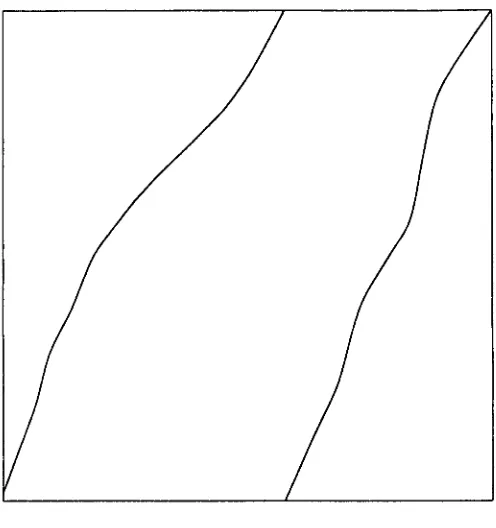
This situation is illustrated in Figures 2·1 and 2·2 below:
Figure 2·1 Possible graph of
<p.
Figure 2·2 Fundamental partition of Sunder TI'
The transformation operates as follows. The square is divided into two rectangles:
[image:40.547.147.395.54.318.2]