Original citation:
Berenbrink, Petra, Goldberg, Leslie Ann, Goldberg, Paul W. and Martin, R. (Russell) (2004) Utilitarian resource assignment. University of Warwick. Department of Computer Science. (Department of Computer Science Research Report). CS-RR-405
Permanent WRAP url:
http://wrap.warwick.ac.uk/61320
Copyright and reuse:
The Warwick Research Archive Portal (WRAP) makes this work by researchers of the University of Warwick available open access under the following conditions. Copyright © and all moral rights to the version of the paper presented here belong to the individual author(s) and/or other copyright owners. To the extent reasonable and practicable the material made available in WRAP has been checked for eligibility before being made available.
Copies of full items can be used for personal research or study, educational, or not-for-profit purposes without prior permission or charge. Provided that the authors, title and full bibliographic details are credited, a hyperlink and/or URL is given for the original metadata page and the content is not changed in any way.
A note on versions:
Utilitarian Resource Assignment
Petra Berenbrink School of Computing Science
Simon Fraser University
Leslie Ann Goldberg Department of Computer Science
University of Warwick
Paul Goldberg
Department of Computer Science University of Warwick
Russell Martin
Department of Computer Science University of Warwick
Abstract
This paper studies a resource allocation problem introduced by Koutsoupias and Papadimitriou. The scenario is modelled as a multiple-player game in which each player selects one of a finite number of known resources. The cost to the player is the total weight of all players who choose that resource, multiplied by the “delay” of that resource. Recent papers have studied the Nash equilibria and social optima of this game in terms of the
cost metric, in which the social cost is taken to be the maximum cost to any player. We study the
variant of this game, in which the social cost is taken to be the sum of the costs to the individual players, rather than the maximum of these costs. We give bounds on the size of the coordination ratio, which is the ratio between the social cost incurred by selfish behavior and the optimal social cost; we also study the algorithmic problem of finding optimal (lowest-cost) assignments and Nash Equilibria. Additionally, we obtain bounds on the ratio between alternative Nash equilibria for some special cases of the problem.
Research Report CS-RR-405, Department of Computer Science, University of Warwick, October 2004.
1
Introduction
This paper studies the resource allocation problem introduced by Koutsoupias and Papadimitriou [7]. In this problem, we are given a collection of resources such as computer servers, printers, or communication links, each of which is associated with a “delay”1. We are also given a collection of tasks, each of which is associated with a “weight” corresponding to its size. Each task chooses a resource. A given resource is shared between its tasks in such a way that each of these tasks incurs a cost corresponding to the time until the resource has completed its work. For example, the task might model a routing request and the resources might model parallel links of an network. If routing requests are broken into packets and these are sent in a round-robin fashion, each request will finish at (approximately) the time that the link finishes its work.
We assume that each task chooses its resource in a selfish manner, minimizing its own cost. Follow-ing [7] we are interested in determinFollow-ing the social cost of this selfish behavior. Previous work on this problem has measured “social cost” in terms of the metric — that is, the longest delay incurred by any task. Our measure of social cost is the metric – that is, the average delay (over tasks). This is sometimes
called the utilitarian interpretation of social welfare, and is a standard assumption in the multi-agent system literature, for example [3, 10, 13]. Furthermore, the model of [11] also uses the metric in the limit of
infinitely many tasks.
We give bounds on the size of the coordination ratio, which is the ratio between the social cost incurred by selfish behavior and the optimal social cost [7]; we also study the algorithmic problem of finding optimal (lowest-cost) assignments. For the case of identical resources or identical tasks we obtain bounds on the ratio between alternative Nash equilibria.
Our results show that the metric behaves very different to the metric. By an assignment we mean
the set of choices of resource that are made by each task. In the case of the metric, there always exists an
optimal assignment that is also Nash, but the costs of different Nash assignments can differ a lot. In the case of the metric, the costs of any optimal assignment and the cost of the minimum-cost Nash assignment
can be arbitrarily far away from each other, but in a lot of cases the costs of different Nash assignments can differ only by a constant factor.
1.1 The model
Here is the model from [7] (which is introduced in the context of networks, as mentioned above). We are given a set of resources with delays . We are also given a set of tasks with weights
. We assume that ! #"
for all$ , and we let% &('
*)
denote the total task load. Each task will select one resource. Thus, an assignment is a vector +,&.-/+0 1 +
32
which assigns the $th
task to resource+ 54
. (In the language of game theory, an assignment associates each task with a “pure
strategy”.2) Let6#&87:9 1 <;
denote the set of all assignments. The load of resource= in assignment+
is defined to be
!->= +
2
&?A@ B DC1EGFHJIK)
@
1The delay is the reciprocal of the quantity commonly called the “speed” or “capacity” in related work. It is convenient to work
in terms of the delay, as defined here, because this simplifies our results.
The load of task$ in assignment+ is!-/+
+
2
. Finally, the (social) cost of assignment+ is given by
L
-/+
2
&B DC1E
!-/+
+
2
The notion of “selfish behavior” that we study comes from the game-theoretic notion of a Nash equi-librium. An assignment + is a Nash equilibrium if and only if no task can lower its own load by changing
its choice of resource (keeping the rest of the assignment fixed). More formally, + is said to be a Nash
assignment if, for every task$ and every resource= , we have-/+
+
2
->= +!M
2
, where the assignment +M
is derived from+ by re-assigning task$ to resource= , and making no other change. We letN8->
2
denote the set of all Nash assignments for problem instance ->
2
. When the problem instance is clear from the context, we refer to this asN . For a given problem instance, we study the coordination ratio from [7] which
is the ratio between the cost of the highest-cost Nash assignment and the cost of the lowest-cost assignment.
That is O0PRQTS
CVU
L
-/W
2
OYX*Z H[C]\
L
-/+
2
This ratio measures the extent to which the social cost increases if we use a worst-case Nash equilibrium rather than an optimal assignment. We also study the ratio between the lowest cost of a Nash assignment and the lowest cost of an (arbitrary) assignment and also the ratio between the lowest cost of a Nash assignment and the highest cost of a Nash assignment.
Note that throughout the paper we study the average cost-per-task. The reader should not confuse this with the average cost-per-resource. The latter is trivial to optimize (it is achieved by assigning all tasks to the link with the lowest delay) but it is not natural.
1.2 Results
Thorem 2.5 in Section 2 bounds the coordination ratio in terms of the range over which the task weights vary. In particular, suppose that all task weights
lie in the range ^_9 `badce
. Then
OYPRQTS CVU
L
-/W
2
OYX*Z H[C]\
L
-/+
2
gf `badc
Several of our results focus on the special cases in which the resource delays are identical (Section 3) or the task weights are identical (Section 4). The results are summarized as follows.
Section 3: Resources with Identical Delays
1. (Lemma 3.2) For every , there is a problem instance with tasks with weights in the range ^_9 ih
e
for which OYXKZ S CjU
L
-/W
2
OYX*Z H[C]\
L
-/+ 2lk
m
Note that this is the ratio of the best Nash cost to the optimal cost of an assignment, hence it gives a lower bound on the coordination ratio. This lower bound should be contrasted with Theorem 2.5 which gives an upper bound off
2. (Theorem 3.3) Nash assignments satisfy the following relation:
O0PRQTS CVU
L
-/W
2
OYXKZ S CVU
L
-/W
2
lno
3. (Lemma 3.4) For everyp q"
, there is an instance satisfying
OYPRQ S CjU
L
-/W
2
OYX*ZTS CVU
L
-/W 2rk
m
n
-s9tup
2
The size of the problem instance depends uponp .
Section 4: Tasks with Identical Weights
Theorem 2.5 gives an upper bound off for the coordination ratio in the case of identical weights. We also
have the following results.
1. (Lemma 4.6) For anyp l"
there is a problem instance for which
O0X*Z
S
CjU
L
-/W
2
OYX*Z H[C]\
L
-/+
2
k
f
n
tvp
2. (Theorem 4.7) The lowest-cost and highest-cost Nash assignments satisfy:
OYPRQ S CjU
L
-/W
2
OYX*Z S CVU
L
-/W
2
f
n
which is an exact result; we show thatfxwAn is obtainable for some instance.
3. (Theorems 4.2 and 4.5) We give algorithms for finding a lowest-cost assignment and a lowest-cost Nash assignment. These algorithms run in timeyz-D{
2
.
Finding social optima using dynamic programming
In Section 5 we show how dynamic programming can be used to find optimal assignments under the
metric, in either the identical-tasks case, or the identical-resources case. The algorithms extend to the case where either the task sizes or the delays may take a limited set of values. This extension is used to give approximation schemes for the cases where instead of a limit on the number of distinct values, we have a limit on the ratio of largest to smallest values.
1.3 Alternative models and related work
There are two collections of work related to our paper. The first uses a similar model, but a different cost function. The second uses a similar cost function, but a different model.
The model that we study was introduced by Koutsoupias and Papadimitriou [7], who initiated the study of coordination ratios. They worked in the more general setting of mixed strategies. In a mixed strategy, in-stead of choosing a resource+
, task$ chooses a vector-}| D~
1 |
D~
2
in which| D~
with which task$ will use resource . A collection of mixed strategies (one strategy for each task) is a Nash
equilibrium if no task can reduce its expected cost by modifying its own probability vector. Unlike us, Kout-soupias and Papadimitriou measure social cost in terms of the! metric. Thus, the cost of a collection of
strategies is the (expected) maximum load of a resource (maximized over all resources). Their coordination ratio is the ratio between the maximum cost (maximized over all Nash equilibria) divided by the cost of the optimal solution. Koutsoupias and Papadimitriou give bounds on the coordination ratio. These bounds are improved by Mavronicolas and Spirakis [9], and by Czumaj and V¨ocking [1] who gave an asymptotically tight bound. Fotakis et al. [6] consider the same model. They study the following algorithmic problems: constructing a Nash equilibrium, constructing the worst Nash equilibrium, and computing the cost of a given Nash equilibrium. For our purposes, we note that the existence of at least one pure Nash assignment (as de-fined in Section 1.1) was also proven in [6]. Czumaj et al. [2] give further results for the model of [7] using the5 metric for a wide class of so-called simple cost functions. They call a cost function simple if it
de-pends only on the injected load of the resources. They also show that for some families of simple monotone cost functions, these results can be carried over to the metric. These are qualitative results relating the
boundedness of the coordination ratio in terms of boundedness of the bicriteria ratio; in contrast here we are studying quantative bounds on the coordination ratio for a special case of non-simple cost functions.
In [5] Gairing et al. study the combinatorial structure and computational complexity of extreme Nash
equilibria, i.e. equilibria that maximize or minimize the objective function. Their results provide substantial
evidence for the Fully Mixed Nash Equilibrium Conjecture, which states that the worst case Nash equilib-rium is the fully mixed Nash equilibequilib-rium where each user chooses each link with positive probability. They also develop some algorithms for Nashification, which is the problem of transforming an arbitrary pure strategy profile into a pure Nash equilibrium without increasing the social cost. In [4] Feldmann et al. give a polynomial time algorithm for Nashification and a polynomial time approximation scheme (PTAS) for computing a Nash equilibrium with minimum social cost. In [8] L¨ucking et al. continue to study the Fully Mixed Nash Equilibrium Conjecture and report substantial progress towards identifying the validity. Note that all these publications use the metric to measure the social cost.
Roughgarden and Tardos [11] study coordination ratios in the setting of traffic routing. A problem instance specifies the rate of traffic between each pair of nodes in an arbitrary network. Each agent controls a small fraction of the overall traffic. Like us, Roughgarden and Tardos use an cost-measure. That is,
the cost of a routing is the sum of the costs of the agents. The model of Roughgarden and Tardos is in one sense much more general than our model (from [7]) which corresponds to a two-node network with many parallel links. However, most work in the model of [11] relies on the simplifying assumption that each agent can split its traffic arbitrarily amongst different paths in the network. In our model, this assumption would correspond to allowing a task to split itself between the resources, dividing its weight into arbitrary proportions — a simplification which would make our problems trivial. In particular, this simplification forces all Nash assignments to have the same cost, which is not true in the unsplittable model that we
2
Coordination Ratio in Terms of Task Weight Range
Suppose that the weights lie in the range ^_9 !`badc]e
. The purpose of this section is to prove Theorem 2.5, which shows that the coordination ratio is at mostf
`badc
.
Definition 2.1 A fractional assignment+ for an instance ->
2
is a collection of real numbers J->=
2 for 4 = 4
, such that
"
->=
2
9 and '
@
C ->=
2
&9 for all
4
.
If+ is a fractional assignment, the load of resource= is defined as!->= +
2 &?@' >C]E ->= 2 . The cost of task $ is defined as
L -/+ 2 & ' @ C ->= 2
!->= +
2
and the cost of + is defined as
L -/+ 2 & ' DC1E L -/+ 2 .
An integral assignment is a fractional assignment where all the quantities ->=
2
are equal to 0 or 1. Note that we reserve the notation + (or +->
2
to denote the sets of tasks and resources) strictly for integral assignments.
Define the throughput of resource set to be& '
@
C
s .
We use Definition 2.1 to provide a lower bound on the cost of any integral assignment for a given instance
->
2
. We start by giving a lower bound on the cost of a fractional assignment. The following lemma is essentially the same as Lemma 2.6 of [11].
Lemma 2.2 If all tasks have weight9 , then the optimal fractional assignment+
~/
gives each resource a load of
w
and therefore any task
has L -/+ ~/ 2 & w . Proof: Let@i&
' DC1E ->= 2
. From Definition 2.1, the load of resource= isJ@A@ .
We have: B @ C T@i& (1) L -/+ 2 &B DC1E L -/+ 2 &B DC]E B @ CA ->= 2
!->= +
2 &B >C]E B @ CA ->= 2 A@JB DC1E ->= 2
where we have used &9 in the expression for!->= +
2 . Thus, L -/+ 2 &B >C]E B @ CA ->= 2 T@A@5&B @ C B >C]E ->= 2 T@A@i&B @ CA @s@B DC]E ->= 2 &B @ CA h @ @
Equation (1) gives a linear constraint on the@ values, and we have expressed
L
-/+
2
in terms of the
T@ values. To minimise
L
-/+
2
subject to (1) we use the well-known method of Lagrange multipliers. This means that the gradient of
L
-/+
2
and that of the function'
@
CA
T@ must have the same direction: 3
4{
such that
-L -/+ 22 & ¡ ]B @ CA T@¢ X
¤£ -¦¥A ¥A
h h 1 ¥A! 2 &#- R 2
Hence, at the optimum we see that @¡& §
h
s for all
= . Using (1), we then find that J@v&
¨
s , and !->= +
~/
2
&@@©& w for all=
4
Finally, for any task$
L
-/+
~/
2
&B
@
CA
->=
2
!->= +
~/
2
&B
@
C
->=
2
&
B
@
CA
->=
2
&
ª
The above result provides a useful lower bound on the cost of any integral assignment+ . We make one
refinement for the lower bound: note that if , then any Nash or optimal assignment will only use
resources having smallest delays.3 Hence an instance ->
2
with can be modified by removing the
«tv resources with largest delay. In what follows, we shall therefore make the assumption that
k
.
We next proceed to give a bound on the coordination ratio for tasks having weights in the range ^_9
5¬
e
. We first give a definition and an observation that will be useful to us.
Definition 2.3 Given a set of resources and a set of
k
tasks, we say resource = is fast provided
that@ ¥R w , otherwise= is slow.
Given a set of tasks , let¯® denote a set of tasks such that °®°&±°z° and each task
4
® has unit
weight. We first make an observation about the slow and fast resources for the optimal fractional assignment
+ ~/
-> ®]
2
.
Observation 2.4 For any sets , in the optimal fractional assignment for the instance -> ®1
2
we have
B
@
CAG² @³
as´>µ
B
DC]E
->=
2
k
w ¥
Proof: Let+
~/
denote an optimal fractional assignment. First note that'
@
CA
'
DC1E
->=
2
& .
Using Lemma 2.2 (and the definition of a “slow resource”) we find that in +
~/
-> ®]
2
each slow resource = satisfies '
>C]E
->=
2
9 w ¥ . Since we assume
k
, at most resources are slow, so that
'
@
CAG²
@
´D¶¤·¹¸
'
DC1E
->=
2
w ¥ .
The result follows from '
@
CAG² @³
as´>µ
'
DC]E
->=
2
&'
@
CA
'
DC1E
->=
2
tv'
@
Cº²
@
´>¶¤·¹¸
'
DC]E
->=
2
.
ª
Here is our bound on the coordination ratio for tasks having weights in the range ^_9
5¬
e
.
Theorem 2.5 Suppose ->
2
is a problem instance with tasks having weights in the range^_9 `badce
and
resources. Then
OYPRQ
S
CVU
L
-/W
2
»f `badc
OYX*Z H[C]\
L
-/+
2
Proof: Following our comments preceeding Definition 2.3 we again assume that
k
.
Let65->
2
denote the set of all fractional assignments for the instance ->
2
. As before, we let®
denote the set of unit-weight tasks, where °¼®°&½°z°. We first note that
OYX*Z HGCR\¾¿E~À
L
-/+
2
k
O0X*Z HÁJC]\ÂÁJ¾¿E~À
L
-/+
2
k
OYX*Z HJÁC]\ÃÁJ¾}E
~JÀ
L
-/+
2
&
Gh
(2)
3If the number of resources is allowed to be large by comparison with the number of tasks, then the optimal fractional assignment
The last equality is an application of Lemma 2.2 to the instance ->®
2
.
We show that in any integral Nash assignmentW , all tasks$ satisfy the inequality!-/W
W
2
gf
i
¨¯Æ .
This would then imply that
OYPRQ S CVU
L
-/W
2
& ' DC1E
-/W
W
2
#f
i¬z AÇ
¨
¢ . This, together with (2),
gives us the result.
LetW denote a Nash assignment. Suppose that under this assignment some resource satisfies
!-È W
2
f
`badc
¢
We prove thatW is not Nash, by finding an assignment W M (obtained fromW ) by transferring one task from
resource to some
M such that
!-È
M
W
M
2
gf `badc
¢
We start by proving there exists a fast resource M such that !-È M W
2
¥ `badc
¨
2
To prove this,
suppose for a contradiction that all fast resources= satisfy
!->= W
2
¥
`badc
¢ (3)
Let+ ~/
denote an optimal fractional assignment for the instance ->®
2
. We recall from Lemma 2.2 that
!->= + ~/
2
&
¨ for all resources
= . Thus, if a fast resource = satisfies (3), we must have !->= W
2
w T@
¥
`badc
->= + ~/
2
w A@ . This means that
B
DC1EG²
S
IK)
@
¥
`badc
B
>C]E
->=
2
(4)
where
->=
2
are the values for the optimal fractional assignment + ~D
. However, from Observation 2.4 we know that in +¼
~/
B
@
Cº² @J³
as´>µ
B
DC1E
->=
2
k
¥
which, with Equation (4) implies
B
@
CAG² @³
as´Kµ
B
DC1EGF
S
I>)
@
¥
-¦¥ `badc
2
& `badc
This is a contradiction since the left hand side of this inequality (which is the sum of weights in the instance
->
2
) is at most
5¬ .
Since we have a contradiction, we instead conclude there exists a fast resource M where
!-È
M
W
2
¥ `badc
¢
We now show how to construct W
M from
W , thereby proving that W was not a Nash assignment, a
contradiction.
Recall since M is a fast resource, É
h
¨ . We consider two cases for
M. LetÊ0&?!-È M W
2
w É
IfÊ `badc
, then moving one task from resource to resource M (to get the new assignment W M), we
find that
!-È
M
W
M
2
É -¦ÊË
`badc 2
¥Ã
¢-`badc
Ë
`badc 2 gf
`badc
¢
If insteadÊ
g`badc
, then moving one task from to M to getW M, we find
-È
M
W
M
2
&#-¦ÊË
`badc 2
É ¥Ê3
É
&?¥A-È
M
W
2
gf `badc
¢
In either case, we have shown thatW is not a Nash assignment because we can move one task (currently
having a load greater thanf
¨ ) from resource
to resource M where it has a lesser load.
Thus, we conclude that if W is a Nash assignment, then!-È W
2
f
i¬
¨
¢ for all resources , as
desired to prove the theorem.
ª
3
Resources with Identical Delay
In this section, we restrict our attention to problem instances with identical delays, i.e.
&?
h
&8ÌÌÌo&? .
If we examine the cost function we are using, we see that if all of the delays are identical, we can factor this term from the cost. Therefore, without loss of generality, we can assume that for all$,
	 .
Notation: Recall that%Í&
'
C1E
denotes the total weight of tasks. Let aÏÎÑÐ
be the average load on a resource, that is,
aÏÎÑÐ
&
'
@
CA !->= +
2
&#% w . Note in the case of identical (unit) delays, aÒÎVÐ
is the same constant value for all assignments associated with a given problem instance ->
2
. The following observation will be useful.
Observation 3.1 Suppose W
4
N . Every task$ with
aÒÎVÐ
has its own resource (which is not shared) inW .
Proof: Suppose to the contrary that task$ shares a resource with task . The load of task is at least
©
Ë
. There must be some resource whose load is at most the average load aÏÎÑÐ
, and task would prefer
to move to this resource, obtaining a new load of at most Ë»
aÒÎVÐ
.
ª
The next lemma shows that in the case of identical resources, the ratio between the cost of the minimum (and, hence, any) Nash assignment and the lowest cost of any assignment can be arbitrarily large. In fact, our example needs just two resources to obtain this result.
Lemma 3.2 For every , there is an instance having identical resources, and tasks with weights in the
range ^_9 h
e
for which the following holds:
OYX*Z
S
CVU
L
-/W
2
k
m OYX*Z H[C]\
L
-/+
2
Proof: For our problem instance we take«&?¥ , &?
h
&89 ,
&
h
&ÓGh , and Ô
&8ÌÌÌT&
&9 .
Any assignment in which tasks 9 and ¥ use the same resource is in6ÕtrN because one of these tasks
could move to decrease its own load. Thus, any W
4
which implies
L
-/W
2
k
. On the other hand, OYX*Z
HGCR\
L
-/+
2
L
-/+®
2
, where+® is the assignment which
assigns tasks 9 and¥ to resource 9 and the other tasks to resource¥ .
L
-/+ ®
2
& f h Ë»-Dzt¥
2
-Dt¥
2
m
h .
Putting these facts together, for everyW
4
N ,
L
-/W
2
k
m O0X*Z HGCR\
L
-/+
2
ª
Remark: The example from the lemma has !`badc
&Ö h and `פØ
&Ù9 , showing that in this case
L
-/W
2
k±Ú ÛÜTÝ/Þ
ß
OYX*Z H[C]\
L
-/+
2
. Thus, the bound of Theorem 2.5 needs to be some function of `badc
. The example in Section 5.3 of [11] gives an observation similar to Lemma 3.2 for the general-flow setting. The example is a four-node problem instance with two agents. The latency functions may be chosen so that there is a Nash equilibrium which is arbitrarily worse than the social optimum.
Lemma 3.2 shows that the cost of the best assignment and the cost of the best Nash assignment can be arbitrarily far apart. On the other hand, we can show that the costs of different Nash assignments are close to one another.
Theorem 3.3 For every instance with identical resources we have
OYPRQ
S
CjU
L
-/W
2
àn OYXKZ
S
CjU
L
-/W
2
Proof: We first reduce the case in which contains a task with
aÏÎÑÐ
to the case in which does
not contain such a task. Let -> M M
2
be a problem instance derived from ->
2
by removing a task$ with
aÏÎÑÐ
and removing one resource. Then by Observation 3.1,
OYPRQ
S
CVU0¾¿E~À
L
-/W
2
&
Ë
O0PRQ
S
CVU0¾¿EÉK~ÉÈÀ
L
-/W
2
Similarly,
OYX*Z
S
CVU0¾¿E~À
L
-/W
2
&
Ë
OYXKZ
S
CVU0¾¿EÉK~ÉÈÀ
L
-/W
2
Thus, to prove the theorem, we only need to show
OYPRQ
S
CVU0¾¿E~À
L
-/W
2
ln O0X*Z
S
CVU0¾¿E~JÀ
L
-/W
2
for problem instances ->
2
in which every task has
aÒÎVÐ
. Let ->
2
be such an instance. Consider task$ having weight
!
. In a Nash assignment+ , the load of task$ satisfies
-/+
+
2
k
OYPRQ
7
aÏÎÑÐ
w ¥x; (5)
since all resources must have load at least aÏÎÑÐ
w ¥ . (If a resource has load less than aÏÎÑÐ
w ¥ then there must
be a resource with load strictly larger than aÏÎÑÐ
with at least ¥ tasks on it, because of our assumption that
aÒÎVÐ
for all tasks
. Then one of the tasks on this heavily loaded resource would move to the other less loaded one.)
Since+ is a Nash assignment, the load of task$ satisfies
!-/+
+
2
aÏÎÑÐ
Ë
The ratio of the upper bound from (6) and the lower bound from (5) is at most n , attained when ¼
&
aÏÎÑÐ
w ¥ . Hence the ratio between total costs (which is the ratio between sums of individual task costs) is
upper bounded by 3.
ª
The following lemma should be compared to Theorem 3.3.
Lemma 3.4 For everyp
q"
, there is an instance with identical resources such that
OYX*Z
S
CVU
L
-/W
2
nm
-s9iËqp
2
OYPRQ
S
CVU
L
-/W
2
(The weights and number of tasks in this constructed instance are allowed to depend uponp .)
Proof: The number of tasks is equal toáâ(Ëã9 n whereâÙ&±ä hå1æ . will denote a set of tasks consisting
ofá tasks of weightn â ,á tasks of weightáâ , andáâçË?9 tasks of weight9 . In this case consists ofá
resources. LetW
¾
À
be the following Nash assignment:
Resource Tasks/Resource Cost/Resource 1 6M+1 tasks, each of weight 1 6M+1 2,3,4 2 tasks, each of weight 6M 12M
5,6 3 tasks, each of weight 3M 9M Then L
-/W
¾
À
2
&#-¦áâèËÓ9
2
Ìo-¦áâéË?9
2
ËgáÌ:9¥âèËgáÌ1êâÍ& n áâ h Ë9 në âçËÓ9 .
LetW
¾
h
À
be the following Nash assignment:
Resource Tasks/Resource Cost/Resource 1,2,3,4,5 1 task of weight 6M; 1 task of weight 3M; M tasks of weight 1 10M
6 1 task of weight 6M; 1 task of weight 3M; M+1 tasks of weight 1 10M+1
In this case we haveL -/W
¾
h
À
2
k
{Ì:9
"
âÍ&#-¦áâèËÓ9
n
2
9
"
â . OYXKZ S
CjU
L
-/W
2
O0PRQ S CVU
L
-/W
2
L
-/W
¾
À
2
L
-/W
¾
h
À
2
n áâ h ËÓ9 në âçË9
9
"
âì-¦áâçËÓ9 n
2
&
nm
áâèË»¥
n
Ë
íî áâèËÓ9 n
¢
&
nm
:9©Ë
9
"
Ë
íî áâèËÓ9
n
¢
nm
9iË 99 áâéËÓ9
n
¢
nm
95Ë 99
h
å Ë9
n
¢ï&
nm
9iË
99p 9¥ ËÓ9
n
p
¢
nm
-s9iËgp
2
ª
4
Tasks with Identical Weights
Definitions: Without loss of generality, we assume that each task has unit weight. Recall that q
h
ÌÌÌ . In this section, we use alternative notation to represent an assignment. In particular, an
assignment will be denoted as»&ñðD 1
ºò , whereJ@ is the number of tasks assigned to resource= .
Thus!->= 2 &J@A@ and L - 2 & ' @ -D h @ @ 2 .
Note that an assignment is a Nash assignment if and only if
-D ËÓ9 2
for all$, .
4.1 Algorithmic Results
We start with a structural observation about lowest-cost assignments.
Lemma 4.1 Suppose that is a lowest-cost assignment for problem instance ->
2
. Let -> M
2
be the problem instance derived from ->
2
by adding one task. LetÊ be any resource that minimizes the quantity
-¦¥RGóËÓ9
2
:ó . Letô be the assignment for -> M
2
which agrees with except thatôió¼&ÓGóËÓ9 . Thenô is
a lowest-cost assignment for -> M
2
.
Proof: We first argue that the problem instance ->
M
2
has a lowest-cost assignment õ withõ:ó
k
ôó .
To see this, suppose thatö is a lowest-cost assignment for -> M
2
withöó0÷Óôó . Let be a resource with
ö
ô
. Letõ be the assignment for -> M
2
that agrees withö except thatõó¼&öóË?9 andõ
&ö tl9 . Then L - õ 2 & L - ö 2 Ë?--/öóøË?9 2 h tùö h ó 2 :óË?--/ö tq9 2 h tùö h 2 & L - ö 2 Ë?-¦¥AöóË9 2 :ótl-¦¥Aö tq9 2 L - ö 2 Ë?-¦¥RGóËÓ9 2 xótà-¦¥Aö tl9 2 (7) L - ö 2 Ë?-¦¥R ËÓ9 2 tl-¦¥Aö tq9 2 (8) L - ö 2 Ë?-¦¥R ËÓ9 2 tl-¦¥R ËÓ9 2 (9) & L - ö 2
where (7) follows from the upper bound on öGó , (8) comes from the choice of Ê , and (9) comes from the
choice of . So by iterating the above argument, we can take õ to be a lowest-cost assignment for -> M
2
satisfyingõó
k
ôó .
Suppose now that L -õ 2 ÷ L - ô 2
. Letú be the assignment for ->
2
that agrees withõ on resources
=zû&?Ê and hasú:ó&õAó!tq9 . Then
L -ô 2 & L - 2 Ë-Dô h ó tü h ó 2 :ó L -ú 2 Ë?-Dô h ó t< h ó 2 xó & L -ú 2 Ë?-¦¥RGóËÓ9 2 :ó L -ú 2 Ë-¦¥õAótl9 2 :ó& L -ú 2 Ë?-¦õ h ó tà-¦õAó!tq9 2 h 2 xó& L -õ 2
where the first inequality follows from the optimality of , giving a contradiction to our assumption on the
costs ofõ andô . Thereforeô is a lowest-cost assignment for ->
M
2
.
ª
Theorem 4.2 follows directly from Lemma 4.1.
Theorem 4.2 Let ->
2
be a problem instance with
k
9 tasks and resources. Algorithm FindOpt
(see Figure 1) constructs a lowest-cost assignment for->
2
inyz-Dº
2
time.
FindOpt(T,R)
1. Set
&
"
for$&9 1 .
2. Forý0&9 1
(a) Choose a resourceÊ so as to minimize-¦¥RÂóËÓ9
2
xó .
(b) Increment[ó .
3. Return , which is a lowest-cost assignment for ->
2
[image:14.612.131.488.58.190.2].
Figure 1: An algorithm for constructing a lowest-cost assignment for a problem instance ->
2
with
k
9
tasks and resources.
Lemma 4.3 Ifõ
4
N->
2
andþ
4
N->
2
then, for any
4
,°õ
tùþ
° 9 .
Proof: Supposeþ:@ õ1@. LetÊ be a resource such thatþTó÷lõAó . Then sinceþ andõ are Nash assignments,
þ@A@ -DþoóË?9
2
:ó õAó1xó -¦õ1@ÃË?9
2
A@ , soþ@ õ1@[Ë?9 .
ª
Lemma 4.4 Suppose
4
N8->
2
. If
then
.
Proof: Suppose to the contrary that
and
. Then -D
Ë9
2
÷
, so is not a Nash
assignment.
ª
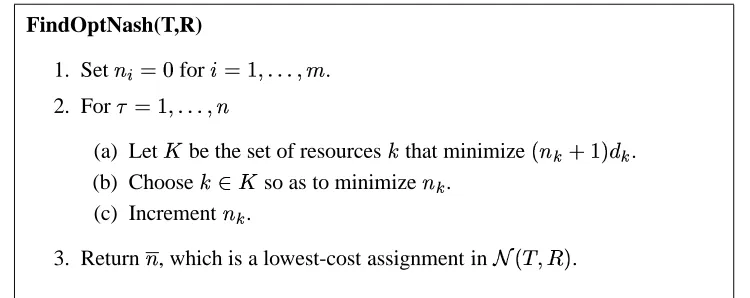
FindOptNash(T,R)
1. Set
&
"
for$&9 1 .
2. Forý0&9 1
(a) Letÿ be the set of resources Ê that minimize -DóËÓ9
2
xó .
(b) ChooseÊ
4
ÿ so as to minimizeÂó .
(c) Increment[ó .
3. Return , which is a lowest-cost assignment inN8->
2
[image:14.612.119.494.395.544.2].
Figure 2: An algorithm for constructing a lowest-cost Nash assignment for a problem instance ->
2
with
k
9 tasks and resources.
Theorem 4.5 Let ->
2
be a problem instance with
k
9 tasks and resources. Algorithm
FindOpt-Nash (see Figure 2) constructs a lowest-cost assignment inN->
2
inyz-Dº
2
Proof: First note that the algorithm maintains the invariant that the assignment for tasks 9 1 on
resources in is a Nash assignment. This follows from the fact thatÊ is chosen so as to minimize-D5ó:Ë09
2
xó .
We prove by induction on that the constructed assignment has lowest cost amongst Nash assignments. The
base case isg& 9 . For the inductive step, let be the (optimal) Nash assignment for a problem instance
->
2
with tasks constructed by the algorithm. Derive-> M
2
from ->
2
by adding one task. Letõ be
the assignment constructed by FindOptNash(T’,R). Let$ be the resource such thatõ
&
Ë9 . Suppose
for contradiction thatþ
4 N-> M 2 satisfies L -þ 2 ÷ L - õ 2
. By Lemma 4.3, there are three cases.
Case 9 : þ
&?õ & ËÓ9 SinceL -þ 2 ÷ L -õ 2
there are resources and= in such thatþ
&?õ
tg9 andþ@i&?õ1@ÃËÓ9 and
þ h Ë»þ h @ A@ ÷lõ h Ëgõ h @ @©& h Ë¡ h @ (10)
Letô be the assignment constructed by the algorithm just before the
th task is assigned to resource .
Then
-DôÃ@[ËÓ9
2
@ -DJ@ÃËÓ9
2
A@5&þ@@ -Dþ
ËÓ9 2 &Ó &#-Dô ËÓ9 2 (11)
where the second inequality follows from the fact thatþ is a Nash assignment. Because the algorithm chose
resource rather than resource= , all of the inequalities in Equation (11) are equalities so
&½-DJ@[ËÓ9 2
@ (12)
Furthermore,ô ôÃ@ so tl9 &ô
ôÃ@ J@ which, together with Equation (12) implies
k
A@
(13)
Finally, the following calculation contradicts Equation (10).
þ h Ë¡þ h @ A@è& -D tg9 2 h Ë-DJ@[ËÓ9 2 h @ & h Ë¡ h @ A@ÃË?-¦¥RJ@ÂËÓ9 2 A@©tl-¦¥R tq9 2 & h Ë¡ h @ A@ÃËg¥T-DJ@ÂËÓ9 2 A@©tl-¦¥R tq9 2 tùA@ & h Ë¡ h @ A@ÃËg¥R tl-¦¥R tq9 2 tüA@ k h Ë¡ h @ A@
The final equality follows from (12) and the inequality follows from (13).
Case¥ : þ
&?õ
tq9!&
We will construct an assignmentö
4 N-> M 2 with L - ö 2 L -þ 2 and ö &õ
. Case 9 then applies toö .
Let be a resource withþ
õ
, so by Lemma 4.3þ
&?õ
ËÓ9 . Sinceõ is a Nash assignment,
-D ËÓ9 2 &õ -¦õ ËÓ9 2 &#-D ËÓ9 2 (14)
Sinceþ is a Nash assignment,
-D ËÓ9 2 &Óþ -Dþ Ë?9 2 &?õ &#-D ËÓ9 2 (15)
Inequalities (14) and (15) together imply
and -Dþ ËÓ9 2 &Óþ (17)
Since the algorithm chose to assign the last task in -> M
2
to resource $ rather to resource , we have
. Lemma 4.4 and Equation (16) imply that
k
. Letö be the assignment that agrees withþ except ö
&þ
Ë?9 andö
&þ
tl9 . Equation (17) implies
the following facts sinceþ is a Nash assignment.
1. for=û
4
7$ 3; , -Dþ
ËÓ9 2 &þ -Dþ@ÂËÓ9 2 A@ ,
2. for=û
4
7$ 3; ,þ
&#-Dþ ËÓ9 2 k þ@A@ .
The first of these implies thatö
-/ö3@ÂËÓ9 2
@ and the second implies that-/ö
ËÓ9 2 k
öT@@ . Thus,ö is
a Nash assignment. The argument that
L -ö 2 L -þ 2
is exactly the same as the end of Case 1.
L -ö 2 t L -þ 2
& -/ö h
tüþ h 2 Ë?-/ö h tüþ h 2 & -¦¥Rþ ËÓ9 2 tl-¦¥Rþ tq9 2 & ¥Rþ tu tl-¦¥Rþ tq9 2 & t Ë¡ "
where the second-to-last equality uses Equation (17).
Casen : þ
&?õ ËÓ9!& Ë»¥
As in Case 2, we construct an assignment ö
4 N-> M 2 withL -ö 2 L - þ 2 and ö & õ
. The argument is similar to Case 2, but is included for completeness.
Let be a resource withþ
÷lõ
, so by Lemma 4.3þ
&?õ
tq9 . Sinceõ is a Nash assignment,
&?õ -¦õ ËÓ9 2 &#-D Ëg¥ 2 (18)
Sinceþ is a Nash assignment,
-D Ëg¥ 2 &þ -Dþ ËÓ9 2 & (19)
Inequalities (18) and (19) together imply
-D Ëg¥ 2 &þ &#-Dþ ËÓ9 2 & (20)
Letö be the assignment that agrees withþ except ö
&þ
tl9 andö
&þ
Ë?9 . Equation (20) implies
the following facts sinceþ is a Nash assignment.
1. for=û
4
7$
3; , -Dþ
ËÓ9 2 &þ -Dþ@ÂËÓ9 2 A@ ,
2. for=û
4
7$ 3; ,þ
The first of these implies thatö -/öT@[Ë?9 2
A@ and the second implies that-/ö
Ë?9 2 k
öT@@ . Thus,ö is
a Nash assignment. Finally,
L -ö 2 t L -þ 2 & -/ö h tüþ h 2 Ë?-/ö h t<þ h 2 & --D ËÓ9 2 h tl-D Ëg¥ 2 h 2 Ë?-D h tà-D tq9 2 h 2 & -¦¥R tl9 2 tl-¦¥R Ë n 2 & Ë?-D tg9 2 tl-D Ëq¥ 2 tl-D ËÓ9 2 & -D tq9 2 tà-D ËÓ9 2 tl-D ËÓ9 2 "
since is a Nash assignment. Note that we use Equation (20) in the last equality.
From the three cases together we see that the algorithm FindOptNash indeed finds an optimal Nash assignment.
ª
4.2 Comparison of Optimal and Nash Costs
Our first result shows that even for identical tasks the minimum cost of a Nash assignment can be larger then the optimal cost.
Lemma 4.6 With identical task weights, for allp
q"
there is an instance for which
OYX*Z S CVU L -/W 2 k -f n tvp 2 OYX*Z H[C]\ L -/+ 2
Proof: Consider the instance with &,¥ , & 9 w ¥ ,
h
&.-s9Ë
å
2
, 8&,¥ ,
&.9 and
h
& 9 .
There are three assignments. The assignment ù&±ð¦¥
"
ò has-s9
2
&9 and
L
-
2
&¥ . This assignment
is a Nash assignment, because moving one of the tasks to resource ¥ would give it a new load of 9!Ë
å
.
The assignment þ &«ðs9 91ò has!-s9 þ
2
& -s9 w ¥
2
, !-¦¥ þ
2 &«9Ë å and L -þ 2 & 9 m Ë å
. This assignment
is not a Nash assignment, because the task on resource ¥ could move to resource 9 for a new load of 9 .
Finally, the assignment ôì&,ð
"
¥ò has!-¦¥ ô
2
& ¥T-s9Ë
å
2
. It is not a Nash assignment, because either task could move to resource 9 for a new load of 9 w ¥ . Thus, is the only member of N and
L
-
2
k
-¦¥ w -s9
m Ë å 22 OYX*Z H[C]\ L -/+ 2 k Ô tvp 2 OYX*Z H[C]\ L -/+ 2 . ª
In the example from the proof of Lemma 4.6 there is only one Nash assignment, and its cost is almost
fxwAn times the cost of the best assignment. If we do the same construction withp5&
"
, we obtain an instance with two different Nash equilibria that differ in cost from each other by a factorfxwAn . The following theorem
shows that fxwAn is in fact the largest ratio obtainable between alternative Nash equilibria for any problem
instance where task weights are identical.
Theorem 4.7 Suppose the tasks weights are identical. For the ratio between the lowest-cost and the highest-cost Nash assignments we have
Proof: Suppose that andþ are distinct assignments inN->
2
. Suppose that= is a resource for which
J@ þ@ . By Lemma 4.3,@i&þ@RË9 . Also, there is a resource= M for which @
É
÷gþ @
É
. Again, by Lemma 4.3,
@
É
ËÓ9!&Óþ
@
É
. We will show that
þ
h
@
A@ÂË¡þ
h
@
É
@
É
f
n
Å
h
@
@ÂË¡
h
@
É
A@
É
Æ
(21)
which proves the theorem since the resources on which andþ differ can be partitioned into pairs such as
the pair= = M.
Now
þ h
@
A@ÂË¡þ h
@
É
@
É
&#-DJ@btq9
2
h
@ÃË-D
@
É
ËÓ9
2
h
@
É
(22)
Since is a Nash assignment,:@J@
@
É
-D
@
É
Ë9
2
&
@
É
þ
@
É
and sinceþ is a Nash assignment,
@
É
þ
@
É
A@1-Dþ@ÂËÓ9
2
&ÓA@J@ so@J@©&Ó@
É
þ@
É
. Now if@
É
&
"
then the right-hand side of (22) is
-DJ@tl9
2
h
A@ÃË?-D @
É
ËÓ9
2
@
É
&#-DJ@btq9
2
h
A@ÃË¡þ @
É
@
É
&#-DJ@btq9
2
h
@ÃË»J@sA@
h
@
@
so (21) holds. So suppose thatG@
É
k
9 . Note that, for any+
k
9 , the right-hand side of (22) is at most
+
-DJ@tl9
2
J@s@ÃË
@
É
ËÓ9
+
-DJ@
É
ËÓ9
2
@
É
ù
We will choose+#&(-D h
@
É
Ëg¥RJ@
É
ËÓ9
2
w -D h
@
É
˻J@
É
ËÓ9
2
so -DJ@
É
Ë?9
2
w +#&(9øËq h
@
É
w -DJ@
É
Ë9
2
. Plugging this in, we get that the right-hand side of (22) is at most
+ Å -DJ@tq9
2
J@sA@ÂË?-DJ@
É
Ë?9
2
A@
É
Ë»
h
@
É
A@
É
Æ
&?+ Å -DJ@tq9
2
J@sA@ÂË¡J@A@ÂË¡
h
@
É
@
É
Æ
&Ó+ Å
h
@
A@ÂËqË
h
@
É
@
É
Æ
Equation (21) follows from the observation that+
qfxwAn for every Â@
É
k
9 .
ª
5
Finding Optima with Dynamic Programming
In [6], the authors present a polynomial time greedy algorithm for computing a Nash assignment for the
cost function. The algorithm works as follows. It considers each of the tasks in the order of non-increasing weights and assigns them to the resource that minimized their delay.
In this last section we give dynamic programming algorithms that find minimum-cost assignments for the various special cases that we have studied. These algorithms extend from the identical tasks (respectively, identical resources) case to the case where there are Y-s9
2
distinct values that may be taken by the task weights (respectively, resource delays). The algorithms extend to give approximation schemes for the case where there is a0-s9
2
bound on the ratio between the largest and smallest task weights (respectively, largest to smallest delays), as studied in Theorem 2.5.
Lemma 5.1 There exists an optimal assignment in which the set of resources can be ordered in such a
way that if$
4
precedes
4
, then all tasks assigned to$ have weight less than or equal to all tasks
Proof: Suppose that we have an assignment + where the resources cannot be ordered in this way. Then
there exist two resources$ and , with two tasks assigned to$ having weights
and
M, and a task assigned
to with weight
MM, such that
÷
MM ÷
M. Let and
be the numbers of tasks assigned to$ and respectively, and let
and
be their delays. Let%
&Ó-D$ +
2
w
and%
&Ó!-È +
2
w
. The total cost of tasks assigned to$ and is%
Ë% . If
then we may exchange the tasks with weights MM and
M to reduce the social cost
L
-/+
2
(the operation reduces%
by M t
MM and increases%
by M t
MM). If
÷g
then we may exchange the tasks with weights
and
MM to reduce
L
-/+
2
. In these cases + is suboptimal. If
&8 we may make either exchange and leave the social cost unchanged.
ª
Theorem 5.2 Suppose that resources have unit delay. Then an optimal assignment of tasks with
arbi-trary weights to those resources may be found in timeY-DhV
2
.
Proof: We may order the task weights so that
k h k . Let L ~
ó be the cost of an optimal
assignment of tasks with weights
]
to resources : 1ó . We want to compute the quantity
L
x~ .
Lemma 5.1 guarantees an optimal assignment of the tasks to a set of resources that will assign the =
lowest-weight tasks to some resource, for some value of= .
L
~
ó may be found by, for each=
4
7:9 ¥ A3; ,
assign tasks with weights
@
1 ©
to resource]ó .
L ~ ó& OYXKZ @ CV~ ~ h ~~ L @ ~ ó º
@[Ë Ë © 2
¢
L
x~
can be found using a dynamic programming table of size 0-Dº
2
each of whose entries is com-puted in time0-D
2
.
ª
The above dynamic programming extends to the case where delays may belong to a set of0-s9
2
elements
71 ] J; where is a constant. Let{@ be the number of resources with delayx@ , so that &# Ë Ë¡ .
Let L ~ ó ~ ó Ç ~
ó be the cost of an optimal assignment of tasks with weights
1 ©
to a set of resources containing Ê@ resources with delay :@ , for = & 9
¥
R
. Lemma 5.1 guarantees an optimal
assignment that will (for some= and = M) assign the = lowest weight tasks to some resource with delay
@
É
, provided Ê @
É l"
. L ~ ó ~ ó Ç ~ ó0& OYX*Z @ CV~ ~ h
~~²
@ ÉÈC ~ h ~~ L @ ~ ó ~ ó Ç ~~ ó É ~~ ó Ëv=øÌA@ É
óøË Ë © 2
¢
The dynamic programming table has sizeY-Dº
2
and each entry is computed in time0-D
2
.
The following theorem generalises the algorithm FindOpt to the case where there is an Y-s9
2
bound on the number of distinct values taken by task weights.
Theorem 5.3 Let weights
]
take values in 7
M 1 M
; . Let @ be the number of tasks with
weight
M
@ , so that
&ÓÃË Ë¡ . Given delays
h
? , we may find an optimal assignment
in timeY-D{ h
2
Proof: Let ó ~
~~
be the cost of an optimal assignment to resources with delays 1 xó of a set of
tasks containing@ tasks of weight
M
@ , for
=	 ¥ ] . For 4"!
, let^
e
denote the set7
"
9 ¥ A [; .
L
ó
~
~
Ç
~~ &
O0X*Z
É
C$# &%
²
É
Ç
C$#
Ç
%
²²É
C'# %
L
ó º ~
É
~~
É
Ël-È
M
Ë Ë
M
2
M
Ìs
M
Ë Ë
M
Ìs
M
2
¢
There are 0-D{
2
entries in the dynamic programming table, and each entry is computed in time
Y-D
2
.
ª
The above algorithm can be used to obtain an approximation scheme for the case where there is a bound on the ratio of maximum to minimum weights, as studied in Theorem 2.5. Assume the weights are indexed in non-ascending order,
k
h
k
k
and the ratio Ñw
is upper-bounded by some pre-set limit
.
Letp be the desired accuracy. ChooseÊ such that
Vw 2
)( ó
9øËqp . Take each weight and round it
up to the nearest value of
w T2
(
ó
where
is as small as possible in 7
"
R Ê; . The new weights
takeʼË?9 distinct values. An optimal assignment for the new weights has cost at most 9iËqp times the cost
of an optimal assignment for the old weights, since each weight has increased by at most a factor 9!Ë?p .
In this special case of fixed ratio of largest to smallest task weight, Ê depends only onp , and the resulting
algorithm has run timeY-D{Ãh
ó
2
.
The other dynamic programming algorithm can be used in exactly the same way to obtain an approxi-mation scheme subject to a fixed limit on the ratio of largest to smallest delay. The details are omitted.
References
[1] A. Czumaj and B. V¨ocking. Tight Bounds for Worst-Case Equilibria. Proc. 13th Annual Symposium on
Discrete Algorithms, SIAM, Philadelphia, PA (2002), pp. 413–420.
[2] A. Czumaj, P. Krysta and B. V¨ocking. Selfish Traffic Allocation for Server Farms. Proc. 34th Annual
Symposium on Theory of Computing (STOC), Montreal, Canada (2002), pp. 287–296.
[3] U. Endriss, N. Maudet, F. Sadri and F. Toni. On Optimal Outcomes of Negotiations over Resources.
Proc. 2nd International Joint Conference on Autonomous Agents and Multiagent Systems (AAMAS),
Melbourne, Australia (2003), pp. 177–184.
[4] R. Feldmann, M. Gairing, T. L¨ucking, B. Monien and M. Rode. Nashification and the Coordination Ratio for a Selfish Routing Game. Proc. 30th International Colloquium on Automata, Languages and
Programming (ICALP), Eindhoven, Netherlands (2003), pp. 514–526.
[5] M. Gairing, T. L¨ucking, M. Mavronicolas, B. Monien and P. Spirakis. Extreme Nash Equilibria. To appear in Proc. 8th Italian Conference on Theoretical Computer Science (ICTCS), (2003).
[6] D. Fotakis, S. Kontogiannis, E. Koutsoupias, M. Mavronicolas and P. Spirakis. The Structure and Complexity of Nash Equilibria for a Selfish Routing Game. Proc. 29th International Colloquium on
[7] E. Koutsoupias and C.H. Papadimitriou. Worst-Case Equilibria. Proc. 16th Annual Symposium on
Theoretical Aspects of Computer Science (STACS), Trier, Germany (1999), pp. 404–413.
[8] T. L¨ucking, M. Mavronicolas, B. Monien, M. Rode, P. Spirakis and I. Vrto. Which is the Worst-case Nash Equilibrium? To appear in Proc. 28th International Symposium on Mathematical Foundations of
Computer Science (MFCS), (2003).
[9] M. Mavronicolas and P. Spirakis. The Price of Selfish Routing. Proc. 33rd Annual Symposium on
Theory of Computing (STOC), Crete, Greece (2001), pp. 510–519.
[10] P. McBurney, S. Parsons and M. Wooldridge. Desiderata for Argumentation Protocols. Proc. 1st
International Joint Conference on Autonomous Agents and Multiagent Systems (AAMAS), Bologna,
Italy (2002), pp. 402–409.
[11] T. Roughgarden and ´E. Tardos. How Bad is Selfish Routing? Journal of the ACM 49(2) (2002), pp. 236–259.
[12] T. Roughgarden. Many papers studying the cost of selfish routing in the flow-model are available at Tim Roughgarden’s web page http://www.cs.cornell.edu/timr/(which also has information and summaries).
[13] T.W. Sandholm. Contract Types for Satisficing Task Allocation: I Theoretical Results. AAAI Spring