University of Warwick institutional repository: http://go.warwick.ac.uk/wrap
A Thesis Submitted for the Degree of PhD at the University of Warwick
http://go.warwick.ac.uk/wrap/38507
This thesis is made available online and is protected by original copyright. Please scroll down to view the document itself.
Understanding Students’ Learner Autonomy
through Practitioner Research
Yi-Chun (Sherri) Wei
A thesis submitted in partial fulfilment of the requirements for the degree of Doctor of Philosophy
Table of Contents
Table of Contents... i
List of Figures... ix
List of Tables... x
List of Screenshots and Excerpts... xii
Acknowledgments... xiv
Abstract... xvi
1 Chapter One Introduction ... 1
1.1 Context of the study... 1
1.1.1 Current English education in Taiwan... 1
1.1.2 Institutional context of the study: Fu-Jen Catholic University ... 3
1.1.3 Developmental stages of AIEDL programme ... 3
1.2 Motivation and purpose of the study ... 5
1.3 Research aims ... 6
1.4 Structure of the thesis... 6
2 Chapter Two Literature review ... 8
2.1 Literature review on LA... 8
2.1.1 A brief history and the definition of LA in language learning ... 10
2.1.1.1 The definitions of learner autonomy language learning...13
2.1.1.1.1 Holec (1981)...13
2.1.1.1.2 Little (1991) ...14
2.1.1.1.3 Dam (1995) ...15
2.1.1.1.4 Littlewood (1999), Smith (2003) and Benson (2007a) ...17
2.1.2 LA in practice: Empirical studies ... 19
2.1.2.1 Cotterall (1995) ...21
2.1.2.2 Yang (2003) ...21
2.1.2.4 Porto (2008) ...22
2.1.3 Factors influencing the development of LA: The roles of collaboration and reflection ... 23
2.2 Literature review on online language learning... 25
2.2.1 The choice of term... 26
2.2.2 Definitions of e-learning and b-learning... 27
2.2.3 The teacher’s role: The importance of sound pedagogy in implementing online modality ... 30
2.2.4 The affordances of the online modality ... 31
2.3 The meeting place of LA and the online modality: Collaboration and reflection... 33
2.3.1 Collaboration ... 34
2.3.2 Reflection ... 35
2.4 Research questions... 36
2.5 Conclusion... 37
3 Chapter Three Pedagogical rationale and the listening course design ... 38
3.1 The reported needs for more listening courses in Taiwan... 38
3.1.1 The status quo of the listening research... 40
3.2 The call for a methodological change in listening instruction ... 40
3.2.1 The merging of listening and strategy instruction ... 41
3.2.1.1 The definition and categories of learning strategies...42
3.2.1.2 The significant role of metacognitive strategies...43
3.2.1.3 Listening strategy instruction ...44
3.2.1.4 Criticism of listening strategy training...47
3.3 The implications of technology in listening research ... 48
3.3.1 The choice of online authentic materials ... 49
3.3.2 Extensive listening... 50
3.3.3 The multimedia environment and the use of ICT... 53
3.4.1 Objective ... 55
3.4.2 Material selection ... 55
3.4.3 Requirements of students ... 56
3.4.3.1 Listening diaries ...56
3.4.3.2 The online discussion ...57
3.4.3.3 Presentations ...58
3.4.4 The use of the platformEngSite... 58
3.4.5 The role of TAs... 59
3.5 Conclusion... 59
4 Chapter Four Data Collection Methodology ... 61
4.1 Research framework: Practitioner research ... 61
4.1.1 Action research... 63
4.1.1.1 The emergence of AR ... 63
4.1.1.2 Models for action research...65
4.1.1.3 Strengths and limitations of AR ...66
4.1.1.4 Writing as a means of recording and promoting reflexivity...67
4.1.2 Empirical studies on learner autonomy and online language learning69 4.1.3 Exploratory Practice ... 69
4.1.3.1 The emergence of EP ...70
4.1.3.2 Interpreting EP in relation to AR...70
4.1.3.3 Encouraging teacher-initiated research...71
4.1.3.4 Achieving understanding...73
4.1.3.5 Including students in mutual development...74
4.1.4 AR and EP as compatible in the research framework...75
4.2 Research design ... 75
4.2.1 Prelude: Negotiating access into the field... 76
4.2.2 Laying the ground (Fall, 2007)... 77
4.2.3 Winter break reflection (February, 2008)... 78
4.2.4 Main Study (Spring, 2008)... 81
4.2.4.2 Class B (b-learning): Computer Assisted Listening Comprehension....83
4.2.4.3 Class C (b-learning) Freshmen Listening Lab...84
4.3 Data collection instruments ... 84
4.3.1 Pedagogically motivated data... 87
4.3.1.1 Interactive space in EngSite...87
4.3.1.1.1 Messages board...88
4.3.1.1.2 Chatroom records ...93
4.3.1.1.3 Other ICT tools: Email and MSN ...94
4.3.1.2 Assignments: Diaries & reflective writing...95
4.3.1.2.1 Listening diaries ...95
4.3.1.2.2 Reflective accounts ...98
4.3.2 Added data ...101
4.3.2.1 Interviews ...101
4.3.2.2 Focus group interviews...103
4.3.2.2.1 Literature review on FG interviews...105
4.3.2.2.2 Developing FG interviews skills: A preliminary study with ELSM students ...107
4.3.2.2.3 The procedure of FG interviews in the main study...110
4.3.2.3 Online FG interviews ...111
4.3.2.4 Individual interviews ...115
4.3.2.5 Questionnaires...118
4.4 Conclusion...119
5 Chapter Five Data Analysis Methodology ...120
5.1 Theoretical rationale of data analysis ...121
5.1.1 Grounded theory...122
5.1.2 The use of content analysis ...123
5.1.3 I-statement analysis ...124
5.1.4 Computer assisted qualitative data analysis (CAQDAS)...125
5.2 Data analysis procedure I: Diaries and reflective accounts ...127
5.2.1 Pre-determined I-statement categories...127
5.2.1.2 We-statements ...131
5.3 Data analysis procedure II: Interviews ...134
5.3.1 Transcribe the interview recordings ...135
5.3.2 Initial manual analysis with predetermined coding categories ....135
5.3.3 Data preparation for NVivo...135
5.3.3.1 Keep the real names...136
5.3.3.2 Formatting heading styles ...136
5.3.3.3 Assign colours to all participants ...138
5.3.4 Analysis using NVivo: From texts to nodes and models ...139
5.3.4.1 Create nodes: Free nodes, tree nodes and In-Vivo...141
5.3.5 Examples of nodes from the interview data...142
5.3.5.1 Coding categories from the initial manual analysis ...143
5.3.5.2 Coding categories from the NVivo analysis ...145
5.3.5.3 Emerging coding categories: Motivation as an example...148
5.3.5.4 Transforming coding categories to models ...152
5.4 Conclusion...153
6 Chapter Six The roles of collaboration and reflection in fostering learner autonomy...154
6.1 Summaries of findings: The roles of collaboration and reflection ...155
6.1.1 The role of collaboration...156
6.1.1.1 Pedagogically motivated data: Interactive space inEngSite...156
6.1.1.2 Added data: Interviews ...159
6.1.1.3 Highlights of findings on collaboration...163
6.1.2 The role of reflection ...163
6.1.2.1 Pedagogically motivated data: Diaries and reflective accounts ...163
6.1.2.1.1 I-statement categories ...164
6.1.2.1.2 We-statements ...171
6.1.2.1.3 Three case studies...173
6.1.2.2 Added data: Interviews ...189
6.1.2.3 Highlights of findings on reflection ...193
autonomy ...193
6.2.1 The role of collaboration...194
6.2.1.1 The impacts of task types ...195
6.2.2 The role of reflection ...198
6.2.2.1 The decision to focus on reflection ...198
6.2.2.2 The role of reflection and the listening process ...200
6.2.2.3 The process of reflection: Stepping back and making sense ...204
6.2.2.4 The social dimension of reflection: We-statements ...209
6.2.3 Highlights of findings on collaboration, reflection and learner autonomy ...212
6.3 Conclusion...213
7 Chapter Seven Multi-modalities in teaching and learning ...214
7.1 Appropriating the diffusion of technology innovation ...214
7.1.1 Theoretical grounds ...215
7.1.2 Issues in the process of appropriation...216
7.1.2.1 Group composition of the three classes...217
7.1.2.2 Different designs between e-learning and b-learning...219
7.1.2.3 Two emerging issues during the process of appropriation ...220
7.2 Students’ motivation and perceptions toward the online modality...226
7.2.1 Motivation in online modalities ...226
7.2.1.1 Dörnyei’s (1998, 2001) process model of L2 motivation...226
7.2.2 Students’ perceptions toward the online modality...230
7.2.2.1 Students’ perceptions toward LMS ...230
7.2.2.2 Students’ choices over the embedded ICT tools...232
7.2.2.2.1 Two successful stories regarding asynchronous tools ...232
7.2.2.2.2 The synchronous interactions in the Chatroom ...235
7.2.3 The perceived freedom and students’ college academic identity .238 7.2.3.1 The perceived freedom granted by the Internet ...239
7.2.3.2 Students’ college academic identity...243
8 Chapter Eight Researching learner autonomy ...246
8.1 Practitioner research in developing pedagogy for autonomy...246
8.1.1 The practitioner research framework: Including both EP and AR .... ...247
8.1.2 Focus group interviews as a means of promoting learner autonomy ...250
8.1.3 I-statement analysis ...254
8.2 Insights into learner autonomy ...255
8.2.1 The role of reflection during the process of language learning....256
8.2.2 Toward a conceptual framework for autonomy in language learning process ...260
8.2.2.1 Motivation ...261
8.2.2.2 Strategies...264
8.2.2.3 Learner autonomy and the dynamic conceptual framework ...265
9 Chapter Nine Conclusion ...270
9.1 Summary of the research design...270
9.2 Summary of answers to the research questions ...272
9.2.1 Collaboration and reflection...272
9.2.2 The online modality...274
9.2.3 Researching learner autonomy ...274
9.3 Significant contributions ...275
9.3.1 Contributions to our understanding of learner autonomy in the classroom...275
9.3.2 Contributions to our understanding of researching learner autonomy ...277
9.4 Limitations ...279
9.5 Implications ...280
9.6 Concluding remarks ...281
Appendices...311
Appendix 1: Sample Syllabus...311
Appendix 2: PPT content on listening diaries...313
Appendix 3: Sample Data— Reflective Accounts...314
Appendix 4: Sample Data— Listening Diaries...315
Appendix 4: Sample Data—Interviews...318
Appendix 5: Chatroom record...337
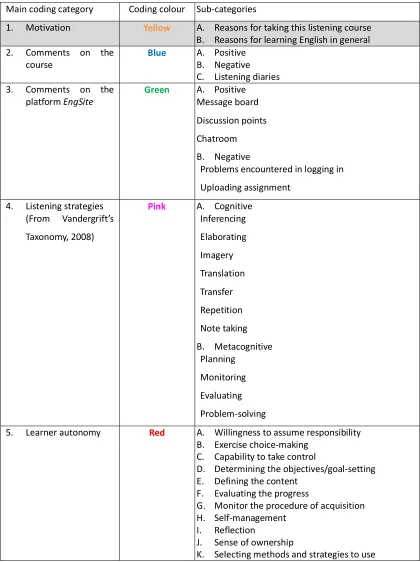
Appendix 6: Sample Data analysis—coding categories of listening strategies ...340
List of Figures
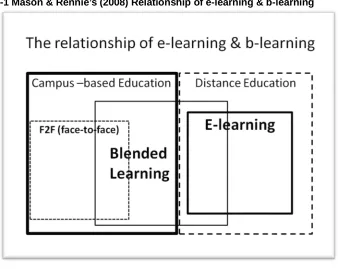
Figure 2-1 Mason & Rennie’s (2008) Relationship of e-learning & b-learning . 29
Figure 4-1 The Numbers of Weekly Discussion Posts... 92
Figure 6-1 Data Collection Schedule ...164
Figure 6-2 Listening Diary PPT ...199
Figure 6-3 Benson's (2001) Control over Cognitive Process...205
Figure 6-4 The Loop of Reflection ...206
Figure 6-5 Creating A Space for Reflection (Multiple Loops)...207
Figure 7-1 Course Design: Class A...219
Figure 7-2 Course Design: Class B & C ...220
Figure 7-3 Process Model of L2 Motivation ...228
Figure 7-4 Message Board ...233
Figure 7-5 Comparison of Channels of Communication in Three Courses ...234
Figure 8-1 Reflection and Drawing Individual Learning Map...256
Figure 8-2 Model on 15-02-2010 ...259
Figure 8-3 Model on 23-02-2010 ...260
Figure 8-4 Iceberg Metaphor of Factors Affecting Motivation (Littlejohn, 2008) ...263
Figure 8-5 The Exercise of Strategies...265
Figure 8-6 The Three Wheels of Motivation, Autonomy and Strategies ...266
Figure 8-7 The Dynamic Conceptual Framework ...267
Figure 9-1 Single Loop & Multiple Loops of Reflection ...276
List of Tables
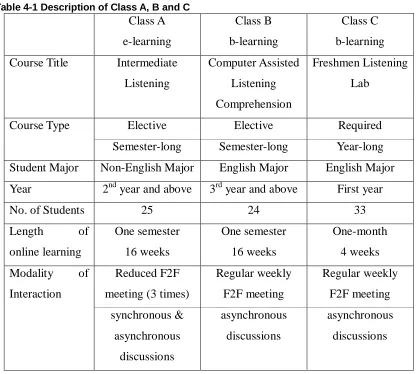
Table 4-1 Description of Class A, B and C ... 82
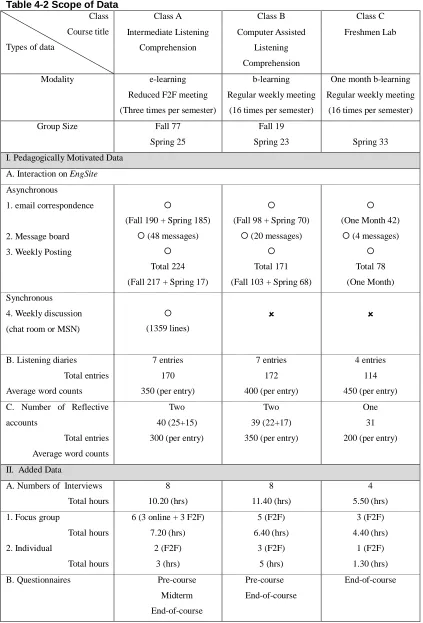
Table 4-2 Scope of Data... 86
Table 4-3 Numbers of Diaries Collected... 96
Table 4-4 Sample Data 1 Diary from Class A (Original) ... 96
Table 4-5 Numbers of Reflective Accounts ... 99
Table 4-6 Reflective Account from Class B (Before the discussion, original) ..100
Table 4-7 Reflective Account from Class B (After the discussion, original)...100
Table 4-8 Numbers and Length of Interviews ...103
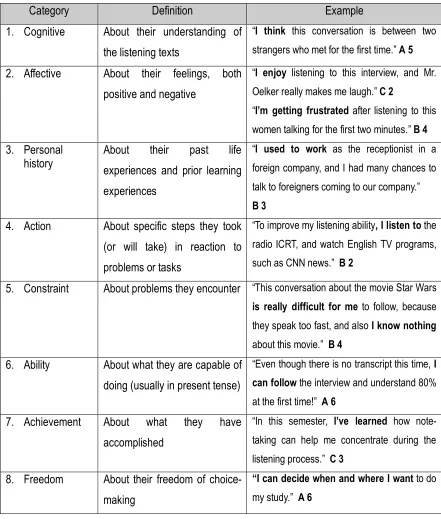
Table 5-1 Gee’s and Warschauer’s Categories of I-statements ...127
Table 5-2 I-statement Categories and Examples ...129
Table 5-3 Combination of Statements...130
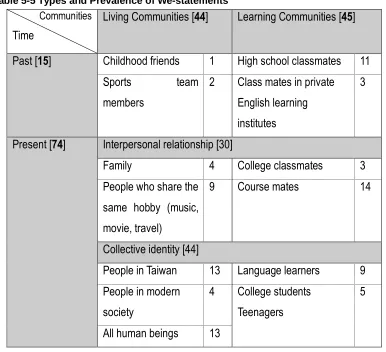
Table 5-4 Examples of We-statements ...132
Table 5-5 Types and Prevalence of We-statements...133
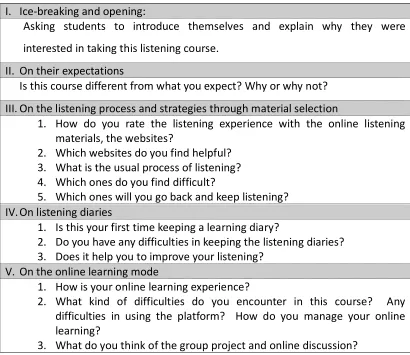
Table 5-6 Interview Questions...143
Table 5-7 Pre-determined & Emerging Coding Categories (motivation) ...144
Table 5-8 Coding Categories (Emerging: Motivation, external factors, attitudes and change of perception) ...146
Table 5-9 Coding Categories: Motivation of Taking the Course...150
Table 6-1 Numbers of Messages onEngSite...157
Table 6-2 Comments on Collaborative Task One ...159
Table 6-3 Comments on Collaborative Task Two (Translated) ...162
Table 6-4 Frequency of I-statements...165
Table 6-5 Cognitive Statements I ...165
Table 6-6 Cognitive Statements II ...166
Table 6-7 Action Statements...167
Table 6-8 Affective Statements...168
Table 6-9 Constraint Statements...169
Table 6-10 Personal History Statements ...169
Table 6-11 Achievement Statements...170
Table 6-12 Types and Prevalence of We-statements...172
Table 6-13 I-statement Distribution of Zenobia (Class A, Spring)...174
Table 6-14 Frequency of Statements...176
Table 6-16 Frequency of Statements (Helen) ...181
Table 6-17 I-statement Distribution of Ming-Fan (Class B, Spring)...184
Table 6-18 Frequency of Statements (Ming-Fan)...186
Table 6-19 Comments on Listening Diaries...190
Table 6-20 The Configuration of Tasks...195
Table 6-21 Negative Comments on Diaries ...203
Table 6-22 Top Five We-statement Categories...210
List of Screenshots and Excerpts
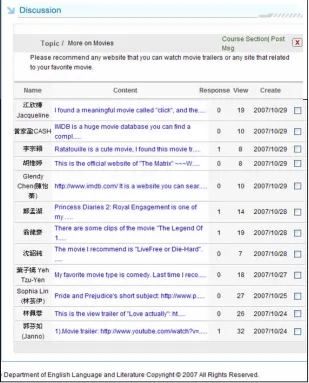
Screenshot 4-1 Message Board (Class B) ... 89
Screenshot 4-2 Weekly Discussion Points (Class C) ... 91
Screenshot 4-3 Threaded discussion (Class A) ... 92
Screenshot 4-4 Chatroom (Class A)... 93
Excerpt 4-1 Listening Diary from Class C (Original) ... 97
Screenshot 5-1 Formatting Questions as Headings ... 137
Screenshot 5-2 NVivo Auto-Coding with Colour Strips... 137
Screenshot 5-3 The Found-and-Replace Function ... 138
Screenshot 5-4 Final Look of Word Files ... 139
Screenshot 5-5 Importing Documents into Folders ... 139
Screenshot 5-6 Coding Segments of Text as Nodes ... 140
Screenshot 5-7 Tree Nodes... 141
Screenshot 5-8 In-Vivo ... 141
Screenshot 5-9 Motivation Nodes ... 149
Screenshot 5-10 Model of Coding Categories ... 152
Excerpt 6-1 Reasons for Not Participating in Online Discussion (Class A, Translated)... 160
Excerpt 6-2 Zenobia's Reflective Account 1 (Original)... 176
Excerpt 6-3 Zenobia on Travel (Original)... 177
Excerpt 6-4 Zenobia on Job's Commencement Speech (Original)... 178
Excerpt 6-5 Zenobia on Reflective Account 2 (Translated from Mandarin) ... 178
Excerpt 6-6 Helen on Reflective Account 1 (Original) ... 182
Excerpt 6-7 Helen on Movie (Original) ... 182
Excerpt 6-8 Helen on Radio Diary I (Original)... 183
Excerpt 6-9 Helen on Radio Diary II (Original)... 183
Excerpt 6-10 Helen on Reflective Account 2 (Original)... 184
Excerpt 6-11 Ming-Fan Reflective Account 1 (Original) ... 187
Excerpt 6-12 Ming-Fan Reflective Account 1 (Original) ... 187
Excerpt 6-13 Ming-Fan on Radio Diaries (Original)... 188
Excerpt 6-14 Ming-Fan: Reflective Account 2 (Original) ... 189
Excerpt 6-15 The Dialectic Process of Diary-keeping (Translated) ... 201
Excerpt 6-16 Interviews on Diary-keeping (Class B, Translated)... 202
Excerpt 7-1 My Fieldnote on 22nd Nov. 2007 (Class B, Original) ... 221
Excerpt 7-2 Preference of Discussion Mode (Class C, Spring, Translated) ... 223
Excerpt 7-3 Cathy's Comments in FG interview (Class B, Translated)... 225
Excerpt 7-4 Chatroom Records (Class A, Spring, Original) ... 236
Excerpt 7-5 My Fieldnotes on Online Chatting (Class A, Spring, Original) ... 238
Excerpt 7-6 Focus Group Interview from Class A (Translated)... 241
Acknowledgments
First and foremost, I would like to express my deepest gratitude to my two
supervisors—Ema Ushioda and Richard Smith. With their supports and
guidance, I have reached a destination I had never imagined when I embarked my journey four years ago. In Dr. Ushioda’s words, this is ‘a process of minimising confusion’, and indeed, I felt less puzzled and more certain about my next step every time I walked out of her office after our tutorials. In our tutorials, they have always listened to my ideas patiently and attentively even at the early stage when ideas were not yet in shapes, they posed questions that directly
pointed out the blind spots I had not noticed, and they were always very generous in sharing their resources with me. Dr. Ushioda has been very prompt and patient in replying all kinds of questions I raised through emails, gently nudged me when necessary and provided detailed comments on my drafts. Dr. Smith has offered alternative views to challenge my thinking. In 2005, it was Dr. Smith’s
edited book Learner Autonomy across Cultures: Language Education
Perspectivesthat had drawn my attention to the notion of learner autonomy and brought me to University of Warwick. He reminded me to step out my comfort zone and question myself things I might have taken for granted, and encouraged me to not only focus on my study but also participate in conferences and seminars. It is truly an honour for me to work with them in the past four years.
Secondly, I am equally grateful to three chairpersons in my home university in Taiwan, Father Denial Bauer, Kate C. W. Liu and Yuan-Pi Yuan. Father Bauer, my first boss in Fu-Jen, hired me soon after I earned my Master degree from New York University in 2002. He has been not only a boss to me but a dear friend who always offers his honest opinions and consistently encouraged me. Special thanks also go to Dr. Liu who started the AIEDL project and has devoted herself in the pioneer work of online English learning which would only be possible as a team work. She pulled together a great team to provide all the technical and financial supports. I also would like to thank Dr. Yuan who agreed to let me teach the freshmen listening course in the day
have shared with me how they put this belief into their practices. As a novice teacher, I was very fortunate to start my career with such a devoting team in Fu-Jen. Even though the term learner autonomy was not stated explicitly in the documents, I have experienced such an autonomous spirit among the faculty.
Thirdly, in this study researching learner autonomy, I am indebted to all the students participated in the three courses. They had not been very open and honest in communicating their thoughts with me in their diaries and in the interviews, and I therefore gained a more colourful picture of their learning. My appreciation also goes to the five TAs who helped to respond to students’ emails and questions posted online, and solved the technical problems students encountered in learning online.
I had to admit that there were moments I doubted my decision of studying abroad, but when I thought about all these amazing people I met in England, I knew I have made the right decision. I would like to thank the group of lovely friends I met in University of Warwick, Claire, Charoula and Theo, Dani and
Rami, Kathy, Khem, Jane and Paulo, Jessie, Jennifer, Joan, Mary, Nicky, Rossana, Rossario, Sophia, Sun, Szu-an, Vani, and Young. They have not only enriched my personal lives, but also stimulated my academic thinking. We had shared all the ups and downs in this foreign country, sometimes crying on each other’s shoulders and sometimes sharing tears of joy. To an international student like me, they are indeed my family that come from various countries all over the world.
Last but not least, I want to dedicate this thesis to my dear family, my forever supports. Even though my father Tai-Hong Wei had passed away years before I started this PhD study, he was the one that planted the seed of studying abroad in my head and saved up the money for my study. I want to thank my mother Shu-Er Cheng for having strong faith in me and encouraging me to pursue my dream. Thanks also go to my sister I-Han and my brother Chun-Chan whom I could always fall on, and my boyfriend Wade and his unconditional love. Writing acknowledgements is emotionally overwhelming for me, as the study has taken several unexpected turns, and finally this is the end. I am extremely grateful that I have a long list of people to thank. My thesis will not
Abstract
This thesis reports on practitioner research I conducted over two semesters
teaching online listening courses to three different groups of students in Fu-Jen
Catholic University in Taiwan. Instead of a typical three-cycle Action Research
model starting with a specific target area to improve, I adopted a more flexible
exploratory approach allowing a longer evaluative phase before deciding on a
focal area. Originally, my interest was to investigate how CSCL (Computer
Supported Collaborative Learning) could help students in counteracting the
relative isolation of online learning. However, after the first phase, I directed my
attention more to the role of reflection as students neglected the online
interactions and preferred communicating their ideas with me through reflective
accounts and listening diaries.
My research questions focused on three areas: the roles of collaboration
and reflection, the online modality and issues related to researching learner
autonomy. With the aim of exploring development over time, I gathered three
kinds of data: pedagogically motivated data including online interactions and
student assignments (listening diaries, reflective accounts); additional student
interview and evaluation data; my fieldnotes and observation data documenting
how I managed the three courses. Therefore, all the data collected was textual
and qualitative in nature. Different approaches to data analysis were applied to
different datasets. Grounded theory was applied to the interview data to allow
themes and codes to emerge, whereas I-statement analysis and some
predetermined coding categories were applied to the diaries and reflective
The findings are structured according to the three areas of investigation.
First of all, regarding collaboration and reflection, the success/failure of
collaborative tasks depends greatly on task design configuration, while
diary-keeping indeed serves as an effective pedagogical tool to raise students’
awareness of their learning processes and heighten their sense of ownership.
Based on this understanding, teachers can create a space for reflection by
marking regular opportunities for reflection and offering guiding questions.
Secondly, regarding the online modality, the success of the online interactions
contributed to students’ sense of ownership, which is closely related to their
perception of what a listening course should be like and their identity as college
students. Lastly, regarding issues related to researching learner autonomy,
combining both Action Research and Exploratory Practice principles is beneficial
to ensure that the teacher-researcher does not impose the research agenda onto
learners. When data elicitation tools and data analysis techniques are also
pedagogically motivated, the findings can authentically represent the picture of
students’ learning. In viewing the development of learner autonomy as a learning
process, considering cognitive, affective and behavioural domains can help us to
understand learners’ perceptions and metacognitive strategies which are not
easily observable from their learning behaviours. Furthermore, the data reveals
that motivation and strategies interplay with learner autonomy throughout the
1 Chapter One Introduction
This chapter aims to present background information of my study; therefore I will begin with the context of my study—the current language teaching and learning situation in Taiwan in 1.1. In 1.2, I will present my motivation for studying learner autonomy in a technology-mediated environment, and the purpose this study aims to achieve will be discussed in 1.3. In 1.4, I will map out the structure of the whole thesis to introduce the following eight chapters.
1.1 Context of the study
My study took place in Fu-Jen Catholic University in Taiwan, a context I am familiar with, since I had completed my bachelor study there and spent another four years teaching after I earned my master degree. According to Toma (2000), this closeness to the people involved in the study contributes to form a subjective understanding which can improve the quality of qualitative data in subtle details (cited in Marshall and Rossman, 2006, p. 61). In this section, I will present this EFL context at three
levels, the overall EFL setting in Taiwan, the teaching context of Fu-Jen Catholic University I worked under and the Advance Intermediate English Distance Learning (AIEDL) programme this course belonged to. The purpose of laying out the three-layer context is to present the outside reality and some uncontrollable factors I faced
in carrying out this practitioner research.
1.1.1 Current English education in Taiwan
Hamp-Lyons (2001), which both reported students’ expressed needs to receive training catering to the growing demand for oral communicative competency. My research aims to address this need for training targeted at developing students’ listening.
The other issue arising in Liu’s investigation is the growing demand to integrate the use of technology on the teacher’s side. He used the term hybrid learning (equal to blended learning) to refer to the mode of learning combining face-to-face meeting with the use of technology, specifically online interactions. Currently, according to what teachers reported in this study, their use of the Internet was limited to sourcing or presenting teaching materials. They either asked students to go online for resources, or they uploaded teaching materials they made themselves. Liu suggested that teachers had yet to discover the potential of more interactive online
tools, or they were aware of these ICT tools but they had not figured out how to effectively integrate them into their English courses.
These two main findings in Liu’s study are exactly what my research aims to address. How my listening course was developed to promote learner autonomy and
respond to students’ need will be elaborated in Chapter Three (Pedagogical Rationale). As for the integration of technology, I am fortunate to have this opportunity to join the AIEDL project mentioned above, which has been established since 2004 to experiment with innovative ways in offering English courses in the online learning mode. The expansion of the AIEDL project in my teaching context in Fu-Jen mirrors the fast-growing demand of hybrid learning in higher education not only in Taiwan but around the globe. My context is a typical example of the soaring interest from higher education toward the goal of building “university/classroom without walls”. According to Cannell (1999), most institutions are seeking a more “mobile and diverse” academic market to face the reality of “declining enrolments, increasing costs, the potential market of adult professionals, pressure from corporations, institutional competition for faculty, and increasing global access to technology”. Most policy-makers encourage the development of distance learning programmes, viewing it as an investment to boost the institution’s reputation and, of course, also to earn more profits. As the policy is encouraged and actually carried out, an increasing number of teachers in the middle of the power structure, including myself, are facing
1.1.2 Institutional context of the study: Fu-Jen Catholic University
My home university is one of the renowned private universities in Taiwan, with one of the earliest founded English Departments. Fu-Jen Catholic University has been well-known for the foreign language education, both modern languages (English, Italian, French, German, Spanish and Japanese) and Latin. The foreign language college was established in 1963 by a group of enthusiastic foreigners coming from various countries. The foreign teachers also brought diverse teaching beliefs and methods with them. As a result, language teachers have been granted greater flexibility in designing their own curriculum. In such a conducive environment that supports language learning and innovative approaches to making the learning happen, I had the chance to explore the use of technology during my four years teaching there
(2002-2006).
1.1.3 Developmental stages of AIEDL programme
In this section, I will focus on the AIEDL (Advance & Intermediate English Distance Learning) project I joined in developing this online listening course. The
developmental stages of the AIEDL project have subtle impacts on the data collection process because these administrative factors were not within my control. The curriculum decision-making, like my goal-setting, the topic selection and activity designs was shaped by the AIEDL programme to a large extent. This background information is therefore important to this practitioner research in contextualising the institution that mediates between the researcher, the students and the outer social milieu (Edge, 2001, p. 5).
The integration of technology into the curriculum is viewed as a valuable asset among universities in higher education. “Distance education incorporates many alternative education opportunities such as web-based or web-enhanced instruction, which enables learning to be more accessible and interactive” (Brewer et al., 2001; Kearsley, 2000; Moore & Thompson, 1997 cited in Cheng & Myles, 2003, p. 29). The AIEDL project is such an example. Initially, it was established to offer paid courses for in-service teachers and professionals who are interested in improving their English language skills; therefore, the term distance learning was adopted.
three developmental stages to identify the potential target students. In Stage One, as the acronym suggests, the programme was designed in the distance learning mode to attract in-service teachers and professionals who wanted to improve their knowledge and skills of English and were willing to pay. Although the students recruited for the first course in 2004 were all highly motivated, the number of students was too small to support the project. The first course I taught in summer 2005 belonged to this initial stage, designed for in-service teachers as part of the English Teaching certificate programme. Due to the regulation of MOE (Ministry of Education), half of the course had to be instructed face-to-face. Although this summer course only lasted for six weeks, for both me and the students, this brand new learning experience in interacting online indeed transcended certain limitations of the conventional in-class
learning.
After the realisation that running the programme with such a small number of students was not cost effective, college students enrolled in Fu-Jen Catholic University were invited to take the courses for free. The 2nd stage marked a turning
point for the AIEDL programme, for the suddenly raised numbers of students, from 20 in a class to 50 to 60 in a class, consequently altered the nature of the course design. The accompanying challenges came from accommodating different needs and learning preferences of students from various departments. Moreover, all the communication was dealt with through the Business Management College and the Social Sciences College where the courses were offered. From the administrative perspective, this was a rather exploratory process as well, since without the direct contact channel with the students, we teachers played a less active role in communicating with them.
The course I offered in Fall, 2005 belonged to Stage Two, and so were the two courses I offered in Fall, 2007 and Spring, 2008, which form the focus of this PhD research. As I mentioned above, two major colleges cooperate with the AIEDL programme, the Business Management College and the Social Science College, both promoting English learning but approaching their goals quite differently. The policy in the Business Management College was to set a threshold—before graduation students have to take TOEIC and reach a certain score, or the alternative was to take a
the AIEDL courses.
In 2005, managing a 72-student online course for the first time, my full attention was on how to structure my course and interact with students online, and as a result, I was totally unaware of the potential influence these two opposite policies casted on students until I started my fieldwork in Fall, 2007. The course in Fall, 2007 was offered under the Business Management College, whereas the course in Spring, 2008 was offered under the Social Science College. In the end-of-semester seminar of Fall, 2007, we teachers shared our observation on how the policies of English learning in students’ college had an impact on students’ initial attitude and motivation. Although motivation is not the main focus of my study, it is an inevitable factor, both a cause and an outcome. The difference shown in students’ participation in class will be
further discussed in the emerging issues of the data collection.
Now the AIEDL project has moved into its 3rd stage. The English Elite Programme (菁英學程) was established under the Sociology department. Starting
from September of the spring semester, 2008, the courses were offered under the English department. Students need to apply for this English language programme and if they can complete 24 credits by the time of graduation, they will earn a certificate as a proof of their fulfilment and of course, as a proof of their English proficiency. As the time of writing, there are still discussions going on about the future development of AIEDL.
1.2 Motivation and purpose of the study
I had been teaching listening courses since I started to teach in Fu-Jen Catholic University in 2002. As described above, in my second year of teaching, I joined the AIEDL project, spent a year developing the online listening course, and offered it in 2005. My initial interests in researching learner autonomy in a listening course emerged from my previous teaching experiences in teaching the listening course in the lab (2002-2006) and online (2005-2006). I observed that certain students adapted themselves to the online learning environment a lot more easily than their peers. This led me to wonder why they managed to regulate themselves better, why they sought solutions on their own when they encountered problems, and why they were able to
first achieve an understanding of students’ actual development of learner autonomy in a technology-mediated environment. Based on this understanding, I can develop a more systematic way to foster students’ subsequent development of learner autonomy.
1.3 Research aims
Instead of presenting all of my research questions here in the introduction chapter, I will address my research aims first in a more general sense, and raise my research questions later in Chapter two, when the literature is reviewed and gaps in the current studies are identified. The previous experience in 2005 gave rise to my interest in how learner autonomy works or does not work in an online learning environment. With this purpose in mind, the primary research aim is to observe how learners exercise autonomy in the online modality.
My fieldwork was divided into two stages—an exploratory phase (Fall Semester 2007) and the main study (Spring Semester 2008). The purpose of the exploratory first phase (Laying the Ground) was to gain initial understanding of the two classes I was teaching—an e-learning group (Class A) and a blended-learning (b-learning)
group (Class B). I wanted to try to perceive students’ learning including both positive and negative aspects. In the Main Study, I added a third class, which was a one-month b-learning group (Class C). In the Main Study, I decided to provide more discussion opportunities, either online or face-to-face, for students to share experience, worries and successful learning tips.
1.4 Structure of the thesis
listening course. It begins with a review of listening research and then moves to listening strategy instruction and the specific use of technology in materials selection and the multimedia learning environment. The use of methodology is divided into two chapters with Chapter Four (Data Collection Methodology) on the data elicitation tools and the scope of data, and Chapter Five (Data Analysis Methodology) on the audit trail of my data analysis process including steps in using NVivo. The discussions on findings comprise three chapters. Chapter Six reports the roles of collaboration and reflection, whereas Chapter Seven looks at the teaching and learning aspects in working with the online modality component. Chapter Eight highlights the insights practitioner research provides into our understanding of learner autonomy. Chapter Nine provides a review of the key findings and further discusses
2 Chapter Two Literature review
As stated in 1.2, my interest in studying learner autonomy derived from a previous
online teaching experience in which I observed positive impacts of learner autonomy. Due to this interest of studying the actual exercise and development of learner autonomy in my technology-mediated context, this chapter consists of two main sections: learner autonomy and the online learning environment.
In 2.1, I will review literature in the learner autonomy arena first because this is my primary research interest. I will start with the historical development of learner autonomy and how this concept has been defined in theoretical discussions within the field of ELT (Benson, 2001, 2007, Dam, 1995, 2003, Holec, 1981, Little, 1991, 2004). With the strong nature of practitioner research underlying my study, I will next turn to empirical studies recording how practitioners carry out the notion of autonomy in actual practice, starting from setting the course objectives, integrating it into the course design and means of assessments. The purpose is to learn from what current research studies have already informed us and further identify the gaps in the literature.
What is reviewed next in 2.2 is the online learning modality, which serves as the context of my study. I will explain why I settle on the terms e-learning and
b-learning which are used in the field of general education instead of CALL which is used more often in our field of language education. Next, in reviewing online language learning, the notion of affordance (Gibson, 1979; van Lier, 2000, 2004) will be elaborated to explain how the online learning modality provides opportunities for
learners to reflect on their learning and interact with their classmates in this learning community. The section 2.3 will look at how the concept of learner autonomy interplays with the innovation of web-based technology in creating new learning opportunities for collaboration and reflection, my main focus in the study. At the end of this chapter, in 2.4, I will raise the set of research questions guiding this study.
2.1 Literature review on LA
influences can lead to intriguing discussions, in this chapter, I will narrow my attention only on learner autonomy in language education to make the already-complex concept feasible. As Pemberton (1996) warned us more than a decade ago, facing the profusion of publications with learner autonomy in the titles, we need to be aware how “different terms are often used to refer to the same thing…[and how] the same term is often used to mean different things” (p. 2).
Under the intention of clarifying what we actually refer to when talking about learner autonomy in our field of language education, this section will begin with a brief summary of the historical development of learner autonomy, and move to a collection of definitions on learner autonomy. The purpose of beginning with this theoretical review is threefold. First, I hope to pinpoint salient characteristics that
have been identified as essential components in autonomy. Although autonomy has been used by different researchers to refer to different things, there remains a set of agreement on fundamental issues, particularly on what autonomy is not. Second, through reviewing these debated issues addressed in the past thirty years, I aim to join
this dialogue and place my research on this continuum. Lastly, these theoretical discussions will serve as the foundation for my later discussions in data analysis (Chapter 5).
2.1.1 A brief history and the definition of LA in language learning
As Smith (2009) states inThe History of Learner Autonomy, the belief underlying the act to examine the history is that “insights from the past can help teachers navigate their own way,criticallybutconstructively, among the top-down, centre to ‘periphery’ fashions which tend to characterize language teaching discourse” (p. 1, emphasis added). In line with this belief in furthering our understanding of learner autonomy, retracing the historical development of learner autonomy in the past helps me better perceive the current debates and arguments so as to position my study on this continuum of dialogue.
Reflecting on the past is necessary in order to address issues and join the ongoing discussion. As mentioned above, with my role as a teacher-researcher and
the practitioner emphasis of my study, I am reviewing the history with an eye to how relevant, or distant, these discussions are for classroom teachers. Several questions I bear in mind are the following:
1. What does the theory tell us about learner autonomy? Since there are apparently different angles of looking at learner autonomy, which will best serve my purpose as an EFL teacher?
2. How do these theoretical constructs help to inform classroom practice, not in terms of providing direct technical transplantations and applications of these concepts to teaching of course, but more in terms of suggesting a framework for teachers to see better, to observe more and to approach learners and classroom ecology in multiple dimensions and realities?
3. When coming to practical concerns, namely turning the framework into action plans, how do these theoretical underpinnings help us, all shareholders including teachers, administrators, curriculum designers and even students themselves, to facilitate the process of developing autonomy in a way that our guidance does help to develop and not to constrain the actual exercise of autonomy?
Under the major paradigm shift from the teacher-centred to the learner-centred learning mode in the past thirty years both in the field of general education (Hase & Kenyon, 2000) and in our field of language education, learner autonomy has earned greater attention than ever since the turn of the century (Benson, 2007). The documentation of autonomy in the field of language education that marked the initial interests of learner autonomy originated from Holec’s (1981) report and his involvement in the self-access learning centre CRAPEL (Centre de Recherches et d’Applications en Langues) at the University of Nancy, France. In fact, this early association between learner autonomy and self-access learning was built in various countries in Europe and across the globe in Asia. Up in the Scandinavian Peninsula, Nordlund (1997) and her colleagues, Karlssson and Kjisik have worked to establish
Autonomous Learning Modules (ALMS) in Helsinki University, Finland. Across the English Channel, In the UK, as Smith (2009) reported, in the 80s, there were also traces of work in the field of individualisation (Altman and James, 1980, Geddes and Sturtridge, 1988), which later merged into learner autonomy (Brookes and Grundy,
1988). Little (1991, 2004) also attributed his initial interests of learner autonomy to the self-access learning project he helped to establish in Trinity College Dublin, Ireland. Across the globe to Asia, Benson and his colleagues also had devoted themselves to the establishment of self-access centres in Hong Kong. In sum, early development of learner autonomy indeed struck a strong chord of self-directed learning and individualisation. A development common to all these self-access centres is to provide some form of learner support, training or advisory and counselling service. According to Little (2004), students could seek help “to determine their objectives, define contents and progressions, select methods and techniques, monitor progress, and evaluate outcomes” (Little and Grant, 1984, 1986 cited in Little, 2004, p. 17).
The etymological root of autonomy might help to explain this early emphasis of being independent, as revealed in “managing one’s learning” and “learning without a teacher”, evident in the works of these pioneers in the 80s and into the 90s. Autonomy has its root in Greek, a combination ofautoandnemo, which when joined together means “to live according to one’s own rules/laws, self-governing” (Oxford,
refuelled” (XXe) (Distance que peut franchir un véhicule…sans être ravitaillé en carburant.) This definition highlights the root auto which “dates back to the time when the capacity of engines started to free humans from constraints of time and space” (Namenwirth, 1994). Although this interpretation compares autonomy with the capacity of engines, a rather mechanical view, its suggestion ofbreaking free from constraint of time and spaceis worth considering.
However, as the seed of autonomy was carried by the wind and spread into the soil of language classrooms, this tone of individualisation has been nurtured and watered by a more social stream of thought. First of all, toward late 80s, Allwright (1988) called for “a radical restructuring of language pedagogy” and proposed to position autonomy within the context of classroom teaching and learning. His
proposal of reconstruction “has become a reality that many language teachers must now come to terms with” (cited in Benson, 2006, p. 22). In the meantime, Little (1991) and Dam (1995) have both raised their voice by accentuating that autonomy is not a synonym for “learning in isolation.” This is significant in drawing our eyes to
the role teachers play, and can play, in creating an autonomy-friendly environment. Consequently, as opposed to independence, Little (1991, 2004) proposed valuing interdependence when defining autonomy, marking a salient social turn in his psychological construct of autonomy. According to Benson (2006), this suggests erasing the definite line between ‘classroom’ and ‘out-of-class’ applications and led to “new and often complex understandings of the role of autonomy in language teaching and learning” (p. 22). Furthermore, the advent of technology, particularly ICTs, stirs this already complex understanding and creates an even more dynamic reconstruction of the look of language learning. Teachers are facing new challenges brought by the latest exciting digital opportunities.
In their commentary chapter, Smith and Ushioda (2009), along with accompanying authors Aoki, Esch and Riley, also lay emphasis on this shift of focus to place the exercise of autonomy within a socially situated framework as “a salient change.” They comment that “from this perspective, autonomy is now seen to develop out of interaction with others, it benefits from interdependence, and classrooms and teachers are no longer peripheral but at the centre-stage of practical
self-access learning. According to Smith (2008b), the significance of Dam’s work lies in the fact that it stretches the potential of autonomy “to address constraints” (p. 9, emphasis original). In sum, under this shift of attention from out-of-class, self-managed learning to in-class institutionalised learning, teachers are brought into the picture in researching learner autonomy, an area my research aims to contribute to.
2.1.1.1 The definitions of learner autonomy language learning
After the brief review on the development of learner autonomy in the past thirty years, this section begins with a fundamental question that has been asked consistently, “what is autonomy”. The purpose is not to locate one single best definition, but to include a collection of variant interpretations. Various aspects of tackling this question and several proposed definitions, including Holec’s (1981), Little’s (1991), Dam’s (1995), Littlewood’s (1987), Smith (2003) and, Benson’s (2001, 2007) will be placed together in capturing evolving snapshots of learner autonomy. This is because, naturally, during the process of defining, we are not only placing the concept under the spotlight; in the meantime, we are also putting ourselves up on the stage. The question, “What is autonomy”, will only be meaningful when we also explain “How do we see it in our eyes?”, namely, how we illustrate our relationship with autonomy. Consequently, the act of defining autonomy carries the discussion beyond the WHAT
question into the WHO and WHERE questions. As Benson (2001) remarks,
researchers in the field of learner autonomy “often agree to disagree” on certain issues, since learner autonomy does not come with a set of prescribed formula, instead it is “a
broad approach to the learning process” (p. 1-2). A certain degree of flexibility is allowed to include practices of different kinds taking place in a range of diverse local settings.
2.1.1.1.1 Holec (1981)
In the literature, the most often cited definition of autonomy as “the ability to take charge of one’s own learning” dates back to Holec’s (1981) report for the Council of Europe’s Modern Language Project (p. 1). This definition interpreted autonomy as a capacity that can be developed, and a list of characteristics were also named, including “determining the objectives, defining the contents and the progressions, selecting methods and techniques to be used, monitoring the procedure of acquisition
(Holec, 1981, p. 3). As discussed earlier, this definition grew from theories of adult education in which the necessity of self-management and self-regulation were highlighted (Little, 2004, p. 16). Although this emphasis was later criticised as too technical (Benson, 2007), its significance lies in the underlying belief construing autonomy as a capacity which can be further developed through training and scaffolding, as oppose to defining it as something innate, something we were born with in our genes. This provides a point of departure for an ongoing attempt to explore means of further developing autonomy inside and/or outside of the classroom, for example, one possible means is to provide learner support and training via strategy use.
2.1.1.1.2 Little (1991)
Little (1991) is known for his extensive publications on and contribution to the
theoretical discussions of learner autonomy, adding a strong psychological dimension to Holec’s definition. According to Benson (2007), Holec’s definition describes “WHAT autonomous learners are able to do”, whereas Little’s definition “explain HOW they are able to do it” (p. 23). Instead of answering the what question directly, Little (1991) defines autonomy by negation to break five misconceptions (p. 3):
1. Autonomy is not a synonym for self-instruction; in other words, not restricted to learning without a teacher.
2. In the classroom context, autonomy does not require the teacher to relinquish all initiative and control.
3. Autonomy is not something teachers do to learners; in other words, not a new methodology.
4. Autonomy is not a single easily described behaviour. 5. Autonomy is not a steady state achieved by different ways.
Little, 2004, p. 22). First of all,learner empowermententails that learners are granted the opportunity and flexibility in taking initiative and making key decisions. During the decision-making process, learner reflection entails that they are guided to reflect on both the content and the process of their learning. This retrospective, metacognitive retracing helps to attach meaning to the first actions. By doing so, learners are also taking the responsibility to evaluate their previous learning experience. The third principle, appropriate target language use, entails use of the target language as the medium of all the above learning activities. As Little puts it, “autonomy in language learning and autonomy in language use are two sides of the same coin, the scope of each constraining the other” (in Little, 2007, p. 7). In a recent article, Little (2007b) adds the word language in front of learner autonomy to draw
our attention to the development of proficiency as “an intended outcome” of language learner autonomy (p. 14).
Another influential idea of Little in defining learner autonomy is to bring interdependence, or what he recently called relatedness, and collaboration into the
stream of discussion. Under the influence of sociocultural theory, specifically Vygotsky’s ZPD, Little (2007) discusses how “higher psychological functions— voluntary attention, logical memory, the formation of concepts—are internalised from social interaction” (p. 22). The interplay of social interaction, namely collaboration, and egocentric speech, namely reflection, is the key to develop autonomy (see 2.3). According to Little (1991, 1999a, 2004), the development of this line of thinking stressing interdependence was influenced by Leni Dam’s (1995) work in Denmark. Since then, as discussed in the above historical account, this social dimension of autonomy has been recognised as necessary by both theorists and practitioners (Benson, 2001; Smith & Ushioda, 2009).
2.1.1.1.3 Dam (1995)
Holec’s and Little’s definition, teachers’ roles and responsibilities are equally highlighted. “To operationalize learner autonomy typically begins by emphasizing the need for teachers and learners jointly to accept the freedom to determine the content of learning” (Bergen, 1990, p. 103). Based on her own teaching experience, Dam listed five differences between the traditional teacher-centred classroom and the one allowing space to develop learner autonomy:
1. A shift in focus from teaching to learning. 2. A change in the learner’s role.
3. A change in the teacher’s role. 4. The role of evaluation.
5. A view of the language classroom as a rich learning environment.
For most learners the process of promoting learner autonomy in school settings
can be “a long, difficult and often painful” process of change, which “demands constant effort on the part of the teacher and learners, not only as individuals but in collaboration with one another; for it is in the interactive process of collaboration that growth-points occur” (ibid, p. 6). Dam did not attempt to define autonomy in terms of building a theoretical construct; however her work with high school students manifests the notion of learner autonomy louder than words. She listed a series of questions her learners had to answer, frominitial evaluation, toplanning,carrying out the plans, and to new planning, a learning loop resembling the cycles in action
research (p. 31). For her learners, through goal-setting, selecting their own learning materials and designing their own activities to eventually evaluating learning outcomes, a sense of ownership was gradually established, step by step. Moreover, conforming to the third pedagogical principle Little (1999) proposed, the target language English was the required medium throughout the above process.
In short, Dam’s version of learner autonomy is a story retold from the teacher’s perspective. Its appeal lies in the fact that all of this was based on hands-on teaching and learning experience. Moreover, it provides possible answers for other teachers interested in the notion of learner autonomy. When we teachers are discussing what
136). In my research, I have rephrased these two questions in defining my role and responsibilities during the process of facilitating the development of learner autonomy. If it is “a teacher’s responsibility … to ensure that her [or his] learners are guided through these steps towards responsibility for their own learning” (ibid, p. 140), a crucial, but context dependent, question is about deciding when to provide guidance and when to let go. A question remaining paramount in my mind throughout my research is “How much guidance is enough, when should I step in and what should I offer?”
2.1.1.1.4 Littlewood (1999), Smith (2003) and Benson (2007a)
Having reviewed Holec’s, Little’s and Dam’s views on learner autonomy and collected questions inspired by their discussions, I will next review Littlewood (1999), Smith (2003) and Benson (2007), whose work contributed to categorising autonomy
into types and versions. As emphasised earlier, my interest is to consider these theoretical discussions in relation to classroom implications; therefore, I will address aspects of their arguments relevant to the practical context of my research focus.
matters is not how we classify types or versions of autonomy but that we draw practitioners’ attention to the planning stage prior to their actual action. If teachers become more aware of the belief system from which their actions derive, they will make more informed decisions.
Throughout his early discussions on learner autonomy, Benson (1996, 1997, 2001) has argued for more recognition of the political dimension of learner autonomy, along with the technical and psychological dimensions. This three-version discussion,
however, sends a different message, not directly regarding pedagogical
implementation, but going beyond the practice of the classroom into the philosophical values which might be too sensitive for some language teachers working in a culture they are not familiar with. Benson’s insistence on bringing in the political dimension
actually leads to another heated debate on culture appropriateness. Although these two areas of debate have commonly been addressed separately, there are some intricate connections between the two. As Little (2007a) put it, when the concept of autonomy is “associated with Western liberal democracy, [this] makes it immediately
suspect as a potential weapon of colonialism” (p. 15). In my research, in line with the argument that autonomy is a capacity all language learners can develop no matter what native language they speak or culture they belong to, I therefore do not attempt to join the debate on cultural appropriateness. This is not to say that the cultural background learners grow up with does not have an impact, but I wish to prioritise individual difference over cultural difference.
In summary, the above theoretical discussions on the defining features of learner autonomy provide a foundation for later discussion. I would like to point out that, although “learner autonomy theory has mostly been developed by practitioners of one kind or another—teachers working in the classrooms, teacher educators, those responsible for designing and evaluating self-access language learning systems, educational researchers charged with implementing innovation” (Little, 2007, p. 2), to date empirical studies into classroom research have been comparatively limited. There has been sufficient theoretical discussion for many voices to come back even more fully into this theoretical auditorium; however, there are fewer voices reporting from the empirical field. This lack of empirical research on learner autonomy has
He also mentioned elsewhere (2007b) that “[o]nce we have clarified the meaning of autonomy, it is assumed, we can then explore methods of fostering it among learners and teachers” (p. 15). Legenhausen (2007) extends Trebbi’s question and voices a pressing concern: Why is so little research on autonomy carried out, if research in a given empirical field is to be understood as the systematic collection and analysis of data with the aim of constructing a theory and/or of providing empirical evidence for the validity of theoretical assumptions or hypotheses? (p. 18)
He carries on raising more questions to be answered:
Where do we find these classrooms, and what are the institutional
frameworks within which they operate?
To what extent are the procedures determined by curricular guidelines and
cultural variables?
What do the classrooms actually look like? What kind of activities are the
learners involved in?
What opportunities for taking over responsibilities and for taking control do
they offer?
How do learners in these classrooms exploit these opportunities and thus
construct their own agendas? What amount of variability can be observed?
How are the various classroom procedures and learning processes
interrelated? How do individual learning styles and preferences determine the learning processes?
For practitioners who are interested in carrying out the concept of autonomy, this list of questions can serve as a starting point to study how we approach autonomy research in the classroom setting. There is therefore a need for practitioners to report on evidence-based empirical studies so as to bridge the gap between the theoretical discussions in books and journals and the hands-on discussions about classroom lives.
2.1.2 LA in practice: Empirical studies
This is also why I chose to stay with the term practitioner research instead of classroom research. It is true that when researching autonomy, especially when we play the dual role as teacher-researchers, we become interested in the dynamic process of learning and teaching, and all the factors involved during this process. Therefore, Action Research as a research methodology enables us to systematically study ways of promoting learner autonomy.
As mentioned above (Benson, 2007a, Legenhausen, 2007), we still have a rather modest collection of empirical studies to show us an overview of what kinds of research have been conducted. Most empirical reports on autonomy tend to be published in specially edited volumes of papers produced by various autonomy-related special interest groups or networks (such as the JALT Learner Development SIG, or the Nordic Workshop Group), rather than in independent research journals.
Because of this, I intend to look for the studies published in journals, and will summarise four empirical studies (Apple, 2006; Cotterall, 1995; Porto, 2008; Yang, 2003) reporting the actual application in language classrooms. I chose these four to focus on in this report because these four cover a period of time when autonomy had
attracted more attention. Moreover, these four reported studies were conducted in different geographical locations, Japan, Taiwan, Chile and New Zealand. As Benson (2007a) suggests, based on contexts of application, the studies can be roughly divided into autonomybeyondthe classroom and autonomywithinthe classroom. The former refers to the self-access learning type of out-of-class learning, while the latter refers to the exercise of autonomy within an educational setting. It is the latter context to which my research belongs; thus, the four I chose all have this same feature. In the following discussion, I will present the studies in a chronological order, starting with Cotterall (1995), Yang (2003), Apple (2006) and Porto (2008).
2.1.2.1 Cotterall (1995)
Cotterall’s study (1995) was first published in ELT Journal and later reprinted in Wallace’s (1998) bookAction Research for Language Teachers. Her study discussed means of promoting learner autonomy in an English language programme designed for international students who wanted to enrol in tertiary intuitions in New Zealand.
Her argument is that “learner autonomy is not something which can be ‘clipped on’ to existing learning programmes, but it has implications for the entire curriculum” (Cotterall, 1998, p. 173). This belief and the consequent action conform to the strong
version of pedagogy for autonomy which Smith (2003) proposed. Through
learner/teacher dialogue, classroom tasks and materials, student record booklets, and a self-access centre, various opportunities were created for learners to exercise decision-making on their learning process. She therefore reached the following four conclusions:
1. Autonomy in language learning is desirable.
2. Dialogue is more important to autonomy than structures.
3. The relationship between the learner and the class teacher is central to the fostering of autonomy.
4. Autonomy has implications for the entire curriculum.
5. In sum, her conclusion highlighted the learner-teacher relationship, which echoes Dam’s emphasis on teachers’ responsibilities. In Cotterall’s case, not only teachers but also programme designers share this responsibility in promoting learner autonomy.
2.1.2.2 Yang (2003)
I chose Yang’s studies because they were conducted in a very similar context to my study, language courses offered in a University in Taiwan. In her 1998 article titled ‘Exploring a New Role for Teachers: Promoting Learner Autonomy’ published in System, the same message was highlighted –teachers’ responsibilities and the change
of role. In saying that it was a “new” role, Yang argued that teachers used to neglect the potential of learners’ ability in taking charge of their own learning. She also started with three questions:
1. How can language teachers aid their learners in becoming autonomous?
2. How do learning strategies contribute to learner autonomy?
From the second question, it shows that she turned to learning strategies as a means of developing learner autonomy in line with Oxford (1990) and Wenden (1991). However, in her 2003 article ‘Integrating Portfolios into Learning Strategy-based Instruction for EFL College Students’, as the title suggests, she included the use of portfolios as a means of raising awareness during the evaluation process. Her studies show that learner autonomy is not a concept that is foreign to English learners in Taiwan. As I mentioned above, when promoting autonomy, it is necessary to consider the cultural background of the learners, and not to interpret autonomy as part of the Western belief system.
2.1.2.3 Apple (2006)
Apple’s study reports his experience in encouraging students to do extensive listening with college students in Japan. I included his study because his study also explores the development of learner autonomy through the listening skill. His study will be elaborated more in 3.4.2 in relation to extensive listening.
2.1.2.4 Porto (2008)
The last practitioner study I would like to review is Porto (2008), who recorded the process of introducing more autonomy into her teaching as part of a larger Action Research project. She is the only one who reflected on her own role in greater depth through the teaching diaries she kept. She first started with a theoretical journal in which she listed several questions for herself to answer, which reveal a strong sense of “I” (p.189).
1. What are my views of autonomy?
2. How do I see my role as a teacher in the foreign language classroom and in education in general?
3. What do the notions of learner responsibility and learner choice entail in my view? 4. How are learner autonomy, responsibility and choice materialised in my classroom?
In order to put her belief of autonomy into practice, the first step she planned was to introduce “a gradual increase of responsibility from learners in the management of their own learning” (p. 194). She started her lesson with a session
students can practice at home. In her findings, she reported the dark side of students’ choice-making. First of all, her own fear of granting more freedom and letting students get out of control led to a still authoritarian way of leading the class. She wrote,
I discovered how inconsistent I had been in my teaching practices…What I said I believed about learner choice and what I did in practice in this respect followed different paths. … It was quite traumatic for me to face the fact that it was me who was unsure about welcoming my learners’ initiatives. My diaries made me see that when learners strayed away from a topic, I tended to view this behaviour as evidence of my loss of control, took direct concrete action to restore order and, if I did
not, I wondered about whether to do so in writing (sic). (p. 196)
How Porto struggled between maintaining control or allowing learner the freedom of choice is a typical dilemma for teachers in actual practice, and her
narrative provides a very genuine suggestion for other teachers who are interested in trying out the same attempt. In fact, aside from encouraging more evidence-based classroom research in showing that learner autonomy has positive learning outcomes, we also need studies like Porto’s which provide insights into what the journey is like for teachers in learning to learn how to let go.
2.1.3 Factors influencing the development of LA: The roles of collaboration and reflection
In this section, I will move on to two interacting factors crucial to the development of learner autonomy—collaboration and reflection. A commonly perceived distinction is that collaboration entails the external social interaction learners engage in with their peers, and reflection entails the internal retrospective accounts of the learning experience. However, according to Vygotskian sociocultural theory, these two actively interplay with one another, that is, through our interaction with others, we are more able to gain reflective understanding and therefore attain optimal cognitive development. In this section, I will briefly summarise related discussion in the field of learner autonomy and then, after reviewing the field of online learning modality,