www.jrf.org.uk
September 2009
To what extent is there a ‘common model’ of fatherhood in a modern multicultural Britain that is changing fast?
This research set out to investigate the parenting beliefs and practices of fathers from 29 ‘ordinary’ two-parent families living in non-affluent neighbourhoods from four ethnic groups: White British, Black African, Black Caribbean and Pakistani.
The study explores:
• how fathers, mothers and children living in ordinary British families view what it means to be a father;
• how individual interpretations of fatherhood are influenced by personal history, culture, ethnicity, faith, and social circumstance;
• whether it is possible to identify common ideals about fathering and the behaviours of fathers across ethnic groups;
• to what degree members of the same family share beliefs, attitudes and practices;
• how beliefs and practices vary within and across ethnic groups;
• how fathers might be better supported in their roles as parents.
Hanan Hauari and
Katie Hollingworth
Understanding fathering
Contents
1 Overall introduction
5
2 Methodology for the study
9
3 What is a father?
16
4 What shapes fathering?
29
5 Conclusions: fathering today
43
Notes
47
References
48
Acknowledgements
51
Overall Introduction
Background to commissioning
This report documents the main findings and conclusions from a study of fathers and fatherhood in modern Britain. The research, which was mainly qualitative, was completed by the Thomas Coram Research Unit (TCRU), Institute of Education, University of London on behalf of the Joseph Rowntree Foundation (JRF) and was commissioned as part of a major programme of research into parenting in Britain.
The study explored aspects of diversity in parenting, in particular focusing on fathering in ordinary, two-parent families in four ethnic groups in England: Pakistani, Black Caribbean, Black African and White British. The aim was to gain a better understanding of what ‘being a father’ means to parents and children in these communities: what does fathering involve, what values and aspirations are attached to fathering and to what extent can there be said to be, in a modern multicultural Britain that is changing fast, a ‘common model’ of fatherhood that holds within and across families from diverse ethnic groups?
Policy, practice and scholarly
interest of the study
In the post-war period, dramatic changes in family structures and in social attitudes to the family have occurred in Britain. While myriad social and political factors have been instrumental in bringing about these changes, two factors in particular can be identified as having impacted fundamentally on attitudes and expectations of fathers. The first is women’s increasing involvement in the paid workforce outside the home, such that, in many respects, the model of families with two working parents is now the norm (ONS, 200). The increasing presence of women in the labour market has brought with it a reassessment of parenting roles and responsibilities, and an
1 Overall introduction
expectation that working-couple families will – at least to some extent – share parenting in ways that give each partner an equal role (O’Brien and Shemilt, 2003; Lamb and Tamis-Lemonda, 200). As we will show later in this report, ‘gender stereotypes’ that place mothers in the pre-eminent caregiving role and assign to fathers the main responsibility for breadwinning are still alive and well within the family, yet for the most part fathers across all groups feel themselves to be – and many are – deeply involved in most of the daily routines of childcare and nurturance in ways that their own parents (and certainly their grandparents) might have found surprising.
The second factor may perhaps be less visible, yet it is no less powerful. The rise of the ‘child-centred’ family incorporates the notion that children require certain inputs from parents in order to grow and develop in optimal ways; they are not just incidental adjuncts to adults but a central focus of family life in their own right, with rights enshrined by international convention (United Nations, 1989). Yet, in modern Britain today, parents show signs of being in the midst of a ‘parenting transformation’ with far-reaching implications. For men, in particular, whose fathering role has undergone previous transformations from a traditional one-dimensional role, such as a breadwinner, to a more multidimensional role during the 20th century, there is now an expectation that a father should be involved in all aspects of childcare and child-rearing activities, not to mention his role as a companion (Lamb and Tamis-Lemonda, 200).
The challenge of how to do the best for their children preoccupied the thoughts of many of the parents who took part in this study. It calls for a complex balance to be maintained, reconciling economic, moral, social and personal dimensions, achieved with considerable skill and effort against a backdrop of social structures and public
Overall Introduction
With this in mind, it is no coincidence that parenting has been a key issue in policy focus over much of the last decade, especially, though not only, in the UK. At times, an observer might be forgiven for imagining that ‘good parenting’ is the common cure for all social ills, given the enormous attention and resources that the State has
provided in recent years (Barrett, 2003; Desforges and Abouchaar, 2003; Moran et al., 200).
Fathering – what it is and how it can be supported – has been part of this, though to a lesser extent than the concern with parenting generally. Policy documents that have emphasised the importance of the father–child relationship, such as Supporting Families (Home Office, 1998) and, more recently,
Every Child Matters (HMT/DfES, 2003) and Every Parent Matters (HMT/DfES, 2007), have provided the impetus for practice initiatives aimed at increasing fathers’ opportunities and inclination to participate in their children’s care. For example, the National Childcare Strategy (DCSF, 200), the National Service Framework for Children, Young People and Maternity Services (DoH, 200) and Sure Start Children’s Centres Practice Guidance (Sure Start Unit, 200) all emphasise the importance of involving fathers in childcare and family support services. Yet initiatives aimed at enhancing their involvement have not always been successful (Ghate et al., 2000; Page et al., 2008).
Policy-makers may be driven to some degree by the economic benefits of father involvement – for example, by ensuring that fathers feel committed to contributing to family costs even if they re-partner or are non-resident with their children (Child Support Act 1991). However, policy and practice interest in fathers’ role in childcare has also been substantially galvanised by a growing body of research evidence on the social and developmental benefits to children of high levels of quality paternal involvement. It is now recognised that, in many respects, sensitive caregiving from both parents contributes to a wide variety of positive child outcomes (Lamb and Tamis-Lemonda, 200). These include the following.
• Better educational outcomes: Flouri and Buchanan (200) and Goldman (200) found fathers’ expectations and levels of involvement in their children’s learning and schools to be
predictive of greater school progress and higher qualifications.
• Better psychosocial adjustment: studies have identified a range of positive outcomes around the psychological development of adolescents, specifically in the domains of children’s
social maturity, behaviour and self-esteem. Many of these are thought to relate from the father–teenager relationship (Zimmermann et al., 2000; Pleck and Masciadrelli, 200; Flouri, 200).
• Reducing adolescent involvement in risk-taking behaviour, such as antisocial behaviour and youth crime (Flouri and Buchanan, 2002a, 2002b; Videon, 200 and Menning, 200 – both cited in Burgess, 2008).
The present study was commissioned with all of these factors in mind: the evidence that the involvement of fathers is good for children; the strong and growing policy interest in promoting father involvement; and the fact that practice still struggles to ensure that services provided to support parents are as accessible and effective for fathers as they are for mothers. In addition, we set out to explore and shed light on fathering in the context of an increasingly multicultural, diverse society.
Conceptualising father involvement
References to ‘father involvement’ throughout this report imply both direct interaction and
involvement in caregiving, as well as the economic contribution that fathers make (O’Brien, 200). As others have noted, paternal involvement in childcare is influenced by a number of distinct but interrelated factors – biological, economic and motivational (Lewis and Lamb, 2007). Much of the recent research on father involvement has been informed by Lamb and colleagues’ (1987) three-part model, which considers paternal involvement in terms of fathers’ engagement, accessibility and
responsibility – three dimensions of fathering that we consider throughout this report.
7
Overall Introduction
interactions involving direct person-to-person contact (for example, play or instruction).
• Accessibility or availability concerns the father’s potential availability for interaction through being present in the child’s vicinity, even if not in direct physical proximity.
• Responsibility for care includes making sure the child’s physical and emotional needs are met and arranging for resources to be available for this where necessary.
The current evidence suggests that greater father involvement in any or all of these three categories is beneficial for the entire family (Pleck and Masciadrelli, 200). Theories of parenting, and this would include fathering, emphasise that parenting is multiply determined, being influenced by a variety of individual and sociocultural factors. These include the:
• characteristics of the father (that is, his
personality, as well as his beliefs and attitudes towards child rearing);
• characteristics of the child (age, gender and temperament);
• context in which fathering takes place (for example, the father’s social support network, employment status and relationship with the child’s mother) (Belsky, 198).
Within these three categories, the father’s relationship with the mother may be particularly important. Furthermore, maternal attitudes regarding the role of fathers may have more influence over fathering practices than fathers’ own beliefs. For example, McBride and colleagues (200) found that mothers’ beliefs regarding the role of the father moderated both fathers’ perceptions regarding the importance of their role and the degree to which they were engaged in their children’s care. To this we might add (as revealed by respondents in this study) that fathers’ own experiences of being parented are also influential, along with a whole complex of practical and logistical factors that frame family life: work,
money, availability of help with childcare, type of neighbourhood in which one lives, health and well-being, among others.
Several researchers have reported that the economic aspects of fathering are an important element and that conceptions of ‘good’ fathering remain linked to some extent to fathers’ traditional role as the family breadwinner, despite the fact that women increasingly provide additional income to households (Lewis, 2000: Lamb and Tamis-Lamonda, 200). Pleck (200) suggests that contemporary conceptualisations of ‘good’ fathers characterise them as individuals who provide both economic and emotional stability for their families. In this respect, it is claimed, both men and women associate fathers’ breadwinning capacity with their masculinity and power within the family structure (Warin et al., 1999). Related to this, others have focused on the contradictory pressures under which modern parents operate: that time involved in childcare may have to be at the expense of time in paid employment – and vice versa (Lewis, 2000). Though much of the media focus is on how mothers ‘juggle’ work and home, for fathers, whose breadwinning role is often a dominant feature of their family membership, managing this ‘role conflict’ may also be a significant pressure.
Aims and objectives of the study
While a study of this scale cannot attempt to address all of the potentially important influences that research suggests impact on fatherhood, its objectives can provide a framework for exploring some of the broadly interconnected questions in order to gain a better understanding of what influences fathering practices.
Research questions that the study set out to address were as follows.
• How do fathers, mothers and children living in ordinary British families view the ‘role’ of a modern-day father. What does it mean to be a father? What do fathers ‘do’ and does this differ in any systematic way from what mothers do?
8 Overall Introduction
history, culture, ethnicity, faith and social circumstance?
• Is it possible to identify commonalities in ideals about fathering and the behaviours of fathers, despite differences of ethnic background and culture?
• To what degree do members of the same family share similar beliefs, attitudes and practices (that is, behaviours)?
• How do beliefs and practices vary within and across ethnic groups?
Structure of the report
Chapter 2 of this report describes the
methodology used in the study, including the sample characteristics. Chapter 3 then goes on to explore ‘What is a father?’, looking at both the values and attitudes held by parents and children about fathering, and what the data tells us about the actual parenting behaviours and activities of fathers in our sample. Chapter focuses on ‘What shapes fathering?’, looking at different influencing factors including parents’ own experiences of being parented, current life and family
9
2 Methodology for the study
Methodology for the study
This was an exploratory, mixed-method study, primarily using qualitative data-collection methods, with a quantitative component in the form of a written activity diary. The research set out to investigate the parenting beliefs and practices of fathers from ‘ordinary’ two-parent families living in non-affluent neighbourhoods from four ethnic groups: White British, Black African, Black Caribbean and Pakistani. The original research design proposed recruiting a purposive sample of ten families and thus 30 individuals in total in each of the four ethnic groups. The data was ‘triangulated’ within families by including fathers, their partners and one child in each family unit, with data collected separately from each member. The age range for children was chosen to enable exploration of fathering of younger, school-age as well as older, adolescent children. Data-collection tools included an activity diary and a semi-structured, in-depth interview lasting from minutes (for children) to 1. to two hours (adults). The fieldwork took place between October 2007 and March 2008.
Sample
In order to ensure that, as far as possible, a good cross-section of ordinary families was achieved, families were recruited to a specification designed by the research team by three professional
companies with expertise in recruiting respondents for qualitative research studies from within local communities. Specific local authority areas in England were selected as recruitment sites for the purposive sample on the basis that they had a significant population of one of the four ethnic groups on which the research focused. Within these authorities, the research team selected particular wards with high rankings in the 2007 Indices of Multiple Deprivation, which combine a number of indicators covering economic, social and housing issues into a single deprivation score
for each area of England,1 and families were
recruited from these wards.
The eventual research sample comprised 29 families in total, and included a father, mother and child in each family (87 individuals in total). Ten families of Pakistani origin were recruited from a metropolitan borough in the North. Ten families of White British origin were recruited from the Inner London area and from large cities in the Midlands and the North West. Seven families of Caribbean origin and two Black African families were recruited from the London area. Only families with a child aged in the selected age range were included.
[image:9.595.307.541.636.766.2]Despite substantial efforts, the use of locally networked recruiters and extending the planned time-frames for recruiting, the final sample was somewhat lower in number than intended, with unequal numbers of families in the different ethnic groups (see Table 1). The shortfall was most serious in relation to the Black African families (only two families were recruited) and to a lesser extent the Black Caribbean families (seven families were recruited). There were also some differences between groups in relation to socio-economic status, as described later in this chapter. As a result of these sampling difficulties, although the sample can be described as a purposive sample of ‘ordinary families’, the families participating were not necessarily typical families. The implications of this will be discussed at the end of this chapter.
Table 1: Geographic location of families
Area Ethnic group Families recruited (n)
North Pakistani 10 Midlands White British North West White British London White British 1 London Black
Caribbean
10 Methodology for the study
Recruitment of families and
individuals within families
As described above, families were indentified and recruited within selected areas by professional companies of recruiters. Once the recruiters had secured initial agreement from fathers to be contacted for further discussion, the research team made contact by telephone to explain the research study in more detail, seek informed consent and arrange for a researcher to make an initial visit to the family’s home.
At the initial visit, each family member was given a research pack containing information about the research, leaflets detailing relevant support agencies and sources of information for parents and young people on a range of issues, written activity diaries and, for children and young people, instructions outlining the camera diary task. The researcher also explained how to fill out the daily activity diaries and agreed with the family the days on which they would complete them. Informed consent from fathers was reconfirmed, and sought from each mother and child in their own right. Provisional arrangements were made at this stage for the in-depth interviews, which followed the completion of the final activity diary.
Data collection
Activity diaries
To record actual parenting behaviours, each participant was asked to keep a diary of their daily activities and interactions over a period totalling eight days (two weekdays and two weekend days during term time and two weekdays and two weekend days during a school holiday period).2
The diaries recorded activities and time spent directly engaged with family members and other significant individuals, as well as availability and accessibility to one another (see Chapter 1). The diaries were pretested and refined with a small number of families prior to more extensive use, to ensure that they were both clear to families and easy to use. Diaries were completed by families prior to the interviews to minimise the possibility of bias in the reporting of activities post-interview. To support the completion process and enhance data quality, daily telephone support and guidance was
given to participating families by the researchers. A simplified version of the written activity diaries was given to children and young people. An example of the adult and child activity diaries can be found in Appendix 1 (separate appendices).
In-depth interviews
Face-to-face in-depth interviews were conducted in participants’ homes after the second diary period had been completed. Interviewers used a topic guide to ensure key topics were covered. Areas covered included:
• attitudes and beliefs about fathering, mothering and gender roles;
• the components of fathering versus mothering (for example what do fathers do, what do mothers do at home?);
• respondents’ own experiences of being parented, and the possible influence of childhood experiences, culture, ethnicity, religion and practical circumstances on present-day fathering;
• the importance of fathers to children and in the family more widely;
• clarification and reflection on the information recorded in the activity diaries.
Copies of the interview topic guides for adults and for children can be found in Appendix 2 (separate appendices).
Camera diary (children only)
11
Methodology for the study
context of home-based activities, particularly watching TV, reading or doing homework together, eating, playing games and spending time on the computer. A few children took photographs of their fathers carrying out domestic activities such as washing up and cooking. There was also a significant number of photographs of family trips out – for example, at the cinema, at restaurants, swimming, shopping and visiting extended family – and some of the boys took photographs at sporting activities, such as football training or fishing, which they attended solely with their fathers.
This camera diary was incorporated into the research design to serve a number of purposes, in addition to helping to engage children and young people in a ‘fun’ aspect of the study. The photographs taken by children and young people were used as a stimulus for discussion in the interviews with children, and served as visual prompts, making discussions of abstract issues relating to fathering more concrete. Not all children returned photos to the team, but many reported having enjoyed this aspect of the study.
Participation rates in the different
stages of data collection
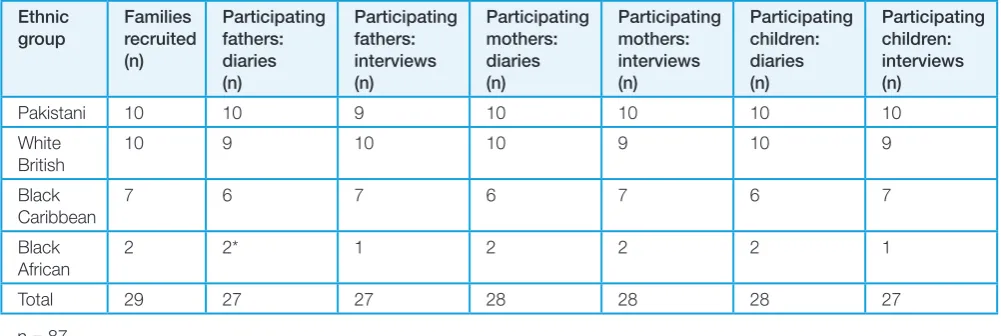
Families were extremely generous with their time. Despite the relatively onerous commitment (an initial visit, keeping three sets of activity diaries and three in-depth interviews, plus a camera diary for children), once families had agreed to participate in the research, most completed all stages of data
collection. Table 2 shows the participation rates for different stages.3
At the end of the study, all respondents were given shopping vouchers to the value of £0 (adults) and £1 (children) as a thank you from the research team.
Analysis
The data gathered from the activity diaries was coded and entered into SPSS. This data was then analysed descriptively to quantify the different activities reported by participants and to identify ‘who did what with whom’.
The qualitative in-depth interviews were digitally recorded (with permission), fully transcribed and indexed (coded) and analysed thematically using the ‘framework’ technique (Ritchie and Spencer, 1993) by entering data into thematically structured charts for collective review by the team.
Ethics
The detailed research methodology and
implementation plan was formally approved by the Institute of Education’s Faculty Research Ethical Committee, prior to the start of fieldwork.
Limitations of the methodology
[image:11.595.48.549.598.766.2]All research designs entail trade-offs and most studies encounter at least one or two problems at the implementation stage. This study was no exception, and we would highlight the following limitations in design and implementation of the
Table 2: Number of completed interviews and diaries
Ethnic group
Families recruited (n)
Participating fathers: diaries (n)
Participating fathers: interviews (n)
Participating mothers: diaries (n)
Participating mothers: interviews (n)
Participating children: diaries (n)
Participating children: interviews (n)
Pakistani 10 10 9 10 10 10 10 White
British 10 9 10 10 9 10 9 Black
Caribbean 7 7 7 7 Black
African 2 2* 1 2 2 2 1 Total 29 27 27 28 28 28 27 n = 87.
12 Methodology for the study
research, with the associated implications for the conclusions.
As the methodology was primarily qualitative, the study set out to be exploratory, aimed at gaining a better understanding of complex meanings and concepts by means of purposive sampling, rather than attempting generalisations about all families in the respective groups. The decision to include mothers and children in the data collection, as well as fathers, naturally imposed limits on the total number of families that could be included within a given time-frame and budget. The original research design proposed a balanced design of ten families and thus 30 individuals in total in each of the four ethnic groups. In the event, despite substantial efforts, the final sample was limited to 29 families and 87 individuals, and was unbalanced in relation to ethnic groups. The imbalance makes it difficult to draw inferences about differences between the groups on grounds of ethnicity, even given the qualitative nature of the data. The two groups of Black African and Black Caribbean families could have been combined and treated as one group of ‘black families’ for the purpose of analysis, but to do so risked obscuring important differences of culture and background. However, on issues where the views of fathers in these two groups concur, they have been described as ‘black fathers’.
Perhaps more insidiously, there were also differences between ethnic groups in relation to employment status and occupational ratings. These too were a reflection of sampling difficulties (and possibly area differences), which resulted in a social bias within the sample, with the Black Caribbean fathers more likely to be in occupations of higher socio-economic status and the White British fathers more likely to be unemployed. These differences have acted to limit some of the analyses that could sensibly be conducted – for example, investigations from the diary data of the average amount of time spent on paid work and other activities by fathers in different ethnic groups, and the conclusions that can be drawn, and must be borne in mind, when interpreting the findings.
While it is important to acknowledge these difficulties, it should be stressed that the care and attention paid to the research design, and the considerable effort and time invested by the
many families who took part, has produced a rich dataset that we believe provides new insights into fathering in multicultural England. With a total sample of 29 families and 87 individuals, the dataset is large by qualitative standards. The triangulation of data across family members gives a unique picture of how different individuals within families experience shared daily routines, while the inclusion of perspectives from children, some as young as 7 years of age, has been a particular achievement of this study.
Sample characteristics
Age of participants
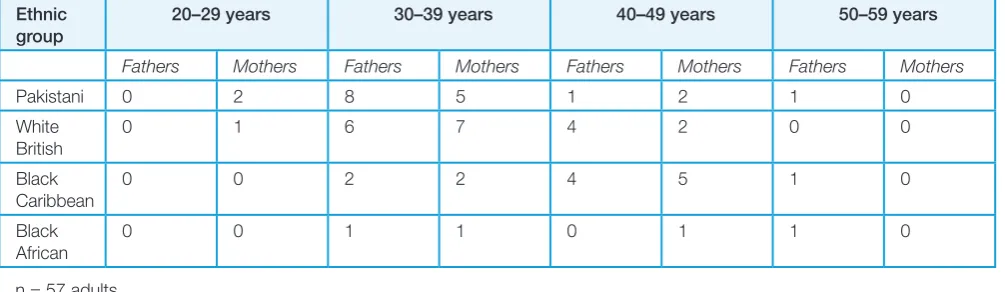
All of the 29 fathers in our sample were between 30 and 9 years of age. Seventeen fathers were 30–39 years old and nine were aged 0–9 years. The proportions of mothers in the same age groups were almost identical to that of fathers. There was almost an equal spread of children and young people across three age ranges. Around a third of children and young people were between 7 and 9 years old; approximately two-fifths were 10–13 years old and a quarter were aged 1–19 years (see Tables 3 and ).
Fathers’ employment status
Within the local communities selected for recruitment, recruiters were asked to identify families where fathers were working predominantly in non-professional occupations, reflecting the funder’s interest in extending the knowledge base on ‘ordinary’ (as opposed to affluent) families. Fathers’ occupational grades were classified
13
[image:13.595.49.552.70.216.2]Methodology for the study Table 3: Age of parents
Ethnic group
20–29 years 30–39 years 40–49 years 50–59 years
Fathers Mothers Fathers Mothers Fathers Mothers Fathers Mothers
Pakistani 0 2 8 1 2 1 0 White
British
0 1 7 2 0 0
Black
Caribbean 0 0 2 2 1 0 Black
African 0 0 1 1 0 1 1 0 n = 7 adults.
Missing data = 1.
because of difficulties experienced in recruiting Caribbean fathers from the lower occupational grades. All of the other working fathers were employed in occupational grade D jobs (see Table ). Many mothers also worked, often part-time, in occupations such as care assistant, supermarket checkout worker, catering and teaching assistant. At the time of the research, one Asian father worked part-time for health reasons and one Caribbean father was on long-term sick leave from his job.
Almost half of the mothers in our sample were not in active employment, while, of those who were working, almost equal numbers were employed in full-time and part-time jobs (see Table ). Table 7 shows the employment status of both mothers and fathers within each family. Most notably, White British families were the only group to have both parents unemployed (five families).
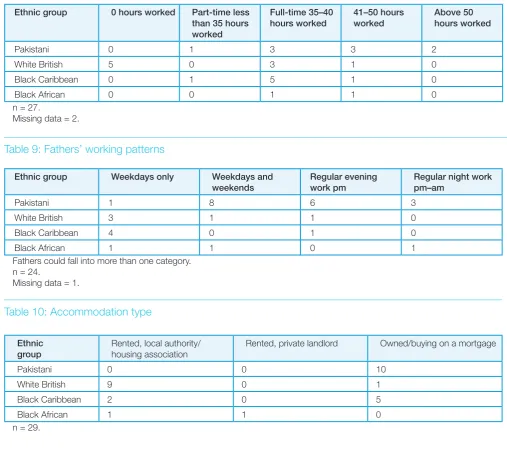
Across the different ethnic groups, fathers’ working patterns differed considerably. Half of all Pakistani fathers worked more than 0 hours a week and in some cases more than 0 hours a
Table : Age and gender of children and young people
Ethnic group
7–9 years 10–13 years 14–16 years 17+ years
Male Female Male Female Male Female Male Female
Pakistani 1 2 1 3 1 1 0 0 White
British
2 1 3 1 1 2 0 0 Black
Caribbean
2 0 2 1 0 1 1 0 Black
African
1 1 0 0 0 0 0 0 n = 28 children and young people.
Missing data = 1.
Table : Fathers’ occupational grades
Ethnic group
Grade C
Grade D
Unemployed (E)
Pakistani 0 10 0 White British 0 Black
Caribbean
7 0 0 Black African 0 2 0 n = 29.
Table : Mothers’ employment status
Ethnic group
Full-time
Part-time
Unemployed
Pakistani 1 3 White British 2 1 7 Black
Caribbean
2 1 Black African 2 0 0 n = 28.
[image:13.595.49.549.273.409.2] [image:13.595.58.548.662.774.2]1 Methodology for the study
week. Eight out of the ten Pakistani fathers worked regularly at weekends in addition to weekdays and evenings, with three working night shifts. In contrast, most of the White British and Black Caribbean working fathers were employed for no more than 0 hours a week, Monday to Friday, and at regular times (see Tables 8 and 9).
Accommodation
The type of housing occupied by families in the sample ranged from relatively spacious owner-occupied homes to rented social housing. All ten of the Pakistani families owned their own homes, which had an average of six rooms per dwelling excluding kitchen and bathroom. In contrast, all except one White British family lived in rented local authority/housing association accommodation, with an average of four rooms per dwelling (see Table 10).
[image:14.595.48.548.65.158.2]We did not probe families’ individual financial circumstances, but it is possible that the differences in tenure reflect the nature of the housing market in the UK, with property prices in some areas well beyond the reach of families on relatively modest incomes, while in other areas cheap availability of property makes owner-occupation possible, even where income is not substantial.
Table 7: Employment status of both parents
Ethnic group Father and mother employed
Father employed and mother unemployed
Father and mother unemployed
Pakistani 0
White British 3 2 Black Caribbean 1 0 Black African 1 1 0 n = 28.
1
[image:15.595.44.552.61.516.2]Methodology for the study Table 8: Fathers’ working hours
Ethnic group 0 hours worked Part-time less than 35 hours worked
Full-time 35–40
hours worked 41–50 hours worked Above 50 hours worked
Pakistani 0 1 3 3 2 White British 0 3 1 0 Black Caribbean 0 1 1 0 Black African 0 0 1 1 0 n = 27.
Missing data = 2.
Table 9: Fathers’ working patterns
Ethnic group Weekdays only Weekdays and weekends
Regular evening work pm
Regular night work pm–am
Pakistani 1 8 3 White British 3 1 1 0 Black Caribbean 0 1 0 Black African 1 1 0 1 Fathers could fall into more than one category.
n = 2.
[image:15.595.51.551.65.166.2]Missing data = 1.
Table 10: Accommodation type
Ethnic group
Rented, local authority/
housing association Rented, private landlord Owned/buying on a mortgage Pakistani 0 0 10
[image:15.595.53.550.231.319.2]1
3 What is a father?
Introduction
Lamb (200), making the point that ideas about fathering are inevitably context-dependent, states that:
There is no single father’s role to which a father should aspire. Rather, a successful father, in terms of his children’s development, is one whose role performance matches the demands and prescriptions of his socio cultural and familial context.
(Lamb, 200, p. 11)
In a multicultural society as diverse as modern Britain, this becomes a complex proposition, since for different families different demands
and prescriptions may apply. Even setting aside the diversity in family background, the question remains as to whether a wider sociocultural context applies and, if so, do families experience this in similar ways? The answer is probably no, but one issue that our study set out to explore was the degree to which people in ostensibly different ethnic and cultural groups share similar ideas about what ‘being a father’ involves, or whether there are clear differences. Put another way, is it possible to identify any common standard of ‘fatherhood’ across these different groups?
Values and attitudes
In this section, we discuss the study’s findings related to some key aspects that define fathering, considered in the context of beliefs held about what fathers should do – that is to say, values and attitudes about fathering, as well as the reality of what fathers actually do and the roles they play within the family. Where appropriate, we have considered whether there appear to be similarities or divergences across the different ethnic groups, as well as within them, between mothers and
fathers, and between parents and children. An important point to note at the outset, however, is that for the most part, in terms of values and attitudes to fathering, there were far more commonalities than there were divergences across the sample of families. Furthermore, across all the ethnic groups, children and young people’s views of their parents’ roles tended to regard them as gender-neutral in principle:
I think that it can be equally shared with both of them. Because I mean mums are just as capable as dads of getting food and money and stuff, to comfort you and stuff really. So I mean it’s just as easy isn’t it for a man as for a woman to do the same things.
(White British young person, male)
Despite this, many children felt that, in
practice, real-life circumstances and individual competencies dictated that responsibilities are more often divided. One parent may be naturally more adept at a certain job and so would take the lead, with the other parent taking more of an assisting and supporting role – for example, mums were viewed as tending to do a better job of cooking and housework and dads at DIY and fixing things. Above all, the interviews with children and young people indicated that most of them were under no illusions about how hard it must be for parents in general to fulfil all the different roles and responsibilities associated with parenthood.
Financial provider
The notion of father as ‘breadwinner’, which was noted earlier, was endorsed by parents and children across our sample. Warin and colleagues’ (1999) research on fathers, work and family life found that parents and children, but fathers in particular, viewed providing an income for the family as the central aspect of fathering. Our study – almost ten years on – suggests this view continues to be widely held.
17
What is a father?
Despite the numbers of working mothers in our sample (1 out of 29 were in work, eight of whom were full-time), many respondents considered the father to be the main financial provider. Indeed, for some fathers, across all four ethnic groups, financial provision was seen as their defining role. It was considered to be both a key part of identity and a major contributor to feelings of self-worth:
If I won the Lottery, yes I’d still go to work … I’d probably change my job … but there is no life if you sit down at home all the time.
(Pakistani father)
Fathers who could not make a financial
contribution to the family through paid work (for example, because of health problems) spoke painfully of the feeling of failure associated with this situation:
You’ve got to provide – and I mean it’s [being a father] all about providing, this is what I believe … I say to [wife] it’s my fault that we’ve got no money coming in, my fault this … at the end of the day, I can’t stop beating myself up.
(White British father)
Pakistani fathers and mothers in particular seemed to place great emphasis on the providing role of the father, which supports the findings of a recent research study on UK Asian fathers (Salway et al., 2009). One Pakistani father in our study stressed that financial security for his children was his main concern, a view that was echoed by some of the black parents.
Two caveats should, however, be noted. First, despite the widespread consensus on fathers as key financial providers in the family, White British, Black Caribbean and younger parents tended to consider that, in today’s society, economic necessity increasingly dictates that both parents have a role to play in earning for the family. Also, in cases where either both parents worked or neither parent worked, fathers and mothers’ values and attitudes tended to be more egalitarian. Second, among the sample of White British families, financial provision assumed less importance as part of the father’s overall parental role. However, this might have been a reflection of the higher levels of unemployment in this group resulting
in work being less valued as a central aspect of fatherhood.
Children and young people from all four ethnic groups viewed financial provision as an important role that fathers should fulfil: ‘Every dad in the entire world should work’ (White British child, male, 7 years old). Several also identified fathers as the ones who give children money. The young people’s comments on financial provision also illustrated the practical nature of their views about parents’ roles. While many considered that, in principle, both parents could work, there was less agreement as to whether they should do so. By the same token, some children expressed the view that, although there was no reason why mothers and fathers should not both provide financially for the family, in practice this would mean there would be no parent at home for the children – for example, when they got in from school or to transport them to activities – and the benefits of spending time with at least one parent were clearly valued:
Then you wouldn’t have like a parent to be there … we’d always know like there is someone there, you see when he was like not feeling well at school and then your dad, he might be busy as well. So somebody needs to be there as well at home and … You always need someone.
(Pakistani child, female)
A few Pakistani children (particularly the younger ages) had strongly gendered views, believing that dads should work and mums should be at home. White British children, on the other hand, tended to have the weakest gender-based constructs, resulting in the most egalitarian views on financial provision.
Physical care and nurture of children
18 What is a father?
children and more ‘instinctively’ aware of their children’s needs:
Well they’re [mothers] better organised and they’re more loving … I think she’s got more patience.
(Pakistani father)
Pakistani families in particular tended to view physical caregiving as more often the responsibility of the mother, partly for reasons of ‘biology’ as above and partly for pragmatic reasons
(specifically that, if the father was the main financial provider, then mothers would spend more time at home with the children).This concurs with the research findings of Salway et al. (2009) who found that, while UK Asian fathers did contribute towards physical caregiving, they very rarely held any overall responsibility for this role. In general, fathers and mothers from White British and Black Caribbean families felt that nurturing and physical caregiving should be a shared role, although mothers still tended to take overall responsibility, with the father providing support and ‘back-up’ if mothers could not meet all the requirements for whatever reason.
A number of fathers from all ethnic
backgrounds said they had found it especially difficult to engage with and provide physical care for babies. Many first-time fathers in particular had felt inadequate at this stage, recalling their fear of handling a new baby:
When we had Erina I was scared to even hold her … probably she get, break something and everything. I was scared.
(Pakistani father)
A strong and recurring theme that emerged from interviews with parents seemed to be the importance of fathers ‘being there’ for their
children. This was also evident in a recent research study by Williams (2009) on African Caribbean and white working-class fathers in the UK. Parents from all ethnic groups felt that an important aspect of a father’s role was being accessible and available to their children as much as possible, but also ensuring they spent ‘quality time’ with them:
It’s just being there really. Being about, being there when your son or your daughter they’re hurt, they need someone, they need a cuddle … or they’re older, they’re in trouble, you’re there to have a go at them, but be there to support them … Even if you’re not doing much, just being there makes a difference.
(Black Caribbean father)
There also appeared to be a consensus across ethnic groups that fathers should have a role in encouraging, talking to and listening to their children. Many parents felt that this was one of the most effective ways through which fathers establish a close relationship and friendship with their children:
Someone they can go to if they need you or if they need help or someone to talk to, or if they needed advice you know, maybe you can give them it or you can give them your point, your view like … Just being there really.
(White British father)
Despite this, many parents stated that mothers were still generally the ones who took responsibility for emotionally supporting the children and the ones in whom children confided. In addition to the biological determinants that suited them for this role, it was suggested that mothers often spent more time with their children and so tended to have closer emotional bonds with them.
Again, some parents considered that children and young people need physical affection and a ‘woman’s touch’ and ‘tenderness’, neither of which comes as naturally to men. They thought that children were more likely to turn to their mothers for both emotional support and physical care. In contrast, fathers were seen by many across all ethnic groups as the physically stronger partner, active in practical ways, and therefore more suited to taking on physically demanding roles than to providing emotional care and support:
I don’t think men are there for kids emotionally, really. They’re more practical if you know what I mean.
19
What is a father?
However, it would be wrong to infer from this that parents did not believe fathers could form close emotional bonds with children. The picture was more nuanced, in that parents across the whole sample acknowledged that it is essential for both
parents to show their love and affection for their children and, to this extent, some mothers and fathers believed the provision of physical care and emotional support was a major component of fathering, as well as mothering:
Because [they’re] my children, I have to help them … depending on the mum, you know, that’s no good. Fathers should look after them as well you know. I know fathers bring in money, financially support from the outside. But fathers should be close with the children as well.
(Pakistani father)
A common theme that emerged across the sample as a whole, and that this father essentially was expressing, was the notion of complementary parenting – that parenting is a partnership within which there is a degree of role differentiation, with each partner taking the lead in different areas. However, to be successful, the partnership involves providing ‘back-up’ for one another and being prepared to cross role boundaries when necessary, with the needs of the children always paramount:
I mean if she’s home, right, and if she’s available, right, then she should … do these things, right? But, if she’s not there and you need to change the nappy, then you’re not supposed to wait for her – you should do it.
(Pakistani father)
Values and attitudes on nurturing and physical caregiving were very mixed among the children and young people, with some viewing this role as something that mothers should take the lead on because they are ‘better at it’ and others seeing it as something that can and should be shared equally between both parents. Views on this aspect of parenting were largely consistent with whether fathers fulfilled this role in practice, rather than showing any specific pattern linked to ethnic identity.
Endorsing the views of many of their parents, children and young people from all ethnic groups referred to inherent biological differences between mothers and fathers. Mothers are deemed to be more emotional, loving and physically affectionate, whereas fathers are more often seen as the physically strong ones, the protectors (see below). Many children felt that, because they tended to have stronger emotional bonds with mothers than with fathers, they more readily turned to them if they had problems or needed emotional support:
I think it’s because mums are more emotional and personal. You can be closer to your mum I think … And I don’t think men like to show their emotions, especially to each other.
(Black Caribbean young person, female)
Nevertheless, young people of all ethnic groups thought it important for children to feel able to talk to and depend on fathers for support and help; fathers, they thought, should show they care and should be loving and warm towards their children:
They should be loving, caring, help you with anything, see you can like talk to him about anything.
(White British young person, female)
Family protector
In one of the few areas in which ideals about fatherhood and traditional constructs of masculinity intersect, the role of ‘family protector’ is one that fathers and mothers across all four ethnic groups generally attributed to fathers. Some highlighted the greater physical strength of men as fitting them for this role, while the physical presence of a father was commonly associated with feeling safer and more secure at home:
When James used to work at nights I didn’t feel as safe in the house on my own with the children as I do when he’s here … I suppose, because they’re seen as the stronger sex, you know, if anybody got in the house when James was here, I’d stand more of a chance of getting out of it I suppose, whereas, if they got in and I was on my own with the children, I wouldn’t stand that chance.
20 What is a father?
Children and young people too, from all ethnic groups, spoke of how important it was to have a strong male presence in the house to feel physically safe and protected:
She [mum] can’t be that strong can she cos if a thief comes in your house what do you do? Your mum would be there screaming with you, she wouldn’t be able to do anything. When things like that happen the dad would stand up.
(Pakistani young person, female, 1 years old)
Some Pakistani and black children talked about this protective role in the context of fathers as the head of the house, the strong authority figure. Physical strength was seen by many children to characterise fathers, justifying their suitability for the role of family protection, as well as for more practical pursuits such as DIY and physical leisure activities:
He’s the man and he’s the strongest of us in the house.
(Black Caribbean child, male, 8 years old)
Teaching and educating
Values and attitudes around fathers’ responsibilities for teaching and educating their children tended to be mixed. While this role was generally shared between mothers and fathers, Pakistani and black parents more often saw it as an integral part of fathers’ overall responsibilities, involving them in actively monitoring, supporting and promoting their children’s education:
A child has to be educated, you know. It’s a way forward in life, you know, education is a priority nowadays especially … if you want to succeed in life you need to have some sort of education behind you … So education is a priority.
(Pakistani father)
White British parents, on the other hand, attached less significance to this, although a number of White British parents spoke about their role in teaching and educating children in the context of life skills as distinct from schooling:
You’ve gotta be like a bit of a teacher I suppose to show the kids how to, how to get up, how to dress themselves, how to clean themselves, how to be around other people.
(White British father)
On the subject of providing teaching and guidance on puberty, sex and relationships, parents from all ethnic groups made clear gender-based distinctions, with fathers assuming responsibility for teaching sons while mothers took on this role for daughters:
I’m sure she would be embarrassed to discuss
[a] boyfriend–girlfriend problem with her dad, but when she wouldn’t be with me.
(Pakistani mother)
As daughters are growing up there are certain things that Sarah, she would come to me. And with Ben as well with his dad, he’ll probably be able to talk to his dad about certain things that he wouldn’t wanna talk to me about. Maybe as like with Sarah, she’s not gonna go and talk about her personal … you know, bodily or whatever, with her dad.
(White British mother)
Many parents felt that fathers had a key role to play in relation to children’s religious education. However, this was not salient for any of the White British families in the sample.
Discipline and instilling values
There seemed to be consensus across all ethnic groups with regard to the importance of discipline and instilling values in children, but less agreement about which parent was best suited to do this and how it should be done. While many parents felt that both mothers and fathers should be involved in disciplining their children generally, Pakistani and black parents tended to see it as primarily the role of the father to discipline sons:
21
What is a father?
in place because they’re turning young men now and they are bigger than their mum, they’re stronger than their mums and they wanna do what they wanna do and this little woman can’t put them in their place.
(Black Caribbean father)
Parents from all ethnic groups saw fathers as holding more authority than mothers and being, therefore, more effective in disciplining children, particularly when they reached adolescence. However, many talked about how the fact that fathers are less often there in the home makes it harder for them to take on the task of day-to-day disciplining. As a result, children can sometimes be surprised when fathers intervene unexpectedly on more serious disciplinary matters. On the other hand, mothers in particular took the view that, because children spend more time with them, they become more relaxed in interpreting their disciplinary boundaries. With fathers’ greater physical size and strength, parents generally considered that children take discipline from their fathers more seriously than from their mothers.
When dads do it, it’ll be stricter. When dads start shouting they’ll know about it. When mum does it they seem to like laugh. When dad shouts they do get the laugh, but they don’t laugh the second time.
(White British father)
The view that fathers have a greater level of authority and therefore are the bottom line when it comes to exercising discipline was particularly strong among black parents:
Women are not authoritative. It’s not in their nature. And some time in the build-up of a child you need somebody who is authoritative to handle them. But mothers are not born to be authoritative.
(Black African father)
Some parents, particularly those of Pakistani origin, believed one parent should be strict and the other less so for children to feel able to approach and confide in at least one of them. They did not view this approach as inconsistent in any way, given that each parent would back the
other up, but rather saw it as a complementary style of parenting. In contrast, a number of Black Caribbean and White British parents believed that both parents should be equal and consistent in their approach to discipline, to avoid the possibility of a situation developing whereby a child might ‘play one parent off against the other’.
The importance attached to fathers as ‘role models’ for developing boys was mentioned by parents from all ethnic groups, although this was an especially strong theme among the Black Caribbean families. Both White British and Black Caribbean parents also viewed fathers as having key importance in teaching boys how to be (good) men and instilling morals and prosocial values such as respect for elders:
I say this, sons, because it seems to be the male most of the time, will look at their fathers and try and be like their dads. Even subconsciously. And, if the father is there all the time, they’re there, then they can only do what they’ve seen. Whereas, if the father’s not there, they, it can be anything.
(Black Caribbean father)
It must be difficult for families that the fathers aren’t there in bringing up boys, teaching them how to be boys but not in an arrogant and violent way, but just in a way to be loving and to bring up their children in the same way. So it must be difficult, I don’t think I could do it, I think that, no the father needs to do that.
(Black Caribbean mother)
Children and young people generally saw discipline as a very important part of a parent’s role, but very few were of the opinion that this should be primarily the role of the father, viewing it more often as something in which both parents should engage equally. The exception was some children of Pakistani or Black Caribbean origin who had strong views that fathers should take the lead.
22 What is a father?
You look up to your dad as the way you wanna grow up really, if you’re a boy. If you’re a girl, it’s the same with your mum. So I mean, without having a dad, I think it’d be … You just grow whatever you want to. You just follow what your mates are or something.
(White British young person, male)
Leisure and play
‘Play’ was commonly regarded by parents across the sample as an integral part of a father’s role in terms of him engaging in leisure and physical activities with children. While mothers were not excluded from fulfilling this particular role, being active, playing and involvement in physical activities with children appeared to be a far more prominent feature of fathers’ responsibilities. Some mothers believed that their children might have missed out on certain physical or outdoor activities had their partner not been present to take them on:
You go to the park and that and you see kids with the fathers, they’re playing and doing things that they don’t really do with the mother.
(White British father)
Fathers generally seemed to find it easier and more satisfying to interact and engage with their children once they were past early childhood and were at an age where they could spend time together on physical activities such as playing sports:
David is getting to that next stage of age, I can do a lot more for David, because you can put his football boots on and play the football match.
(White British father)
Once again, a gender difference was apparent when distinguishing the nature of the time parents spend with their children, with mothers tending to refer more often to time spent on physical and emotional care, particularly talking, whereas fathers referred to spending time that was more activity based:
I think it’s slightly different cos Andy likes to do things and get out and get on with it …
Mine is, I think, more of an emotional role than Andy’s. Andy’s is, ‘I’m the dad, I’ve got to do this’.
(White British mother)
Children and young people similarly identified a father as someone with whom they could play, have fun, ‘have a laugh’ and share in leisure activities. They tended to place great value on having a parent who was the ‘active’ one and this was typically the father:
We do all the same things like cricket, my mum wouldn’t play cricket like he would.
(Pakistani young person, male)
If my dad wasn’t around then I wouldn’t really have much fun.
(Pakistani child, female)
This linked in very strongly with children’s belief that fathers should make time for their children, ‘be there’ and spend quality time with them. Like their parents, young people indicated that mothers too could fulfil this role, but the elements of activity and play were more often associated with the roles and responsibilities of fathers.
Domestic chores – housework and cooking
Parents across the sample acknowledged that fathers are, and should be, increasing their
involvement in housework and cooking, particularly in cases where both parents are working. Above all, mothers stressed the importance of fathers increasing their involvement in these roles and that, ideally, household tasks should be shared equally:
In an ideal world everything would be split, work would be split, housework would be split, responsibilities would be split.
(White British mother)
If a woman can do a man’s job, I’m sure a man can do a woman’s job. There’s no such thing as cooking and cleaning is just for women, no. Men should do it as well.
23
What is a father?
The views of the fathers in the study were more divergent and appeared to fall into three distinct groups. There were fathers across the sample, including many Pakistani fathers, who believed that these roles should remain the sole responsibility of the mother – particularly where the father was the only financial provider. Other fathers from across ethnic groups felt that, in principle, it was fair to expect both parents to take equal responsibility for these roles, but that, in practice, women were naturally more competent at them and so should perhaps take the lead. The third group of fathers maintained that there was no justifiable reason why these roles should not be shared equally. These fathers tended to be from White British and Black Caribbean families where either both parents worked or neither parent worked.
The jobs of housework and cooking were viewed by many children and young people across the sample as something for which mothers usually take overall responsibility because they tend to be naturally better at these roles. Despite this, there was a strong feeling that fathers potentially can fill these functions and that ideally the responsibility for them should be shared:
I think me dad should, like, hoover up more really because me mum sometimes has to hoover, sometimes me sister, but me dad should do.
(White British child, male)
In practice, across all ethnic groups, it appeared that mothers were associated more often with taking the lead and retaining the responsibility for housework and cooking, along with physical caregiving. Both activities therefore still appear to be relatively gender-biased, as Chapter will go on to explore.
Behaviours – what do fathers do?
We now explore the actual parenting behaviours of fathers as recorded in the activity diaries (see methodology described in Chapter 2). In particular, we focus on the activities and interactions of fathers relevant to measuring each component of paternal involvement: paternal engagement (direct interaction with child); accessibility (availability) to the child; and responsibility (taking care of and
arranging resources for the child). Using Lamb
et al.’s (198) construct of paternal involvement as a guide, we grouped the activities recorded in the diaries under each component of paternal involvement to allow us to measure the time fathers spent directly engaged with the index child in activities and time spent indirectly involved by being accessible/available to the index child and/or responsible for a particular caregiving activity such as employment. Although families were instructed to record a primary and secondary activity, very few recorded secondary activities. Analysis is therefore limited to primary activities only.
When looking at the data it is worth noting that the age of the child/young person has a significant bearing on the amount of time spent engaged in certain activities. For example, parents with older children recorded spending less time on the physical care of their children than parents with younger children. Likewise, time spent directly engaging with children appeared to be affected by parental availability. Thus fathers who worked reported significantly less time for direct engagement with their children. A full list of activities can be found in Appendix (separate appendices).
The data presented here represents the mean time spent per day (based on aggregated 1-minute-interval time periods) across the eight-day diary period, based on fathers’ behaviours, as recorded in their diaries. Comparisons of the full set of diary data generated by all of the family members who completed them will be the subject of future publications, following further detailed analysis.
Responsibility
According to Lamb and colleagues (198),
2 What is a father?
On average, employed fathers spent .2 hours in paid work a day. Because of differences in employment status within the sample, it would not be sensible to comment on differences between the ethnic groups in time spent in paid work. However, analyses of Pakistani and Black Caribbean fathers’ diaries (all of whom were in employment) revealed that Pakistani fathers reported spending the most time in paid employment, on average six hours per day.
Fathers spent considerably less time than mothers on other indirect activities of responsibility. Across all groups they reported spending an average of 1 minutes a day physically caring for their children, which included activities such as feeding, bathing and childcaring/minding. However, Black Caribbean fathers reported spending double the average amount of time, 30 minutes, on physical childcare. As might be expected, fathers who worked long and irregular hours were less involved in domestic activities such as housework and cooking, spending no more than 1 minutes a day on average on such activities, whereas fathers who were employed in higher-grade jobs or who were unemployed reported greater levels of involvement in domestic responsibilities. White British fathers reported spending nearly two hours a day on domestic responsibilities, compared with an average of one hour a day spent by Black Caribbean fathers.
Endorsing the interview reports of relatively high levels of father involvement in transporting and accompanying children to school, the diary data showed that on average they spent between 1 and 30 minutes a day transporting their children to and from school, extra-curricular activities and faith-related activities.
Engagement
Across all parents in our sample, analysis shows that the average time of . hours per day spent
by fathers engaged in activities with the index child was slightly less than the 7.2 hours average spent by mothers.
Table 11 compares the mean hours per day that fathers and mothers from each ethnic group spent directly engaged in activities with their index child. It shows that the amount of time mothers and fathers spent engaged in activities with the index child also varied by ethnic group. For example, Pakistani mothers spent on average almost five hours more time engaged in activities with the index child than Pakistani fathers. Similarly, Black African mothers spent just over two hours more engaged in activities with the index child than Black African fathers. However, White British mothers and fathers spent almost the same amount of time engaged in activities with the index child. Of all the ethnic groups, White British fathers spent the most time per day engaged with their index children, but this might be explained largely by the fact that many of the white fathers in our sample were unemployed and had more time to spend with their children compared to Pakistani and black fathers, all of whom were in employment.
We also identified the most significant types of activities in which fathers engaged with their index children. Across all ethnic groups the fathers in our sample spent a significant amount of time – around minutes on average per day – engaging with the index children in housework and/or cooking. However, this overall figure conceals the considerable variation across ethnic groups, with the White British fathers spending on average 1.2 hours per day, compared with the Black Caribbean fathers 0.7 hours and Pakistani fathers only 0.2 hours. Comparable figures for mothers confirmed the interview findings that, overall, they took a lead in this role, spending on average nearly three hours per day engaging with their children in these activities.
Table 11: Mean hours spent engaged in activities with index child
White British Pakistani Black Caribbean Black African* Fathers Mothers Fathers Mothers Fathers Mothers Fathers Mothers
7 hrs mins
7 hrs mins
3 hrs 30 mins
8 hrs 1 mins
hrs 30 mins
hrs 2 hrs 1 mins
2
What is a father?
The difference between mothers and fathers in terms of the amount of time spent engaging with their index children in leisure activities outside the home (for example, shopping, going to the park, trips out) was considerably less extreme. Fathers spent on average just under one hour per day, compared with just over one hour for mothers. Of all the ethnic groups, the Black Caribbean fathers in our sample spent the most time on these activities (1.2 hours), followed by White British fathers at just over one hour per day. Pakistani fathers were engaged with their index children in these activities for approximately 0. hours per day. This level of engagement in leisure activities outside the home supports the interview data, both from fathers of all ethnic groups, who reported having a primary role in pursuing outdoor leisure activities with their children, and from their children, many of whom talked of fathers who spent significant amounts of time taking them out.
Of all the types of activities in which fathers were engaged with their index children, leisure/play at home (for example, computers, TV, reading, music, games) was by far the foremost in terms of the amount of time spent: an average of three hours per day across all fathers in our sample. Leisure/play at home also took up a considerable amount of mothers’ time: on average around two hours per day spent with their index child on these types of pursuits. However, when looked at by ethnic group, a wide variation becomes clear. White British fathers spent five hours a day on average with their index children on leisure and play (three hours for White British mothers) and Pakistani and Black Caribbean fathers two hours a day (Pakistani mothers two hours, Black Caribbean mothers minutes).
Overall, the average time spent on talking/ listening with the index child was negligible (less than five minutes per day), but analysis by
ethnic group again shows some variation, with White British and Pakistani fathers in our sample spending around 0. hours and just under one hour respectively engaged in this activity. Furthermore, time spent by Pakistani fathers differed little from that spent by Pakistani mothers. These relatively low figures should not be taken to represent the actual amount of time spent communicating with the child, since fathers and mothers will also communicate with their children when involved in other activities such as sport, physical care or cooking, but rather the amount of time during the day in which this was the primary activity.
Accessibility/availability
[image:25.595.52.548.710.767.2]Accessibility or availability refers to the fathers’ potential availability for interaction with the child by virtue of being present in the same environment. Using the diary data, this was measured by analysing the amount of time fathers spent undertaking an activity for which the index child was present but not actively participating with the father. As we would expect, those fathers who reported working the longest and most unsociable hours were available considerably less. Pakistani fathers recorded the lowest levels of accessibility, an average of under four hours a day. However, White British fathers (half of whom were unemployed) and Caribbean fathers (who worked regular hours in higher socio-economic grades of work) reported much higher levels of accessibility – almost double that of Pakistani fathers with an average of more than eight hours a day. It is also interesting to note the comparison with mothers’ accessibility as detailed in Table 12, which shows that, with the exception of the Black African mothers, all of the mothers in our sample spent at least eight hours per day potentially available for interaction with their index child.
Table 12: Mean hours of fathers’ and mothers’ potential availability for interaction with index child
White British Pakistani Black Caribbean Black African* Fathers Mothers Fathers Mothers Fathers Mothers Fathers Mothers
8 hrs 2 mins
8 hrs 7 mins
hrs 8 hrs 8 hrs 1 mins
8 hrs 1 mins
2 What is a father?
Stated values versus actual
behaviours: case studies
It is beyond the scope of this report to cross-reference values and attitudes about fathering with actual behaviours as recorded in the diaries for all of the fathers in our sample. Nevertheless, it is important to make some comparison between