Original Article
Genetic polymorphisms in COL18A1 influence the
development of osteosarcoma
Zhihao Guo, Tianji Zhang, Juntao Wu, Hongwei Wang, Xiaotan Liu, Linqiang Tian
Department of Orthopedics, The Third Affiliated Hospital of Xinxiang Medical University, Xinxiang, China Received July 31, 2015; Accepted August 28, 2015; Epub September 1, 2015; Published September 15, 2015
Abstract: We conducted a case-control study to investigate the association of COL18A1 D104N polymorphism in the development of osteosarcoma in a Chinese population. Between May 2012 and May 2014, 141 patients with pathologically proven osteosarcoma and 341 were selected into this study. Genotyping of COL18A1 D104N was analyzed using polymerase chain reaction (PCR) coupled with restriction fragment length polymorphism (RFLP). By logistic regression analysis, we found that individuals with the NN genotype of COL18A1 D104N were significantly associated with an increased risk of osteosarcoma when compared with the DD genotype (OR=20.97, 95% CI=2.74-933.42). In dominant model, the NN+DN genotype of COL18A1 D104N had a 1.99 fold risk of osteosarcoma when compared with the DD genotype. Moreover, the NN genotype was correlated with a 20.45 fold risk of osteosarcoma when compared with the DN+DD genotype in recessive model. However, we did not find significant interaction be-tween COL18A1 D104N polymorphism and Enneking stage, histological subtype, tumor metastasis and tumor loca-tion of patients with osteosarcoma. In conclusion, our study suggests that the homozygous DN and NN genotypes of COL18A1 D104N were associated with the risk of osteosarcoma.
Keywords: COL18A1, polymorphism, osteosarcoma
Introduction
Osteosarcoma is a highly malignant and aggressive bone tumor, which is derived from mesenchymal tissues and often occurs in the distal femur, proximal tibia and humeral metaphysis. Osteosarcoma is the most leading bone malignancy in adolescents [1]. It is esti-mated that the annual incidence of osteosar-coma is about 3/105 worldwide [1]. The
osteo-sarcoma is caused by complex, multistep and multifactorial processes, and many environ-mental and genetic factors are involved in its carcinogenesis [2, 3]. Previous experimental studies have conducted to investigate the can-cer stem cells and their potential to cause tumors [4, 5]. The concept of genetic factors being involved in the susceptibility to osteosar-coma has gained many studies to investigate the genetic determinants for osteosarcoma in the last decade.
Angiogenesis, the formation of new blood ves-sels from preexisting endothelium, is a discrete
Materials and methods
Subjects
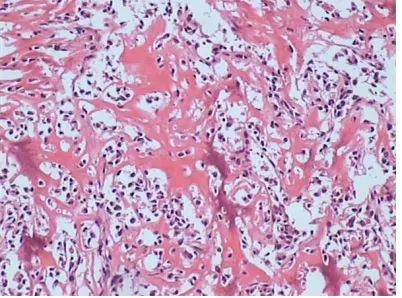
Between May 2012 and May 2014, 166 patients with pathologically proven osteosar-coma were selected from the Third Affiliated Hospital of Xinxiang Medical University. Osteosarcoma patients were newly diagnosed and histopathologically confirmed indepen -dently by two pathologists (Figure 1). Patients who had primary tumors other than osteosar-coma, tumors of an unknown origin or any his-topathologicl diagnosis other than osteosarco-ma were excluded. Finally, 141 patients with osteosarcoma were included into our study, and the participation rate was 89.24%.
A total of 352 adult healthy subjects without osteosarcoma were randomly collected from individuals who received regular health check-up in the Third Affiliated Hospital of Xinxiang Medical University during May 2012 and May 2014. The control subjects were confirmed to be without any primary tumors. Finally, 341 patients agreed to participate in this study, and the participation rate was 96.88%.
Patients with osteosarcoma and control sub-jects were investigated by doctors to obtain demographic parameters, including gender, age and family history of cancer. The clinical and pathological information of patients with osteosarcoma were collected from the medical records, including Enneking stage, histological subtype, tumor location and tumor metastasis. All individuals voluntarily participated in the study and gave their informed consent. The protocol of this study was approved by the
eth-ics committee of the Third Affiliated Hospital of Xinxiang Medical University.
Genotyping
5 ml peripheral blood sample was drawn from each patient with osteosarcoma and control subject, and the peripheral blood sample was kept in -20°C until using. Genomic DNA was iso-lated from the blood samples using a Qiagen genomic DNA isolation kit according to manu-facturer’s instructions. Genotyping of COL18A1 D104N was analyzed using polymerase chain reaction (PCR) coupled with restriction frag-ment length polymorphism (RFLP). Primers and probes for COL18A1 D104N were designed using Primer premier v5.0 software (Applied Biosystems). The primers for COL18A1 D104N were 5’-ACTTTCACCCACAGGGATC-3’ (forwards) and 5’-TTTCTCCTATCTGCAGGGC-3’ (reverse), respectively. The PCR amplification cycle was one cycle of DNA denaturation at 94°C for 5 min, followed by 30 cycles of denaturation at 94°C for 1 min, 55°C annealing step for 1 min with a 72°C extension step for 2 min, with a final extension step of 5 min at 72°C. The PCR fragments of the investigated polymorphisms were subsequently digested with their specific restriction enzyme. Digestion products were separated by electrophoresis on ethidium bro-mide stained agarose gel and visualized under UV light.
Statically analysis
[image:2.612.90.291.72.221.2]P-value <0.05. Statistical analysis was con-ducted using the SPSS 16.0 package (SPSS Inc., Chicago, IL, USA).
Results
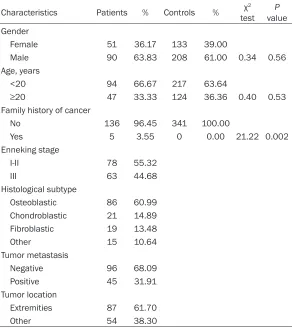
The distributions of the clinicopathological characteristics of the patients with osteosar-coma and controls were shown in Table 1. The mean ages of the included patients and con-trols at the time of enrolling into our study were 17.3±6.1 and 16.7±6.4 years old. By χ2 test, patients with osteosarcoma were likely to have family history of cancer when compared with controls. Of the 141 patients with osteosarco-ma, 78 (55.32%) patients were at I-II Enneking stage, 63 (44.68%) were at III stage, 86 (60.99%) were osteoblastic osteosarcoma, 21 (14.89%) were chondroblastic osteosarcoma, 19 (13.48%) were fibroblastic osteosarcoma, 45 (31.91%) had tumor metastasis and 87 (61.70%) showed extremities of osteosarcoma. The genotype distributions of COL18A1 D104N were found to in line with Hardy-Weinberg
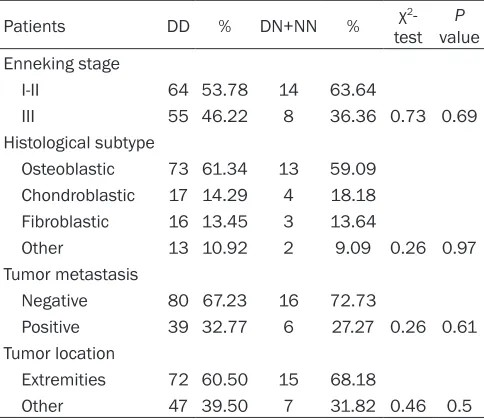
equi-18A1 D104N polymorphism and clinicopatho-logical characteristics of osteosarcoma (Table 3). By χ2-test, we did not find significant interac -tion between COL18A1 D104N polymorphism and Enneking stage, histological subtype, tumor metastasis and tumor location of patients with osteosarcoma (P<0.05).
Discussion
[image:3.612.92.385.97.426.2]Osteosarcoma is generally believed to be a gene-environment interaction disease with high morbidity and mortality. However, the mechanism of osteosarcoma was unclear. A number studies has showed that gene polymor-phism is closely correlated with the risk of osteosarcoma recently. In our study, we investi-gated whether the COL18A1 D104N polymor-phism alters the susceptibility of osteosarco-ma, and found that individuals with the homo-zygous DN and NN genotypes were associated with risk of osteosarcoma. This is the first report to analyze the association between the COL18A1 D104N polymorphism and develop-ment of osteosarcoma.
Table 1. Clinicopathological characteristics of the patients with osteosarcoma and controls
Characteristics Patients % Controls % testχ2 valueP Gender
Female 51 36.17 133 39.00
Male 90 63.83 208 61.00 0.34 0.56
Age, years
<20 94 66.67 217 63.64
≥20 47 33.33 124 36.36 0.40 0.53
Family history of cancer
No 136 96.45 341 100.00
Yes 5 3.55 0 0.00 21.22 0.002
Enneking stage
I-II 78 55.32
III 63 44.68
Histological subtype
Osteoblastic 86 60.99 Chondroblastic 21 14.89 Fibroblastic 19 13.48
Other 15 10.64
Tumor metastasis
Negative 96 68.09
Positive 45 31.91
Tumor location
Extremities 87 61.70
Other 54 38.30
librium in the control group (Table 2). By χ2-test, we found that genotype fre-quencies of the DD, DN and NN were significant differ -ence between patients with osteosarcoma and controls (χ2=16.37, P<0.001). By lo- gistic regression analysis, we found that the NN geno-type of COL18A1 D104N was significantly associated with an increased risk of osteosarcoma when com-pared with the DD genotype (OR=20.97, 95% CI=2.74-933.42). In dominant model, the NN+DN genotype of COL18A1 D104N had a 1.99 fold risk of osteosar-coma when compared with the DD genotype. Moreover, the NN genotype was corre-lated with a higher risk of osteosarcoma than the DN+DD genotype in reces-sive model (OR=20.45, 95% CI=2.68-909.89).
The COL18A1 D104N polymorphism of Endostatin, a 183-amino-acid proteolytic frag-ment produced by the cleavage of the C-terminal non-collagenous domain (NC1) of human type XVIII collagen, is an efficient anti-angiogenic molecule [12]. As an angiogenic inhibitor, Endostatin could prevent tumor growth and expansion by controlling the formation of new blood vessels. In vitro and in vivo studies, they have shown that treatmentwith Endostatin can increase apoptotic activity and decrease microvessel density and metastasis in many tumors [13-15].
Previous studies have reported the role of the
COL18A1 D104N polymorphism in the
suscep-tumors. Another study in a British population has reported that COL18A1 D104N polymor-phism is not associated with susceptibility of breast cancer [11]. In our study, we have found that the COL18A1 D104N polymorphism is sig-nificantly associated with an increased risk of osteosarcoma, which is controversial with pre-vious studies. These different results may be due to the heterogeneity of the different dis-eases, ethnicities, study design, source of patients and sample size.
[image:4.612.91.521.84.244.2]In our study, we did not find that the COL18A1 D104N polymorphism has association with clinicopathological characteristics of osteosar-coma, including Enneking stage, histological Table 2. Association between COL18A1 D104N polymorphism and the risk of osteosarcoma
Polymorphisms Patients % Controls % HWE χ2-test P value Adjusted OR (95% CI)1 P value
COL18A1 D104N Codominant
DD 119 84.40 312 91.50 0.66 16.37 <0.001 1.0 (Ref.)
DN 14 9.93 28 8.21 1.31 (0.62-2.68) 0.43
NN 8 5.67 1 0.29 20.97 (2.74-933.42) <0.001
Dominant
DD 119 84.40 312 91.50 5.31 0.02 1.0 (Ref.)
NN+DN 22 15.60 29 8.50 1.99 (1.04-3.74) 0.02
Recessive
DN+DD 133 94.33 340 99.71 15.76 <0.001 1.0 (Ref.)
NN 8 5.67 1 0.29 20.45 (2.68-909.89) <0.001
1Adjusted for sex, age and family history of cancer.
Table 3. Association between COL18A1 D104N polymor-phism and clinicopathological characteristics of osteo-sarcoma
Patients DD % DN+NN % testχ2- valueP Enneking stage
I-II 64 53.78 14 63.64
III 55 46.22 8 36.36 0.73 0.69 Histological subtype
Osteoblastic 73 61.34 13 59.09 Chondroblastic 17 14.29 4 18.18 Fibroblastic 16 13.45 3 13.64
Other 13 10.92 2 9.09 0.26 0.97 Tumor metastasis
Negative 80 67.23 16 72.73
Positive 39 32.77 6 27.27 0.26 0.61 Tumor location
Extremities 72 60.50 15 68.18
Other 47 39.50 7 31.82 0.46 0.5
tibility of many benign and malignant tumors, such as hepatocellular carcino-ma, prostate cancer, breast cancer, mul-tiple myeloma and lung cancer as well as adrenocortical tumors [8, 11, 16-20]. Wu et al. conducted three independent case-control studies in a Chinese popu-lation, and they reported that COL18A1 rs7499 could contribute to the develop-ment of hepatocellular carcinoma [16]. Iughetti et al. have reported that the
[image:4.612.91.333.315.525.2]subtype, tumor metastasis and tumor location of patients with osteosarcoma. One previous study have also reported that the COL18A1 D104N polymorphism is no associated with tumour grade, nodal status, vascular invasion or overall survival of breast cancer [11]. Further studies are greatly needed to confirm our results.
There are three limitations in our study. First, patients with osteosarcoma and controls were selected from one hospital, and selection bias may exist and influence the results of our study. Second, we did not observe a significant asso -ciation between the COL18A1 D104N polymor-phism and clinicopathological characteristics of osteosarcoma. This result may be due to the small number of the NN genotype may influ -ence their association. Third, the sample size of this study is relatively small, and small sample size may limit the statistical power to find differ -ences between groups.
In conclusion, our study suggests that the homozygous DN and NN genotypes of COL18A1 D104N were associated with the risk of osteo-sarcoma. Therefore, our study has indicated that the COL18A1 D104N polymorphism may contribute to the development of osteosarco-ma. Further large sample studies are greatly warranted to elucidate our finding.
Acknowledgements
This work was supported by the Scientific Research Fund of Xinxiang Medical University (2014QN104).
Disclosure of conflict of interest None.
Address correspondence to: Dr. Linqiang Tian, De- partment of Orthopedics, The Third Affiliated Hospital of Xinxiang Medical University, Xinxiang, China. Tel: 3029595; Fax: +86-373-3029595; E-mail: [email protected]
References
[1] Mirabello L, Troisi RJ, Savage SA. Osteosarcoma incidence and survival rates from 1973 to 2004: Data from the Surveillance, Epide- miology, and End Results Program. Cancer 2009; 115: 1531-43.
[2] Powers M, Zhang W, Lopez-Terrada D, Czerniak BA, Lazar AJ. The molecular pathology of sar-comas. Cancer Biomark 2010; 9: 475-91.
[3] Bovée JV, Hogendoorn PC. Molecular patholo-gy of sarcomas: concepts and clinical implica-tions. Virchows Arch 2010; 456: 193-9. [4] Osuna D, de Alava E. Molecular pathology of
sarcomas. Rev Recent Clin Trials 2009;4: 12-26.
[5] Berger M, Muraro M, Fagioli F, Ferrari S. Osteosarcoma derived from donor stem cells carrying the Norrie’s disease gene. N Engl J Med 2008; 359: 2502-4.
[6] Nakamura Y, Yasuoka H, Tsujimoto M, Imabun S, Nakahara M, Nakao K, Nakamura M, Mori I, Kakudo K. Lymph vessel density correlates with nodal status, VEGF-C expression, and prognosis in breast cancer. Breast Cancer Res Treat 2005; 91: 125-32.
[7] Hanahan D, Folkman J. Patterns and emerging mechanisms of the angiogenic switch during tumorigenesis. Cell 1996; 86: 353-64. [8] Mariani BM, Trarbach EB, Ribeiro TC, Pereira
MA, Mendonca BB, Fragoso MC. Genotype analysis of the human endostatin variant p.D104N in benign and malignant adrenocorti-cal tumors. Clinics (Sao Paulo) 2012; 67: 95-8. [9] Kim HS, Lim SJ, Park YK. Anti-angiogenic factor
endostatin in osteosarcoma. APMIS 2009; 117: 716-23.
[10] Visakorpi T. Molecular genetics of prostate cancer. Ann Chir Gynaecol 1999; 88: 11-6. [11] Balasubramanian SP, Cross SS, Globe J, Cox A,
Brown NJ, Reed MW. Endostatin gene variation and protein levels in breast cancer susceptibil-ity and seversusceptibil-ity. BMC Cancer 2007; 7: 107. [12] O’Reilly MS, Boehm T, Shing Y, Fukai N, Vasios
G, Lane WS, Flynn E, Birkhead JR, Olsen BR, Folkman J. Endostatin: An endogenous inhibi-tor of angiogenesis and tumor growth. Cell 1997; 88: 277-85.
[13] Xu M, Xu CX, Bi WZ, Song ZG, Jia JP, Chai W, Zhang LH, Wang Y. Effects of endostar com-bined multidrug chemotherapy in osteosarco-ma. Bone 2013; 57: 111-5.
[14] Fu XH, Li J, Zou Y, Hong YR, Fu ZX, Huang JJ, Zhang SZ, Zheng S. Endostar enhances the an-tineoplastic effects of combretastatin A4 phos-phate in an osteosarcoma xenograft. Cancer Lett 2011; 312: 109-16.
[15] Jiang WG, Lu XA, Shang BY, Fu Y, Zhang SH, Zhou D, Li L, Li Y, Luo Y, Zhen YS. Genetically engineered endostatin-lidamycin fusion pro-teins effectively inhibit tumor growth and me-tastasis. BMC Cancer 2013; 13: 479.
[16] Wu X, Wu J, Xin Z, Wang H, Zhu X, Pan L, Li Z, Li H, Liu Y. A 3’ UTR SNP in COL18A1 is associat-ed with susceptibility to HBV relatassociat-ed hepatocel-lular carcinoma in Chinese: three independent case-control studies. PLoS One 2012; 7: e33855.
FF, Gurgel MS, Lima CS. A high risk of occur-rence of sporadic breast cancer in individuals with the 104NN polymorphism of the COL18A1 gene. Breast Cancer Res Treat 2006; 100: 335-8.
[18] Iughetti P, Suzuki O, Godoi PH, Alves VA, Sertié AL, Zorick T, Soares F, Camargo A, Moreira ES, di Loreto C, Moreira-Filho CA, Simpson A, Oliva G, Passos-Bueno MR. A polymorphism in end-ostatin, an angiogenesis inhibitor, predisposes for the development of prostatic adenocarci-noma. Cancer Res 2001; 61: 7375-8.
[19] Ortega MM, Nascimento H, Costa FF, Teori MT, Lima CS. A polymorphism in the angiogenesis inhibitor, endostatin, in multiple myeloma. Leuk Res 2003; 27: 93-4.