PRINCIPAL’S ROLE IN EFFECTIVE TIME MANAGEMENT: KEY COMPONENT IN ENHANCING
SYLLABUS COVERAGE IN THE KENYAN SCHOOLS IN THE 21ST CENTURY AND BEYOND
PhD, Senior Lecturer, Head of Department, Post Graduate Studies in Education at
The Catholic University of Eastern Africa Nairobi
ARTICLE INFO ABSTRACT
Studies have shown
poverty.” There is public concern on the use of allocated school time in Kenya. Teachers use out of class hours during holidays, weekends, morning and evening preps and physical edu
cover the syllabus. The teachers’ argue that the syllabus is overloaded to be covered within the allocated time but the Ministry of Education reiterates that the school time is adequate. Both parties exhibit conflicting intellectual capt
examine, deconstruct and update their reasoning, and reconstruct it with appropriate alternatives. It is against this background that a study was conducted to find out the principals’ effecti
management in secondary schools in Nyamira County, Kenya. This study was guided by the following research questions. To what extent do principals perform effectively their roles of time management in schools? What are activities contribute
What strategies can be put in place to curb time wasters? Convergent Parallel Mixed Design guided the study. The sample size was 200 teachers and 400 students. Data collection Instruments were questionnaires,
pilot tested. Key findings showed that most of instructional time was wasted in non academic activities such as annual teachers’ national strike, sending students home for fe
teacher and student tardiness, procrastination among others. The study concluded that allocated time was adequate but not utilized well. The researcher recommended that principals should organize workshops to equip teachers and stud
Copyright © 2017, Momanyi Marcella. This is an open use, distribution, and reproduction in any medium, provided
INTRODUCTION
Most scholars and practitioners agree that school principals are the most influential factor in the success of any educational institution. The rationale being that they oversee the entire educational programs. It is the leadership of the principal that sets the tone of climate for learning, the level of professionalism and morale of teachers and the degree of concern of what students may or may not become.
leadership ensures that instructional time is protected and allocated for both curricular and instructional matters. important to note that effective leaders work tirelessly with teachers to ensure maximization of instructional time. They do this by ensuring that a lot of allocated times are devoted to instructional activities specifically in the teaching of core academic subjects. Studies have shown that learning
leaders undertake an array of activities that protect valuable instructional time from interruptions.
*Corresponding author:Momanyi Marcella
PhD, Senior Lecturer, Head of Department, Post Graduate Studies in Education at The Catholic University of Eastern Africa Nairobi Kenya
ISSN: 0975-833X
Vol.
Article History:
Received 15th August, 2017
Received in revised form
15th September, 2017
Accepted 29th October, 2017
Published online 30th November, 2017
Citation: Momanyi Marcella. 2017. “Principal’s role in effective time management: key component in enhancing syllabus coverage in the kenyan
schools in the 21st century and beyond”, International Journal of Current
Key words:
Allocated time, Effectiveness, Instructional time, Principal, Syllabus coverage, Time management, Time wasters.
RESEARCH ARTICLE
PRINCIPAL’S ROLE IN EFFECTIVE TIME MANAGEMENT: KEY COMPONENT IN ENHANCING
SYLLABUS COVERAGE IN THE KENYAN SCHOOLS IN THE 21ST CENTURY AND BEYOND
*Momanyi Marcella
PhD, Senior Lecturer, Head of Department, Post Graduate Studies in Education at
The Catholic University of Eastern Africa Nairobi – Kenya
ABSTRACT
Studies have shown that the greatest problem school administrators’ encounter today is “time poverty.” There is public concern on the use of allocated school time in Kenya. Teachers use out of class hours during holidays, weekends, morning and evening preps and physical edu
cover the syllabus. The teachers’ argue that the syllabus is overloaded to be covered within the allocated time but the Ministry of Education reiterates that the school time is adequate. Both parties exhibit conflicting intellectual captivity and need decolonization of mind or attitude; to critically examine, deconstruct and update their reasoning, and reconstruct it with appropriate alternatives. It is against this background that a study was conducted to find out the principals’ effecti
management in secondary schools in Nyamira County, Kenya. This study was guided by the following research questions. To what extent do principals perform effectively their roles of time management in schools? What are activities contribute to instructional time wastage in your school? What strategies can be put in place to curb time wasters? Convergent Parallel Mixed Design guided the study. The sample size was 200 teachers and 400 students. Data collection Instruments were questionnaires, Interview guide and Focus Group discussions. The instruments were validated and pilot tested. Key findings showed that most of instructional time was wasted in non academic activities such as annual teachers’ national strike, sending students home for fe
teacher and student tardiness, procrastination among others. The study concluded that allocated time was adequate but not utilized well. The researcher recommended that principals should organize workshops to equip teachers and students on time management skills.
open access article distributed under the Creative Commons Attribution provided the original work is properly cited.
Most scholars and practitioners agree that school principals are the most influential factor in the success of any educational being that they oversee the entire educational programs. It is the leadership of the principal that sets the tone of climate for learning, the level of professionalism and morale of teachers and the degree of concern of what students may or may not become. School leadership ensures that instructional time is protected and allocated for both curricular and instructional matters. It is important to note that effective leaders work tirelessly with teachers to ensure maximization of instructional time. They do this by ensuring that a lot of allocated times are devoted to instructional activities specifically in the teaching of core academic subjects. Studies have shown that learning-focused leaders undertake an array of activities that protect valuable
PhD, Senior Lecturer, Head of Department, Post Graduate Studies in Education at The Catholic University of Eastern Africa Nairobi –
These include assigning academic subjects
least likely to be disturbed by school events; protecting teachers from distractions from the school office; developing, implementing. They monitor procedures like marking of class registers in the morning before commencing teaching and the afternoon to reduce student tardiness and absenteeism; and ensuring that teachers are punctual. Most importantly foster more productive use of instructional time by coordinating time usage among teachers across. However, there has been a public concern in Kenya on the use of school time. Teachers argue the syllabus is overloaded; that adding more in school can enable them teach, interact with learners more and complete the syllabus. The perplexing question is; how do teachers and students use their instructional time? How comes some schools complete the work while others do not yet they use the same allocated time? This is what this article wants to enlighten by critically examining various aspects of instructional time.
What is instructional time?
There is no single universal accepted definition of instructional time; hence different scholars have defined it diversely. For
International Journal of Current Research
Vol. 9, Issue, 11, pp.61759-61766, November, 2017
Principal’s role in effective time management: key component in enhancing syllabus coverage in the kenyan
International Journal of Current Research, 9, (11), 61759-61766.
PRINCIPAL’S ROLE IN EFFECTIVE TIME MANAGEMENT: KEY COMPONENT IN ENHANCING
SYLLABUS COVERAGE IN THE KENYAN SCHOOLS IN THE 21ST CENTURY AND BEYOND
PhD, Senior Lecturer, Head of Department, Post Graduate Studies in Education at
Kenya
that the greatest problem school administrators’ encounter today is “time poverty.” There is public concern on the use of allocated school time in Kenya. Teachers use out of class hours during holidays, weekends, morning and evening preps and physical education lessons to cover the syllabus. The teachers’ argue that the syllabus is overloaded to be covered within the allocated time but the Ministry of Education reiterates that the school time is adequate. Both parties ivity and need decolonization of mind or attitude; to critically examine, deconstruct and update their reasoning, and reconstruct it with appropriate alternatives. It is against this background that a study was conducted to find out the principals’ effectiveness on time management in secondary schools in Nyamira County, Kenya. This study was guided by the following research questions. To what extent do principals perform effectively their roles of time to instructional time wastage in your school? What strategies can be put in place to curb time wasters? Convergent Parallel Mixed Design guided the study. The sample size was 200 teachers and 400 students. Data collection Instruments were Interview guide and Focus Group discussions. The instruments were validated and pilot tested. Key findings showed that most of instructional time was wasted in non academic activities such as annual teachers’ national strike, sending students home for fees, delays in assembly, teacher and student tardiness, procrastination among others. The study concluded that allocated time was adequate but not utilized well. The researcher recommended that principals should organize
ents on time management skills.
ribution License, which permits unrestricted
These include assigning academic subjects time slots that are least likely to be disturbed by school events; protecting teachers from distractions from the school office; developing, implementing. They monitor procedures like marking of class registers in the morning before commencing teaching and in the afternoon to reduce student tardiness and absenteeism; and ensuring that teachers are punctual. Most importantly foster more productive use of instructional time by coordinating time usage among teachers across. However, there has been a public cern in Kenya on the use of school time. Teachers argue the syllabus is overloaded; that adding more in school can enable them teach, interact with learners more and complete the syllabus. The perplexing question is; how do teachers and instructional time? How comes some schools complete the work while others do not yet they use the same allocated time? This is what this article wants to enlighten by critically examining various aspects of instructional time.
There is no single universal accepted definition of instructional time; hence different scholars have defined it diversely. For
OF CURRENT RESEARCH
instance, Benavot and Amandio (2004) defines intended instructional time as the number of hours during the school year that educational authorities expect local schools to allocate for the teaching of all required (and optional) curricular subjects as well as other planned school activities. Such administrative expectations or guidelines are typically operationalized in decisions concerning the length of the working school year and, more importantly, in official timetables (or school plans) which list the subjects to be taught at each grade level (or educational cycle) and the mandated number of weekly ‘periods’ or instructional ‘hours’ for each subject. As used in this article instructional time includes time scheduled for purposes of instruction, examinations/testing and other student activities where direct student –teacher interaction and supervision are maintained. This time does not include co curricular activities, staff meetings, class conferences, Parent Teachers Association meetings, teachers’ professional development and lunch and breaks in between classes.
Dimensions of instructional time
[image:2.595.40.287.547.684.2]Time in school is a dynamic concept with multiple dimensions. For instance, Berliner (1990) has provided the diverse aspects of instructional time as; the allocated time, engaged time, transition time, available time, perseverance, task and pace time. The available time refer to days schools actually run within academic year. It is the total number of days the school should function as per school calendar. In Kenya, the Ministry of Education releases the academic calendar for the term dates annually; opening and closing dates for Primary and Secondary schools as well as diploma teacher training colleges. The allocated time refers to the time that Ministry of Education provides to schools and teachers for student instruction. There are 45 lessons of 40 minutes each per week devoted to teaching and learning in each class. The Kenya Secondary school syllabus distributes the lessons to different classes; Lower classes include form 1 and 2 whereas upper classes are forms 3 and 4. Table 1 shows the distribution of lessons in different classes per as per curriculum guidelines.
Table 1. Distribution of subject lessons per class
Subject forms 1 and 2
/week
forms 3 and 4/week
English 6 8
Mathematics 6 7
Kiswahili 5 6
Biology 4 5
Chemistry 4 5
Physics 4 5
Geography 3 4
History 3 4
CRE/HRE/IRE 3 per each 4 per each
Applied/Technical Subjects 3 per each 4 per each
Foreign Languages/Cultural Subjects 3 per each 4 per each
Physical Education (PE) 1 2
Source: Revised Kenya secondary school syllabus, 2002
KEY: CRE-Christian Religious Education; IRE-Islamic
Religious Education:
HRE-Hindu Religious Education
It is important to note that upper classes may have more time for instruction because they have selected a few subjects for examinations. Forms one and two they take all subjects in the curriculum. It is the principals’ role to ensure that all the
subjects are time tabled correctly as per guidelines and instructional time is utilized well. Engaged time is the time that students appear to be paying attention to materials or presentations that have instructional objectives. Time-on-task, defined as engaged time on particular learning tasks e.g written exercise, explanations, discussions, all related to objectives of
topic of study. Transition time refers to the non instructional
time between instructional activities, for example, a teacher marking students’ attendance register and movements between
classes.Perseverance in the context of study means the amount
of time a student is willing to spend on learning a task or unit of instruction. Pace, usually defined as the amount of content covered during some time period. Success in class and syllabus coverage depends on how effective the instructional time is managed by the teachers and students
Time management
There is no single universally accepted definition of time management. Different scholars have tried to explain the term using different terms. For instance, time management has been explained by Davis (2000) as techniques for managing time. For Orpen (1994) it is a technique for effective time use, especially having enough time to accomplish the many tasks required. Others like Strongman and Burt (2000) define time management as the degree to which individuals perceive their use of time to be structured and purposive. It is also a technique to increase the time available to pursue activities
(King et al., 1986); time management practices intended to
maximize intellectual productivity (Britton and Tesser, 1991). Drawing from the diverse definitions, time management as used in this study refers to as a range of skills, tools, and techniques used by principals and teachers to manage available time to accomplish specific instructional tasks within timelines. It encompasses a wide scope of activities which
include planning, allocating, setting goals, delegation, analysis
of time spent, monitoring, organizing, scheduling, and prioritizing. In time management teachers’ plan and exercise conscious control over the amount of time spent on specific activities, especially to increase effectiveness, efficiency or productivity. The coverage of the syllabus in schools Kenya depends to a large extent how teachers manage instructional time allocated for different subjects in the curriculum by the Ministry of Education.
Teachers control over the allocated time
personnel in Kinango District, Coast province. The current study looked at the principal role in effective time management in Nyamira County. Chandi, Ndiritu, Kidomo, Mbwesa, and Keiyoro(2013) studied on "The effect of time management on academic performance of Distance learners: A case of the University of Nairobi Distance Learners, the current study addressed the secondary school students who are not distance learners.
A Study was conducted to find out the principals’ effectiveness on time management in secondary schools in Nyamira County, Kenya. One of the research questions that guided the study was: To what extent do principals perform effectively the roles of time management? What are activities contribute to instructional time wastage in your school? What strategies can be put in place to curb time wasters? Convergent Parallel Mixed Design that combines both qualitative and quantitative data guided the study.
In qualitative specifically phenomenology collected data on lived experiences of principals. In quantitative, cross sectional survey was used to collect data from a large number of students in forms 3 and 4.
The study targeted all principals, teachers and students of secondary schools in Nyamira County. Probability specifically stratified random sampling technique was utilized to select a sample 36 schools, 200 teachers and 400 students to participate in the study. The strata were based on the category of school, departments and class level respectfully. Principals of the selected schools were automatically included in the study. Instruments used to collect data were questionnaire, Interview guide and Focus Group discussions. Research instruments were subjected to content and face validity. Reliability of quantitative data was determined using Cronbach’s Alpha on Likert scale items and yielded a coefficient of 0.8. The Cronbach Alpha technique is generally the most appropriate test of internal reliability for survey research and other questionnaires, which use more than two choices, such as the Likert scale (Kothari and Garg, 2014).
The coefficient reliability was computed using SPSS for windows version 20 and the questionnaires were accepted at reliability estimate of 0.8. McMillan and Schumacher, (2001) stipulate that, whatever research type undertaken, a good rule of thumb for a satisfactory reliability is at least 0.70. Reliability estimate obtained from the questionnaires met the rule of thumb, and therefore, the measurement instruments were accepted to be reliable. Reliability of qualitative instruments was determined using source triangulation, member checking and peer debriefing. Statistical Package for
Social Sciences (SPSS) Version 20 was used to analyze quantitative data. Descriptive statistics notably frequencies and percentages summarized quantitative data and were presented in distribution tables. Qualitative data was organized into themes based of research questions and presented in direct quotations and narratives.
Finding, discussions and Interpretation of the Study
The researcher sought to find out the teachers’ and students’ views regarding the principals’ effectiveness in the performing the role of time management.
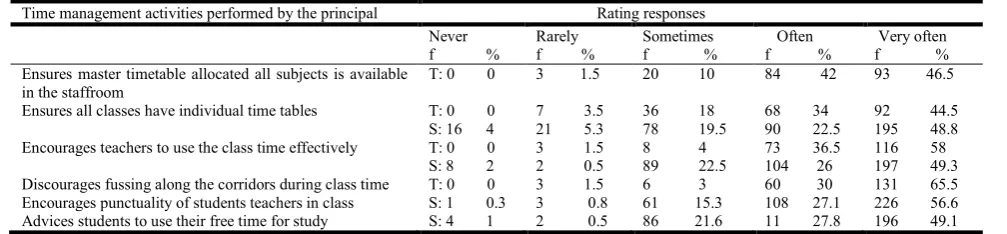
The participants were presented with six statements about the principal and were asked to rate each on a five point Likert scale where 1 was the lowest score and 5 the highest rating score. Table 2 presents the findings.
The students and the teachers’ high ratings on the principals’ performance in Table 2 indicate that they managed instructional time well. On whether the principals availed the master teaching time tables in staffroom; the majority (46.5%) and (42%) of the teachers indicated very often and often respectively. The minority (10%) pointed out sometimes and 1.5% as rarely. The researcher confirmed it during staffroom observation. The master teaching time tables were posted on the notice board. It indicated all the subjects taught in the school in all classes throughout the week. With regards as to whether the principals ensured that all classes got individual timetables, the majority (44.5%) and (34%) of teachers indicated very often and often respectively. A smaller percentage 18% and 5% mentioned sometimes and never respectfully. Responding to a similar statement, 48.8% of the students said very often; 22.5% as often and 19.5% sometimes. During classroom observation, the researcher noted that each had a class timetable; master timetables were placed in the staff rooms and in the principal’s offices. A well prepared teaching timetable ensures that teaching and learning proceeds smoothly in an orderly manner without collision. The same master timetable co-ordinates the use of common rooms such as the libraries, workshops and laboratories by various classes. However, some classes did not have a timetable as pointed out by 4% of the participating students.
[image:3.595.48.552.285.402.2]The researcher confirmed this during classroom observation that some classes did not have timetables. This is likely to put students in a serious dilemma with regard to subject allocations and their readiness for the lessons. Discouraging fussing along the corridors during class time was done either often or very often as pointed out by 65.5 % and 30% of the teachers who
Table 2. Teachers’ and Students’ Ratings of the Principals effectiveness on Time Management
Time management activities performed by the principal Rating responses
Never f %
Rarely f %
Sometimes f %
Often f %
Very often f % Ensures master timetable allocated all subjects is available
in the staffroom
T: 0 0 3 1.5 20 10 84 42 93 46.5
Ensures all classes have individual time tables T: 0 0
S: 16 4
7 3.5 21 5.3
36 18 78 19.5
68 34 90 22.5
92 44.5 195 48.8
Encourages teachers to use the class time effectively T: 0 0
S: 8 2
3 1.5 2 0.5
8 4 89 22.5
73 36.5 104 26
116 58 197 49.3
Discourages fussing along the corridors during class time T: 0 0 3 1.5 6 3 60 30 131 65.5
Encourages punctuality of students teachers in class S: 1 0.3 3 0.8 61 15.3 108 27.1 226 56.6
Advices students to use their free time for study S: 4 1 2 0.5 86 21.6 11 27.8 196 49.1
Source: Revised Kenya secondary school syllabus, 2002
said very often and often respectively. Only very few (3%) stated sometimes and 1.5% rarely respectfully. This was confirmed by 56.6% and 22.6% of the students who showed that the principals encouraged teachers and students punctuality in all aspects in the school. Very few principals did not do it as indicated by 0.3% of the students. Informal interviews showed that principals encouraged teachers to use class time effectively, by teaching and involving learners in a variety of learning activities related to the topic under study. In another item, students were asked to state whether the principals advised them on proper use free time for study. The majority (49.1%) indicated very often and 27.8% as often. On average 21.6% stated sometimes whereas very few (0.5%) and (1%) stated rarely and never respectfully. From the findings, effective use of time differentiated high and low performing schools. The researcher found out that in effective schools, the principals provided an academic emphasis.
Teachers allocated a significant amount of classroom time to instruction in basic skills. Students were engaged in planned learning activities at the appropriate level of difficult and were experiencing success. During interview, one principal of a better performing school concurred with the students when said:
I ensure that all the teaching staff members understand their role in facilitating the delivery of high quality educational program to all students. This means that students are provided maximum opportunity to learn during school day. I do this by minimising timewasters such as sending errand students out of class. My role is to ensure that all the personnel the teachers, students have skills in time management and make the best use
of class time.
From the above responses the researcher concluded that instructional time was utilised effectively whereby teachers and learners focused on teaching and learning priorities respectively. This confirms earlier findings of Smith and Andrews (1989) who found out that the principal who displays strong instructional leadership recognizes time as a scarce resource and creates order and discipline by minimizing factors that may disrupt the learning process. To determine the effective use of instructional time, the researcher asked principals of better performing schools to indicate various strategies they devised to manage school time. The principals’ responses varied; some had devised instruments such as weekly class attendance sheet to monitor teachers’ punctuality and effective teaching. For instance, class prefects indicated the time the teacher entered and left class. They commented on lesson teaching, especially time wastage in irrelevant story telling or any substantial digression from the lesson topic indicating unpreparedness. The sheets are taken to the deputy head every Friday to forward them to the principal. Teachers know about the evaluations and such knowledge is included in their performance appraisal. It kept teachers on their toes in observing punctuality in class.
In other schools, the principals established daily class returns, not on weekly basis to monitor teachers’ and students’ class attendance. These sheets enable the principal to be aware of who is absent and reasons for absence. Invalid absences due to malingering, indifference or truancy are detected and appropriate disciplinary action taken against the culprits. The students who through sickness missed important tests are identified early and appropriate remedial programs are
provided and tests of equal difficulty administered to them. It was evident that in those schools syllabus coverage was adequate and completed on time in second term. Third term was meant for revision and students preparations for examination. Principals never took for granted that effective teaching is taking place all the time. They went round physically to examine the school equipment, asked students informally about their lessons, syllabus coverage and difficult subjects to determine their confidence in passing examinations. Other principals established policies on curbing time wastage as narrated by one participant:
One thing has helped me in my school to cub time wastage. I devised the following policies with teachers to ensure smooth, rapid translations between activities throughout the class. That class starts quickly and purposefully, teachers get assignments or activities ready for students when they arrive. Instructional materials such as course books and reference are readily available. Students get ready for the next lesson by getting books out. Where appropriate, teachers handle administrative matters quickly and establish efficient routines that keep class disruptions to a minimum.
In poor performing schools administered by de-motivated heads, the researcher noted the laxity of teachers’ class attendance. Some reported on duty but did not go to class. Chronic absenteeism of teachers was rampart in those schools as teachers were equally de-motivated to utilize their instructional time effectively. They lagged behind the syllabus coverage, a situation that triggered stress and fear of failing exams among learners.
Time wasters according to teachers
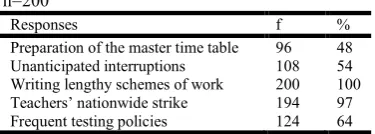
[image:4.595.340.528.536.603.2]Teachers in selected schools were asked to indicate activities that challenged their effective use of instructional time. The responses were categorized into five broad categories as shown in Table 2
Table 3. Distribution of teachers’ responses on activities that wasted the instructional time
n=200
Responses f %
Preparation of the master time table 96 48
Unanticipated interruptions 108 54
Writing lengthy schemes of work 200 100
Teachers’ nationwide strike 194 97
Frequent testing policies 124 64
Table 3 shows that all (100%) of teacher participants mentioned writing length scheme of work as a major time waster whereas 97% indicated teacher’s national strike. Another 54% and 48% of participants indicated unanticipated interruptions and preparation of master teaching time table respectfully. Frequent testing policies were indicated by 64% of the teacher participants. The study revealed that a considerable time was dedicated to preparation of the teaching master time table. This showed that instructional time was wasted as teachers and students waited for the teaching master timetable.
the students and teachers of valuable instructional time. Daily lesson preparations added to work overload. Holding lengthy staff meetings the whole day during school hours equally robbed students and teachers of valuable instructional time which are never recovered. Teacher’s participants also noted that the nationwide teachers strike occurrence almost annually affects instructional time. For instance in the year 2015, students lost five weeks of learning during third term when candidates of Kenya Certificate of Primary Education (KCSE) and Kenya Certificate of Primary Education (KCPE) were supposed to sit for exams. The huge instructional time lost could not be recovered; students neither covered the syllabus nor prepared adequately for examinations hence mass failures. Frequent testing policies contributed to instructional time wastage. Some teacher participants observed that some tests given to students were not valid. They raised concern on how some teachers followed a lazy way of setting examination questions or tests by lifting the past examination papers from the cupboard without making any substantial alterations. Such testing was administered when teachers were unprepared to teach as a way of keeping students busy. Assessments of that kind serve no purpose at all as the marks assigned do not reflect the academic achievement of the students or the skill measured. Unplanned interruptions were mentioned as causing wreak havoc on a teacher’s attempt to implement a carefully-developed and deliberately scheduled lesson plan. Teacher participants indicated the following interruptions as robbing students and teachers’ instructional time.
Uncoordinated lengthy students class conferences
when parents meet with teachers to discuss the progress of their children
Teachers walking to and from staff room to get a book/
class notes
Sending students home to collect fees and other levies
for school projects like buying a school bus, construction of boarding facilities among others
Delays in assembly on Mondays and Fridays weekly.
The researcher observed that many activities take place during assembly: Flag rising, prayers and preaching, lengthy announcements and taking disciplinary actions. All these encroach into the first lesson reducing its instructional time.
We can say that principals in those schools did not assist teachers and student to manage their instructional time effectively hence were poor managers. The findings also indicate that instruction in school, as Smith (2000) notes, “is nothing like the steady flow of learning we like to imagine and that students need to meet the new standards set for them. More accurately, it is a series of stop-and-go learning opportunities that compete with one another for scarce time” (p. 672). It is important to note that in some schools principals had created a school culture of attending assemblies, class conferences, fee payments that do not affect instructional time. Assemblies were held at 7:30 a.m, announcements were precise and focused and discipline administered outside class hours.
Students’ responses on time wasters
Students were asked to indicate incidences that eroded their instructional time. Information obtained was triangulated with those of the principals and the teachers. Their responses varied from school to school. In some day school students mentioned
co- curricular activities such as sports and music festivals as a major erode of instructional time. Students narrated absurd situations where they practised sports and music festivals all day on weekdays. The finding concur with that (Smith, 2000; Berliner, 1990) who found out that the amount of allocated time devoted to instruction was significantly less than usually assumed. Teacher tardiness to class was another time waster mentioned by the students. Students observed that some teachers not only arrived late in class but also spent most of instructional time telling irrelevant stories not related to the topics taught. Other concerns raised included students’ absenteeism from class due to fees, sickness and indiscipline cases. The researcher was informed that some schools take a long time to commence learning at the beginning of the term. This is a time when students in public day school clean classrooms, clear bushes in the compound. Teachers equally do not report the first day because it is time to attend to family activities e.g escorting their children to school as well. In boarding schools, students experienced similar situations; they had to clean classrooms, dormitories and dining halls before commencing the lectures.
Teachers’ absenteeism was also observed when attending staff meetings and workshops held in their counties. Suspending classes to allow teachers to attend staff meetings, conferences, workshops, seminars affect instructional time. Regarding this set of tradeoffs, Smith (2000) acknowledges that teachers do “require opportunities . . . to plan, coordinate, and reflect together on such errands. But, detracting from instructional time for students in order to accommodate for teacher professional development is not appropriate. Giving too much homework especially as a substitute for class work contributed
to time wastage. Student participants complained of being
given too much work which teachers neither marked nor
returned to learners. Though the homework is an extension of
class work, studies conducted by Gratz (2000) on keeping high standards in the school, show that when not correctly utilized can be a drudgery that makes a school unpleasant and unappealing to students. Gratz suggest that when homework is assigned it should be worthy doing, clearly explained and should be connected to the curriculum. In that way teachers encourage via meaningful homework the students’ love for school. If a school sets homework, the principal’s duty is to ensure that, it is based on an agreed policy decided after deliberations in staff meetings. Other time wasters mentioned by the students include:
Procrastination whereby some students do their studies
the last minute, just before sitting for examinations
Teachers excessive corporal punishments administered
during lesson to low achievers in particularly Mathematics
Lesson transition e.g from classroom to the laboratory
for science subjects.
Stormy days curtails learning in rooms without a
sealing board
Failure of machines to work e.g computer lesson,
failure of experiments in laboratories meant that the lesson be discontinued and repeated again
Unforeseen events like burning of schools, student
mischief, fights and security bombing threats
School activities such as prize giving day, motivation
In some schools, use students labour to harvest maize and beans from school farms, an exploitation of the child labour
Uncoordinated preps characterised by noise making
Principals Strategies used to curb instructional time wasters
The principal is an instructional time manager. The participating principals were asked to indicate strategies they put in place to curb time wasters in order to improve on the use of instructional time. Their responses are shown on Table 2.
Table 4. Distribution of principals’ strategies to curb loss of instructional time
n= 36
Responses f %
SMART instructional objectives 26 72.2
Advance preparation of the master time table 36 100
Prior preparation of scheme of work 30 83.3
Improve staff meetings 28 77.8
Table 4 shows that all principals (100%) acceded that advance preparation of the master teaching time table was crucial in minimizing loss of instructional time. Another 83.5% suggested prior preparation of the schemes of work whereas 77.8% were of the view of improving the time taken in holding staff meetings. About 72.2% indicated teachers designing of the SMART objectives and focusing learners to attain them as a way of improving the effective use of instructional time. Reports from principals in better performing schools opined that advance preparation of the master teaching time table regulates instructional time. They ensured that the committee responsible for designing teaching time table prepares it during the holiday. The time tabling team followed the Ministry of Education guidelines; ensured the double periods in languages and Mathematics are split to cater for the learner’s concentration. Assign double lesson for science practical experiments. The copy was posted on the notice board in the staffroom for teachers’ reference. Class teachers extracted the individual class timetables posted in classrooms prior to opening the school so that learning commenced the first day. The findings are similar to those of Griffins (1987) who advices principals on selecting time saving practices as follows:
Hold the staff meetings before the start of the term to issue the necessary learning resources; insist on departmental meetings take place outside teaching time; get down to serious teaching on the first day of the term; be strict regarding teacher punctuality and have a system that will alert you of any teacher absence; avoid suspension as a punishment, do not allow teachers to sent children out of class or do marking in class while students read novels or play cards which is iniquitous; teachers when in classroom must teach. Keep half-term holidays short and build a tradition whereby directly an internal examination ends, the staff gets back to serious teaching and students serious learning. An improvement on time taken on staff meeting was another strategy put forward. Principals from schools that completed their syllabus early opined that they released the agenda of the meeting in advance for teachers to go through, discuss among themselves in preparation for the meeting. That minimized the time spent on discussing issues, focused on the agenda items and enhanced instructional time. Others suggested holding meeting outside class hours
Prior preparation of the scheme of work was done in diverse ways. In some schools principals encouraged teachers to make scheme of work for the whole year to ensure systematic teaching annually. Other school heads advised teachers to make schemes of work in soft which they will later re-adjust rather than re- writing the entire scheme. In schools with many streams one subject teacher made the scheme of work which is distributed to all teachers handling the same class level. The participating principals in schools that completed the syllabus on time pointed out the following strategies of safeguarding instructional time which if utilized well by other schools can enhance instructional time. They can be done before commencing the lesson, transition between classes and dismissal time.
Before beginning the lesson
Principals and teachers announcements at assembly are
kept to a minimum to avoid disruption of first class periods.
Lesson begins when bell rings
Teacher commence lesson on time and students get to
work immediately
Minimal teacher tardiness by requesting class prefects
to note the time the teachers enter and leave class.
Class teachers check learners class attendance before
the first lesson commences
In the Classroom
Teachers ensure active learning and maximize learner
engagement throughout the lesson period.
Students get their course books and other materials
ready as soon as the bell rings for next class
Principals placed a wall clock for teachers to use to
monitor time use and designate amounts of time for specific tasks.
Established protocols and routines followed when
distributing materials, set up or clean up, moving from whole group to small group instruction among others
Teachers actively to minimize disruptions in class
Transitions between Classes
Teachers ensured that students carry materials they
need for multiple classes to avoid repeating trips to their lockers when transferring to another class
Class were located within proximity to minimize travel
time between classes. The researcher observed that classrooms for science subjects are next to laboratories for easier movement to minimize loss of instructional time.
Student transitions are supervised by teachers in an
orderly way to reduce disruptions and delays in commencing the next class.
Science teachers were advised to pre-test their practical
prior to lesson to determine its success to minimize failure during class.
Dismissal Time
Adherence to instructional time guidelines, ending class
on time.
Policies established on not dismissing students before
Teachers observed punctuality in leaving class as soon as the bell rings.
The findings concur with those of Levine and Lezotte (1990)
on the correct use of time for learning which indicate that, principals in effective schools ensure that little time is expended between classes, recess, fussing about starting the lesson or other extraneous to learning.
Principals’ Strategies to recapture lost instructional time
When queried about this practice, principals said that encouraged teachers and students punctuality in class. Heads of Department encouraged team teaching whereby available teachers teach to cover the lesson of the absent colleague. Those teachers with prior knowledge of missing class swerved lessons with colleagues taught covered class work early and colleagues teach their lessons later. In some schools, students were introduced to good study habits. These according to Nzubuga (2000) involve habits of place, time table habits as well as habits of health. Each student was to find a quiet place, corner of library free from distraction for reading. In terms time table students were advised to make individual time tables, indicate subject to be revised, tasks to be performed, and the duration including breaks. These enhanced proper use of free time. In other schools principals had created a school culture of reading. The students formed group discussions, read extensively on the topics contained in the syllabus and tackled past examination papers.
In boarding schools, teachers who missed their lessons could teach students during night preps. Day schools had morning preps between 7:00 am and 7:45 am when teachers came to make up for the missed lessons. The increasing of instructional time was received differently by teachers and principals. Others viewed it as not adding value to students learning as commuting students either arrived late for preps or missed classes. This too applied to students in boarding schools. Teachers’ feedback on remedial teaching indicated that learners were too tired to learn or do meaningful works thus resort to naps. Teachers were equally stressed and exhausted to teach after the heavy days duties. Critically it can be argued that it is not always true that increasing student instructional time will enhance learning. If additional time is not used for instructional activities, or the instruction is of poor quality; it will not contribute to students’ achievement. What matters most then is maximizing academic learning time when students are able to pay attention, receive instruction that is appropriately revelled and in which learning occurs (Blai, 1986). Several studies done have demonstrated that the effectiveness of instruction determines whether the extended school time has positive, negative or no effects on students’ outcome (Topin, 1987).
Some studies however show that adding school time does enhance students’ academic achievement. For instance, Faberman (2015) reviewed both research and practice and found out that adding school time can impact on the students’ proficiency and their entire educational experience especially the economically disadvantaged who lag behind their peers. That both teachers and students have more engaged time in academic classes, allowing broader and deeper coverage of the curricula. Also more time is devoted to enriching classes and activities that expand the students’ educational experiences and boost engagement in school. Similarly principals and teachers from better performing schools concurred that more time given
to low achievers increases their achievement. Hence, they designed ways of assisting low achievers. For instance, they formed small groups and subjects teachers dedicated their free time after school repeat the content where appropriate in bits covering the topics in detail and answered students’ questions using practical examples. Schools where it was practised, teachers observed great improvement among low achievers.
It is important to note that time spent on student learning depends on the quality of instruction they receive at that time. That is why efforts to improve the student achievement can succeed only with building the capacity of teachers to improve their instructional practice (Darling Harmond 2009). When asked how they improved teachers’ instructional practice, some principals said that organised workshops on best
instructional pedagogies. They include giving clear
instructions on the work to be done, emphasizing important tasks that learners need to pay attention to, effective class management practices to minimize disruption. Motivation plays a large part in determining the levels of performance of teachers and students. If motivation is low, teachers and students performance will suffer as much as if the ability was low. The study sought to establish how principals motivated their teachers. The reported indicated the utilization of both formal and informal strategies. Formally, teachers were recommended for promotion and Parents Teachers Association luncheons held for them. However, school heads had abandoned the luncheons because it created petty jealousy among teachers. Instead they resorted to less formal methods of incentives such as spontaneous oral appreciation for well accomplished task, encouraged collegiality and celebrating together and thanking the teacher privately.
Conclusion
Instructional time was not utilized well in schools. There are many non academic activities in school that compete on the use of instructional time. Some of the principals did not minimize time for non-instructional activities. On the other hand some principal’s effective use of instructional time enhanced syllabus coverage and attainment of educational objectives. Crictically, increasing the length of stay in schools does not enhance student achievement. It is the careful utilization of the allocated time and quality of instruction that determines student achievement. Principals, teachers need to decolonize their way of thinking that the time allocated is inadequate. Instead critically examine their usage of time allocated to schools to better performance of students. Time-on-task is positively associated with students’ academic achievement. Students who are active participants in their knowledge acquisition and skill development own their
learning and will perform at high levels of accomplishment.
Principal and teacher educators who are familiar with the time-on-task know their students well, use effective classroom management techniques, and employ good teaching practices and interactive learning activities that enhance syllabus coverage effectively.
Way
Forward
Principals organize worships at school level to equip
teachers and students on time management skills
Teachers to visit schools that complete the syllabus
Encourage teachers to attend conferences on time management skills
Teachers and students to read on time management
skills
Include time management skills in teacher education
curriculum to equip pre-service teachers
Quality assurance to organize INSETS on time
management skills to professional teachers already in the field
REFERENCES
Benavot, A. and Amandio, M. 2004. A global study of intended instructional time official school curricula, 1980-2000. Geneva: UNESCO
Berliner, D. C. 1990. What’s all the fuss about instructional time? In M. Ben-Peretz and R. Bromme(Eds.), The nature of time in schools: Theoretical concepts, practitioner perceptions (pp. 3-35). New York: Teachers College Press. Blai, B., Jr. 1986. Education reform: It’s about ‘time,’
Clearing House 60(1), 38-40
Britton, B.K. and Tesser, A. 1991. “Effects of
time-management practices on college grades”, Journal of
Educational Psychology, Vol. 83, pp. 405-10.
Chandi J, Ndiritu A, Kidombo H, Mbwesa J, Keiyoro P. 2013.
"The effect of time management on academic performance
of Distance learners: A case of the University of Nairobi
Distance Learners.".;
Davis, M. A. 2000. Time and the nursing home assistant:
relations among time management, perceived control over
time, and work-related outcomes. Educational Research,
57:1 pp. 69-95.
Farbman , A. D. 2015. The case of improving and expanding
school time. Review of key research and practice. National
centre on time learning.
Gratz, D.B. 2000. High standards for whom? Phi Delta
Kappan 81 (9), 681-687).
Griffins, G. 1996. School mastery. a straight talk about
boarding school management. Nairobi: Lectern
Publications Limited.
K’obonyo, P., Monari, F., Andollo, A. A. 2012. "The Influence
of Time Management Tendencies on the Relationship Between Employee Empowerment and Organizational Performance: A Study of the University of Nairobi
Employees.". In: AIBUMA. Vol. n/a.;
King, A.C., Winett, R.A. and Lovett, S.B. 1986. “Enhancing coping behaviours in at-risk populations: the effects of time-management instruction and social support in women
from dual-earner families”, Behaviour Therapy, Vol. 17,
pp. 57-66.
Kothari, C. R., and Garg, G. 2014. Research methodology.
Methods and techniques (3rd ed.). New Delphi: New Age
International (P) Ltd., Publishers.
Levine. D.U And Lezotte W.L. 1990. Unusually Effective
Schools. National Centre for Effective Schools Research
and Development, Madison, Board of Regents of the
University of Winston System.
Linda Darling Hammond, et al, Professional Learning in the
Learning Profession: A Status Report on Teacher
Development in the United States and Abroad, (Dallas, TX:
National Staff Development Council, 2009, p. 7.
McMillan, J., and Schumacher, S. 2001. Research in
education, a conceptual introduction. New York: Priscilla
McGeehon.
Nsubuga, E. H. K. 2000. The teacher as a professional.
Kampala: MK Publishers (U) Ltd
Orpen, C. 1994. The effect of time-management training on
employee attitudes and behaviour: A field experiment. The
Journal of Psychology, 128, 393-396.
Paper presented at the Academy of Management, Toronto, Canada.
Republic of Kenya 2002. The Kenya Secondary school
syllabus. Nairobi: Kenya Institute of Education
Smith, F.W. and Andrews, L.R. 1989. Instructional
Leadership. How Principals Make a Difference.
Washington: Edwards Brothers, Inc.
Smith. B. 2000. Quantity matters: annual instructional time in
an urban school system. Educational Administration
Quarterly Vol. 36, No. 5 (December) pp. 652-682
Strongman, K.T. and Burt, C.D.B. 2000. “Taking breaks from
work: an exploratory inquiry”, Journal of Psychology, Vol.
134, pp. 229-42.
Tobin,K. 1987 “The Role of Wait Time in Higher Cognitive
Level Learning,” Review of
Walberg, H. 2010. Handbook on Restructuring and Substantial School Improvement. Academic Development Institute