ISSN Print: 2327-5219
DOI: 10.4236/jcc.2018.611001 Nov. 7, 2018 1 Journal of Computer and Communications
Optimized Algorithm for Clustering Routing for
Wireless Sensor Networks
Tieyuan Chang
*, Weina Liu, Yan Zhang
College of Electronic and Information Engineering, Hebei University, Baoding, China
Abstract
LEACH protocol randomly selects cluster head nodes in a cyclic manner. It may cause network to be unstable, if the low energy node is elected as the cluster head. If the size of cluster is too large or too small, it will affect the survival time of the network. To address this issue, an improved solution was proposed. Firstly, the scheme considered the average and standard deviation of the nodes’ residual energy and the distance between the node and the base station, then considered the distance between the node and the cluster head and the energy of the cluster head to optimize the cluster head selection and clustering. The performance analysis results showed this scheme could reduce premature deaths of the cluster heads and too high energy consumption of some clusters. Thus, the proposed algorithm could prompt the stability and prolong the lifetime of the network.
Keywords
Wireless Sensor Network (WSN), LEACH Routing Protocol, Optimize Clustering, Residual Energy, Stability, Network Lifetime
1. Introduction
Wireless sensor network (WSN) is a new generation sensor network. The repre-sentative discussion related to it appeared as early as 1999. With the develop-ment of science and technology, some experts predict that the developdevelop-ment and wide application of WSN will bring great influence and impetus to people’s so-cial life and industrial transformation [1]. WSN is a kind of wireless communi-cation network composed of a large number of sensor nodes without infrastruc-ture. It integrates sensor technology, embedded technology, distributed informa-tion processing technology and wireless communicainforma-tion technology. It senses and collects environmental information (such as temperature, humidity, noise,
How to cite this paper: Chang, T.Y., Liu, W.N. and Zhang, Y. (2018) Optimized Algorithm for Clustering Routing for Wireless Sensor Networks. Journal of Computer and Communications, 6, 1-11.
https://doi.org/10.4236/jcc.2018.611001
Received: October 8, 2018 Accepted: November 4, 2018 Published: November 7, 2018
Copyright © 2018 by authors and Scientific Research Publishing Inc. This work is licensed under the Creative Commons Attribution International License (CC BY 4.0).
DOI: 10.4236/jcc.2018.611001 2 Journal of Computer and Communications
light intensity, etc.) of the node deployment area, then processes the data to re-move redundancy based on the ability to obtain detailed and accurate informa-tion, and eventually transmits the data to the observer over the wireless network
[2]. The development of wireless sensor network technology has experienced three stages: intelligent sensor phase, wireless intelligent sensor phase and wire-less sensor network phase [3]. For the future of wireless sensor network tech-nology, its development prospects are more optimistic; in environmental moni-toring, emergency relief, smart home, medical care, industrial production con-trol and commercial and other fields will have a wide range of applications [4].
Different from traditional networks, WSN network has its own characteristics, so the routing protocols and algorithms used in traditional networks cannot meet the requirements of WSN applications. In WSN, sensor nodes form a data transmission path by cooperating with each other and send the data from the source node to the destination node. Data transmission cannot be separated from routing protocol; routing protocol is the basis of networking. Because sen-sor nodes have little energy and distribute randomly, long-distance transmission of data consumes a lot of energy. Unreasonable routing algorithm can easily lead to rapid death of local nodes. It can even lead to the energy black hole. As an important factor for network performance, routing directly determines the effi-ciency of sensor nodes in the transmission of data [5]. The different speed and time of data transmission in different paths can influence the energy consump-tion. Sensor nodes are microelectronic devices with limited energy, and their lifetime is largely dependent on battery power [6]. They are mostly distributed in work places where the environment is very bad, so it is very difficult to replace batteries. Therefore, it is very important to design a routing algorithm with low energy consumption, high data transmission speed and high success rate, which directly affects the performance of the whole wireless sensor network system [7]. This paper introduced the typical LEACH protocol, and pointed out its prob-lems, improper selection of cluster heads and uneven distribution of energy consumption. We took steps to improve its shortcomings. First, we used a new threshold probability formula to improved cluster head electing phase. Second, we optimized clustering phase by adding a reference for clustering. This im-provement method aiming at two aspects performed better than the previous methods.
2. Related Model
2.1. Network Model
This paper assumes that the sensor network has the following properties:
• The base station is unique, located in the center of the network area. The
lo-cation is known to all other nodes, and the energy is not limited.
• Nodes are randomly distributed in the network, the locations are known and
fixed.
DOI: 10.4236/jcc.2018.611001 3 Journal of Computer and Communications • Each node has same initial energy and data processing capability.
• Base stations can communicate with all nodes [8].
2.2. Energy Model
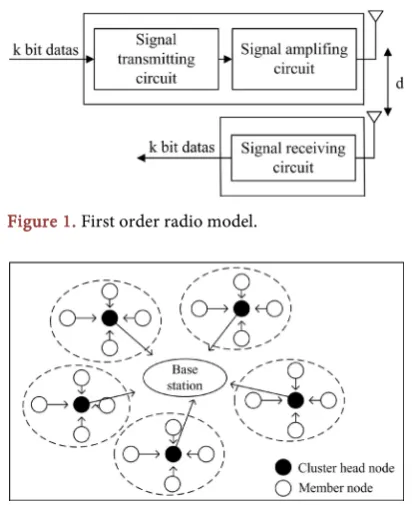
The simulation model of this experiment is based on the first order radio model, as shown in Figure 1[9].
According to Figure 1, the energy ET, consumed by the sensor node to
transmit k bit data is composed of two parts, one is the energy consumption of the signal transmitting circuit, and the other is the energy consumption of the signal amplifying circuit, as in (1).
2
0 4
0
elec fs
T
elec mp
kE k d d d
E
kE k d d d
ε ε
+ <
=
+ ≥
(1)
where, Eelec is the energy consumption for transmitting or receiving each bit of
data, εmp is the power amplification factor of the multipath fading model, εfs
is the power amplification factor of the free space model, d is the distance for transmitting data, d0 = ε εfs mp . When the transmitting distance d d≥ 0, the
multipath fading model is adopted, the energy consumption is proportional to the 4th power of the distance; when d d< 0, the free space model is adopted,
and the energy consumption is proportional to the 2nd power of the distance
[10].
The energy ER, consumed by the sensor node to receive k bit data is shown
as (2).
R elec
E =kE (2)
3. LEACH Protocol
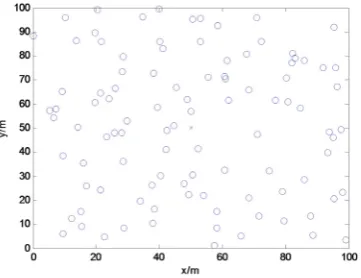
Combined with the limited energy of sensor nodes, many effective algorithms have been designed, among which, the most classical one is the low energy adap-tive cluster hierarchical protocol (LEACH). The idea of this algorithm was to se-lect cluster head nodes randomly in a cyclic way, it’s shown in Figure 2. The cluster head nodes collected data from member nodes and sent them to the base station. In that way, the energy consumption can be evenly distributed to each node of the network [11].
DOI: 10.4236/jcc.2018.611001 4 Journal of Computer and Communications
Figure 1. First order radio model.
Figure 2. Clustering diagram of LEACH protocol.
Cluster head selecting phase and clustering phase were the core parts of the LEACH protocol. The details are described as follows:
• Each node generated a random number between [0] and 1.
• Each node got a threshold T(i) according to the following formula, which we
can get in [7].
( )
1 mod 10 otherwise
P i G
P r
T i P
∈
− ×
=
(3)
where, P was the percentage of cluster heads in all nodes, r was round, G was the set of nodes that had not been selected as cluster head.
• The nodes whose random number was less than the threshold were selected
as cluster heads and sent the massages to other nodes. Remarkably, those se-lected nodes could not be cluster heads in the after rounds.
• The unselected nodes chose a cluster head according to the strength of the
received information to participate in the cluster.
• The cluster heads generated a time division multiple access (TDMA), and
sent them to their member nodes.
• Member nodes collected the around data then sent to their cluster heads on
the basis of TDMA.
• The cluster heads fused the data and then sent them to the base station [12].
DOI: 10.4236/jcc.2018.611001 5 Journal of Computer and Communications
member nodes reduced the amount of data. However, there were still some shortcomings in LEACH protocol. Scholars had put forward different improve-ment methods for different problems. In LEACH protocol, no matter how far the cluster head was from the base station, it was necessary to send the data di-rectly to the base station. The energy consumption for data transmission showed exponential relationship with the distance. When the distance was over a certain level, the energy consumption would increase sharply. The author in [13] took an improvement by selecting a sub-cluster head in each cluster. It allowed the cluster head far away from the base station to transmit data by multi-hops through the sub-cluster head, so as to reduce energy consumption for long dis-tance transmission. In [14], a self-guided adaptive clustering method was pro-posed to prolong the lifetime of network by allowing or prohibiting nodes to participate in the clustering phase. Some nodes in dense clusters were allowed to enter dormant mode. It could reduce the communication with cluster heads. Thus, it prolonged the network lifetime. This paper introduced an improved al-gorithm, optimized clustering LEACH protocol based on energy and distance of cluster head (O-LEACH). The algorithm took two steps to improve the LEACH. Firstly, optimize the cluster head selecting to prolong the stability period. Then optimize the clustering phase to average energy consumption among clusters.
4. Improvement Plans
4.1. Optimize Cluster Head Selecting Phase
The cluster head is randomly selected in LEACH algorithm, regardless of the current energy remaining of the node and the transmitting distance between the node and the base station. The node which is selected as the cluster head could be low in energy or far from the base station. This may result in uneven distribu-tion of energy consumpdistribu-tion. In this case, the node will die prematurely and the network will be unstable. In order to solve this problem, there is an improved algorithm, Cluster-head-selecting Optimized Advanced LEACH Protocol (COAL). A new threshold probability is used in the algorithm. The new thre-shold probability has two parts, as shown in (4). CP includes parameters such
as the mean and standard deviation of the current energy of the node in each round and the distance between the node and the base station. The energy pa-rameter and distance papa-rameter make the nodes with higher energy and shorter distance from the base station more likely be selected as the cluster heads.
( ) (
1)
P PDOI: 10.4236/jcc.2018.611001 6 Journal of Computer and Communications
base station. This will increase the energy consumption in per round. The max-imal cluster indicates that there are large numbers of member nodes in the clus-ter. This will increase the energy consumption for cluster head to receive the in-formation member nodes, and the coverage of the cluster will increase. Some nodes have to communicate with the cluster head for a long distance, which in-creases the energy consumption of the member nodes and shortens the network life cycle. Maximal cluster also means that the range covered by the cluster is very large. Some nodes have to communicate with the cluster head over a long distance. It increases the energy consumption of member nodes. Thus, network’s lifetime will be greatly shortened. Therefore, it is necessary to optimize the clus-tering phase [15].
4.2. Optimize Clustering Phase
In order to optimize the clustering phase and prolong network’s lifetime, the clustering optimized LEACH Protocol based on energy and distance of cluster head (O-LEACH) is proposed.
O-LEACH protocol has three phases, cluster head selecting phase, clustering phase and stable communicating phase. In cluster head selecting phase, each node generates a random number between 0 and 1 to compare with a threshold calculated according to (4). And if the random number is less than the threshold, the node is selected as a cluster head; In clustering phase, each member nodes calculate a parameter, Pc, according to (5), the parameter is related to the
clus-ter heads. Each node chooses a appropriate clusclus-ter head to participate in ac-cording to the value of Pc. Its stable communicating phase is the same as
LEACH protocol. The steps in cluster head selecting phase and clustering phase are shown in Figure 3.
The key part of O-LEACH protocol is the clustering phase. It is important to calculate Pc and choose the cluster head which minimum value of Pc
corres-ponding to.
2
max
CH o
c
cur
d E
P if i N
d E
= + ∈ (5)
where, d2CH indicates the distance from the node to the cluster head, dmax
The maximum distance between any two surviving nodes, Eo and Ecur
represent the initial energy and the current energy of the cluster head, N
represents a collection of non-cluster head nodes. The smaller d2CH is, the
smaller Pc is. And the larger a is, the smaller b is. The minimum value
indi-cates that the cluster head is closer to the node or has higher residual energy.
5. Simulation and Results
5.1. Simulation Environment
evalua-DOI: 10.4236/jcc.2018.611001 7 Journal of Computer and Communications
[image:7.595.223.520.146.536.2]tion steps are to analyze the behavior of the three protocols in terms of the dead nodes and average of current energy. As shown in Figure 4, 100 nodes distribute randomly.
Table 1. Simulation environment parameters.
item value
Number of nodes 100
Size of the network 100 m × 100 m
Location of the base station (50, 50)
Initial energy 0.04 J
length of data 3500 bit
length of control data 32 bit
P 5%
elec
E 50 nJ/bit·m−1
DA
E 5 nJ/bit·m−1
mp
E 0.0013 pJ/bit·m−4
fs
[image:7.595.285.466.565.704.2]E 10 pJ/bit·m−2
Figure 3. Chart of cluster head selecting phase and clustering phase.
DOI: 10.4236/jcc.2018.611001 8 Journal of Computer and Communications
5.2. Simulation Results
The energy of the node decreases with each round. If its energy is less than zero, the node is considered dead. When most nodes in the network die, the monitor-ing has no mean. The network’s life ends, if the proportion of dead nodes reach-es 98% [16].
As shown in Figure 5, the number of dead nodes varied over rounds of simu-lation. It could be seen that all nodes survive until 30th rounds. The first dead
node appeared in the 31st round. Later, the number of death nodes increased
dramatically. The network’s lifetime completely ended in the 125th round. The Figure 6 illustrated the average of current energy varies over simulation rounds. The energy decreased drastically. Until the 125th round, it was close to zero.
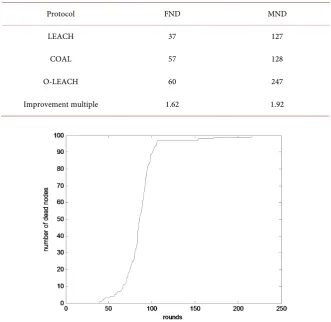
Figure 7 showed the comparison of the number of dead nodes for the three protocols in one experiment. From the simulation results we could see in LEACH protocol the first node died in the 39th round, and the network’s lifetime
ended in the 126th round; In COAL protocol the first node died in the 58th
round, and the network’s lifetime ended in the 128th round; In O-LEACH
pro-tocol the first node died in the 60th round, and the network’s lifetime ended in
the 245th round.
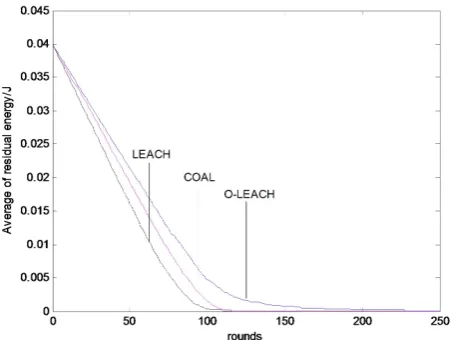
To avoid contingency, we did several experiments, and then calculated the mean value of the simulation results. According to the first node dead time (FND) and the most nodes dead time (MND), we listed the improvement effect in Table 2. The data show, LEACH protocol and COAL protocol had almost the same MND, but COAL protocol had later FND, its network-stability increased by 54%; Compared to LEACH protocol, O-LEACH protocol had both later FND and MND, its network-stability increased by 62%, its network lifetime prolonged by 92%. O-LEACH protocol has made two improvements. In the new threshold probability of the cluster head selecting phase, we added the average value and the standard deviation of the current energy. As we all know, that the standard deviation can describe the stability of the data. The smaller the variance, the higher the stability. Because of the parameters, the more stable nodes were more likely to be selected a cluster head. This could make the COAL protocol have longer stablility period and shorter unstability period. So the network is more stable. After we optimized the clustering phase by adding a parameter. Number nodes could select a cluster head depend on a more specific basis. So the clusters were more uniformity and rational. The energy consumption distributed more evenly. Thus the network lifework was longer. This could also be seen from the change in the residual energy of the network in Figure 8.
Figure 8 showed the comparison of the average of current energy for the three protocols in one experiment. Along with the simulation rounds, the death of nodes continued to increase and the current energy of nodes continued to de-crease. According to Figure 8, from the beginning to the 40th round the current
energy of the three protocols was similar. From 40th to about 120th, the current
differ-DOI: 10.4236/jcc.2018.611001 9 Journal of Computer and Communications
ence among them gradually increased. The value of the two improved protocols were higher than LEACH protocol. After the 120th round, the energy of LEACH
[image:9.595.208.540.162.484.2]protocol and COAL protocol was almost zero. In the simulation process, under the same round, two improvement protocols always had more energy.
Table 2. Comparison of node dead time.
Protocol FND MND
LEACH 37 127
COAL 57 128
O-LEACH 60 247
[image:9.595.252.493.518.702.2]Improvement multiple 1.62 1.92
Figure 5. Change of death node number of LEACH protocol.
DOI: 10.4236/jcc.2018.611001 10 Journal of Computer and Communications
Figure 7. Comparison of death node number.
Figure 8. Comparison of average residual energy.
6. Conclusion
This paper introduced the LEACH protocol and analyzed its problems. In re-sponse to its problems, the O-LEACH protocol was proposed. The improved protocol optimized cluster head selecting phase through adding parameters, the mean and standard deviation of the current energy of the node and the distance between the node and base station, and also optimized clustering phase through adding parameters, the current energy of the cluster head and the distance be-tween the node and clusters. The simulation results showed that the O-LEACH protocol increased the network stability and prolonged the network lifetime.
Conflicts of Interest
The authors declare no conflicts of interest regarding the publication of this pa-per.
References
[image:10.595.261.487.278.448.2]DOI: 10.4236/jcc.2018.611001 11 Journal of Computer and Communications Structure Routing Method Based on LEACH in Wireless Sensor Networks. Wireless Personal Communications, 4, 6369-6379.
https://doi.org/10.1007/s11277-017-4482-y
[2] Padmavati, T.C.A. (2014) Comparison of Routing Protocols in Wireless Sensor Network Using Mobile Sink—A Survey. Engineering and Computational Sciences, Chandigarh, 6-8 March 2014, 1-4. https://doi.org/10.1109/RAECS.2014.6799601 [3] Liu, M. (2016) Analysis of Wireless Sensor Network Technology Development.
In-formation and Communications, 6, 286-287.
[4] Li, T.F., Du, X.J. and Niu, K. (2014) Wireless Sensor Network Data Fusion in Layer Based on Hierarchy. Modern Electronic Technology, 20, 11-13.
[5] Wang, Z.J., Zhang, Q. and Luo, J.H. (2014) C Optimization Simulation Analysis of Wireless Sensor Network Communication. Computer Simulation, 1, 282-285. [6] Xu, J.S., Yang, G. and Chen, S.S. (2009) A Global Information Based Protocol for
LEACH Improvement. Journal of Nanjing University of Posts and Telecommunica-tions (Natural Science), 4, 55-63.
[7] Heinzelman, W.R., Chandrakasan, A. and Balakrishnan, H. (2000) Energy-Efficient Communication Protocol for Wireless Microsensor Networks. Proceedings of the
33rd Annual Hawaii International Conference on System Sciences, Maui, HI, 7 January 2000, 10.https://doi.org/10.1109/HICSS.2000.926982
[8] Guo, D. and Xu, L. (2012) Proceedings of the International Conference on Informa-tion Engineering and ApplicaInforma-tions (IEA).Springer, London, 153-160.
[9] Heinzelman, W.B., Chandrakasan, A.P. and Balakrishnan, H. (2002) An Applica-tion Specific Protocol Architecture for Wireless Microsensor Networks. IEEE Transactions on Wireless Communication,1, 660-670.
https://doi.org/10.1109/TWC.2002.804190
[10] Aghera, K. (2017) MMR-LEACH: Multi-Tier Multi-Hop Routing in LEACH Pro-tocol. Proceedings of International Conference on Communication and Networks. 205-214.https://doi.org/10.1007/978-981-10-2750-5_22
[11] Thakkar, A. (2017) DEAL: Distance and Energy Based Advanced LEACH Protocol.
International Conference on Information and Communication Technology for In-telligent Systems, Ahmedabad, 25-26 March 2017,370-376.
[12] Darabkh, K.A., Al-Rawashdeh, W.S. and Al-Zubi, R.T. (2017) C-DTB-CHR: Cen-tralized Density- and Threshold-Based Cluster Head Replacement Protocols for Wireless Sensor Networks. Journal of Supercomputing, 5, 1-22.
https://doi.org/10.1007/s11227-017-2089-4
[13] Li, A.C. and Chen, G.F. (2017) An Improved Clustering Routing Algorithm for He-terogeneous Wireless Sensor Networks. Chinese Journal of Sensors Actuators, 11, 1712-1718.
[14] Manjeshwar, A. and Agrawal, D.P. (2002) TEEN: A Routing Protocol for Enhanced Efficiency in Wireless Sensor Networks. Parallel and Distributed Processing Sym-posium, San Francisco,23-27 April 2002, 189.
[15] Ye, C., Sun, L.M. and Liao, Y. (2004) An Overview of Energy Management in Sen-sor Networks. Computer Engineering and Applications, 8, 196-198.