ISSN Print: 2152-7180
DOI: 10.4236/psych.2018.99131 Sep. 11, 2018 2296 Psychology
A Theoretical Integration of Schema Therapy
and Cognitive Therapy in OCD Treatment:
Experiential Techniques and Cognitive-Based
Interventions in Action (Part III)
Barbara Basile
1*, Olga Ines Luppino
1, Francesco Mancini
1,2, Katia Tenore
11Association of Cognitive Psychology, School of Cognitive Psychotherapy, Rome, Italy 2Marconi University, Rome, Italy
Abstract
This final article is part of the trilogy presenting a possible integration of Schema Therapy (ST) and Cognitive Therapy (CT) in Obsessive-compulsive disorder (OCD) treatment. It aims at describing how experiential and cogni-tive based acceptance techniques might be applied to treat this psychopatho-logical condition. In the first article published in this special issue (Luppino et al., 2018) we reported the main data supporting the role of proximal psycho-logical determinants in the genesis and maintenance of the obsessive symp-tomatology, highlighting the role of deontological guilt and disgust, and of the Not Just Right Experience. According to these, we described the internal profile of the disorder as conceptualized by Mancini’s (2018) cognitive model. In the second manuscript (Tenore et al., 2018) we proposed a conceptualiza-tion of OCD, in terms of schemas and modes (as proposed by ST), integrating it with the previously described cognitive model. In agreement with these two articles, the aim of this work is to explain how experiential and cognitive techniques can be integrated to explain obsessive functioning and to achieve a successful treatment. We first describe emotion focused-experiential proce-dures derived from the ST framework, specifically focusing on imagery tech-niques, such as diagnostic imagery, rescripting and Healthy Adult imagery. Secondly we explain how chairwork can be applied to change obsessive dys-functional schema modes. Finally, we focus on cognitive based acceptance intervention aimed at reducing the typical feelings of deontological guilt and disgust, two core emotions in OCD. In the conclusion we briefly resume the major aspects proposed in the three articles, and we present some potential further applications of a joined approach applied to other psychopathological
How to cite this paper: Basile, B., Luppi-no, O. I., Mancini, F., & Tenore, K. (2018). A Theoretical Integration of Schema Ther-apy and Cognitive TherTher-apy in OCD Treat-ment: Experiential Techniques and Cogni-tive-Based Interventions in Action (Part III). Psychology, 9, 2296-2311.
https://doi.org/10.4236/psych.2018.99131
Received: July 2, 2018 Accepted: September 8, 2018 Published: September 11, 2018
Copyright © 2018 by authors and Scientific Research Publishing Inc. This work is licensed under the Creative Commons Attribution International License (CC BY 4.0).
http://creativecommons.org/licenses/by/4.0/
DOI: 10.4236/psych.2018.99131 2297 Psychology conditions.
Keywords
Obsessive-Compulsive Disorder, Schema Therapy, Cognitive Therapy, Imagery with Rescripting, Chairwork, Acceptance
1. Introduction
In this last paper of the trilogy published in this number of Psychology we pro-pose an integrated model where cognitive (CT) and schema therapy (ST) ele-ments and techniques are combined in order to facilitate a deeper understanding of OCD functioning and treatment intervention. In line with the two previous articles (see Luppino et al., 2018; and Tenore et al., 2018, in this issue), our aim here is to explain how schema and cognitive strategies and techniques can be applied to treat obsessive symptoms. Emotion-focused experiential techniques might be particularly useful to explore and to manage early-life factors that might have sensitized patients towards actual obsessive pathology, while cogni-tive techniques might be applied to understand and treat actual OCD symptoms. In this view, the ST framework might be particularly useful in the sense of giving a richer representation of the OCD mental state, in terms of early maladaptive schemas (Young et al., 2003), and of the early negative experiences that might have contributed to the development of such schemas, setting the basis for fu-ture symptomatic development. As well, schema modes conceptualization might be helpful in illustrating the obsessive functioning in a more dynamic way, with a dedicated focus on the patient’s actual emotional state. On the other hand, the cognitive model is particularly useful (Luppino et al., 2018) to understand beliefs, goals, maintenance factors, and the general mind set, of obsessive pa-tients.
DOI: 10.4236/psych.2018.99131 2298 Psychology
2. Experiential Techniques
2.1. Imagery Work
Imagery is a nonverbal strategy for producing change (Smucker, Dancu, Foa, & Niederee, 1995; Arntz & Weertman, 1999). It makes it possible to recall early negative emotional events, which are mainly stored in the form of images
(Conway & Pleydell-Pearce, 2000). Particularly, Imagery with Rescripting (ImRS) is a technique which aims to modify the meanings associated with nega-tive or traumatic memories (Arntz & Weertman, 1999; Smucker, Dancu, Foa, & Niederee, 1995), connecting the patient’s primary emotions to early maladaptive schemas. Imagery applies to core beliefs as well as to other cognitive behavioral constructs, and it has been recognized to have greater power than verbal repre-sentation (Paivio, Smythe, & Yuille, 1968). Imagery can be applied when suffi-cient safety and trust in the therapist has been established.
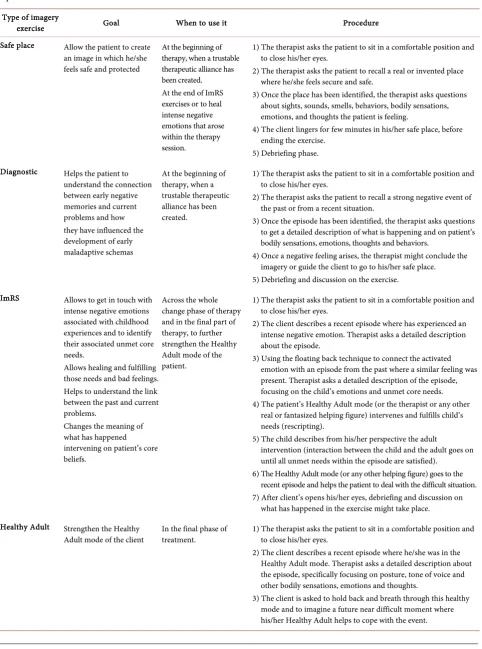
Other kinds of imagery exercises can be used in different phases of therapy, in order to prepare the patient for future ImRS intervention, or to strengthen the Healthy Adult mode. These include imagery associated with a safe place and di-agnostic imagery (Arntz, 2011; Young et al., 2003). They can be applied during the first stages of therapy. In later stages Healthy Adult imagery can be utilized. Here, we will briefly describe the rationale for each imagery technique, and we invite you to examine Table 1 for a detailed description concerning the proce-dure for each exercise. After each imagery session, specifically after having em-ployed ImRS, clients are asked how vivid the image was, what they have noticed about the experience, and whether they recognize a relationship between their actual problems and what has happened in the past. They are also asked whether they have developed a new meaning (of themselves or others involved in the ep-isode) in relation to what happened in the image. This final phase provides the most individualized formulation of the activated schema, associated with the pa-tient’s personal life history. Each imagery exercise must be audio-recorded and is given to the client after the session to listen to as homework.
1) Safe place imagery
In this imagery exercise, the patient and therapist work together to create an image of a place where the patient feels safe. This image can be real (i.e., a place from the past, an actual one, or even the therapist’s room) or made-up (i.e., a safety bubble, Farrell & Shaw, 2018), and it can be used later to bring safety into the session whenever needed, as for instance after an imagery with rescripting exercise (Arntz, 2011; Young et al., 2003). Safe places might also include other people or animals, or no one; the essential aspect is that the client should feel completely safe.
2) Diagnostic imagery
DOI: 10.4236/psych.2018.99131 2299 Psychology
Table 1. Principal goals and phases of therapy in which of each imagery exercise can be used, and detailed clinical procedures are reported.
Type of imagery
exercise Goal When to use it Procedure
Safe place Allow the patient to create an image in which he/she feels safe and protected
At the beginning of therapy, when a trustable therapeutic alliance has been created. At the end of ImRS exercises or to heal intense negative emotions that arose within the therapy session.
1) The therapist asks the patient to sit in a comfortable position and to close his/her eyes.
2) The therapist asks the patient to recall a real or invented place where he/she feels secure and safe.
3) Once the place has been identified, the therapist asks questions about sights, sounds, smells, behaviors, bodily sensations, emotions, and thoughts the patient is feeling.
4) The client lingers for few minutes in his/her safe place, before ending the exercise.
5) Debriefing phase. Diagnostic Helps the patient to
understand the connection between early negative memories and current problems and how they have influenced the development of early maladaptive schemas
At the beginning of therapy, when a trustable therapeutic alliance has been created.
1) The therapist asks the patient to sit in a comfortable position and to close his/her eyes.
2) The therapist asks the patient to recall a strong negative event of the past or from a recent situation.
3) Once the episode has been identified, the therapist asks questions to get a detailed description of what is happening and on patient’s bodily sensations, emotions, thoughts and behaviors.
4) Once a negative feeling arises, the therapist might conclude the imagery or guide the client to go to his/her safe place. 5) Debriefing and discussion on the exercise.
ImRS Allows to get in touch with intense negative emotions associated with childhood experiences and to identify their associated unmet core needs.
Allows healing and fulfilling those needs and bad feelings. Helps to understand the link between the past and current problems.
Changes the meaning of what has happened intervening on patient’s core beliefs.
Across the whole change phase of therapy and in the final part of therapy, to further strengthen the Healthy Adult mode of the patient.
1) The therapist asks the patient to sit in a comfortable position and to close his/her eyes.
2) The client describes a recent episode where has experienced an intense negative emotion. Therapist asks a detailed description about the episode.
3) Using the floating back technique to connect the activated emotion with an episode from the past where a similar feeling was present. Therapist asks a detailed description of the episode, focusing on the child’s emotions and unmet core needs. 4) The patient’s Healthy Adult mode (or the therapist or any other
real or fantasized helping figure) intervenes and fulfills child’s needs (rescripting).
5) The child describes from his/her perspective the adult
intervention (interaction between the child and the adult goes on until all unmet needs within the episode are satisfied).
6) The Healthy Adult mode (or any other helping figure) goes to the recent episode and helps the patient to deal with the difficult situation. 7) After client’s opens his/her eyes, debriefing and discussion on
what has happened in the exercise might take place. Healthy Adult Strengthen the Healthy
Adult mode of the client In the final phase of treatment. 1) The therapist asks the patient to sit in a comfortable position and to close his/her eyes. 2) The client describes a recent episode where he/she was in the
Healthy Adult mode. Therapist asks a detailed description about the episode, specifically focusing on posture, tone of voice and other bodily sensations, emotions and thoughts.
DOI: 10.4236/psych.2018.99131 2300 Psychology influenced the development of the client’s maladaptive schemas (Arntz, 2011; Young et al., 2003). After the exercise, the therapist helps the patient understand the connection between the past episode and his/her current problems. The ma-jor aim of diagnostic imageryis to get some initial information about the type of early experiences and relationships that are likely to have played a role in the development of maladaptive schemas’, as these might be related to the patient’s actual problems. For example, Mark might have recollected a specific memory where he was 6 years old and was with his mother, who, very angry at him, was wearing a scornful expression on her face because he had lost his school bag. As a child, Mark was very upset, and continued to feel very guilty about what had happened. To restore Mark’s negative emotions within the context of the diag-nostic imagery exercise, the therapist might ask him to go back to his safe place, and to linger within the feelings of security and care generated by that place.
3) Imagery with Rescripting (ImRS)
Imagery with rescripting technique was first developed by Smucker and his colleagues in 1995 and applied to women diagnosed with a post-traumatic stress disorder. Afterwards, it was fluidly integrated within the ST model as one of its major emotion-focused experiential techniques.
The major goals of ImRS are (Smucker et al., 1995; Arntz & Weertman, 1999; van Vreeswijk et al., 2012):
1) To obtain a better understanding of the childhood origin of maladaptive schemas.
2) To link the origins of the client’s schemas in childhood and adolescence together with his/her current problems.
3) To identify more precisely schemas that are central to the patient by elicit-ing core images linked to primary emotions like fear, loneliness, hopelessness, shame, guilt, grief and so on. In the case of OCD, the most relevant emotions are usually guilt (Basile et al., 2018; Veale et al., 2012), often associated with parental reproach/blame experiences (Basile et al., 2018), and fear of being disgusting
(Tenore et al., 2018; Mancini, 2018).
4) To help the patient feel and accept the emotions associated with those im-ages more fully (see also the acceptance intervention paragraph, in the second part of the article).
5) To change the meaning of negative memories and to allow cognitive re-structuring, modifying patient’s core beliefs and self-representation (Arntz, 2011; Brewin, 2006; Mancini & Mancini, 2018).
6) To provide a basis for self-compassion by experiencing the emotional pain of the image.
7) And, for the therapist, to better understand the patient in an emotional sense, facilitating empathic responsiveness and an overall therapeutic alliance.
exam-DOI: 10.4236/psych.2018.99131 2301 Psychology ple, Mark reported a specific negative episode that took place in his childhood. The client’s memory developed from a recent negative event in which Mark had experienced a great deal of stress when he thought he had lost his wallet on the bus. In the childhood memory, both of Mark’s parents had become very irritated and upset when Mark had received a bad mark in a school test. Within the re-scripting phase, both the therapist and Mark as an adult entered the scene by comforting and supporting little Mark, who was feeling deeply sad and guilty for having disappointed his parents’ expectations, fearing they would reject him, or even leave him. The adult Mark hugged the child, promising he was never going to leave him and that he would always love him, no matter what he could do wrong! In a second intervention, in the context of the same episode, the therap-ist spoke to Mark’s parents, while the little Mark and adult Mark ltherap-istened, ex-plaining how exaggerated their reaction had been, and how this was affecting their son’s psychological wellbeing. The therapist explained that everyone, espe-cially children, has the right to make mistakes, and how it is through errors that children can learn, understand how to cope with their problems and develop a healthy sense of self-esteem. She then asked them to lower their unrelenting standards towards the boy, who was then just an 8 years old child, with specific needs for care, acceptance, encouragement, support and reassurance that needed to be satisfied. After the imagery session, Mark recognized that maybe his long-lasting self-beliefs about being “a bad and difficult child”, with exaggerated needs and requests towards his caregivers, were incorrect. In addition, the client recognized that maybe his parents were too demanding and only minimally tuned into their son’s own feelings and emotional needs. Although this different awareness and perspective was painful, it allowed Mark to gain a new perception of himself and improve his sense of self-worth.
4) Healthy Adult Imagery
DOI: 10.4236/psych.2018.99131 2302 Psychology was able to imagine himself dealing with an upcoming stressful situation. When, the following week, a stressful episode did occur, the client, in his Healthy Adult mode, was more able to cope in it a healthy and functional way.
2.2. Evidences about ImRS Efficacy
Evidence about the efficacy of ImRS in OCD (Veale et al., 2012; Tenore, Basile, Cosentino et al., 2018; Fink et al., 2018) and in other disorders (see Arntz, 2012
and Morina et al., 2017, for a review) has been collected in the last decade. Im-agery exercises have been found to reduce the valence of the associated memory
(Dibbets, Poort, & Arntz, 2012) and the strength of the encapsulated negative beliefs (Lee & Kwon, 2013; Wild et al., 2007, 2008). The latter is particularly re-levant in depressive symptoms (Renner et al., 2018), eating disorders (Cooper, Todd, & Turner, 2007; Cooper, 2012) and OCD (Veale et al., 2012; Basile et al., 2018).
3. Chair Modes Work
Chairwork derived from Gestalt therapy. This technique was created by Moreno
in the psychodrama context (1989; 2012), and was further developed and applied within psychotherapeutic settings by Perls (1973) and Kellogg (2004). Tradition-ally, chairwork involves one single chair (the “empty chair”) which is used representing a significant person in the client’s (actual or past) life. It is a partic-ularly creative and flexible technique that can be used in many situations, using internal (i.e., modes work, making choices) and external (i.e., loss, grief) dialo-gues (Kellogg, 2004). Within the ST model this technique has been particularly rewarding in helping the therapist to identify and deal with the client’s modes. In line with the ST purpose, and according to its case formulation, more chairs are introduced, with every chair representing a different mode for the patient
(Kellogg, 2004). In fact, although chair dialogues are usually conducted between two sides of the patient, it is also possible that more than two modes are involved (multiple chair dialogue). During chair dialogues, the patient is helped to set boundaries for his/her punishing and demanding sides, while at the same time he/she is trained to further develop and strengthen his/her healthy side (Healthy Adult mode), able to take care of the inner Vulnerable child side (Vulnerable Child mode). The therapist guides the patient’s different modes through the di-alogues.
identi-DOI: 10.4236/psych.2018.99131 2303 Psychology fy his various modes (i.e., overcontroller/perfectionstic, detached Protector and self-soother, Demanding and Punitive Parental modes), and to define their spe-cific function in Mark’s life. This was done using a “Mode Interview”. When in-terviewing the mode, the client is asked to move to a new chair, to play that mode and let the therapist explore it. For instance, the therapist asked Mark to put his Detached Protector part (which avoided any contact with negative emo-tions and needs associated with his Vulnerable Child mode) on a new chair, and she interviewed it directly asking questions such as: “When did you develop in Mark’s life? Why did you develop as a mode in the first place? What are your specific functions in Mark’s life? What are your pros and cons? Can we give you a name that allows us to characterize you?” In this exploring phase, the aim of the therapist is to better understand the mode, to support and validate its adap-tive function in the client’s early life, and to help the patient to recognize it as a “part” of him/herself, allowing some distancing (so called, “disidentification process”, Roediger, 2012). At the same time, exploring its cons might allow the patient to acknowledge its costs in his/her life, motivating some new more func-tional behaviors. Another important aspect of the mode interview is its associa-tion with specific parental voices. When the therapist interviewed Mark’s De-manding/Punitive Parent mode, for example, its association with his maternal messages emerged quite clearly, also throwing light on some of the ways in which the client had, as a Child, developed his over-controller and perfectionis-tic behavior in order to compensate for his fear of abandonment and rejection, shielding himself from his mother’s criticism.
DOI: 10.4236/psych.2018.99131 2304 Psychology the possibility of dating! And you do not even allow him to understand how and
what he feels spontaneously! You are not good, you have to lower your requests and demands, and give Mark the chance to really understand how he feels! And if you don’t allow him to do that, I will not allow you to stay here anymore!” Af-ter debriefing about what has happened and how Mark had felt while the therap-ist was arguing with his Demanding and Punitive mode, in the following sessions similar exercises were played with Mark’s Healthy Adult (helped by the therapist), who gradually faced up to and confronted his dysfunctional parental mode.
If new modes emerge during the chairwork, such as the Vulnerable (i.e., upset, guilty, fearful of being despised) or Angry Child, or the dysfunctional coping mode, the new part is named and put on a new chair and, according to its cha-racteristics, faced up to and confronted by the therapist and the Healthy Adult of the client. The main goal is to identify the emotions and the needs of the Vul-nerable or Angry Child (see Tenore et al., 2018, this issue for more details about this mode), and to fulfill those needs in a caring and appropriate way (with a proper and adequate expression of anger). When doing so, sometimes the dys-functional coping modes or the parental inner voices might interfere. Again, ap-propriate interventions to lower, negotiate or banish the unhealthy mode must be applied.
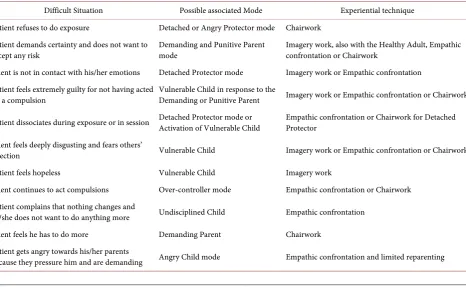
[image:9.595.67.534.453.741.2]During therapy, recurrent difficult situations might arise when treating OCD patients. Some of these are listed in Table 2, with specific corresponding mode attribution and clinical intervention explained in detail.
Table 2. List of possible difficult situations that might arise during OCD treatment are reported in the first column. The corres-ponding dysfunctional mode and consequent experiential or relational techniques are listed, respectively in the second and third columns (adapted from Van Vreeswijk, Broersen, & Nadort, 2012).
Difficult Situation Possible associated Mode Experiential technique Patient refuses to do exposure Detached or Angry Protector mode Chairwork
Patient demands certainty and does not want to
accept any risk Demanding and Punitive Parent mode Imagery work, also with the Healthy Adult, Empathic confrontation or Chairwork Client is not in contact with his/her emotions Detached Protector mode Imagery work or Empathic confrontation
Patient feels extremely guilty for not having acted
on a compulsion Vulnerable Child in response to the Demanding or Punitive Parent Imagery work or Empathic confrontation or Chairwork
Patient dissociates during exposure or in session Detached Protector mode or Activation of Vulnerable Child Empathic confrontation or Chairwork for Detached Protector
Client feels deeply disgusting and fears others’
rejection Vulnerable Child Imagery work or Empathic confrontation or Chairwork
Patient feels hopeless Vulnerable Child Imagery work
Client continues to act compulsions Over-controller mode Empathic confrontation or Chairwork Patient complains that nothing changes and
he/she does not want to do anything more Undisciplined Child Empathic confrontation Client feels he has to do more Demanding Parent Chairwork
Patient gets angry towards his/her parents
DOI: 10.4236/psych.2018.99131 2305 Psychology
4. Cognitive Interventions
In this paragraph, our intent is to present an overview of cognitive interventions in relation to guilt, specifically deontological guilt, and disgust sensitivity. As al-ready explained in Luppino et al. (2018), these emotions play a key role in actual obsessive symptoms and in their genesis, leading towards a specific vulnerability to OC symptoms. The main cognitive technique we will focus on is acceptance, one of the most efficacious interventions for dealing with emotional distress (A-Tjak et al., 2015, for a recent review). Acceptance can be used in combination with the experiential techniques presented earlier, in order to banish the De-manding and Punitive parental modes, responsible for the intense feelings of guilt and disgust that are commonly reported by many OCD patients. Our pri-mary attention is directed towards the strengthening of the Healthy Adult mode, in order to promote a more mindful, compassionate and accepting perspective of the self, and of life in general. Risk acceptance, the awareness that life implies taking risks and making mistakes, which are ineluctable and not necessarily re-lated to the individual self-worth and moral value, are the key aspects that need to be addressed within therapy and which must be internalized by the Healthy Adult mode.
Guilt and Disgust Acceptance
As reported by Luppino et al. (2018), a fundamental goal of obsessive patients is to prevent or neutralize the possibility of feeling guilty within the symptomatic domain. For instance, Mark was afraid of losing his wallet; he could not tolerate the risk of being responsible for a possible gas explosion; and he could not tole-rate the possibility of being gay. All these fears were associated with a profound sense of guilt and, with regard to homosexuality, with the possibility of being disgusting, and eventually despised and rejected by significant others. In addi-tion, the possibility of being guilty was regarded as threatening, serious, likely to happen, and, more importantly, as unacceptable and unforgivable. That is to say, fear of guilt in the symptomatic domain derives from a more pervasive and grave fear of being reproachable and morally blamed. Feeling guilty would irremedia-bly compromise one’s self-worth as a moral being, which is, as noted, a valued goal for many OCD clients (Mancini, 2018).
DOI: 10.4236/psych.2018.99131 2306 Psychology
Table 3. Cognitive restructuring and acceptance interventions in relation to guilt and disgust-related experiences are described in detail here. The target belief is represented by a potential threat associated with the possibility of feeling guilty or being despised by others.
Cognitive Restructuring Acceptance intervention The belief that the threat (the possibility
of being guilty or disgusting/despised) does not exist, or is unlikely to happen
Guilt or being despised cannot be avoided; feelings of guilt are in the natural order of things.
Trying to prevent those feelings is useless or causes additional stress (criticizing and anger towards oneself, sadness, and extra checking or seeking reassurance). The client has no (or little) responsibility
for preventing the threat from happening Being morally perfect or not blameful is not a human right or duty. The potential threat is minimized Feeling guilty or disgusting is unpleasant, but not
catastrophic: one can learn to deal with it!
Other relevant moral goals can be found, pursued and reached.
cognitive restructuring with acceptance interventions. Both kinds of techniques can be used by the therapist to help the client to deal with the threat of being possibly guilty, or/and judged as disgusting or despised by others.
Acceptance means getting from a mindset of “pursuing a goal that is impossi-ble to reach”, to the point of giving it up and accepting the unrealistic nature of this goal. In the case of OCD, patients commonly think that emotions such as guilt or disgust are unacceptable feelings that one has the power to control, and the duty to prevent, at any cost. In our previous two articles we explained how both emotions, and their associated appraisals and behaviors, play a core role in the genesis of obsessive symptoms and their maintenance. Guilt acceptance im-plies living with the awareness of one’s own moral imperfection, within a specif-ic domain, resulting in the abandonment of behavior aimed at preventing such flaws. Mark, for example, feared being responsible and guilty for having lost his wallet, or leaving the gas valve open or the front door open. He was afraid that, if he did not do as much as he could to prevent those risks from happening, he would feel deeply wrong and evil, and would therefore be “a bad human being”. On the other hand, he was also terrified by his concerns about the possibility of being gay, which would have meant being disgusting and repellent, leading to-wards others’ scorn and rejection.
reduc-DOI: 10.4236/psych.2018.99131 2307 Psychology
tio ad absurdum argument (Mosticoni, 1984; Mancini, 2018; Gragnani et al., 2018). A second step is aimed at modifying the belief that attempts to elude, or at least to reduce, the threat are valuable. This belief might be addressed focusing on the costs of solution attempts, with respect to other relevant goals, and de-bating the usefulness of such beliefs. Mark and his therapist identified all the cons associated with his avoidant behaviors and compulsions (that is, the de-tached Protector and the over-controller coping modes), such as not playing soccer, avoiding studying, social isolation, the feeling that he was ruining his life, the sense of going crazy, feeling very tired and stressed, recurrently checking the gas and the door, and so on. Further steps involve supporting the belief that feelings of guilt are in the natural order of things, and decatastrophyzing its ex-perience. The latter can be done through Socratic dialogue, behavioral experi-ments, and distancing and de-fusion exercises, all the while increasing experien-tial acceptance. All these aspects are discussed and allow for the strengthening of the Healthy Adult mode. Additionally, these cognitive interventions can be adopted during imagery exercises and in the context of chairwork when con-fronting with the dysfunctional coping and parental modes.
Finally, a last phase of cognitive interventions includes helping the client to investing in reachable goals. This means fostering value awareness, identifying and defining appropriate goals in positive terms, identifying behaviors that allow goal achievement and, overall, increasing committed behavior. Mark identified making new friends, going back to the soccer, subscribing to Facebook and fi-nishing his studies as some of his new positive goals. For each of these, specific sub-goals were identified and planned in every detail. All these exposures were completed while accepting the risk of making mistakes and of imperfection, without in any way affecting his ethical value as a human being. At the same time Mark grounded his commitment in new valuable goals related to environ-mental awareness, thus trying to be sustainable and more respectful towards the earth.
5. Conclusion
DOI: 10.4236/psych.2018.99131 2308 Psychology over the course of the patient’s life. Modes further favor a dynamic and concrete representation of the client’s emotional and behavioral states. According to these premises, within the first paper by Luppino et al. (2018) we proposed how spe-cific emotional and cognitive aspects might explain obsessive functioning. We particularly focused on the main goals and beliefs of the obsessive patient, moreover highlighting the role of deontological guilt and disgust in explaining the dynamics of the recursive processes involved in the maintenance of the dis-order. All these elements together allow understanding patient’s internal profile, within a CT framework (Mancini, 2018). In the second article by Tenore et al. (2018) we integrated these cognitive and emotional elements within the schema therapy context, proposing a conceptualization of the disorder in terms of sche-mas and modes. Early maladaptive schesche-mas reflect the core themes reported by obsessive patients, and have their roots in early-life experiences that might represent specific vulnerability factors predisposing towards obsessive symptoms development. In both papers we also provided some clinical and research evi-dence about the two models, individually. Finally, in this last article, we offered a detailed overview on how the integration of ST and CT can be implemented to successfully treat OCD. We particularly concentrated on emotion-focused expe-riential procedures, such as imagery and chair dialogue, which might be useful to acknowledge and heal negative emotions associated with patients’ stressful early life experiences. We described in detail how safe place and diagnostic im-agery might be used within the first stages of the therapeutic process, heading up towards consequent imagery with rescripting and, in the final stages of therapy, Healthy Adult imagery. Further we highlighted the potential benefits associated with chairwork in understanding and reducing the dysfunctional parental and coping modes, and strengthening the Healthy Adult mode. In the last part of the paper we explained how cognitive based acceptance techniques might be used to help the patient to deal and accept negative emotional states, such as deontolog-ical guilt and disgust sensitivity, allowing a more realistic and compassionate perspective on the self.
Possible applications to other psychopathological conditions might also be hypothesized. For instance, guilt in the form of the altruistic type, intolerance of uncertainty, perfectionism and unrelenting standards might offer some exam-ples of specific psychological features that might characterize other disorders such as depression (O’Connor et al., 2002; Gilbert, 1992), hypochondria (Fergus & Valentiner, 2001) and eating related disorders (Shafran et al., 2002; Simpson, 2012). These core characteristics might play a role in the genesis and mainten-ance of specific symptoms. Getting a deeper comprehension, through the identi-fication of their vulnerability and maintenance mechanisms, within each specific psychopathological condition, might throw new light on the functioning of the disorder and make it possible to apply appropriate clinical intervention.
Conflicts of Interest
DOI: 10.4236/psych.2018.99131 2309 Psychology
References
Arntz, A. (2011). Imagery Rescripting for Personality Disorders. Cognitive Behavior and Practice, 18, 466-481. https://doi.org/10.1016/j.cbpra.2011.04.006
Arntz, A. (2012). Imagery Rescripting as a Therapeutic Technique: Review of Clinical Trials, Basic Studies, and Research Agenda. Journal of Experimental Psychopathology, 3, 189-208.https://doi.org/10.5127/jep.024211
Arntz, A., & Weertman, A. (1999). Treatment of Childhood Memories: Theory and Prac-tice. Behaviour Research and Therapy, 37, 715-740.
https://doi.org/10.1016/S0005-7967(98)00173-9
A-Tjak, J. G., Davis, M. L., Morina, N., Powers, M. B., Smits, J. A., & Emmelkamp, P. M. (2015). A Meta-Analysis of the Efficacy of Acceptance and Commitment Therapy for Clinically Relevant Mental and Physical Health Problems. Psychotherapy & Psychoso-matic, 84, 30-36.https://doi.org/10.1159/000365764
Basile, B., Fadda, S., De Sanctis, B., Saliani, A. M., Perdighe, C., Luppino, O. I., Tenore, K., & Mancini, F. (2018). Early Life Experiences in OCD and Other Disorders: A Re-trospective Observational Study Using Imagery with Re-Scripting Characterize OCD, But Not Other Disorders. Clinical Neuropsychiatry. [In Press]
Basile, B., Fadda, S., De Sanctis, B., Saliani, A. M., Perdighe, C., Luppino, O. I., Tenore, K., & Mancini, F. (2018). Early Life Experiences in OCD and Other Disorders: A Re-trospective Observational Study Using Imagery with Re-Scripting Characterize OCD, But Not Other Disorders. Clinical Neuropsychiatry. (In Press)
Berle, D., & Phillips, E. S. (2006). Disgust and Obsessive-Compulsive Disorder: An Up-date. Psychiatry, 69, 228-238. https://doi.org/10.1521/psyc.2006.69.3.228
Brewin, C. R. (2006). Understanding Cognitive Behaviour Therapy: A Retrieval Competi-tion Account. Behaviour Therapy and Research, 44, 765-784.
https://doi.org/10.1016/j.brat.2006.02.005
Conway, M. A., & Pleydell-Pearce, C. W. (2000). The Construction of Autobiographical Memories in the Self-Memory System. Psychological Review, 107, 261-288.
https://doi.org/10.1037/0033-295X.107.2.261
Cooper, M. J. (2012). Working with Imagery to Modify Core Beliefs in People with Eating Disorders: A Clinical Protocol. Cognitive and Behavioral Practice, 18, 454-465.
https://doi.org/10.1016/j.cbpra.2010.08.003
Cooper, M. J., Todd, G., & Turner, H. (2007). The Effects of Using Imagery to Modify Core Beliefs: An Experimental Pilot Study. Journal of Cognitive Psychotherapy, 21,
117-122.https://doi.org/10.1891/088983907780851577
Dibbets, P., Poort, H., & Arntz, A. (2012). Adding Imagery Rescripting during Extinction Leads to Less ABA Renewal. Journal of Behavior Therapy and Experimental Psychiatry, 43, 614-624. https://doi.org/10.1016/j.jbtep.2011.08.006
Farrell, J. M., & Shaw, I. A. (2018). Experiencing Schema Therapy from the Inside Out a Self-Practice/Self-Reflection Workbook for Therapists. New York/London: Guilford Press.
Fergus, T. A., & Valentiner, D. P. (2001). Intolerance of Uncertainty Moderates the Rela-tionship Between Catastrophic Health Appraisals and Health Anxiety. Cognitive Therapy and Research, 35, 560-565.https://doi.org/10.1007/s10608-011-9392-9
Fink, J., Pflugradt, E., Stierle, C., & Exner, C. (2018). Changing Disgust through Imagery Rescripting and Cognitive Reappraisal in Contamination-Based Obsessive-Compulsive Disorder. Journal of Anxiety Disorders, 54, 36-48.
DOI: 10.4236/psych.2018.99131 2310 Psychology Gilbert, P. (1992). Depression: The Evolution of Powerlessness. Hove: Lawrence Erlbaum
Associates.
Gragnani, A., Buonanno, A., & Saettoni, M. (2018) Ch. 9. Techniques of Cognitive Re-structuring: Accepting Risk Cognitive Techniques. In The Obsessive Mind. Abing-don-on-Thames: Routledge. (In Press)
Kellogg, S. (2004). Dialogical Encounters: Contemporary Perspectives on “Chairwork” in Psychotherapy. Psychotherapy: Theory, Research, Practice, Training, 41, 310-320. https://doi.org/10.1037/0033-3204.41.3.310
Lee, S. W., & Kwon, J.-H. (2013). The Efficacy of Imagery Rescripting (IR) for Social Phobia: A Randomized Controlled Trial. Journal of Behavior Therapy and Experimen-tal Psychiatry, 44, 351-360. https://doi.org/10.1016/j.jbtep.2013.03.001
Luppino, O. I., Tenore, K., Mancini, F., & Basile, B. (2018). An Integration of Schema and Cognitive Therapy in OCD Treatment: Goals and Beliefs of the Obsessive Mind (Part I). Psychology, 9, 2261-2277.https://doi.org/10.4236/psych.2018.99131
Mancini, A., & Mancini, F. (2018) Rescripting Memory, Redefining the Self: A Me-ta-Emotional Perspective on the Hypothesized Mechanism(s) of Imagery Rescripting.
Frontiers in Psychology, 20, 9-581. https://doi.org/10.3389/fpsyg.2018.00581
Mancini, F. (2018). The Obsessive Mind. Abingdon-on-Thames: Routledge.
Moreno, J. (1989). Introduction to Primary Care and Psychology. Journal of Group Psy-chotherapy, Psychodrama, & Sociometry, 42, 3-12.
Moreno, Z. T. (2012). Mental Health Resources.
Morina, N., Lancee, J., & Arntz, A. (2017). Imagery Rescripting as a Clinical Intervention for Aversive Memories: A Meta-Analysis. Journal of Behavior Therapy and Experi-mental Psychiatry, 55, 6-15.https://doi.org/10.1016/j.jbtep.2016.11.003
Mosticoni, R. (1984). La ricerca nevrotica dell’equilibrio. Roma: Bulzoni.
O’Connor, L. E., Berry, J. W., Weiss, J., & Gilbert, P. (2002). Guilt, Fear, Submission, and Empathy in Depression. Journal of Affective Disorders, 71, 19-27.
https://doi.org/10.1016/S0165-0327(01)00408-6
Paivio, A., Smythe, P. C., & Yuille, J. C. (1968). Imagery versus Meaningfulness of Nouns in Paired-Associated Learning. Canadian Journal of Psychology, 22, 427-441.
https://doi.org/10.1037/h0082782
Perls, F. (1973). The Gestalt Approach and Eye Witness to Therapy. Mountain View, CA: Science and Behavior Books.
Renner, F., DeRubeis, R., Arntz, A., Peeters, F., Lobbestael, J., & Huibers, M. (2018). Ex-ploring Mechanisms of Change in Schema Therapy for Chronic Depression. Journal of Behavior Therapy and Experimental Psychiatry, 58, 97-105.
https://doi.org/10.1016/j.jbtep.2017.10.002
Roediger, E. (2012). Why Are Mindfulness and Acceptance Central Elements for Thera-peutic Change in Schema Therapy Too? An Integrative Perspective. In M. van Vrees-wijk, J. Broersen, & M. Nadort (Eds.), The Wiley-Blackwell Handbook of Schema Therapy: Theory, Research, and Practice. Hoboken, NJ: Wiley-Blackwell.
Salkovskis, P. M. (1999). Understanding and Treating Obsessive-Compulsive Disorder.
Behaviour Research and Therapy, 37, S29-S52. https://doi.org/10.1016/S0005-7967(99)00049-2
Shafran, R., Cooper, Z., & Fairburn, C. G. (2002). Clinical Perfectionism: A Cogni-tive-Behavioural Analysis. Behavior Research and Therapy, 40, 773-791.
DOI: 10.4236/psych.2018.99131 2311 Psychology Simpson, S. (2012). Ch. 10. Schema Therapy for Eating Disorders: A Case Study Illustra-tion of the Mode Approach. In The Wiley-Blackwell Handbook of Schema Therapy: Theory, Research, and Practice. Chichester: Wiley-Blackwell.
https://doi.org/10.1002/9781119962830.ch10
Smucker, M. R., Dancu, C., Foa, E. B., & Niederee, J. L. (1995). Imagery Rescripting: A New Treatment for Survivors of Childhood Sexual Abuse Suffering from Post-Traumatic Stress. Journal of Cognitive Psychotherapy, 9, 3e17.
Sprengelmeyer, R., Young, A. W., Pundt, I., Sprengelmeyer, A., Calder, A. J., Berrios, G. et al. (1997). Disgust Implicated in Obsessive-Compulsive Disorder. Proceedings of the Royal Society of London, Series B, 264, 1767-1773.
https://doi.org/10.1521/psyc.2006.69.3.228
Tenore, K., Basile, B., Cosentino, T., De Sanctis, B., Fadda, S., Gragnani, A., Luppino, O. I., Perdighe, C., Romano, G., Saliani, A. M., & Mancini, F. (2018). Efficacy of Imagery with Rescripting in Treating OCD: A Single Case Series Experimental Design (Prelim-inary Results). In Sixth EABCT SIG Meeting on OCD.
Tenore, K., Basile, B., Mancini, F., & Luppino, O. I. (2018). An Integration of Schema and Cognitive Therapy in OCD Treatment: A Proposal for Theoretical Conceptualization and Rationale (Part II). Psychology, 9, 2278-2295.
https://doi.org/10.4236/psych.2018.99129
Van Vreeswijk, M., Broersen, J., & Nadort, M. (2012). The Wiley-Blackwell Handbook of Schema Therapy: Theory, Research, and Practice. Chichester: Wiley-Blackwell. https://doi.org/10.1002/9781119962830
Veale, D., Page, N., Woodward, E., & Salkovskis, P. (2012). Imagery Rescripting for Ob-sessive Compulsive Disorder: A Single Case Experimental Design in 12 Cases. Journal of Behavior Therapy and Experimental Psychiatry, 49, 1-7.
Wild, J., Hackmann, A., & Clark, D. M. (2007). When the Present Visits the Past: Updat-ing Traumatic Memories in Social Phobia. Journal of Behavior Therapy and Experi-mental Psychiatry, 38, 386-401. https://doi.org/10.1016/j.jbtep.2007.07.003
Wild, J., Hackmann, A., & Clark, D. M. (2008). Rescripting Early Memories Linked to Negative Images in Social Phobia: A Pilot Study. Behavior Therapy, 39, 47-56. https://doi.org/10.1016/j.beth.2007.04.003