A Universal Selection Method in Linear Regression Models
Eckhard Liebscher
Department of Computer Science and Communication Systems, Merseburg University of Applied Sciences, Merseburg, Germany
Email: [email protected]
Received January 27, 2012; revised February 29, 2012; accepted March 9, 2012
ABSTRACT
In this paper we consider a linear regression model with fixed design. A new rule for the selection of a relevant sub-model is introduced on the basis of parameter tests. One particular feature of the rule is that subjective grading of the model complexity can be incorporated. We provide bounds for the mis-selection error. Simulations show that by using the proposed selection rule, the mis-selection error can be controlled uniformly.
Keywords: Linear Regression; Model Selection; Multiple Tests
1. Introduction
In this paper we consider a linear regression model with fixed design and deal with the problem of how to select a model from a family of models which fits the data well. The restriction to linear models is done for the sake of transparency. In applications the analyst is very often interested in simple models because these can be inter-preted more easily. Thus a more precise formulation of our goal is to find the simplest model which fits the data reasonably well. We establish a principle for selecting this “best” model.
Over time the problem of model selection has been studied by a large number of authors. The papers [1,2] by Akaike and Mallows inspired statisticians to think about the comparisons of fitted models to a given dataset. Akaike, Mallows and later Schwarz (in [3]) developed information criteria which may be used for comparisons and in particular, may be applied to non-nested sets of models. The basic idea is the assessment of the trade-off between the improved fit of a larger model and the in-creased number of parameters. Akaike’s approach is to penalise the maximised log-likelihood by twice the num- ber of parameters in the model. The resulted quantity, the so called AIC, is maximised with respect to the parame-ters and the models. The disadvantage of this procedure is that it is not consistent; more precisely, the probability of overfitting the model tends to a positive value. Subse-quently, a lot of other criteria have been developed. In a series of papers the consistency of procedures based on several information criteria (BIC, GIC, MDL, for exam-ple) are shown. The MDL-method was introduced by Rissanen in [4]. In the nineties of the last century a new class of model selection methods came into focus. The
FDR procedure of Benjamini and Hochberg (see [5]) uses ideas from multiple testing and attempts to control the false discovery rate, which we will call the mis-se- lection rate in this paper. More recent papers of this di-rection are published by Bunea et al. [6], and by Benja-mini and Gavrilov [7]. Surveys of the theory and existing results may be found in [8-11]. In a large number of pa-pers the consistency and loss efficiency of the selection procedure is shown and the signal to noise ratio is calcu-lated for the criterion under consideration. Among these papers we refer to [12-16], where consistency is proved in a rather general framework. A method for the sub-model selection using graphs is studied in [17]. Leeb and Pötscher examine several aspects of the post-model-se- lection inference in [9,18,19]. The authors point out and illustrate the important distinction between asymptotic results and the small sample performance. Shao intro-duced in [20] a generalised information criterion, which includes many popular criteria or which is asymptotically equivalent to them. In this paper Shao proved conver-gence rates for the probability of mis-selection. In [21] a rather general approach using a penalised maximum like-lihood criterion was considered for nested models.
Edwards and Havránek proposed in [22] a selection procedure aimed at finding sets of simplest models that are accepted by a test like a goodness-of-fit test. Unfor-tunately, it is not possible to use the typical statistical tests of linear models in Edwards and Havránek’s proce-dure since the assumption (b) in the Section 2 of their paper is not fulfilled (cf. Section 4 of their paper).
In this paper we develop a new universal method for selecting a significant submodel from a linear regression model with fixed design, where the selection is done
from the whole set of all submodels. We point out the several new features of our approach:
1) A new selection procedure based on parameter tests is introduced. The procedure is not comparable with methods based on information criteria and it is different from Efroymson’s algorithm of stepwise variable selec-tion in [23].
2) We derive convergence rates for the probability of mis-selection which are better than those proved in pa-pers about information criteria e.g. in [20].
3) Subjective grading of the model complexity can be incorporated.
Concerning 1) we consider tests on a set of parameters in contrast to FDR-methods, where several tests on only one parameter are applied. Moreover w.r.t. 2), many au-thors do not analyse the behaviour of mis-selection pro- babilities. The results on bounds or convergence rates of these probabilities are more informative than the consis-tency. The aspect 3) is of special interest from the point of view of model building. Typically model builder have some preference rules in mind when selecting the model. They prefer simple models with linear functions to mod-els with more complex functions (exponential or loga-rithmic, for example). The crucial idea is to assign to each submodel a specific complexity number.
We do not assume that the errors are normally distrib-uted. This ensures a wide-ranging applicability of the approach, but only asymptotic distributions of test statis-tics are available. From examples in Section 2, it can be seen that applications are possible in several directions, for instance to the one-factor-ANOVA model. The simu-lations show an advantage of the proposed method in that it controls the frequency of mis-selection uniformly. For models with a large number of regressors, the problem of establishing an effective selection algorithm is not dis-cussed in this paper; we refer to the paper [24].
The paper is organised as follows: In Section 2 we in-troduce the regression model and several versions of submodels. The asymptotic behaviour of the basic statis-tic is also studied there. Section 3 is devoted to the model selection method. We provide convergence rates for the probability that the procedure selects the wrong model (mis-selection). We see that the behaviour is similar to that in the case of hypothesis testing. The results of simu- lations are discussed in Section 4. The reader finds the proofs in Section 5.
2. Models
Let us introduce the master model
1
k
i j
i ij j
Y x
i1, , n1, ,
n k
j k
1, ,
T k
, , n
for ,
where is the design matrix,
k is the parameter vector, and
1
ij i1, , ,n X x
0 i
are independent random variables. Assume that , i p for some p2, and
2Var i . 1 n denote the values of the
re-sponse variable. In short we can write , ,
Y Y
Y X
, ,
TY Y Y
1, , n
T, (1) where 1 n , . The least square estimator for is given by
1 ˆ X XT X YT .
This leads to the residual sum of squares
2 1
ˆ T T T
n
R Y X Y I X X X X Y , where . is the Euclidean vector norm.
The aim is to select model (1) or an appropriate sub-model which fits the data well. Moreover, we search for a reasonably simple model. In the following we define the submodels of (1). The submodel with index
1, ,
, , ,
T ll
l :l
has the parameter vector
1 2 , , where the vector
is related to by D with an appropriate ma-trix Dk l having maximum rank l k . In a large
number of applications, the γi’s coincide with different
components of . The submodel indices 1 and correspond to the model function equal to zero (no pa-rameters) and to the full model, respectively. Thus we can write the model equation for the submodel as
Y X , (2)
X XD. The parameter space of submodel
where
in (1) is given by
D : l
. Next we give
several versions for the definition of submodels in dif-ferent situations.
Example 1. We consider all submodels, where com-ponents of are zero. More precisely, index is assigned to a submodel if 1i1, , l il
1 2 il j 0
are the
parameters of the submodel (i i ),
for j J : i1, , il
1 1
1 l 2ij
j
0, , 0,1 , 0,
T ki i
e
and . Let
be the i-th unit vector. Then
1, 2, , l
k l
i i i
D e e e , and
: j 0 for all j J
. For example, for k5,
the submodel with index 14 has the parameters 1 1
, 23 , 34 and 250
1 0 0 0 0 0 0 1 0 0 0 1 0 0 0
D
5:2 5 0
holds. Moreover, we have
in this case. Here the digits “1” in the binary representa-tion of 1 give the indices of the parameters j
available in the submodel . X in (2) consists of the
columns i1,,il of the design matrix X
correspond-ing to the present parameters in submodel . □
Example 2. Let k3. submodel 1: 10 T
2, 3 . Submodel 2: ,
11, . Sub-model 3: identity (1). □
2 3
, T
ij
Y
Example 3. We consider the one-factor ANOVA model
i ij
for i1, , g, j1, , ng
, g
T nn Ygn
, ,
k
,
where Y Y Y11, 12, , Y11,Y21, ,
g T
1 i
n
n , ,
i , 1 g is the parameter
vector. 11 gng are independent random variables. The submodels are characterised by the fact that several μi’s are equal. Let be the k-th Bell number. A
Sub-model with index
1, ,
is determined by a par-tition J1, , J ,l of
1, , g
for somei i
in the following way:
j k ,j k J : if
. The submodel
with index has l
parameters. Furthermore,
ij i1, , ,kD d
1 where
0 o
1, ,j l holds
for ,
therwise. ,
j ij
d
i J
□
Example 3 shows that the model selection problem occurs also in the context of ANOVA. In submodel (2) with index , the least square estimator ˆ and the residual sum of squares S are given by
1
.
T
X X Y
:n
1
2
ˆ ,
ˆ
T T
T T
X X X Y
S Y X Y I X X
(3)
What is an appropriate statistic for model selection? Let M S Rn. Here we consider a quantity
n
M , which is similar to F-statistics known from hy-pothesis testing in linear regression models with normal errors:
1
ˆ
1
for , 0.
n n
T T
n
M M
S n l
D X
n l M
ˆ X ˆ D ˆ
S
(4)
The main difference to classical F-statistics is that the estimator 1 S
n l of the model variance in submodel
appears in the denominator. The quantity
1
S n l
is the proper estimator under the hypothesis of submodel
. Classical F-statistics are used in Efroymson’s algo-rithm of stepwise variable selection (see [23]).
In the remainder of this section we study the asymp-totic behaviour of the statistic Mn
when 0 is the true parameter of the model (1). For this reason, we first introduce some assumptions.Assumption . Let Gn1nX XT . Assume that
Rank Gn k,
lim n
nG , regular.
Moreover,
2 1, , 1: max n p p .
np ij
j k i
B x o n
ij
□
In a wide range of applications, the entries x of the design matrix are uniformly bounded such that
p2
np
B O n o n p2
: D DT l l
since . The Assumption may be weakened in some ways, but we use this as-sumption to reduce the technical effort. We introduce
and
1
0 0
: T T
K I D D .
Proposition 2.1 clarifies the asymptotic behaviour of the statistic Mn
.Proposition 2.1. Assume that Assumption is sat-isfied.
0
1) Assume that and l
k . Then we have
2 n k l
M .
2) Suppose that 0 and l
k. Let
1 2n
G o n be satisfied n . Then we have
2
1
n K K n nWn o n
M ,
0, 2
n W
W
where 2 4
2
2 2W
, K K
.
Depending on whether the true parameter 0 belongs to submodel or not, the statistic Mn
has adif-ferent asymptotic behaviour. In the first case, it has an asymptotic χ2-distribution. In the second case it tends to infinity in probability with rate n . Therefore, the sta-tistic Mn
is suitable for model selection. In the nextsection a selection procedure is introduced based on
n
M serving as fundamental statistic.
3. The New Selection Rule
In this section we propose a selection rule which is based
d d d
are: on the statistic (4). We introduce a measure d
1) is the degree of the polynomial plus 1, of the complexity for submodel with
max. With this quantity d l
d d
d
0 2) is the number of parameters j
avail-able in the submodel, the other parameters
it is possible to incorporate a subjective grading of the model com-plexity. The restriction to integers is made for simpler handling in the selection algorithm. The following exam-ples should illustrate the applicability of the complexity measure.
j
are zero,
Example 4. We consider the polynomial
k . The regressor is observed
at the measurement points 1
1 2p x x xk1
, , n
x x . Hence j1
ij i
x x
k
or , . Possible choices for
f i1, , n j1, ,
3) 1
2
k k
d l , where l
is the number of parameters j available in the submodel. This choicehas the advantage that a polynom of higher degree al-ways gets a higher complexity number. □
Example 5. For a quasilinear model with regression function f x
1 2x3ln
x , we can define das follows:
1 2
3 1 2
1 3 2 3
1 for submodel functions , ,
2 for submodel function ln odel function
bmodel functions ln , ln
5 for the full model
f x f x x
f x x
d 3 for f x x
4 fo subm
r su f x x f x x x
: ,
\ i i i d i
This choice takes into account that the logarithm is a more complex function in comparison to constants or linear functions. □
Next we need restricted parameter sets defined by
d
. It is assumed that
for 1, , .
d l
Example 1: If then
: j 0 for all j J , j 0 for all j J
l. □
d Example 3: If then
: j k for all j J ki, J I,i I, j k if ,j k Ji for some i
. □
Given values n
0 , ,n
dmax
0,
, 1, weintroduce special χ2-quantiles:
, 2
1
n d l k l n d
0, , 1
l k n
d k,
1
d l,
for , .
Here n is just the quantile of order 1n
dof the asymptotic distribution of Mn
unter the nullhypothesis 0
d , cf. part 1) of Proposition 2.1. The
quantity n will play the role of an asymptotic
type-1 error probability later. A submodel is referred to as admissible if Mn
n
d
,l
is satisfied,which in turn corresponds to the nonrejection of the hy-pothesis that the parameter belongs to the space of the submodel. The generalised information criterion in-troduced by Shao (see [20]) is given by
n n
GIC S l R n k . We next show that there is a relationship between the both approaches. A sub-model is admissible if
GIC GIC,
where n n
n
. More-over, note that our selection procedure is completely dif-ferent from Shao’s one. Whereas nn k k l n k
in information criteria is typically free of choice, the quantity n is well-defined and motivated. Let Fl be the distribution function of the -distribution. We introduce the
fol-lowing rule for the selection: Select a model ν* such that
2
l
* min
:1 ,
,
n n
d d M d l
and
*
*
*
min :1 , .
n k l
n k l
F M
F M d d
The central idea is to prefer any admissible model with lower complexity. If there is more than one admissible model with the same minimum complexity, then we take the model with maximum p-value of Mn
.The next step is to analyse the asymptotic behaviour of the probability that the wrong model is selected; i.e. the probability of mis-selection (PMS). Let 0
,
d d , l l
. The following cases of mis-selec- tion can occur:
(m1) Mn n d l,
,
(m2) Mn n d l,
,
n
n
k l i k l
F M i F M for some i d i:
d ,
n n
M j M for all j d j:
d ,
for some j with d j d
0 .
The probability of mis-selection case (m2) may be de-creased by reducing the number of submodels having the same complexity. The Theorem 3.1 below provides bounds for the selection error.
Theorem 3.1. Let
. Assume that Assumption is fulfilled, and
0n d
1 limn ln
n
for all d 0, , dmax.
1) If
1 2 p3n
G o n as n , and , then
3 2
31 n 1 1 n
m d o O n B
with 3
1, , 1
max n
n j ij
k i
B x
3 .
2) If a
n d Cn for all d with some
max
0, ,d
,
a C0, then
2
p
np
B n
3
m O
and p
np
m O B n
.
The PMS of case (m1) behaves like a type-1-error in a statistical test. It approaches asymptotically n
dunder the assumptions of part 1). The additional term with rate
3 2
n
O n B
3 comes from the application of the central limit theorem, and has rate O n
1 2
1in the case, where the xij’s are uniformly bounded. This theorem
shows that the PMS of cases (m2) and (m3) tends to zero at rate O n p provided that the x
ij’s are uniformly
bounded and
d Cna d
n for all and some
. These rates of PMS are rather fast. They are better than in comparable cases in [20] ( n
0 a
and n can be
considered to have the same rate). One reason is that in this paper alternative techniques such as Fuk-Nagaev inequality are employed to obtain the convergence rates. The results of Theorem 3.1 recommend the selection rule above from the theoretical point of view. The behaviour in practice is discussed in the next section.
4. Simulations
Here we consider the polynomial model:
2 3
4 i i
x x
1 2
ni i
Y x 3 i for i1, , n
where 1 n
are the observations of there-gressor variable, and the εi’s are i.i.d. random variables.
, , 0,1
x x
For simplicity, we consider the case i i x
n
d
. The com-
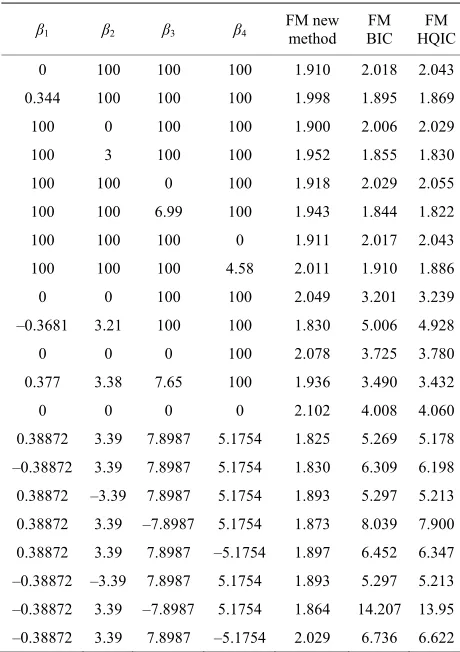
[image:5.595.307.537.115.441.2]plexity is measured as given in Example 4(b). We compare the selection method of the previous section with procedures based on Schwarz’s Bayesian informa-tion criterion (BIC, see [3]) and the Hannan-Quinn crite-rion (HQIC, see [25]). The Tables 1-3 show the frequen-cies of mis-selection. The results are based on 106 repli-cations of the model. We choose the following error
Table 1. Frequencies for mis-selection (FM) in percent in the case n = 100, σ = 0.2, εi ~ (0, σ2).
β1 β2 β3 β4 FM new method BIC FM HQICFM
0 100 100 100 1.910 2.018 2.043
0.344 100 100 100 1.998 1.895 1.869
100 0 100 100 1.900 2.006 2.029
100 3 100 100 1.952 1.855 1.830
100 100 0 100 1.918 2.029 2.055
100 100 6.99 100 1.943 1.844 1.822
100 100 100 0 1.911 2.017 2.043
100 100 100 4.58 2.011 1.910 1.886
0 0 100 100 2.049 3.201 3.239
–0.3681 3.21 100 100 1.830 5.006 4.928
0 0 0 100 2.078 3.725 3.780
0.377 3.38 7.65 100 1.936 3.490 3.432
0 0 0 0 2.102 4.008 4.060
[image:5.595.307.538.474.587.2]0.38872 3.39 7.8987 5.1754 1.825 5.269 5.178 –0.38872 3.39 7.8987 5.1754 1.830 6.309 6.198 0.38872 –3.39 7.8987 5.1754 1.893 5.297 5.213 0.38872 3.39 –7.8987 5.1754 1.873 8.039 7.900 0.38872 3.39 7.8987 –5.1754 1.897 6.452 6.347 –0.38872 –3.39 7.8987 5.1754 1.893 5.297 5.213 –0.38872 3.39 –7.8987 5.1754 1.864 14.207 13.95 –0.38872 3.39 7.8987 –5.1754 2.029 6.736 6.622
Table 2. FM in percent for different error distributions.
n β1 β2 β3 β4 εi ~ FM new meth. BICFM HQICFM
100 0 0 0 0 σ·t(3) 1.735 3.895 3.951 0.468 4.104 9.516 6.264 σ·t(3) 2.043 2.966 2.943
400 0 0 0 0
0,2
0 0 0 0 σ· ) 0.942 1.736 2.459
–0.216 1.873 4.365 –2.863
0.956 1.780 2.502
t(3
0,2
σ·t3)
1.122 5.869 3.905 –0.216 1.873 4.365 –2.863 ( 3.067 8.164 6.275
rob
p abilities: n
1 0.02, n
2 0.022,
3 0.024n
, n
4 0.026 in the case n100, and
i 0.01 0.
Th ule of the prev ous section alwa s
FM
n in the case n 40
e selection r i ys give
-values near the given values of n. The methods
based on BIC and HQIC partially show FM-values also near these n, but in some special cases the FM-values
are much higher (for example, for 1 0.38872, 2 3.39
, 3 7.8987, 45.1754 according to
Table 1; 1 0.2569, 22.227, 3 5.197,
5
43.40 according to Table 3). By our method we
Table 3. FM in percent the case in n = 400, σ = 0.2, εi ~ σ·t(3).
2 3 4 method BIC HQIC
β1 β β β FM new FM FM
0 0 0 0 0.942 1.736 2.459
0.2569 2.227 5.197 3.405 –0.2569 2.227 5.197 3.
1
1
1
1
2 –
1.003 1.990 1.596
405 0.958 2.086 1.657
0.2569 –2.227 5.197 3.405 0.984 2.169 1.728 0.2569 2.227 –5.197 3.405 0.945 2.575 2.004 0.2569 2.227 5.197 –3.405 0.987 2.141 1.690 –0.2569 –2.227 5.197 3.405 1.011 2.005 1.606 –0.2569 2.227 –5.197 3.405 0.798 3.567 2.652 –0.2569 2.227 5.197 –3.405 1.015 2.299 1.823
0 100 100 100 1.200 1.064 1.427
0.217 100 100 100 0.983 1.059 0.890
00 0 100 100 1.004 0.873 1.217
100 1.89 100 100 0.969 1.046 0.868
100 00 0 100 0.984 0.844 1.202
100 100 4.38 100 0.976 1.059 0.876
100 100 00 0 0.948 0.817 1.168
100 100 100 2.87 0.992 1.070 0.887
100 0 0 00 0.973 1.0706 1.525
100 2.08 4.84 100 1.010 1.084 0.914
100 .08 4.84 100 0.868 2.2384 1.741
are to ol M es o -
riate
able contr the F -valu by cho sing an appro
p n.
of
enote a positive generic constant which can ace to place and does not depend on other ate
5. Pro s
By C, we d vary from plvari s. Throughout this section, we assume that As-sumption is fulfilled. In the following we prove aux-iliary statements which are used later in the proofs of the theorems.
Lemma 5.1.
p2eC0 n
or all 1 T T np C B XX holds f 0, where C C0, 10 are constants not ng on
dependi , n. Proof: Obviously,
2 1, k n ij i j i k n ij i j i 1 1 1 2 1 1
TXXT x k
x k
n
and 2
1
Trace
n ij i
x n G O n .
Applying aev’s inequality (see [2
ob-tain the ass of the lemma:
Fuk-Nag 6]), we
ertion
2 2 2 1 1 1 2 exp exp .k n p p
p
ij i n
j i ij i p np C C x x C C B n
Lemma 5.2. Assume that 0
TXXT
for some
1, ,
. Then
2 n p n n l holds for 2 32 2 2
1 S C p e C
2 8
n l , 1
and n large enough,
where l :l
and C C2, 30 are constants not e- d pending on , n. The same upper bound holds for2 1 n l T .
Proof: Observe that
1
T T T
S I X X X X
by (3). Hence
2 2 1 1 1 2 1 . 2 TT T T
n l
X X X X
n l
S
n l
(5)
Further an application of Fuk-Nagaev’s inequality fro [26] leads to
m
2
1 2 2 2 4 1 2 2 2 8 exp i n p p p i i i
p p C n
C n
C n
C n e
2 2 2
1 n T i n n l
(6)
for n8l2, n2l . Since
1
, 1
: T T T k k
D D X X D D D
n
holds, and
therefore, D
has a bounded norm, we deduce
1 2 2 1 .T T T
T T p p C n
np
X X X X
l
XX C n C B n e
(7)
by Lemma 5.1 for n large enough. A combination of Inequalities (5)-(7) yields the lemma.
2
n
Copyright © 2012 S OJS Note that
0 X X 0
ciRes.
12 ,
T T T
S X I X X X
S S S
1 2 3
(8)
T
1 T
X X X
where
1 TS I X
,
1
T T T
nD G Dn X
2 0
S I G ,
0 n n
S n
G G 1
0
T T
n n
D G D G
3
, Gn:1nX XT .
0
Lemma 5.3. Suppose that for some
1, ,
2
0 K 2
. Let , l l
. Then
1) S3nK o n
and2)
2
2
2
2 5
4 0
1 S C n p p e C n
n l 0
for n
4, 5 0
C C n
and large enough with constants not depending on , .
Proof: Part 1) is a consequence of Gn and
. 2) Using Lemmas 5.1 and 5.2, we deduce
n
G
1 3 2 3
1 2 1 2
2
1 1 1 1
2 2 2 2
1 1 1 1
2 2 2 2
2 1 2 T T T
S S S S S
n l n l n l
K n C K n C C X
l n l
n l
0
1
n
2
2
0 0
2 2 0
2 2
2 0 2
0 0
1
2
T T
p C n p C n
T p p
np
XX C n
C B n e C n e
n l
for n2l large enou plies assertion 2) of the lemma.
An application of th mit theorem and the Cramér-Wold device leads to the following lemma:
gh. This im
e central li
Lemma 5.4. Let : 1 2 T
n n X
.
i
x denotes the i-th column of XT. Then
2
1
1 n 0,
n i i
i x n
.In the second part of this section we provide the proofs of Proposition 2.1 and Theorem 3.1.
Proof of Proposition 2.1. 1) Let 0 .
hen D l
T 00 holds with an appropriate vector 0
. We have
1 1 1 1 1T T T T
T T
n n n
T T nT T
T
1 T
TM Y X X X
.
n
X X X X X Y
D
G D G D
ver, the id
1 1 1 1
lim T T
n n
n G D G D D D
X X X
X X D X
Moreo entity
(9)
ds in view of Assumption . An application of Lemma 5.4 and the Cochran theorem leads to
hol
2 2
n k l
M
emma 5.2 implies that
. L
2
S
n l
1
, and therefore assertion 1) of Pro-
position 2 is proved. 2) Let 0, and
1 1
0
: 2 T T
n n n n n
W G G D G D . By assumption,
1 1 T 1 1 T 1 2
n n
G D G D DD o n holds true.
We derive
n
.X o n 1 0 1 0 0
T T T
T T
n n n n n
W n G G D G D G nK nW
From Lemma 5.4, n at
2 0
0,
1 T T T
D X X
0 1 1 n T T
n n n n
M X X X X X D X X
G D G D n
T T
(9) and G , it follows th
n
W , where
2 2 1 1
0 0
2 : 4
4 .
T T T
K
1 D 1D
0
D D
We obtain
2 1 1 Sn l
using Lemma 5.2.
Moreover, we deduce
1
2 0T n n T n
Hence by (8) and Lemma 5.3,
S 2 K1
n l
, which completes the proof of
he pr of of T , we g
Lemma which is pro re.
assertion 2).
In t o heorem 3.1 need the followin
ved befo
Lemma 5.5. For 0 , K 0 holds true.
Proof. Let 1 2D DT
1 1 2, and
:
Q I 1 2
0
y
0
T
K y y since Q is symmetric and idem- oreov
Therefore we have the following representatio
1 m, 0m1, , 0 k ,
and h, , h the fir
. Then potent. M Q er,
1
Rank Q Trace
Q Rank DDT: .
k m
k l
n 1 i Q m T T i i
h h HDH
, Ddiag
1 , ,1
1 m
k k
are st m columns of the orthogo-nal matrix H . For xk,
2 1 0 m T T i i ix Qx x h x h
for i1, x
hm1, , hk
. consider the lin,m
We ear independent vectors
1 1, , l
z D e z Del, ej
0, ,1j
vector, and obtain
,0,
is the
T
0j
D D e (10)
T l
j-th unit
1
T T T T
j j j
z Pz e D D D D .
Since 1 2 1 2
1 1, , l l m1, , k
z z z z h h a r independent, these vectors form a basis of
re lin- ea
hm1, , hk
that K 0. Then there exist al such
a
. Assum that
e
1 2 1 2
0
i
a z D a
, and hence D a1
l i i
0
in contradiction to the assumption. This pr he le- mma.
Proof o eorem 3.1: One shows easily that oves t
f Th
, 0n d l
.
1) Let 1
n
1 1 2
n Gn n
(
n
as in Lemma 5.4), an ant. Define
d 0
be a const
2 1 4
: ,
n n n d l
,
2 1 4
: ,
n n n d l
. Since
2 T , 1 2 1 T 1n n n n n n n n2
M G G I G D G D G
ob-tain by using Lemma 5.2
, we
2 1 4
1 2
2 1 2
1 , 1 n n n n T
n n n n
m M d l
2 1 4 1
, ,
n n
M d l n S
n l
S n
n l
M O n
G O n
(11) and analogously,
,
T 2
1 2n n n n n n
M d l G O n
.
(12) Note that cov
2n Gn
, which implies
cov n I. Further by Assumption ,
3
3 2 1 2 3 2
3 1
n
n i i n
i
n G x O n B
.Since
zk:z Gz aT
is a convex set for all 0a , we can apply Bhattacharya’s theorem on a multi-variate Berry-Esseen inequality (see [27])
T 2
T T 2
1 2nGn n n Z G Zn n O n
,
where Z
0,I . The Cochran theorem implies that 2T T
n k l
Z G Z . We denote the distribution function of the 2
k l
-distribution by Fk l . Hence
2 2 11 , 1 1 1 1 ,
T T
n n k l n
n n
k l
Z G Z F
F d l o d o
and
T T 2
1
1
n n n
Z G Z d o
.
Combining these identities and (11), (12) we obtain assertion 1).
2) One can show that n
d l i,
O
ln
n
. Let
n be a sequence of real numbers with n ,
1
,
n o n n d l i
. We deduce
: : 2 :for some :
, 1 , 1 , , n k l
n n n n
k l i k l k l i
i d i d i d i d
n i d i d
n n n i n
M i F M i d i d
2 , ,
n n k l i n
m M d l F
1
n
F M i F d l F M i d
k l i d
M i d l i S
n l i
M i
:
id i d
1
.
i n
S
n l i
Define T
T
n1 1
0 0
:
ni n n
K G G D G Di in i G
. Let i
with d i
d . Obviously, limnKni Ki hSi olds true.
nce 0 i, we have Ki0 by Lemma 5.5. Fur-
thermore, by Lemma 5.1 we obtain
1 1
1 1
0
1 1
0
, ,
, 2 ,
2 ,
T T
n n n ni n n i in i n n n n
T
ni n n n n n n n
T T
n n n n ni n n np
M i d l i nK G D G D nW d l i
nK nW d l i G G D G d l i
G G D G D nK d l i n
for n large enough. On the other hand, we have
1 2
1 2 2
T
n n ni
T T p
n
D n nK
C n XX Cn O B n
2 2 2
1 p p Cnn
i n n
S O n e
n l i
by Lemma 5.3. We choose 1 2p n n
. Then
1
,
n o n n d l i
. This completes the proof of the bound for
m2
. Observe that
:
,
n n
i
i d M i d i l i
.3 m
M in n d i l i, for some ,i d
The bound for
m3
can now be established along the lines of the proof for
m2
. e, “A New Look at the Statistical M del Identi-fication,” IEEE Transactions on Automatic Control, Vol. 19, 1974, pp. 716-723. doi:10.1109/TAC.1974.1100705
d i d
REFERENCES
[1] H. Akaik o
[2] C. Mallows, “Some Comments on Cp,” Technometrics, Vol. 15, No. 4, 1973, pp. 661-675. doi:10.2307/1267380 [3] G. Schwarz, “Estimating the Dimension of a Model,”
Annals of Statistics, Vol. 6, No. 2, 1978, pp. 461-464. /aos/1176344136
doi:10.1214
[4] g by ortest Data Description,” , pp. 465-471.
doi:10.1016/0005-1098(78)90005-5 J. Rissane
Automatican, “Modelin, Vol. 14, No. 5, 1978 Sh
[5] Y. Benjamini and Y. Hochberg, “Controlling the False Discovery Rate: A Practical and Powerful Approach to le Testing,” Journal of the Royal Stat ociety
, V 995, pp. 289-300.
] F. Bunea, M. H. Wegkamp and A. Auguste, “Consistent Variable Selection in High Dimensional Regression via Multiple Testing,” Journal of Statistical Planning and Inference, Vol. 136, No. 12, 2006, pp. 4349-4364. doi:10.1016/j.jspi.2005.03.011
Multip istical S ,
Series B ol. 57, No. 1, 1 [6
[7] Y. Benjamini and Y. Gavrilov, “A Simple forward Selec-tion Procedure Based on False Discovery Rate Control,”
Annals of pp. 179-
1
Applied Statistics, Vol. 3, No. 1, 2009, 98. doi:10.1214/08-AOAS194
[8] G. Claeskens and N. L. Hjort, “Model Selection and Model Averaging,” Cambridge University Press, am-bridge, 2008.
] H. Leeb and B. M. Pötscher, “Model Selection,” In: T. G. Andersen, et al., Eds., Handbook of Financial Time Se- ries, Springer, Berlin, 2009, pp. 889-925.
doi:10.1007/978-3-540-71297-8_39
C
[9
. Tsai, “Re
,” World ie ific, Singa-pore City, 1998.
[11]
i-a
[12] B. Droge, “Asymp of Model Selection Procedures in Linear Regression,” Statistics, Vol. 40, No. 1, 2006, pp. 1-38. doi:10.1080/02331880500366050a
[10] A. D. R. McQuarrie and C.-L gression and Time Series Model Selection Sc nt
A. J. Miller, “Subset Selection in Regression,” 2nd Ed tion, Chapman & H ll, New York, 2002.
totic Properties
[13] R. Nishii, “Asymptotic Properties of Criteria for Selection of Variables in Multiple Regression,” Annals of Statistics, Vol. 12, No. 2, 1984, pp. 758-765.
doi:10.1214/aos/1176346522
[14] C. R. Rao and Y. Wu, “A Strongly Consistent Procedure for Model Selection in a Regression Problem,” Bio-metrika, Vol. 76, No. 2, 1989, pp. 369-374.
doi:10.1093/biomet/76.2.369
[15] J. Shao, “An Asymptotic Theory for Linear Model Selec-tion,” Statistica Sinica, Vol. 7, 1997, pp. 221-264. [16] C.-Y. Sin and H. White, “Information Criteria for
Select-ing Possibly Misspecified Parametric Models,” Journal of Econometrics, Vol. 71, No. 1-2, 1996, pp. 207-225. doi:10.1016/0304-4076(94)01701-8
[17] C. Gatu, P. I. Yanev and E. J. Kont
Approach to Generate All Possibleoghiorghes, “A Graph Regression Submod-els,” Computational Statistics & Data Analysis, Vol. 52, No. 2, 2007, pp. 799-815. doi:10.1016/j.csda.2007.02.018 [18] H. Leeb, “The Distribution of a Linear Predictor afte Model Selection: Conditional Finite-Sample Distribution and Asymptotic Approximations,” Journal of Statistical Planning and Inference, Vol. 134, No. 1, 2005, pp .64-89. [19] H. Leeb and B. M. Pötscher, “Model Selection and
Infer-Econometric Theory, Vol. 21, No. 1, 2005, pp.
21-r s
ence: Facts and Fiction,”
59. doi:10.1017/S0266466605050036 ates of the Generalized Informa-[20] J. Shao, “Convergence R
riterion,” J ametric Statistics, Vol. 9, No. 3, 1998, pp. 217-225.
doi:10.1080/10485259808832743 tion C ournal of Nonpar
[21] A. Chambaz, “Testing the Order of a Model,” Annals of Statistics, Vol. 34, No. 3, 2006, pp. 1166-1203.
doi:10.1214/009053606000000344
[22] D. E. Edwards st Model Selection Procedure for ls,” Journal of the
and T. Havránek, “A Fa Large Families of Mode
American Statistical Association, Vol. 82, No. 397, 1987, pp. 205-213. doi:10.2307/2289155
[23] M. A. Efroymson, “Multiple Regression Analysis,” In: A. Ralston and H. S. Wilf, Eds., Mathematical Methods for Digital Computers, John Wiley, New York, 1960. [24] M. Hofmann, C. Gatu and E. J. Kontoghiorghes,
“Effi-cient Algorithms for Computing the Best-Subset Regres-sion Models for Large Scale Problems,” Computational Statistics & Data Analysis, Vol. 52, No. 1, 2007, pp. 16- 29. doi:10.1016/j.csda.2007.03.017
[25] E. J. Hannan and B. G. Quinn, “The Determination of the Order of an Autoregression,” Journal of the Royal
Statis-y of
Vol. 16, 1971, pp.
tical Society, Series B, Vol. 41, No. 2, 1979, pp.190-195. [26] D. Kh. Fuk and S. N. Nagaev, “Probability Inequalities
for Sums of Independent Random Variables,” Theor Probability and Its Applications,
643-660. doi:10.1137/1116071