1863
Backpropagating through Structured Argmax using a
SPIGOTHao Peng♦ Sam Thomson♣ Noah A. Smith♦
♦Paul G. Allen School of Computer Science & Engineering, University of Washington
♣ School of Computer Science, Carnegie Mellon University
{hapeng,nasmith}@cs.washington.edu, [email protected]
Abstract
We introduce the structured projec-tion of intermediate gradients optimiza-tion technique (SPIGOT), a new method for backpropagating through neural net-works that include hard-decision struc-tured predictions (e.g., parsing) in in-termediate layers. SPIGOT requires no marginal inference, unlike structured at-tention networks (Kim et al., 2017) and some reinforcement learning-inspired so-lutions (Yogatama et al., 2017). Like so-called straight-through estimators (Hinton,
2012),SPIGOTdefines gradient-like quan-tities associated with intermediate nondif-ferentiable operations, allowing backprop-agation before and after them; SPIGOT’s proxy aims to ensure that, after a param-eter update, the intermediate structure will remain well-formed.
We experiment on two structured NLP pipelines: syntactic-then-semantic depen-dency parsing, and semantic parsing fol-lowed by sentiment classification. We show that training with SPIGOT leads to a larger improvement on the downstream task than a modularly-trained pipeline, the straight-through estimator, and structured attention, reaching a new state of the art on semantic dependency parsing.
1 Introduction
Learning methods for natural language process-ing are increasprocess-ingly dominated by end-to-end dif-ferentiable functions that can be trained using gradient-based optimization. Yet traditional NLP often assumed modular stages of processing that formed a pipeline; e.g., text was tokenized, then tagged with parts of speech, then parsed into a
phrase-structure or dependency tree, then semanti-cally analyzed. Pipelines, which make “hard” (i.e., discrete) decisions at each stage, appear to be in-compatible with neural learning, leading many re-searchers to abandon earlier-stage processing.
Inspired by findings that continue to see benefit from various kinds of linguistic or domain-specific preprocessing (He et al.,2017;Oepen et al.,2017;
Ji and Smith, 2017), we argue that pipelines can be treated as layers in neural architectures for NLP tasks. Several solutions are readily available:
• Reinforcement learning (most notably the REINFORCEalgorithm;Williams,1992), and structured attention(SA;Kim et al.,2017). These methods replaceargmax with a sam-pling or marginalization operation. We note two potential downsides of these ap-proaches: (i) not allargmax-able operations have corresponding sampling or marginaliza-tion methods that are efficient, and (ii) in-spection of intermediate outputs, which could benefit error analysis and system improve-ment, is more straightforward for hard deci-sions than for posteriors.
• Thestraight-through estimator(STE; Hin-ton, 2012) treats discrete decisions as if they were differentiable and simply passes through gradients. While fast and surpris-ingly effective, it ignoresconstraints on the argmax problem, such as the requirement that every word has exactly one syntactic par-ent. We will find, experimentally, that the quality of intermediate representations de-grades substantially underSTE.
in the argmax problem. SPIGOT can be applied with any intermediate layer that is expressible as a constrained maximization problem, and whose feasible set can be projected onto. We show em-pirically that SPIGOT works even when the max-imization and the projection are done approxi-mately.
We offer two concrete architectures that employ structured argmax as an intermediate layer: se-mantic parsing with syntactic parsing in the mid-dle, and sentiment analysis with semantic parsing in the middle (§3). These architectures are trained using a joint objective, with one part using data for the intermediate task, and the other using data for the end task. The datasets are not assumed to over-lap at all, but the parameters for the intermediate task are affected by both parts of the training data. Our experiments (§4) show that our architecture improves over a state-of-the-art semantic depen-dency parser, and thatSPIGOToffers stronger per-formance than a pipeline, SA, and STE. On sen-timent classification, we show that semantic pars-ing offers improvement over a BiLSTM, more so with SPIGOT than with alternatives. Our analy-sis considers how the behavior of the intermedi-ate parser is affected by the end task (§5). Our code is open-source and available at https:// github.com/Noahs-ARK/SPIGOT.
2 Method
Our aim is to allow a (structured) argmax layer in a neural network to be treated almost like any other differentiable function. This would allow us to place, for example, a syntactic parser in the mid-dle of a neural network, so that the forward calcu-lation simply calls the parser and passes the parse tree to the next layer, which might derive syntactic features for the next stage of processing.
The challenge is in the backwardcomputation, which is key to learning with standard gradient-based methods. When its output is discrete as we assume here,argmaxis a piecewise constant func-tion. At every point, its gradient is either zero or undefined. So instead of using the true gradient, we will introduce aproxyfor the gradient of the loss function with respect to the inputs toargmax, allowing backpropagation to proceed through the argmax layer. Our proxy is designed as an im-provement to earlier methods (discussed below) that completely ignore constraints on theargmax operation. It accomplishes this through a
projec-tion of the gradients.
We first lay out notation, and then briefly review max-decoding and its relaxation (§2.1). We define SPIGOT in §2.2, and show how to use it to back-propagate through NLP pipelines in§2.3.
Notation. Our discussion centers around two tasks: a structuredintermediatetask followed by an end task, where the latter considers the out-puts of the former (e.g., syntactic-then-semantic parsing). Inputs are denoted as x, and end task outputs as y. We use z to denote intermedi-ate structures derived fromx. We will often re-fer to the intermediate task as “decoding”, in the structured prediction sense. It seeks an output ˆ
z = argmaxz∈ZS from the feasible setZ, max-imizing a (learned, parameterized) scoring func-tionS for the structured intermediate task. L de-notes the loss of the end task, which may or may not also involve structured predictions. We use ∆k−1 = {p ∈
Rk | 1>p = 1,p ≥ 0} to
denote the (k−1)-dimensional simplex. We de-note the domain of binary variables asB={0,1},
and the unit interval asU = [0,1]. By projection
of a vector v onto a set A, we mean the closest point inAtov, measured by Euclidean distance: projA(v) = argminv0∈Akv0−vk2.
2.1 Relaxed Decoding
Decoding problems are typically decomposed into a collection of “parts”, such as arcs in a depen-dency tree or graph. In such a setup, each element ofz, zi, corresponds to one possible part, and zi
takes a boolean value to indicate whether the part is included in the output structure. The scoring functionSis assumed to decompose into a vector
s(x)of part-local, input-specific scores:
ˆ
z= argmax z∈Z
S(x,z) = argmax z∈Z
z>s(x) (1)
In the following, we drops’s dependence onxfor clarity.
In many NLP problems, the output spaceZcan be specified by linear constraints (Roth and Yih,
2004):
A
z
ψ
≤b, (2)
ˆ z
˜
z
ˆ
z ⌘rˆzL
rsL
ˆ z
ˆ
z ⌘rzˆL
[image:3.595.85.271.64.120.2]rsL
Figure 1: The original feasible set Z (red ver-tices), is relaxed into a convex polytope P (the area encompassed by blue edges). Left: making a gradient update to ˆz makes it step outside the polytope, and it is projected back to P, resulting in the projected point ˜z. ∇sL is then along the edge. Right: updating ˆz keeps it within P, and thus∇sL=η∇ˆzL.
The problem in Equation1can be NP-complete in general, so the{0,1} constraints are often re-laxed to [0,1] to make decoding tractable ( Mar-tins et al.,2009). Then the discrete combinatorial problem overZis transformed into the optimiza-tion of a linear objective over a convex polytope
P={p ∈Rd|Ap≤b}, which is solvable in
poly-nomial time (Bertsimas and Tsitsiklis,1997). This is not necessary in some cases, where theargmax can be solved exactly with dynamic programming.
2.2 FromSTEtoSPIGOT
We now view structuredargmax as an activation function that takes a vector of input-specific part-scoressand outputs a solutionˆz. For backpropa-gation, to calculate gradients for parameters ofs, the chain rule defines:
∇sL=J∇ˆzL, (3)
where the Jacobian matrix J = ∂ˆz
∂s contains the derivative of each element of ˆz with respect to each element of s. Unfortunately, argmax is a piecewise constant function, so its Jacobian is ei-ther zero (almost everywhere) or undefined (in the case of ties).
One solution, taken instructured attention, is to replace the argmax with marginal inference and asoftmaxfunction, so thatˆzencodes probability distributions over parts (Kim et al.,2017;Liu and Lapata,2018). As discussed in§1, there are two reasons to avoid this modification. Softmax can only be used when marginal inference is feasible, by sum-product algorithms for example (Eisner,
2016; Friesen and Domingos, 2016); in general marginal inference can be #P-complete. Further, a soft intermediate layer will be less amenable to inspection by anyone wishing to understand and improve the model.
In another line of work, argmax is aug-mented with a strongly-convex penalty on the so-lutions (Martins and Astudillo, 2016; Amos and Kolter,2017;Niculae and Blondel,2017;Niculae et al., 2018;Mensch and Blondel, 2018). How-ever, their approaches require solving a relaxation even when exact decoding is tractable. Also, the penalty will bias the solutions found by the de-coder, which may be an undesirable conflation of computational and modeling concerns.
A simpler solution is the STE method ( Hin-ton,2012), which replaces the Jacobian matrix in Equation 3 by the identity matrix. This method has been demonstrated to work well when used to “backpropagate” through hard threshold func-tions (Bengio et al., 2013; Friesen and Domin-gos,2018) and categorical random variables (Jang et al.,2016;Choi et al.,2017).
Consider for a moment what we would do ifˆz
were a vector of parameters, rather than intermedi-ate predictions. In this case, we are seeking points inZ that minimizeL; denote that set of minimiz-ers byZ∗. Given∇
ˆ
zLand step sizeη, we would updatezˆto beˆz−η∇ˆzL. This update, however, might not return a value in the feasible set Z, or even (if we are using a linear relaxation) the re-laxed setP.
SPIGOT therefore introduces a projection step that aims to keep the “updated” ˆz in the feasible set. Of course, we do not directly update ˆz; we continue backpropagation through s and onward to the parameters. But the projection step nonethe-less alters the parameter updates in the way that our proxy for “∇sL” is defined.
The procedure is defined as follows:
ˆ
p= ˆz−η∇ˆzL, (4a)
˜
z= projP(ˆp), (4b)
∇sL,ˆz−˜z. (4c)
First, the method makes an “update” to ˆz as if it contained parameters (Equation4a), lettingpˆ de-note the new value. Next,ˆpis projected back onto the (relaxed) feasible set (Equation4b), yielding a feasible new value ˜z. Finally, the gradients with respect tosare computed by Equation4c.
Due to the convexity ofP, the projected point˜z
will always be unique, and is guaranteed to be no farther thanpˆ from any point inZ∗ (Luenberger
and Ye, 2015).1 Compared to STE, SPIGOT
in-1Note that this property follows fromP’s convexity, and
volves a projection and limits ∇sL to a smaller space to satisfy constraints. See Figure 1 for an illustration.
When efficient exact solutions (such as dynamic programming) are available, they can be used. Yet, we note thatSPIGOTdoes not assume theargmax operation is solved exactly.
2.3 Backpropagation through Pipelines
Using SPIGOT, we now devise an algorithm to “backpropagate” through NLP pipelines. In these pipelines, an intermediate task’s output is fed into an end task for use as features. The parameters of the complete model are divided into two parts: de-note the parameters of the intermediate task model byφ(used to calculates), and those in the end task model as θ.2 As introduced earlier, the end-task loss function to be minimized isL, which depends on bothφandθ.
Algorithm 1 describes the forward and back-ward computations. It takes an end task training pairhx,yi, along with the intermediate task’s fea-sible setZ, which is determined byx. It first runs the intermediate model and decodes to get inter-mediate structureˆz, just as in a standard pipeline. Then forward propagation is continued into the end-task model to compute lossL, usingˆzto de-fine input features. Backpropagation in the end-task model computes∇θLand∇ˆzL, and∇sLis then constructed using Equations 4. Backpropa-gation then continues into the intermediate model, computing∇φL.
Due to its flexibility, SPIGOT is applicable to many training scenarios. When there is nohx,zi
training data for the intermediate task,SPIGOTcan be used to induce latent structures for the end-task (Yogatama et al., 2017; Kim et al., 2017; Choi et al., 2017, inter alia). When intermediate-task training datais available, one can useSPIGOT to adopt joint learning by minimizing an interpo-lation of L (on end-task data hx,yi) and an intermediate-task loss functionLe(on intermediate
task datahx,zi). This is the setting in our experi-ments; note that we do not assume any overlap in the training examples for the two tasks.
3 Solving the Projections
In this section we discuss how to compute approx-imate projections for the two intermediate tasks
2Nothing prohibits tying across pre-argmaxparameters
and post-argmaxparameters; this separation is notationally convenient but not at all necessary.
Algorithm 1Forward and backward computation withSPIGOT.
1: procedureSPIGOT(x,y,Z)
2: ConstructA,bsuch thatZ={p∈Zd|Ap≤b}
3: P ← {p∈Rd|Ap≤b} .Relaxation
4: Forwardprop and computesφ(x)
5: ˆz←argmaxz∈Zz >
sφ(x) .Intermediate decoding
6: Forwardprop and computeLgivenx,y, andˆz 7: Backprop and compute∇θLand∇ˆzL
8: ˜z←projP(ˆz−η∇ˆzL) .Projection
9: ∇sL←ˆz−˜z
10: Backprop and compute∇φL
11: end procedure
considered in this work, arc-factored unlabeled de-pendency parsing and first-order semantic depen-dency parsing.
In early experiments we observe that for both tasks, projecting with respect to all constraints of their original formulations using a generic quadratic program solver was prohibitively slow. Therefore, we construct relaxed polytopes by con-sidering only a subset of the constraints.3 The projection then decomposes into a series of singly constrained quadratic programs (QP), each of which can be efficiently solved in linear time.
The two approximate projections discussed here are used in backpropagation only. In the forward pass, we solve the decoding problem using the models’ original decoding algorithms.
Arc-factored unlabeled dependency parsing. For unlabeled dependency trees, we impose[0,1] constraints and single-headedness constraints.4
Formally, given a length-ninput sentence, ex-cluding self-loops, an arc-factored parser consid-ersd=n(n−1)candidate arcs. Leti→jdenote an arc from theith token to thejth, andσ(i→j) denote its index. We construct the relaxed feasible set by:
PDEP=
p∈Ud
X
i6=j
pσ(i→j)= 1,∀j
, (5)
i.e., we consider each token j individually, and force single-headedness by constraining the num-ber of arcs incoming tojto sum to 1. Algorithm2
summarizes the procedure to project onto PDEP.
3A parallel work introduces an active-set algorithm to
solve the same class of quadratic programs (Niculae et al., 2018). It might be an efficient approach to solve the projec-tions in Equation4b, which we leave to future work.
4 It requiresO(n2)auxiliary variables andO(n3)
Line3forms a singly constrained QP, and can be solved inO(n)time (Brucker,1984).
Algorithm 2Projection onto the relaxed polytope
PDEP for dependency tree structures. Let bold σ(·→j)denote the index set of arcs incoming to
j. For a vectorv, we usevσ(·→j)to denote vector
[vk]k∈σ(·→j).
1: procedureDEPPROJ(pˆ) 2: forj= 1,2, . . . , ndo
3: ˜zσ(·→j)←proj∆n−2 pˆσ(·→j)
4: end for
5: return˜z 6: end procedure
First-order semantic dependency parsing. Se-mantic dependency parsing uses labeled bilexical dependencies to represent sentence-level seman-tics (Oepen et al., 2014, 2015, 2016). Each de-pendency is represented by a labeled directed arc from a head token to a modifier token, where the arc label encodes broadly applicable semantic re-lations. Figure2diagrams a semantic graph from the DELPH-IN MRS-derived dependencies (DM), together with a syntactic tree.
We use a state-of-the-art semantic dependency parser (Peng et al.,2017) that considers three types of parts: heads, unlabeled arcs, and labeled arcs. Let σ(i →` j) denote the index of the arc from
i toj with semantic role `. In addition to [0,1] constraints, we constrain that the predictions for labeled arcs sum to the prediction of their associ-ated unlabeled arc:
PSDP
( p∈Ud
X
`
p
σ(i→`j)=pσ(i→j),∀i6=j )
.
(6)
This ensures that exactly one label is predicted if and only if its arc is present. The projection onto
PSDP can be solved similarly to Algorithm2. We
drop the determinism constraint imposed byPeng et al.(2017) in the backward computation.
4 Experiments
We empirically evaluate our method with two sets of experiments: using syntactic tree structures in semantic dependency parsing, and using semantic dependency graphs in sentiment classification.
4.1 Syntactic-then-Semantic Parsing
In this experiment we consider an intermedi-ate syntactic parsing task, followed by
seman-… became dismayed at
poss arg1
arg2
’s
G-2 connectionsto arresteddrug traffickers
arg2 compound root
[image:5.595.309.528.62.112.2]arg2 arg1 arg2
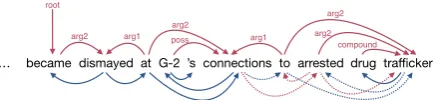
Figure 2: A development instance annotated with both gold DM semantic dependency graph (red arcs on the top), and gold syntactic dependency tree (blue arcs at the bottom). A pretrained syn-tactic parser predicts the same tree as the gold; the semantic parser backpropagates into the interme-diate syntactic parser, and changes the dashed blue arcs into dashed red arcs (§5).
tic dependency parsing as the end task. We first briefly review the neural network architectures for the two models (§4.1.1), and then introduce the datasets (§4.1.2) and baselines (§4.1.3).
4.1.1 Architectures
Syntactic dependency parser. For intermedi-ate syntactic dependencies, we use the unlabeled arc-factored parser ofKiperwasser and Goldberg
(2016). It uses bidirectional LSTMs (BiLSTM) to encode the input, followed by a multilayer-perceptron (MLP) to score each potential depen-dency. One notable modification is that we replace their use of Chu-Liu/Edmonds’ algorithm (Chu and Liu, 1965; Edmonds, 1967) with the Eisner algorithm (Eisner, 1996, 2000), since our dataset is in English and mostly projective.
Semantic dependency parser. We use the basic model of Peng et al. (2017) (denoted as NEUR-BOPARSER) as the end model. It is a first-order parser, and uses local factors for heads, unlabeled arcs, and labeled arcs. NEURBOPARSER does not use syntax. It first encodes an input sentence with a two-layer BiLSTM, and then computes part scores with two-layer tanh-MLPs. Inference is conducted with AD3(Martins et al.,2015). To add syntactic features to NEURBOPARSER, we con-catenate a token’s contextualized representation to that of its syntactic head, predicted by the in-termediate parser. Formally, given length-n in-put sentence, we first run a BiLSTM. We use the concatenation of the two hidden representations
hj = [−→hj;←−hj]at each positionjas the
hj with the representation of its headhHEAD(j)by
e
hj = [hj;hHEAD(j)] =
hj; X
i6=j
ˆ
zσ(i→j)hi
,
(7)
wherezˆ∈Bn(n−1)is a binary encoding of the tree
structure predicted by by the intermediate parser. We then use ehj anywhere hj would have been
used in NEURBOPARSER. In backpropagation, we compute ∇ˆzL with an automatic differentiation toolkit (DyNet;Neubig et al.,2017).
We note that this approach can be generalized to convolutional neural networks over graphs (Mou et al., 2015; Duvenaud et al., 2015; Kipf and Welling, 2017, inter alia), recurrent neural net-works along paths (Xu et al.,2015;Roth and La-pata, 2016, inter alia) or dependency trees (Tai et al.,2015). We choose to use concatenations to control the model’s complexity, and thus to better understand which parts of the model work.
We refer the readers to Kiperwasser and Gold-berg(2016) andPeng et al.(2017) for further de-tails of the parsing models.
Training procedure. Following previous work, we minimize structured hinge loss (Tsochantaridis et al.,2004) for both models. We jointly train both models from scratch, by randomly sampling an in-stance from the union of their training data at each step. In order to isolate the effect of backpropaga-tion, we do not share any parameters between the two models.5 Implementation details are summa-rized in the supplementary materials.
4.1.2 Datasets
• For semantic dependencies, we use the English dataset from SemEval 2015 Task 18 (Oepen et al.,2015). Among the three for-malisms provided by the shared task, we con-sider DELPH-IN MRS-derived dependencies (DM) and Prague Semantic Dependencies (PSD).6 It includes §00–19 of the WSJ cor-pus as training data,§20 and§21 for devel-opment and in-domain test data, resulting in a 33,961/1,692/1,410 train/dev./test split, and
5Parameter sharing has proved successful in many related
tasks (Collobert and Weston, 2008;Søgaard and Goldberg, 2016;Ammar et al.,2016;Swayamdipta et al.,2016,2017,
inter alia), and could be easily combined with our approach.
6We drop the third (PAS) because its structure is highly
predictable from parts-of-speech, making it less interesting.
DM PSD
Model UF LF UF LF
NEURBOPARSER – 89.4 – 77.6
FREDA3 – 90.4 – 78.5
PIPELINE 91.8 90.8 88.4 78.1 SA 91.6 90.6 87.9 78.1
STE 92.0 91.1 88.9 78.9
SPIGOT 92.4 91.6 88.6 78.9
(a)F1on in-domain test set.
DM PSD
Model UF LF UF LF
NEURBOPARSER – 84.5 – 75.3
FREDA3 – 85.3 – 76.4
PIPELINE 87.4 85.8 85.5 75.6 SA 87.3 85.6 84.9 75.9 STE 87.7 86.4 85.8 76.6
SPIGOT 87.9 86.7 85.5 77.1
(b)F1on out-of-domain test set.
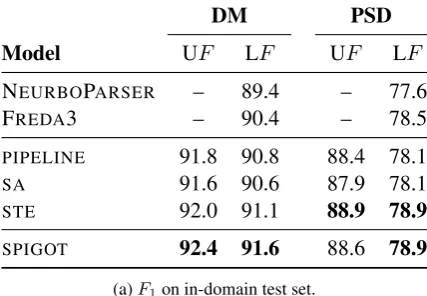
Table 1: Semantic dependency parsing perfor-mance in both unlabeled (UF) and labeled (LF)
F1 scores. Bold font indicates the best
perfor-mance.Peng et al.(2017) does not report UF.
1,849 out-of-domain test instances from the Brown corpus.7
• For syntactic dependencies, we use the Stan-ford Dependency (de Marneffe and Manning,
2008) conversion of the the Penn Treebank WSJ portion (Marcus et al.,1993). To avoid data leak, we depart from standard split and use§20 and§21 as development and test data, and the remaining sections as training data. The number of training/dev./test instances is 40,265/2,012/1,671.
4.1.3 Baselines
We compare to the following baselines:
• A pipelined system (PIPELINE). The pre-trained parser achieves 92.9 test unlabeled at-tachment score (UAS).8
7The organizers remove, e.g., instances with cyclic
graphs, and thus only a subset of the WSJ corpus is included. SeeOepen et al.(2015) for details.
8Note that this number is not comparable to the parsing
[image:6.595.309.523.65.213.2]archi-• Structured attention networks (SA;Kim et al.,
2017). We use the inside-outside algo-rithm (Baker,1979) to populatez with arcs’ marginal probabilities, use log-loss as the ob-jective in training the intermediate parser.
• The straight-through estimator (STE;Hinton,
2012), introduced in§2.2.
4.1.4 Empirical Results
Table1 compares the semantic dependency pars-ing performance of SPIGOT to all five baselines. FREDA3 (Peng et al., 2017) is a state-of-the-art variant of NEURBOPARSER that is trained using multitask learning to jointly predict three different semantic dependency graph formalisms. Like the basic NEURBOPARSERmodel that we build from, FREDA3 does not use any syntax. Strong DM per-formance is achieved in a more recent work by us-ing joint learnus-ing and an ensemble (Peng et al.,
2018), which is beyond fair comparisons to the models discussed here.
We found that using syntactic information improves semantic parsing performance: using pipelined syntactic head features brings 0.5– 1.4% absolute labeledF1improvement to
NEUR-BOPARSER. Such improvements are smaller compared to previous works, where depen-dency path and syntactic relation features are in-cluded (Almeida and Martins,2015;Ribeyre et al.,
2015;Zhang et al.,2016), indicating the potential to get better performance by using more syntactic information, which we leave to future work.
Both STE and SPIGOT use hard syntactic fea-tures. By allowing backpropation into the inter-mediate syntactic parser, they both consistently outperform PIPELINE. On the other hand, when marginal syntactic tree structures are used, SA outperformsPIPELINE only on the out-of-domain PSD test set, and improvements under other cases are not observed.
Compared toSTE, SPIGOToutperformsSTEon DM by more than 0.3% absolute labeledF1, both
in-domain and out-of-domain. For PSD, SPIGOT achieves similar performance toSTEon in-domain test set, but has a 0.5% absolute labeled F1
im-provement on out-of-domain data, where syntactic parsing is less accurate.
tecture achieves 93.5 UAS when trained and evaluated with the standard split, close to the results reported byKiperwasser and Goldberg(2016).
4.2 Semantic Dependencies for Sentiment Classification
Our second experiment uses semantic dependency graphs to improve sentiment classification perfor-mance. We are not aware of any efficient algo-rithm that solves marginal inference for seman-tic dependency graphs under determinism con-straints, so we do not include a comparison toSA.
4.2.1 Architectures
Here we use NEURBOPARSERas the intermediate model, as described in§4.1.1, but with no syntac-tic enhancements.
Sentiment classifier. We first introduce a base-line that does not use any structural information. It learns a one-layer BiLSTM to encode the in-put sentence, and then feeds the sum of all hidden states into a two-layerReLU-MLP.
To use semantic dependency features, we con-catenate a word’s BiLSTM-encoded representa-tion to the averaged representarepresenta-tion of its heads, to-gether with the corresponding semantic roles, sim-ilarly to that in Equation7.9 Then the concatena-tion is fed into an affine transformaconcatena-tion followed by a ReLU activation. The rest of the model is kept the same as the BiLSTM baseline.
Training procedure. We use structured hinge loss to train the semantic dependency parser, and log-loss for the sentiment classifier. Due to the dis-crepancy in the training data size of the two tasks (33K vs. 7K), we pre-train a semantic dependency parser, and then adopt joint training together with the classifier. In the joint training stage, we ran-domly sample 20% of the semantic dependency training instances each epoch. Implementations are detailed in the supplementary materials.
4.2.2 Datasets
For semantic dependencies, we use the DM dataset introduced in§4.1.2.
We consider a binary classification task using the Stanford Sentiment Treebank (Socher et al.,
2013). It consists of roughly 10K movie review sentences from Rotten Tomatoes. The full dataset includes a rating on a scale from 1 to 5 for each constituent (including the full sentences), resulting in more than 200K instances. Following previous work (Iyyer et al.,2015), we only use full-sentence
9In a well-formed semantic dependency graph, a token
Model Accuracy (%)
BILSTM 84.8
PIPELINE 85.7
STE 85.4
[image:8.595.320.513.61.134.2]SPIGOT 86.3
Table 2: Test accuracy of sentiment classification on Stanford Sentiment Treebank. Bold font indi-cates the best performance.
instances, with neutral instances excluded (3s) and the remaining four rating levels converted to bi-nary “positive” or “negative” labels. This results in a 6,920/872/1,821 train/dev./test split.
4.2.3 Empirical Results
Table 2 compares our SPIGOT method to three baselines. Pipelined semantic dependency predic-tions brings 0.9% absolute improvement in clas-sification accuracy, and SPIGOT outperforms all baselines. In this taskSTEachieves slightly worse performance than a fixed pre-trainedPIPELINE.
5 Analysis
We examine here how the intermediate model is affected by the task training signal. Is the end-task signal able to “overrule” intermediate predic-tions?
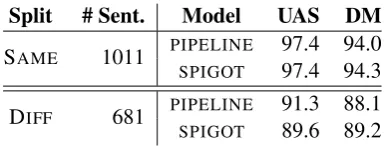
We use the syntactic-then-semantic parsing model (§4.1) as a case study. Table 3 compares a pipelined system to one jointly trained using SPIGOT. We consider the development set in-stances where both syntactic and semantic an-notations are available, and partition them based on whether the two systems’ syntactic predic-tions agree (SAME), or not (DIFF). The second group includes sentences with much lower syn-tactic parsing accuracy (91.3 vs. 97.4 UAS), and SPIGOT further reduces this to 89.6. Even though these changes hurt syntactic parsing accuracy, they lead to a 1.1% absolute gain in labeled F1 for
semantic parsing. Furthermore, SPIGOT has an overall less detrimental effect on the intermediate parser thanSTE: usingSPIGOT, intermediate dev. parsing UAS drops to 92.5 from the 92.9 pipelined performance, whileSTEreduces it to 91.8.
We then take a detailed look and categorize the changes in intermediate trees by their correlations with the semantic graphs. Specifically, when a modifierm’s head is changed fromhtoh0 in the
Split # Sent. Model UAS DM
SAME 1011 PIPELINE 97.4 94.0 SPIGOT 97.4 94.3
[image:8.595.121.241.64.147.2]DIFF 681 PIPELINE 91.3 88.1 SPIGOT 89.6 89.2
Table 3: Syntactic parsing performance (in unla-beled attachment score, UAS) and DM semantic parsing performance (in labeled F1) on different
groups of the development data. Both systems predict the same syntactic parses for instances from SAME, and they disagree on instances from DIFF(§5).
tree, we consider three cases: (a) h0 is a head of
min the semantic graph; (b)h0is a modifier ofm in the semantic graph; (c)h is the modifier ofm
in the semantic graph. The first two reflect mod-ifications to the syntactic parse that rearrange se-mantically linked words to be neighbors. Under (c), the semantic parser removes a syntactic depen-dency that reverses the direction of a semantic de-pendency. These cases account for 17.6%, 10.9%, and 12.8%, respectively (41.2% combined) of the total changes. Making these changes, of course, is complicated, since they often requireother modi-fications to maintain well-formedness of the tree. Figure2gives an example.
6 Related Work
Joint learning in NLP pipelines. To avoid cas-cading errors, much effort has been devoted to joint decoding in NLP pipelines (Habash and Rambow, 2005; Cohen and Smith, 2007; Gold-berg and Tsarfaty,2008;Lewis et al.,2015;Zhang et al.,2015,inter alia). However, joint inference can sometimes be prohibitively expensive. Recent advances in representation learning facilitate ex-ploration in the joint learning of multiple tasks by sharing parameters (Collobert and Weston,2008;
Blitzer et al., 2006; Finkel and Manning, 2010;
Zhang and Weiss, 2016;Hashimoto et al., 2017,
inter alia).
Differentiable optimization. Gould et al.
(2016) review the generic approaches to differ-entiation in bi-level optimization (Bard, 2010;
Kunisch and Pock, 2013). Amos and Kolter
in NLP. In another line of work, the steps of a gradient-based optimization procedure are un-rolled into a single computation graph (Stoyanov et al., 2011; Domke, 2012; Goodfellow et al.,
2013; Brakel et al., 2013). This comes at a high computational cost due to the second-order derivative computation during backpropagation. Moreover, constrained optimization problems (like many NLP problems) often require projec-tion steps within the procedure, which can be difficult to differentiate through (Belanger and McCallum,2016;Belanger et al.,2017).
7 Conclusion
We presented SPIGOT, a novel approach to back-propagating through neural network architectures that include discrete structured decisions in in-termediate layers. SPIGOT devises a proxy for the gradients with respect to argmax’s inputs, employing a projection that aims to respect the constraints in the intermediate task. We empiri-cally evaluate our method with two architectures: a semantic parser with an intermediate syntactic parser, and a sentiment classifier with an inter-mediate semantic parser. Experiments show that SPIGOT achieves stronger performance than base-lines under both settings, and outperforms state-of-the-art systems on semantic dependency pars-ing. Our implementation is available athttps: //github.com/Noahs-ARK/SPIGOT.
Acknowledgments
We thank the ARK, Julian Michael, Minjoon Seo, Eunsol Choi, and Maxwell Forbes for their helpful comments on an earlier version of this work, and the anonymous reviewers for their valuable feed-back. This work was supported in part by NSF grant IIS-1562364.
References
Mariana S. C. Almeida and Andr´e F. T. Martins. 2015. Lisbon: Evaluating TurboSemanticParser on multi-ple languages and out-of-domain data. In Proc. of SemEval.
Waleed Ammar, George Mulcaire, Miguel Ballesteros, Chris Dyer, and Noah A. Smith. 2016. Many lan-guages, one parser.TACL4:431–444.
Brandon Amos and J. Zico Kolter. 2017. OptNet: Differentiable optimization as a layer in neural net-works. InProc. of ICML.
J. K. Baker. 1979. Trainable grammars for speech recognition. In Speech Communication Papers for the 97th Meeting of the Acoustical Society of Amer-ica.
Jonathan F. Bard. 2010. Practical Bilevel Optimiza-tion: Algorithms and Applications. Springer.
David Belanger and Andrew McCallum. 2016. Struc-tured prediction energy networks. InProc. of ICML.
David Belanger, Bishan Yang, and Andrew McCallum. 2017. End-to-end learning for structured prediction energy networks. InProc. of ICML.
Yoshua Bengio, Nicholas Lonard, and Aaron
Courville. 2013. Estimating or propagating gradients through stochastic neurons for conditional computation. arXiv:1308.3432.
Dimitris Bertsimas and John Tsitsiklis. 1997. Introduc-tion to Linear OptimizaIntroduc-tion. Athena Scientific.
John Blitzer, Ryan McDonald, and Fernando Pereira. 2006. Domain adaptation with structural correspon-dence learning. InProc. of EMNLP.
Phil´emon Brakel, Dirk Stroobandt, and Benjamin Schrauwen. 2013. Training energy-based models for time-series imputation. Journal of Machine Learning Research14:2771–2797.
Peter Brucker. 1984. AnO(n)algorithm for quadratic knapsack problems. Operations Research Letters
3(3):163 – 166.
Jihun Choi, Kang Min Yoo, and Sang-goo Lee. 2017. Unsupervised learning of task-specific tree struc-tures with tree-LSTMs. arXiv:1707.02786.
Yoeng-Jin Chu and Tseng-Hong Liu. 1965. On the shortest arborescence of a directed graph. Science Sinica14:1396–1400.
Shay B. Cohen and Noah A. Smith. 2007. Joint mor-phological and syntactic disambiguation. InProc. of EMNLP.
Ronan Collobert and Jason Weston. 2008. A unified architecture for natural language processing: Deep neural networks with multitask learning. InProc. of ICML.
Marie-Catherine de Marneffe and Christopher D. Man-ning. 2008. Stanford typed dependencies manual. Technical report, Stanford University.
Justin Domke. 2012. Generic methods for
optimization-based modeling. In Proc. of AIS-TATS.
Jack Edmonds. 1967. Optimum branchings. Jour-nal of Research of the NatioJour-nal Bureau of Standards
71B:233–240.
Jason Eisner. 2000. Bilexical grammars and their cubic-time parsing algorithms. InAdvances in Prob-abilistic and Other Parsing Technologies, Springer Netherlands, pages 29–61.
Jason Eisner. 2016. Inside-outside and forward-backward algorithms are just backprop. In Proceed-ings of the EMNLP Workshop on Structured Predic-tion for NLP.
Jason M. Eisner. 1996. Three new probabilistic models for dependency parsing: An exploration. InProc. of COLING.
Jenny Rose Finkel and Christopher D. Manning. 2010. Hierarchical joint learning: Improving joint parsing and named entity recognition with non-jointly la-beled data. InProc. of ACL.
Abram L. Friesen and Pedro M. Domingos. 2016. The sum-product theorem: A foundation for learning tractable models. InProc. of ICML.
Abram L. Friesen and Pedro M. Domingos. 2018. Deep learning as a mixed convex-combinatorial op-timization problem. InProc. of ICLR.
Yoav Goldberg and Reut Tsarfaty. 2008. A single gen-erative model for joint morphological segmentation and syntactic parsing. InProc. of ACL.
Ian Goodfellow, Mehdi Mirza, Aaron Courville, and Yoshua Bengio. 2013. Multi-prediction deep Boltz-mann machines. InProc. of NIPS.
Stephen Gould, Basura Fernando, Anoop Cherian, Pe-ter Anderson, Rodrigo Santa Cruz, and Edison Guo. 2016. On differentiating parameterized argmin and argmax problems with application to bi-level opti-mization. arXiv:1607.05447.
Nizar Habash and Owen Rambow. 2005. Arabic tok-enization, part-of-speech tagging and morphological disambiguation in one fell swoop. InProc. ACL.
Kazuma Hashimoto, Caiming Xiong, Yoshimasa Tsu-ruoka, and Richard Socher. 2017. A joint many-task model: Growing a neural network for multiple NLP tasks. InProc. of EMNLP.
Luheng He, Kenton Lee, Mike Lewis, and Luke Zettle-moyer. 2017. Deep semantic role labeling: What works and whats next. InProc. of ACL.
Geoffrey Hinton. 2012. Neural networks for machine learning.Courseravideo lectures.
Mohit Iyyer, Varun Manjunatha, Jordan Boyd-Graber, and Hal Daum´e III. 2015. Deep unordered compo-sition rivals syntactic methods for text classification. InProc. of ACL.
Eric Jang, Shixiang Gu, and Ben Poole. 2016. Cat-egorical reparameterization with Gumbel-Softmax. arXiv:1611.01144.
Yangfeng Ji and Noah A. Smith. 2017. Neural dis-course structure for text categorization. InProc. of ACL.
Yoon Kim, Carl Denton, Luong Hoang, and Alexan-der M. Rush. 2017. Structured attention networks. InProc. of ICLR.
Eliyahu Kiperwasser and Yoav Goldberg. 2016. Sim-ple and accurate dependency parsing using bidirec-tional LSTM feature representations. TACL4:313– 327.
Thomas N. Kipf and Max Welling. 2017. Semi-supervised classification with graph convolutional networks. InProc. of ICLR.
Karl Kunisch and Thomas Pock. 2013. A bilevel op-timization approach for parameter learning in varia-tional models. SIAM Journal on Imaging Sciences
6(2):938–983.
Mike Lewis, Luheng He, and Luke Zettlemoyer. 2015. Joint A* CCG parsing and semantic role labelling. InProc. of EMNLP.
Yang Liu and Mirella Lapata. 2018. Learning struc-tured text representations.TACL6:63–75.
David G. Luenberger and Yinyu Ye. 2015. Linear and Nonlinear Programming. Springer.
Mitchell P. Marcus, Mary Ann Marcinkiewicz, and Beatrice Santorini. 1993. Building a large annotated corpus of english: The penn treebank. Computa-tional Linguistics19(2):313–330.
Andre Martins and Ramon Astudillo. 2016. From soft-max to sparsesoft-max: A sparse model of attention and multi-label classification. InProc. of ICML.
Andr´e F. T. Martins, Miguel B. Almeida, and Noah A. Smith. 2013. Turning on the turbo: Fast third-order non-projective turbo parsers. InProc. of ACL.
Andr´e F. T. Martins, M´ario A. T. Figueiredo, Pedro M. Q. Aguiar, Noah A. Smith, and Eric P. Xing. 2015. AD3: Alternating directions dual decomposi-tion for map inference in graphical models. Journal of Machine Learning Research16:495–545.
Andr´e F. T. Martins, Noah A. Smith, and Eric P. Xing. 2009. Polyhedral outer approximations with ap-plication to natural language parsing. In Proc. of ICML.
Arthur Mensch and Mathieu Blondel. 2018. Differen-tiable dynamic programming for structured predic-tion and attenpredic-tion. arXiv:1802.03676.
Graham Neubig, Chris Dyer, Yoav Goldberg, Austin Matthews, Waleed Ammar, Antonios Anastasopou-los, Miguel Ballesteros, David Chiang, Daniel Clothiaux, Trevor Cohn, Kevin Duh, Manaal Faruqui, Cynthia Gan, Dan Garrette, Yangfeng Ji, Lingpeng Kong, Adhiguna Kuncoro, Gau-rav Kumar, Chaitanya Malaviya, Paul Michel, Yusuke Oda, Matthew Richardson, Naomi Saphra, Swabha Swayamdipta, and Pengcheng Yin. 2017. DyNet: The dynamic neural network toolkit. arXiv:1701.03980.
Vlad Niculae and Mathieu Blondel. 2017. A regular-ized framework for sparse and structured neural at-tention. InProc. of NIPS.
Vlad Niculae, Andr F. T. Martins, Mathieu
Blon-del, and Claire Cardie. 2018. SparseMAP:
Differentiable sparse structured inference. arXiv:1802.04223.
Stephan Oepen, Marco Kuhlmann, Yusuke Miyao, Daniel Zeman, Silvie Cinkova, Dan Flickinger, Jan Hajic, and Zdenka Uresova. 2015. SemEval 2015 task 18: Broad-coverage semantic dependency pars-ing. InProc. of SemEval.
Stephan Oepen, Marco Kuhlmann, Yusuke Miyao, Daniel Zeman, Silvie Cinkov´a, Dan Flickinger, Jan Hajiˇc, Angelina Ivanova, and Zdeˇnka Ureˇsov´a. 2016. Towards comparability of linguistic graph banks for semantic parsing. InProc. of LREC.
Stephan Oepen, Marco Kuhlmann, Yusuke Miyao, Daniel Zeman, Dan Flickinger, Jan Hajic, Angelina Ivanova, and Yi Zhang. 2014. SemEval 2014 task 8: Broad-coverage semantic dependency parsing. In
Proc. of SemEval.
Stephan Oepen, Lilja vrelid, Jari Bjrne, Richard Jo-hansson, Emanuele Lapponi, Filip Ginter, and Erik Velldal. 2017. The 2017 shared task on extrinsic parser evaluation. towards a reusable community in-frastructure. In Proc. of the 2017 Shared Task on Extrinsic Parser Evaluation.
Hao Peng, Sam Thomson, and Noah A. Smith. 2017. Deep multitask learning for semantic dependency parsing. InProc. of ACL.
Hao Peng, Sam Thomson, Swabha Swayamdipta, and Noah A. Smith. 2018. Learning joint semantic parsers from disjoint data. InProc. of NAACL.
Corentin Ribeyre, ´Eric Villemonte De La Clergerie, and Djam´e Seddah. 2015. Because syntax does mat-ter: Improving predicate-argument structures pars-ing uspars-ing syntactic features. InProc. of NAACL.
Dan Roth and Wen-tau Yih. 2004. A linear program-ming formulation for global inference in natural lan-guage tasks. InProc. of NAACL.
Michael Roth and Mirella Lapata. 2016. Neural se-mantic role labeling with dependency path embed-dings. InProc. of ACL.
Richard Socher, Alex Perelygin, Jean Wu, Jason Chuang, Christopher D. Manning, Andrew Ng, and Christopher Potts. 2013. Recursive deep models for semantic compositionality over a sentiment tree-bank. InProc. of EMNLP.
Anders Søgaard and Yoav Goldberg. 2016. Deep multi-task learning with low level tasks supervised at lower layers. InProc. of ACL.
Veselin Stoyanov, Alexander Ropson, and Jason Eis-ner. 2011. Empirical risk minimization of graphical model parameters given approximate inference, de-coding, and model structure. InProc. of AISTATS.
Swabha Swayamdipta, Miguel Ballesteros, Chris Dyer, and Noah A. Smith. 2016. Greedy, joint syntactic-semantic parsing with stack LSTMs. In Proc. of CoNLL.
Swabha Swayamdipta, Sam Thomson, Chris Dyer, and Noah A. Smith. 2017. Frame-semantic parsing with softmax-margin segmental RNNs and a syntactic scaffold. arXiv:1706.09528.
Kai Sheng Tai, Richard Socher, and Christopher D. Manning. 2015. Improved semantic representations from tree-structured long short-term memory net-works. InProc. of ACL.
Ioannis Tsochantaridis, Thomas Hofmann, Thorsten Joachims, and Yasemin Altun. 2004. Support vector machine learning for interdependent and structured output spaces. InProc. of ICML.
Ronald J. Williams. 1992. Simple statistical gradient-following algorithms for connectionist reinforce-ment learning. Machine Learning8(3-4):229–256.
Yan Xu, Lili Mou, Ge Li, Yunchuan Chen, Hao Peng, and Zhi Jin. 2015. Classifying relations via long short term memory networks along shortest depen-dency paths. InProc. of EMNLP.
Dani Yogatama, Phil Blunsom, Chris Dyer, Edward Grefenstette, and Wang Ling. 2017. Learning to compose words into sentences with reinforcement learning. InProc. of ICLR.
Xun Zhang, Yantao Du, Weiwei Sun, and Xiaojun Wan. 2016. Transition-based parsing for deep de-pendency structures. Computational Linguistics
42(3):353–389.
Yuan Zhang, Chengtao Li, Regina Barzilay, and Ka-reem Darwish. 2015. Randomized greedy inference for joint segmentation, POS tagging and dependency parsing. InProc. NAACL.
Yuan Zhang and David Weiss. 2016.