611
TutorialBank: A Manually-Collected Corpus for Prerequisite
Chains, Survey Extraction and Resource Recommendation
Alexander R. Fabbri Irene Li Prawat Trairatvorakul Yijiao He Wei Tai Ting Robert Tung Caitlin Westerfield Dragomir R. Radev
Department of Computer Science, Yale University
{alexander.fabbri,irene.li,prawat.trairatvorakul,yijiao.he, robert.tung,weitai.ting,caitlin.westerfield,dragomir.radev}@yale.edu
Abstract
The field of Natural Language Processing (NLP) is growing rapidly, with new re-search published daily along with an abun-dance of tutorials, codebases and other on-line resources. In order to learn this dy-namic field or stay up-to-date on the lat-est research, students as well as educa-tors and researchers must constantly sift through multiple sources to find valuable, relevant information. To address this situ-ation, we introduce TutorialBank, a new, publicly available dataset which aims to facilitate NLP education and research. We have manually collected and categorized over 6,300 resources on NLP as well as the related fields of Artificial Intelligence (AI), Machine Learning (ML) and Infor-mation Retrieval (IR). Our dataset is no-tably the largest manually-picked corpus of resources intended for NLP education which does not include only academic pa-pers. Additionally, we have created both a search engine1 and a command-line tool for the resources and have annotated the corpus to include lists of research topics, relevant resources for each topic, prereq-uisite relations among topics, relevant sub-parts of individual resources, among other annotations. We are releasing the dataset and present several avenues for further re-search.
1 Introduction
NLP has seen rapid growth over recent years. A Google search of “Natural Language Processing” returns over 100 million hits with papers, tutorials,
1http://aan.how
blog posts, codebases and other related online re-sources. Additionally, advances in related fields such as Artificial Intelligence and Deep Learn-ing are strongly influencLearn-ing current NLP research. With these developments, an increasing number of tutorials and online references are being published daily. As a result, the task of students, educa-tors and researchers of tracking the changing land-scape in this field has become increasingly diffi-cult.
Recent work has studied the educational aspect of mining text for presenting scientific topics. One goal has been to develop concept maps of top-ics, graphs showing which topics are prerequisites for learning a given topic (Gordon et al., 2016;
Liu et al.,2016;Pan et al., 2017a,b;Liang et al.,
2017). Another goal has been to automatically create reading lists for a subject either by build-ing upon concept graphs (Gordon et al.,2017) or through an unstructured approach (Jardine,2014). Additionally, other work has aimed to automati-cally summarize scientific topics, either by extrac-tively summarizing academic papers (Jha et al.,
2013,2015;Jaidka et al., 2016) or by producing Wikipedia articles on these topics from multiple sources (Sauper and Barzilay, 2009; Liu et al.,
2018). Scientific articles constitute primary texts which describe an author’s work on a particular subject, while Wikipedia articles can be viewed as tertiary sources which summarize both results from primary works as well as explanations from secondary sources. Tang and McCalla (2004,
2009) and Sheng et al.(2017) explore the peda-gogical function among the types of sources.
6,300 high-quality resources on NLP and related fields. The corpus’s magnitude, manual collection and focus on annotation for education in addition to research differentiates it from other corpora. Throughout this paper we use the general term “re-source” to describe any tutorial, research survey, blog post, codebase or other online source with a focus on educating on a particular subject. We have created a search engine for these resources and have annotated them according to a taxonomy to facilitate their sharing. Additionally, we have annotated for pedagogical role, prerequisite rela-tions and relevance of resources to hand-selected topics and provide a command-line interface for our annotations.
Our main contribution is the manual collection of good quality resources related to NLP and the annotation and presentation of these resources in a manner conducive to NLP education. Addition-ally, we show initial work on topic modeling and resource recommendation. We present a variant of standard reading-list generation which recom-mends resources based on a title and abstract pair and demonstrate additional uses and research di-rections for the corpus.
2 Related Work
2.1 Pedagogical Value of Resources
Online resources are found in formats which vary in their roles in education. Sheng et al. (2017) identify seven types of pedagogical roles found in technical works: Tutorial, Survey, Software Man-ual, Resource, Reference Work, Empirical Re-sults, and Other. They annotate a dataset of over 1,000 resources according to these types. Beyond these types, resources differ in their pedagogical value, which they define as “the estimate of how useful a document is to an individual who seeks to learn about specific concepts described in the doc-ument”. Tang and McCalla(2004, 2009) discuss the pedagogical value of a single type, academic papers, in relation to a larger recommendation sys-tem.
2.2 Prerequisite Chains
Prerequisite chains refer to edges in a graph de-scribing which topics are dependent on the knowl-edge of another topic. Prerequisite chains play an important role in curriculum planning and reading list generation. Liu et al. (2016) propose “Con-cept Graph Learning” in order to induce a graph from which they can predict prerequisite relations
among university courses. Their framework con-sists of two graphs: (1) a higher-level graph which consists of university courses and (2) a lower-level graph which consists of induced concepts and pair-wise sequential preferences in learning or teaching the concept.
Liang et al. (2017) experiment with prerequi-site chains on education data but focus on the recovery of a concept graph rather than on pre-dicting unseen course relations as in Liu et al.
(2016). They introduce both a synthetic dataset as well as one scraped from 11 universities which includes course prerequisites as well as concept-prerequisite labels. Concept graphs are also used in (Gordon et al., 2016) to address the problem of developing reading lists for students. The con-cept graph in this case is a labeled graph where nodes represent both documents and concepts (de-termined using Latent Dirichlet Allocation (LDA) (Blei et al.,2003)), and edges represent dependcies. They propose methods based on cross en-tropy and information flow for determining edges in the graph. Finally, finding prerequisite relation-ships has also been used in other contexts such as Massive Open Online Courses (MOOCs) (Pan et al.,2017a,b).
2.3 Reading List Generation
Jardine (2014) generates recommended reading lists from a corpus of technical papers in an un-structured manner in which a topic model weighs the relevant topics and relevant papers are chosen through his ThemedPageRank approach. He also provides a set of expert-generated reading lists. Conversely, Gordon et al. (2017) approach read-ing list generation from a structured perspective, first generating a concept graph from the corpus and then traversing the graph to select the most relevant document.
2.4 Survey Extraction
collect at least surveys written by experts on each topic, also making use of citation networks to ex-pand their corpus. They introduce a content model as well as a discourse model and perform a qual-itative comparisons of coherence with a standard summarization model.
The task of creating surveys for specified top-ics has also been viewed in the multi-document summarization setting of generating Wikipedia articles (Sauper and Barzilay, 2009; Liu et al.,
2018). Sauper and Barzilay (2009) induce domain-specific templates from Wikipedia and fill these templates with content from the Internet. More recently Liu et al.(2018) explore a diverse set of domains for summarization and are the first to attempt abstractive summarization of the first section of Wikipedia articles, by combining ex-tractive and absex-tractive summarization methods.
3 Dataset Collection
3.1 An Overview of TutorialBank
As opposed to other collections like the ACL An-thology (Bird et al., 2008; Radev et al., 2009,
2013, 2016), which contain solely academic pa-pers, our corpus focuses mainly on resources other than academic papers. The main goal in our deci-sion process of what to include in our corpus has been the quality-control of resources which can be used for an educational purpose. Initially, the re-sources collected were conference tutorials as well as surveys, books and longer papers on broader topics, as these genres contain an inherent amount of quality-control. Later on, other online resources were added to the corpus, as explained below. Stu-dent annotators, described later on, as well as the professor examined resources which they encoun-tered in their studies. The resources were added to the corpus if deemed of good quality. Important to note is that not all resources which were found on the Internet were added to TutorialBank; one could scrape the web according to search terms, but quality control of the results would be largely missing. The quality of a resource is a somewhat subjective measure, but we aimed to find resources which would serve a pedagogical function to ei-ther students or researchers, with a professor of NLP making the final decision. This collection of resources and meta-data annotation has been done over multiple years, while this year we cre-ated the search engine and added additional anno-tations mentioned below.
1 - Introduction and Linguistics
2 - Language Modeling, Syntax and Parsing 3 - Semantics and Logic
4 - Pragmatics, Discourse, Dialogue and Applications 5 - Classification and Clustering
6 - Information Retrieval and Topic Modeling 7 - Neural Networks and Deep Learning 8 - Artificial Intelligence
[image:3.595.310.521.59.158.2]9 - Other Topics
Table 1: Top-level Taxonomy Topics
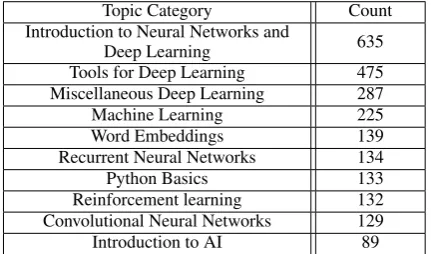
Topic Category Count
Introduction to Neural Networks and
Deep Learning 635
Tools for Deep Learning 475 Miscellaneous Deep Learning 287
Machine Learning 225
Word Embeddings 139
Recurrent Neural Networks 134
Python Basics 133
Reinforcement learning 132 Convolutional Neural Networks 129 Introduction to AI 89
Table 2: Corpus count by taxonomy topic for the most frequent topics (excluding topic “Other”).
3.1.1 TutorialBank Taxonomy
In order to facilitate the sharing of resources about NLP, we developed a taxonomy of 305 topics of varying granularity. The top levels of our taxon-omy tree are shown in Table 1. The backbone of our Taxonomy corresponds to the syllabus of a university-level NLP course and was expanded to include related topics from other courses in ML, IR and AI. As a result, there is a bias in the corpus towards NLP resources and resources from other fields in so far as they are relevant to NLP. How-ever, this bias is planned, as our focus remains teaching NLP. The resource count for the most fre-quent taxonomy topics is shown in Table2.
3.2 Data Preprocessing
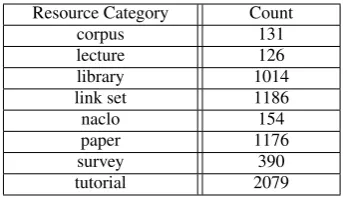
[image:3.595.309.525.201.328.2]Resource Category Count
corpus 131
lecture 126
library 1014
link set 1186
naclo 154
paper 1176
survey 390
[image:4.595.338.497.59.169.2]tutorial 2079
Table 3: Corpus count by pedagogical feature.
4 Dataset Annotation
Annotations were performed by a group of 3 PhD students in NLP, and 6 undergraduate Computer Science students who have taken at least one course in AI or NLP.
4.1 Pedagogical Function
When collecting resources from the Internet, each item was labeled according to the medium in which it was found, analogous to the pedagogical function of (Sheng et al.,2017). We will use this term throughout the paper to describe this catego-rization. The categories along with their counts are shown in Table3:
•Corpus: A corpus provides access to and a de-scription of a scientific dataset.
•Lecture: A lecture consists of slides/notes from a university lecture.
•Library: A library consists of github pages and other codebases which aid in the implemen-tation of algorithms.
•NACLO: NACLO problems refer to linguistics puzzles from the North American Computa-tional Linguistics Olympiad.
•Paper: A paper is a short/long conference paper taken from sites such as https://arxiv.org/ and which is not included in the ACL Anthology.
•Link set: A link set provides a collection of helpful links in one location.
•Survey: A survey is a long paper or book which describes a broader subject.
•Tutorial: A tutorial is a slide deck from a con-ference tutorial or an HTML page that de-scribes a contained topic.
4.2 Topic to Resource Collection
We first identified by hand 200 potential topics for survey generation in the fields of NLP, ML, AI and
Capsule Networks Domain Adaptation Document Representation
Matrix factorization Natural language generation
Q Learning Recursive Neural Networks
Shift-Reduce Parsing Speech Recognition
[image:4.595.95.267.61.160.2]Word2Vec
Table 4: Random sample of the list of 200 top-ics used for prerequisite chains, readling lists and survey extraction.
IR. Topics were added according to the following criteria:
1. It is conceivable that someone would write a Wikipedia page on this topic (an actual page may or may not exist).
2. The topic is not overly general (e.g., “Natu-ral Language Processing”) or too obscure or narrow.
3. In order to write a survey on the topic, one would need to include information from a number of sources.
than replace the topics to reflect TutorialBank cov-erage, we leave these topics in and plan to add ad-ditional resources in a future release.
4.3 Prerequisite Chains
Even with a collection of resources and a list of topics, a student may not know where to begin studying a topic of interest. For example, in or-der to unor-derstand sentiment analysis the student should be familiar with Bayes’ Theorem, the ba-sics of ML as well as other topics. For this pur-pose, the annotators annotated which topics are prerequisites of others for the given topics from their reading lists. We expanded our list of poten-tial prerequisites to include eight additional topics which were too broad for survey generation (e.g., Linear Algebra) but which are important prerequi-sites to capture. Following the method of (Gordon et al.,2016), we define labeling a topic Y as a pre-requisite of X according to the following question:
• Would understanding Topic Y help you to un-derstand Topic X?
As in (Gordon et al.,2016), the annotators can an-swer this question as “no”, “somewhat” or “yes.”
4.4 Reading Lists
When annotators were collecting relevant re-sources for a particular topic, we asked them to order the resources they found in terms of the use-fulness of the resource for learning that particular topic. We also include the Wikipedia pages corre-sponding to the topics, when available, as an ad-ditional source of information. We do not perform additional annotation of the order of the resources or experiment in automatically reproducing these ordered lists but rather offer this annotation as a pedagogical tool for students and educators. We plan the expansion of these lists and analysis in future experiments.
4.5 Survey Extraction
We frame the task of creating surveys of scien-tific topics as a document retrieval task. A student searching for resources in order to learn about a topic such as Recurrent Neural Networks (RNN’s) may encounter resources 1) which solely cover RNN’s as well as 2) resources which cover RNN’s within the context of a larger topic (e.g., Deep Learning). Within the first type, not every piece of content (a single PowerPoint slide or section in a blog post) contributes equally well to an un-derstanding of RNN’s; the content may focus on
background information or may not clearly ex-plain the topic. Within the second type, larger tutorials may contain valuable information on the topic, but may also contain much information not immediately relevant to the query. Given a query topic and a set of parsed documents we want to retrieve the parts most relevant to the topic.
In order to prepare the dataset for extracting surveys of topics, we first divide resources into units of content which we call “cards”. Power-Point slides inherently contain a division in the form of each individual slide, so we divide Pow-erPoint presentations into individual slides/cards. For HTML pages, the division is less clear. How-ever, we convert the HTML pages to a markdown file and then automatically split the markdown file using header markers. We believe this is a reason-able heuristic as tutorials and similar content tend to be broken up into sections signalled by headers. For each of the resources which the annotators gathered for the reading lists on a given topic, that same annotator was presented with each card from that resource and asked to rate the usefulness of the card. The annotator could rate the card from 0-2, with 0 meaning the card is not useful for learning the specified topic, 1 meaning the card is somewhat useful and 2 meaning the card is useful. We chose a 3-point scale as initial trials showed a 5-point scale to be too subjective. The annotators also had the option in our annotation interface to drop cards which were parsed incorrectly or were repeated one after the other as well as skip cards and return to score a card.
4.6 Illustrations
im-ages from Google search, we believe illustrations can be an additional feature of our search engine, and we describe an interface for this collection be-low.
5 Additional Features and Analysis
5.1 Search Engine
In order to present our corpus in a user-friendly manner, we created a search engine using Apache Lucene2. We allow the user to query key words to search our resource corpus, and the results can then be sorted based on relevance, year, topic, medium, and other meta data. In addition to searching by term, users can browse the resources by topic according to our taxonomy. For each child topic from the top-level taxonomy down-ward, we display resources according to their ped-agogical functions. In addition to searching for general resources, we also provide search func-tionality for a corpus of papers, where the user can search by keyword as well as by author and venue. While the search engine described above pro-vides access to our base corpus and meta data, we also provide a command-line interface tool with our release so that students and researchers can easily use our annotations for prerequisite topics, illustrations and survey generation for educational purposes. The tool allows the user to input a topic from the taxonomy and retrieve all images related to that topic according to our meta data. Addi-tionally, the user can input a topic from our list of 200 topics, and our tool outputs the prerequisites of that topic according to our annotation as well as the cards labelled as relevant for that topic.
5.2 Resource Recommendation from Title and Abstract Pairs
In addition to needing to search for a general term, often a researcher begins with an idea for a project which is already focused on a nuanced sub-task. An employee at an engineering company may be starting a project on image captioning. Ideas about the potential direction of this project may be clear, but what resources may be helpful or what papers have already been published on the subject may not be immediately obvious. To this end we pro-pose the task of recommending resources from ti-tle and abstract pairs. The employee will input the title and abstract of the project and obtain a list of resources which can help complete the project.
2http://lucene.apache.org/
This task is analogous to reproducing the reference section of a paper, however, with a focus on tu-torials and other resources rather than solely on papers. As an addition to our search engine, we allow a user to input a title and an abstract of vari-able length. We then propose taxonomy topics based on string matches with the query as well as a list of resources and papers and their scores as determined by the search engine. We later explore two baseline models for recommending resources based on document and topic modeling.
5.3 Dataset and Annotation Statistics
We created reading lists for 182 of the 200 top-ics we identify in Section 4.2. Resources were not found for 18 topics due to the granularity of the topic (e.g., Radial Basis Function Networks) as well as our intended restriction of the chosen resources to PowerPoint presentations and HTML pages. The average number of resources per read-ing list for the 182 topics is 3.94. As an extension to the reading lists we collected Wikipedia pages for 184 of the topics and present these urls as part of the dataset.
We annotated prerequisite relations for the 200 topics described above. We present a subset of our annotations in Figure1, which shows the net-work of topic relations (nodes without incoming edges were not annotated for their prerequisites as part of this shown inter-annotation round). Our network consists of 794 unidirectional edges and 33 bidirectional edges. The presence of bidirec-tional edges stems from our definition of a pre-requisite, which does not preclude bidirectional-ity (one topic can help explain another and vice-versa) as well as the similarity of the topics. The set of bidirectional edges consists of topic pairs (BLEU - ROUGE; Word Embedding - Distribu-tional Semantics; Backpropagation - Gradient de-scent) which could be collapsed into one topic to create a directed acyclic graph in the future.
Figure 1: Subset of prerequisite annotations taken from inter-annotator agreement round.
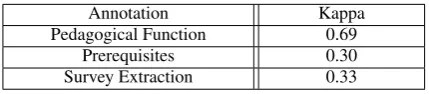
Annotation Kappa
Pedagogical Function 0.69
Prerequisites 0.30
Survey Extraction 0.33
Table 5: Inter-annotator agreement.
presented or may not pertain fully to the topic of that survey. These numbers confirm the appropri-ateness of this survey corpus as a non-trivial infor-mation retrieval task.
To better understand the difficulty of our anno-tation tasks, we performed inter-annotator agree-ment experiagree-ments for each of our annotations. We randomly sampled twenty-five resources and had annotators label for pedagogical function. Addi-tionally, we sampled twenty-five topics for pre-requisite annotations and five topics with reading list lengths of five for survey annotation. We used Fleiss’s Kappa (Fleiss et al., 2004), a variant of Cohen’s Kappa (Cohen, 1960) designed to mea-sure annotator agreement for more than two anno-tators. The results are shown in Table 5. Using the scale as defined in Landis and Koch (1977), pedagogical function annotation exhibits substan-tial agreement while prerequisite annotation and survey extraction annotation showfair agreement. The Kappa score for pedagogical function is com-parable to that ofSheng et al.(2017) (0.68) while the prerequisite annotation is slightly lower than the agreement metric used inGordon et al.(2016) (0.36) although they measure agreement through Pearson correlation. We believe that the sparsity of the labels plays a role in these scores.
5.4 Comparison to Similar Datasets
Our corpus distinguishes itself in its magnitude, manual collection and focus on annotation for ed-ucational purposes in addition to research tasks. We use similar categories for classifying pedagog-ical function asSheng et al.(2017), but our corpus is hand-picked and over four-times larger, while exhibiting similar annotation agreement.
Gordon et al. (2016) present a corpus for pre-requisite relations among topics, but this corpus differs in coverage. They used LDA topic model-ing to generate a list of 300 topics, while we man-ually create a list of 200 topics based on criteria described above. Although their topics are gener-ated from the ACL Anthology and relgener-ated to NLP, we find less than a 40% overlap in topics. Ad-ditionally, they only annotate a subset of the top-ics for prerequisite annotations while we focus on broad coverage, annotating two orders of magni-tude larger in terms of prerequisite edges while ex-hibiting fair inter-annotator agreement.
Previous work and datasets on generating sur-veys for scientific topics have focused on scien-tific articles (Jha et al.,2013,2015;Jaidka et al.,
2016) and Wikipedia pages (Sauper and Barzilay,
2009;Liu et al., 2018) as a summarization task. We, on the other hand, view this problem as an information retrieval task and focus on extract-ing content from manually-collected PowerPoint slides and online tutorials. Sauper and Barzilay
(2009) differ in their domain coverage, and while the surveys of Jha et al. (2013, 2015) focus on NLP, we collect resources for an order of magni-tude larger set of topics. Finally, our focus here in creating surveys, as well as the other annotations, is first and foremost to create a useful tool for stu-dents and researchers. Websites such as the ACL Anthology3 and arXiv4 provide an abundance of resources, but do not focus on the pedagogical as-pect of their content. Meanwhile, websites such as Wikipedia which aim to create a survey of a topic may not reflect the latest trends in rapidly chang-ing fields.
6 Topic Modeling and Resource Recommendation
As an example usage of our corpus, we experi-mented with topic modeling and its extension to
3
http://aclweb.org/anthology/
[image:7.595.74.289.183.230.2]Figure 2: Plot showing a query document with title “Statistical language models for IR” and its neighbour document clusters as obtained through tSNE dimension reduction for Doc2Vec (left) and LDA topic modeling (right). Nearest neighbor documents titles are shown to the right of each plot.
resource recommendation. We restricted our cor-pus for this study to non-HTML files to exam-ine the single domain of PDF’s and PowerPoint presentations. This set consists of about 1,480 files with a vocabulary size 191,446 and a to-ken count of 9,134,452. For each file, the to-kens were processed, stop toto-kens were stripped, and then each token was stemmed. Words with counts less than five across the entire corpus were dropped. We experimented with two models: LDA, a generative probabilistic model mentioned earlier, and Doc2Vec (Le and Mikolov, 2014), an extension of Word2Vec (Mikolov et al.,2013) which creates representations of arbitrarily-sized documents. Figure 2 shows the document repre-sentations obtained with Doc2Vec as well as the topic clusters created with LDA. The grouping of related resources around a point demonstrates the clustering abilities of these models. We applied LDA in an unsupervised way, using 60 topics over 300 iterations as obtained through experimenta-tion, and then colored each document dot with its category to observe the distribution. Our Doc2Vec model used hidden dimension 300, a window size of 10 and a constant learning rate of 0.025. Then, the model was trained for 10 epochs.
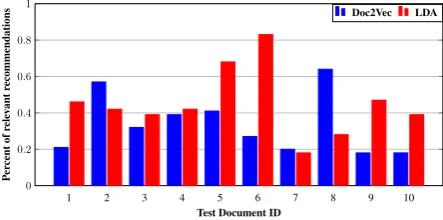
We tested these models for the task of resource recommendation from title+abstract pairs. We col-lected 10 random papers from ACL 2017. For LDA, the document was classified to a topic, and then the top resources from that topic were cho-sen, while Doc2Vec computed the similarity be-tween the query document and the training set and chose the most similar documents. We concate-nated the title and abstract as input and had our models predict the top 20 documents. We then had five annotators rate the recommendations for
1 2 3 4 5 6 7 8 9 10
0 0.2 0.4 0.6 0.8 1
Test Document ID
P
er
cent
of
rele
v
ant
recommendations
Doc2Vec LDA
Figure 3: Relevance accuracies of the Doc2Vec and LDA resource recommendation models.
helpfulness as 0 (not helpful) or 1 (helpful). Rec-ommended resources were rated according to the criterion of whether reading this resource would be useful in doing a project as described in the ti-tle and abstract. The results are found in Figure
[image:8.595.308.530.262.372.2]7 Conclusion and Future Work
In this paper we introduce the TutorialBank Cor-pus, a collection of over 6,300 hand-collected re-sources on NLP and related fields. Our corpus is notably larger than similar datasets which deal with pedagogical resources and topic dependen-cies and unique in use as an educational tool. To this point, we believe that this dataset, with its multiple layers of annotation and usable interface, will be an invaluable tool to the students, edu-cators and researchers of NLP. Additionally, the corpus promotes research on tasks not limited to pedagogical function classification, topic model-ing and prerequisite relation labellmodel-ing. Finally, we formulate the problem of recommending resources for a given title and abstract pair as a new way to approach reading list generation and propose two baseline models. For future work we plan to con-tinue the collection and annotation of resources and to separately explore each of the above re-search tasks.
Acknowledgments
We would like to thank all those who worked on the development of the search engine and website as well as those whose discussion and annotated greatly helped this work, especially Jungo Kasai, Alexander Strzalkowski, Michihiro Yasunaga and Rui Zhang.
References
Steven Bird, Robert Dale, Bonnie J. Dorr, Bryan R. Gibson, Mark Thomas Joseph, Min-Yen Kan, Dong-won Lee, Brett Powley, Dragomir R. Radev, and Yee Fan Tan. 2008. The ACL Anthology Reference Corpus: A Reference Dataset for Bibliographic
Re-search in Computational Linguistics. InLREC.
Eu-ropean Language Resources Association.
David M. Blei, Andrew Y. Ng, and Michael I. Jordan.
2003. Latent Dirichlet Allocation. Journal of
Ma-chine Learning Research, 3:993–1022.
Jacob Cohen. 1960. A Coefficient of Agreement for
Nominal Scales. Educational and psychological
measurement, 20(1):37–46.
Joseph L. Fleiss, Bruce Levin, and Myunghee Cho
Paik. 2004. The Measurement of Interrater
Agree-ment. John Wiley & Sons, Inc.
Jonathan Gordon, Stephen Aguilar, Emily Sheng, and Gully Burns. 2017. Structured Generation of
Tech-nical Reading Lists. InBEA@EMNLP, pages 261–
270. Association for Computational Linguistics.
Jonathan Gordon, Linhong Zhu, Aram Galstyan, Prem Natarajan, and Gully Burns. 2016. Modeling
Con-cept Dependencies in a Scientific Corpus. In
Pro-ceedings of the 54th Annual Meeting of the Associ-ation for ComputAssoci-ational Linguistics, ACL 2016, Au-gust 7-12, 2016, Berlin, Germany, Volume 1: Long Papers.
Kokil Jaidka, Muthu Kumar Chandrasekaran,
Sa-jal Rustagi, and Min-Yen Kan. 2016. Overview
of the Cl-SciSumm 2016 Shared Task. In
BIRNDL@JCDL, volume 1610 ofCEUR Workshop Proceedings, pages 93–102. CEUR-WS.org.
James Gregory Jardine. 2014. Automatically
Generat-ing ReadGenerat-ing Lists. Ph.D. thesis, University of Cam-bridge, UK.
Rahul Jha, Amjad Abu-Jbara, and Dragomir R. Radev. 2013. A System for Summarizing Scientific
Top-ics Starting from Keywords. InProceedings of the
51st Annual Meeting of the Association for Com-putational Linguistics, ACL 2013, 4-9 August 2013, Sofia, Bulgaria, Volume 2: Short Papers, pages 572– 577.
Rahul Jha, Reed Coke, and Dragomir R. Radev. 2015. Surveyor: A System for Generating Coherent
Sur-vey Articles for Scientific Topics. In Proceedings
of the Twenty-Ninth AAAI Conference on Artificial Intelligence, January 25-30, 2015, Austin, Texas,
USA., pages 2167–2173.
J Richard Landis and Gary G Koch. 1977. The Mea-surement of Observer Agreement for Categorical Data. Biometrics, pages 159–174.
Quoc V. Le and Tomas Mikolov. 2014.
Dis-tributed Representations of Sentences and
Docu-ments. CoRR, abs/1405.4053.
Chen Liang, Jianbo Ye, Zhaohui Wu, Bart Pursel, and C. Lee Giles. 2017. Recovering Concept Pre-requisite Relations from University Course
Depen-dencies. In Proceedings of the Thirty-First AAAI
Conference on Artificial Intelligence, February 4-9, 2017, San Francisco, California, USA., pages 4786– 4791.
Hanxiao Liu, Wanli Ma, Yiming Yang, and Jaime G.
Carbonell. 2016. Learning Concept Graphs from
Online Educational Data. J. Artif. Intell. Res.,
55:1059–1090.
Peter J. Liu, Mohammad Saleh, Etienne Pot, Ben Goodrich, Ryan Sepassi, Lukasz Kaiser, and Noam
Shazeer. 2018. Generating Wikipedia by
Summariz-ing Long Sequences. International Conference on Learning Representations.
Liangming Pan, Chengjiang Li, Juanzi Li, and Jie Tang.
2017a. Prerequisite Relation Learning for Concepts
in MOOCs. In Proceedings of the 55th Annual Meeting of the Association for Computational Linguistics, ACL 2017, Vancouver, Canada, July 30 -August 4, Volume 1: Long Papers, pages 1447–1456.
Liangming Pan, Xiaochen Wang, Chengjiang Li, Juanzi Li, and Jie Tang. 2017b. Course Concept Extraction in MOOCs via Embedding-Based Graph
Propagation. InIJCNLP(1), pages 875–884. Asian
Federation of Natural Language Processing.
Dragomir R. Radev, Mark Thomas Joseph, Bryan R. Gibson, and Pradeep Muthukrishnan. 2016. A Bib-liometric and Network Analysis of the Field of Com-putational Linguistics.JASIST, 67(3):683–706.
Dragomir R. Radev, Pradeep Muthukrishnan, and Va-hed Qazvinian. 2009. The ACL Anthology Network
Corpus. InProceedings, ACL Workshop on Natural
Language Processing and Information Retrieval for Digital Libraries, Singapore.
Dragomir R. Radev, Pradeep Muthukrishnan, Vahed
Qazvinian, and Amjad Abu-Jbara. 2013. The ACL
Anthology Network Corpus. Language Resources and Evaluation, 47(4):919–944.
Christina Sauper and Regina Barzilay. 2009. Automat-ically Generating Wikipedia Articles: A
Structure-Aware Approach. InACL 2009, Proceedings of the
47th Annual Meeting of the Association for Compu-tational Linguistics and the 4th International Joint Conference on Natural Language Processing of the AFNLP, 2-7 August 2009, Singapore, pages 208– 216.
Emily Sheng, Prem Natarajan, Jonathan Gordon, and Gully Burns. 2017. An Investigation into the
Peda-gogical Features of Documents. InBEA@EMNLP,
pages 109–120. Association for Computational Lin-guistics.
Tiffany Ya Tang and Gordon I. McCalla. 2004. On the Pedagogically Guided Paper Recommendation for an Evolving Web-Based Learning System. In
FLAIRS Conference, pages 86–92. AAAI Press.
Tiffany Ya Tang and Gordon I. McCalla. 2009. The
Pedagogical Value of Papers: a